Category: Coins

Digital assets, cryptocurrencies, blockchain, and currency news.

  • Uniswap Launches StablePair Hook for Stablecoin Pairs

    Uniswap Launches StablePair Hook for Stablecoin Pairs

    Uniswap Labs Launches StablePair Hook for Dynamic Fee Stablecoin Trading

    Uniswap Labs has deployed StablePair Hook on September 10, introducing a dynamic-fee mechanism for stablecoin pairs on Uniswap v4. The launch activates two initial pools on Ethereum mainnet: USDC/USDG and USDC/USDT.

    Targeting High-Volume Stablecoin Swaps

    The release addresses one of decentralized finance’s most active segments. According to the company’s announcement, stablecoin-to-stablecoin swaps reached $43.4 billion in Q2, surpassing the combined volume of the next three onchain venues. StablePair Hook represents the first upgradeable dynamic-fee design from Uniswap Labs, engineered to return a larger share of generated value to liquidity providers (LPs).

    How the Dynamic Fee Mechanism Works

    Stable pairs typically trade around a known parity rate, meaning most value accrues from correcting price deviations. A static fee structure either sacrifices this spread to arbitrage bots or prices the pool out of competitiveness. As Uniswap Labs wrote in its announcement:

    “set the fee too low and they keep the spread, set it too high and the pool prices itself out.”

    StablePair Hook replaces the fixed fee with a model that measures a pool’s drift from a reference rate and adjusts on every swap. Within a tight band, the fee moves to quote a fixed bid-ask spread. Once price drifts outside this band, swaps pushing it further away pay zero fee, while corrective swaps execute through a Dutch auction that starts high and decreases each block until filled.

    Governance-Controlled Upgradability

    Designed for long-term evolution rather than a one-time deployment, the hook allows pool parameters and fee logic to be upgraded via Uniswap Governance without requiring LPs to migrate positions. The team frames this as a pathway to refine the mechanism as adoption grows. StablePair Hook joins DualPool, Permissioned Pools, and LitePSM as the latest hook from Uniswap Labs, with additional hooks on the roadmap.

    Strategic Context: Fee Design as Competitive Battleground

    The launch coincides with stablecoin trading increasingly concentrating on Uniswap, which recently surpassed $1 trillion in Layer-2 volume. By redirecting a portion of arbitrage value back to liquidity providers, the protocol aims to make supplying stablecoin liquidity more attractive. This signals a shift where fee architecture—rather than token incentives alone—is becoming the primary competitive lever for the largest onchain markets.

    Liquidity providers can migrate positions into the new USDC/USDG and USDC/USDT pools, while traders can access them through the Uniswap Web App and Uniswap Wallet. StablePair Hook expands a v4 hook ecosystem that already includes a separate Uniswap hook exceeding $500 million in usage.

  • Ethereum Volatility Surges After Wintermute’s $160M Deposit; ETH Rebound Hinges on Key Condition

    Ethereum Volatility Surges After Wintermute’s $160M Deposit; ETH Rebound Hinges on Key Condition

    Ethereum Price Volatility Intensifies as Wintermute Moves $160M ETH to Exchanges

    Ethereum ($ETH) experienced sharp volatility after briefly reclaiming the $2,500 level and climbing toward $2,600 before pulling back toward $2,400. At press time, the asset traded near $2,524, reflecting a 2.26% daily gain and a 2% weekly increase. The pullback coincided with significant large-holder activity, though exchange supply metrics present a more nuanced picture of market dynamics.

    Wintermute Deposits 61,847 ETH to Binance and Coinbase

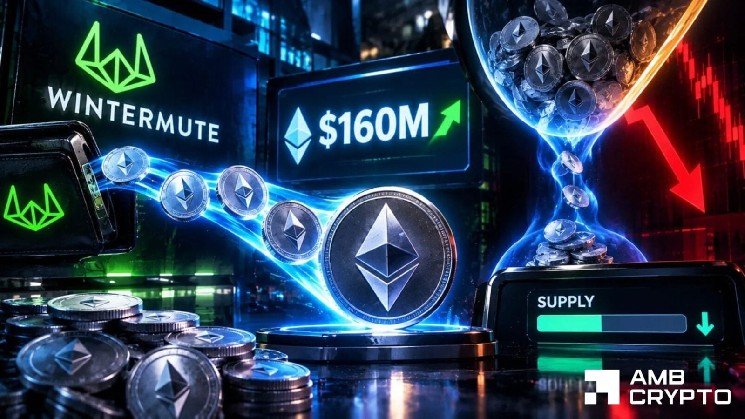
    Lookonchain reported that Wintermute deposited 61,847 $ETH worth approximately $160.3 million into Binance and Coinbase. The transfer initially raised selling concerns among market observers. However, an exchange deposit does not confirm a sale. Market makers regularly move inventory between venues for liquidity provision and operational purposes.

    Source: Arkham

    If intended for liquidity provision, the transfer may not represent directional selling. Nevertheless, market sales from that inventory could increase short-term supply and create downside volatility. The transfer matters, but its purpose determines whether it translates into genuine selling pressure.

    Ethereum Exchange Supply Ratio Hits 2016 Lows

    Despite Wintermute’s deposit, Ethereum’s broader Exchange Supply continued falling. AMBCrypto previously reported that Ethereum reserves on Binance had reached a three-month low. While Binance represents a single venue, the Exchange Supply Ratio (ESR) showed that the decline extended across exchanges.

    Source: CryptoQuant

    ESR declined for ten consecutive days and reached 0.125 at press time. The metric had not visited this level since 2016. Its decline indicates that exchanges hold a smaller share of Ethereum’s circulating supply. This suggests the market absorbed individual deposits without creating a broad buildup of immediately sellable $ETH.

    Historically, lower Exchange Supply can reduce selling pressure. The harder question remains why $ETH remained weak as its liquid supply contracted.

    Whale Distribution Outpaces Accumulation

    Source: SwissIntelligence

    SwissIntelligence data showed that 196 whales were distributing $ETH, compared with 125 accumulating. This imbalance suggests that large-holder selling continues to weigh on $ETH as whales secure modest gains.

    Technical Indicators Signal Seller Advantage

    Source: TradingView

    The True Strength Index has declined since forming a bearish crossover several days earlier. At the same time, the Balance of Power remained negative. Together, both indicators show that sellers retain a short-term advantage despite declining exchange balances.

    Key Price Levels and Scenarios

    $ETH is caught between fewer immediately sellable coins and more whales willing to sell. If whale distribution continues, $ETH could revisit $2,300 if Wintermute’s transfer becomes market sales. By contrast, shrinking Exchange Supply could help $ETH reclaim $2,600 and target $2,800 if demand returns. The next move may reveal whether buyers can absorb whale sales without losing the emerging supply squeeze.

    Final Summary

    • Wintermute deposited 61,847 $ETH worth $160.3 million into Binance and Coinbase.
    • Ethereum’s Exchange Supply Ratio reached 2016 levels, yet whale distribution continued weakening price momentum.
  • 241 Billion Shiba Inu Netflow Threatens Rally

    241 Billion Shiba Inu Netflow Threatens Rally

    Shiba Inu Rally Stalls as Exchange Inflows Signal Rising Sell Pressure

    Shiba Inu ($SHIB) opened the session with a bullish advance of roughly 4%, but on-chain data suggests the uptick may be losing steam as traders move large volumes of tokens back onto trading platforms.

    Exchange Netflow Turns Sharply Positive

    According to the latest figures from CryptoQuant, Shiba Inu recorded a net exchange inflow of 241,877,000,000 $SHIB over the past 24 hours. A positive netflow of this magnitude typically signals bearish sentiment, as it indicates that the volume of tokens deposited to exchanges for selling far exceeds the amount withdrawn for accumulation.

    The data implies that market participants are opting to realize gains following the recent price recovery rather than add to positions. With sellers dominating order flow, the path of least resistance for $SHIB appears tilted to the downside in the near term.

    Price Action Reverses Intraday

    Consistent with the on-chain shift, $SHIB erased its early gains and slipped into negative territory. As of the latest print, the token trades down approximately 0.45% on the day, underscoring how quickly exchange-driven supply can overwhelm buying interest.

    Market Watchers Await Flow Reversal

    Traders are now monitoring exchange netflow metrics for signs of a turnaround. A return to negative netflow — where withdrawals exceed deposits — would suggest renewed accumulation and could provide the catalyst for a faster price recovery.

  • Bitcoin, ETH, XRP Rally Threatened as September 16 Fed Rate Hike Odds Surge to 86%

    Bitcoin, ETH, XRP Rally Threatened as September 16 Fed Rate Hike Odds Surge to 86%

    Bitcoin, Ethereum, and XRP are bracing for a fresh macroeconomic headwind as market-implied odds of a Federal Reserve rate hike at the September 16 Federal Open Market Committee (FOMC) meeting have climbed sharply.

    Bitcoin Faces Key Test Ahead of September FOMC Decision

    According to the CME FedWatch Tool, the probability of a 25-basis-point increase has surged in recent sessions, reflecting sticky inflation data and resilient labor-market readings that have pushed traders to reprice the terminal-rate outlook. The shift puts risk assets—including the largest cryptocurrencies by market capitalization—on alert for heightened volatility in the days leading up to the policy announcement.

    Rate-Hike Expectations Reaccelerate

    Fed futures now show a materially higher chance of a hike compared with a week ago, when the consensus leaned strongly toward a pause. The repricing follows a run of economic releases—including consumer-price-index and producer-price-index reports—that came in above forecast, reviving concerns that the central bank’s disinflation progress has stalled.

    Crypto Market Implications

    Bitcoin, often viewed as a liquidity-sensitive asset, has historically sold off when rate-hike expectations rise, as higher discount rates pressure valuations across the risk spectrum. Ethereum and XRP tend to exhibit even higher beta to macro shifts, amplifying downside moves during hawkish repricing episodes. Traders are monitoring key technical levels on BTC/USD, ETH/USD, and XRP/USD pairs for signs of trend exhaustion or breakout confirmation once the FOMC statement and accompanying Summary of Economic Projections are released.

    What to Watch on September 16

    • Policy rate decision: Whether the Fed raises the federal funds target range by 25 basis points or holds steady.
    • Dot-plot projections: Updated median forecasts for the policy path through 2024 and beyond.
    • Chair Powell’s press conference: Tone on inflation persistence, labor-market tightness, and the reaction function for future meetings.

    Market participants will parse every word for clues on whether the hiking cycle has truly ended or if one more increase remains on the table before a prolonged pause. The outcome will likely set the near-term trajectory for digital-asset prices as well as traditional risk markets.

  • Metaplanet Cuts Series 10 Stock Rights Pool 41% to Boost Bitcoin per Share

    Metaplanet Cuts Series 10 Stock Rights Pool 41% to Boost Bitcoin per Share

    Tokyo-listed Bitcoin treasury firm Metaplanet Inc. (TSE: 3350) announced on 11 September 2026 that its board of directors resolved to reduce the potential share pool under its 10th Series Stock Acquisition Rights by 41.1%, from 319,464,000 to 188,190,000 shares. The decision follows feedback from shareholders and capital market participants. Chief executive Simon Gerovich signed the notice on behalf of the company.

    Board Resolution Details

    The amendment cuts the number of shares underlying each stock acquisition right from 696 to 410, lowering the total potential pool by 131,274,000 shares. After deducting the portion already exercised, the remaining potential shares fall by 55.5%, from 236,640,000 to 105,366,000.

    Unvested rights now carry a new exercise restriction, with three equal portions becoming exercisable on 18 August 2029, 2030, and 2031 respectively. The company also withdrew its plan to transfer up to 90,000 rights to a long-term officer and employee incentive vehicle and will instead design a new compensation plan with a global consultant. The lock-up through 17 August 2031 and the JPY 10 exercise price remain unchanged. If all remaining rights are exercised, the company would receive roughly JPY 1.05 billion.

    Why Metaplanet Changed Course

    The board said it reconsidered the reference date used to calculate the shares underlying the rights, shifting it from 30 June 2026 to 1 September 2025. Metaplanet argued this better aligns the options with the period when its equity financings were executed at the highest premiums to net asset value, whereas later offerings including the September 2025 international placement were completed at more modest premiums. The company has drawn scrutiny as its floating option pool expanded alongside its share count while it pursued a strategy of raising equity to accumulate Bitcoin.

    Bitcoin Per Share Improves

    Because the fully diluted share count falls in line with the rights reduction, Metaplanet said its fully diluted Bitcoin per share improves accordingly. The company holds 43,000 BTC and reported roughly 0.0286646 BTC per effective diluted share, up from 0.0263554 as of 30 June, with the current-quarter BTC Yield at 8.8%.

    The disclosure shows one director holds 276,000 units, equal to 113,160,000 underlying shares after the cut, with 49,128,000 still exercisable. As Metaplanet expands its treasury strategy, it expects the amendment’s impact on current-year results to be immaterial.

  • Hyperliquid Burns 32.77K HYPE as TVL Nears $7B: Can Bulls Recover?

    Hyperliquid Burns 32.77K HYPE as TVL Nears $7B: Can Bulls Recover?

    Hyperliquid Burns 32,770 HYPE Tokens Worth $2.65 Million as TVL Nears $7 Billion

    Hyperliquid’s native token $HYPE underwent another supply reduction this week as the protocol executed a buyback and burn of approximately 32,770 HYPE. The transaction carried a value of roughly $2.65 million at an average purchase price of $81.01 per token.

    According to on-chain data, this latest burn brings the cumulative lifetime burns to 48.57 million HYPE, representing an estimated $3.82 billion at current market valuation. The removed tokens account for approximately 4.86% of the total $HYPE supply. The mechanism permanently reduces the maximum circulating supply rather than temporarily locking tokens, converting protocol-generated revenue into deflationary pressure on an ongoing basis.

    While the burn mechanism continues to operate as designed, analysts note that supply reduction alone does not guarantee immediate price appreciation. Sustained revenue generation remains essential to maintain the scale and frequency of future buybacks.

    Rising TVL Strengthens Hyperliquid’s Burn Engine

    Underpinning the burn activity, Hyperliquid’s Total Value Locked (TVL) has climbed toward the $7 billion mark, up from a prior range near $6 billion. The acceleration began in September, pushing locked capital to near all-time highs.

    Daily protocol fees continue to reach several million dollars, with periodic spikes significantly exceeding baseline levels. This combination of elevated TVL and robust fee generation provides the economic foundation for recurring $HYPE purchases. However, the burn mechanism ultimately depends on durable platform usage rather than TVL growth in isolation. A sustained alignment of capital inflows and fee generation would enhance $HYPE’s long-term supply dynamics.

    Source: DefiLlama

    Derivatives Traders Show Tentative Return to Long Exposure

    On the derivatives front, positioning has shifted following volatile funding rate fluctuations throughout September. The $HYPE open interest-weighted funding rate briefly turned negative multiple times after September 8, but recovered into positive territory around 0.0012% by September 12, per CoinGlass data.

    The reversal suggests long positions have reclaimed a slight funding premium over shorts. However, current rates remain well below the higher positive levels recorded during late August sessions, indicating renewed long exposure has not yet returned to similarly aggressive levels.

    A sustained positive funding rate could support the demand outlook provided leverage remains controlled. Conversely, another move below zero would signal renewed short-side pressure.

    Source: CoinGlass

    $HYPE Price Action Tests Critical $78.50 Support After Channel Breakdown

    Price action presents the clearest near-term risk after $HYPE failed at the $88.14 resistance zone. The rejection pushed price beneath its rising channel before finding temporary stability around the $78.65 area.

    The $78.50 level has emerged as immediate structural support that will determine whether the breakdown deepens. A confirmed break below this threshold could validate a Change of Character (CHoCH) in price direction, signaling a structural shift to bearish momentum.

    Technical indicators align with the weakening structure:

    • MACD registered a bearish crossover accompanied by a negative histogram
    • RSI cooled to 50.69 after previously reaching overbought territory during the recent advance

    The RSI remains in neutral territory rather than oversold conditions, confirming the deteriorating technical structure without yet signaling capitulation. Successfully defending $78.50 could support stabilization and reopen a recovery attempt toward the $88.14 supply zone. However, losing the key support would reinforce the bearish structural shift and expose the $70 support region.

    Source: TradingView

    Key Takeaways

    • Hyperliquid’s recurring burns continue reducing $HYPE supply as TVL approaches $7 billion
    • $HYPE must defend $78.50 to avoid confirming a bearish Change of Character
  • Bitcoin Suisse Plans to Cut Up to Half Its Swiss Jobs as Work Shifts Abroad

    Bitcoin Suisse Plans to Cut Up to Half Its Swiss Jobs as Work Shifts Abroad

    Bitcoin Suisse Cuts 60 Jobs in Switzerland, Shifts Development Overseas

    Crypto financial services firm Bitcoin Suisse plans to eliminate up to 60 positions in Switzerland, reducing its domestic workforce by half, as the company moves software development and back-office operations to lower-cost international hubs. The Zug-based firm, which oversees more than $3 billion in digital assets under custody, employs roughly 200 people globally.

    Restructuring Driven by Cost Efficiency

    As part of the reorganization, Bitcoin Suisse is closing its IT development site in Copenhagen. The company already operates a technology hub in Bratislava, Slovakia, and intends to establish another in Vietnam. CEO and co-founder Andrej Majcen explained the rationale to Swiss outlet Finews, which first reported the restructuring:

    “In Bratislava and Vietnam, we can provide these services at significantly lower cost,”

    Majcen emphasized that the decision reflects the company’s international growth strategy and is unrelated to difficult crypto market conditions.

    Expansion Beyond Crypto Services

    Founded in 2013, Bitcoin Suisse offers crypto trading, custody, staking, and lending. According to Majcen, the firm now aims to broaden its scope into wealth and asset management services targeting high-net-worth individuals and institutional clients.

    To support that expansion, the company has begun securing regulatory licenses. Its Liechtenstein subsidiary received authorization in June under the European Union’s Markets in Crypto-Assets (MiCA) framework, enabling it to serve clients across selected European Economic Area markets.

  • OpenAI IPO Not Happening This Year, Sam Altman Confirms

    OpenAI IPO Not Happening This Year, Sam Altman Confirms

    OpenAI Public Offering Pushed to 2027 as Safety Concerns Take Priority

    OpenAI has signaled that its initial public offering will not arrive before 2027, with Chief Executive Officer Sam Altman emphasizing that current safety challenges make a stock market debut ill-advised at this stage.

    Altman: “Ill-Advised Moment to Go Public”

    Speaking with Fortune, Altman explained that the company faces no external pressure to pursue an IPO and remains focused on the substantial work required to ensure artificial intelligence safety and alignment.

    “I actually think that, given everything happening with safety, right now would be an ill-advised moment to go public, and we don’t feel pressure on that,” OpenAI CEO Sam Altman told Fortune.

    “We got a lot of stuff to do, like meeting this moment of what is going to be required for safety and alignment, and how the industry and governments can work together,” he continued.

    Industry Leaders Call for AI Race Slowdown

    The timeline update arrives amid growing consensus among top AI executives about the need for a more measured development pace. Anthropic CEO Dario Amodei publicly urged a slowdown in the competitive AI race over the weekend, a position that quickly drew agreement from both Altman and Elon Musk.

    This alignment across competing firms underscores a shifting industry priority: moving beyond raw capability advancement toward robust safety frameworks and coordinated governance with policymakers.

  • Ripple Stablecoin Executive Identifies $13 Trillion Corporate Treasury Opportunity for RLUSD

    Ripple Stablecoin Executive Identifies $13 Trillion Corporate Treasury Opportunity for RLUSD

    Ripple’s RLUSD stablecoin, launched nearly two years ago, still trails industry leaders Tether’s USDT and Circle’s USDC, yet its growth trajectory is accelerating. According to Token Terminal data, RLUSD’s circulating supply has reached $2.4 billion, marking an increase of more than 50% over the past month. Of that total, approximately $1 billion resides on the XRP Ledger, while $1.4 billion sits on Ethereum.

    Utility and Daily Activity Trump Market Cap

    Ripple emphasizes real-world usage over headline market capitalization. “What’s more exciting to us is the utility and the daily activity,” McDonald said. He noted that RLUSD’s daily activity has more than tripled since the beginning of the year, climbing to roughly $750 million a day last month from about $200 million.

    Payments and Capital Markets Drive Adoption

    Two primary verticals are fueling RLUSD adoption: payments and capital markets.

    • Payments: Ripple has made RLUSD the primary stablecoin in its payments business.
    • Capital markets: The token serves as the cash leg for transactions, settlement, and collateral.

    Ripple has partnered with firms including Franklin Templeton and DBS around tokenized money-market funds and lending. Additionally, RLUSD can be posted as collateral through Ripple Prime, the institutional brokerage business formed from the Hidden Road acquisition.

    Integrated Strategy: Stablecoins Meet Custody, Trading, and Prime Brokerage

    This approach reflects Ripple’s broader push to combine stablecoins with custody, trading, payments, and prime brokerage rather than operate RLUSD as a standalone product.

  • CFTC Probes Polymarket Trades Linked to Biden Pardons, Iran, Google, Report Says

    CFTC Probes Polymarket Trades Linked to Biden Pardons, Iran, Google, Report Says

    CFTC Opens Three Insider Trading Investigations Into Polymarket

    The Commodity Futures Trading Commission has launched at least three previously unreported investigations into suspected insider trading on the prediction market platform Polymarket, according to a report from WIRED. The probes target event contracts tied to presidential pardons issued by former President Joe Biden, Iran-related geopolitical outcomes, and Google’s 2025 Year in Search rankings.

    First Probe Follows NPR Report on Pardon Markets

    CFTC Chairman Michael Selig approved the first investigation in early May. The action followed an NPR report detailing a trader who earned more than $300,000 from pardon-related markets after correctly predicting several preemptive pardons.

    Second Investigation Targets Iran Contracts

    A second investigation was approved at the end of May. This probe centers on Iran-related contracts and was prompted by a 60 Minutes report on accounts that reportedly earned $2.4 million with a 98% win rate.

    Third Probe Examines Google Search Rankings

    In July, the CFTC approved a third investigation into suspected insider trading involving Google’s 2025 Year in Search ranking. An agency official said the probe would examine additional individuals and noted that the Southern District of New York was conducting a parallel investigation.

    CFTC enforcement officials clarified that this investigation is separate from an existing case against former Google engineer Michele Spagnuolo, who allegedly made more than $1.2 million trading Polymarket contracts based on confidential information about Google’s 2025 Year in Search rankings.

    Polymarket’s U.S. Return Under CFTC Oversight

    Polymarket has been working to rebuild its reputation in the United States after four years of operating outside the country. In late 2025, the company relaunched in the U.S. following the acquisition of QCEX, granting Americans limited access to its event contracts under CFTC oversight.

    Previous DOJ and CFTC Probe Concluded

    The Justice Department, alongside the CFTC, previously examined whether the crypto prediction market circumvented restrictions on U.S. traders imposed under a 2022 settlement with the CFTC. The authorities ended that probe in July 2024.