Category: Coins

Digital assets, cryptocurrencies, blockchain, and currency news.

  • AMC CEO Challenges Robinhood’s 1:1 Token Backing Claim

    AMC CEO Challenges Robinhood’s 1:1 Token Backing Claim

    AMC CEO Adam Aron Challenges Robinhood’s 1:1 Stock Token Backing Claims

    AMC Entertainment CEO Adam Aron has publicly questioned whether Robinhood’s stock tokens maintain true one-for-one backing if the underlying shares are lent to short sellers. In a series of posts on X dated Sept. 12–13, Aron directed pointed questions to Robinhood CEO Vlad Tenev and Chief Legal Officer Dan Gallagher, following their recent public defense of the company’s tokenized stock products.

    Aron Calls Stock Token Model “Abhorrent”

    In his latest post, Aron called the stock token model “abhorrent” and argued that it conflicts with the purpose of public share ownership. He questioned whether customers could misunderstand the rights attached to the products when Robinhood promotes them using the names and prices of listed companies.

    “If those tokens are theoretically backed 1:1 by real shares, but hypothetically some of those underlying real shares are in turn lent out to short sellers, are the tokens really backed 1:1 in fact?”

    Aron wrote. The question concerns the assets Robinhood holds against its token liabilities. Robinhood’s stock token documentation says Robinhood Assets Jersey Limited issues tokenized debt securities that provide economic exposure to an underlying security.

    How Robinhood’s Stock Tokens Work

    Robinhood says each public-company stock token is backed by a corresponding share. Its documents do not say that the token itself represents legal ownership of the underlying equity. A token holder instead holds a claim against the Jersey issuer. Aron did not cite Robinhood records, custody statements, or onchain evidence showing that the corresponding shares had been lent. His post asked Robinhood to disclose how the backing operates if securities lending occurs.

    Token Holders Lack Shareholder Rights

    Under Robinhood’s structure, the investor receives exposure to movements in the referenced stock’s price. The product can account for distributions such as dividends, but the holder does not appear on the public company’s shareholder register. Token owners lack voting rights attached to the referenced shares. Robinhood’s Key Information Document characterizes the product as a derivative and identifies Robinhood Assets Jersey Limited as its manufacturer.

    The document warns that investors depend on the issuer’s ability to meet its obligations. Ownership of a token therefore differs from direct ownership of AMC common stock, even when the token’s value tracks an AMC share.

    European Rollout and U.S. Regulatory Questions

    Robinhood introduced stock tokens for European customers as part of an international expansion announced in 2025. The company later connected the product line with Robinhood Chain, its blockchain network for tokenized assets. The products are not offered to U.S. persons. Robinhood’s expansion announcement says the stock tokens are issued through Robinhood Assets Jersey Limited and provide exposure to U.S.-listed securities.

    Aron questioned why Robinhood’s U.S. website promotes the concept when domestic customers cannot purchase the products. He described the Jersey structure as an offshore operation designed to function outside U.S. securities laws. Robinhood has not accepted that description.

    Tenev: Companies Cannot Veto Referenced Tokens

    Tenev defended the stock token model during a Sept. 9 CNBC “Squawk Box” interview. He argued that issuers control the rights and duties attached to shares they issue but do not control every separate financial product referencing their stock.

    “Issuers should have control and do have control over the rights and obligations of the stock that they issue, but that doesn’t mean they control everything about it,”

    Tenev said. Tenev stated that issuer consent “depends on what exactly you’re doing.” He maintained that Robinhood’s products “should not automatically require issuer consent,” although no cited court or U.S. regulatory decision has settled that position for Robinhood’s structure. Aron previously said AMC did not authorize, endorse, or participate in the creation of its referenced token. In a prior statement, he called on Robinhood to stop offering the product and said AMC would consult securities lawyers about possible legal and regulatory action.

    Gallagher Rejects AMC Demand

    Gallagher rejected the demand publicly.

    “We know a little something about the U.S. securities laws and will not ‘DECIST,’”

    he wrote on X, reproducing a misspelling in Aron’s earlier post. Gallagher invited AMC to send its lawyers. No public lawsuit filed by AMC over Robinhood’s stock tokens had been identified by Sept. 13. The U.S. Securities and Exchange Commission had not announced an enforcement action involving the AMC-linked product.

    Share Lending and Voting Remain Open Questions

    Robinhood’s public material explains how token prices follow referenced securities, but its available summaries provide limited detail about the custody and possible lending of each backing share. Aron’s latest post asks the company to state whether reserve shares are kept unencumbered or can enter securities-lending transactions.

    A securities loan transfers shares temporarily to a borrower under a separate agreement. Aron’s hypothetical question does not establish that Robinhood uses this arrangement for stock token collateral. A direct answer would require information from Robinhood or its custodian concerning the treatment of reserve shares.

    The company has not published a token-by-token reserve register showing where each corresponding share is held. Its stock token documentation identifies the issuer and product mechanics but does not give token holders direct voting control over the referenced equity. Robinhood therefore controls, directly or through its custody structure, any voting power connected to the underlying shares. Tenev has not announced how votes attached to stock token collateral are exercised.

    Regulatory Warnings and Comparable Cases

    European regulators have raised separate concerns about products that track shares without transferring legal ownership. The European Securities and Markets Authority has warned that tokenized instruments may create investor confusion when buyers do not receive the governance rights attached to conventional shares, Reuters reported.

    OpenAI raised a comparable ownership distinction in 2025 after Robinhood promoted a token tied to the private company. OpenAI said the instrument was not its equity and had not received the company’s endorsement, according to Reuters.

    Robinhood Maintains 1:1 Backing Description

    Robinhood maintains that its tokens can give eligible international customers economic exposure to U.S. securities. The company is developing Robinhood Chain to support tokenized assets, while crypto.news reported that its architecture creates a revenue stream for Arbitrum through chain-related fees.

    As of Sept. 13, Robinhood continued to describe its public-company tokens as one-for-one backed. Neither Tenev nor Gallagher had publicly answered Aron’s specific question about whether shares assigned to that backing may be lent to short sellers.


  • Chainflip Loses 736,442 USDT in TRON Exploit

    Chainflip Loses 736,442 USDT in TRON Exploit

    Chainflip Loses $736,442 in USDT Through TRON Memo Exploit

    Cross-chain protocol Chainflip suffered a security breach resulting in the loss of 736,442.17 USDT after an attacker exploited how the platform processes TRON transaction memos. The incident occurred during the early hours of September 12, prompting the protocol to pause operations while developers investigated and prepared a fix, according to a September 13 incident update.

    An update on yesterday’s exploit affecting Tron $USDT.736,442.17 $USDT was taken. All other funds are unaffected and secure, and impacted users will be made whole.The network stays paused while we finalise the fix and the restart plan.Full update: https://t.co/LTWSqLBOn3
    — CHAINFLIP (@Chainflip) September 13, 2026

    How the TRON Memo Exploit Worked

    Unlike other supported blockchains where Chainflip receives swap instructions through dedicated contract functions, the protocol’s TRON USDT integration relies on transaction memos to read swap instructions attached to TRON transfers. According to the incident report, the attacker discovered a method to attach a new memo to a transaction that Chainflip validators had already signed.

    The protocol’s systems interpreted the added memo as a separate swap instruction. When this new instruction appeared to fail, Chainflip issued a refund — but the original deposit had already produced a payout. Processing the altered memo therefore caused the protocol to pay against the same deposit a second time.

    Chainflip attributed the flaw to its own processing of TRON transaction memos and confirmed that the TRON blockchain, the USDT smart contract, and Tether’s reserve system were not compromised.

    Attack Timeline and Detection

    The attacker repeated the exploit method eight times over approximately 90 minutes. Early attempts used small amounts, with each subsequent attempt nearly doubling the previous one. Only six attempts produced unauthorized payouts totaling 736,442.17 USDT.

    The protocol detected the incident after subsequent USDT payments began failing. Developers traced the failures to the repeated processing of deposits through altered memos. Chainflip suspended network activity to examine whether the vulnerability could affect other assets or integrations. A preliminary review found the exploit was limited to TRON USDT, with remaining vault funds secure.

    The project described this as its first critical security event involving funds taken from protocol vaults, noting that earlier operational problems had not caused comparable losses.

    User Impact and Repayment Plans

    One legitimate user swap worth 115,654.41 USDT remains unpaid, though the funds are still held in Chainflip’s vault and can be released after the network restarts. This transaction is not counted among the six unauthorized payouts.

    Chainflip stated that affected users would be made whole, though the reimbursement method had not been selected or published as of September 13. Several options remain under review. The protocol has notified relevant parties about the stolen funds to track or recover proceeds as they move between addresses and services, but did not name those parties or confirm whether any USDT had been frozen.

    Tether can freeze addresses holding its tokens when acting under applicable legal or enforcement processes. No public statement from Tether or TRON concerning the Chainflip attack had been identified by publication time.

    Network Restart Targeted for Monday

    Chainflip reported that the underlying fix had been completed, but developers still needed to finalize the exact restart procedure. The network will remain paused “until Monday at the earliest,” making September 14 the earliest possible restoration date rather than a confirmed launch time.

    Before reopening, the team plans to finalize a technical restart plan designed to avoid further processing problems. Chainflip has not disclosed whether validators will need new software, a coordinated upgrade, or a governance vote.

    Once the system resumes, the protocol expects to process the pending 115,654.41 USDT swap and begin handling compensation for users whose funds were paid to the attacker. A complete technical report will follow after the restart plan is locked down and the network is operating securely, though no publication deadline has been announced.

  • Ethereum Logs Near-Record Q3 as ETH Nears All-Time High

    Ethereum Logs Near-Record Q3 as ETH Nears All-Time High

    Ethereum Stages Strong Q3 Recovery, Tests Key Resistance Above $2,500

    Ethereum (ETH) has mounted a significant comeback from its June lows, positioning the asset for one of its strongest third-quarter performances on record. The cryptocurrency currently trades near $2,492, marking a recovery of over 55% from the quarterly low of approximately $1,600.

    Technical Structure Shifts Bullish

    More importantly, Ethereum has reclaimed a position comfortably above all major moving averages after spending the majority of 2026 trading below them. The moving-average structure has improved substantially: short-term averages are rising beneath price action, with the $2,350–$2,400 zone serving as immediate dynamic support. Longer-term averages now cluster between $2,180 and $2,250, and ETH has even recovered its major long-term moving average.

    August Breakout Drives Momentum

    The strongest portion of the advance arrived in August. After consolidating around the $1,850–$1,950 range for several weeks, ETH surged through the $2,000 psychological level and swiftly reached the $2,400–$2,500 region. A significant increase in trading volume accompanied the breakout, reinforcing the move’s technical validity.

    Rather than surrendering gains immediately, Ethereum has since consolidated between $2,400 and $2,550. This consolidation is constructive, as the market remains well above the prior breakout zone while absorbing the strong August advance.

    Momentum Shows Signs of Cooling

    Despite the bullish structure, indicators suggest short-term momentum is moderating. The Relative Strength Index (RSI) soared into overbought territory during the August breakout but has since declined toward the mid-50s. This retracement eliminates much of the overheated condition from the initial rally, though it also signals buyers have lost some near-term urgency.

    Next Key Test: $2,550–$2,650 Resistance

    The next significant test lies at the $2,550–$2,650 resistance band. Ethereum has repeatedly failed to establish a foothold above $2,500. A decisive breakout above this zone could open a path toward $2,700 and potentially $3,000.

    Q3 Bullish Structure Remains Intact

    As of now, Ethereum’s third-quarter turnaround remains substantial. The broader bullish structure formed during the quarter stays intact as long as ETH holds within the $2,350–$2,400 support range.

  • Uniswap Extends DEX Lead as Volume Tops $70 Billion

    Uniswap Extends DEX Lead as Volume Tops $70 Billion

    Uniswap processed over $70 billion in trading volume during the 30‑day period ending September 13, surpassing the combined volume of the next three largest decentralized exchanges according to DeFiLlama Research data cited by the protocol. The milestone reflects activity across Uniswap v2, v3 and v4 on all supported blockchains and does not represent revenue earned by Uniswap Labs or the market value of the $UNI governance token.

    Uniswap has processed $70B+ in volume over the past monthMore than the next three DEXs combinedThe world’s value moves on 🦄 pic.twitter.com/ak426mmX1x
    — Uniswap (@Uniswap) September 12, 2026

    Uniswap v4 and v3 drive the bulk of volume

    DeFiLlama’s Uniswap v4 page showed nearly $38 billion in trading volume over the preceding 30 days when accessed on September 13, while the analytics platform attributed roughly $32 billion to Uniswap v3 over a similar period. Uniswap v2 contributed more than $1.2 billion, pushing the combined three‑version total above the $70 billion figure cited by the protocol. Minor discrepancies between the version‑level sum and Uniswap’s published number can arise from smaller deployments or differences in data‑update timing.

    Volume measures the dollar value of swaps executed by the protocol; it does not indicate trader profits, liquidity‑provider returns, or revenue flowing to $UNI holders. Each trade generates fees for liquidity providers, and selected pools direct a portion of those fees to the protocol under governance‑approved settings. Uniswap v3 remains active because it allows liquidity providers to concentrate capital within chosen price ranges, while version 4 employs a shared contract architecture with programmable hooks that let developers add customized pool functions. Recent growth has moved v4 ahead of v3 in the current monthly snapshot, though both versions continue to serve different pools, assets and integrations.

    Volume spans dozens of blockchain networks

    Uniswap’s aggregate volume covers deployments on Ethereum and numerous scaling networks. DeFiLlama lists v3 contracts on more than 40 chains, with Ethereum accounting for the largest share of the version’s locked liquidity. Activity from Base, Arbitrum, BNB Chain, Polygon, OP Mainnet and Robinhood Chain all contribute to the combined protocol figures. Each deployment processes swaps through its own pools, while analytics providers group the results under the Uniswap protocol.

    Robinhood Chain emerges as a notable contributor

    Robinhood Chain has recently become a significant source of Uniswap activity. As reported by crypto.news, the network reached approximately $945 million in daily DEX volume on August 25, with Uniswap serving as its primary public automated market maker. DeFiLlama’s September 13 snapshot showed Robinhood Chain processing roughly $1.35 billion in total DEX volume over 24 hours and $12.19 billion over seven days. Uniswap accounted for about $262 million of the chain’s daily volume and close to $4 billion of its seven‑day total at the time of measurement. Uniswap Labs launched v2, v3, v4 and UniswapX on Robinhood Chain in July, integrating the protocol into the Uniswap web app, wallet and API from the network’s first day of public operation.

    On Ethereum, DeFiLlama recorded approximately $681 million in total DEX trading over the latest 24‑hour period and $8.5 billion over seven days. Uniswap competes there with Curve, PancakeSwap, SushiSwap and other automated exchanges.

    Competitor comparison is a moving snapshot

    Uniswap stated that its monthly volume exceeded the next three DEXs combined but did not name the three competitors in its announcement. Rankings can vary depending on whether an analytics provider groups protocol versions, counts only spot swaps, or combines activity across supported chains. DeFiLlama defines DEX volume as the value of spot token swaps processed by a protocol; perpetual futures trading is presented separately, preventing derivatives‑focused venues from being mixed with spot exchanges in the same metric.

    Competition within the DEX sector has shifted over time. Raydium surpassed Uniswap in one monthly comparison during January 2025, while PancakeSwap held a higher 30‑day total during parts of that year. The latest data cited by Uniswap places the protocol back at the top of the selected spot‑DEX ranking. An earlier monthly record offers additional context: crypto.news reported in November 2024 that Uniswap reached $38 billion across Ethereum scaling networks. The current figure is more than 80 % above that total, though the two measurements cover different dates and may not include an identical set of chains and protocol versions. Uniswap’s competitor comparison should therefore be read as a trailing‑period snapshot verifiable only against the methodology, protocol groupings and timestamp used for the underlying ranking.

    Protocol fees link volume to $UNI supply

    Uniswap governance approved a fee mechanism that directs a portion of trading charges from selected pools to the protocol. The settings do not cover every pool or every dollar of reported volume, so monthly trading volume cannot be multiplied by a single fee rate to calculate protocol revenue. In July, Governance Proposal 100 expanded the mechanism to v4 pools across seven networks. Crypto.news reported that the change raised Uniswap’s measured daily protocol revenue from approximately $114,000 to $325,000 at the time.

    Captured fees are routed through TokenJar contracts and can fund $UNI purchases and token burns under the governance system. Liquidity providers continue to receive the portion assigned to them under each pool’s settings. Uniswap Labs has continued expanding products connected to the protocol’s liquidity. A June agreement brought $150 million in Spark stablecoin liquidity to v4, with plans to move the assets into a programmable DualPool hook developed with Uniswap Labs. Spark’s design places idle stablecoins in yield‑bearing vaults between trades and moves the required capital into a v4 pool when a swap occurs. Uniswap said USDS would serve as the first quote asset, with support planned for USDT and PYUSD liquidity.

    $UNI price action

    $UNI traded near $6.21 during the latest market session, down roughly 2 % from the previous close. The token moved between approximately $6.17 and $6.55 during the day, with no verified evidence connecting the price decline to Uniswap’s monthly volume announcement.

  • Solana Founder Links Elon Musk, Altman’s AI Slowdown to ‘Profitability at $1 Trillion Market Cap’

    Solana Founder Links Elon Musk, Altman’s AI Slowdown to ‘Profitability at $1 Trillion Market Cap’

    Solana blockchain co-founder Anatoly Yakovenko reacted with pointed sarcasm after three of the most prominent figures in artificial intelligence simultaneously called for a slowdown in advanced model development. Anthropic CEO Dario Amodei, OpenAI CEO Sam Altman, and xAI founder Elon Musk each warned of safety risks, yet Yakovenko framed the coordinated messaging as a strategic move to protect trillion-dollar valuations.

    Yakovenko Targets Profit Motive Behind Pause Narrative

    Commenting on Amodei’s manifesto, “We Must Pace the Frontier,” Yakovenko posted a concise remark on X: “Profitability at $1 trillion mcap”. He followed up with a tweet mocking the voluntary restraint narrative:

    Profitability at $1t mcap https://t.co/wEpIG4cJ9N
    — toly 🇺🇸 (@toly) September 13, 2026

    The Solana founder’s implication is clear: OpenAI and Anthropic have reached an infrastructure wall. Chip and electricity costs are rising exponentially, while investor pressure demands demonstrable profitability rather than continued capital burn.

    David Sacks Accuses AI Labs of Hypocrisy

    Former White House AI and crypto czar David Sacks amplified the criticism, highlighting what he calls the blatant hypocrisy of leading AI labs. If OpenAI and Anthropic genuinely perceive an existential threat in their own developments, Sacks argues, they do not need industry-wide legislation — they can simply halt their own work voluntarily.

    Instead, Sacks contends the push for top-down regulation serves two pragmatic goals:

    • Eliminating startups: Strict restrictions would block young companies and free open-source projects — such as Meta’s models and the Hugging Face platform — that have rapidly closed the gap with commercial leaders, effectively cementing an artificial duopoly.
    • Ignoring geopolitical reality: A global AI truce is utopian because China will not comply. Under these conditions, restrictions on American labs amount to voluntary technological capitulation by the United States.

    Markets Remain Calm Amid Rhetoric

    Despite the high-profile statements, equity markets showed no panic at Monday’s open. The prevailing consensus holds that a potential slowdown in frontier model development does not signal reduced investment in AI infrastructure; rather, it stretches out equipment procurement cycles.

  • Trump Meets Advisers on CLARITY Act Ahead of Tuesday Vote

    Trump Meets Advisers on CLARITY Act Ahead of Tuesday Vote

    President Donald Trump convened advisers on Friday, September 11, to negotiate the ethics language holding up the Digital Asset Market Clarity Act, four days before a pivotal Senate cloture vote that requires 60 votes to advance the legislation. Politico first reported the closed-door session, citing two people familiar with the talks. Neither the White House nor the negotiators disclosed the outcome. By Sunday, no revised text had circulated. Trump’s crypto policy adviser, Patrick Witt, struck an upbeat tone the following day, writing that it was a “Bad day to be a Clarity Act doomer.” He did not specify what had changed. With the Senate returning Monday, lawmakers have one working day before taking a public position on Tuesday.

    One paragraph of ethics text stalls a 630-page bill

    Lawmakers resolved most of the CLARITY Act months ago. The sole remaining obstacle is a conflict-of-interest provision targeting officials who profit from digital assets—a clause that describes the sitting president with uncomfortable precision. Trump previously accepted a version brokered by Senator Cynthia Lummis, but Senate Democrats and at least one Republican, Thom Tillis, deemed it too weak to secure their votes. Tillis has warned the bill collapses without a White House agreement. The current draft bars officials and their spouses from issuing tokens, yet permits them to hold crypto personally, exempts their children, and sunsets in 2029.

    Trump family collects 75% of $WLFI sale proceeds

    The Trump family launched World Liberty Financial in September 2024, with Donald Trump Jr., Eric Trump, and Barron Trump serving as its web3 ambassadors. The venture operates a governance token, $WLFI, and a dollar-pegged stablecoin, USD1, backed by Treasuries and custodied by BitGo. Under the project’s own disclosures, an entity tied to Trump and family members receives 75% of $WLFI sale proceeds after reserves, and the family holds billions of tokens directly. Trump reported more than $1 billion in crypto income for 2025, including roughly $515 million from $WLFI sales. Senator Elizabeth Warren said the draft does nothing to stop him from “vacuuming up his next $1.4 billion in crypto profits.”

    The token has punished outside buyers, trading below $0.06 while early investors remain locked out of most of their holdings. In August, the Office of the Comptroller of the Currency granted a World Liberty affiliate preliminary approval to pursue a national trust bank charter, which would tie the family’s finances to a federally regulated bank for the first time.

    CLARITY Act splits crypto oversight between SEC and CFTC

    Stripping away the politics, the bill draws the regulatory line the two agencies have contested for a decade. A maturity test determines which regulator governs a token: the network must be fully operational, no single entity may control more than 20% of supply or voting power, and founders cannot hold unilateral upgrade authority. Tokens clearing that threshold move from securities law to commodities law, sharply altering their compliance burden.

    How the maturity test works

    • Network status: Fully operational
    • Control threshold: No single holder controls more than 20% of supply or votes
    • Founder authority: No unilateral upgrade power

    Payment stablecoins fall into a shared SEC-CFTC category, with core rules already established by the GENIUS Act.

    Cloture requires 60 votes; Republicans hold 53

    Tuesday’s vote is a procedural cloture motion to begin debate, not final passage. The arithmetic remains unforgiving. Republicans need at least seven Democrats to cross over, and the likeliest Democratic supporters tied their backing to stronger ethics language that never materialized during the recess. The House demonstrated this coalition can hold when the ethics fight subsides, passing the bill 294–134 in July 2025 with 78 Democrats in favor. The Senate Banking Committee advanced its version 15–9 in May. The floor is where personal stakes become explicit, and where Senator Ruben Gallego is drafting a compromise no one has yet endorsed.

    Cloture math at a glance

    Category Count
    Votes needed to proceed 60
    Republican senators 53
    Additional Democrats required 7+

    Key senator positions

    • Rand Paul (R): Firm no
    • Josh Hawley (R): Firm no
    • Thom Tillis (R): Conditional
    • 7 pro-crypto Democrats: Undecided
    • Kirsten Gillibrand (D): Hard line on ethics

    Disclosure without divestment leaves conflict intact

    The administration’s proposed compromise leans on transparency: officials would report crypto holdings rather than divest. Watchdogs argue disclosure does little when assets are liquid and volatile, because knowing what a president owns does not prevent those tokens from moving on the policies he signs. Warren’s committee staff found the provisions riddled with loopholes and noted enforcement would fall to a Justice Department he appoints. Transparency International reached the same conclusion. Friday’s meeting did not visibly close that gap.

    Failed vote hands crypto to agency rulebooks until at least 2029

    Prediction markets have priced in the difficulty. Polymarket odds of 2026 passage slid from 82% in February to roughly 16% by late August, and Galaxy Digital cut its estimate near 10%. A failed cloture vote would end the bill’s legislative year and leave the industry under regulation by enforcement, with the SEC, CFTC, and OCC each writing pieces of the rulebook on their own terms. The SEC has already proposed exempting certain token offerings from securities registration. That reality has fueled the argument that crypto regulation can advance even if CLARITY stalls—a view gaining traction among executives who would prefer a statute but expect to operate without one. Europe’s MiCA regime is already live and licensing firms, and a prolonged U.S. stalemate cedes that ground abroad.

    A calendar problem looms beyond Tuesday

    A timing issue the vote counts rarely mention compounds the uncertainty. The House has canceled its late-September voting weeks to focus on the midterm campaign, meaning even a Senate substitute would need identical House text or a lame-duck session after the November 3 elections to reach the president’s desk. Tuesday reads less as a finish line than as a signal of whether a 2026 deal remains mathematically alive.

  • North Korea Recruits Foreign Talent to Infiltrate US Companies, Report Finds

    North Korea Recruits Foreign Talent to Infiltrate US Companies, Report Finds

    North Korea is increasingly recruiting IT workers from third countries—including Iran and Lebanon—to help infiltrate U.S. companies and funnel salaries back to state agencies funding weapons programs, NBC News reported Friday.

    U.S. Alert Details North Korean IT Worker Scheme

    A joint advisory issued in July by the U.S. government and several foreign agencies warned that North Korean IT workers “seek out contracts with the intent of remitting their salaries to their parent North Korean agencies. They also pose an insider threat to companies and are involved in data exfiltration, cryptocurrency theft, and theft of sensitive information.”

    Tactics Shift to Third-Country Intermediaries

    As the United States and partner governments have tightened screening to counter North Korea’s remote-work infiltration, the DPRK has adapted by using foreign nationals to pass initial job interviews. According to the NBC report, once contracts are secured, North Korean operatives typically take over the positions.

    Foreign IT workers have been recruited on LinkedIn, with some offered $500 per month in cryptocurrency to work part-time as “interview associates,” the report said.

    Cyber Operations Yield Billions in Crypto Theft

    The regime’s evolving tactics appear to be paying off. Cointelegraph reported in May, citing cybersecurity firm CrowdStrike, that North Korean state-affiliated hackers and threat actors were responsible for more than $2 billion in cryptocurrency losses in 2025—a 51% year-over-year increase.

    Economy Grows Despite Sanctions

    The Bank of Korea estimates North Korea’s gross domestic product grew 3.5% in 2025, even as international sanctions remain in place.

  • Chinese Crypto Founder Issues Bitcoin Warning: “Significant Price Movement May Be On the Way”

    Chinese Crypto Founder Issues Bitcoin Warning: “Significant Price Movement May Be On the Way”

    B.TOP Founder Jiang Zhuoer Warns of Bitcoin Correction After Leveraged Liquidations

    Jiang Zhuoer, founder of the B.TOP mining pool, has assessed Bitcoin’s short-term price trajectory and warned that a significant correction could follow the liquidation of highly leveraged positions in the market.

    Key Liquidation Zones Identified

    According to Zhuoer’s analysis, the most probable scenario involves Bitcoin first clearing an intense liquidation zone above $76,000. During the same period, Ethereum is expected to test a liquidation zone around $2,665, which would eliminate a substantial portion of short positions at higher levels.

    Two Divergent Scenarios Post-Liquidity Clear

    After Bitcoin clears liquidity above $76,000, Zhuoer outlined two distinct scenarios that could unfold:

    Scenario 1: Recovery Above $75,000

    If Bitcoin recovers without falling below the $75,000 support level, Zhuoer states the rally could extend toward $80,000. The analyst believes the price could even test the strong resistance zone between $83,000 and $84,000. However, Zhuoer cautions that a larger correction could follow such an advance.

    Scenario 2: Break Below $75,000 Support

    Should Bitcoin lose the $75,000 support level, a deeper correction is expected that would mirror the upward movement originating from $64,000. In this case, Zhuoer predicts Bitcoin could decline to the $70,000-$72,000 region before entering the next phase of the bull market.

    Upcoming Catalysts and Strategic Positioning

    Zhuoer highlighted that an expected vote on a bill next week, combined with developments from the Federal Reserve, will serve as important catalysts that could determine market direction. Due to this uncertainty, Zhuoer explained he is pursuing a more balanced strategy against market direction, maintaining a full short position in Bitcoin and a full spot position in Ethereum.

    This is not investment advice.

  • Morgan Stanley’s $50.6M Bitcoin Purchase Bolsters Market, But Rally to $82K Faces Key Hurdle

    Morgan Stanley’s $50.6M Bitcoin Purchase Bolsters Market, But Rally to $82K Faces Key Hurdle

    Morgan Stanley Expands Bitcoin ETF Holdings as Institutional Demand Strengthens

    Institutional appetite for Bitcoin accelerated this week as Morgan Stanley continued building its position in the MSBT Bitcoin ETF, while broader spot ETF flows remained positive and exchange netflows signaled tightening supply.

    Morgan Stanley Adds 51.58 BTC to MSBT Fund

    Morgan Stanley’s MSBT Bitcoin ETF received an additional 51.58 BTC, valued at approximately $4 million, transferred from Coinbase Prime. The transaction extends a two-week accumulation streak that has brought the fund’s total inflows to 641.87 BTC, worth roughly $50.6 million.

    Notably, the accumulation occurred through multiple smaller transfers rather than a single large transaction, a pattern that coincided with Bitcoin consolidating below the $82,000 resistance level. This steady buying pressure reinforces the institutional demand narrative as price action stabilizes.

    Broader Spot ETF Flows Remain Positive

    Beyond Morgan Stanley, the wider Bitcoin spot ETF market recorded $6 million in daily net inflows during the latest reporting period, equivalent to approximately 78.39 BTC. Cumulative net inflows across all spot ETFs have now reached nearly $55.63 billion, representing roughly 695,820 BTC.

    While the daily figure remains modest relative to the cumulative total, the consistent positive flows complement MSBT’s accumulation and strengthen the broader demand outlook. Sustained ETF inflows could provide additional buying support if Bitcoin continues defending its current demand zone.

    Source: CoinGlass

    Persistent Exchange Outflows Restrict Supply

    Exchange activity added another supportive element, with Bitcoin spot netflows remaining predominantly negative across the observed period. The most recent reading on September 12 showed a netflow of -$6.66 million, continuing a pattern of frequent spot outflows.

    Negative netflows indicate that withdrawals exceeded deposits during these sessions, suggesting more BTC is leaving exchanges than entering them. This trend limits immediate supply pressure even as institutional players continue accumulating.

    Source: CoinGlass

    Technical Analysis: Bitcoin Defends Key Order Block

    At press time, Bitcoin traded near $77,257 after retreating from the $82,000 resistance area and returning toward its daily order block. On 24-hour charts, price continues holding above the $76,500 support level, keeping the demand structure intact despite the recent pullback.

    The Relative Strength Index (RSI) offers additional context, having cooled rapidly from earlier overbought conditions. The latest reading stands at 55.02, while the RSI average signal remains higher at 63.71. Despite softened buying momentum, the indicator stays above the neutral 50 level as Bitcoin defends the order block.

    Source: TradingView

    Outlook: $76,500 Support Determines Next Move

    A decisive defense of the $76,500 support could encourage another recovery attempt toward $82,000, particularly if institutional demand persists. Conversely, a loss of that support would weaken the technical structure and increase the probability of a deeper price correction.

    Key Takeaways

    • Morgan Stanley’s MSBT ETF accumulated 641.87 BTC ($50.6M) over two weeks via multiple Coinbase Prime transfers.
    • Spot Bitcoin ETFs posted $6M daily net inflows (78.39 BTC), with cumulative inflows reaching $55.63B (695,820 BTC).
    • Exchange netflows stayed negative (-$6.66M on Sept 12), signaling net withdrawals and constrained supply.
    • Bitcoin holds $76,500 support with RSI at 55.02; defense of this level keeps $82,000 recovery in play.
  • Bitcoin vs Ethereum ETFs: Which asset is winning September’s flow battle?

    Bitcoin vs Ethereum ETFs: Which asset is winning September’s flow battle?

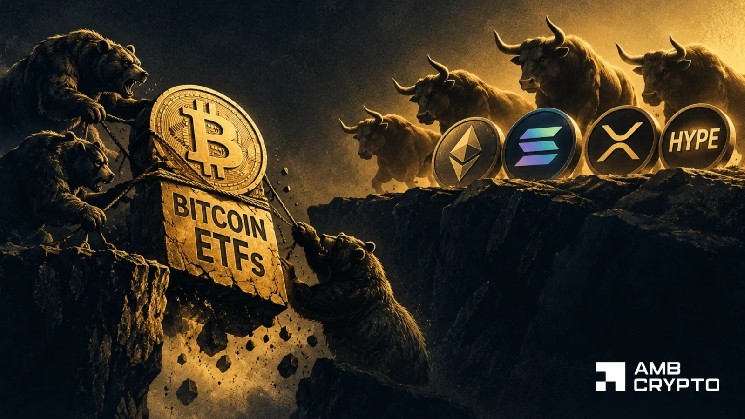
    Bitcoin ETFs See $462.7 Million Weekly Outflows as Price Drops Below $78K

    Following a robust August rally that brought $3.52 billion in monthly inflows to spot Bitcoin ETFs, September has opened with significant selling pressure. During the week of September 8–11, these funds recorded cumulative net outflows of $462.73 million, coinciding with Bitcoin’s price decline from approximately $79,000 to $77,324.76—a 2.9% weekly drop.

    Daily Breakdown of Bitcoin ETF Flows

    The week began negatively on September 8 with $46.6 million in net outflows. Fidelity recorded $17.1 million in redemptions, Invesco saw $4.7 million exit, and Grayscale’s GBTC led with a substantial $65.5 million outflow, according to SoSo Value data.

    Selling intensified on September 9, pushing net outflows to $120.2 million. BlackRock experienced a $19.5 million outflow, ARK Invest’s ARKB lost $78.0 million, and GBTC shed another $27.2 million.

    September 10 marked the worst session with $282.7 million in net outflows. Pressure eased slightly on September 11, limiting outflows to $13.2 million. Across the four-day period, ARKB and GBTC emerged as the primary sources of selling pressure.

    Ethereum ETFs Diverge With Strong Late-Week Inflows

    Spot Ethereum ETFs followed a different trajectory, per Farside Investors data. After a weak September 8 showing $24.3 million in net outflows, the products reversed decisively on September 9 with $34.7 million in net inflows. Selling returned on September 10 before a dramatic reversal on September 11, when Ethereum ETFs recorded $216.4 million in net inflows—the largest single-day positive total of the week.

    BlackRock’s ETHA dominated with $148.8 million in inflows, followed by BlackRock’s ETHB at $18.3 million.

    Altcoin ETFs Show Mixed Results

    Other cryptocurrency ETFs displayed varied flow patterns during the same period. Solana’s SOL ETF attracted $10.30 million in weekly inflows, driven primarily by Bitwise’s BSOL. XRP ETFs recorded zero flows, while Hyperliquid’s HYPE ETFs saw $26.42 million in net outflows, according to SoSo Value.

    Market Sentiment Remains Constructive Despite Outflows

    Despite the weekly outflows, Bitcoin’s dominance persists. The altcoin index stands at 40, indicating Bitcoin continues to lead the market, per Coinglass data. The Crypto Fear and Greed Index sits at 63—firmly in “Greed” territory—suggesting investors remain bullish and view the slowdown as temporary, according to Alternative.

    This optimism aligns with the strong inflows seen during the first week of September, supported by shifting macroeconomic expectations around U.S. monetary policy.