Category: Coins

Digital assets, cryptocurrencies, blockchain, and currency news.

  • Payward’s $100M Deal Leads Latitude’s $35M Crypto VC Funding Round

    Payward’s $100M Deal Leads Latitude’s $35M Crypto VC Funding Round

    Crypto Funding Weekly: $151 Million Across Five Deals Led by Nasdaq’s $100 Million Kraken Investment

    Crypto companies disclosed $151 million in new financing across five deals during the week of September 5–11, 2026. The total is dominated by Nasdaq Ventures’ agreement to invest $100 million in Payward, the parent company of Kraken, and a $35 million Series A for stablecoin payments infrastructure provider Latitude. The figures capture announced financing agreements rather than completed cash transfers in every case, and exclude rounds with undisclosed amounts, valuation changes without new capital, and acquisitions.

    Nasdaq Ventures Commits $100 Million to Payward for Tokenized Equities Collaboration

    On September 10, Nasdaq announced that its venture arm had signed an agreement to invest $100 million in Payward. The exchange operator emphasized that the announcement describes an agreement to invest, meaning the capital is counted as announced financing rather than cash already received. The deal represents roughly 66% of the week’s total disclosed volume.

    The partnership extends existing work between Nasdaq and Payward on tokenized equities. Nasdaq stated the companies plan to connect its proposed Nasdaq Equity Tokens design with Payward’s xStocks infrastructure. Additionally, Payward will adopt Nasdaq’s market surveillance technology across its trading venues. Nasdaq targets a second-quarter 2027 launch for its equity-token design, a timeline the company characterizes as a target rather than a guaranteed launch date. The initiative directly involves U.S. securities-market infrastructure, as Nasdaq operates American exchanges and the proposed design concerns the ownership and trading of tokenized shares.

    Latitude Raises $35 Million Series A to Bridge Stablecoin Settlement and Local Payments

    Oak HC/FT led Latitude’s $35 million Series A, announced September 9. The company builds infrastructure that uses stablecoins for settlement while delivering payments to recipients through local banking and payment systems. Oak described Latitude’s product as a single interface for businesses sending money across markets, with an investment thesis centered on the operational work required to turn stablecoin transfers into usable local-currency payments, including banking connections, liquidity management, and compliance.

    The financing carries a practical U.S. regulatory angle: the investor noted Latitude has secured money-transmitter licenses or approvals across 45 U.S. markets, providing a regulated route for businesses originating payments in the United States that need to pay recipients abroad. The $35 million reflects only the new Series A; an earlier $8 million round from March falls outside this weekly tally. Together, Payward and Latitude account for $135 million, or approximately 89% of the five deals’ disclosed value.

    Antarctic Exchange Secures $7 Million for Decentralized Perpetual Futures Platform

    Antarctic Exchange announced a $7 million financing round on September 7 for its decentralized perpetual-futures platform. The company-supplied announcement, published by Crypto Fundraising, named Valisa Capital Markets and Lucidity Capital as backers and indicated Republic Crypto structured the transaction’s token component. The round was structured as a SAFE-plus-token deal at a $70 million company valuation, a figure that measures the stated price of the business in the transaction and is separate from the $7 million raised.

    Antarctic states it is developing trading tools for retail derivatives users. Claims about platform standing and product performance originate from the company announcement and should be treated as company claims rather than independently verified results. This round represents the week’s largest disclosed financing for a decentralized trading platform.

    Smaller Rounds: RealGo and TINA

    RealGo Reports $6 Million Strategic Financing

    Web3 gaming company RealGo reported a $6 million strategic financing involving UZ Capital, Greenwood Global Capital, and Infinite Alliance. According to the report, the funds will be directed toward product development, team expansion, and AI research. The figure reflects the newly reported round, separate from earlier RealGo funding.

    TINA Raises $3 Million for Geospatial Data Network

    TINA announced a $3 million financing for its geospatial data network, according to ChainCatcher. Investors include THINKWARE, Gemhead Capital, Archer Capital, Astra Capital, Mayer Venture, and Tidal Capital. The company said the funding would support expansion of its location-data project and dashcam ecosystem. The report did not identify a lead investor, so backers are listed without assigning a lead role.

    Undisclosed Investments and Excluded Transactions

    Several notable transactions fall outside the $151 million total due to undisclosed amounts or structural classification.

    TRM Labs Series C Expansion

    San Francisco-based TRM Labs announced a Series C expansion on September 9 led by Blockchain Capital, with the company’s valuation reaching $2 billion, double the valuation attached to its February Series C. TRM did not disclose the amount of new capital raised. The $2 billion figure is a valuation, not funding received.

    Robinhood Equity Stakes in Crypto.com and OG.com

    Robinhood disclosed it would hold equity stakes in Crypto.com and OG.com through a prediction-markets partnership announced September 8. The companies did not disclose investment amounts. OG.com stated Robinhood would route some event-contract volume through its U.S. derivatives infrastructure. The equity arrangements are counted as two disclosed-stake transactions, but neither adds a dollar figure to the weekly total.

    Acquisitions Excluded

    Acquisitions appearing in funding databases, including Circle’s Tazapay transaction, are excluded because an acquisition price is not fresh financing raised by the acquired company.

    Methodology Note

    The deal inventory draws on CryptoRank’s funding database and Crypto Fundraising’s deal records, with transaction details checked against company, investor, and other reporting sources. The disclosed total counts each of the five dated financings once.

  • Fed Rate Hike Odds Surge to 87% Ahead of FOMC Meeting

    Fed Rate Hike Odds Surge to 87% Ahead of FOMC Meeting

    Federal Reserve officials face a critical policy test next week as financial markets now assign an 87% probability to a 25-basis-point rate increase at the September 15–16 meeting. The sharp repricing follows August consumer price index data that showed inflation remaining stubbornly above the central bank’s 2% target. With Bitcoin trading near $77,256, cryptocurrency traders are assessing how tighter monetary policy could influence digital asset flows.

    Markets Sharply Reprice September Hike Odds

    Rate futures indicate an 87% chance of a hike, up from 72% just a day earlier. Nearly all economists surveyed now expect a quarter-point move, a dramatic reversal from earlier consensus. The Federal Reserve’s benchmark rate currently sits at 3.50%–3.75%.

    Before the latest inflation report, most economists anticipated a pause, citing easing price pressures and the approaching U.S. midterm elections. Only 13 of 48 economists had penciled in a September increase. Hotter-than-expected core inflation upended that view. On a year-over-year basis, headline CPI rose 3.4%, matching forecasts, while core CPI held at 2.4%, also in line with estimates.

    Heather Long: September Hike “Almost Locked In”

    Chief economist Heather Long described a September increase as “almost locked in,” warning that the risk of entrenched inflation continues to grow. Long reinforced the call on social media:

    A September Fed rate hike is almost locked in now
    85% chance the Fed hikes next week.
    It’s the right call. The risks are growing that inflation remains entrenched (or keeps broadening). Fed Chair Warsh doesn’t want to make the same mistake Powell did of waiting too long to… pic.twitter.com/RdGcjhTP4G

    — Heather Long (@byHeatherLong) September 11, 2026

    If enacted, the move would mark the first Federal Reserve rate increase in three years.

    Traders Now See Multiple Hikes Through 2027

    The repricing extends well beyond September. Futures markets now imply at least three rate hikes through June 2027, up from two previously, with a base case of four increases by July 2027. That trajectory represents a stark turnaround from the start of 2026, when investors were pricing in four rate cuts over the same horizon.

    Former Fed Vice Chair Richard Clarida emphasized the likelihood of a sustained tightening cycle:

    “If we get a hike next week, certainly we’ll get additional ones.”

    “It would not be a ‘one and done’ move.”

    The shift signals a higher-for-longer interest-rate outlook as investors brace for prolonged inflation-fighting efforts.

    Implications for Bitcoin and Crypto Markets

    Higher interest rates typically reduce the appeal of riskier assets, as investors can earn competitive yields from safer instruments such as government bonds. That dynamic can drain capital from Bitcoin, Ethereum, and the broader cryptocurrency complex.

    Despite the hawkish repricing, digital assets rallied on the inflation data. Bitcoin briefly approached $77,500, while Ether climbed above $2,511, suggesting near-term momentum may be decoupling from rate expectations.

  • Poloniex Highlights Ethereum Surpassing $2,600

    Poloniex Highlights Ethereum Surpassing $2,600

    Ethereum Surges Past $2,600, Signaling Potential Shift in Market Sentiment

    Ethereum has broken above the $2,600 threshold, igniting fresh optimism among cryptocurrency traders. The milestone was highlighted by Poloniex Exchange in a recent social media update, drawing attention to a notable price movement that could reshape short-term trading strategies.

    Market Context: Mixed Signals, Standout Performance

    The broader crypto market continues to send mixed signals, with varying momentum across major assets. However, Ethereum’s recent price action distinguishes itself, suggesting a possible resurgence in investor interest. Analysts point to evolving trading volume dynamics and order book activity as indicators that market participants may be positioning for further upside.

    As a foundational layer for smart contracts and decentralized applications (dApps), Ethereum maintains a central role in the digital asset ecosystem. Poloniex, a major digital asset trading platform, regularly monitors and reports on significant price developments to inform traders of emerging opportunities.

    Key Levels to Watch Following the Breakout

    With Ethereum now trading above $2,600, the focus shifts to psychological resistance levels that could dictate the next directional move. Sustained increased trading volume would support the case for continued momentum, but market participants should exercise caution.

    External catalysts — including regulatory announcements and macroeconomic trends — remain critical variables that could swiftly alter sentiment. Traders are advised to monitor these factors closely while assessing Ethereum’s trajectory in the sessions ahead.

  • Pendle Finance Launches Direct Trading of T‑Bill Yields

    Pendle Finance Launches Direct Trading of T‑Bill Yields

    Pendle Finance Integrates T-Bill Yields With Robinhood Crypto Platform

    Pendle Finance has announced a significant platform enhancement that enables U.S. Treasury bill yields to be traded directly through Robinhood’s cryptocurrency offerings. The integration, revealed via official social media channels, represents a strategic bridge between traditional finance and decentralized finance (DeFi), allowing users to lock in fixed rates or pursue leveraged exposure to government-backed yield instruments.

    Strategic Bridge Between TradFi and DeFi

    The broader cryptocurrency market continues to show mixed signals with fluctuating momentum across major assets. Against this backdrop, Pendle’s initiative stands out as a deliberate move to connect conventional financial products with blockchain-based trading infrastructure. By tokenizing T-Bill yields for on-chain trading, the protocol positions itself as a forward-thinking participant in the evolving DeFi landscape, potentially attracting traditional investors seeking innovative yield opportunities amid declining conventional interest rates.

    Key Integration Details

    • T-Bill yield trading via Robinhood is effective immediately
    • Users can lock in fixed rates or gain leveraged exposure
    • The offering targets traditional investors entering the DeFi space
    • Pendle aims to expand its product suite with this feature
    • Announcement has generated significant interest within the DeFi community

    Market Reception and Trading Activity

    Current market data shows subdued activity for Pendle Finance, with no reported trading volume over the past 24 hours. This quiet period may reflect the need for broader market education on the new offerings as traders evaluate the implications of integrating traditional Treasury yields into a DeFi protocol. The varied trends across the wider crypto market could influence how quickly Pendle’s latest feature gains traction among both retail and institutional participants.

    Pendle Finance operates as a decentralized finance protocol that allows users to tokenize and trade future yield on various assets. The integration of T-Bill yields provides a unique mechanism for traders to access a traditional financial product within a DeFi context, aligning with the protocol’s mission to enhance yield opportunities in the cryptocurrency space.

    Outlook and Monitoring Points

    Market participants should monitor the initial reception of Pendle’s T-Bill yield trading, as early adoption patterns may influence broader market sentiment toward tokenized traditional assets. Successful integration could drive increased engagement from institutional investors seeking yield alternatives in the current economic environment. Analysts will be tracking trading volumes and user adoption metrics closely, as these indicators will likely shape Pendle’s growth trajectory within the competitive DeFi sector.

    This article is for informational purposes only and does not constitute financial advice.

  • Revolut Disclosed Customer Bitcoin Records Following Unauthorized Government Request, Report Says

    Revolut Disclosed Customer Bitcoin Records Following Unauthorized Government Request, Report Says

    A number of Revolut customers have reported receiving notifications that their personal and financial data — including Bitcoin transaction histories — was disclosed in response to a government request now believed to be fraudulent.

    Fraudulent Request Used Legitimate-Looking Credentials

    According to an email shared by onchain investigator ZachXBT, the request originated from an unauthorized email account that nevertheless used a government agency’s official domain and carried valid domain authentication credentials. The convincing appearance of the request may have led Revolut to process it without detecting the deception.

    Scope of Exposed Data

    The disclosed information is extensive. Personal details include customers’ full names, dates of birth, occupations, postal addresses, email addresses, and telephone numbers. Identity and verification records — such as passport or driver’s license copies and verification selfies — were also released.

    On the financial side, the data covers account statements, IBANs, withdrawal records, and full transaction histories, including Bitcoin activity. The email specified that biometric facial telemetry data was not shared.

    Experts Warn of Targeted Attack on High-Net-Worth Users

    Security experts suggest Revolut may have failed to recognize the fraudulent nature of the request before releasing customer information. “While the incident is likely limited in size it seems to have been targeted at high net worth users,” ZachXBT said.

    Revolut has not yet commented publicly on the reported data exposure.

  • US Bank Transfers USBDC Cross-Border via Stellar, but Only Internally

    US Bank Transfers USBDC Cross-Border via Stellar, but Only Internally

    U.S. Bank Completes Live Cross-Border Payment Pilot With USBDC Stablecoin on Stellar Network

    U.S. Bank has successfully executed a live cross-border payment pilot using USBDC, its proprietary U.S. dollar-backed stablecoin. The test, announced on September 9, demonstrated the bank’s ability to move its own token between internal entities on the Stellar public blockchain while maintaining established financial controls.

    Intercompany Transaction on Public Blockchain

    The payment transferred value between U.S. Bank entities located in North America and Europe. Notably, the transaction was an intercompany pilot rather than a customer-facing transaction. The announcement did not disclose the amount transferred, a timeline for customer access, or a commercial rollout date.

    Because both ends of the transaction remained within U.S. Bank’s corporate structure, the pilot demonstrates internal cross-border payment capabilities on Stellar but does not establish settlement with external banks, merchants, or retail customers.

    Testing Comprehensive Token Lifecycle Controls

    The pilot evaluated four critical functions: minting, payment redemption, freezing, and clawback. Freezing and clawback mechanisms give the issuer the ability to halt or reverse token movement when required, allowing U.S. Bank to test controls over the asset’s lifecycle while utilizing public blockchain infrastructure.

    Together, these functions cover the complete payment path and the issuer’s intervention capabilities. Minting and redemption govern how the bank creates and removes token units, while freezing and clawback address exceptional situations. U.S. Bank tested these controls as part of the same live transaction rather than presenting them solely as future platform features.

    Integration With Core Banking Infrastructure

    According to the bank, the transaction remained fully integrated with its core finance, risk, compliance, and operations infrastructure. U.S. Bank’s internally developed Digital Asset Platform served as the foundation for issuing, managing, and transferring the token. The pilot validated the platform’s connection between traditional banking infrastructure and blockchain networks.

    The test encompassed both token movement and the banking processes surrounding it. By using USBDC for a cross-border payment between its own regional entities while keeping the transaction tied to the systems governing its broader money movement, the pilot carries institutional significance without implying the token is ready for public use.

    Stellar Network’s Issuer-Control Features Leveraged

    The Stellar Development Foundation confirmed that the network’s issuer-control features supported the test. U.S. Bank and the Foundation are now exploring additional institutional applications, including liquidity management, collateral mobility, and cross-border treasury operations. Each potential application would extend the same approach to another facet of institutional money movement, though neither organization presented these possibilities as committed products.

    Institutional Pilot, Not Public Stablecoin

    For now, USBDC remains evidence of a working institutional pilot rather than a stablecoin available to customers. The next material signal will be whether U.S. Bank expands the token beyond intercompany transfers, discloses more operating details, or sets a timetable for client use.

  • Metaplanet CEO Surrenders $220M Stock Rights to Restore Investor Trust

    Metaplanet CEO Surrenders $220M Stock Rights to Restore Investor Trust

    Metaplanet Cuts Executive Rewards Amid Declining Bitcoin Per-Share Value

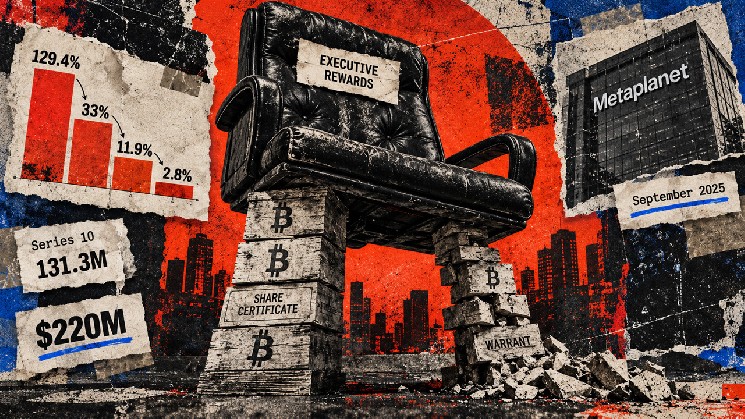
    Tokyo-listed Bitcoin treasury company Metaplanet announced on September 11 that it is resetting its Series 10 stock acquisition rights, eliminating more than $220 million in warrant value. The move cancels 131.3 million potential shares — representing 41.1% of the Series 10 pool — and reduces the remaining unexercised shares by 55.5% to approximately 105.4 million.

    Reset Draws a Line at September 2025 Financing

    The board’s review of previous equity financings focused on the premium to Bitcoin net asset value (NAV) at which shares were sold, the $BTC Yield generated, and the resulting shareholder value. Financings completed through mid-2025 were executed at multiples of Bitcoin NAV and produced substantial increases in Bitcoin per fully diluted share.

    That dynamic shifted with Metaplanet’s September 2025 international offering and subsequent capital raises, which closed at more modest premiums to NAV. While those transactions still added Bitcoin per share, the rate of accretion slowed dramatically.

    CEO Simon Gerovich stated that the September offering marked the point when capital raises became “less accretive” and the Series 10 structure began giving holders disproportionate value relative to existing shareholders.

    Sharp Decline in $BTC Yield Highlights the Problem

    Metaplanet’s $BTC Yield — a measure of Bitcoin accumulation per diluted share — reached 129.4% in the second quarter of 2025 as holdings jumped to 13,350 BTC from 4,046 BTC. The metric fell to 33% in the following quarter, 11.9% in the fourth quarter, and dropped to 2.8% in the first quarter of 2026.

    This declining accretion created a structural issue: the Series 10 pool was designed to adjust alongside Metaplanet’s diluted share count. As the company issued more stock to buy Bitcoin, management’s potential entitlement could expand even when each financing generated progressively less Bitcoin for existing shareholders.

    Investor Pressure Drives Deeper Cuts

    Metaplanet initially addressed the issue in August by eliminating the automatic adjustment mechanism and fixing the Series 10 pool at 319.5 million potential shares, using the June 30, 2026 share count as the reference point. However, investor criticism persisted.

    The board has now gone substantially further, replacing the June 2026 reference date with September 1, 2025 and resetting the conversion ratio to 410 shares per Series 10 right from 696.

    Matthew Sigel, VanEck’s head of digital assets research, called the revision a “meaningful concession,” saying it better aligns management with shareholders. He also noted that the revision would see the firm’s “CEO forfeit $123 million of controversial Series 10 comp.”

    Compensation Reset Boosts Bitcoin Per Share Without New Purchases

    The cancellation of 131.3 million potential shares raises Bitcoin per fully diluted share by approximately 8.8%, according to Gerovich. The company still holds 43,000 BTC; the improvement comes purely from a reduction in the share-count denominator.

    By extinguishing more than $220 million of warrant value, Metaplanet is effectively surrendering part of management’s future equity upside to improve existing investors’ Bitcoin-per-share position. The change also ties executive rewards more closely to the quality of future capital raises, acknowledging that an additional Bitcoin bought with newly issued stock does not provide the same shareholder benefit at every valuation.

    The board also abandoned a proposal to transfer up to 90,000 Series 10 rights into a new employee incentive pool. Those rights will be canceled as part of the 41% reduction.

    New Pay Structure Under Development

    The remaining Series 10 awards are being pushed further out: unvested rights will become exercisable in three equal portions in 2029, 2030, and 2031, while shares received through exercise remain subject to the existing five-year lock-up. This timeline gives the board time to decide which metrics — such as $BTC Yield, Bitcoin per diluted share, or NAV accretion — should determine future rewards as the treasury strategy matures.

    Metaplanet is also expanding internationally, including a pending acquisition of a controlling stake in Nasdaq-listed Super League Enterprise and the establishment of a Hong Kong subsidiary, Metaplanet Asset Management Asia Limited. The company said it will work with a leading global compensation consultant and other external advisers on a new incentive program for employees and future hires.

    CEO Gerovich Outlines Next Steps

    Gerovich said:

    “We will develop a new plan in consultation with a leading global compensation consultant to incentivize new hires. We will share details as the design progresses.”

    Metaplanet’s next compensation plan will reveal whether the September 10 concession simply reduced an unusually large legacy award or permanently changed how executives are rewarded for growing the company’s Bitcoin stack.

  • Why Nasdaq Surveillance Can’t Settle the Fight Over 24/7 Tokenized Markets

    Why Nasdaq Surveillance Can’t Settle the Fight Over 24/7 Tokenized Markets

    Nasdaq Invests $100 Million in Kraken Parent Payward as Always-On Markets Push Tests Regulatory Boundaries

    Nasdaq’s venture arm has agreed to invest $100 million in Payward, the parent company of crypto exchange Kraken, marking a significant convergence between traditional exchange infrastructure and digital-asset venues. Announced Sept. 10, the deal includes Payward’s adoption of Nasdaq surveillance technology across its portfolio of trading venues covering crypto, equities, tokenized equities, futures, and options.

    The investment arrives one day after Citadel Securities petitioned U.S. regulators to keep equity-linked products — including event contracts and perpetual derivatives tied to public companies — within the Securities and Exchange Commission’s regulatory perimeter. Together, the two moves highlight the unresolved classification questions facing always-on markets that operate beyond traditional trading hours.

    Surveillance Deal Lacks Cross-Market Data Details

    While Nasdaq’s surveillance adoption spans a broad range of asset classes, the announcement provides limited implementation specifics. No deployment date was disclosed, and the companies did not clarify whether Payward’s system would integrate order and trade data from the underlying U.S. cash-equity market — a critical capability for detecting manipulation that spans venues.

    Citadel’s Sept. 9 comment letter argues that effective oversight requires regulators to surveil equity-linked products alongside activity in the underlying cash equity. The market maker describes scenarios where traders with material nonpublic information could profit through equity-linked derivatives before issuer announcements, or use derivatives in strategies involving the price of the underlying security.

    This cross-market surveillance requirement represents a test the Nasdaq-Payward announcement does not answer: whether multi-asset monitoring also means access to the securities data needed to spot insider trading and manipulation across markets.

    Classification Determines Market Access and Investor Protections

    Surveillance technology can strengthen a venue’s case for operating an orderly market, but it cannot determine whether an equity-linked instrument qualifies as a security, security-based swap, swap, or futures contract under federal law. That classification controls the regulatory route to market and the investor protections that apply.

    Under CFTC Regulation 40.2, a designated contract market may list a product without prior Commission approval after filing a written self-certification by the preceding business day. Regulation 40.3 provides a separate voluntary approval route. The SEC does not use a uniform track for every exchange filing, creating divergent paths for similar products.

    Divergent Filings Illustrate Regulatory Split

    Recent filings demonstrate the contrast. A July 10 Cboe notice described binary options tied to issuer key performance indicators as a proposed rule change under the SEC. An Aug. 24 MEMX notice similarly described proposed securities event contracts tied to financial metrics reported by issuers.

    Meanwhile, CFTC product filings show a different trajectory. A QCEX KPI Contract was certified on June 18, while another CFTC page for organization code COIN listed US500, Tech100, Defense10, China10, and AI10 index perpetual-style futures as certified. These certifications establish regulatory status but do not prove live commercial trading, broad availability, or significant volume.

    The official record supports a narrower conclusion than claims that equity perpetuals are already broadly trading in the United States: multiple equity-index products have been certified, but the cited pages do not confirm their live commercial status.

    Bitcoin Precedent Does Not Resolve Equity Questions

    On May 29, 2026, the CFTC approved KalshiEX’s bitcoin-referencing BTCPERP under Regulation 40.3, accompanied by a policy statement calling for case-by-case review of perpetuals tied to other asset classes. That bitcoin-specific approval did not settle how equity-linked perpetuals should be classified.

    Citadel’s filing argues the SEC perimeter brings substantial protections beyond an approval process: best execution and order handling rules, front-running prohibitions, execution-quality disclosure, fair access requirements, venue transparency, coordinated trading halts, market-access controls, and safeguards against automatic deleveraging during volatile periods.

    These practical stakes mean two contracts providing exposure to similar corporate outcomes can offer vastly different disclosure, execution, and surveillance arrangements. A faster listing route widens access but creates uncertainty over which protections apply and which regulator holds the data and authority to investigate misconduct spanning the derivative and the underlying stock.

    Tokenized Equities Pilot Advances on Separate Track

    On March 18, 2026, the SEC approved Nasdaq’s rule change for eligible securities to trade in tokenized form during a Depository Trust Company pilot. Under this model, a tokenized share must be fungible with its traditional counterpart, carry the same CUSIP and symbol, provide the same shareholder rights, and trade on the same order book with the same execution priority. Market surveillance for both forms would rely on the same underlying data available to Nasdaq and FINRA.

    The March 18 approval did not equal a launch. The framework becomes effective only after DTC establishes the required infrastructure and post-trade settlement services, followed by at least 30 calendar days’ notice to members before tokenized trading begins.

    Separately, Nasdaq expects its work with Payward on Nasdaq Equity Tokens (NETs) to launch in the second quarter of 2027 — a forward-looking target. The sources do not establish that the Payward rollout and the DTC-pilot model have identical operating conditions.

    SEC Roundtable Addresses 24-Hour Trading Infrastructure

    The SEC’s Sept. 17 roundtable will bring these questions closer together without resolving them. The published agenda covers exchange and broker readiness, overnight surveillance, closing-price processes, clearance and settlement, investor protection, system resiliency, market-data continuity, and expected liquidity.

    The event concerns preparations for 24-hour trading in conventional market infrastructure, with a later panel looking toward possible future expansion to 24×7 trading. It is a public discussion, not a rulemaking decision — a distinction that prevents the debate about longer U.S. equity sessions from collapsing into the separate question of tokenized equities and perpetual derivatives that may trade continuously.

    Venues Need Both Surveillance and Legal Clarity

    The regulatory test is not a choice between surveillance and law. Venues will need both. Nasdaq’s technology could help Payward demonstrate that always-on markets are observable across its own stack. Citadel’s argument is that equity-linked oversight must also reach the underlying securities market and fit the statutory boundary between the SEC and CFTC.

    Until those pieces align, the fastest token rail will not necessarily deliver the broadest U.S. access. The products that reach users with durable liquidity may be the ones that combine continuous monitoring, cross-market data, operational resilience, and a classification regulators can defend.

  • XRP ‘Anti-Volatile’ Pattern Returns, Echoing Prior 240-Day Sideways Drift

    XRP ‘Anti-Volatile’ Pattern Returns, Echoing Prior 240-Day Sideways Drift

    XRP’s brief August rally has lost momentum, with the token’s price retreating to the $1.34–$1.37 range. Daily volatility has nearly evaporated, evidenced by Bollinger Bands tightening into a narrow horizontal line on the daily chart, according to TradingView data. Historically, this state of “anti-volatility” signals only one outcome for XRP: the market is hitting pause.

    Previous Cycles Point to Extended Sideways Action

    Historical patterns show that after such a lull, the asset typically enters a sluggish sideways drift lasting up to 240 days. The market’s current stillness is not without catalyst. Major participants and speculators are openly reluctant to establish positions ahead of a pivotal week that could reshape the macroeconomic landscape.

    Two Critical Events Loom Next Week

    First, the U.S. Senate is scheduled to vote on the CLARITY Act on September 15. The legislation stalled throughout the summer, prompting institutions to freeze activity, while inflows into XRP exchange-traded funds plunged by 93%.

    Second, the Federal Reserve will announce its interest rate decision on September 16. U.S. inflation is accelerating again, with the Producer Price Index jumping to 5.4%, while Brent crude has surged above $107. Markets are pricing in a hawkish outcome with a 70% probability, driving major capital into cash positions.

    XRP/USD daily chart showing Bollinger Bands squeeze and declining volatility, Source: TradingView

    Holder Sentiment Provides Downside Support

    Despite macro pressure, XRP is being shielded from a deeper decline by a sharp shift in holder behavior. According to analytics platform CryptoQuant, the peak inflow of coins onto exchanges on September 9 was followed by a rapid outflow. In a single day, XRP reserves on Binance alone fell to 2.631 billion tokens.

    The price drop to a local low of $1.33 forced traders to stop selling and begin withdrawing assets from trading platforms while awaiting the upcoming catalysts.

    Two Historical Timeframes Frame the Consolidation

    Raw data from XRP’s previous accumulation periods reveals two clear scenarios:

    Short Cycle (79–89 Days)

    This duration matches how long the token accumulated strength during previous local cycles in 2025. If history repeats, the chart will not “wake up” until late November or early December 2026.

    Macro Cycle (Up to 240 Days)

    This aligns almost exactly with the previous exhausting sideways period before the August 31 breakout: nearly eight months, or 236 days. In the worst-case scenario, XRP will not emerge from its current consolidation until spring 2027.

    The timer for a potentially prolonged flat has already started. Its actual duration will be determined by the Senate vote and the Federal Reserve’s decision over the next few days.

  • Former Alameda CEO Caroline Ellison Joins Manifund

    Former Alameda CEO Caroline Ellison Joins Manifund

    The Hire Predated the Public Announcement

    Manifund announced that Caroline Ellison began a work trial on July 13 and accepted a full-time role on August 10. During that period, she published work and supported users under the name “Carol.” Her stated responsibilities include developing the funding platform, operations, customer support, and research into how philanthropic funding should be directed. The September 11 post was therefore an identity disclosure rather than a same-day hiring decision.

    Manifund Is Not a Crypto Return

    Ellison has not returned to a cryptocurrency exchange, trading firm, or custody business. Manifund is a 501(c)(3) charity that hosts public grant proposals, fundraising, and regranting programmes. Its website lists 486 funded projects, $17.2 million directed to projects, and $5.46 million distributed through regrantors.

    The connection is not entirely separate from FTX. Manifund co-founder Austin Chen wrote that the FTX Future Fund had provided seed funding to Manifold and influenced the philanthropic model Manifund later adopted. That background helps explain why an FTX-related hire is material to Manifund’s donors and grant recipients, even though the organisation is not a crypto platform.

    The Reconciliation Tool Found Errors, But It Does Not Explain Access

    Manifund says Ellison built a reconciliation tool that found several incorrectly registered transactions in the five- to six-figure range. If the errors were identified and corrected as Manifund describes, the tool could improve the accuracy of its records.

    Finding an incorrect record is different from preventing an unauthorised payment before it happens. The announcement does not describe the platform’s approval structure or Ellison’s access to payment systems, so the public record does not allow readers to assess those controls.

    Transparency and Controls Are Different Things

    Manifund describes itself as unusually transparent, saying that its grant proposals, evaluations, finances, source code, and meeting notes are public. The company acknowledged that using a pseudonym for Ellison was a compromise on that principle, although Chen said he still supported the decision.

    Public proposals and source code make parts of Manifund easier to inspect. They do not, on their own, show how the charity separates payment authority, record-keeping, and independent review. A small team makes those role boundaries especially relevant because fewer people may be involved in approving, recording, and reviewing the same transaction. A September 3 Manifund hiring post described the team as “2ish FTE” and listed grant payouts, incoming donations, bookkeeping, and work with auditors among its operations and finance tasks.

    The FTX Record Makes the Role Material

    Ellison pleaded guilty in 2022 to fraud, conspiracy, and money-laundering-related charges tied to FTX and Alameda Research. The U.S. Department of Justice said she admitted her role in schemes that defrauded FTX customers and investors before cooperating with prosecutors.

    Ellison’s guilty plea and cooperation explain why her identity is material to donors and grant recipients. The announcement acknowledges that concern, but does not specify how Manifund has divided operational and financial responsibilities since hiring her. Coindoo’s earlier overview of the FTX case explains the different outcomes for the executives involved. That legal history provides the context for scrutiny; it does not establish how Manifund operates today.

    The Next Disclosure Should Be Operational

    Manifund has identified Ellison and explained why it initially used a pseudonym. It could reduce the remaining uncertainty by explaining whether significant payouts require more than one approval, who can modify financial records, and how reconciliation work is independently reviewed. That would give donors and grant recipients a clearer basis to judge the platform’s safeguards than a general promise of transparency.