Category: Coins

Digital assets, cryptocurrencies, blockchain, and currency news.

  • Markets Eye Federal Reserve: Goolsbee on Inflation, Bessent on Warsh

    Markets Eye Federal Reserve: Goolsbee on Inflation, Bessent on Warsh

    Key Highlights

    • Chicago Fed President Austan Goolsbee signaled openness to rate cuts if inflation meaningfully decelerates toward the 2% target, while emphasizing the need for decisive action against price pressures.
    • U.S. Treasury Secretary Scott Bessent expressed confidence in Fed Chairman Kevin Warsh and noted President Donald Trump shares that confidence, alongside an expansion of the Treasury’s bond repurchase program.
    • With U.S. PCE inflation at 3.7% as of July, Goolsbee stressed that reaching the 2% goal depends on easing supply constraints and distinguishing between supply-driven and demand-driven inflation components.

    Goolsbee Outlines Conditional Path for Rate Cuts Amid Inflation Fight

    Chicago Federal Reserve President Austan Goolsbee delivered a nuanced assessment of monetary policy during a meeting in London, stating that the central bank would not oppose interest rate reductions if inflation slows significantly toward its 2% target. His remarks come on the heels of the Fed’s 25 basis point rate increase last week—the first hike since 2023—with markets now pricing potential further increases in October or December. Goolsbee emphasized that the Federal Reserve must have the courage to respond forcefully to inflation when necessary, expressing optimism that the 2% goal remains achievable provided there are no signs of overheating demand.

    Disentangling Supply Shocks from Demand Pressures

    Central to Goolsbee’s analysis is the ongoing effort to parse how much of current inflation stems from supply disruptions versus demand strength. He pointed specifically to robust investment in artificial intelligence as a factor supporting demand, while noting that persistent supply shocks continue to exert upward pressure on prices. As of July, U.S. personal consumption expenditures (PCE) inflation stood at 3.7%, and Goolsbee underscored that returning to the 2% target hinges on the easing of supply-side constraints. Officials, he said, are still analyzing the relative contributions of supply and demand dynamics to the current inflation picture.

    Bessent Backs Warsh, Highlights Treasury Market Operations

    Following the Fed’s latest rate decision, U.S. Treasury Secretary Scott Bessent appeared on CNBC to convey a message of stability regarding Fed leadership. Bessent reiterated his confidence in Federal Reserve Chairman Kevin Warsh and added that President Donald Trump also maintains confidence in Warsh’s stewardship of monetary policy. The Treasury chief also addressed market liquidity conditions, disclosing that the department has increased the size of its bond repurchase program—a move aimed at supporting smooth functioning in the government securities market.

    Central Bank Independence Takes Center Stage

    Goolsbee waded into the institutional dimension of monetary policy, arguing that expectations for the Fed to lower federal government borrowing costs underscore the critical importance of central bank independence. He emphasized that the Federal Reserve must set monetary policy strictly in line with its inflation mandate, free from fiscal dominance considerations. The comments arrive at a moment when the interplay between U.S. monetary policy and Treasury market interventions is under intense scrutiny from investors and policymakers alike.

    Why This Matters

    The divergent but complementary signals from the Fed and Treasury reflect a delicate balancing act as policymakers navigate the final stretch of 2026. Goolsbee’s conditional dovishness—openness to cuts only if inflation data cooperates—signals that the Fed remains data-dependent despite the recent hike. Meanwhile, Bessent’s public backing of Chairman Warsh and the expansion of the Treasury’s buyback operation aim to anchor market confidence in both leadership continuity and plumbing liquidity. With PCE inflation still nearly double the target and AI-driven investment bolstering demand, the path to 2% remains contingent on supply-side normalization, making upcoming inflation prints and Fed communications pivotal for market pricing through year-end.

    Frequently Asked Questions

    What conditions would prompt the Fed to consider rate cuts according to Goolsbee?

    Goolsbee stated the Fed would not oppose rate cuts if inflation slows significantly toward the 2% target, provided there are no signs of overheating demand and supply pressures continue to ease.

    What is the current level of U.S. PCE inflation and the Fed’s target?

    As of July, U.S. PCE inflation was at 3.7%, while the Federal Reserve’s target remains 2%.

    What actions has the Treasury taken to support market liquidity?

    Treasury Secretary Scott Bessent announced an increase in the size of the Treasury’s bond repurchase program to address liquidity conditions in the government securities market.

  • What’s Driving Bitcoin’s Rise? Glassnode and CryptoQuant CEOs Explain

    What’s Driving Bitcoin’s Rise? Glassnode and CryptoQuant CEOs Explain

    Key Highlights

    • Bitcoin surged past $85,000 as short-position liquidations between $82,000 and $86,000 accelerated upward momentum, according to Glassnode on-chain data.
    • CryptoQuant CEO Ki Young Ju confirmed Bitcoin has reclaimed the critical 365-day moving average at approximately $83,000, a level widely watched to signal the end of the bear market.
    • Analysts suggest sustained trading above the 365-day MA could trigger increased buying pressure from trend-following and institutional investors driven by FOMO.

    Short-Position Liquidations Fuel Bitcoin’s Break Above $85,000

    Bitcoin opened the week with a decisive move above the $85,000 threshold, marking its highest level in months. On-chain analytics firm Glassnode attributes the acceleration to a cascade of short-position liquidations clustered between $82,000 and $86,000. According to Glassnode data, a significant volume of short liquidity had accumulated in this range over recent months. When Bitcoin failed to produce the sharp pullbacks many traders anticipated, those holding short positions were forced to buy back $BTC to cover, creating a feedback loop that propelled prices higher.

    Glassnode analysts described the dynamic in their latest assessment: “As expected, Bitcoin quickly broke through the short liquidation wall.” They elaborated that the rejection at this level proved insufficient to halt the advance: “Short positions accumulated between $82,000 and $86,000 over the months, but the rejection at that level was insufficient. Now these short positions have become fuel, because these traders need to buy back $BTC.” This short-covering rally has effectively turned prior bearish positioning into buying pressure.

    365-Day Moving Average Reclaimed: A Critical Bull-Market Signal

    Adding weight to the bullish narrative, CryptoQuant CEO Ki Young Ju posted on X that Bitcoin has reclaimed its 365-day moving average, currently situated near $83,000, with price action holding above $84,000. Ju emphasized that this long-term trend indicator is a primary reference point for market participants assessing whether the bear market has concluded. CryptoQuant has historically treated a sustained breakout above the 365-day MA as a confirmation signal for a new bull market cycle.

    Ju’s commentary underscored the psychological and structural importance of the level: “Bitcoin reclaimed the 365MA at the $83,000 level and is currently sitting above $84,000.” He further noted the potential for momentum-driven inflows: “This is the line everyone is watching for the end of the bear market. If it holds, momentum will start to drive traders and institutions crazy with FOMO. This is where things get fun.”

    Why This Matters

    The confluence of short-covering dynamics and a key long-term technical reclamation presents a noteworthy inflection point for Bitcoin. The $82,000–$86,000 zone had acted as a liquidity magnet for bearish bets; its clearance removes a structural overhang and may reduce near-term selling pressure from forced liquidations. Simultaneously, the 365-day moving average reclaim is widely regarded by quantitative analysts and institutional desks as a regime-change filter. A daily close above this level, if sustained, could unlock algorithmic trend-following strategies and encourage capital allocation from funds that mandate bull-market confirmation before deploying size. Market participants will now monitor whether Bitcoin can establish support above the 365-day MA and the $84,000–$85,000 band, which would strengthen the case for a durable uptrend.

    Frequently Asked Questions

    What caused Bitcoin’s rapid move above $85,000?

    The surge was driven by a cascade of short-position liquidations. Glassnode data shows a large concentration of short bets between $82,000 and $86,000. When price failed to reverse sharply in that zone, short sellers bought back $BTC to cover, creating a self-reinforcing upward spiral.

    Why is the 365-day moving average so important?

    The 365-day moving average (currently ~$83,000) is a widely watched long-term trend indicator. CryptoQuant and many institutional analysts treat a sustained break above this level as a primary signal that the bear market has ended and a new bull market may be underway.

    What needs to happen for the bullish case to strengthen?

    Analysts will look for Bitcoin to hold above the 365-day MA and the $84,000–$85,000 range on daily closes. Sustained support could trigger additional buying from trend-following algorithms and institutional investors, amplifying momentum.

  • Bitmine Buys $75 Million in Ether as Tom Lee Says Institutions Remain Underweight Crypto

    Bitmine Buys $75 Million in Ether as Tom Lee Says Institutions Remain Underweight Crypto

    Key Highlights

    • Bitmine Immersion Technologies (BMNR) acquired 27,562 ETH worth approximately $75.2 million last week, raising its total holdings to 5,983,940 ETH — roughly 4.9% of the total 122.1 million ETH supply.
    • The firm has purchased ether weekly since its June 2025 pivot to a crypto treasury strategy and has staked about 5 million ETH (85% of holdings), projecting roughly $357 million in annual staking revenue at current yields.
    • BMNR shares rose 5.8% in pre-market trading, extending Friday’s 8% rally, as ETH surged to a fresh high since late January; Chairman Tom Lee says institutional investors remain underexposed to crypto and may be playing catch-up after favoring AI-linked stocks earlier this year.

    Bitmine Immersion Technologies Accelerates Ethereum Accumulation Toward 5% Supply Target

    Bitmine Immersion Technologies, the largest corporate holder of Ethereum by treasury allocation, continued its methodical accumulation strategy last week with the purchase of 27,562 ETH at an average price of $2,727 per token. The transaction, valued at approximately $75.2 million, brings the company’s total holdings to 5,983,940 ETH — representing roughly 4.9% of the cryptocurrency’s 122.1 million circulating supply. At its current weekly acquisition pace, the firm is on track to reach its stated goal of controlling 5% of the total ETH supply within the next couple of months.

    Consistent Weekly Buying Since Strategic Pivot in June 2025

    The latest purchase extends a buying streak that began in June 2025, when Bitmine formally pivoted to a crypto treasury strategy. Since that inflection point, the company has executed weekly ether acquisitions without interruption, demonstrating a disciplined dollar-cost averaging approach regardless of short-term price volatility. This consistency has allowed Bitmine to build a dominant position while avoiding the market impact of larger, sporadic purchases. The firm’s treasury now holds nearly 6 million ETH, a scale that exceeds the reserves of most known institutional holders and positions Bitmine as a de facto whale in the Ethereum ecosystem.

    Staking Infrastructure Generates Significant Yield

    Beyond accumulation, Bitmine has deployed approximately 5 million ETH — roughly 85% of its total holdings — into staking infrastructure. At current network yields, this staked position is projected to generate approximately $357 million in annual revenue, creating a substantial income stream that supplements the company’s core operations. The staking strategy also reinforces Ethereum’s proof-of-stake security while providing Bitmine with a productive use of capital that aligns with its long-term conviction in the asset. The dual benefit of price appreciation potential and yield generation distinguishes Bitmine’s approach from pure speculative holding.

    Market Reaction and Institutional Sentiment

    Financial markets responded positively to the accumulation news. BMNR shares climbed 5.8% in pre-market trading on Monday, extending Friday’s 8% rally that coincided with ether’s surge to its highest level since late January. The share price action suggests equity investors are repricing Bitmine not merely as a technology company but as a leveraged proxy for Ethereum exposure. Chairman Tom Lee, a prominent voice in digital asset strategy, framed the buying within a broader institutional narrative: institutional investors remain underexposed to crypto and may be playing catch-up after favoring artificial intelligence-linked stocks earlier in the year. His assessment implies that Bitmine’s aggressive accumulation could be an early signal of a broader rotation into digital assets by traditional capital allocators.

    Why This Matters

    Bitmine’s pursuit of a 5% supply target represents one of the most aggressive corporate treasury strategies in the digital asset space, rivaling even MicroStrategy’s bitcoin accumulation in terms of supply percentage ownership. At nearly 6 million ETH, Bitmine’s holdings exceed the staked balances of many major validators and approach the scale of the Ethereum Foundation’s own reserves. This concentration raises structural questions about governance influence, liquidity availability, and the degree to which a single entity’s actions can move the market. For institutional observers, Bitmine’s weekly buying cadence provides a real-time case study in how traditional corporations can operationalize crypto treasury management at scale. The projected $357 million in staking revenue also introduces a new paradigm: crypto-native yield as a material line item on a public company’s income statement. As ETH approaches multi-month highs and institutional sentiment shifts, Bitmine’s next quarterly disclosures will be closely watched for signs of whether the 5% threshold is reached — and what the firm signals as its next strategic milestone.

    Frequently Asked Questions

    How much ETH does Bitmine Immersion Technologies currently hold?
    As of the latest purchase, Bitmine holds 5,983,940 ETH, representing approximately 4.9% of the total 122.1 million ETH circulating supply.
    What is the projected annual revenue from Bitmine’s staked ETH?
    With roughly 5 million ETH staked (85% of holdings), Bitmine projects approximately $357 million in annual staking revenue at current network yields.
    When did Bitmine begin its weekly ETH accumulation strategy?
    The company started buying ether every week in June 2025, when it formally pivoted to a crypto treasury strategy.
  • Google and Apple Recruit Crypto Talent as Big Tech Targets Stablecoin and Tokenization Infrastructure

    Google and Apple Recruit Crypto Talent as Big Tech Targets Stablecoin and Tokenization Infrastructure

    Key Highlights

    • Google Cloud is recruiting an Industry Principal Architect in Hong Kong to drive real-world asset tokenization across the Asia-Pacific region, signaling a strategic push into blockchain infrastructure for institutional clients.
    • Apple is seeking an Apple Pay Financial Product Strategy Lead in Cupertino or New York, indicating the iPhone maker is deepening its exploration of digital-asset integration within its payments ecosystem.
    • The job postings confirm that stablecoins, tokenized deposits, and blockchain-based payments are becoming core competencies inside the world’s largest technology and payments platforms, moving beyond crypto-native firms.

    Big Tech Accelerates Digital Asset Hiring Amid Institutional Shift

    Google and Apple are actively recruiting specialized talent for digital asset initiatives, providing the clearest evidence yet that the world’s most valuable technology companies are preparing for a significant expansion of blockchain-based payments, stablecoins, and asset tokenization within their core business lines. The simultaneous hiring pushes reveal a coordinated industry movement where traditional Web2 giants are building the internal expertise necessary to support institutional-grade digital asset infrastructure.

    Google Cloud Targets APAC Tokenization Leadership

    Google Cloud has posted a role for an Industry Principal Architect based in Hong Kong, tasked with working directly with protocol foundations, exchanges, custodians, and financial institutions to tokenize real-world assets across the Asia-Pacific region. The position explicitly requires deep experience with blockchain networks, smart contracts, stablecoin infrastructure, tokenized deposits, and custody technologies. According to the listing, the hire will advise executives and help shape Google Cloud’s Web3 product roadmap as the division seeks to become the preferred cloud provider for digital-asset builders and institutional adopters. The Hong Kong location underscores the strategic importance of the APAC market, where regulatory frameworks in Hong Kong and Singapore are rapidly evolving to accommodate tokenized securities and regulated stablecoins.

    Apple Pay Explores Financial Product Strategy for Digital Assets

    In parallel, Apple is advertising for an Apple Pay Financial Product Strategy Lead to be based in either Cupertino, California, or New York. While the job description does not explicitly mention blockchain or cryptocurrency, the placement within Apple Pay—the company’s vast payments ecosystem that processes billions of transactions annually—suggests a focus on integrating new forms of digital value transfer. The role sits at the intersection of consumer payments, financial services partnerships, and emerging payment rails, positioning Apple to potentially leverage stablecoins or tokenized deposits for faster settlement, cross-border transactions, or new financial product offerings for its hundreds of millions of users.

    Why This Matters

    The hiring activity marks a pivotal inflection point for the digital asset industry. For years, blockchain infrastructure and stablecoin development were largely confined to crypto-native startups and specialist firms. The entry of Google Cloud and Apple signals that the technology has matured sufficiently for hyperscale cloud providers and global payments networks to treat it as a standard enterprise capability rather than an experimental frontier. Google Cloud’s explicit pursuit of institutional custodians and exchanges as clients reflects a broader trend: traditional financial institutions are moving from pilot programs to production deployments of tokenized assets, requiring the security, compliance, and scalability that only major cloud platforms can deliver. Meanwhile, Apple’s exploration within Apple Pay could accelerate consumer-facing adoption of blockchain-based payments by abstracting complexity behind familiar interfaces. Regulators in major jurisdictions are simultaneously finalizing frameworks for stablecoins and tokenized deposits, creating a more predictable environment for Big Tech investment. The next 12 to 18 months will likely reveal whether these hires translate into product announcements, platform integrations, or strategic partnerships that reshape how digital value moves across the global economy.

    Frequently Asked Questions

    Are Google or Apple launching their own cryptocurrencies or stablecoins?

    No. The job listings do not confirm that either company is launching a new crypto product, stablecoin, or blockchain. They indicate that both firms are building internal expertise to support digital asset infrastructure, tokenization services, and potential payment integrations for institutional partners and developers.

    Why is Google Cloud hiring in Hong Kong specifically?

    Hong Kong has emerged as a leading hub for digital asset regulation in Asia, with new licensing regimes for virtual asset trading platforms and active pilots for tokenized green bonds and wholesale central bank digital currencies. The location positions Google Cloud to serve financial institutions and protocol foundations operating under these evolving regulatory frameworks across the broader APAC region.

    What does the Apple Pay role suggest about the company’s direction?

    The Apple Pay Financial Product Strategy Lead role suggests Apple is evaluating how emerging payment rails—including stablecoins, tokenized deposits, and potentially central bank digital currencies—could enhance its payments ecosystem. This could enable faster cross-border settlements, new financial product partnerships, or programmable payment features for merchants and consumers, though no specific product has been announced.

  • Machine Learning Algorithm Sets Shiba Inu (SHIB) Price for October 1, 2026

    Machine Learning Algorithm Sets Shiba Inu (SHIB) Price for October 1, 2026

    Key Highlights

    • Finbold’s AI Agent predicts Shiba Inu ($SHIB) will reach $0.000006525 by October 1, 2026, implying a 13% gain from the current $0.00000573 level.
    • The forecast aggregates outputs from two large language models—DeepSeek Chat and Gemini 3.5 Flash—projecting rallies of 18.67% and 9.08%, respectively.
    • Technical signals support the bullish outlook: MACD has crossed above both the signal and zero lines, while RSI sits at 62.77%, indicating strengthening momentum.

    Finbold’s AI Agent Issues October Price Target for Shiba Inu

    As Bitcoin (BTC) and Ethereum (ETH) paced a broader cryptocurrency market recovery, Finbold’s AI Agent released a forward-looking price projection for Shiba Inu ($SHIB) on September 21, 2026. The model sets an end-of-month target of $0.000006525 for October 1, representing a potential 13% upside over the subsequent ten days from the token’s then-current trading level of approximately $0.00000573. The prediction arrives amid a tentative rebound for the memecoin, which has climbed more than 37% over the past two months despite a steep 54% decline over the trailing twelve months.

    Dual-LLM Methodology Drives Consensus Forecast

    Finbold’s AI Agent derived its composite target by querying two distinct large language models. DeepSeek Chat returned the more optimistic projection, forecasting an 18.67% advance to $0.0000068. Gemini 3.5 Flash offered a more measured outlook, anticipating a 9.08% increase to $0.00000625. The agent’s final $0.000006525 figure effectively splits the difference between the two model outputs, reflecting a consensus view that balances aggressive and conservative algorithmic interpretations of current market structure.

    Technical Indicators Signal Renewed Bullish Momentum

    The AI-driven forecast is underpinned by two widely watched technical oscillators. The Moving Average Convergence Divergence (MACD) recently printed a bullish crossover, with the MACD line ascending above both the signal line and the zero line—a configuration technicians associate with the early stages of a new uptrend. Concurrently, the Relative Strength Index (RSI) registered 62.77%, positioning the asset firmly in bullish territory without yet signaling overbought conditions. Together, these readings suggest momentum is accelerating from a supportive base rather than exhausting near a local top.

    Context: From 54% Drawdown to Stabilizing Volume

    The projected rebound must be weighed against a punishing bear market. Between September 22, 2025, and the publication date, $SHIB tumbled from $0.00001276 to roughly $0.0000057, erasing more than half its value and compressing the project’s market capitalization to $3.4 billion. Recent on-chain activity offers a modest counter-narrative: 24-hour trading volume swelled 6.9% to $99.14 million, per CoinMarketCap data, hinting at returning speculative interest. Whether the AI’s October target materializes will likely depend on whether the broader risk-on sentiment sustaining Bitcoin and Ethereum continues to lift high-beta altcoins in tandem.

    Why This Matters

    AI-generated price targets are becoming a staple of crypto media coverage, offering retail traders algorithmic second opinions that blend quantitative technical analysis with natural-language reasoning from frontier models. The Finbold forecast illustrates how multi-LLM ensembles can produce a single actionable number while exposing the range of disagreement between underlying engines. For Shiba Inu specifically, the prediction tests whether a memecoin that has lost majority ownership concentration and developer mindshare can still stage technical rallies driven purely by momentum and liquidity cycles. Traders should treat the $0.000006525 level as a reference point for risk management—not a guarantee—given the asset’s history of violent reversals and its sensitivity to Bitcoin’s directional bias.

    Frequently Asked Questions

    What is Finbold’s AI Agent predicting for Shiba Inu on October 1, 2026?

    The AI Agent forecasts a price of $0.000006525, a 13% increase from the September 21 level of approximately $0.00000573.

    Which models and indicators inform the prediction?

    The composite target aggregates outputs from DeepSeek Chat and Gemini 3.5 Flash, weighted by technical readings from the MACD (bullish crossover above zero) and RSI (62.77%).

    How has Shiba Inu performed over the past year?

    $SHIB has declined 54% from $0.00001276 on September 22, 2025, to roughly $0.0000057 at press time, reducing its market capitalization to $3.4 billion.

  • Bitcoin Surges 44% in Q3, Signaling Potential Full-Blown Crypto Bull Run

    Bitcoin Surges 44% in Q3, Signaling Potential Full-Blown Crypto Bull Run

    Key Highlights

    • Bitcoin surged 44% in Q3 2025, marking its strongest quarterly performance since Q4 2024, significantly outpacing gold (+8.7%), the S&P 500 (+2%), and the Nasdaq (+2%).
    • Despite the rally, Bitcoin remains 48% below its all-time high of $126,000 set in October 2024, while major altcoins including ETH, XRP, SOL, UNI, and NEAR posted gains between 40% and 150%.
    • The initial recovery was fueled by oversold conditions and a short squeeze, but a emerging regulatory tailwind has recently provided additional momentum for the cryptocurrency complex.

    Bitcoin Leads Asset Class Performance in Third Quarter

    As the third quarter draws to a close, Bitcoin has emerged as the standout performer across major asset classes, climbing approximately 44% to trade near $84,753. Data from TradingView confirms the cryptocurrency’s dominance over traditional benchmarks: gold advanced 8.7%, while the S&P 500 and the tech-heavy Nasdaq Composite each managed only a 2% gain. The reversal is striking given the market dynamics at the start of the year, when equities—propelled by artificial intelligence enthusiasm—outpaced digital assets by a wide margin.

    Outpacing Mega-Cap Tech Including Nvidia

    The scale of Bitcoin’s outperformance extends to individual equity giants. Nvidia (NVDA), one of the world’s largest companies by market capitalization and a primary beneficiary of the AI investment wave, has risen roughly 11% over the same period. Bitcoin’s nearly fourfold advantage over the semiconductor leader underscores a pronounced shift in risk appetite and capital rotation toward digital assets during the quarter.

    Valuation Context: Still Well Below Record Highs

    Despite the robust quarterly advance, Bitcoin does not appear extended on a historical basis. The cryptocurrency remains approximately 48% below its all-time high of $126,000 reached in October 2024. This gap suggests substantial room for further recovery before previous peaks are retested, a factor likely supporting the narrative that the current rally represents a normalization rather than a speculative excess.

    Broad-Based Altcoin Strength Signals Risk-On Rotation

    The gains are not confined to Bitcoin. Major alternative tokens have recorded even larger percentage advances. Ether (ETH), XRP, Solana (SOL), Uniswap (UNI), and Near Protocol (NEAR) have each posted quarterly returns ranging from 40% to 150%. The breadth of the move indicates a broad-based risk-on rotation within the digital asset ecosystem rather than a Bitcoin-specific flight to safety.

    From Technical Overshoot to Regulatory Tailwind

    Market analysts attribute the initial phase of the recovery to deeply oversold technical conditions that attracted bargain hunters, amplified by a short squeeze that accelerated price appreciation. More recently, however, a regulatory tailwind has emerged as a fundamental catalyst. While the source does not specify particular policy developments, the shift suggests that evolving regulatory clarity—or the perception thereof—is beginning to underpin the technical recovery with a more durable structural bid.

    Why This Matters

    The third quarter performance marks a critical inflection point for digital assets. After a prolonged period where equity markets—particularly AI-exposed mega-caps—dominated returns, capital appears to be rotating back toward crypto as a distinct, high-beta asset class. The fact that Bitcoin outperformed both traditional safe havens (gold) and growth benchmarks (S&P 500, Nasdaq, Nvidia) simultaneously suggests a repricing of crypto’s role in diversified portfolios. With prices still significantly below the October 2024 peak, the setup favors continued recovery if the regulatory environment remains constructive. Upcoming quarterly earnings from crypto-exposed public companies and any further policy signals from major jurisdictions will be key drivers for Q4 momentum.

    Frequently Asked Questions

    How much has Bitcoin risen in Q3 2025?
    Bitcoin has gained approximately 44% in the third quarter, trading near $84,753 as the quarter ends.
    Is Bitcoin at a new all-time high?
    No. Despite the quarterly rally, Bitcoin remains about 48% below its record high of $126,000 set in October 2024.
    What drove the initial phase of the rally?
    The initial recovery was primarily driven by oversold technical conditions that attracted bargain hunters and a short squeeze that pushed prices higher.
  • Bitcoin Hits $85,000 as Short Squeeze Liquidates $648 Million in Bearish Bets

    Bitcoin Hits $85,000 as Short Squeeze Liquidates $648 Million in Bearish Bets

    Key Highlights

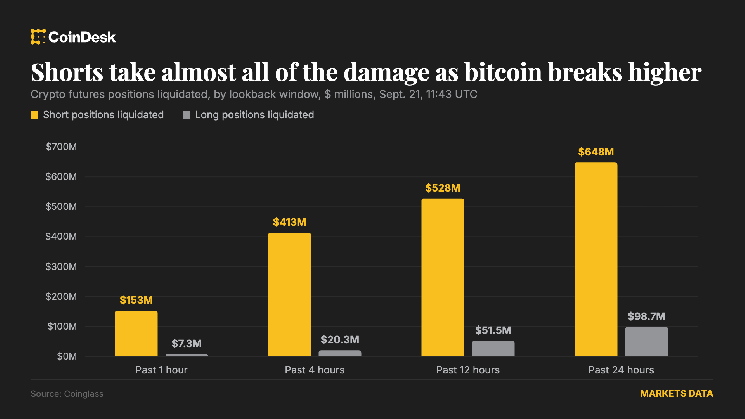
    • Bitcoin surged 5.4% to $84,984, breaking decisively above the September range high of $82,284 set on Sept. 4.
    • The rally was fueled primarily by a massive short squeeze, with $746 million in positions liquidated over 24 hours—$647.9 million of them shorts.
    • Open interest rose 7.59% to $156 billion and volume jumped 39% to $224 billion, indicating traders are re-establishing positions rather than exiting the market.

    Bitcoin Breaks September Resistance on Heavy Short Liquidations

    Bitcoin BTC extended its breakout above the top of its September trading range on Monday, changing hands at $84,984 during the late European morning session. The move represents a 5.4% gain over the prior 24 hours and leaves the asset well clear of the $82,284 high recorded on Sept. 4, which had previously capped upside attempts throughout the month.

    Forced Buying Drives Momentum Rather Than Fresh Conviction

    According to market analysts and data from Coinglass, the rally is being propelled predominantly by forced buying stemming from a cascading short squeeze rather than an influx of new long-side conviction. Over the past 24 hours, $746 million in total positions were liquidated, of which $647.9 million were short positions. In the most recent hour alone, an additional $159.9 million in positions were wiped out, with 95% of those liquidations on the short side.

    Bitcoin shorts accounted for $277.5 million of the 24-hour liquidation total, while Ether (ETH) shorts contributed $122.8 million. The disproportionate short-side washout underscores a market that was heavily positioned for downside or range-bound price action, leaving bears vulnerable to a sharp upside repricing.

    Open Interest and Volume Signal Position Replenishment

    Despite the massive short covering, open interest across the market has risen 7.59% to $156 billion, and 24-hour trading volume has surged 39% to $224 billion. This combination—rising open interest alongside heavy liquidations—suggests that traders are actively replacing the positions being closed out rather than stepping back from the market. The data points to a structural repositioning, with new participants or existing players re-entering on the long side as the breakout confirms.

    Why This Matters

    The break above the September range high marks a technically significant development for Bitcoin, which had been consolidating in a relatively tight band for weeks. The fact that the move was catalyzed by a short squeeze rather than organic spot buying introduces a degree of fragility: if the forced buying exhausts itself without follow-through from spot accumulators, a pullback toward the former resistance—now potential support—around $82,000 could materialize. However, the concurrent expansion in open interest and volume suggests the market is not merely covering shorts but rebuilding directional exposure. Traders will be watching closely for sustained spot bid interest, funding rate normalization, and whether the $85,000 level can flip to support in the coming sessions. The next key technical hurdle lies near the late-July highs around $87,500–$88,000.

    Frequently Asked Questions

    What triggered Bitcoin’s break above the September range?

    The breakout was driven primarily by a massive short squeeze, with $746 million in positions liquidated over 24 hours—$647.9 million of them shorts—forcing bearish traders to buy back positions and accelerating upside momentum.

    Does rising open interest during a short squeeze signal bullish continuation?

    Yes. The 7.59% increase in open interest to $156 billion, combined with a 39% volume surge to $224 billion, indicates traders are replacing liquidated shorts with new long positions rather than exiting the market, suggesting conviction behind the move.

    What are the key levels to watch after this breakout?

    Immediate support now sits at the former September high of $82,284. Upside targets include the late-July highs near $87,500–$88,000. Sustained spot buying and funding rate normalization will be critical for follow-through.

  • Bitcoin and Altcoin Rally Extends: BTC Hits Eight-Month High Amid Liquidations Update

    Bitcoin and Altcoin Rally Extends: BTC Hits Eight-Month High Amid Liquidations Update

    Key Highlights

    • Bitcoin surged 2.5% in one hour to breach $85,000 for the first time since January 30, posting a 9.1% weekly gain and nearing a 30% monthly increase.
    • Ethereum rallied 6% to surpass $2,730, while top altcoin gainers included Sui (22.3%), Venice Token (22%), and Sei (20%) over the last 24 hours.
    • A short-squeeze liquidated approximately $400 million in leveraged positions within hours, contributing to a 24-hour total of $750 million across 136,931 traders.

    Bitcoin Breaks $85,000 as Broad Crypto Rally Accelerates

    Bitcoin extended its recovery on Tuesday, climbing above the psychologically significant $85,000 threshold for the first time since January 30. The flagship cryptocurrency added 2.5% in a single hour, lifting its seven-day advance to 9.1% and its 30-day gain to nearly 30%. The move comes despite lingering macroeconomic headwinds, including last week’s negative developments surrounding the Clarity Act and Federal Reserve policy signals, suggesting that internal market dynamics are currently outweighing external regulatory and monetary concerns.

    Oil Decline Correlates with Risk-On Sentiment

    Market analysts noted that the cryptocurrency rally coincides with a four-day slide in international oil prices. The drop in energy costs has historically eased inflation expectations, fostering a more favorable environment for risk-on assets such as equities and digital currencies. This correlation appears to be fueling renewed buying pressure across the board, with Bitcoin acting as the primary catalyst for broader market participation.

    Altcoins Outperform as Ethereum Reclaims $2,700

    Ethereum led the major altcoin charge, surging 6% over the past 24 hours to trade above $2,730—its first visit above the $2,700 level since the end of January. Other layer-one protocols posted strong gains, with XRP advancing 6.6%, Solana climbing 7%, and HyperLiquid (HYPE) rising approximately 4%. The breadth of the rally indicates improving sentiment across multiple blockchain ecosystems rather than a Bitcoin-only phenomenon.

    Mid-Cap Tokens Lead Percentage Gainers

    According to CoinMarketCap data, the most explosive moves occurred in the mid-cap segment. The platform reported the following 24-hour leaders: “Sui (SUI – 22.3%), Venice Token (VVV – 22%), Sei (SEI – 20%), Near Protocol (NEAR – 19.9%), Render (RENDER – 17.9%) and Avalanche (AVAX – 13.9%)”. These outsized returns highlight speculative appetite returning to higher-beta assets, often a hallmark of early-stage bull market rotations.

    Short Liquidations Fuel Price Discovery

    The rapid ascent triggered a massive unwinding of bearish leverage. Approximately $400 million worth of leveraged trades were liquidated in the space of a few hours, with the vast majority representing short positions. Over the full 24-hour window, total liquidations reached $750 million, affecting 136,931 individual accounts. The single largest liquidation occurred on Binance’s BTC/USDT perpetual contract, valued at $11.29 million, underscoring the intensity of the short squeeze on the dominant trading venue.

    Why This Matters

    The simultaneous breakout in Bitcoin and Ethereum, combined with aggressive short covering and broad altcoin participation, suggests a potential regime shift from consolidation to trend expansion. The $85,000 level for Bitcoin has acted as stiff resistance since January; a sustained close above it could invite fresh institutional and retail inflows. Meanwhile, the scale of short liquidations—$750 million in 24 hours—indicates that a significant portion of the market was positioned for further downside, creating structural fuel for continued upside if momentum persists. Traders will now watch for follow-through volume and whether the Clarity Act and Fed narratives reassert influence in the coming sessions.

    Frequently Asked Questions

    What triggered the latest Bitcoin surge above $85,000?
    The rally appears driven by a combination of falling oil prices improving risk sentiment, a sharp short squeeze liquidating $400 million in bearish bets within hours, and broad-based buying across major and mid-cap altcoins.
    Which altcoins posted the largest 24-hour gains?
    Per CoinMarketCap, the top performers were Sui (SUI) at 22.3%, Venice Token (VVV) at 22%, Sei (SEI) at 20%, Near Protocol (NEAR) at 19.9%, Render (RENDER) at 17.9%, and Avalanche (AVAX) at 13.9%.
    How significant were the liquidations?
    Total liquidations reached $750 million over 24 hours, impacting 136,931 traders. The largest single liquidation was an $11.29 million BTC/USDT position on Binance, highlighting the force of the short-covering rally.

    *This is not investment advice.

  • NEAR Intents Launches Unified Liquidity Solution for DeFi

    NEAR Intents Launches Unified Liquidity Solution for DeFi

    Key Highlights

    • NEAR Protocol launches NEAR Intents to create a unified liquidity layer for cross-chain DeFi operations.
    • ZCash users gain access to Cash App and PayPal transactions through NEAR Intents integration.
    • Traders monitor NEAR’s ecosystem growth as cross-chain volume rises across the cryptocurrency market.

    NEAR Protocol Unveils NEAR Intents to Unify Cross-Chain Liquidity

    NEAR Protocol has officially introduced NEAR Intents, a new architectural concept designed to function as a unified liquidity layer across blockchain networks. The announcement, published via the official NEAR Protocol Twitter account, signals a strategic push to streamline decentralized finance (DeFi) interactions by reducing fragmentation between previously isolated ecosystems. As cross-chain transaction volumes climb industry-wide, the initiative positions NEAR as a foundational infrastructure provider for next-generation liquidity routing.

    ZCash Integration Expands Real-World Payment Utility

    A practical demonstration of the technology’s reach is already live: ZCash users can now transact through mainstream financial applications including Cash App and PayPal, enabled by NEAR Intents integration. This development bridges privacy-focused cryptocurrency holdings with widely adopted consumer payment rails, broadening the scope of DeFi usability beyond native crypto interfaces. The integration underscores NEAR Protocol’s long-standing focus on facilitating seamless transactions and interoperability between disparate blockchain networks.

    Market Context: Mixed Signals Amid Growing Cross-Chain Momentum

    The broader cryptocurrency market is currently displaying mixed momentum across altcoins, yet cross-chain activity continues to accelerate. NEAR Intents arrives at a pivotal moment when liquidity solutions are becoming a critical component of the DeFi stack. Regulatory clarity around decentralized finance remains an evolving landscape that influences how projects like NEAR Protocol develop technologies and expand market reach. By targeting the interoperability layer directly, NEAR aims to capture value from the increasing demand for frictionless asset movement across chains.

    Why This Matters

    Unified liquidity layers represent a structural shift in DeFi architecture, moving away from fragmented, chain-specific liquidity pools toward aggregated, intent-based settlement. NEAR Intents could reduce slippage, lower transaction costs, and simplify user experience by abstracting away the complexity of bridging and routing. For developers, the framework may lower barriers to building cross-chain applications. For users, it brings crypto closer to the seamless payment experiences found in traditional finance. The ZCash-to-Cash App/PayPal pathway illustrates how such infrastructure can unlock real-world utility for privacy coins and other niche assets.

    Frequently Asked Questions

    What is NEAR Intents?

    NEAR Intents is a concept introduced by NEAR Protocol to create a unified liquidity layer that enables cross-chain transactions and DeFi interactions across multiple blockchain networks.

    How does the ZCash integration work with Cash App and PayPal?

    Through NEAR Intents integration, ZCash users can now transact via popular platforms like Cash App and PayPal, bridging privacy-focused cryptocurrency with mainstream payment applications.

    Why are traders watching NEAR Protocol’s developments closely?

    Traders are monitoring the impact of NEAR Intents on cross-chain liquidity, as successful implementation could drive increased engagement and liquidity within NEAR’s ecosystem amid rising cross-chain volumes.

  • Crypto Rallies on Bullish Bounce After Fed Rate Hike: Weekly Outlook

    Crypto Rallies on Bullish Bounce After Fed Rate Hike: Weekly Outlook

    Key Highlights

    • Bitcoin holds near $84,000, demonstrating resilience despite the Federal Reserve’s benchmark rate holding at 4.00% following last week’s hawkish stance.
    • The SEC’s conditional five-year exemption window for tokenized securities pilot trading opens September 22, allowing select institutional venues to trade tokenized stocks on public blockchains.
    • Major governance votes are underway across Lido DAO, Uniswap, and CoW DAO, addressing liquidity provisions, protocol fee extensions, and solver competition redesigns.

    Bitcoin Resilience Amid Macro Uncertainty

    Cryptocurrency markets opened the week on a firm footing, with bitcoin BTC trading at $83,915.85 and testing the psychologically significant $84,000 threshold. The digital asset’s stability comes as investors digest the Federal Reserve’s latest policy posture, which maintained the benchmark target rate at 4.00% after last week’s hawkish signaling. While traditional risk assets often react negatively to restrictive monetary policy, bitcoin’s current price action suggests a decoupling from immediate rate-sensitive impulses, at least in the near term.

    The macroeconomic calendar this week centers on a cluster of high-impact U.S. data releases that could recalibrate rate-cut expectations. Initial jobless claims for the period ending September 19 are estimated at 201,000, up from the previous 196,000, while new home sales for August are forecast to decline to 700,000 from 739,000. Durable goods orders are expected to contract 0.3% month-over-month in August after a 1.1% gain previously, and the final University of Michigan Consumer Sentiment Index for September is seen at 47.8, down sharply from 51.7. Canadian retail sales for August are also due, estimated at -0.8% versus a prior 0.6% gain. Cross-asset markets continue to process the divergent policy paths emerging from the Bank of Japan and the Bank of England, adding another layer of complexity to the global liquidity backdrop.

    SEC Tokenized Securities Pilot Framework Goes Live

    A pivotal regulatory milestone arrives on September 22, when the U.S. Securities and Exchange Commission’s conditional five-year exemption window officially opens. This framework permits select institutional venues to commence pilot trading of tokenized stocks directly on public blockchains. The initiative represents the most concrete step yet by U.S. regulators to bridge traditional securities infrastructure with distributed ledger technology, potentially unlocking new paradigms for settlement efficiency, fractional ownership, and market accessibility. Market participants will be closely monitoring which venues receive approval and the volume dynamics during the pilot’s early phase.

    Governance Activity Intensifies Across Major DAOs

    Decentralized autonomous organizations are driving a busy week of on-chain governance. Lido DAO is voting on a proposal to authorize a contingent LDO centralized-exchange liquidity market-making mandate, budgeting up to $1.5 million in recallable LDO and 480,000 USDC to maintain orderbook depth and mitigate potential exchange delisting risks. Voting concludes September 21. Uniswap Governance is conducting a temperature check on extending its protocol fee collection and UNI burn infrastructure to Arc, a Layer 1 network built by Circle, with voting ending September 23. Meanwhile, CoW DAO is voting on a redesign of its solver quote competition, allocating a dedicated quote reward budget equal to 10% of protocol revenue to enhance price routing and order conversion; this vote wraps up September 25.

    Token Unlock Schedule Presents Supply Dynamics

    Several notable token unlocks are scheduled this week, introducing incremental supply into circulating markets. Canton (CC) unlocks 0.38% of its circulating supply, valued at approximately $17.17 million, on September 21. Toncoin (TON) follows on September 22 with a 1.3% unlock worth $51.2 million. Humanity (H) releases 14.7% of its circulating supply, valued at $20.8 million, on September 23. No major token launches are confirmed for the period, and the conference calendar remains clear.

    Why This Matters

    The convergence of bitcoin’s price resilience, the SEC’s tokenized securities pilot launch, and heightened DAO governance activity signals a maturing market structure where regulatory engagement, institutional infrastructure, and decentralized coordination are advancing simultaneously. The SEC pilot, in particular, could establish precedent for how traditional assets are issued, traded, and settled on-chain, potentially attracting broader institutional participation. Meanwhile, the governance votes at Lido, Uniswap, and CoW reflect the growing operational sophistication of major protocols as they address liquidity sustainability, cross-chain fee architectures, and execution quality—issues critical to long-term protocol viability. Traders should monitor this week’s macro data for signals on the Fed’s next move, as any shift in rate expectations could rapidly reassert correlation between digital assets and traditional risk markets.

    Frequently Asked Questions

    What is the SEC’s tokenized securities pilot framework?

    The SEC’s conditional five-year exemption window, opening September 22, allows select institutional venues to conduct pilot trading of tokenized stocks directly on public blockchains. This regulatory sandbox aims to test distributed ledger technology for securities settlement and trading under supervised conditions.

    Why are the Lido, Uniswap, and CoW DAO votes significant?

    These governance proposals address critical operational priorities: Lido seeks to secure exchange liquidity for LDO to prevent delistings; Uniswap explores extending its fee and burn mechanism to Circle’s Arc network; CoW Protocol aims to improve solver competition and order routing through a dedicated reward budget. Outcomes will shape protocol economics and cross-chain strategies.

    Which macroeconomic data points should crypto traders watch this week?

    Key releases include U.S. initial jobless claims (Sept. 24, 8:30 a.m. ET), new home sales (Sept. 24, 10:00 a.m. ET), durable goods orders (Sept. 25, 8:30 a.m. ET), and the final Michigan Consumer Sentiment Index (Sept. 25, 10:00 a.m. ET). These indicators will influence Federal Reserve policy expectations and broader risk sentiment.