Category: Coins

Digital assets, cryptocurrencies, blockchain, and currency news.

  • 0G Launches Liquid Staking Gateway for AI Compute Credits

    0G Launches Liquid Staking Gateway for AI Compute Credits

    Key Highlights

    • 0G launches Ascend liquid staking product enabling users to stake 0G tokens and receive a0G for DeFi use while accessing AI compute credits through a five-step Compute Finance (ComFi) system.
    • Infinite AI (iAI) product scheduled for September 29 will connect liquid staking positions to compute credits valued at over $1 per day for eligible staked iAI, usable exclusively within the 0G ecosystem including Private Computer and 0G App.
    • US access to Ascend, iAI, and staking functions remains contingent on final product terms and eligibility rules, with compute credits explicitly designated as non-cash service credits without guaranteed financial returns.

    0G Unveils Ascend Liquid Staking as Gateway to Compute Finance Ecosystem

    0G has launched Ascend, a liquid staking product that serves as the inaugural entry point for Compute Finance—branded as ComFi—a system engineered to bridge digital assets with usable AI computing resources. Announced in a September 21 press release shared with crypto.news, the product allows eligible users to stake the network’s native 0G token and receive a0G, a liquid staking derivative that remains deployable across compatible decentralized finance applications while the underlying 0G stays staked.

    The architecture introduces a five-step conversion pipeline: stake 0G, receive a0G, mint iAI, stake iAI, and collect compute credits. These credits are designed for expenditure on supported AI products within the 0G ecosystem rather than redemption as cash or standard token rewards. At launch, a0G functions as the sole asset accepted for minting iAI, positioning Ascend as the mandatory starting point for the ComFi system. Minting iAI locks the underlying collateral, while burning the asset provides a mechanism for unlocking it, subject to final product terms.

    Infinite AI and the Compute Credit Economy

    A second product, Infinite AI, is scheduled to launch on September 29. Its iAI asset will connect the liquid staking position to compute credits accepted by selected services in the 0G ecosystem. Under initial parameters disclosed by the company, eligible staked iAI is designed to generate compute credits carrying a stated usage value of more than $1 per day. However, actual credit amounts, eligibility rules, availability, and permitted uses will depend on terms and policies applied to the products, which the company notes may change.

    0G identified Private Computer as one supported service—a platform designed to provide private and verifiable AI access expected to offer more than 130 models at launch. The credits will also be usable within the 0G App, a development platform where users can interact with AI models and build or launch applications. The company did not disclose how many credits each task will require or whether prices will vary between models and services. Infinite AI is also expected to become available through Comfy.fun, 0G’s launchpad for agents and tokens, with access dependent on terms applied at launch.

    Compute Finance as a New Asset-Value Paradigm

    Michael Heinrich, co-founder and CEO of 0G, framed ComFi as a financial layer for AI compute that treats access to computing resources as the output generated by a digital asset position. Drawing historical parallels, Heinrich stated:

    “Equity introduced dividends, proof of work introduced new ways to reward participation, and DeFi expanded what people could do with digital assets,” Heinrich said.

    “Compute Finance explores a different model by connecting digital assets with access to AI compute.”

    He added that Ascend and Infinite AI represent the company’s first implementations of this concept. The structure combines several functions normally offered separately: liquid staking through a0G, collateral-backed minting through iAI, and service access through compute credits. Each stage depends on the previous one, while the underlying collateral remains subject to the minting and burning process described by 0G.

    Liquidity, DeFi Integration, and Risk Considerations

    Ascend provides the liquidity component by issuing a0G against deposited 0G. Liquid staking tokens generally let holders use a representation of their staked assets in DeFi instead of waiting for the original tokens to become available. For Ascend users, a0G can remain active in compatible DeFi applications and also serve as the input for minting iAI, meaning the same position can support network staking and entry into the compute-credit system simultaneously.

    Use across DeFi can introduce risks that differ from standard native staking, depending on the protocols, smart contracts, and liquidity pools selected by a holder. 0G’s announcement focused on the product flow and did not state which external DeFi platforms will initially support a0G. The company also framed ComFi as an open category for AI projects rather than a term reserved for 0G products, describing a broader thesis in which participants can own claims on compute and earn, spend, or trade access to computing resources.

    Regulatory Context and US Access Constraints

    For users in the United States, access to Ascend, iAI, and related staking functions will depend on eligibility rules released with the final documentation. The announcement states that credit availability, supported uses, and minting conditions will be governed by applicable terms and policies. 0G has not assigned the compute credits a cash value that users can redeem, describing them as units intended only for eligible AI services that do not provide guaranteed financial returns.

    The treatment of a0G and iAI for US regulatory or tax purposes will depend on their final functions, distribution terms, and availability. The announcement does not name a US regulator, exemption, or registration connected with either product. Additional documentation is expected to specify minting requirements, eligible iAI positions, supported services, and the rules for burning iAI to release locked collateral when Infinite AI launches on September 29.

    Why This Matters

    0G’s ComFi model arrives amid growing convergence between blockchain infrastructure and artificial intelligence. In September, crypto.news covered blockchain verification for AI-driven financial tools, where RoboTech Frontier Hub founder Denis Saklakov noted that blockchains can record system states, decision conditions, and execution histories without running the AI itself on-chain. 0G’s approach differs by using blockchain infrastructure to connect staking positions directly to access rights for AI products. The company operates an AI-focused EVM-compatible layer-1 network alongside encrypted storage, private computing tools, and model-verification systems, positioning its ComFi system as a novel primitive for monetizing compute access through tokenized staking positions rather than traditional cloud billing models.

    Frequently Asked Questions

    What is the five-step process to earn compute credits through 0G’s ComFi system?
    The process consists of: (1) stake 0G tokens through Ascend, (2) receive a0G liquid staking tokens, (3) deposit a0G to mint iAI, (4) stake eligible iAI, and (5) collect compute credits for use on supported AI services within the 0G ecosystem.
    Can compute credits be converted to cash or traded as financial assets?
    No. 0G explicitly states that compute credits do not represent cash, cash equivalents, or guaranteed financial returns. They are units intended only for eligible AI services within the 0G ecosystem, separating their stated usage value from redeemable monetary payment.
    When does Infinite AI launch and what determines US user eligibility?
    Infinite AI is scheduled for September 29. US access to Ascend, iAI, and related staking functions will depend on eligibility rules released with final product documentation, governed by applicable terms and policies. The company has not named a specific US regulator or registration connected with either product.
  • Bitcoin Could Test $90,000 After Short Squeeze, but Traders Warn Leverage Is Building

    Bitcoin Could Test $90,000 After Short Squeeze, but Traders Warn Leverage Is Building

    Key Highlights

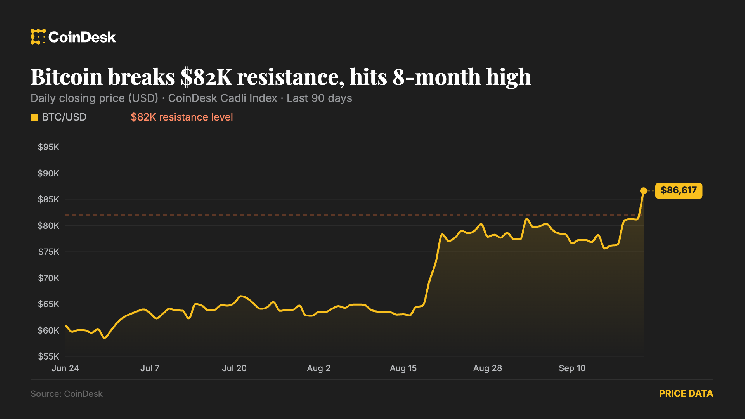
    • Bitcoin surged to an eight-month high of $86,000 on Monday, clearing the $82,000 resistance level that had capped prices since August and triggering roughly $750 million in bearish derivative liquidations.
    • Futures open interest rose faster than price, with approximately $2 billion in new leveraged exposure added since the breakout, signaling aggressive fresh positioning even as short sellers were wiped out.
    • While renewed spot ETF demand and short covering drove the rally, crypto-native investor positioning has been slower to flip from bearish to bullish, according to Nansen analytics.

    Bitcoin Breaks Key Resistance at $82,000

    Bitcoin pushed to a fresh eight-month high of $86,000 on Monday, extending a rally that forced bearish traders out of their short positions and drew fresh leverage bets back into the market. The move cleared the $82,000 level that had acted as a ceiling for prices since August, unleashing a cascade of liquidations across crypto derivative markets.

    Short Liquidations Fuel Momentum

    Roughly $750 million in bearish crypto derivative positions were liquidated as bitcoin cleared $82,000, according to CoinGlass data. When short positions are liquidated, exchanges execute buy orders to close them, adding fuel to an already upward market. “Bitcoin up 5% this morning due to short perpetual futures contracts being liquidated,” Schwab’s head of crypto research Jim Ferraioli told CoinDesk.

    Leveraged Bets Return Aggressively

    Meanwhile, futures open interest — the value of outstanding derivatives bets — rose even faster than bitcoin’s price. Since the breakout, about $2 billion in new leveraged exposure has been added, according to Coinalyze data, suggesting traders are placing fresh bets even as shorts got wiped out. The rapid rebuild in open interest indicates strong conviction among market participants that the breakout has legs.

    ETF Demand vs. Crypto-Native Caution

    While the rally has been fueled by a mix of renewed ETF demand and short covering, crypto-native positioning has been slower to shift from bearish to bullish, according to crypto analytics firm Nansen’s senior research analyst, Nicolai Sondergaard. This divergence suggests that while institutional flows via exchange-traded products are driving near-term price action, the core crypto trading community remains cautious about the sustainability of the move.

    Why This Matters

    The $82,000 level had served as a critical technical barrier since August, and its decisive breach marks the first time bitcoin has traded above this threshold in eight months. The combination of massive short liquidations and a rapid $2 billion rebuild in open interest creates a feedback loop that can sustain upward momentum in the near term. However, the reluctance of crypto-native traders to fully embrace the rally introduces a potential vulnerability: if ETF flows slow or macro conditions shift, the market may lack the deep conviction needed to hold gains. Market participants will be watching whether open interest continues to expand alongside price — a sign of healthy trend development — or if the current leverage buildup sets the stage for a volatile unwind.

    Frequently Asked Questions

    What triggered Bitcoin’s surge to $86,000?

    The rally was driven by a combination of renewed spot Bitcoin ETF demand and a massive short squeeze. As Bitcoin cleared the $82,000 resistance level — a ceiling since August — roughly $750 million in bearish derivative positions were liquidated, forcing exchanges to execute buy orders that accelerated the move higher.

    How much new leverage has entered the market since the breakout?

    According to Coinalyze data, approximately $2 billion in new leveraged exposure has been added to futures open interest since Bitcoin broke above $82,000, with open interest rising faster than price itself.

    Are crypto-native traders bullish on this move?

    Not yet. Nansen senior research analyst Nicolai Sondergaard notes that crypto-native positioning has been slower to shift from bearish to bullish, suggesting the core trading community remains cautious despite the price breakout and ETF-driven inflows.

  • Russia’s Largest Stock Exchange Makes Surprise Decision to List Bitcoin and Four Altcoins; Trading Begins Tomorrow

    Russia’s Largest Stock Exchange Makes Surprise Decision to List Bitcoin and Four Altcoins; Trading Begins Tomorrow

    Key Highlights

    • Moscow Exchange will launch perpetual futures contracts for Bitcoin, Ethereum, Solana, XRP, and TRX starting September 22, 2026, accessible only to qualified investors.
    • The contracts—coded BTCUSDF, ETHUSDF, SOLUSDF, XRPUSDF, and TRXUSDF—are priced in U.S. dollars but settled financially in Russian rubles with no physical delivery of cryptocurrency.
    • These one-day automatically renewing futures expand Moscow Exchange’s existing crypto derivatives lineup, which previously covered only Bitcoin and Ethereum futures.

    Moscow Exchange Expands Crypto Derivatives Offering with Five New Perpetual Futures

    Moscow Exchange, Russia’s largest stock exchange operator, announced the upcoming launch of perpetual futures contracts tied to five major cryptocurrencies. According to the exchange’s official statement, trading in contracts tracking Bitcoin, Ethereum, Solana, XRP, and TRX indices will commence on September 22, 2026. The new instruments will be available exclusively to qualified investors, maintaining the exchange’s regulatory compliance framework for digital asset derivatives.

    Contract Structure and Settlement Mechanics

    The five new contracts carry the tickers BTCUSDF, ETHUSDF, SOLUSDF, XRPUSDF, and TRXUSDF. Each is based on a cryptocurrency index calculated independently by Moscow Exchange. The products are structured as one-day futures with a daily automatic renewal mechanism, allowing open positions to roll over seamlessly to the next trading session without requiring investors to manually re-enter contracts. This perpetual design eliminates expiration dates, a feature distinguishing them from traditional fixed-maturity futures.

    Pricing, Settlement, and No Physical Delivery

    While the contracts are quoted and priced in U.S. dollars, financial settlement will be executed in Russian rubles. Moscow Exchange explicitly stated that investors will not receive Bitcoin, Ethereum, Solana, XRP, or TRX as a result of these transactions. The cash-settled nature aligns with the exchange’s existing crypto futures framework, which previously introduced standard futures contracts for Bitcoin and Ethereum. The addition of Solana, XRP, and TRX perpetuals broadens the asset class coverage for institutional participants seeking regulated exposure to digital asset price movements.

    Why This Matters

    The launch represents a significant deepening of Moscow Exchange’s digital asset derivatives infrastructure. By introducing perpetual futures—widely used on global crypto-native platforms—into a regulated national exchange environment, the operator bridges traditional financial market architecture with cryptocurrency price discovery. The restriction to qualified investors underscores a cautious regulatory approach, while ruble-denominated settlement reflects the constraints and adaptations of Russia’s capital markets amid ongoing international sanctions. The September 2026 timeline gives market participants ample preparation period for onboarding, risk modeling, and compliance reviews. As the first perpetual crypto futures on a major Russian exchange, these contracts may set a precedent for further product expansion, potentially including options or additional altcoin indices, contingent on regulatory evolution and market demand.

    Frequently Asked Questions

    Who can trade the new Moscow Exchange perpetual crypto futures?

    Only qualified investors as defined under Russian securities regulations will have access to the BTCUSDF, ETHUSDF, SOLUSDF, XRPUSDF, and TRXUSDF contracts when they launch on September 22, 2026.

    Will investors receive actual cryptocurrency upon contract settlement?

    No. The contracts are cash-settled in Russian rubles. Moscow Exchange explicitly states that investors will not receive Bitcoin, Ethereum, Solana, XRP, or TRX as a result of these transactions.

    How do these perpetual futures differ from the exchange’s existing Bitcoin and Ethereum futures?

    The existing Bitcoin and Ethereum futures are standard fixed-maturity contracts. The new perpetual futures for all five assets—including the newly added Solana, XRP, and TRX—feature a one-day automatic renewal system with no expiration date, allowing positions to roll over daily without manual intervention.

  • Monero and Zcash Rally as MemeToro Introduces Public Smart Contract Rules for BNB Chain Memecoin Launches

    Monero and Zcash Rally as MemeToro Introduces Public Smart Contract Rules for BNB Chain Memecoin Launches

    Key Highlights

    • Monero (XMR) breaks a multi-month descending trendline, trading near $580 with a critical resistance level at $585.37 that could open a path toward a modeled $650 target.
    • Zcash (ZEC) surges over 200% in three months to hold above $1,500, fueled by Grayscale’s $900M+ ETF holdings, a planned 3-for-1 stock split, and the upcoming NU7 network upgrade.
    • MemeToro releases 1,373 lines of public Solidity code under an MIT license for a BNB Chain fair-launch memecoin platform, aiming to eliminate insider allocations, though the project remains pre-deployment and unaudited.

    Privacy Coins Reassert Market Strength Amid Technical Breakouts

    The privacy coin sector is commanding renewed market attention as both Monero and Zcash demonstrate robust technical structures and fundamental catalysts. Monero has decisively broken a descending trendline that had capped rallies since January, while Zcash has posted a staggering 200% gain over three months. These moves represent live-market rallies anchored by clear technical levels and network-level developments, distinguishing them from purely speculative narratives.

    Monero Targets $585 Resistance After Trendline Break

    Monero is currently trading close to $580 after slicing through a descending trendline that had acted as a ceiling since the start of the year. This breakout is a bullish technical development, signaling that buyers have overwhelmed sellers at a level where supply previously dominated. The immediate focus is the $585.37 resistance level; a daily close above this price would validate the broader breakout structure. Algorithmic models suggest a potential weekly target near $650.40 if this level holds, though such a move requires sustained demand and a constructive broader market backdrop. Momentum indicators remain neutral to bullish, indicating room for upside but offering no guarantees. As with all privacy assets, XMR remains sensitive to regulatory shifts, liquidity conditions, and sudden changes in market sentiment.

    Zcash Rally Powered by Institutional Demand and Protocol Upgrade

    Zcash has surged above $1,500, capping a powerful three-month ascent. Institutional interest has been a primary driver, with Grayscale’s Zcash ETF reportedly managing over $900 million in assets under management. A planned 3-for-1 stock split for the fund aims to enhance accessibility and liquidity for investors. On the protocol layer, the NU7 network upgrade, scheduled for November 5, is a major catalyst. The upgrade targets a reduction in block-generation times from 75 seconds to 25 seconds, a change designed to significantly improve the user experience for private payments. While ZEC eyes resistance near $1,700, the velocity of the rally introduces correction risk. Market participants are closely monitoring whether demand can be sustained after such a large, rapid move.

    MemeToro Unveils Public Smart Contract Framework for BNB Chain Launches

    Distinct from the established privacy assets, MemeToro represents an early-stage project focused on restructuring the memecoin launch process on BNB Chain. The project has published 1,373 lines of Solidity code across 17 files under an MIT license, including a FairLaunchEscrow contract, interfaces, tests, and documentation. The stated objective is to enforce transparent, immutable launch conditions from inception. Key proposed rules include fixed contributor and liquidity allocations, the elimination of developer-insider allocations in the fair-launch split, defined refund and liquidity pathways, and public functions for claims and finalization.

    For buyers, this framework promises improved transparency regarding tokenomics and fund flows. For creators, it offers a structured, rule-based launch alternative to the often opaque processes prevalent in the sector. However, the project is at a nascent stage: the code requires deployment, rigorous testing, liquidity execution, and independent security review. Public code availability is a meaningful transparency step, but it does not equate to a live, audited, or battle-tested platform.

    Illustrative $MT Token Economics Highlight Risk/Reward Profile

    MemeToro has provided illustrative scenarios for its native $MT token. A $1,000 purchase at a hypothetical price of $0.00430 would yield approximately 232,558 tokens before fees. If the token reaches a displayed launch target of $0.05186, the holding would carry a paper value near $12,060—a 12.06x multiple. At a theoretical $1 billion fully diluted valuation across the 1.2 billion token supply, the implied price would be near $0.8333, valuing the same allocation at roughly $193,798. The project explicitly states these are not guaranteed returns or investment advice. Realized outcomes depend on taxes, fees, slippage, liquidity depth, token supply mechanics, market demand, and successful product delivery. Prospective buyers are directed to the official MemeToro purchase guide for full details.

    Why This Matters

    The divergence between Monero, Zcash, and MemeToro underscores the widening spectrum of risk and maturity within the crypto asset class. Monero and Zcash are established Layer 1 networks with deep liquidity, proven cryptographic primitives, and live ecosystems; their current price action reflects technical analysis and institutional product dynamics. MemeToro, by contrast, is a pre-launch application-layer project attempting to solve the “fair launch” problem for memetic assets via transparent smart contract logic. While the privacy coins offer a “live price discovery story with visible support and resistance,” MemeToro’s value proposition is entirely contingent on future execution—specifically, whether AI-guided creation tools and public contract rules can attract a critical mass of creators and traders to BNB Chain. Investors and users must apply fundamentally different risk standards: one set for battle-tested monetary assets, another for unaudited, pre-revenue platform bets.

    Frequently Asked Questions

    What is the key breakout level for Monero (XMR)?

    Monero needs to hold above $585.37 to validate its breakout from the January descending trendline. A successful hold could open a path toward a modeled weekly target near $650.40, though this remains speculative and dependent on broader market conditions.

    Why is Zcash (ZEC) rising significantly?

    Zcash’s rally is supported by three primary catalysts: strong institutional demand evidenced by Grayscale’s Zcash ETF holdings exceeding $900 million; a planned 3-for-1 stock split for the fund to improve liquidity; and the upcoming NU7 network upgrade on November 5, which will reduce block times from 75 to 25 seconds.

    Does MemeToro’s public code eliminate the risks of memecoin launches?

    No. While the public smart contract rules aim to improve transparency—fixing allocations, removing insider splits, and defining refund paths—they cannot guarantee liquidity, market demand, smart contract security, or future token prices. The code is currently unaudited and the platform is not yet live.

  • Crypto Casinos Face Doxxing Risk After Curaçao Regulator Hacked

    Crypto Casinos Face Doxxing Risk After Curaçao Regulator Hacked

    Key Highlights

    • Curaçao Gaming Authority (CGA) confirmed a cyberattack on its online gaming portal on September 17, with investigation ongoing into the scope of data accessed
    • Crypto casino operators licensed by CGA — including major brands like Stake and 1xBet — face potential exposure of sensitive KYC documents, corporate records, and beneficial ownership details
    • Curaçao’s regulatory framework has historically relied on minimal due diligence, though new anti-money laundering legislation was introduced this year to address reputation concerns

    Regulator Confirms Breach, Scope Unclear

    The Curaçao Gaming Authority (CGA) disclosed on September 17 that hackers had gained unauthorized access to its online gaming portal, the central system used for license applications, renewals, and ongoing compliance filings. In a public statement, the regulator acknowledged the intrusion but stopped short of detailing what specific datasets were compromised. “While the unauthorized access has been contained, the investigation remains ongoing and has not yet established the full scope of the incident,” the CGA said. “The CGA is currently assessing whether and which information was accessed, as well as the potential consequences arising from such access,” the regulator added. The authority pledged to directly notify any affected individuals, applicants, licensees, or other stakeholders should the investigation confirm material impact.

    Industry Speculation Centers on Operator Data Exposure

    The announcement triggered immediate speculation across industry forums and social media, where participants highlighted the sensitive nature of data routinely submitted to the CGA. On X, user @smokeylisa posted: “CGA investigates unauthorized access to its online gaming portal” Well that’s not good…Are we about to see the KYC of UBOs leaked for various CGA licensed casinos? pic.twitter.com/Lq0PZcobm5 The concern centers on Know Your Customer (KYC) dossiers for Ultimate Beneficial Owners (UBOs), which typically include government-issued photo identification, proof of address, corporate structure documents, and source-of-funds declarations. If exfiltrated, such information could enable identity theft, targeted phishing, or extortion campaigns against operators and their principals.

    Curaçao’s Regulatory History Under Scrutiny

    Curaçao has long served as a primary licensing jurisdiction for crypto-native casinos, attracting operators such as Stake, 1xBet, and — until its license was apparently revoked this month — Rollbit. The island’s appeal has rested on a streamlined, low-friction licensing process that critics argue prioritized volume over rigorous vetting. While the CGA has historically conducted only minimal background checks on applicants, the jurisdiction moved this year to introduce new legislation mandating transparent anti-money laundering (AML) procedures and strengthened identity verification requirements. The breach now raises questions about whether those reforms included commensurate investments in cybersecurity infrastructure commensurate with the sensitivity of the data collected.

    Why This Matters

    The CGA hack underscores a systemic vulnerability in offshore gambling regulation: regulators themselves become high-value targets because they aggregate the most sensitive personal and corporate data of every licensee they oversee. For the crypto casino sector — already navigating banking restrictions, advertising bans, and evolving global compliance standards — a mass doxxing of beneficial owners would represent a catastrophic operational and reputational blow. The incident also tests Curaçao’s credibility as it attempts to shed its reputation as a lax jurisdiction. Stakeholders will be watching closely for the CGA’s forensic findings, the timeline and completeness of breach notifications, and whether the regulator’s post-breach response aligns with the stricter AML and data-protection standards its new legislation promises.

    Frequently Asked Questions

    What data might have been exposed in the CGA breach?

    The CGA has not confirmed the specific datasets accessed. However, the portal processes license applications and compliance filings that typically contain KYC documents for beneficial owners (passports, proof of address), corporate registration records, source-of-funds evidence, and ongoing transaction monitoring reports.

    Which crypto casinos are licensed by Curaçao?

    Major operators historically licensed by the CGA include Stake, 1xBet, and formerly Rollbit — whose Curaçao license appears to have been revoked in September 2026. Dozens of smaller crypto casinos also hold Curaçao sub-licenses or master licenses.

    What should affected operators do now?

    Operators should monitor official CGA communications for breach notifications, engage independent cybersecurity firms to assess their own exposure, and prepare incident response plans for potential doxxing or extortion attempts targeting their principals. They should also verify whether their submitted KYC packages contain reusable credentials that should be rotated.

  • XRP Lags Latest Crypto Rally: Will It Catch Up to Rivals’ Gains?

    XRP Lags Latest Crypto Rally: Will It Catch Up to Rivals’ Gains?

    Key Highlights

    • Large cryptocurrency whales have accumulated over $2 billion worth of XRP, driving an 8.22% price surge in three days according to analyst Ali Martinez.
    • On-chain URPD data indicates limited resistance up to $1.60, a level where approximately 2.5 billion XRP previously changed hands and may trigger profit-taking.
    • XRP currently trades near $1.49, up 6.33% in 24 hours and 5.08% over the past week, outperforming recent altcoin market trends.

    Whale Accumulation Sparks XRP Price Surge

    After lagging behind other altcoins during the recent broader market rally, XRP has reclaimed investor attention following aggressive accumulation by large-scale holders. According to crypto analyst Ali Martinez, whales have purchased more than $2 billion worth of XRP in recent sessions, a volume significant enough to shift market dynamics and catalyze a sharp price recovery. The buying pressure has translated into an 8.22% gain over just three trading days, signaling renewed conviction among high-net-worth participants in the token’s near-term trajectory.

    On-Chain Metrics Point to $1.60 as Critical Resistance

    Martinez’s analysis relies heavily on URPD (UTXO Realized Price Distribution) data, which maps the price levels at which the current circulating supply last moved on-chain. The metric reveals a relative absence of realized supply between current prices and $1.60, suggesting that few holders are sitting on break-even or loss positions in that range. This structural characteristic typically reduces selling pressure during upward moves, as there are fewer incentivized exit points for traders looking to recover costs.

    The $1.60 Supply Wall

    However, the same data identifies $1.60 as a zone of heavy historical activity. Approximately 2.5 billion XRP changed hands near this price level in the past, creating a dense cluster of realized cost basis. Martinez warns that as price approaches this region, a significant portion of those holders may look to liquidate positions at or near break-even, introducing substantial selling pressure. The analyst characterizes this as the next major resistance zone where profit-taking could stall or reverse the current uptrend.

    Current Market Position and Momentum

    As of the latest data, XRP is trading at approximately $1.49, representing a 6.33% increase over the past 24 hours and a 5.08% gain over the trailing seven days. The token’s ability to sustain momentum above the $1.45 level has kept the path toward $1.60 technically viable, though the on-chain supply distribution suggests the final approach to that level may encounter increasing friction. Volume profiles and order book depth will be critical indicators of whether whale demand can absorb the anticipated supply wall.

    Why This Matters

    The resurgence of whale activity in XRP highlights a broader pattern where large capital flows often precede sustained trend changes in mid-cap crypto assets. Unlike retail-driven pumps, accumulation of this magnitude—exceeding $2 billion—typically reflects strategic positioning ahead of anticipated catalysts, whether regulatory clarity, institutional adoption, or network-level developments on the XRP Ledger. The URPD framework used by Martinez offers a more granular view of holder psychology than traditional technical indicators, mapping actual economic pain points rather than arbitrary chart levels. For market participants, the $1.60 zone represents not just a price target but a behavioral test: whether new demand can overwhelm the latent supply from prior market cycles. A decisive break above this level could signal a shift in market structure, while rejection may consolidate XRP in a lower range until fresh catalysts emerge.

    Frequently Asked Questions

    What is driving the recent XRP price increase?

    The primary driver is accumulation by large holders (whales) who have purchased over $2 billion worth of XRP, according to analyst Ali Martinez. This concentrated buying pressure has pushed the price up 8.22% in three days.

    What does the URPD data suggest about XRP’s next resistance?

    URPD (UTXO Realized Price Distribution) data shows limited on-chain supply between current levels and $1.60, indicating minimal resistance. However, $1.60 itself is a major supply zone where ~2.5 billion XRP last transacted, making it a likely profit-taking target.

    Is XRP expected to continue rising past $1.60?

    Analyst Ali Martinez suggests there is room for gains up to $1.60 based on current on-chain structure, but warns that the dense cluster of realized supply at that level may trigger significant selling pressure, potentially stalling further upside without new demand catalysts.

  • Crypto Giants Resume Buying Bitcoin, Ethereum, and Solana, On-Chain Data Shows

    Crypto Giants Resume Buying Bitcoin, Ethereum, and Solana, On-Chain Data Shows

    Key Highlights

    • Strategy (formerly MicroStrategy) added 950 BTC to its treasury, raising total holdings to 846,000 BTC, while also repurchasing $174 million in STRC preferred shares.
    • Bitmine, the largest corporate Ethereum holder, acquired 27,562 ETH to reach 5.98 million ETH (4.9% of circulating supply), valuing its total crypto-asset portfolio at $17.1 billion.
    • Nasdaq-listed DeFi Development Corp. increased its Solana position by 101,381 SOL, bringing total holdings to 2.49 million SOL for staking and validator operations.

    Corporate Treasury Accumulation Accelerates Across Major Crypto Assets

    Bitcoin, Ethereum, and Solana have all registered significant price appreciation in recent sessions, coinciding with a renewed wave of institutional buying from publicly listed treasury companies. The coordinated accumulation signals growing conviction among corporate allocators that the digital asset bull cycle is entering a mature expansion phase, particularly as macroeconomic headwinds ease and tokenization narratives gain traction.

    Strategy Extends Bitcoin Lead With Fresh 950 BTC Purchase

    Strategy, the world’s largest publicly traded Bitcoin holder, resumed its acquisition program after a multi-week pause. According to a statement by Strategy founder Michael Saylor, the company purchased an additional 950 Bitcoin, lifting its aggregate treasury to 846,000 BTC. In parallel, Strategy repurchased STRC preferred shares valued at $174 million. Saylor noted that Strategy holds assets worth $6.09 billion, adding that the company’s dollar-denominated assets could cover current preferred stock dividends and interest payments for approximately 3.8 years.

    Bitmine Deepens Ethereum Dominance With 27,562 ETH Acquisition

    Bitmine, recognized as the world’s largest corporate holder of Ethereum, disclosed last week that it purchased an additional 27,562 ETH, bringing its total holdings to 5,983,940 ETH. According to the announcement, this represents 4.9% of the total circulating ETH supply. The official statement also noted that Bitmine’s total assets, including cryptocurrency, cash, marketable securities, and strategic investment assets, have reached $17.1 billion. This figure includes 5.98 million ETH, 212 Bitcoin, $714 million in cash and marketable securities, $180 million worth of Beast Industries shares, and $105 million worth of Aitco Holdings shares. Assuming an ETH price of $2,688, Bitmine’s ETH holdings are estimated to be worth approximately $16.1 billion.

    Bitmine Chairman Tom Lee Outlines Bull Market Thesis

    Bitmine Chairman Tom Lee stated, “We believe a crypto bull market is continuing, driven by several factors, including the shift from AI to crypto that began in late June, the strengthening of crypto fundamentals around both tokenization and AI, and finally, the end of the 4-year cycle. In our view, $ETH’s tremendous performance in Q3 2026 is seen as a harbinger of potentially even stronger growth in Q4 2026. Given that institutions kept their crypto investments low in early 2026, partly due to the superior performance of AI stocks in early 2026, we expect institutions to significantly increase their crypto investments in the final three months of 2026.”

    DeFi Development Corp. Expands Solana Infrastructure Bet

    Last week, Nasdaq-listed company DeFi Development Corp. announced it had purchased an additional 101,381 Solana tokens, bringing its total SOL holdings to 2.49 million. The company also added that it plans to use its SOL holdings for staking, validator operations, and on-chain financial infrastructure, depending on market conditions and risk management standards.

    Why This Matters

    The simultaneous accumulation across Bitcoin, Ethereum, and Solana by three distinct public companies illustrates a broadening institutional adoption curve that extends beyond single-asset exposure. Strategy’s continued Bitcoin stacking reinforces its role as a de facto Bitcoin proxy for equity investors, while Bitmine’s outsized Ethereum position — now approaching 5% of circulating supply — underscores growing confidence in ETH’s staking yield and tokenization utility. DeFi Development Corp.’s validator-focused Solana strategy highlights a shift toward active network participation rather than passive holding. Collectively, these moves suggest corporate treasurers are diversifying across the layer-one spectrum, positioning for a cycle where yield-bearing staking assets and programmable infrastructure tokens command premium valuations alongside Bitcoin’s store-of-value narrative.

    Frequently Asked Questions

    How much Bitcoin does Strategy now hold after its latest purchase?

    Strategy holds 846,000 BTC following the acquisition of an additional 950 Bitcoin.

    What percentage of Ethereum’s circulating supply does Bitmine control?

    Bitmine’s 5,983,940 ETH represents 4.9% of the total circulating ETH supply.

    What is DeFi Development Corp.’s stated purpose for its Solana holdings?

    The company plans to use its 2.49 million SOL for staking, validator operations, and on-chain financial infrastructure, subject to market conditions and risk management standards.

  • ECB Plans to Buy Tokenized Bonds with Its Own Funds

    ECB Plans to Buy Tokenized Bonds with Its Own Funds

    Key Highlights

    • The European Central Bank (ECB) plans to allocate a small portion of its reserves to tokenized securities, establishing direct exposure to blockchain-based financial markets.
    • Transactions will settle via Pontes, a new Eurosystem platform that connects the ECB’s payment infrastructure to blockchain networks using central bank money.
    • ECB Executive Board member Piero Cipollone emphasized that Pontes brings “the stability and trust of central bank money to the European tokenized finance ecosystem.”

    ECB Takes Strategic Step Into Tokenized Securities

    The European Central Bank has announced plans to invest a modest share of its foreign reserves in tokenized securities, marking a significant institutional endorsement of blockchain-based financial infrastructure. The initiative positions the ECB as an active participant rather than a mere observer in the evolving digital asset landscape, allowing it to gain firsthand operational experience with the technology’s potential for wholesale financial markets.

    Pontes Platform Bridges Central Bank Money and Blockchain Markets

    Central to the strategy is Pontes, a newly launched Eurosystem platform designed to settle wholesale transactions in central bank money. The platform functions as a bridge between the ECB’s existing payment system and blockchain-based financial markets, enabling the secure transfer of tokenized assets against central bank liabilities. This architecture addresses a critical gap in the current digital asset ecosystem: the ability to settle tokenized securities with the same finality and risk profile as traditional central bank money settlements.

    “Pontes brings the stability and trust of central bank money to the European tokenized finance ecosystem,” said Piero Cipollone, member of the ECB’s executive board. “It will give an important advantage to help it scale.”

    Initial Investment Focus on Euro-Denominated Government Securities

    The ECB’s initial foray will concentrate exclusively on euro-denominated securities issued by euro-area governments, regional authorities, agencies, and European supranational institutions. This conservative scope reflects the central bank’s mandate to maintain financial stability while exploring innovation. By limiting purchases to high-quality public sector issuers, the ECB minimizes credit risk while testing the end-to-end workflow of tokenized bond acquisition, settlement, and ongoing portfolio management.

    Testing Technology Across Full Investment Lifecycle

    Beyond the initial purchase, the ECB intends to evaluate the technology across the complete investment lifecycle. This includes assessing how tokenized bonds perform in secondary market trading, corporate actions processing, coupon payments, and redemption events—all settled through the Pontes infrastructure. The exercise serves as a practical stress test for the Eurosystem’s readiness to integrate distributed ledger technology into core central banking operations without compromising monetary policy implementation or financial stability.

    Why This Matters

    The ECB’s move signals a broader strategic shift among major central banks toward operational engagement with tokenization. While many monetary authorities have conducted proofs-of-concept or pilot projects, the decision to commit actual reserves—however small—represents a tangible step toward mainstreaming blockchain-based settlement for wholesale finance. The Pontes platform specifically addresses the “settlement finality” challenge that has hindered institutional adoption of tokenized assets, offering a model where central bank money anchors the transaction. As the European Union advances its Markets in Crypto-Assets (MiCA) regulation and explores a digital euro, the ECB’s hands-on experience with tokenized government securities will likely inform future policy frameworks for digital asset markets and central bank digital currency interoperability.

    Frequently Asked Questions

    What is the Pontes platform?

    Pontes is a new Eurosystem platform that enables wholesale transactions in tokenized securities to settle in central bank money. It connects the ECB’s traditional payment infrastructure with blockchain-based financial markets, providing settlement finality equivalent to existing central bank systems.

    What types of tokenized securities will the ECB purchase?

    The ECB’s initial investments will focus exclusively on euro-denominated securities issued by euro-area governments, regional authorities, agencies, and European supranational institutions.

    Why is the ECB investing in tokenized securities now?

    The ECB aims to test the technology as an active investor—from purchase through settlement to portfolio management—gaining operational insight into blockchain-based markets while supporting the scaling of the European tokenized finance ecosystem with the stability of central bank money.

  • Senate’s Clarity Act Repeal: Why Banks and Offshore Hubs Like Dubai Are Winners

    Senate’s Clarity Act Repeal: Why Banks and Offshore Hubs Like Dubai Are Winners

    Key Highlights

    • The failure to pass the Clarity Act leaves U.S. crypto regulation to be shaped by agencies rather than Congress, with the SEC and CFTC moving forward on separate rulemaking tracks.
    • The SEC issued a temporary conditional exemption allowing eligible venues to trade tokenized U.S. stocks via permissioned liquidity pools on public blockchains.
    • The UAE now hosts over 110 regulated virtual-asset businesses with roughly 20 more holding in-principle approvals, contrasting with U.S. regulatory uncertainty.

    Regulatory Vacuum Drives Agency Action After Clarity Act Stalls

    The immediate consequence of the legislative failure to pass the Clarity Act is that cryptocurrency regulation in the United States will continue to be crafted outside the halls of Congress. With the bill effectively stalled, federal agencies have stepped into the void, advancing their own frameworks at a rapid pace. The Securities and Exchange Commission moved swiftly following the vote, issuing a temporary conditional exemption that permits eligible trading venues to offer tokenized U.S. equities through permissioned liquidity pools operating on public blockchains. This move signals the SEC’s willingness to engage with tokenized assets under specific, controlled conditions while broader statutory authority remains unresolved.

    CFTC Advances Undisclosed Proposal to White House

    Hot on the heels of the SEC’s action, the Commodity Futures Trading Commission submitted a new crypto rule proposal to the White House for review. The agency has not disclosed the details of the submission, leaving the industry in the dark regarding which digital assets the proposal contemplates, what requirements exchanges would need to meet for licensing, what restrictions would apply, and how far the CFTC believes its jurisdictional authority extends. This opacity adds another layer of uncertainty for market participants awaiting a coherent federal framework.

    Industry Voices Highlight Legislative Void and Global Divergence

    The legislative impasse has drawn sharp commentary from industry observers. “Clarity Act is dead, at least for now,” Jesse Hamilton, CoinDesk’s deputy managing editor in charge of global policy and regulation, wrote in an analysis that explains what very few appear to know: what the Clarity Act actually is. The assessment underscows the knowledge gap surrounding the failed legislation even as its demise reshapes the regulatory landscape.

    The contrast with international jurisdictions is becoming a focal point for crypto businesses. “While the U.S. continues debating the Clarity Act, in the UAE we actually have clarity,” Irina Heaver, a Dubai-based crypto lawyer and founder of NeosLegal, said via Telegram. Heaver noted that more than 110 regulated virtual-asset businesses currently operate in the country, with about 20 more holding in-principle approvals, highlighting a fully operational regulatory regime that stands in stark relief to the fragmented U.S. approach.

    Why This Matters

    The death of the Clarity Act for this congressional session cements a reality where U.S. crypto policy is set through agency rulemaking, enforcement actions, and limited exemptions rather than comprehensive statute. This piecemeal approach creates compliance complexity for firms trying to navigate SEC securities law, CFTC derivatives oversight, and state-level money transmission rules simultaneously. Meanwhile, jurisdictions like the United Arab Emirates, the European Union under MiCA, and Singapore are offering defined licensing pathways, potentially accelerating a talent and capital migration that has been underway since 2022. The SEC’s tokenized stock exemption and the CFTC’s undisclosed White House submission represent the next immediate flashpoints; market participants will scrutinize both for clues on whether a dual-agency framework can provide the predictability that legislation failed to deliver.

    Frequently Asked Questions

    What is the current status of the Clarity Act?
    The Clarity Act is dead for now, according to CoinDesk’s Jesse Hamilton, meaning it will not advance in the current congressional session and no comprehensive statutory framework for crypto market structure has been enacted.
    What did the SEC’s temporary conditional exemption authorize?
    The SEC’s exemption allows eligible venues to trade tokenized U.S. stocks through permissioned liquidity pools on public blockchains, providing a narrow, controlled pathway for on-chain equity settlement.
    How does the U.S. regulatory environment compare to the UAE’s?
    The UAE operates a live, comprehensive virtual-asset licensing regime with over 110 regulated businesses and roughly 20 additional firms holding in-principle approvals, offering regulatory certainty that contrasts with the U.S. reliance on agency-by-agency rulemaking.
  • Markets Eye Federal Reserve: Goolsbee on Inflation, Bessent on Warsh

    Markets Eye Federal Reserve: Goolsbee on Inflation, Bessent on Warsh

    Key Highlights

    • Chicago Fed President Austan Goolsbee signaled openness to rate cuts if inflation meaningfully decelerates toward the 2% target, while emphasizing the need for decisive action against price pressures.
    • U.S. Treasury Secretary Scott Bessent expressed confidence in Fed Chairman Kevin Warsh and noted President Donald Trump shares that confidence, alongside an expansion of the Treasury’s bond repurchase program.
    • With U.S. PCE inflation at 3.7% as of July, Goolsbee stressed that reaching the 2% goal depends on easing supply constraints and distinguishing between supply-driven and demand-driven inflation components.

    Goolsbee Outlines Conditional Path for Rate Cuts Amid Inflation Fight

    Chicago Federal Reserve President Austan Goolsbee delivered a nuanced assessment of monetary policy during a meeting in London, stating that the central bank would not oppose interest rate reductions if inflation slows significantly toward its 2% target. His remarks come on the heels of the Fed’s 25 basis point rate increase last week—the first hike since 2023—with markets now pricing potential further increases in October or December. Goolsbee emphasized that the Federal Reserve must have the courage to respond forcefully to inflation when necessary, expressing optimism that the 2% goal remains achievable provided there are no signs of overheating demand.

    Disentangling Supply Shocks from Demand Pressures

    Central to Goolsbee’s analysis is the ongoing effort to parse how much of current inflation stems from supply disruptions versus demand strength. He pointed specifically to robust investment in artificial intelligence as a factor supporting demand, while noting that persistent supply shocks continue to exert upward pressure on prices. As of July, U.S. personal consumption expenditures (PCE) inflation stood at 3.7%, and Goolsbee underscored that returning to the 2% target hinges on the easing of supply-side constraints. Officials, he said, are still analyzing the relative contributions of supply and demand dynamics to the current inflation picture.

    Bessent Backs Warsh, Highlights Treasury Market Operations

    Following the Fed’s latest rate decision, U.S. Treasury Secretary Scott Bessent appeared on CNBC to convey a message of stability regarding Fed leadership. Bessent reiterated his confidence in Federal Reserve Chairman Kevin Warsh and added that President Donald Trump also maintains confidence in Warsh’s stewardship of monetary policy. The Treasury chief also addressed market liquidity conditions, disclosing that the department has increased the size of its bond repurchase program—a move aimed at supporting smooth functioning in the government securities market.

    Central Bank Independence Takes Center Stage

    Goolsbee waded into the institutional dimension of monetary policy, arguing that expectations for the Fed to lower federal government borrowing costs underscore the critical importance of central bank independence. He emphasized that the Federal Reserve must set monetary policy strictly in line with its inflation mandate, free from fiscal dominance considerations. The comments arrive at a moment when the interplay between U.S. monetary policy and Treasury market interventions is under intense scrutiny from investors and policymakers alike.

    Why This Matters

    The divergent but complementary signals from the Fed and Treasury reflect a delicate balancing act as policymakers navigate the final stretch of 2026. Goolsbee’s conditional dovishness—openness to cuts only if inflation data cooperates—signals that the Fed remains data-dependent despite the recent hike. Meanwhile, Bessent’s public backing of Chairman Warsh and the expansion of the Treasury’s buyback operation aim to anchor market confidence in both leadership continuity and plumbing liquidity. With PCE inflation still nearly double the target and AI-driven investment bolstering demand, the path to 2% remains contingent on supply-side normalization, making upcoming inflation prints and Fed communications pivotal for market pricing through year-end.

    Frequently Asked Questions

    What conditions would prompt the Fed to consider rate cuts according to Goolsbee?

    Goolsbee stated the Fed would not oppose rate cuts if inflation slows significantly toward the 2% target, provided there are no signs of overheating demand and supply pressures continue to ease.

    What is the current level of U.S. PCE inflation and the Fed’s target?

    As of July, U.S. PCE inflation was at 3.7%, while the Federal Reserve’s target remains 2%.

    What actions has the Treasury taken to support market liquidity?

    Treasury Secretary Scott Bessent announced an increase in the size of the Treasury’s bond repurchase program to address liquidity conditions in the government securities market.