Category: Coins

Digital assets, cryptocurrencies, blockchain, and currency news.

  • Binance Announces Support for Altcoin Network Upgrade

    Binance Announces Support for Altcoin Network Upgrade

    Key Highlights

    • Binance will suspend LUNA deposits and withdrawals on September 21, 2026, at approximately 5:00 PM UTC to support the Terra network upgrade at block height 22,942,000.
    • Spot trading and other market transactions for Terra-based tokens will remain fully operational during the upgrade window.
    • Binance will manage all technical requirements on behalf of users; deposits and withdrawals will resume automatically once the network is confirmed stable, with no separate announcement planned.

    Binance Prepares for Terra Network Upgrade with Temporary Transfer Pause

    Global cryptocurrency exchange Binance has confirmed its support for an upcoming network upgrade on the Terra (LUNA) blockchain, implementing a temporary suspension of deposit and withdrawal services to ensure the transition proceeds securely for its user base. The move aligns with standard industry practice for major blockchain protocol upgrades, where centralized exchanges pause on-chain transfers to mitigate risks such as transaction failures, chain splits, or replay attacks during the migration.

    Upgrade Timeline and Operational Impact

    According to the official announcement, deposit and withdrawal operations via the Terra network are scheduled to be halted on September 21, 2026, at approximately 5:00 PM UTC. The Terra network upgrade itself is expected to activate roughly one hour later, at block height 22,942,000, at approximately 6:00 PM UTC. This buffer allows Binance to finalize internal node updates and validate network stability before the protocol change takes effect.

    Critically, the suspension applies exclusively to on-chain deposit and withdrawal transactions. The exchange emphasized that spot trading and all other market operations for Terra-based tokens will continue without interruption. Users retain full ability to buy, sell, and trade LUNA and associated assets on Binance markets throughout the upgrade period.

    User Experience and Technical Management

    Binance has stated that it will execute all necessary technical procedures on behalf of its customers, including node software updates and any required consensus participation. No action is required from users during this process. The exchange’s infrastructure team will monitor the upgrade in real time, validating block production, finality, and network health before re-enabling transfer services.

    The announcement did not specify a fixed resumption time for deposits and withdrawals. Instead, Binance indicated that services will be restored once the Terra network is assessed to be operating stably and securely following the upgrade’s completion. Notably, the exchange confirmed it will not issue a separate announcement regarding the reopening of these operations. Users are advised to monitor their account interfaces directly for the restoration of transfer functionality and to anticipate potential delays as the network settles.

    Why This Matters

    Network upgrades are pivotal events for proof-of-stake blockchains like Terra, often introducing protocol improvements, security patches, or governance changes. For exchanges, supporting these upgrades is a core operational responsibility that balances user asset safety with service continuity. Binance’s decision to pause only on-chain transfers—while keeping markets live—reflects a mature risk management approach: it prevents users from sending funds into a potentially unstable chain state while preserving liquidity and price discovery. The absence of a follow-up resumption announcement places the onus on users to verify service status proactively, a common practice among major exchanges during non-contentious upgrades. As Terra continues to evolve its ecosystem, seamless exchange support remains critical for maintaining token accessibility and investor confidence.

    Frequently Asked Questions

    Will I be able to trade LUNA on Binance during the upgrade?

    Yes. Binance confirmed that spot trading and all other market transactions for Terra network tokens will remain fully operational throughout the upgrade window. Only deposit and withdrawal functions via the Terra blockchain are temporarily suspended.

    Do I need to take any action with my LUNA holdings on Binance?

    No. Binance will handle all technical requirements for the network upgrade on behalf of users. No manual steps—such as token swaps, wallet migrations, or consensus participation—are required from account holders.

    How will I know when deposits and withdrawals are available again?

    Binance stated it will not publish a separate announcement for the resumption of transfer services. Users should monitor the deposit and withdrawal pages within their Binance accounts directly; functionality will be restored automatically once the exchange confirms the Terra network is stable and secure post-upgrade.
  • Kalshi Faces ‘fake crypto volume’ Allegations as Critic Flags Identical $5,500 Trades

    Kalshi Faces ‘fake crypto volume’ Allegations as Critic Flags Identical $5,500 Trades

    Key Highlights

    • Analyst Beni alleges wash trading on Kalshi’s ether perpetual market, citing repetitive $5,500 trade sizes accounting for up to 58% of volume across four days as “undeniable proof” of manipulation.
    • The allegations center on a CFTC-filed rebate schedule allowing Self-Clearing Members to trade at net-zero fees via a 0.3-basis-point maker rebate offsetting a 0.3-basis-point taker fee.
    • Kalshi representative IcoBeast.eth initially dismissed concerns on X but later issued a detailed rebuttal as the discussion gained traction.

    Wash Trading Allegations Surface Around Kalshi Ether Perpetuals

    Market structure analyst Beni has leveled serious accusations of volume manipulation against Kalshi’s ether perpetual futures market, presenting data patterns he characterizes as conclusive evidence of wash trading. The core of the argument rests on the identification of highly unusual, repetitive trade sizes of exactly $5,500 that appeared across four distinct trading sessions. According to Beni’s analysis, these uniform transactions single-handedly constituted up to 58% of the platform’s total ether perpetual trading volume during those periods, a statistical anomaly he labeled undeniable proof of artificial volume inflation.

    Zero-Cost Trading Incentives Under Scrutiny

    The allegations draw a direct line between the observed trading patterns and Kalshi’s fee structure, specifically a rebate schedule filed with the Commodity Futures Trading Commission (CFTC). The schedule permits Self-Clearing Members to operate at a net-zero fee cost, balancing a 0.3-basis-point maker rebate against a 0.3-basis-point taker fee. In standard market mechanics, rebates serve as financial incentives—typically partial fee refunds or cash payments—designed to compensate high-volume market makers for providing liquidity. However, Beni argues that when the marginal cost of trading against oneself drops to zero, the economic barrier to self-dealing evaporates, creating a powerful incentive for participants to artificially inflate volume metrics without incurring transaction costs.

    Platform Response Evolves From Dismissal to Detailed Rebuttal

    The response from Kalshi, voiced through the pseudonymous account IcoBeast.eth on X, followed a two-stage trajectory. Initially, the platform brushed off the wash trading concerns, asserting that its existing fee structure alone should act as a sufficient deterrent against manipulative behavior. As the analytical thread gained viral momentum within the crypto trading community, the tone shifted. IcoBeast.eth subsequently published a comprehensive, point-by-point breakdown intended to refute the methodology and conclusions of the wash trading analysis, signaling the seriousness with which the platform now treats the reputational challenge.

    Why This Matters

    The controversy touches on a fundamental tension in the rapidly evolving crypto derivatives landscape: the reliability of volume as a metric for market health and the regulatory adequacy of rebate structures overseen by the CFTC. Kalshi operates as a designated contract market (DCM) under CFTC jurisdiction, placing it under a stricter regulatory umbrella than many offshore competitors. If allegations of systemic wash trading on a regulated U.S. venue are substantiated, it could prompt regulatory review of rebate programs that enable zero-cost self-trading. For market participants, the episode underscores the difficulty of distinguishing genuine organic liquidity from incentivized or fabricated volume, a distinction critical for risk management, price discovery, and institutional adoption of crypto derivatives.

    Frequently Asked Questions

    What specific pattern did Beni identify as evidence of wash trading?
    Beni identified repetitive trade sizes of exactly $5,500 that accounted for up to 58% of Kalshi’s ether perpetual volume across four separate days, calling this pattern undeniable proof of manipulation.
    How does Kalshi’s rebate structure allegedly enable wash trading?
    A CFTC-filed rebate schedule allows Self-Clearing Members to pay a net-zero fee via a 0.3-basis-point maker rebate offset by a 0.3-basis-point taker fee, which Beni argues removes the cost barrier to trading against oneself.
    How has Kalshi responded to the allegations?
    Kalshi representative IcoBeast.eth initially dismissed the concerns on X, citing the fee structure as a deterrent, but later issued a detailed rebuttal as the analysis gained widespread attention.
  • Binance ETH Withdrawals Hit Highest Level Since 2023, Analysts Report

    Binance ETH Withdrawals Hit Highest Level Since 2023, Analysts Report

    Key Highlights

    • Binance’s average monthly Ethereum withdrawal count has exceeded 90,000, reaching a three-year high and roughly doubling the pace seen at the start of the year.
    • CryptoQuant analyst Darkfost links the surge to investors moving $ETH to personal wallets, signaling a shift toward self-custody and potential long-term holding.
    • While exchange outflows suggest accumulation, Darkfost cautions that withdrawals alone do not definitively prove long-term holding intent.

    Binance Ethereum Withdrawals Hit Three-Year Peak Amid Accumulation Signals

    On-chain data from CryptoQuant reveals that Ethereum withdrawals from Binance have surged to their highest monthly average since 2023, with the exchange now processing more than 90,000 $ETH withdrawals per month on average. According to analyst Darkfost, this metric has approximately doubled compared to levels recorded at the beginning of the year, marking the most elevated accumulation activity in the last three years. The spike coincides with a broader trend of assets leaving centralized exchanges, a pattern often interpreted by market observers as a precursor to reduced sell-side pressure.

    Analyst Darkfost Highlights Shift Toward Self-Custody

    Darkfost stated that the large amount of $ETH being moved out of cryptocurrency exchanges is noteworthy in terms of investor behavior. The analyst noted that withdrawals from exchanges could be linked to the transfer of purchased Ethereum assets to personal wallets or other external addresses, suggesting a tendency towards longer-term holdings. The transfer of assets from exchanges to personal or external wallets may indicate that investors prefer to store those assets in addresses under their own control rather than holding them on exchanges for short-term trading.

    Custody Preferences Evolving But Intent Remains Nuanced

    Despite the compelling correlation between exchange outflows and accumulation narratives, Darkfost emphasizes a critical caveat: exchange exits alone do not definitively prove that investors intend to hold assets long-term. Funds withdrawn from Binance could be redirected to decentralized finance protocols, staking services, or over-the-counter desks rather than cold storage. This distinction matters for market structure analysis because the ultimate destination of the withdrawn $ETH determines whether selling pressure is genuinely removed or merely relocated.

    Why This Matters

    The sustained elevation of Ethereum withdrawals from Binance—the world’s largest cryptocurrency exchange by volume—serves as a real-time barometer of investor sentiment and custody preferences. Historically, prolonged periods of net exchange outflows have coincided with bullish market phases, as they reduce the immediately available supply for trading. However, the current macroeconomic backdrop, including evolving regulatory scrutiny of centralized platforms and the upcoming Ethereum network upgrades, adds layers of complexity. Market participants should monitor whether the 90,000-withdrawal monthly threshold holds in subsequent months, as a reversal could signal renewed trading appetite or profit-taking, while persistence would reinforce the accumulation thesis.

    Frequently Asked Questions

    Who is Darkfost and what is CryptoQuant?

    Darkfost is an analyst at CryptoQuant, a blockchain analytics firm that provides on-chain data and market insights for cryptocurrencies including Bitcoin and Ethereum.

    Does a high withdrawal count guarantee Ethereum’s price will rise?

    No. While large exchange outflows often correlate with accumulation and reduced sell-side supply, Darkfost explicitly notes that withdrawals alone do not definitively prove long-term holding intent. Price action depends on multiple factors including demand, macro conditions, and overall market sentiment.

    What does “self-custody” mean in this context?

    Self-custody refers to investors holding their Ethereum in personal wallets where they control the private keys, rather than leaving assets on a centralized exchange like Binance. This gives the holder full control but also full responsibility for security.

  • Analysts Say Binance ETH Withdrawals Hit Highest Level Since 2023, Flag Bullish Signal

    Analysts Say Binance ETH Withdrawals Hit Highest Level Since 2023, Flag Bullish Signal

    Key Highlights

    • Binance Ethereum withdrawals hit a three-year high, with monthly averages exceeding 90,000 transactions—roughly double the rate seen at the start of 2024.
    • CryptoQuant analyst Darkfost links the surge to investors moving ETH into self-custody wallets, signaling a shift toward longer-term holding strategies rather than active exchange trading.
    • While exchange outflows suggest growing preference for personal custody, Darkfost cautions that withdrawal data alone does not conclusively prove long-term investment intent.

    Binance Ethereum Withdrawals Surge to Highest Level Since 2021

    On-chain analytics firm CryptoQuant has flagged a notable acceleration in Ethereum withdrawals from Binance, the world’s largest cryptocurrency exchange by volume. According to analyst Darkfost, the platform’s average monthly ETH withdrawal count has climbed above 90,000, marking the most elevated sustained level since 2021. The current pace is approximately twice the monthly average recorded in the opening months of 2024, underscoring a pronounced shift in how market participants are managing their Ethereum holdings.

    Analyst Interprets Outflows as Signal of Accumulation Behavior

    Darkfost’s analysis of on-chain data frames the withdrawal spike as a noteworthy behavioral indicator. The analyst stated that the large volume of ETH leaving exchange wallets could be linked to the transfer of purchased assets to personal wallets or other external addresses, suggesting a tendency towards longer-term holdings. This pattern aligns with a broader market narrative in which investors increasingly favor self-custody solutions—such as hardware wallets or non-custodial software wallets—over leaving assets on centralized platforms for short-term speculative trading.

    Self-Custody Preference Grows Amid Custody Landscape Evolution

    The movement of assets from exchange-controlled addresses to user-controlled addresses may indicate that investors prefer to store those assets in addresses under their own control rather than holding them on exchanges for short-term trading. This trend coincides with heightened regulatory scrutiny of centralized custodians, high-profile exchange failures in recent years, and the maturation of user-friendly self-custody tooling. However, Darkfost emphasized that exchange exits alone do not definitively prove that investors intend to hold assets long-term; funds could be rotated to other venues, deployed in decentralized finance protocols, or staged for over-the-counter transactions.

    Why This Matters

    Sustained high withdrawal volumes from a dominant venue like Binance serve as a real-time barometer of investor sentiment and custody preferences. If the elevated outflow rate persists, it would suggest a structural reduction in the exchange-resident ETH supply, potentially tightening available liquidity for short-term traders and altering market dynamics during periods of volatility. Conversely, a reversion to lower withdrawal levels could signal renewed comfort with exchange-based custody or a shift back toward active trading strategies. Market observers will likely monitor the weekly and monthly withdrawal trends closely as a leading indicator for medium- and long-term Ethereum market behavior.

    Frequently Asked Questions

    What is driving the surge in Ethereum withdrawals from Binance?

    CryptoQuant analyst Darkfost attributes the increase to investors transferring ETH to personal or external wallets, indicating a preference for self-custody and longer-term holding over keeping assets on the exchange for active trading.

    Does a high withdrawal count guarantee bullish long-term price action for ETH?

    Not necessarily. While outflows suggest reduced exchange supply, Darkfost cautions that withdrawals alone do not definitively prove long-term holding intent; funds may move to other exchanges, DeFi protocols, or OTC desks.

    How does the current withdrawal rate compare to historical levels?

    The monthly average of ETH withdrawals on Binance has reached its highest point since 2021 and is roughly double the rate observed at the beginning of 2024.

  • Binance Announces Support for Terra Network, LUNA Price Surges 15%

    Binance Announces Support for Terra Network, LUNA Price Surges 15%

    Key Highlights

    • Binance, the world’s largest cryptocurrency exchange by trading volume, announced support for the upcoming Terra (LUNA) network upgrade on Monday.
    • LUNA token price surged following the announcement, extending its weekly gains to nearly 30% as market sentiment improved.
    • The exchange’s backing signals significant institutional confidence in the Terra ecosystem’s technical roadmap and long-term viability.

    Binance Commits Support for Terra Network Upgrade

    The world’s largest cryptocurrency exchange, Binance, confirmed on Monday that it will support the impending Terra (LUNA) network upgrade, a move that triggered an immediate positive price response for the native token. The announcement, made through the exchange’s official channels, outlines technical readiness for the protocol transition, including the suspension of deposits and withdrawals during the upgrade window to ensure user fund safety.

    According to the exchange’s statement, Binance will handle all technical requirements involved in the network upgrade for LUNA holders on its platform, eliminating the need for individual users to take manual action. This custodial support is particularly significant for retail investors who may lack the technical expertise to navigate mainnet transitions independently.

    Market Reaction Drives LUNA Weekly Gains Near 30%

    Following the Binance announcement, the LUNA token experienced a sharp price appreciation, extending its weekly performance to gains of almost 30%. The surge reflects renewed market confidence in the Terra ecosystem after a period of heightened volatility and uncertainty surrounding the project’s technical direction. Trading volumes across major pairs spiked in tandem, indicating strong buyer interest catalyzed by the exchange’s endorsement.

    Analysts suggest that support from a Tier-1 exchange like Binance serves as a critical validation signal for blockchain projects undergoing major protocol changes. The exchange’s rigorous due diligence process before announcing support for network upgrades typically reassures market participants about the technical soundness and security of the proposed changes.

    Why This Matters: Institutional Backing Stabilizes Terra Ecosystem

    The Terra network has been navigating a complex recovery phase following the historic collapse of its algorithmic stablecoin UST and the original LUNA token in May 2022. The current LUNA token, often referred to as LUNA 2.0, operates on a revived chain with a revised governance model and tokenomics. Major exchange support for protocol upgrades is a key milestone in re-establishing infrastructure reliability and developer confidence.

    Binance’s participation reduces fragmentation risk during the upgrade, ensuring liquidity continuity and minimizing the potential for chain splits or user confusion. For the broader cryptocurrency market, the event underscores the pivotal role centralized exchanges play in the governance and operational stability of proof-of-stake networks, particularly during critical consensus changes.

    Frequently Asked Questions

    What does Binance supporting the Terra network upgrade mean for LUNA holders on the exchange?

    LUNA holders on Binance do not need to take any action. The exchange will manage all technical aspects of the upgrade, including token swaps or mainnet transitions, and will temporarily pause deposits and withdrawals during the process to protect user assets.

    Why did LUNA price increase nearly 30% weekly after this announcement?

    The price surge reflects restored market confidence. Support from the world’s largest crypto exchange validates the upgrade’s technical credibility and reduces execution risk, encouraging both retail and institutional buying interest.

    Is this upgrade related to the 2022 Terra collapse?

    This upgrade pertains to the current Terra 2.0 chain (LUNA), which launched after the 2022 collapse of the original Terra Classic (LUNC) and UST. It represents ongoing development of the revived ecosystem, not a remediation of the prior failure.

  • X Sues Bitcoin Influencers Over Alleged £207K Scheme

    X Sues Bitcoin Influencers Over Alleged £207K Scheme

    Key Highlights

    • X Internet Unlimited Company and X Corp. filed a High Court lawsuit in England on September 17 against Vivek Kumar Sen, Zamyang Sherpa, and “persons unknown” alleging a coordinated network manipulated engagement across six Bitcoin-focused accounts to extract at least £207,384 from the Creator Revenue Sharing program.
    • The complaint identifies six primary accounts—@Vivek4real_, @Bitcoin_Teddy, @saylordocs, @TrendingBitcoin, @Kalshibacktest, and @PolyBackTest—alleging they operated “as a single coordinated network” with substantially similar posts appearing within seconds or minutes of each other and cross-engagement patterns designed to inflate monetizable metrics.
    • The legal action comes as X retired its Creator Revenue Sharing program in early September and launched the Original Content Rewards program, which explicitly excludes fraudulent, paid, promoted, or artificially generated impressions and requires identity verification through Stripe for non-U.S. creators.

    X Files UK High Court Lawsuit Alleging Coordinated Fraud Scheme

    X Internet Unlimited Company and X Corp. have initiated legal proceedings in the Business and Property Courts of England and Wales under claim number BL-2026-001161, filing particulars of claim on September 17 that name two identified defendants—Vivek Kumar Sen and Zamyang Sherpa—alongside unidentified account operators described as “persons unknown.” The lawsuit alleges that a coordinated network of Bitcoin-focused accounts systematically manipulated engagement metrics to fraudulently qualify for and collect payments from X’s Creator Revenue Sharing program between August 2023 and February 2026. The claims have not been adjudicated, and no publicly accessible defense filing or court judgment responding to the September 17 particulars of claim was located as of September 21.

    Six Primary Accounts Identified in Alleged Payout Network

    The complaint centers on six primary accounts enrolled in Creator Revenue Sharing: @Vivek4real_, @Bitcoin_Teddy, @saylordocs, @TrendingBitcoin, @Kalshibacktest, and @PolyBackTest. X’s filing links payment accounts associated with the first three to Sen and the remaining three to Sherpa, while alleging that other people may have operated or controlled parts of the network. Three additional handles—@BTC_Vibes, @MrSuperBitcoin, and @Laserlump—appear in Annex A as accounts that allegedly repeatedly liked, replied to, and reposted material from the primary accounts as part of the same activity, with the company stating further investigation and disclosure could identify more accounts or incidents.

    X claims the defendants operated the accounts “as a single coordinated network” to increase monetizable engagement. The company alleges substantially similar posts appeared across accounts within short periods while the accounts liked, reposted, and replied to one another’s material. Specific examples cited in the filing include: on August 13, @Vivek4real_, @saylordocs, and @Bitcoin_Teddy allegedly replied to the same third-party post within 31 seconds; on July 23, July 26, and August 3, @TrendingBitcoin, @Vivek4real_, and @Bitcoin_Teddy allegedly published matching content within minutes; and on August 5, @Vivek4real_ and @TrendingBitcoin allegedly published substantially similar posts only 11 seconds apart. X characterizes those activities as deliberate engagement manipulation, though the claims remain allegations presented by the company.

    Financial Claims Exceed £207,000 with Additional Investigation Costs

    The financial claim covers payments X says it made because the disputed accounts appeared eligible for Creator Revenue Sharing. The company’s schedule lists £74,332.44 for @Vivek4real_, approximately £50,065 plus a smaller payment converted from Paraguayan guaraní for @Bitcoin_Teddy, £49,441.91 for @saylordocs, £22,938.35 for @TrendingBitcoin, £3,490.71 for @Kalshibacktest, and £6,705.25 for @PolyBackTest—totaling no less than £207,384 in Creator Revenue Sharing losses. X estimates another £75,000 or more in investigation, analysis, remediation, and prevention expenses, though the filing notes that second amount was not yet fully known.

    The complaint alleges the defendants supplied misleading information through associated payment accounts and used overlapping devices, software clients, cookies, and other identifiers. X claims some accounts were connected through financial details that did not match the apparent account operators. Those allegations form part of X’s case for deceit, unlawful-means conspiracy, breach of contract, unjust enrichment, and knowing receipt connected with the older program. The filing seeks delivery or repayment of the disputed funds, damages, equitable or restitutionary compensation, interest under Section 35A of the Senior Courts Act 1981, legal costs, and any further relief the court considers appropriate. The September 17 pleading carries statements of truth from two X legal directors.

    Account Suspensions Preceded Legal Action Amid Program Transition

    X says it suspended the defendants’ accounts on August 18 for what it described as coordinated revenue-sharing fraud and platform manipulation, filing the court action one month later. The suspensions occurred while X was preparing to retire the monetization system at issue in the lawsuit. According to X’s official Creator Revenue Sharing guidance, new enrollments stopped August 7 and existing participants could continue earning only through September 7, with the final payout for earnings under the former program scheduled around September 11. As previously reported, the platform had been considering USDC and other stablecoins as possible creator-payment options while moving away from the old revenue-sharing model, though no stablecoin payment system had been confirmed at the time.

    The older program rewarded eligible creators partly according to engagement generated by their posts. To qualify, users had to meet requirements including an X Premium subscription, more than five million organic impressions over the previous three months, more than 500 verified followers, and compliance with platform rules. X relied heavily on those rules in its pleading, stating that Creator Revenue Sharing terms permitted it to withhold or recover payments when creators artificially inflated views, used bots, or manipulated the platform. In related enforcement actions, X tightened monetization enforcement in March for creators posting undisclosed AI-generated war videos, imposing temporary suspensions from revenue sharing and permanent removal for repeat violations.

    Why This Matters

    This lawsuit illuminates the ongoing challenges platforms face in policing monetization programs vulnerable to coordinated inauthentic behavior. The alleged scheme—spanning nearly three years and involving multiple accounts, overlapping technical identifiers, and cross-border payment details—demonstrates how sophisticated actors can exploit engagement-based revenue models. X’s transition to the Original Content Rewards program, which bases payouts on qualified impressions from original material viewed by Premium subscribers in the Home Timeline and expressly excludes fraudulent or artificially generated impressions, reflects a broader industry shift toward more verifiable monetization metrics. The case also highlights the legal strategy platforms may pursue to recover funds and deter future abuse: combining civil claims for deceit, conspiracy, breach of contract, and unjust enrichment with platform-level enforcement actions such as account suspensions. For creators and advertisers, the outcome could signal how aggressively platforms will pursue clawbacks and legal remedies when program integrity is compromised.

    Frequently Asked Questions

    Who are the named defendants in X’s UK lawsuit?
    Vivek Kumar Sen and Zamyang Sherpa are the two named defendants, along with unidentified operators referred to as “persons unknown” in the High Court filing.
    How much money does X allege was fraudulently obtained?
    X claims total Creator Revenue Sharing losses of no less than £207,384 across six primary accounts, plus an estimated £75,000 or more in investigation and remediation costs.
    What program replaced Creator Revenue Sharing?
    X launched the Original Content Rewards program on September 8, which bases payouts on qualified impressions from original content viewed by Premium subscribers and explicitly excludes fraudulent, paid, promoted, or artificially generated impressions.
  • Fetch.ai and NuNet Lose $2 Million in Private Key Compromise

    Fetch.ai and NuNet Lose $2 Million in Private Key Compromise

    Key Highlights

    • A single attacker exploited compromised privileged credentials to drain $1.53 million in $FET from Fetch.ai and mint 408.5 million unauthorized NTX tokens worth $462,730 from NuNet, totaling approximately $2.01 million.
    • Security firms PeckShield, Blockaid, and SlowMist linked both incidents to the same wallet, identifying a critical failure in key management where a single ECDSA signature from an externally owned account authorized the TokenConversionManagerV3 contract without limit checks or on-chain proof verification.
    • NTX collapsed nearly 95% to an all-time low of $0.00004075 due to massive supply inflation, while $FET remained relatively stable because the attack removed existing tokens rather than creating new ones.

    Coordinated Infrastructure Exploit Targets Fetch.ai and NuNet

    An attacker compromised privileged signing credentials to breach infrastructure shared by Fetch.ai and NuNet, two projects within the broader Artificial Superintelligence Alliance ecosystem, extracting approximately $2.01 million in a coordinated exploit detected on September 19, 2026. Blockchain security firms PeckShield and Blockaid independently traced both incidents to the same attacker wallet cluster, revealing a cascade failure in operational security that spanned connected systems despite the underlying token contracts themselves remaining uncompromised.

    According to PeckShield, the exploiter siphoned 8.7 million $FET valued at $1.53 million from a Fetch.ai converter contract, while simultaneously receiving an unauthorized mint of 408.5 million NTX tokens worth approximately $462,730 from the NuNet deployer account. Blockaid’s real-time monitoring confirmed approximately $1.56 million in $FET drained from the converter alongside roughly $452,000 in newly minted NTX, bringing the total observed value to $2.01 million while the attack was still ongoing. NuNet, described by CoinMarketCap as the second spin-off from SingularityNET, operates within the same AI-crypto ecosystem as Fetch.ai, amplifying the systemic implications of the shared credential compromise.

    Single Signature Authorization Failure Identified as Root Cause

    SlowMist’s technical analysis pinpointed the structural vulnerability: the TokenConversionManagerV3 contract relied solely on an ECDSA signature from a single externally owned account to authorize the conversionIn() function that drained the $FET reserves. The contract lacked a checkLimits(amount) control mechanism and did not verify the presence of burn or lock proofs on-chain. This design meant that once the authorizer key was compromised, a legitimate signature alone was sufficient to empty the converter’s entire $FET balance without additional safeguards.

    Fetch.ai’s preliminary analysis concluded that the signing key had likely been compromised, while on-chain evidence suggests the NuNet minting key may have suffered a similar breach. The projects responded collaboratively: Fetch.ai confirmed it worked with SingularityNET to deactivate affected wallets and contracts, stating that no Fetch.ai contracts remained at risk and that AGIX-to-$FET conversions had been paused as a precaution. An on-chain analysis tracing the attack from the compromised signing key to the attacker’s cash-out wallets has been published on ASI:One, though Fetch.ai emphasized this is not the final report.

    Divergent Market Impacts Highlight Supply Dynamics

    The two tokens exhibited starkly different price responses driven by the distinct mechanics of each exploit. The $FET hack removed previously issued tokens from circulation, while the NTX hack generated hundreds of millions of unauthorized tokens, fundamentally compromising supply integrity and creating intense selling pressure. CoinMarketCap data shows NTX trading around $0.000066, down nearly 95% within 24 hours after hitting an all-time low of $0.00004075 on September 20. In contrast, $FET avoided a comparable catastrophe because the attack reduced rather than inflated its circulating supply.

    Why This Matters

    While the $2 million direct loss appears modest against the estimated $2.85 trillion cryptocurrency market capitalization, the attack methodology aligns with a dominant and escalating industry threat vector. TRM Labs recorded 207 hacks totaling $972 million in losses during the first half of 2026, with infrastructure and operational compromises accounting for only 15% of incidents but approximately 76% of stolen funds. CoinGecko’s 2026 security report reinforces this pattern, documenting over $1.8 billion in losses from infrastructure and supply-chain breaches between January 2025 and July 2026, with private-key compromise persisting as a primary failure point. A parallel case emerged in June 2026 when Humanity Protocol disclosed that exposed private keys contributed to losses up to $31 million, sending its H token down as much as 90%. The Fetch.ai and NuNet incident underscores how weaknesses in key management can cascade across interconnected protocols, even when smart contracts themselves are not directly exploited.

    Frequently Asked Questions

    How did the attacker gain access to both Fetch.ai and NuNet systems?
    Security firms linked both exploits to the same attacker wallet. Fetch.ai’s analysis indicates the signing key for the TokenConversionManagerV3 contract was compromised, allowing unauthorized conversionIn() calls. On-chain evidence suggests the NuNet minting key may have been similarly compromised, enabling the unauthorized NTX mint from the deployer account.
    Why did NTX crash 95% while $FET remained stable?
    The $FET exploit drained existing tokens from a converter contract, reducing circulating supply. The NTX exploit minted 408.5 million new unauthorized tokens, massively inflating supply and destroying tokenomics. This supply shock created overwhelming sell pressure that crashed NTX from ~$0.000066 to an all-time low of $0.00004075.
    What steps have Fetch.ai and NuNet taken to contain the damage?
    Fetch.ai deactivated affected wallets and contracts in coordination with SingularityNET, paused AGIX-to-$FET conversions as a precaution, and stated no Fetch.ai contracts remain at risk. An on-chain analysis is available on ASI:One tracing the attack flow. NuNet’s specific remediation steps for the unauthorized NTX supply have not been detailed in the current reports.
  • FCA Targets Three London Premises in Illegal P2P Crypto Trading Crackdown

    FCA Targets Three London Premises in Illegal P2P Crypto Trading Crackdown

    Key Highlights

    • The Financial Conduct Authority, HM Revenue & Customs, and the Metropolitan Police jointly inspected three London commercial premises on September 10 over suspected unregistered peer-to-peer crypto trading, with details published on September 17.
    • Cease-and-desist notices were issued to the businesses involved, targeting physical and P2P operations operating outside the UK’s anti-money-laundering registration and financial promotions framework.
    • The enforcement action coincides with the upcoming opening of the FCA’s new crypto authorisation gateway at the end of September, signaling a dual-track approach of enabling compliant firms while penalizing non-compliant operators.

    Regulators Target Unregistered Crypto Venues in Coordinated London Operation

    The Financial Conduct Authority has intensified its crackdown on illegal peer-to-peer cryptocurrency trading in the capital, conducting coordinated inspections at three commercial premises alongside HM Revenue & Customs and the Metropolitan Police. The operation, which took place on September 10 and was publicly disclosed by the FCA on September 17, resulted in cease-and-desist notices being served to the businesses under investigation. According to the regulator, the action focused specifically on unregistered peer-to-peer and physical crypto trading venues—not on licensed UK exchanges or mainstream digital asset platforms.

    Distinction Between Unregistered Operators and Licensed Exchanges Critical

    The distinction matters because the United Kingdom is in the midst of a comprehensive overhaul of its cryptocurrency regulatory regime. The FCA’s new authorisation gateway for cryptoasset firms is scheduled to open at the end of September, but businesses already face existing obligations around anti-money-laundering registration and financial promotions compliance. Physical and peer-to-peer businesses that operate outside that framework remain primary enforcement targets. The latest action appears squarely aimed at that segment of the market and is not evidence that the FCA is suddenly targeting licensed exchanges or shutting down mainstream crypto trading activity.

    Enforcement and Authorisation Advancing in Tandem

    Dual-Track Strategy Creates Clearer Market Incentives

    The timing of the operation is notable. On one side, the FCA is establishing a clearer regulatory pathway for crypto firms that want to operate legally under the incoming regime. On the other, it is increasing pressure on businesses that choose to ignore those rules. Those two tracks are mutually reinforcing: a licensing system only carries weight if companies that bypass it face tangible consequences. For legitimate firms, that dynamic can eventually be beneficial. Clear rules are expensive to comply with, but they become even harder to justify commercially if competitors can simply disregard them without repercussion.

    The FCA’s message is becoming fairly straightforward: the UK wants crypto businesses, but it increasingly expects them to behave like regulated financial businesses. By pairing the rollout of a formal authorisation gateway with visible enforcement against unregistered operators, the regulator is signaling that compliance is not optional—it is the price of market access.

    Why This Matters

    The coordinated action underscores a pivotal moment in UK crypto regulation. As the FCA prepares to launch its full authorisation regime, the September 10 inspections serve as a practical demonstration that the regulator will not rely solely on paper rules. The involvement of HMRC and the Metropolitan Police highlights the multi-agency nature of financial crime enforcement in the crypto space, particularly around anti-money-laundering obligations. For industry participants, the message is clear: the window for operating in regulatory grey zones is closing. Firms that have not yet secured AML registration or aligned with financial promotions rules face escalating risk of enforcement, while those pursuing authorisation gain a competitive advantage in a market where regulatory credibility is becoming a prerequisite for banking relationships, institutional partnerships, and consumer trust.

    Frequently Asked Questions

    Which agencies participated in the September 10 inspections?

    The Financial Conduct Authority, HM Revenue & Customs, and the Metropolitan Police jointly conducted the inspections at three London commercial premises.

    Were licensed UK crypto exchanges targeted in this operation?

    No. The FCA stated the action focused on unregistered peer-to-peer and physical crypto trading businesses operating outside the existing anti-money-laundering and financial promotions framework, not on licensed exchanges.

    When does the FCA’s new crypto authorisation gateway open?

    The FCA’s new authorisation gateway for cryptoasset firms is scheduled to open at the end of September.

  • Uniswap Founder Says Sam Bankman-Fried Paid Seven Figures for Domain

    Uniswap Founder Says Sam Bankman-Fried Paid Seven Figures for Domain

    Key Highlights

    • Uniswap founder Hayden Adams alleges Sam Bankman-Fried paid a seven-figure sum for the Uniswap.com domain and redirected it to the SushiSwap fork in 2021.
    • A World Intellectual Property Organization panel ordered the domain transferred to Uniswap Labs in September 2021 after finding it had been registered and used in bad faith.
    • Uniswap.com now redirects to the official Uniswap application, while Bankman-Fried’s 25-year fraud sentence was affirmed by the U.S. Court of Appeals for the Second Circuit in June 2026.

    Adams Reveals Bankman-Fried’s Alleged Domain Purchase

    Uniswap founder Hayden Adams disclosed on September 21, 2026 that Sam Bankman-Fried purchased the Uniswap.com domain for a seven-figure sum after Uniswap Labs declined to meet the original owners’ asking price. In a post on X (formerly Twitter), Adams wrote: “Fun fact, the og owners of https://t.co/bRvDs5brca wanted 7 figures, but we refused to pay that amount So SBF bought it (for 7 figures) and pointed it to a fork – I guess to flex / mess with usThis malicious use of the domain was enough for our legal team to get it for free https://t.co/ZV0yJhdvZg” Adams characterized Bankman-Fried’s motive as speculative, stating: “I guess to flex / mess with us,” while discussing the possible reasoning behind the redirect.

    WIPO Domain Dispute Proceedings Confirm Bad Faith Use

    The World Intellectual Property Organization (WIPO) case record substantiates key elements of Adams’ account. Uniswap Labs filed a complaint in May 2021 after discovering that Uniswap.com was redirecting visitors to SushiSwap, a decentralized exchange created as a fork of the Uniswap protocol. Contemporary reporting from The Block documented the redirect at the time, while SushiSwap contributor 0xMaki denied the SushiSwap team had purchased the domain.

    A three-member WIPO panel reviewed evidence including a screenshot dated May 18, 2021 and archived Wayback Machine records showing the domain resolving to a SushiSwap webpage. The panel described SushiSwap as operating in the same financial market as Uniswap Labs. The respondent, identified in the proceeding as Registration Private, Domains By Proxy, LLC / Future XXX of Hong Kong, contested parts of the case, arguing that SushiSwap was an open-source derivative and disputing the redirect’s establishment. The panel rejected these arguments after reviewing additional evidence.

    The decision, issued September 3, 2021, found that Uniswap Labs held registered rights to the UNISWAP trademark and that the domain was identical to that mark. The panel determined the SushiSwap redirect did not qualify as bona fide use and created a high risk of implied affiliation. WIPO concluded the domain had been registered and used in bad faith, noting the respondent acquired the domain on April 7, 2021—years after the protocol’s creation—and had knowledge of Uniswap Labs beforehand. The domain was ordered transferred to Universal Navigation Inc., which operates as Uniswap Labs, under the Uniform Domain Name Dispute Resolution Policy without requiring purchase from the respondent.

    Bankman-Fried’s Documented SushiSwap Involvement Provides Context

    Bankman-Fried had a documented role with SushiSwap months before the domain dispute. In September 2020, SushiSwap creator Chef Nomi transferred control of the project to Bankman-Fried during a governance crisis after withdrawing tokens from the developer fund. Bankman-Fried helped oversee SushiSwap’s migration before control moved toward a multisignature structure. This historical relationship contextualizes Adams’ statement, though neither the WIPO record nor contemporary reporting independently establishes Bankman-Fried’s ownership of Uniswap.com. The WIPO respondent was represented by Australian law firm Cornwalls, and the published decision does not name Bankman-Fried as Future XXX or disclose a seven-figure transaction.

    Current Domain Status and Ongoing Trademark Enforcement

    As of September 21, 2026, Uniswap.com redirects directly to the official Uniswap application at app.uniswap.org. Uniswap Labs maintains trademark guidelines stating third parties should not use UNISWAP, $UNI, or UNISWAP LABS trademarks in domain names or create names suggesting false affiliation. The company’s support directory identifies Uniswap.org as the official website and app.uniswap.org as the trading interface, with Uniswap.com functioning as a redirect.

    Why This Matters

    The Uniswap.com dispute illustrates how trademark law and domain dispute resolution mechanisms can protect decentralized protocol brands against malicious redirection, even when the underlying software is open source. The WIPO panel’s ruling established that open-source licensing does not permit unauthorized use of trademarked names in domains to create confusion or imply affiliation. For the broader cryptocurrency ecosystem, the case demonstrates that traditional intellectual property frameworks remain effective tools for protecting users from phishing, impersonation, and brand dilution. The alleged involvement of Bankman-Fried—later convicted of fraud in the FTX collapse—adds a notable layer to the narrative of early DeFi competitive dynamics, though the WIPO decision rested on trademark and bad-faith findings rather than the identity of the domain purchaser.

    Frequently Asked Questions

    Did the WIPO panel name Sam Bankman-Fried as the purchaser of Uniswap.com?

    No. The WIPO decision identified the respondent as Registration Private, Domains By Proxy, LLC / Future XXX of Hong Kong and does not name Bankman-Fried as the domain purchaser or disclose a seven-figure transaction. Adams’ allegation is based on his own knowledge and has not been independently confirmed by the WIPO record.

    What was the basis for WIPO transferring Uniswap.com to Uniswap Labs?

    The panel found that Uniswap Labs held registered trademark rights to UNISWAP, the domain was identical to that mark, and the respondent had registered and used the domain in bad faith by redirecting it to SushiSwap, creating a high risk of implied affiliation. The transfer was ordered under the Uniform Domain Name Dispute Resolution Policy without requiring Uniswap Labs to purchase the domain.

    Where does Uniswap.com redirect today?

    As of September 21, 2026, Uniswap.com redirects directly to the official Uniswap trading interface at app.uniswap.org. Uniswap.org remains the company’s primary official website.

  • Bitcoin Surges Past $81,000 as NEAR Jumps 23% on Zcash Swap Traffic

    Bitcoin Surges Past $81,000 as NEAR Jumps 23% on Zcash Swap Traffic

    Key Highlights:

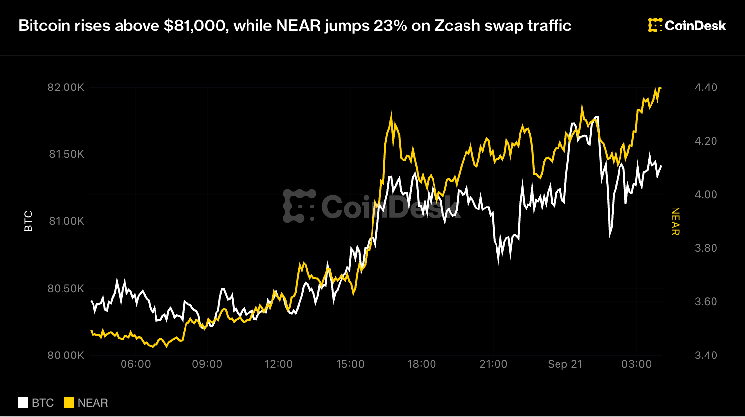
    • Bitcoin holds above $81,000 in Monday Asian trading, extending gains after the SEC greenlit onchain trading of tokenized U.S. equities.
    • NEAR token surges roughly 23% to above $4 as its cross-chain swap service, NEAR Intents, becomes a primary routing layer for Zcash (ZEC) volume.
    • Major consumer wallets ZODL and Vizor have integrated NEAR Intents, driving a sixfold jump in daily ZEC volume routed through the protocol in the past week.

    Bitcoin Consolidates Above $81K as SEC Tokenized Stock Ruling Lifts Sentiment

    Bitcoin traded just above $81,000 during Monday morning hours in Asia, marking a gain of less than 1% over the preceding 24 hours according to CoinDesk data. The cryptocurrency has been adding to its recovery since Thursday, when the U.S. Securities and Exchange Commission cleared a regulatory path for the onchain trading of tokenized U.S. stocks. The move is widely seen as a landmark step toward bridging traditional equity markets with blockchain-based settlement, providing a fresh catalyst for digital-asset risk appetite.

    NEAR Token Leads Major-Cap Gains on Cross-Chain Routing Demand

    The standout performer among major tokens was NEAR, which climbed approximately 23% to trade just above $4. The rally traces directly to NEAR Intents, a swap service built on the NEAR blockchain that enables a wallet to exchange one token for another across different chains without requiring the user to move funds between networks first. The abstraction of cross-chain complexity has turned NEAR into a de facto routing layer for one of the most heavily traded assets in the market.

    Wallet Integrations Drive Sixfold Volume Spike for ZEC

    Major consumer wallets, including ZODL and Vizor, have plugged NEAR Intents into their interfaces to offer Zcash (ZEC) swaps. Since those integrations went live, daily ZEC volume routed through the service has jumped sixfold in a single week. The surge in order flow has created a positive feedback loop for the NEAR token itself, which has followed the traffic as the underlying settlement and gas asset for the routing activity.

    Broader Market Moves Remain Measured

    Outside of NEAR’s outsized move, the rest of the major-cap complex posted modest advances. ZEC itself gained 3% to just above $1,500, while BNB rose 2% to nearly $777. Ether and HYPE each added roughly 2%. The remaining large-cap cohort — XRP, DOGE, SOL, and TRX — all rose 1% or less, indicating a market digesting the SEC news selectively rather than chasing a broad risk-on impulse.

    Why This Matters

    The SEC’s decision to allow onchain trading of tokenized U.S. equities represents a structural shift: it legitimizes the use of public blockchains as settlement rails for regulated securities. For protocols like NEAR that have invested in chain-abstraction infrastructure, the ruling arrives as tailwinds build for cross-chain liquidity aggregation. The sixfold volume increase on NEAR Intents demonstrates real user demand for seamless interoperability — a prerequisite if tokenized stocks are to trade natively onchain at scale. Watch for further wallet integrations and whether other Layer 1s deploy similar intent-based routing to capture order flow.

    Frequently Asked Questions

    What is NEAR Intents and why is it driving NEAR’s price higher?

    NEAR Intents is a cross-chain swap service on the NEAR blockchain that lets users trade tokens across different networks without manually bridging funds. Wallets ZODL and Vizor have integrated it for ZEC swaps, causing a sixfold volume spike that increases demand for NEAR as the routing layer’s native gas and settlement token.

    How did the SEC’s tokenized stock decision affect Bitcoin?

    Bitcoin has extended gains since Thursday’s SEC ruling, trading above $81,000 on Monday. The decision is viewed as a bullish regulatory signal for the broader digital-asset ecosystem, though Bitcoin’s own move has been modest — up less than 1% in 24 hours — suggesting the market is still calibrating the long-term implications.

    Which other major tokens moved on Monday?

    ZEC gained 3% to above $1,500; BNB rose 2% to near $777; Ether and HYPE each added about 2%; while XRP, DOGE, SOL, and TRX all rose 1% or less.