Category: Coins

Digital assets, cryptocurrencies, blockchain, and currency news.

  • Circle Mints $500M USDC on Solana in 6 Hours

    Circle Mints $500M USDC on Solana in 6 Hours

    Key Highlights

    • Circle minted approximately $500 million USDC on the Solana blockchain within a six-hour window, signaling strong stablecoin demand.
    • The minting activity was flagged by on-chain analyst @SolanaFloor and coincides with Solana’s expanding role in tokenized finance and DeFi.
    • Increased USDC supply on Solana is expected to boost network liquiduity, potentially influencing trading volumes and DeFi protocol activity.

    Circle Accelerates USDC Supply on Solana Amid Growing Ecosystem Demand

    Circle Internet Financial has minted roughly $500 million worth of USD Coin (USDC) on the Solana blockchain over a six-hour period, according to on-chain data highlighted by prominent crypto commentator @SolanaFloor. The substantial issuance underscores accelerating demand for dollar-pegged stablecoins within Solana’s rapidly expanding decentralized finance (DeFi) and tokenized asset ecosystem. As one of the two dominant regulated stablecoins globally—alongside Tether’s USDT—USDC’s supply dynamics on high-throughput chains like Solana serve as a real-time barometer for institutional and retail capital flows into on-chain financial applications.

    Strategic Liquidity Expansion in a Mixed Market Environment

    The minting surge arrives while the broader cryptocurrency market exhibits divergent momentum across major assets such as Bitcoin and Ether. Circle’s decision to preemptively expand USDC supply on Solana appears to be a proactive liquidity management strategy, ensuring adequate stablecoin reserves are available for trading, lending, and settlement as Solana continues to attract capital allocated to tokenized real-world assets (RWAs), payment rails, and high-frequency DeFi strategies. The Solana network’s sub-second finality and low transaction fees have positioned it as a preferred execution layer for market makers and quantitative funds rotating stablecoin inventories across venues.

    USDC’s Regulatory Framework and Cross-Chain Utility

    Issued by Circle under a regulated framework that includes regular attestations of reserve assets—primarily short-term U.S. Treasuries and cash held at regulated financial institutions—USDC maintains a 1:1 peg to the U.S. dollar. This regulatory clarity, combined with native issuance on networks including Ethereum, Solana, Arbitrum, Polygon, and Avalanche, allows USDC to function as interoperable settlement infrastructure. The latest Solana minting reinforces Circle’s multi-chain distribution strategy, which aims to meet demand where transaction activity concentrates rather than relying solely on cross-chain bridges that introduce latency and smart-contract risk.

    Why This Matters

    Stablecoin minting volumes on high-performance blockchains like Solana are increasingly viewed as leading indicators of on-chain economic activity. A $500 million injection in six hours suggests market participants are positioning for elevated trading volumes, new DeFi protocol launches, or expanded tokenized treasury and money-market fund offerings on Solana. For traders and liquidity providers, deeper USDC pools reduce slippage on decentralized exchanges such as Orca and Raydium and improve capital efficiency for basis trades and funding-rate arbitrage. For the broader industry, the move signals confidence in Solana’s infrastructure maturity following network upgrades that have improved reliability and throughput consistency.

    Frequently Asked Questions

    Who reported the $500 million USDC minting on Solana?

    The on-chain activity was identified and publicized by @SolanaFloor, a widely followed CryptoTwitter commentator and analytics account that tracks Solana ecosystem metrics in real time.

    What does a large USDC mint typically indicate?

    Large minting events generally reflect anticipation of increased demand for the stablecoin—whether for trading, DeFi lending, payments, or as collateral for tokenized asset issuance—rather than immediate circulation. Circle mints USDC in response to authorized institutional redemption requests.

    How might this affect Solana’s DeFi ecosystem?

    Additional native USDC supply deepens liquidity on Solana-based decentralized exchanges and lending protocols, potentially lowering borrowing costs, tightening spreads, and enabling larger position sizes for market makers and yield strategies operating on the network.


  • Ripple News and XRP Price Update: September 25

    Ripple News and XRP Price Update: September 25

    Key Highlights

    • Spot XRP ETFs have attracted roughly $1.75 billion in cumulative net inflows across 10 consecutive positive weeks, with new filings from T. Rowe Price and Exchange Listed Funds Trust signaling expanding institutional appetite.
    • Whales accumulated over 1.54 billion XRP tokens in approximately 96 hours following the CLARITY Act’s failure, viewing the resulting pullback as a strategic entry point.
    • Ripple’s RLUSD stablecoin has reached a $2.37 billion market capitalization—ranking ninth among stablecoins—while XRP itself corrected 8% to $1.47 after touching a 2026 high near $1.65.

    Institutional Momentum Builds Around XRP ETFs

    Spot XRP exchange-traded funds continue to draw substantial capital from conservative investors, underscoring sustained institutional confidence in Ripple’s cross-border token despite recent price volatility. According to data reported by CryptoPotato, these financial vehicles have posted ten straight weeks of positive flows, pushing cumulative net inflows to approximately $1.75 billion. The past two sessions extended the streak, suggesting the upward trajectory remains intact. Current issuers include Bitwise, Franklin Templeton, Canary Capital, 21Shares, and Grayscale, while additional managers await regulatory clearance to launch their own products.

    The pipeline of forthcoming funds highlights growing sophistication in crypto-linked investment strategies. T. Rowe Price recently amended its crypto ETF filing to include a 9.15% allocation to XRP within a multi-asset basket. Separately, Exchange Listed Funds Trust submitted the “CYBER HORNER S&P 500® and $XRP 75/25 Strategy ETF” to the U.S. Securities and Exchange Commission. If approved, the product would offer investors blended exposure to the broad equity benchmark and Ripple’s native token in a fixed 75/25 ratio, marking a notable convergence of traditional and digital asset structures.

    Whale Accumulation Signals Confidence Amid Regulatory Uncertainty

    Large-scale holders have seized on recent weakness to aggressively increase positions. Over a roughly four-day window last week, whales acquired more than 1.54 billion XRP units. The accumulation began shortly after the CLARITY Act failed to advance in the United States, an event that triggered a market pullback. On-chain behavior suggests these investors interpreted lower prices as a buying opportunity rather than a signal to exit, reinforcing the narrative that long-term conviction remains undimmed by legislative setbacks.

    Ripple Expands Stablecoin Strategy at MESA Forum

    Ripple’s institutional outreach took center stage at the MESA Forum, where Reece Merrick, Managing Director for the Middle East & Africa, appeared alongside representatives from financial heavyweights BlackRock and HSBC. The panel addressed stablecoins, tokenized deposits, and tokenized money-market funds—areas where traditional finance and blockchain infrastructure increasingly intersect. Merrick emphasized the strategic rationale behind Ripple’s dollar-pegged stablecoin, stating: “Stablecoins: The always-on layer moving value between institutions without existing relationships (why $RLUSD was built not to replace bank money, but to let it travel).”

    Merrick also signaled Ripple’s deepening footprint in the United Arab Emirates, noting the jurisdiction is “open for business” and “actively building.” In summer 2025, the Dubai Financial Services Authority formally recognized RLUSD as a crypto token within the Dubai International Financial Center. Since its December 2024 launch, the stablecoin has secured backing from prominent exchanges and institutions, propelling its market capitalization to $2.37 billion—making it the 43rd-largest cryptocurrency overall and the ninth-largest stablecoin by market value.

    Price Correction Tests Key Technical Levels

    After rallying to nearly $1.65 earlier this week—the highest level since the start of 2026—XRP succumbed to a broad-market correction, sliding approximately 8% to $1.47 according to CoinGecko data. Technical observers are now watching whether bulls can reclaim the $1.50 threshold to reignite upward momentum. Pseudonymous analyst Diana identified $1.61 as the critical resistance level that must be cleared to open a path toward the $1.70–$2.00 range. The token’s ability to stabilize above current levels will likely determine whether the recent ETF and whale-driven fundamentals can override near-term macro headwinds.

    Why This Matters

    The convergence of regulated ETF products, sovereign-grade stablecoin adoption, and persistent whale accumulation paints a picture of maturing institutional infrastructure around the XRP ecosystem. While legislative efforts like the CLARITY Act stall in Washington, market participants are advancing practical solutions—tokenized deposits, multi-asset ETFs, and cross-border stablecoin rails—that bypass the need for immediate regulatory perfection. Ripple’s engagement with entities such as BlackRock, HSBC, and the DFSA signals that major financial centers are treating blockchain-based value transfer as an operational reality rather than a speculative experiment. For investors, the key question becomes whether the current correction represents a healthy consolidation within a longer uptrend or a deeper repricing driven by macro liquidity conditions.

    Frequently Asked Questions

    Which firms have launched spot XRP ETFs so far?
    Bitwise, Franklin Templeton, Canary Capital, 21Shares, and Grayscale currently offer spot XRP ETFs. Additional issuers, including T. Rowe Price and Exchange Listed Funds Trust, have filed for new products awaiting SEC approval.
    What is RLUSD and how large has it grown?
    RLUSD is Ripple’s U.S. dollar-pegged stablecoin, launched in December 2024. It has reached a $2.37 billion market capitalization, ranking as the ninth-largest stablecoin and the 43rd-largest cryptocurrency overall. The Dubai Financial Services Authority recognized it within the DIFC in summer 2025.
    What price levels are analysts watching for XRP’s next move?
    After falling to $1.47, traders are monitoring a reclaim of $1.50 as the first step toward renewed bullish momentum. The key resistance sits at $1.61; a decisive break above that level could open the door to a $1.70–$2.00 target zone, according to technical analysis cited in the market.
  • Duelbits Crypto Hack Drains $7M as Casino Goes Offline

    Duelbits Crypto Hack Drains $7M as Casino Goes Offline

    Key Highlights

    • Crypto casino Duelbits suffered a ~$7 million exploit across four blockchain networks, with hot wallets on BNB Chain, Ethereum, Tron, and Bitcoin drained by attackers.
    • Stolen assets—including 836 ETH, 593,000 USDT, 97,000 USDC, 31,500 DAI, 12.4 billion SHIB, and 8.1 BTC—were rapidly swapped into Ether and consolidated into a single address holding roughly 2,234 ETH (~$6 million).
    • Co-founder Joe confirmed the breach and stated the platform will remain offline until the investigation concludes and hot wallets are replenished; users are warned against phishing links circulating during the outage.

    Multi-Chain Hot Wallet Compromise Drains Millions

    Blockchain security firm Scam Sniffer—described in the source as “a company that specializes in blockchain security research”—first flagged a string of unusual transfers from Duelbits wallets on BNB Chain, Ethereum, and Tron. A subsequent detection revealed a loss of 8.1 BTC from the platform’s Bitcoin wallet. The affected wallets were identified as hot wallets: online accounts where a platform holds sufficient cryptocurrency to process client deposits and withdrawals quickly. While convenient for transaction speed, hot wallets carry elevated risk if credentials are compromised.

    Co-Founder Confirms Breach, Investigation Underway

    Duelbits co-founder Joe publicly acknowledged the incident, writing:

    Confirming a ~$7M hack. Still investigating exactly what happened and how.

    Joe added that the casino would remain offline until the investigation is complete and the company has replenished its hot wallets. As of publication, there has been no independent verification of the safety of user funds, and Duelbits has not disclosed how the attackers gained system access or provided a timeline for reopening withdrawals.

    Stolen Funds Converted to Ether, Complicating Recovery

    The attacker’s haul included 836 ETH, approximately 593,000 USDT, 97,000 USDC, 31,500 DAI, and 12.4 billion SHIB. Due to the speed and scale of the withdrawals, Scam Sniffer suspects a private key compromise—meaning the master credentials controlling the wallets were obtained, allowing transfers without exploiting the underlying blockchains. Duelbits has not confirmed this theory.

    Most of the stolen tokens were swiftly exchanged for Ether and consolidated into a single address holding about 2,234 ETH, valued at roughly $6 million at the time of tracing. The funds had not moved onward. This conversion to Ether significantly complicates potential recovery: the issuers of USDT and USDC can freeze those assets, but Ether has no central issuer capable of freezing or reversing transactions.

    Why This Matters

    The Duelbits hack underscores the persistent vulnerability of centralized hot-wallet infrastructure in the crypto-gambling sector. When platforms concentrate liquidity in online wallets for operational speed, a single private-key breach can expose millions across multiple chains simultaneously. The rapid conversion of stablecoins and altcoins into Ether—an asset without a freeze mechanism—demonstrates how attackers structure exits to evade recovery efforts. For users, the incident highlights the importance of verifying platform solvency claims independently and remaining vigilant against phishing campaigns that surge during service outages.

    Frequently Asked Questions

    Which blockchains and assets were affected in the Duelbits hack?

    The exploit hit hot wallets on BNB Chain, Ethereum, Tron, and Bitcoin. Stolen assets included 836 ETH, ~593,000 USDT, 97,000 USDC, 31,500 DAI, 12.4 billion SHIB, and 8.1 BTC.

    Can the stolen funds be frozen or recovered?

    The attacker converted most tokens into Ether and consolidated them in one address. While USDT and USDC issuers can freeze those specific tokens, Ether cannot be frozen because it has no central issuer. Recovery prospects therefore depend on law-enforcement action or the attacker’s future mistakes.

    Is Duelbits currently operational, and what should users do?

    Duelbits has taken its site offline and has not announced a reopening date. Co-founder Joe stated the platform will stay down until the investigation finishes and hot wallets are replenished. Users should avoid any “refund” or “recovery” links circulating during the outage, as these are likely phishing attempts designed to steal wallet credentials.

  • Chainalysis Says Crypto Activity Barely Fell Despite $2.1T Market Rout

    Chainalysis Says Crypto Activity Barely Fell Despite $2.1T Market Rout

    Key Highlights

    • Global crypto economic activity declined only 1.6% year-over-year to $9.4 trillion despite a $2.1 trillion market capitalization drop, according to Chainalysis’ 2026 Global Crypto Adoption Index.
    • Domestic peer-to-peer crypto transfers surged 302.9% to $228.7 billion, while cross-border stablecoin flows grew 77.5% to $220.3 billion in the 12 months ended June 30, 2026.
    • Centralized crypto service inflows fell 4.3%, signaling a structural shift toward decentralized and stablecoin-based utility during the bear market.

    Chainalysis Index Reveals Resilience Beneath Market Turmoil

    Cryptocurrency prices plummeted over the past year, wiping out roughly $2.1 trillion in market capitalization, yet the underlying economic activity on blockchain networks proved remarkably durable. That is the central finding from the 2026 Global Crypto Adoption Index released by blockchain analytics firm Chainalysis, which measures on-chain activity across the 12-month period ended June 30, 2026. The report estimates total measured crypto economic activity contracted a modest 1.6%, sliding from approximately $9.5 trillion to $9.4 trillion—a fraction of the destruction reflected in asset prices.

    Stablecoins and P2P Transfers Drive Utility Growth

    The divergence between price performance and network usage forms the most compelling narrative in the data. While capitalization evaporated, domestic peer-to-peer crypto transfers exploded 302.9% to reach $228.7 billion during the measurement window. Simultaneously, cross-border stablecoin flows climbed 77.5% to $220.3 billion. These figures indicate that users increasingly rely on dollar-denominated tokens and direct wallet-to-wallet transactions for payments, savings, and remittances irrespective of Bitcoin’s market cycle. By contrast, the value flowing into centralized crypto services declined 4.3%, suggesting a migration away from custodial platforms toward self-custodied, on-chain activity.

    A Structural Decoupling of Price and Usage

    Historically, crypto bear markets produced a simpler dynamic: collapsing prices led to vanishing speculative interest and a corresponding drop in network usage. Stablecoins have complicated that relationship. A token pegged to the U.S. dollar retains its utility for cross-border transfers, commerce, and store-of-value functions whether Bitcoin trades at an all-time high or deep in a drawdown. The same holds for peer-to-peer transfers in emerging markets where cryptocurrency serves as financial infrastructure rather than a speculative vehicle. Chainalysis’ data underscores that the asset class has developed a usage floor decoupled from its valuation ceiling.

    Why This Matters

    The 1.6% activity decline against a $2.1 trillion capitalization collapse signals a maturation of the crypto ecosystem. Market capitalization reflects momentary asset pricing; transaction volume reflects real-world utility. The growth in stablecoin and P2P rails suggests crypto is increasingly functioning as a parallel payments and settlement layer, particularly in regions with volatile fiat currencies or limited banking access. For regulators, investors, and builders, the data implies that measuring industry health solely through token prices misses the expansion of programmable money infrastructure. The next cycle may test whether this utility-driven floor holds when speculative capital returns.

    Frequently Asked Questions

    What period does the 2026 Global Crypto Adoption Index cover?
    The index measures on-chain economic activity across the 12 months ended June 30, 2026.
    Which metrics grew despite the bear market?
    Domestic peer-to-peer transfers rose 302.9% to $228.7 billion, and cross-border stablecoin flows increased 77.5% to $220.3 billion.
    How did centralized service usage change?
    Value moving into centralized crypto services declined 4.3%, indicating a shift toward decentralized and self-custodied activity.
  • ARK Invest Tokenizes ARK Venture Fund on Ethereum via Securitize

    ARK Invest Tokenizes ARK Venture Fund on Ethereum via Securitize

    Key Highlights

    • ARK Invest has tokenized its ARK Venture Fund (ARKVX) via Securitize, marking the first time one of Cathie Wood’s flagship actively managed strategies is available onchain.
    • Tokenized fund interests launch on Ethereum, giving eligible investors blockchain-based exposure to private tech holdings including OpenAI, Anthropic, Stripe, and Databricks.
    • The move follows the SEC’s innovation exemption for tokenized securities and expands Securitize’s regulated digital-asset infrastructure across the U.S. and EU, with partners such as BlackRock, Apollo, and KKR.

    ARK Invest Brings Flagship Venture Fund Onchain Through Securitize Partnership

    ARK Invest, the disruptive-innovation investment manager founded by Cathie Wood, announced on 24 September that it has tokenized the ARK Venture Fund (ARKVX) through Securitize Corp. (NYSE: SECZ). The transaction brings an actively managed, closed-end interval fund onto a public blockchain for the first time, with tokenized interests initially issued on Ethereum. Securitize handles the onchain issuance and the end-to-end investor experience, reflecting a shared conviction between the two firms that tokenization can modernize how investment products are accessed, owned, and managed.

    What the Tokenized Fund Holds

    ARKVX invests across private and public companies aligned with disruptive innovation. Its portfolio includes stakes in OpenAI, Anthropic, Stripe, and Databricks, among others, so eligible investors who access the fund through Securitize gain exposure to leading private technology companies through blockchain-based infrastructure. Fund holdings are subject to change. ARK, which Wood founded in 2014 and is headquartered in St. Petersburg, Florida, focuses solely on disruptive innovation, targeting large-scale opportunities across artificial intelligence, robotics, energy storage, and blockchain technology. As an interval fund, ARKVX offers limited liquidity through periodic repurchase offers, and its shares are not listed on an exchange; the tokenized interests represent a stake in the fund itself rather than direct ownership of the underlying companies.

    Leadership Frames the Move as a Capital-Markets Evolution

    “Tokenizing the $ARK Venture Fund puts our conviction in the evolution, if not revolution, of capital markets into practice,” said Cathie Wood, $ARK’s founder, CEO and chief investment officer. “Making the $ARK Venture Fund available onchain is a natural extension of our mission to democratize access to technologically enabled disruptive innovation.”

    Securitize co-founder and CEO Carlos Domingo framed the launch as proof that established managers can move existing products onto modern rails. “Bringing ARKVX onchain demonstrates how leading asset managers can use tokenization to move established investment products onto modern capital markets infrastructure,” he said.

    Why This Matters: Institutional Tokenization Gains Momentum

    The tokenization follows the U.S. Securities and Exchange Commission’s innovation exemption for tokenized stock trading and extends Securitize’s regulatory footprint, including a memorandum of understanding with Dubai’s Virtual Assets Regulatory Authority (VARA) signed in September. Securitize, which reports roughly $5 billion in assets under management as of August, says it is the only company operating regulated digital-securities infrastructure in both the U.S. and the EU. Its partner roster includes Apollo, BlackRock, BNY, Hamilton Lane, KKR, and VanEck, signaling broad institutional adoption of blockchain-based fund distribution. For investors, the development lowers barriers to accessing private-market innovation strategies that were previously limited to large institutions or high-net-worth individuals, while also introducing 24/7 settlement and programmable compliance features native to blockchain rails.

    Frequently Asked Questions

    What exactly does an investor own when purchasing tokenized ARKVX interests?

    The tokenized interests represent a stake in the ARK Venture Fund itself, not direct ownership of the underlying portfolio companies such as OpenAI or Stripe. The fund remains an actively managed, closed-end interval vehicle with periodic repurchase offers and no exchange listing.

    On which blockchain are the tokenized interests initially available?

    The tokenized ARKVX interests are available initially on Ethereum, with Securitize managing the onchain issuance and investor onboarding experience.

    How does this launch fit into the broader regulatory landscape?

    The offering leverages the SEC’s innovation exemption for tokenized securities and builds on Securitize’s dual U.S.–EU regulated infrastructure, reinforced by a recent MOU with Dubai’s VARA. This positions the ARKVX tokenization as a compliant, institutionally viable model for bringing traditional fund products onto blockchain rails.

  • Bitcoin Nears $90K as Bybit Fuels Market Excitement

    Bitcoin Nears $90K as Bybit Fuels Market Excitement

    Key Highlights

    • Bitcoin approaches the psychologically significant $90,000 threshold, drawing heightened trader attention and speculation on near-term price direction.
    • Crypto exchange Bybit launches a prediction campaign offering 17,000 USDT in rewards for accurate forecasts on whether BTC surpasses $90K by September 25.
    • Broader market signals remain mixed, with varying momentum across major assets and large wallet movements signaling potential volatility ahead.

    Bitcoin Nears $90K Milestone as Bybit Fuels Trader Engagement

    Bitcoin’s latest price surge has placed the cryptocurrency within striking distance of the $90,000 level, a round-number barrier that historically acts as both a psychological magnet and a resistance zone. The advance comes amid a flurry of social-media chatter and on-chain activity, with Bybit, one of the world’s largest derivatives exchanges, amplifying the conversation through a public prediction initiative. The campaign invites users to forecast whether BTC will trade above $90K by September 25, allocating a 17,000 USDT prize pool to participants who submit the closest estimates. By framing the milestone as a community-driven event, Bybit is leveraging its platform reach to convert passive market observation into active engagement, a tactic that also generates real-time sentiment data for the exchange’s own risk models.

    Market Structure Shows Divergent Momentum Across Major Assets

    While Bitcoin commands the spotlight, the broader digital-asset landscape is flashing mixed signals. Ethereum, Solana, and several layer-one tokens have failed to replicate BTC’s relative strength, creating a dispersion in performance that often precedes heightened cross-asset volatility. On-chain analytics indicate that several high-net-worth wallets have shifted sizable BTC positions between cold storage and exchange deposit addresses in recent sessions, a pattern that frequently foreshadows increased order-book activity. Traders are interpreting these transfers as potential precursors to either profit-taking near the $90K level or repositioning for a breakout attempt, underscoring the importance of monitoring wallet flows alongside price charts.

    Bybit’s Campaign Design Encourages Analytical Participation

    The exchange’s prediction mechanic requires entrants to submit a specific price target rather than a simple binary choice, compelling participants to incorporate technical levels, funding-rate dynamics, and macroeconomic inputs into their models. This structure transforms what could be a speculative guess into a crowdsourced forecasting exercise, producing a distribution of expectations that Bybit can compare against its internal order-flow metrics. Rewards are denominated in USDT, the dominant stablecoin for derivatives margin, ensuring that payouts remain liquid and immediately reusable for further trading. The September 25 cutoff aligns with the weekly options expiry cycle, a period when gamma hedging by market makers often amplifies intraday swings.

    Why This Matters

    The convergence of a round-number psychological barrier, a major exchange’s gamified sentiment probe, and detectable whale-wallet repositioning creates a high-probability window for elevated volatility. For institutional desks, the $90K zone represents a key reference point for structured-product knock-in/knock-out barriers and delta-hedging adjustments. Retail participants, meanwhile, gain a transparent, incentive-aligned mechanism to test their market-reading skills against a broad peer group. Regulators and market-surveillance teams will likely scrutinize the campaign’s order-flow footprint to ensure no coordinated manipulation occurs around the prediction deadline. Ultimately, how Bitcoin behaves at this juncture will set the tone for Q4 risk appetite across the entire crypto complex, influencing everything from ETF flow trajectories to altcoin correlation regimes.

    Frequently Asked Questions

    What is the exact deadline for Bybit’s Bitcoin price prediction campaign?

    The campaign closes on September 25, coinciding with the weekly options expiry that often intensifies short-term price action.

    How large is the reward pool and in what asset is it paid?

    Bybit has allocated 17,000 USDT, paid in the Tether stablecoin, to be distributed among users who submit the most accurate BTC price forecasts.

    Why are large wallet movements considered a leading indicator for volatility?

    Transfers between cold storage and exchange addresses typically signal intent to trade; sizable inflows can precede sell pressure, while outflows may indicate accumulation or custody changes, both of which affect order-book depth and price stability.

  • Blockchain.com, NYSE Plan 24/7 Tokenized Stock Trading Access

    Blockchain.com, NYSE Plan 24/7 Tokenized Stock Trading Access

    Key Highlights

    • Blockchain.com and NYSE Group have signed a memorandum of understanding to explore distribution of tokenized U.S.-listed stocks and ETFs via NYSE’s planned digital alternative trading system (ATS).
    • The proposed service aims to enable 24/7 trading, fractional ownership, stablecoin funding, and onchain settlement for eligible global users, pending regulatory approvals and the launch of NYSE’s digital venue.
    • The agreement includes bilateral data sharing: ICE and NYSE equity data would integrate into Blockchain.com products, while Blockchain.com crypto-market data could be distributed by ICE.

    Blockchain.com and NYSE Group Forge Partnership to Explore Tokenized Equities

    Blockchain.com and the New York Stock Exchange Group have entered into a formal agreement to investigate bringing tokenized versions of NYSE-listed securities directly to the crypto platform’s global user base. The memorandum of understanding covers joint product development and market-data sharing, with the long-term objective of enabling Blockchain.com customers to trade tokenized stocks and exchange-traded funds through infrastructure built on NYSE’s forthcoming digital alternative trading system. The collaboration marks a significant convergence between a major crypto-native exchange and the world’s largest equity market operator.

    NYSE’s Digital ATS Designed for Crypto-Native Features

    NYSE has previously outlined plans for a digital alternative trading system architected around tokenized securities. The proposed venue is engineered to support functionality familiar to cryptocurrency traders but largely absent from traditional brokerage platforms: continuous 24/7 market access, fractional share ownership, stablecoin denominated funding, and onchain settlement. If launched, Blockchain.com would serve as a distribution partner, offering its international customer base a pathway to trade tokenized representations of exchange-listed shares and ETFs within the same ecosystem they use for digital assets.

    Bilateral Data Integration Extends Beyond Trading

    The agreement envisions data flowing in both directions. Intercontinental Exchange (ICE), NYSE’s parent company, could distribute Blockchain.com’s cryptocurrency market data to its network, while Blockchain.com would integrate ICE and NYSE equity market data into its own product suite. This reciprocal arrangement underscores a strategic alignment that goes beyond simple order execution, positioning both firms to leverage each other’s data assets across traditional and digital asset markets.

    Agreement Remains Preliminary Pending Regulatory Clearance

    Despite the strategic significance, executives emphasize that the memorandum of understanding does not constitute a live trading launch. Tokenized NYSE securities are not available for unrestricted 24-hour trading today. The service is contingent on NYSE successfully launching its planned digital ATS and securing all required regulatory approvals. Jurisdictional restrictions will also apply; tokenizing a share does not eliminate the applicability of securities laws merely because ownership is represented on a blockchain.

    Why This Matters

    This partnership places two major industry trends on a direct collision course. Over the past year, cryptocurrency exchanges have aggressively pursued tokenized equity products, while traditional market infrastructure providers have begun experimenting with blockchain-based settlement layers. Blockchain.com contributes crypto-native users, wallet infrastructure, and a global distribution footprint. NYSE Group contributes regulated market structure, the underlying securities ecosystem, and the credibility of the world’s premier listing venue. If the project clears regulatory hurdles, the result could resemble less a crypto imitation of the stock market and more the stock market adopting crypto-style settlement rails—potentially reshaping how global investors access U.S. equities.

    Frequently Asked Questions

    Can I trade tokenized NYSE stocks on Blockchain.com right now?

    No. The companies have signed a memorandum of understanding only. Tokenized securities are not currently available for trading. The service depends on NYSE launching its digital alternative trading system and obtaining necessary regulatory approvals.

    Will tokenized stocks be available 24/7 to users worldwide?

    The proposed digital ATS is designed to support 24/7 trading, fractional ownership, and stablecoin funding. However, access will be subject to jurisdictional restrictions and securities regulations in each user’s country of residence.

    What role does ICE play in this partnership?

    Intercontinental Exchange (ICE) is the parent company of NYSE. Under the agreement, ICE could distribute Blockchain.com’s cryptocurrency market data, while Blockchain.com would integrate ICE and NYSE equity market data into its platform.

  • ‘Bull Market Confirmed’: Analyst Identifies Bitcoin’s Fifth Historic Signal

    ‘Bull Market Confirmed’: Analyst Identifies Bitcoin’s Fifth Historic Signal

    Key Highlights

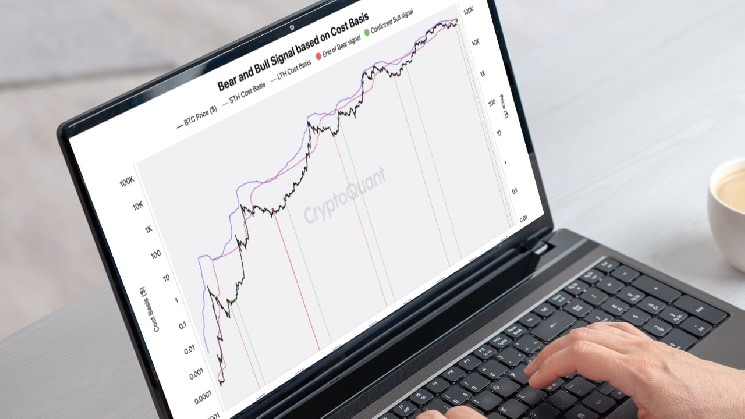
    • Cryptoquant contributor Darkfost identifies a fifth historical bull market signal for Bitcoin on September 24, marking the first such crossover since 2023 and joining prior signals in 2012, 2015, 2019, and 2023.
    • The signal triggers when the short-term holder cost basis rises above the active long-term holder cost basis, using a seven-year activity filter that excludes over 3.5 million dormant BTC untouched for a decade or more.
    • U.S. spot Bitcoin ETFs recorded $2.06 billion in net inflows over three consecutive days (Sept. 21–23), led by a record $999 million single-day inflow on Sept. 21, coinciding with the signal’s confirmation.

    Fifth Cost-Basis Crossover Confirms Bull Market Structure

    A new on-chain metric flashed a bullish confirmation for Bitcoin on September 24, marking the fifth time in the asset’s history that the average acquisition cost of short-term holders has surpassed that of active long-term holders. The analysis, published by Cryptoquant contributor Darkfost, identifies the crossover as a recurring structural signal that has preceded sustained upward moves in each of the four prior cycles.

    In a post on X, the analyst stated: “Bull Market Confirmed … This is the 5th occurrence, which gives a bit more credibility to the dynamic bitcoin is putting in place, though there’s always a margin for error, and I prefer to point that out.” The comment underscores both the statistical weight of the pattern and the inherent uncertainty in any single indicator.

    The metric compares two distinct cost bases: the average price paid by short-term holders versus the average price paid by active long-term holders. Crucially, the long-term cohort is filtered to include only coins that have moved at least once in the past seven years. This design excludes deeply dormant supply—estimated at more than 3.5 million BTC older than ten years—which the analyst argues would otherwise distort the measure of genuine holder conviction.

    Defining Active Long-Term Holders: The Seven-Year Filter

    The seven-year activity threshold serves a different analytical purpose than the standard 155-day holding period used by firms such as Glassnode to separate short-term from long-term supply. While Glassnode’s definition classifies any coin held longer than roughly five months as long-term, Darkfost’s additional filter asks whether that long-term coin has shown any on-chain life in the last seven years. Coins that have not are treated as effectively lost or permanently dormant and removed from the active cost-basis calculation.

    The analyst acknowledges the cutoff is arbitrary but notes its practical relevance. The dormant pile grows by an estimated 8,000 to 30,000 BTC each month, and its monthly change has turned negative only once since 2019—when an early miner moved approximately 100,000 BTC. Notably, coins inactive for five to 15 years resumed movement in 2026, demonstrating that even decade-old supply can re-enter circulation and validating the decision to track active versus dormant segments separately.

    ETF Inflows Provide Liquidity Backdrop for the Signal

    The cost-basis crossover arrived alongside a surge of institutional demand via U.S. spot Bitcoin exchange-traded funds. According to daily flow data from Farside, the funds attracted $2.06 billion in net inflows across the three sessions from September 21 through September 23. Every session printed positive flows, though the pace decelerated sharply after the opening day.

    September 21 saw the largest single-day inflow of 2026 at $999 million. The following day added $714.7 million, and September 23 contributed $346.9 million. The three-day sequence coincides with the period in which the on-chain signal confirmed, lending circumstantial support to the argument that fresh ETF liquidity is reinforcing the shift in holder economics. The analyst cautions, however, that the flow data establishes correlation during the signal window, not causation of the crossover itself.

    Spot Bitcoin ETFs allow investors to gain exposure through brokerage-traded shares backed by actual BTC held by the fund, lowering the operational barrier for institutional allocators and wealth managers who cannot or prefer not to custody digital assets directly.

    Cycle Outlook: Tempered Volatility, Multi-Fold Returns

    The bullish signal and ETF momentum are being framed within a broader cycle thesis. In a separate assessment published September 22, Cryptoquant founder and CEO Ki Young Ju argued that the market’s expanding size and deepening institutional ownership could dampen the extreme boom-bust amplitude characteristic of earlier cycles. His base-case forecast projects threefold to fivefold returns for Bitcoin this cycle, followed by a milder bear market drawdown than historical norms.

    Why This Matters

    The fifth cost-basis crossover matters because it represents a rare confluence of on-chain holder behavior and institutional capital flows. Prior occurrences in 2012, 2015, 2019, and 2023 each preceded significant bull-market legs, suggesting the metric captures a fundamental shift in the marginal buyer—from long-term accumulators to newer participants willing to pay higher average prices. The seven-year activity filter refines this insight by focusing on economically active long-term holders, filtering out supply that behaves more like lost coins than invested capital. Meanwhile, the $2.06 billion in ETF inflows over three days—anchored by a record $999 million session—signals that traditional financial infrastructure is now a primary vector for Bitcoin demand. If Ki Young Ju’s cycle thesis holds, the combination of structural on-chain signals and sustained institutional flows could produce a cycle defined by steadier appreciation and shallower corrections, reshaping risk expectations for both retail and institutional participants.

    Frequently Asked Questions

    What exactly is the “fifth bull market signal” identified by Cryptoquant?

    It is the fifth historical occurrence where the short-term holder realized price (average acquisition cost of coins held less than ~155 days) crosses above the active long-term holder realized price (average cost of coins held longer than 155 days that have also moved at least once in the past seven years). Previous crossovers appeared in 2012, 2015, 2019, and 2023.

    Why does the analysis exclude Bitcoin that hasn’t moved in over seven years?

    The analyst treats coins untouched for seven-plus years as dormant or effectively lost supply. Including them in the long-term holder cost basis would dilute the measure of active holder conviction. Over 3.5 million BTC fall into this category, growing by 8,000–30,000 BTC monthly, with only one monthly decline since 2019.

    Did the ETF inflows cause the bullish crossover?

    The data shows the $2.06 billion in net ETF inflows (Sept. 21–23) coincided with the signal’s confirmation, but the analyst explicitly states the flows “do not establish that ETF buying caused the crossover.” The inflows provide liquidity context, not proof of causation.

  • Crypto Market Reacts as Bitcoin Holders Cash Out $2.4B

    Crypto Market Reacts as Bitcoin Holders Cash Out $2.4B

    Key Highlights

    • Bitcoin holders realized $2.4 billion in profits according to Bitfinex data, a steep decline from historical peaks of $7 billion to $10 billion in daily realized profits.
    • Zero trading volume reported over the past 24 hours signals a cautious market atmosphere and potential stagnation across the broader crypto ecosystem.
    • The profit-taking trend suggests investors are securing gains rather than holding for further appreciation, a behavior shift that could reshape near-term market dynamics.

    Bitfinex Data Reveals Sharp Decline in Realized Bitcoin Profits

    Bitcoin holders recently realized $2.4 billion in profits, according to a tweet from Bitfinex, one of the world’s longest-running cryptocurrency exchanges. This figure stands in stark contrast to historical market tops, where daily realized profits consistently ranged between $7 billion and $10 billion. The sizable gap underscores a notable shift in investor behavior: rather than riding momentum toward new highs, market participants appear to be locking in gains at lower thresholds. Analysts interpret this as a signal that confidence in immediate upside potential has waned, even as Bitcoin maintains its role as the primary bellwether for the entire digital asset sector.

    Trading Volume Evaporates as Market Enters Cautious Phase

    The current environment reveals mixed signals across the broader crypto market. While profit realization remains significant in absolute terms, overall trading activity has gone conspicuously quiet, with no reported volume in the past 24 hours. This absence of turnover contrasts sharply with previous bullish cycles, where heavy volume accompanied profit-taking as traders rotated positions. The combination of realized profits and vanishing volume paints a picture of a market in wait-and-see mode, where both retail and institutional investors are reassessing risk exposure amid fluctuating conditions. Many traders are closely monitoring these developments, as the divergence between profit-taking and participation could foreshadow a shift in market dynamics.

    Historical Context Underscores Shift in Investor Behavior

    As of now, Bitcoin shows no trading volume, which underscores the cautious atmosphere among investors. Recent profit realizations could suggest that traders are opting to secure gains rather than hold out for further price increases. The lack of trading activity highlights a potentially stagnant market, where sentiment appears to be influenced heavily by recent profit-taking. Bitcoin serves as a leading cryptocurrency, often acting as a bellwether for the entire crypto market. Its price movements and trading behaviors can significantly influence market sentiment and investor strategies, making it a focal point for both retail and institutional investors alike.

    Market Participants Await Directional Catalysts

    Traders are watching for potential shifts in market sentiment as profit realizations continue. The historical context suggests that if this trend of taking profits persists, it could lead to increased volatility and uncertainty in the market. Investors should remain vigilant for upcoming trends as the dynamics of profit realization could reshape strategies moving forward. Market reactions are subject to change based on new information.

    Why This Matters

    The sharp drop in daily realized profits—from a historical ceiling of $10 billion to the current $2.4 billion—combined with the evaporation of trading volume, marks a meaningful inflection point for Bitcoin and the wider crypto market. In prior cycles, elevated profit realization accompanied by robust volume signaled conviction-driven rotation; today’s low-volume profit-taking suggests defensive repositioning. Because Bitcoin’s price action and on-chain behavior set the tone for altcoins, DeFi protocols, and institutional allocation decisions, this shift warrants close attention from portfolio managers, miners, and derivatives desks alike. The next directional move will likely hinge on macroeconomic catalysts—such as Federal Reserve policy signals, ETF flow data, or regulatory clarity—that could either revive risk appetite or deepen the current consolidation.

    Frequently Asked Questions

    How does the current $2.4 billion in realized profits compare to previous market peaks?

    Historical data shows that during prior market tops, daily realized profits consistently hovered between $7 billion and $10 billion. The current $2.4 billion figure represents a decline of roughly 65% to 75% from those peak levels, indicating significantly reduced profit-taking intensity.

    Why is zero trading volume significant in this context?

    Zero reported volume over 24 hours suggests a lack of conviction among buyers and sellers alike. In healthy bull markets, profit-taking is typically matched by fresh capital entering positions. The absence of volume implies participants are sideline-oriented, waiting for clearer directional signals before committing new capital.

    What could trigger a change in the current cautious sentiment?

    Market participants are monitoring macroeconomic developments—including Federal Reserve interest rate decisions, spot Bitcoin ETF flow trends, and regulatory announcements—as potential catalysts. A shift in any of these factors could either revive risk appetite and volume or reinforce the current consolidation phase.

  • Bitget Crypto Exchange Exploited for $351M as Hacker Swaps Stolen Funds for Ethereum

    Bitget Crypto Exchange Exploited for $351M as Hacker Swaps Stolen Funds for Ethereum

    Key Highlights

    • Crypto exchange Bitget confirmed a $351.6 million security breach involving multiple hot wallets
    • Attackers moved stolen assets across chains and converted stablecoins into Ethereum through rapid transactions
    • The breach represents one of the largest exchange hot wallet compromises in recent crypto history

    Bitget Confirms Major Hot Wallet Security Breach

    Cryptocurrency exchange Bitget has officially confirmed a massive security breach resulting in the loss of $351.6 million from its hot wallet infrastructure. According to the exchange’s disclosure, attackers successfully drained several hot wallets before moving the stolen assets across multiple blockchain networks and converting stablecoin holdings into Ethereum through a series of rapid transactions.

    Attack Methodology and Asset Movement

    The breach involved a coordinated exploitation of Bitget’s hot wallet systems, which are internet-connected wallets used for daily trading operations and withdrawals. The attackers executed a sophisticated multi-chain strategy, transferring compromised funds across different blockchain networks to obscure the trail before consolidating the value into Ethereum. This conversion of stablecoins into ETH suggests the perpetrators sought to move into a more liquid, widely accepted asset that can be more easily mixed or bridged to other ecosystems.

    Why This Matters

    This incident ranks among the largest centralized exchange hot wallet compromises on record, surpassing many previous high-profile breaches in sheer dollar value. The scale underscores persistent vulnerabilities in hot wallet architectures despite industry advances in multi-signature schemes, threshold signatures, and hardware security modules. For the broader crypto market, the breach reinforces concerns about custodial risk and may accelerate user migration toward self-custody solutions or exchanges with proven reserve transparency. Regulators will likely scrutinize Bitget’s security practices and incident response, potentially influencing forthcoming exchange compliance standards globally.

    Frequently Asked Questions

    How much was stolen in the Bitget hot wallet breach?

    Bitget confirmed a loss of $351.6 million from several compromised hot wallets.

    What did the attackers do with the stolen funds?

    The attackers moved assets across chains and converted stablecoins into Ethereum during rapid transactions.

    Which exchange was hacked?

    Crypto exchange Bitget was the victim of this security breach.