Category: Coins

Digital assets, cryptocurrencies, blockchain, and currency news.

  • Bitcoin Ownership in the EU: Number of Investors Is Rising Fast

    Bitcoin Ownership in the EU: Number of Investors Is Rising Fast


    • Europe’s crypto market is changing rapidly. Since we knew that the uniform MiCA rules were coming, the number of investors has been growing rapidly.
    • Digital assets are becoming an integral part of portfolios. But who actually invests the most – and why?

    Market analyzes show that the strongest growth in the number of cryptocurrency owners is in Central and Eastern Europe, while the largest sums are invested in economically stronger Western Europe.

    Germany is the front runner

    Germany, France and the Netherlands are among the largest markets for Bitcoin and Co in terms of trading volume and institutional activity.

    Germany in particular benefits from the increasing number of regulated providers, a strong FinTech sector and more and more crypto-savvy investors.

    At the same time, the Eastern European states of Poland, the Czech Republic and Bulgaria are rapidly catching up. Here, younger, digitally savvy population groups in particular are driving the growth of crypto assets.

    Eastern Europe is quickly catching up
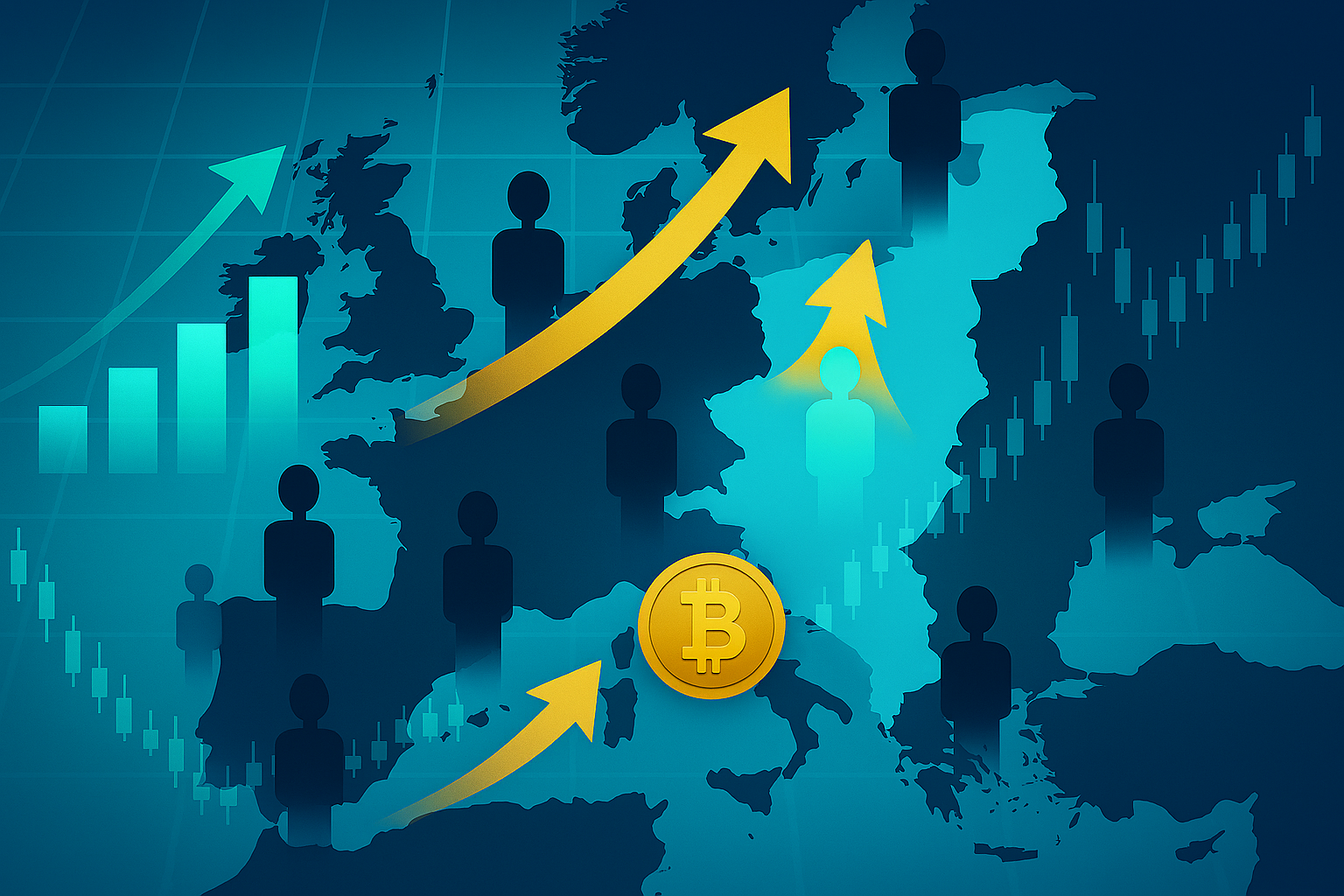
    The entry threshold is low, interest in alternative forms of investment is high, and the economic uncertainty of recent years has increased interest in independent forms of investment. In some Eastern European countries, the proportion of the population with crypto ownership is already above the EU average.

    Another driver is the institutions. European asset managers, banks and family offices are investing more and more in Bitcoin, Ethereum and tokenized RWA. The MiCA regulation acts like a catalyst here.

    Trust through legal certainty

    Legal certainty creates trust, and trust creates capital inflows. Crypto financial systems are emerging particularly in Luxembourg, Switzerland – not in the EU, but closely interconnected – and Liechtenstein, which specifically attract institutional investors.

    Legal certainty is the common basis of motivation in the different regions of Europe. While investors in Western Europe tend to view cryptocurrencies as a long-term investment, in Southern and Eastern Europe the tangible, pragmatic reasons dominate.

    These include protection against inflation, access to global markets and the certainty of being able to build and hold assets independently of banks.

    All of these positive effects of the EU MiCA Regulation are taking Europe into a new phase in terms of the importance of forms of investment and thus their growth. Cryptoassets are gaining an increasingly broader base among the EU population.

    They are no longer an investment niche for the initiated. They have arrived in the middle of Europe, which has accepted cryptocurrencies and made them socially acceptable.

  • German ABN-Amro subsidiary HADC receives MiCA license

    German ABN-Amro subsidiary HADC receives MiCA license


    • ABN AMRO is a Dutch full-service bank headquartered in Amsterdam, serving private and business customers.
    • Its German subsidiary Hauck Aufhäuser Digital Custody has now received a MiCA license from BaFin.

    The MICA regulation came into force at the end of 2024 and is intended to harmonize the previously inconsistent EU crypto regulation and give service providers from different countries of origin the opportunity to offer their services across the EU via so-called “passporting”.

    ABN AMRO through MiCA license in the EU internal market


    Die Hauck Aufhäuser Digital Custody GmbH HADC, which emerged from the Hauck Aufhäuser Lamp Privatbank and has been part of the ABN Amro Group since 2025, is becoming a pioneer in the custody and management of crypto assets.

    But the license not only allows custody and administration, but also the execution of transactions on behalf of institutional investors. This means that customers benefit from a combination of 230 years of banking tradition, focused expertise, international reach and an A rating. HADC board member Dr. Holger Sepp explained:

    “Our depository stands for something that is particularly valuable these days: continuity and partnership. We build on our special positioning in the German market: as a medium-sized company, we have a pronounced agility and maintain personal exchanges with our customers.”

    In this way, ABN Amro is strengthening its position as a “European bank”. The MiCA license is the most important regulatory basis for trust and legal certainty, especially for institutional investors who have previously been hesitant to take larger exposures to the crypto market.

    Through European approval ABN Amro can now offer its digital asset services across the entire EU internal market and secure decisive market shares at an early stage.

    At the same time, the expansion makes it clear that large banks no longer view crypto custody as a niche, but increasingly as a strategic business area of ​​high relevance.

    For the market as a whole, the license is a signal that the regulatory basis has been created to integrate digital assets into the mainstream of the financial world, with all the opportunities and risks – and legally secure investor protection.

  • Bitcoin price analysis at the end of the year: What becomes important now

    Bitcoin price analysis at the end of the year: What becomes important now


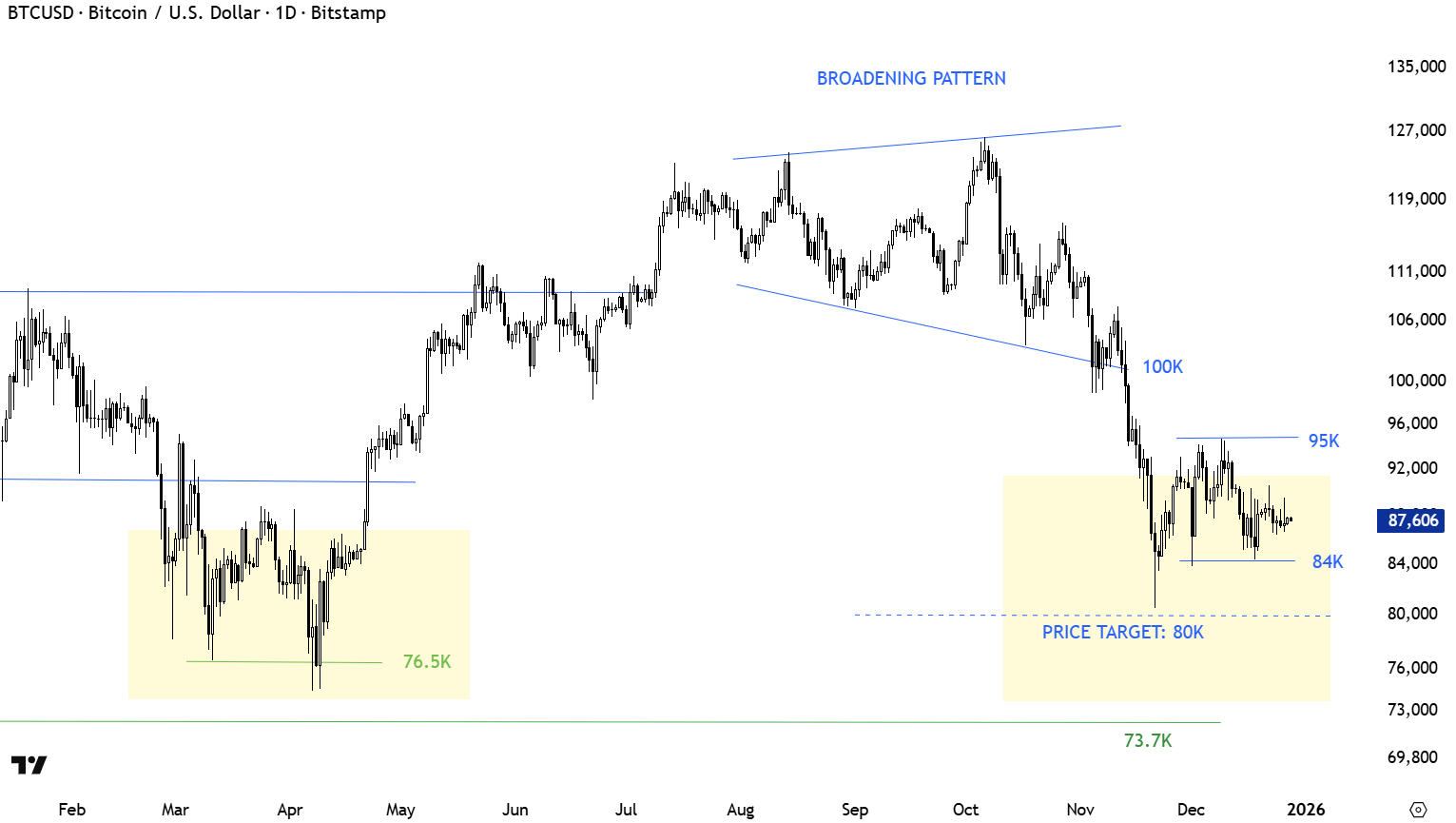
    • Bitcoin continues to trade between $84,000 and $95,000: low volatility, technical holding mode.
    • BTC/Gold looks oversold while on-chain data remains mixed.

    At the end of the year, Bitcoin continues to move in a technically delicate area, with the price in the last few days more like a stablecoin. Since November 23rd, the BTC price has been stuck in the zone between $84,000 and $95,000.

    According to Chartered Market Technician (CMT) and former fund manager Aksel Kibar, after an extremely volatile top phase (“broadening pattern”) followed by a sharp sell-off, Bitcoin has now slipped into a phase of low volatility. The price is currently stabilizing in a range between $84,000 and $95,000.

    “We are in the middle of the process. Volatility runs in cycles. High volatility is now followed by a phase of low volatility – until we find a clean chart pattern that can be traded in a targeted manner,” writes the renowned chart analyst via X.

    Bitcoin Kursanalyse
    Bitcoin price analysis | Source: @TechCharts on X


    Bitcoin/Gold: Oversold like never before

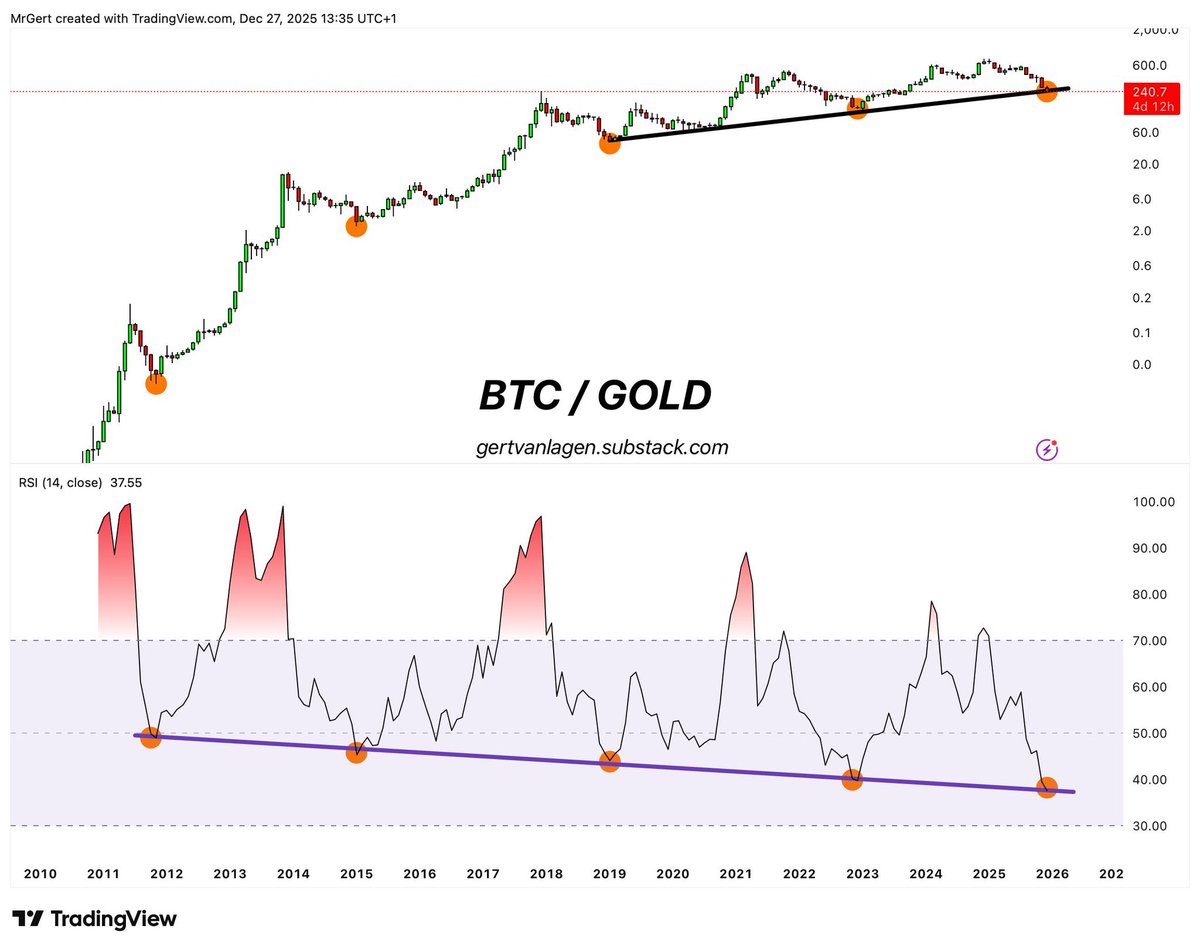
    At the same time, some market observers are focusing on the relative valuation compared to gold. YouTuber Furkan Yildirim posted a BTC/Gold chart with the note: “Bitcoin has never been as oversold relative to gold as it is currently. Interestingly, the lows were formed at exactly these points in time and Bitcoin was then able to march upwards. Is history repeating itself or is everything different this time, what do you think?”

    Bitcoin has never been so oversold relative to gold
    Bitcoin has never been so oversold relative to gold, source: @FurkanCCTV on X

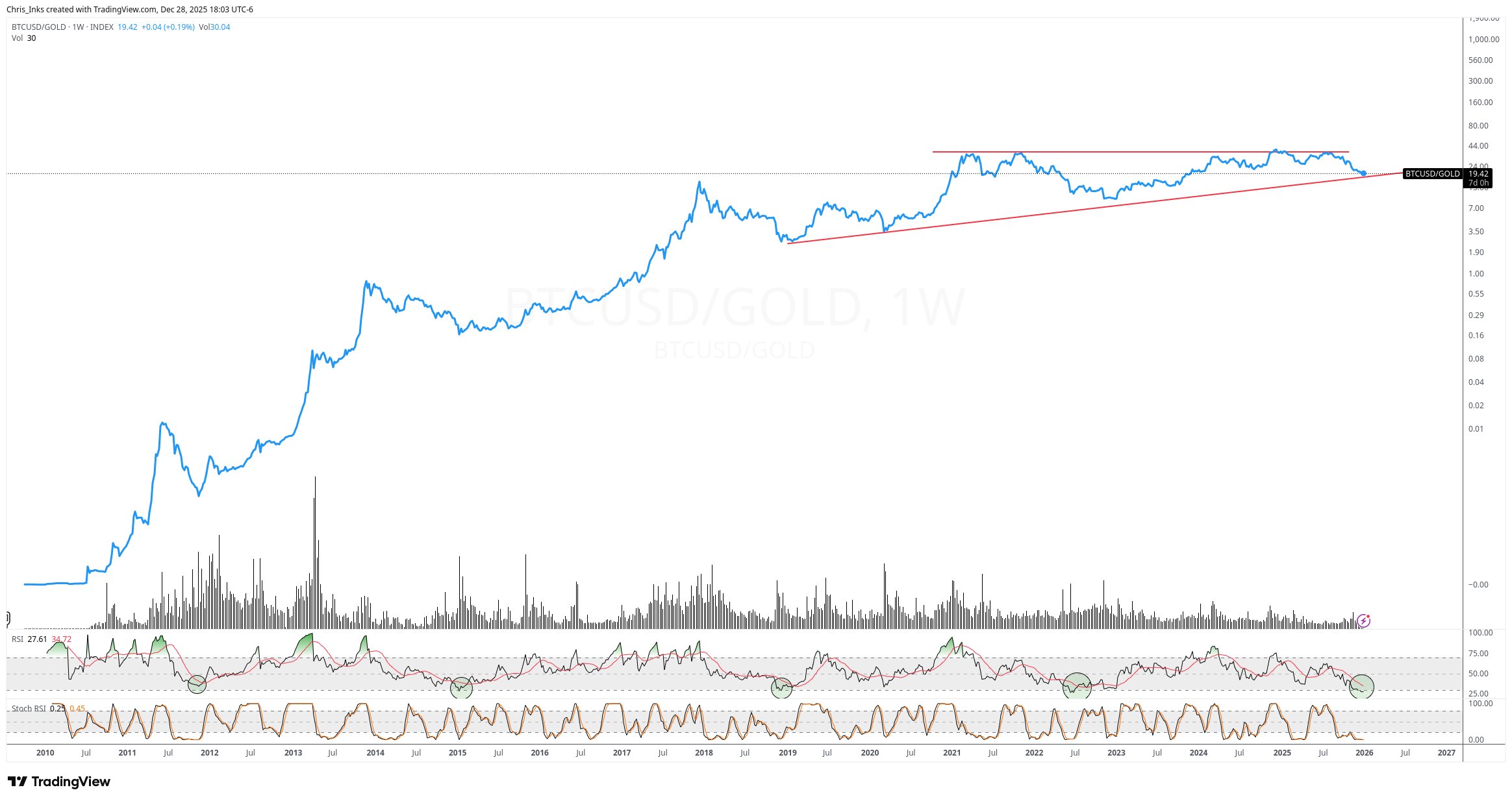
    Chart analyst Christopher Inks (@TXWestCapital) sees it similarly. While other analysts are panicking that Bitcoin could fall lower, Inks is projecting a bullish chart pattern. “I have seen several BTC/Gold line charts that virtually guarantee you further Bitcoin downward pressure. […] It is possible that an ascending triangle has formed and the price is heading straight back to the ascending support line.”

    Bitcoin Kursanalyse
    Bitcoin Forms Ascending Triangle, Source: @TXWestCapital on X

    In addition, like Yildirim, Inks also references the RSI in the weekly chart. “Every time in Bitcoin’s history when the RSI in this chart has fallen into oversold territory, it marked the bottom of the respective correction. That doesn’t mean that it necessarily has to be the same this time – it can always be different.”

    On-chain data: Realized losses remain high

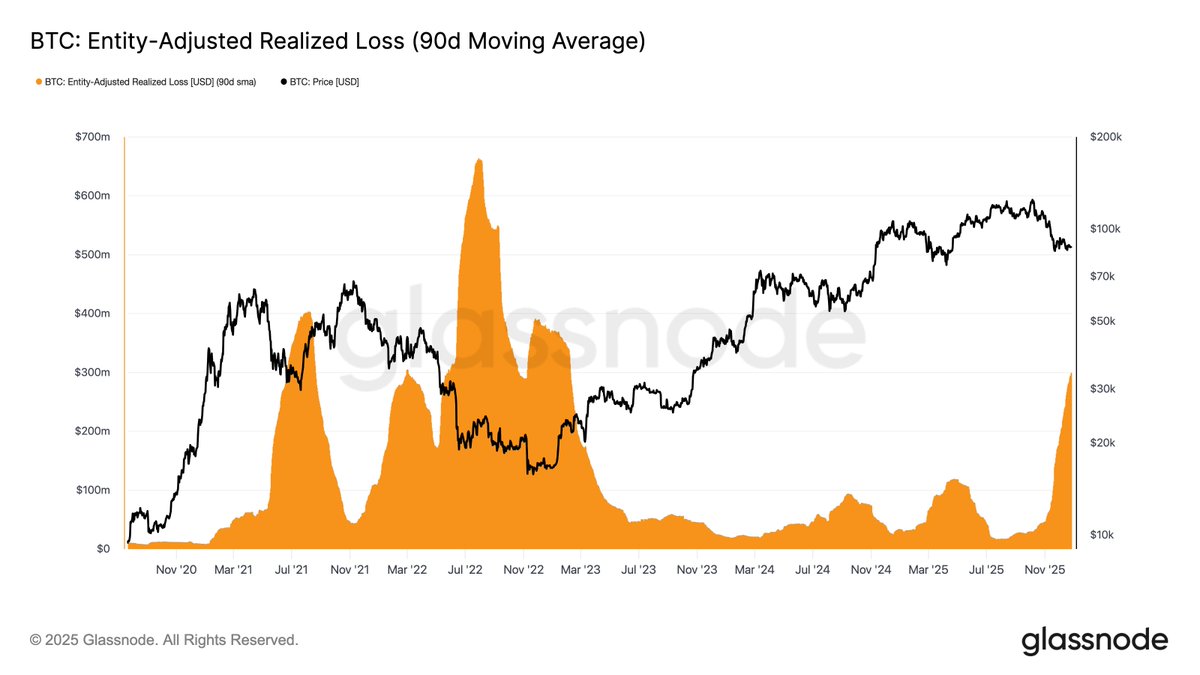
    While technical traders wait for clean setups, on-chain data shows a mixed picture. Glassnode Lead Analyst CryptoVizArt reports via

    Bitcoin Realized Losses (90-Day Moving Average)
    Bitcoin Realized Losses (90-Day Moving Average), Source: @CryptoVizArt on X

    The second sentence is crucial: “Although the price has stabilized above the true market mean (US$81,000), selling at a loss, triggered by the time-related frustration of the top buyers, has not decreased significantly.” This means that the bottom may still not be reached.

    Axel Adler Jr. interpreted the same loss dynamic as a “regime shift” after a capitulation phase. In his Morning Brief (“Capitulation Behind Us: Seller Pressure Down 80%”) he summarizes the core thesis as follows:

    “Three months of data show a radical regime change. November’s capitulation, with a Z-score between 8 and 11, marked the maximum stress point of the cycle. Since then, the 7-day average of realized losses has fallen from $2.4 billion to $0.5 billion, a decline of around 80 percent.”

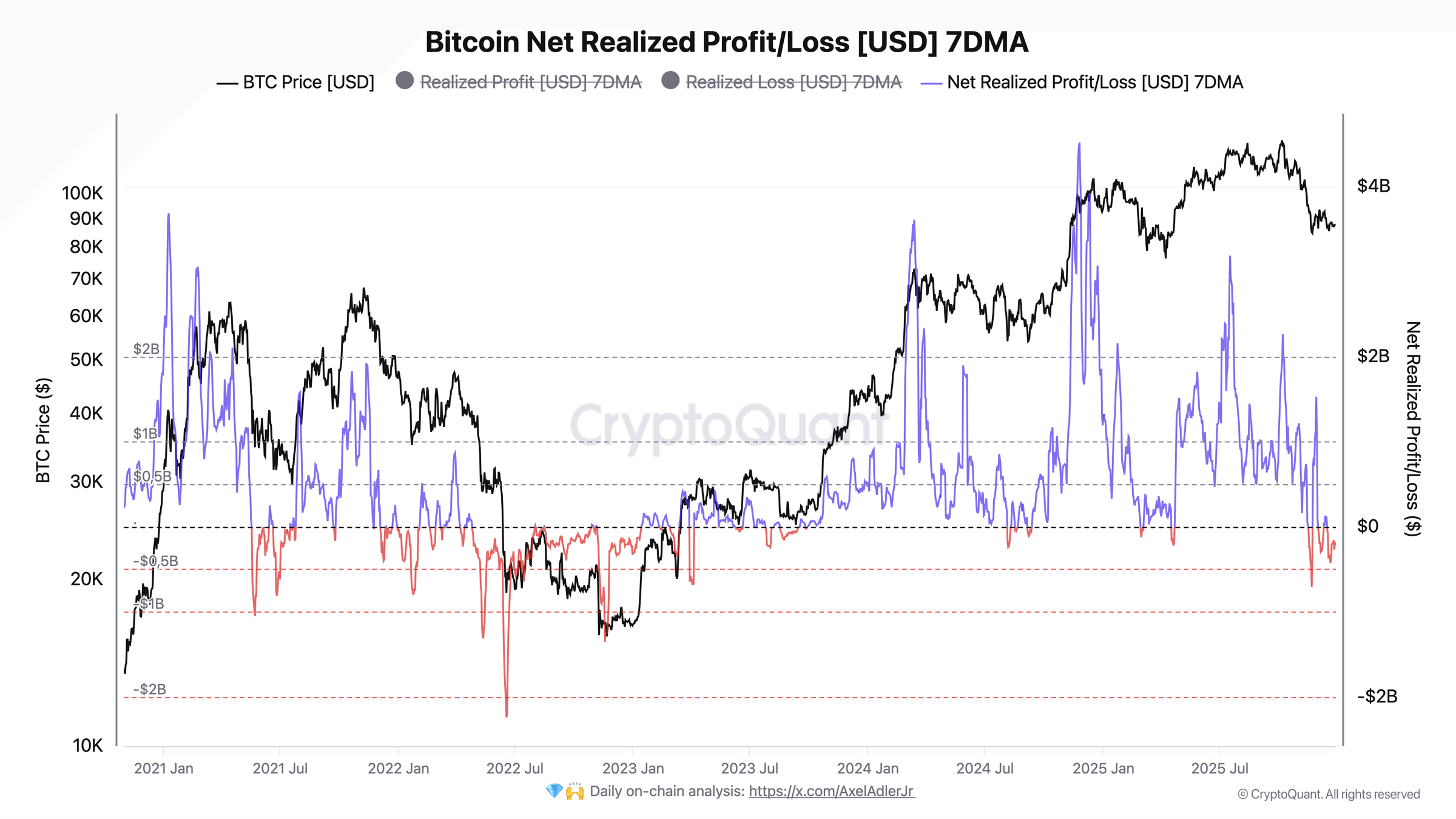
    Bitcoin Net Realized Profit Loss 7DMA
    Bitcoin Net Realized Profit Loss 7DMA, Quelle: Axel Adler

    Adler also refers to the “Bitcoin Net Realized Profit/Loss (7D SMA)”: Although the value is still negative, the direction is “clearly upwards,” and the depth of the negative swings “almost halved” in the last week of December. According to Adler, the approach to the zero line is a harbinger of a change in mood, but explicitly conditional: a real turnaround requires new demand.

    The bottom line is that at the end of the year, Bitcoin looks less like a trend market than like a market that is in the discovery phase. However, this is not unusual either. The turn of the year is traditionally a quieter phase on the financial markets. Technically, the $95,000 level remains the key resistance, while $84,000 is key support for the bulls.

  • Bitunix Exchange celebrates fourth anniversary with “Ultra 4ward” campaign and 4 million USDT in rewards

    Bitunix Exchange celebrates fourth anniversary with “Ultra 4ward” campaign and 4 million USDT in rewards


    Bitunix, one of the world’s fastest growing crypto exchanges, is celebrating its fourth anniversary. The anniversary marks a clear path towards greater security, better liquidity, advanced tools and an ever-growing global community.

    This development has recently been recognized internationally. Bitunix received two major awards for innovation, reliability and rapid growth. A few weeks ago, the platform was named “Best Emerging Exchange” was awarded. Bitunix previously received the title “Breakthrough Platform of the Year“The crypto exchange underlines its position as one of the most promising and trustworthy platforms in the crypto market.

    On its fourth anniversary, Bitunix looks back on years of growth, innovation and community building. With stronger security, deeper liquidity, practical trading tools and a global user base, the platform has earned the trust of millions of traders.

    Ultra security and transparency

    Bitunix has continuously expanded its security standards while increasing transparency for users. These include recent partnerships with Fireblocks and Elliptic for institutional security and compliance, independent security audits by Hacken, Certified and Salus, and the launch of Proof of Reserves. This means you can check at any time whether your holdings are fully covered.

    In 2025, Bitunix also launched the Bitunix Care Fund. This is a reserve of 30 million USDC intended to protect users in the event of unexpected technical or system-related problems.

    Ultra liquidity and trading experience

    Today, Bitunix supports more than 1,000 crypto trading pairs, processes over $5 billion in daily trading volume, and has more than 3 million users worldwide. This development also led to top 5 rankings on CoinGecko and reflects the growing confidence in the crypto market.

    Ultra-practical and easy-to-use products

    When developing new features, Bitunix relies on powerful but easy-to-understand tools. Instead of unnecessary complexity, the focus is on efficient and accessible crypto trading.

    The most important innovations include:

    • Ultra K-Line with advanced candlestick views
    • 16-Chart-Multi-Window-Modus for simultaneous market observation
    • Coin-M Perpetual Futures for additional trading options
    • Bitunix Earn for flexible income options

    The products support different trading strategies and remain intuitive to use.

    Strongly growing global community

    Bitunix’s growth is closely linked to its community. The exchange has been working with traders, content creators and data platforms for years to expand its international presence. In 2025, Bitunix also entered into a partnership with padel icon Sanyo Gutiérrez, who now acts as a community ambassador.

    In 2025 alone, the team was represented at ten major international events, including:

    • Web3 Amsterdam
    • Paris Blockchain Week
    • Token2049 Dubai
    • Token2049 Singapore
    • Wealth Expo Argentina
    • Cripto Latin Fest
    • LABITCONF

    A special highlight was Padel Day. At this event, Bitunix brought traders together for a day full of sport, exchange and personal encounters and showed that a crypto exchange can also be a community beyond the screen.

    Forward with gratitude

    The four-year anniversary represents not only the company, but also all users, partners and supporters who have accompanied this journey. The years from 2021 to 2025 tell a common story, characterized by individual decisions, new features and milestones achieved. With this foundation and a growing community, Bitunix is ​​moving confidently towards 2026, with the aim of remaining transparent, focusing on security and acting humanely.

    Celebrate four years with 4 million USDT in rewards, including Tesla and gold

    To mark the anniversary, Bitunix launched the Ultra 4ward Rewards campaign. A total of 4,000,000 USDT in prizes will be awarded, including Tesla vehicles, gold and trading rewards. You can participate by completing simple tasks such as trading, depositing, sharing your annual trading history, or inviting friends. Additionally, there are lucky draws and trading competitions with multiple chances to win. With Ultra 4ward, Bitunix thanks its community and gives back part of its success.

    To participate in Bitunix’s 4th anniversary campaign, visit this Link.

    About Bitunix

    Bitunix is a global crypto derivatives exchange with more than 3 million users in over 100 countries. The platform relies on transparency, compliance and security. A quick registration process, a user-friendly verification system with mandatory KYC and global security standards Proof of Reserves and the Bitunix Care Fund are the focus. The Ultra K-Line charting system offers a smooth trading experience for beginners and experienced traders. With leverages of up to 200x and deep liquidity, Bitunix is ​​one of the most dynamic platforms in the crypto market.

    Bitunix Global Accounts

    X | Telegram Announcements | Telegram Global | CoinMarketCap | Instagram | Facebook | LinkedIn | Reddit | Medium

  • MiCAR 2026: No more fun – Lithuania is the hardliner

    MiCAR 2026: No more fun – Lithuania is the hardliner


    • According to EU requirements, the transition period for the introduction of the EU MiCA regulation does not end until July 2026.
    • Not so in Lithuania: There it ends on December 31, 2025 with the start of the new year – and the small Baltic state has good reasons for this.

    Lithuania is a preferred EU location for crypto companies, even questionable ones. There are a lot of letterbox companies there that have benefited from the previously relaxed registration practices. This should end now, immediately.

    The Lithuanian Central Bank made it clear that unlicensed providers will face fines, website bans, forced closures and even criminal prosecution. The responsible managers of the companies face imprisonment of up to four years.

    The measures should not only be enforced against active platforms, but also against any company that continues to operate a website and maintain customer accounts without being able to show a MiCA license.

    The reason is plausible: over 370 crypto companies are registered, but only around 120 have real operational business. Less than ten percent have so far even applied for the MiCA license.

    This means that hundreds of companies will disappear from the market in 2026 – either voluntarily by going out of business or through foreclosure. Lithuania is therefore a MiCAR hardliner, aggressively presenting itself as a strictly regulating “MiCA gateway state” of the EU.

    The rowdies should go

    Dubious actors should disappear, and we want to become all the more attractive to renowned institutional providers.

    From mid-2026, all crypto service providers in the EU must be fully MiCA compliant. National transition periods, which could last up to 18 months, are expiring. Meanwhile, the EU stock market regulator ESMA has set up a central MiCA register.

    It makes licenses, white papers and violating providers public because everyone can see them. This creates a transparent market overview based on uniform criteria.

    Regulation becomes a location advantage

    For the DACH region this means: banks, regulated FinTechs and institutional custodians are becoming more important and EU passporting is becoming a decisive competitive advantage.

    This creates a counter-model to offshore jurisdictions in the Baltics, which advances EU MiCA regulation.

    In any case, there is a global regulation trend. The UAE is now cracking down on unlicensed crypto services including self-custody wallets; and even in the US and Asia, regulators are increasing their requirements.

    Regulation is becoming a global competitive advantage for an industry that has seen its days of the Wild West behind it.

  • ETH and XRP ETFs have a lot in common – but different levels of success

    ETH and XRP ETFs have a lot in common – but different levels of success


    • Ether ETFs are stable again after heavy outflows; XRP ETFs continue to have strong inflows – but without any effect on the price.
    • The data shows a market in which institutional investors are selective but not cautious.

    Ethereum ETFs had $84.6 million in net inflows, following outflows of over $700 million the previous week.

    Market volatility is currently increasing, while economic uncertainties – from tech stock prices to inflation data – are dampening risk appetite.

    Ethereum ETFs on the rise

    At the same time, a new impulse is causing discussion: BlackRock has applied for an “iShares Staked Ethereum Trust” (ETHB), one of the first ETFs that is intended to reflect staked ETH. This brings institutional staking within reach – a potential game-changer for the return structure of Ethereum products.

    XRP ETFs with inflows since day one

    The situation is completely different with XRP. XRP ETFs have not experienced a single day of outflow since their launch and most recently attracted $43.9 million in a single day – the highest amount since early December. Cumulative inflows are now over $1.1 billion. This long-term persistence of a positive trend in the crypto ETF sector is unique and even surpasses the early phases of Bitcoin and Ethereum ETFs.

    But despite the impressive capital inflows, the XRP price remains sluggish. According to analysis, several factors are responsible for this:

    • Much of the ETF optimism was already priced in
    • Arbitrage mechanisms dampen the visible buying pressure and
    • Off-exchange transactions move liquidity effects out of the spot market.

    In addition, XRP recently fell below the psychologically important $2 mark – despite 20 days of uninterrupted ETF inflows.

    The ETF data therefore shows a mixed picture: ETH is at the end of a phase of institutional restraint and could receive new impetus from products that can be staked.

    XRP, on the other hand, experiences one of the longest capital inflows in the entire market, without this being reflected in the price.

    For investors and analysts, the central question remains: Is XRP a silent accumulation phase – or a warning signal that even billions in ETF inflows will not be enough to mask structural market problems?

  • XRP has arrived in the DeFi world with “earnXRP”.

    XRP has arrived in the DeFi world with “earnXRP”.


    • Until now, XRP was primarily known as a payment currency, which impressed with its speed and efficiency in global payment transactions.
    • Start with “earnXRP”. Flare Network, Upshift Finance and Clearstar Labs an onchain facility with XRP earnings.

    For investors this means: full transparency, full control and the opportunity to finally let XRP work productively. earnXRP works very simply: Who FXRP – tokenized XRP on Flare – deposits into the vault, receives earnXRP tokens in return. These represent the deposit and current income.

    Behind the scenes, the system distributes funds to carry trades, staking over Firelight or concentrated automated market maker liquidity. This creates a diversified return profile that spreads risks and maximizes returns.

    Profits are automatically reinvested in XRP. In this way, your own portfolio grows continuously without you having to actively intervene.

    The combination of non-custody and interest rate effect makes earnXRP a product that is attractive for experienced DeFi users as well as for “classic” XRP investors. No central custody, no complicated administration – just a single vault that bundles complex Renndite strategies and returns the returns directly into XRP.

    Die „ROI-Engine“ XRP

    With earnXRP, XRP will finally be in the DeFi world arrived. Until now, the cryptocurrency was primarily known as a payment token. Now it is also a return asset. This is particularly exciting for private investors who rely on transparent, on-chain products. EarnXRP combines security, innovation and customer friendliness – not a given in the DeFi world.

    But the typical risks remain: vulnerabilities of smart contracts, market volatility and uncertainties in regulatory interpretation can influence the level of returns. But the fact that earnXRP runs completely onchain and is non-custodial creates trust and sets it apart from the usual classic DeFi products.

    For the XRP community, earnXRP is the signal that XRP no longer just has a future as a means of payment, but also as a source of returns.

  • Czech Republic: After 3 years no more taxes on Bitcoin & Co

    Czech Republic: After 3 years no more taxes on Bitcoin & Co


    • The Czech Republic charges on cryptocurrency held for more than three years, ka capital gains tax more.
    • This makes the Czech Republic one of them most crypto-friendly EU states and is likely to attract more long-term investors into the country.

    Profits from the sale of Bitcoin and other cryptocurrencies will in future be tax-free in the Czech Republic if they are held for at least three years. They apparently want to become a crypto-friendly EU location.

    The new capital gains tax law rewards long-term investors and is intended to make speculation as unattractive as possible. It is a strategic step to create stability in the market and bring international investors and startups into the country.

    Industry experts already see the Czech Republic as a hub for crypto innovations.

    Capital gains tax in Germany and the Czech Republic

    competitor Germany

    Now one could argue that in Germany crypto investors are exempt from capital gains tax after just one year. That’s correct. But there is a catch, and it is crucial: you are only exempt from capital gains tax.

    However, anyone who uses their coins for staking or lending in Germany must hold them for up to ten years in order to benefit from tax exemption. The Czech Republic, on the other hand, relies on a clear and simple deadline of three years, regardless of use – “No muss, no fuss,” as the Americans would say.

    Both countries are pursuing different approaches to achieve the same thing; they want to regulate their markets and at the same time promote investment.

    Germany makes it complicated, the Czech Republic makes it easy. The Czech model could therefore be more attractive for private investors.

    Positive industry reaction

    The response from the crypto industry is predominantly positive. Retailers and startups see opportunities for more planning security and lower costs. But analysts point out that tax rules can change as quickly as they are put into effect. Investors should follow developments closely.

    With the new law, the Czech Republic is sending a clear message: Anyone who holds Bitcoin and other cryptocurrencies for the long term will be able to benefit tax-free in the future – and the country itself could prove to be the preferred crypto location for the European crypto industry.

  • Bitcoin forecast for 2026: VanEck sees cycle low at $75,000

    Bitcoin forecast for 2026: VanEck sees cycle low at $75,000


    • VanEck expects Bitcoin consolidation in 2026.
    • Declining volatility and adjusted leverage tend to suggest bottoming out.

    VanEck expects Bitcoin to be a year of consolidation in 2026, rather than a new parabolic rise or a deeper crash.

    In a 2026 outlook titled “Plan for 2026: Predictions from Our Portfolio Managers,” Matthew Sigel (Head of Digital Assets Research) writes that the broader crypto market “enters 2026 with mixed but constructive signals. Bitcoin fell about 80% in the last cycle, but realized volatility has since fallen by about half, implying a proportional decline of around 40% this time.”

    No Bitcoin price target, but a bottom forecast

    Since the Bitcoin price is already almost 35% below October’s all-time high of $126,199, VanEck assumes that the further fall is likely to be relatively small. A 40% drawdown from the all-time high could mean a cycle low around $75,000.

    Additionally, Sigel relies on the historical halving cycle: “Bitcoin’s historical four-year cycle, which typically peaks immediately after the US election, remains unchanged after peaking in early October 2025. This pattern suggests that 2026 will be a year of consolidation rather than a year of rapid rise or collapse.”

    In support of this thesis, VanEck’s chief analyst highlights three other reasons: First, global liquidity is “mixed”: possible interest rate cuts could be bullish, while US liquidity tightens “a little” as AI-driven bubble worries meet a more fragile funding environment and credit spreads widen. This is rather bearish.

    Secondly, leverage levels across the crypto market have reset after several “washouts” such as the October 10 crash, which is also a bullish signal. Third, Sigel observes positive on-chain signals, “even if they are not yet clear.”

    However, VanEck consciously remains defensive. To its institutional clients, the asset manager recommends “a disciplined Bitcoin allocation of 1 to 3%, built up via dollar-cost averaging,” supplemented by active timing: follow-up purchases in the event of “leverage unwinds” and scale “into speculative excesses.”

    In addition to the macro events, VanEck addresses the increasingly loud topic of quantum computers. “We also note that Quantum Security has become an active topic within the community, and while it is not an immediate threat, any coordinated response could be similar to the early Blocksize debates.”

    The key is the process: During the 2017 Blocksize Wars, “a transparent and technically rich public process attracted large numbers of new observers to the ecosystem and strengthened long-term commitment,” said Sigel.

    Bitcoin miners and stablecoins

    However, VanEck sees the strongest opportunities not in the Bitcoin spot market, but in the mining sector. The authors expect the “strongest opportunity” in capital-intensive competition for 2026: Miners would have to simultaneously expand hashrate and finance AI and high-performance computing (HPC) infrastructure. “This is pushing balance sheets to their limits and widening the cost of capital spread within the sector.”

    According to VanEck, miners with hyperscaler partnerships can take out new loans on attractive terms, while second-tier operators rely on dilutive converts or “sell Bitcoin into weakness.”

    VanEck speaks of “the cleanest consolidation setup since 2020 to 2021” and sees the best risk-reward profile in miners evolving into “energy-backed compute platforms” with “credible HPC economics,” cheap electricity access and advantageous financing routes.

    VanEck cites stablecoins in B2B payment transactions as a second, more selective thesis: real settlement flows could improve working capital and reduce cross-border costs. However, the authors see the “most lasting” opportunity in fintech and e-commerce operators that enable adoption, rather than in broad token exposure.

  • XRP sentiment turns negative, price falls below important support

    XRP sentiment turns negative, price falls below important support


    • XRP is seeing significantly negative social media sentiment and is falling below the important $1.95 mark.
    • The US spot XRP ETFs continue to report net inflows, although the chart picture is stressed in the short term.

    Shortly before Christmas, XRP is in a classic area of ​​tension: While social sentiment data has slipped significantly into the negative again and thus historically favors a rebound, the price has lost much-noticed support at higher time levels. In parallel, inflows into US spot XRP ETFs remain green.

    XRP sees extremely negative social media sentiment

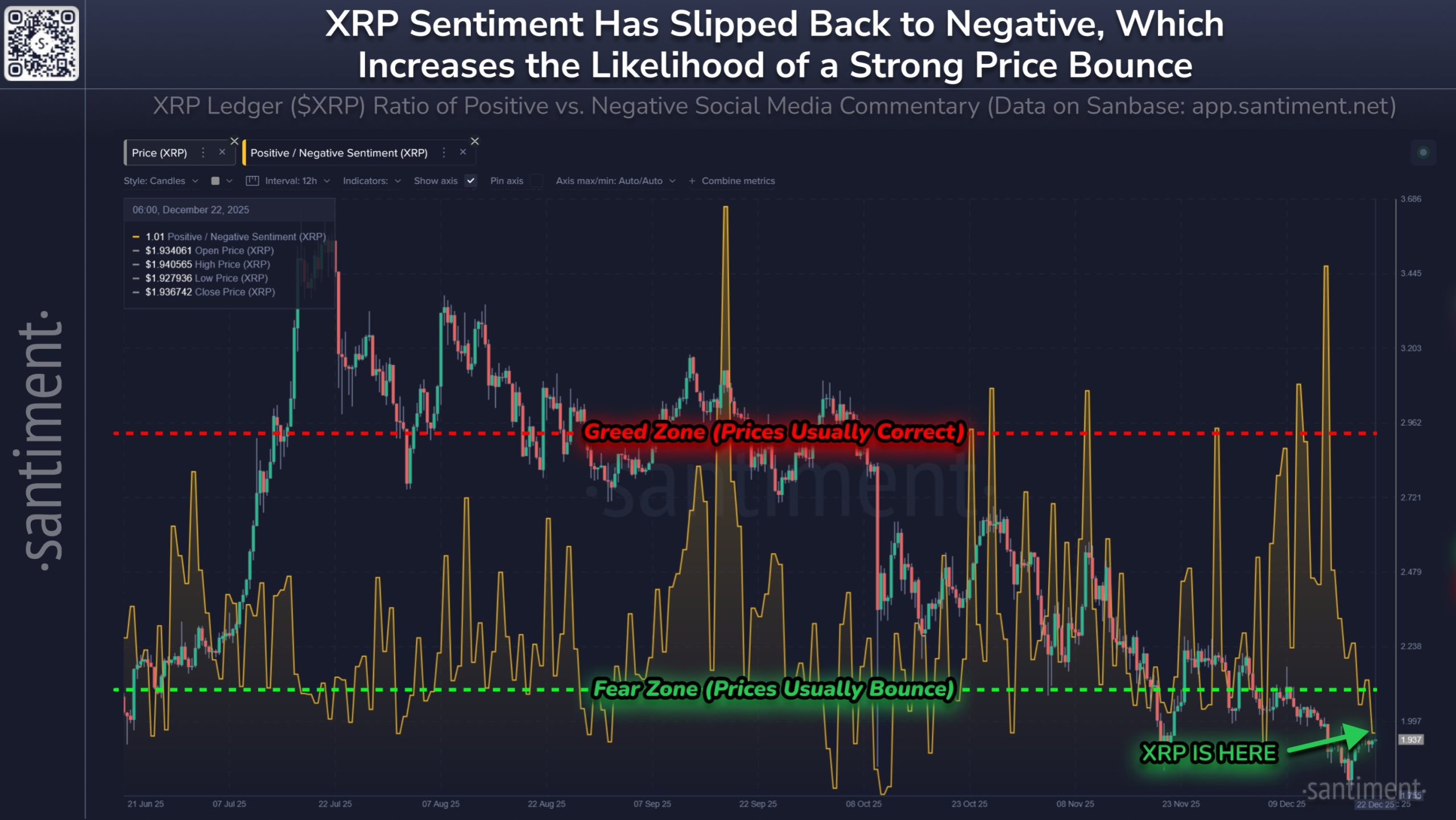
    On-chain analytics firm Santiment has a chart on X dividedwhich shows above-average negative sentiment on social media towards XRP. Santiment commented on X on Thursday:

    “XRP is currently experiencing significantly more negative comments on social media than usual. Historically, this pattern often led to price increases. When retail investors doubt that a coin can rise, an increase becomes significantly more likely.”

    XRP Social Sentiment Daten
    XRP Social Sentiment Data, Source: @santimentfeed on X

    The point is not a price target, but a setup: If retail becomes significantly more skeptical than usual, the XRP price has tended to recover in the past.

    XRP price slips below central support

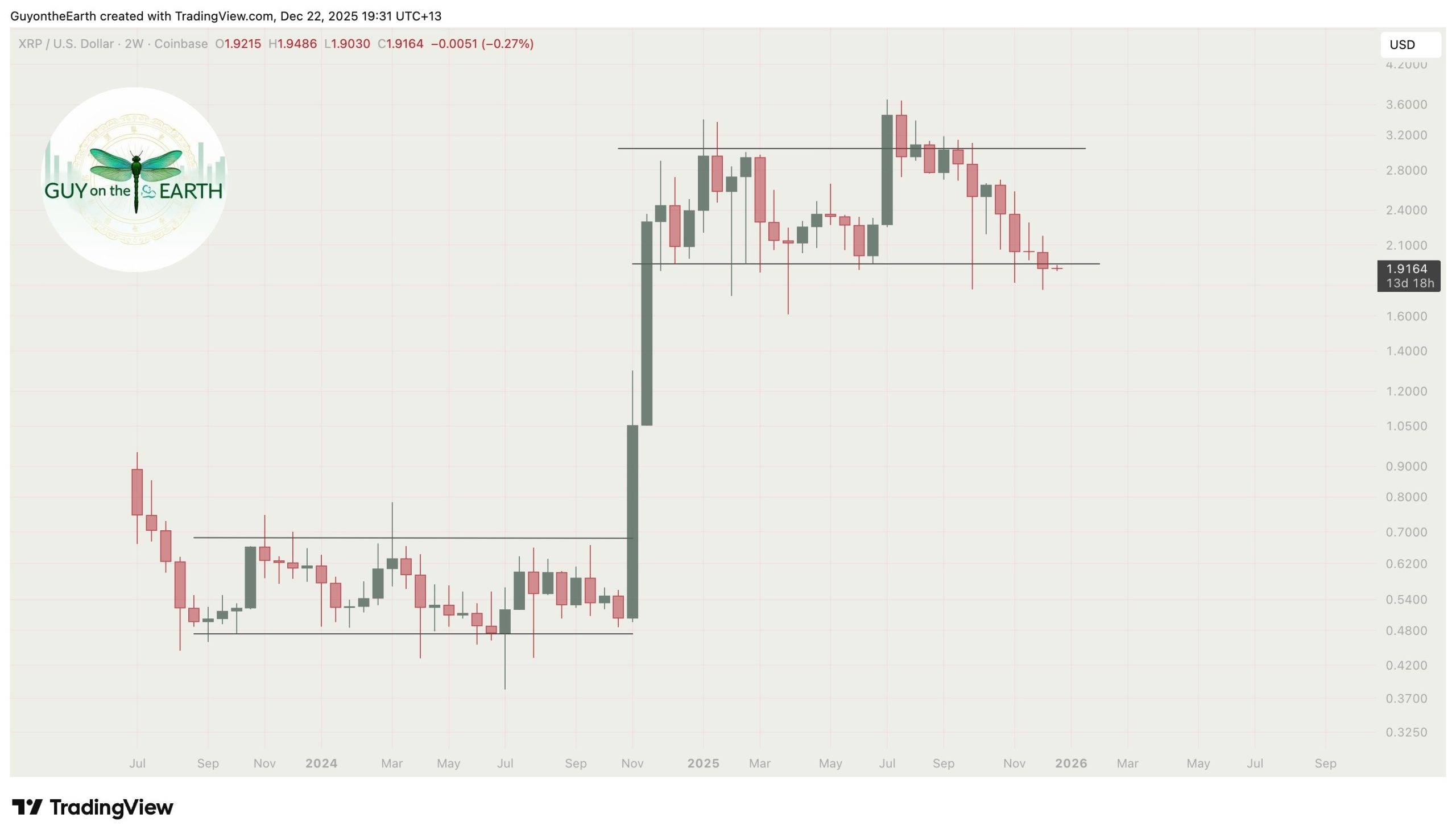
    Crypto analyst “Guy on the Earth” (@guyontheearth) focuses on the zone around $1.95. He writes via

    XRP price analysis, 2-week chart
    XRP price analysis, 2-week chart | Source: @guyontheearth on X

    This directly links the break of a “Rectangle” structure with a technical downside target of $0.90. At the same time, he makes it clear what condition applies to a short-term easing: a price above 1.95 US dollars.

    “The goal is to get back above $1.95. We tested this earlier but were rejected and another lower high has formed. Only an attack to 1.95 and a close above (on any time frame now) would turn my short-term bias back to bullish.”

    His time window is narrow: He says his “best hope” is that the month doesn’t lose the zone and that XRP gets back above $1.95 “in the next 9 days”. At the same time, he emphasizes the character of the move as structurally bearish: “The chart is bearish – that cannot be explained away.”

    The article is also a guide for different risk profiles:

    “If you feel uncomfortable with this breakdown, sell to reduce your risk to a level you are comfortable with. Then buy back as soon as there is a close above $1.95 on the daily chart (or on the time frame you trust) – then your percentage loss in XRP will be almost negligible. However, if we fall to $0.90, you would – on the invested capital – “We are looking at another 50% loss.”

    For long-oriented buyers, he names staggered zones: 1.61 US dollars, 1.42 US dollars, then 0.90 US dollars and 0.75 US dollars as an “initial breakout”.

    Despite the break, he still sees bullish elements: “And it’s not all bad! We’re less than four cents away from resistance, and there continues to be a massive bullish divergence on multiple time frames that can still play out. I still believe we can recover from here – and that this breakdown could be a capitulation, like in April.”

    ETF flows remain green

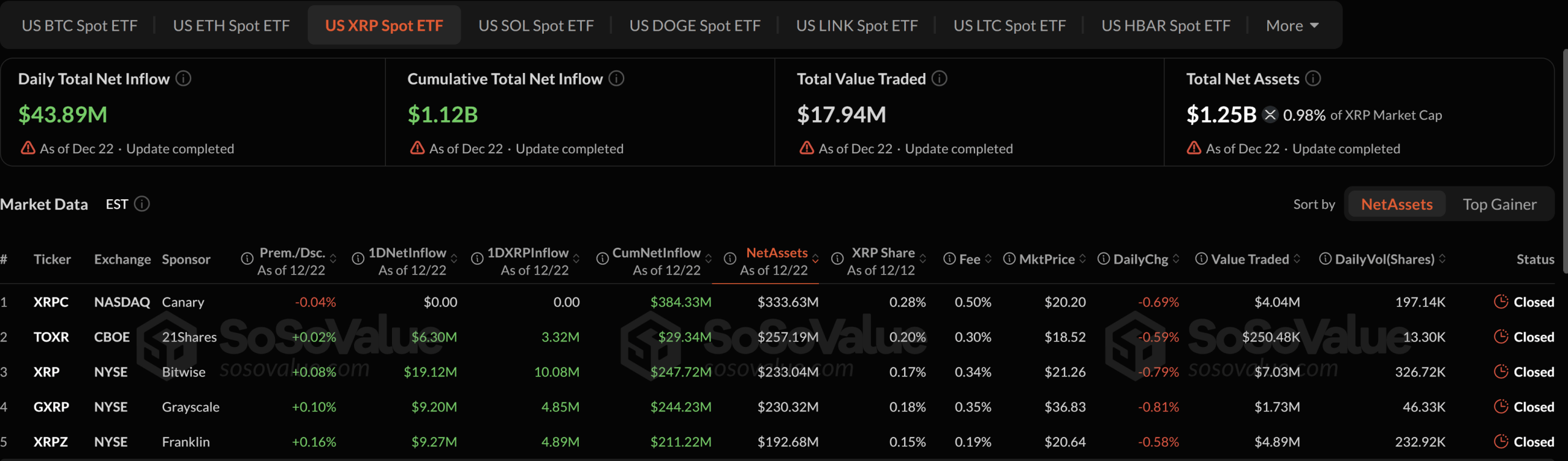
    The third data point is the US spot XRP ETFs. After the brilliant launch of the XRP ETFs, SoSoValue data continues to show an uninterrupted series of ETF net inflows that have now lasted six weeks; Cumulative inflows are $1.25 billion and Cumulative Total Net Inflows are $1.12 billion.

    Among the five spot XRP ETFs, Canary continues to defend the top position with $384.33 million in capital. In total, all ETFs have attracted a net capital of $93.57 million and $82.04 million, respectively, over the past two weeks. Yesterday, Monday, it was already 43.89 million US dollars.

    Spot XRP ETF data
    Spot XRP ETF data | Source: SoSoValue

    At the time of writing, XRP was available $1.90 and therefore still below the important market price of $1.95.