Category: Coins

Digital assets, cryptocurrencies, blockchain, and currency news.

  • Bitcoin under pressure: Is Japan instead of Greenland the trigger for the crash?

    Bitcoin under pressure: Is Japan instead of Greenland the trigger for the crash?


    • Bitcoin has temporarily fallen over 8% since Sunday and is currently trading at around $89,400.
    • Experts see the driver as a renewed shock in the Japanese bond market and not the US-EU customs dispute.

    The Bitcoin price has fallen by more than 8 percent since Sunday. After BTC temporarily reached almost 98,000 US dollars with a strong start to the year, a large part of these gains has now been given back. On Wednesday, Bitcoin was trading at around $89,400. The US-EU customs dispute in the wake of Donald Trump’s Greenland demands was initially seen as the trigger for the setback.

    In fact, according to several market observers, an abrupt shock in the Japanese bond market may have led to the risk-off move in Bitcoin and altcoins, while gold hit a new all-time high at $4,888 an ounce. Japan’s bond yields exploded: the 30-year JGBs rose to 3.875 percent (record), the 40-year to 4.224 percent (record), and the 10-year JGBs rose 3.7 percent in a day.

    US Treasury Secretary Scott Bessent made Japan the direct driver of the current market turmoil in a TV appearance on Tuesday. Bessent explained:

    “I think the markets are falling because the Japanese bond market has had a move of six standard deviations in the last two days. […] “I have been in touch with my economic policy contacts in Japan and urged them to take the necessary measures to stabilize their bond market – but this is spilling over into all bond markets.”

    He added that yields rose not only in the US, but also in Germany and France, and emphasized: “This has nothing to do with Greenland.”

    The central fear: Japan is considered the largest foreign holder of US government bonds. If the rise in domestic yields causes Japanese investors to stay at home more or create selling pressure, this could hit the US Treasury market – either through lower demand or through reallocations.

    BitMEX-Gründer Arthur Hayes wrote to do this on X:

    “The problem for bonds is if Japanese investors stay home because yields on JGBs are higher and stop funding Pax Americana.”

    In another post, he highlighted the long maturities as a potential spark: “This is the match: the 30-year JGB yield. Let’s see how big the fire gets.”

    From Hayes’ point of view, the headline itself is less important than the volatility. He advises:

    “Watch MOVE. If he shoots to 130-140, some sort of bailout is coming. Otherwise, get ready for the pain trade if that triggers risk-off.”

    LondonCryptoClub (@LDNCryptoClub) argued on

    “Bitcoin is reflexively traded as a risk asset. However, it will quickly recognize the liquidity and subsequent devaluation and follow the price of gold. As previously mentioned, Bitcoin covers both the left and right ends of the risk distribution. On the left, when the current economic and political structures collapse, it is the ultimate hedge. We are not there yet… but we are getting close to that point.”

    Meanwhile, Dan Tapiero, founder and CEO of 50T Funds, explains on X that Bitcoin should actually rise, but perhaps not immediately:

    “The Japanese bond market is collapsing completely and is currently affecting all markets. This is what a market looks like that is no longer functioning properly. The authorities will try to intervene and stabilize the situation. Bessent is aware of this. The yen will continue to fall sharply. Gold is rising, Bitcoin is expected to follow.”

  • VeChain sharpens governance: Sunny Lu calls “lazy voting” into the fight

    VeChain sharpens governance: Sunny Lu calls “lazy voting” into the fight


    • VeChain founder Sunny Lu presents a two-tier governance proposal for VeBetterDAO that aims to prevent “lazy voting” in weekly voting.
    • Phase 1 relies on new multipliers, phase 2 introduces delegable “navigators” with staking and slashing rules.

    VeChain founder Sunny Lu brought attention to his new governance proposal on the VeBetterDAO forum in a post on X on January 20th. The Suggestion is intended to combat the issue of “lazy voting” in weekly allocation voting.

    His idea is a two-stage upgrade: In the first step, incentives for active voting are improved, after which VeChain users should be able to delegate their voting rights without giving up control of their tokens.

    How the Vechain founder wants to promote more participation

    According to the VeChain founder, the current governance model favors convenience over active participation, resulting in “stagnant allocations” and disadvantages for new projects. Lu writes:

    “Weekly allocation voting has gradually become highly reward-driven, resulting in widespread ‘lazy voting.’

    To encourage active participation, Phase 1 relies on two multipliers. The “Freshness Multiplier” increases weekly voting power depending on how recently a VeChain user has actively adjusted their allocation.

    Those who update weekly receive 3.00x; an update every two weeks brings 2.00x; without an update over three or more rounds it remains at 1.00x. An “update” is any change, such as adding or removing dApps or rebalancing shares. The logic: Regular reassessment should not be forced, but should be more economically attractive than passivity.

    The second multiplier targets votes in which, according to Lu, extremely high abstention rates dominate. The VeChain founder states:

    “50-60% of votes are ‘abstention’, often from over 10,000 wallets. ‘For/against’ votes in recent proposals typically come from fewer than 2,000 wallets. At this stage of ecosystem maturity, abstention provides minimal information or governance value – and inflates the optics of participation without improving decision quality.”

    According to the proposal, a second multiplier should therefore be introduced: abstentions will still be possible, but will be paid less. For/Against receives 1.00x, abstention receives 0.30x (“Governance Intent Multiplier”).

    Phase 2: Delegation an „Navigators“

    Phase 2 introduces “Navigators,” where users can voluntarily delegate their weekly decision. The delegation can be revoked at any time; users retain ownership of VOT3. The delegated voting power is based on the token holder’s multipliers and their behavior. Navigators must disclose a public profile, voting strategy, conflicts of interest, and publish regular reports.

    As a reward, Navigators receive a fixed share of 20% of the delegators’ weekly rewards; Charges will be suspended for four rounds. A staking and slashing framework is central: 10% of the delegated VOT3 is required, with a minimum stake of 50,000 VOT3 and a maximum stake of 1% of the circulating VOT3.

    If the stake falls below the minimum for seven days, auto-removal follows; Violations can result in minor slashes (10%), such as missed votes or missing reports, up to major slashes (up to 100% of stake and blocked fees) in the event of serious misconduct such as manipulation, bribery or undisclosed relationships.

  • Cronos Labs joins the MiCA Crypto Alliance

    Cronos Labs joins the MiCA Crypto Alliance


    • Cronos Labs, operator of the Cronos blockchain, has joined the MiCA Crypto Alliance. This association of EU crypto companies is committed to a uniform, practical implementation of the MiCA regulation.
    • By joining, the Alliance is expanding its network to include a technologically strong player who has been committed to practical regulation and sustainable system development for years.

    The MiCA Crypto Alliance sees itself as the voice of the European crypto industry, in which regulation has become increasingly important since the turn of the year.

    The Alliance has been criticizing for months that the MiCA rules are being implemented at different speeds and with different levels of rigor in the individual EU member states. This creates uncertainty for companies that operate in several EU countries at the same time.

    That is why there is a call for closer exchange between regulatory institutions and the industry in order to create uniform standards.

    For Cronos Labs, joining is a strategic step. The company supports start-ups, developers and Web3 projects in the Cronos system and sees clear regulatory frameworks as a prerequisite for sustainable growth.

    The EU MiCAR era has begun

    For the first time, the MiCA Regulation offers an EU-wide legal framework for crypto assets, which provides greater security, especially for institutional market participants. Cronos Labs wants to actively shape this process and contribute its technical expertise in areas such as DeFi security, interoperability and token economics.

    The accession also has a symbolic meaning. Cronos Labs is closely involved Crypto.com one of the largest global crypto providers that has already received a MiCA license.

    This brings a protagonist into the Alliance who is very well connected both technologically and institutionally. For the Alliance, this means additional influence and for Cronos Labs the opportunity to help shape regulatory developments at an early stage.

    The EU crypto industry relies on professionalization and reliable regulation. As MiCA implementation reaches its final phase this year, Cronos Labs is playing an important role in balancing the tension between technological innovation and legally sound regulation.

  • IOTA in Seoul: Schiener positions IOTA as an infrastructure for global trade

    IOTA in Seoul: Schiener positions IOTA as an infrastructure for global trade


    • IOTA refers to a Maeil mention by co-founder Dominik Schiener in the context of the World Crypto Forum (WCF) in Seoul.
    • Schiener wants to explain “how trade data can be moved quickly and precisely across borders.”

    On Monday, IOTA pointed out on X that co-founder Dominik Schiener was mentioned in the South Korean business newspaper Maeil Business Newspaper in the context of the World Crypto Forum (WCF).

    The post marks a continuation of the Korea initiative that IOTA aggressively announced at the beginning of January: more mainstream presence, less crypto internal communication and a clear focus on cross-border trade data as an area of ​​adoption.

    In the Maeil report, the WCF is classified as a meeting point for international industry representatives. It says there:

    “The first World Crypto Forum, where global heavyweights discuss the future of digital assets, is taking place in Seoul. In keeping with the motto of a ‘fusion of finance and digital assets’, it is about digital financial models in which stablecoins and real-world assets (RWA) are merged with blockchain networks. 68 speakers are traveling from North America, Europe, Africa, Asia and the Middle East.”

    What is striking is the common thread: stablecoins, payment infrastructure, tokenization and “real-world” data flows. Maeil lists, among others, a16z, Solana, Chainlink, Binance and Grayscale as participants and anchors Schiener in a thematic block that does not sell “narratives” but rather addresses concrete integration questions.

    About IOTA, the presentation says that Schiener wants to explain “how trading data can be moved quickly and precisely across borders.”

    IOTA brings Korea into focus

    The tone is consistent with what IOTA announced at the beginning of January. As CNF reported, in the context of Korean media presence it said:

    “We are excited to start 2026 in The Economist Korea’s spotlight, showcasing Dominik Schiener and positioning IOTA as the core infrastructure for the digitalization of global trade.”

    At the beginning of the year, the IOTA Foundation stated that South Korea had already made great progress in the area of ​​digitalization, but identified a possible use case in global trade:

    “The biggest bottleneck remains cross-border trade, where international processes continue to rely on paper and manual trust mechanisms. This is exactly where IOTA and TWIN come in: a neutral, public infrastructure that connects these systems openly, securely and globally across borders.”

    Schiener himself announced at the beginning of January that he would “spend significantly more time in Korea this year and push forward the introduction of IOTA among financial institutions, logistics companies and the government.” The WCF now provides a stage for this and at the same time a signal that IOTA wants to advance its adoption narrative in South Korea in 2026.

  • From the wallet to the tax office: Why Bitcoin investors now have to document more precisely

    From the wallet to the tax office: Why Bitcoin investors now have to document more precisely


    • Income from crypto assets has previously been a gray area from a tax perspective that overwhelmed many private investors – and the tax authorities were lenient.
    • The new reporting and transparency obligations that have been in force in the EU since January and also in Switzerland through international agreements are now over.

    For crypto investors, this means one thing above all: Anyone who does not properly document and correctly state their transactions will risk receiving notice from the tax office much more quickly in the future. The most important change concerns the automatic transmission of transaction data.

    Crypto exchanges, brokers and other crypto service providers must report all relevant movements to the tax authorities. Leaving smaller or older transactions quietly under the table will no longer be tolerated.

    Even transfers between your own wallets can become tax-relevant if they indicate profits or changes in value. Investors should therefore start organizing their wallet structure early on and create comprehensible documentation.

    The question of the holding period is tricky. In Germany, profits from the sale of cryptocurrencies are tax-free after one year, while Austria and Switzerland have different deadlines. The new rules do not change this, but they do increase the likelihood that incorrect information will be noticed.

    Anyone who moves tokens between several wallets quickly loses track of the purchase times. Tax experts therefore recommend logging every transaction immediately and, ideally, using software that automatically combines purchase, sale and transfer histories.

    Staking and lending are also moving more into focus. Many investors forget that income from such activities is taxable regardless of the holding period. Thanks to the new reporting requirements, this income is now systematically recorded.

    Anyone who provides incomplete information not only risks back payments, but also criminal consequences. It is therefore worth regularly checking the tax treatment of your own crypto strategy and adjusting it if necessary.

    Another point concerns evaluation. Since cryptocurrencies are traded around the clock, the exact time of a transaction is crucial. Tax offices are increasingly relying on standardized price sources, which can lead to deviations if investors use their own values.

    In order to avoid disputes, it is recommended to document the price data used transparently and to use generally accepted price indices.

    Overall, the new rules lead to more clarity, but also to more processing work. Anyone who structures their crypto activities, documents them properly and declares them correctly for tax purposes does not have to worry about the new requirements.

    For everyone else, it’s time to get their wallets in order before the tax office does.

  • Ethiopia plans state-run Bitcoin mining: search for partners starts

    Ethiopia plans state-run Bitcoin mining: search for partners starts


    • Ethiopia wants to mine Bitcoin state-run and is looking for a partner.
    • The project is part of a broader sovereignty agenda. Ethiopia wants to bundle strategic infrastructure more closely with the state.

    Ethiopia’s government is signaling that it not only wants to tolerate Bitcoin mining, but also wants to operate it at the state level. Kal Kassa, founder of the Ethiopian education initiative BitcoinBirr, drew attention to this development on January 19th. In a shared video, Ethiopian Prime Minister Abiy Ahmed Ali says state-owned Ethiopian Investment Holdings (EIH) is looking for a partner to mine Bitcoin “directly on behalf of the country.”

    Kassa wrote on

    In the shared video, Abiy Ahmed Ali says: “Crypto mining with large companies is starting to work and is expected to prove highly profitable. Through Ethiopian Investment Holdings, a state-owned company, we are looking for experienced partners who can bring capital, technology and expertise in mining. Through this, Ethiopia aims to generate revenue directly for the country instead of relying solely on private companies.”

    Ethiopia has grown as a Bitcoin mining location in recent years, primarily due to cheap hydropower. A central building block is the Grand Ethiopian Renaissance Dam (GERD), which, according to Reuters, was officially inaugurated in 2025 and has reached a capacity of 5,150 megawatts.

    Global hashrate distribution estimates vary depending on the source. Hashrate Index puts Ethiopia’s share of the global Bitcoin hashrate at 2.58% or around 27.5 EH/s. This puts Ethiopia behind the USA (37.523% or 200 EH/s), Russia (16.417% or 175 EH/s), China (11.726% or 125 EH/s), Paraguay (4.034% or 43 EH/s), Oman (3.002% or 32 EH/s) and Canada (2.627% or 28 EH/s), but ahead of Kazakhstan (2.064% or 22 EH/s).

    Bitcoin mining as part of a larger agenda

    The EIH should not only handle mining. It is part of a larger plan to bundle key infrastructure more closely with the state. According to one Message by BirrMetrics on the “Finance Forward Ethiopia 2026” conference, the EIH is expected to accelerate the development of domestic banknote production capacity – a project that would reduce Ethiopia’s dependence on foreign printers.

    In this context, Abiy said about the role of the holding company: “The institution will establish many central, previously unspoken strategic arms.” By 2030, the holding company is expected to cover around 20% of economic output. “If this goal is achieved, Ethiopia will have created a structure that can be passed on to the next generation,” Abiy said.

    According to BirrMetrics, EIH manages around 40 state-owned companies and is also working on a gold refinery in addition to the Bitcoin mining project.

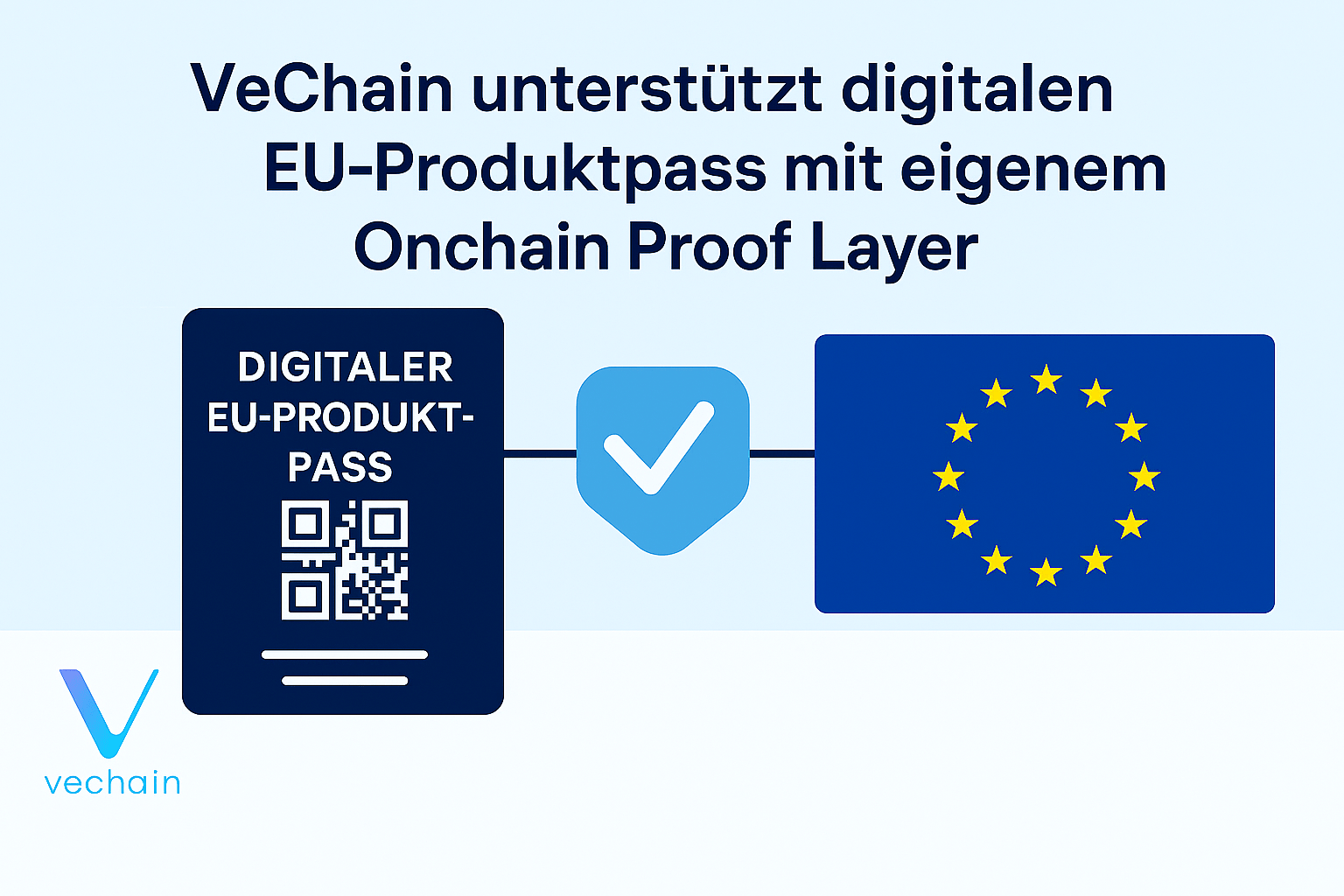
  • VeChain and Rekord bring the EU product passport into production

    VeChain and Rekord bring the EU product passport into production


    • VeChain and Rekord AG are developing a product for the EU Digital Product Passport (DPP) together with the AMRC (University of Sheffield).
    • Technically, VeChainThor verifies the evidence and data sets as layer 1, while Rekord puts a “trust layer” on top.

    The VeChain Foundation and Schweizer Rekord AG are continuing to expand their partnership and want to deliver a production-ready infrastructure for the rollout of the EU Digital Product Passport (DPP).

    In one Contribution on

    VeChain and Rekord are building EU DPP infrastructure

    VeChain refers to the EU Ecodesign for Sustainable Products Regulation (ESPR) as well as other regulations such as EUDR, CBAM and CSRD, which will make life cycle traceability a de facto condition for entry into the EU market. The mandatory DPP rollout begins in the EU for large companies from 2026. Other sectors and company sizes are to follow gradually by 2030.

    VeChain and Rekord see this as an opportunity: Many manufacturers are planning but not yet productive. Record puts it like this:

    “Despite the urgency, most manufacturers are still in the planning or pilot phase. Digital Product Passport initiatives and roadmaps significantly exceed the number of production-ready systems that will be live before the first enforcement dates. Our collaboration with VeChain and the AMRC aims to close this readiness gap by delivering an industrial-scale stack that can be rolled out in factories today.”

    As CNF reported last week, the pilot test has already processed more than 100,000 transactions in its first month.

    AMRC is an industry-focused research and development center at the University of Sheffield and part of the UK High Value Manufacturing Catapult. It works with industrial partners from areas such as aviation, automotive, energy and medical technology.

    An AMRC spokesperson emphasizes the project’s great ambitions:

    “Digital product passports are rapidly moving from concept to mandatory in the European Union. Working with Rekord, we see one of the first stacks that can meet ESPR and DPP requirements at realistic industrial scale – with real-time data instead of PowerPoint slides.”

    Technically, the product relies on VeChainThor as a Layer 1 network to verify evidence and data sets; Rekord places a “trust layer” on top that translates raw data into verifiable, data protection-preserving evidence.

    AI services are mentioned that evaluate dynamic inputs such as IoT signals, satellite images or ERP events, while VeChainThor takes over the on-chain execution. The VeChain Foundation emphasizes:

    “What comes next is the tokenization and digitization of products entering the European Union to meet real-world regulatory requirements – a vision we have been building on since launch – the true embodiment of Real-World Assets (RWAs) that drive real value on-chain.”

    As CNF reported, VeChain laid the technical foundation for MiCA compliance with the Hayabusa upgrade. With the “Compliance by Design” standard, the project aims to create mass adaptation in Europe.

  • First major Belgian bank launches MiCa-compliant Bitcoin and ETH trading for private customers

    First major Belgian bank launches MiCa-compliant Bitcoin and ETH trading for private customers


    • The major Belgian bank KBC has become the first major EU financial institution to start MiCA-regulated trading in Bitcoin and Ethereum for private customers.
    • It can become a model for how digital assets can be practically integrated into traditional banking.

    Using KBC’s own investment platform Bolero, customers can now buy, hold and sell BTC and ETH directly – embedded in the usual banking infrastructure and in compliance with all new EU rules for crypto service providers.

    MiCA as an EU standard for security and transparency

    By implementing the MiCA requirements, KBC meets strict requirements for custody, risk management and transparency. The bank uses its own custody architecture, which means that there is no forwarding to external exchanges.

    For investors, this means a clear separation of customer and bank assets, defined liability rules and a significant reduction in operational risks, as became apparent in the past through the insolvency of crypto exchanges.

    Before customers are allowed to trade, they must complete a mandatory knowledge test that ensures they understand the risks of digital assets. KBC does not offer advice; trading takes place exclusively on the basis of specific instructions from the customer.

    BTC and ETH as a “normal” banking product for the first time

    At the start, the offer is deliberately limited to Bitcoin and Ethereum. Both are now considered liquid, highly capitalized and clearly regulated assets, making it easier for conservative investors to get started.

    Trading takes place directly via an existing depot, including uniform tax reports and a familiar user interface. This means that for many customers, crypto will for the first time become an individual banking product that fits into existing financial instruments.

    Minimalist 16:9 graphics with exactly 1.5 cm wide borders at the top and bottom. Serious banking aesthetics, very subtle Belgian colors, clear lines, modern financial look. No coins, no cluttered elements. Text only in the lower third of the image, extremely small: "Belgian Bank starts MiCA-Trade".

    Signaling effect for Germany and Austria

    The pioneering role of the Belgian KBC Bank is likely to have an impact across the EU. Banks in Germany and Austria are already working on their own offers, including Commerzbank, DZ Bank and Raiffeisen Bank International.

    Industry observers expect other large banks to follow suit in 2026 and 2027. In any case, the KBC crypto entry should be seen as the starting signal for the integration of digital assets for private customers in the EU banking sector.

  • EU forces industry to adopt digital product passport – VeChain, Rekord and AMRC provide turnkey solution

    EU forces industry to adopt digital product passport – VeChain, Rekord and AMRC provide turnkey solution


    • With the “Ecodesign for Sustainable Products Regulation” ESPR, digital product passports will become mandatory for the manufacturing industry in the EU.
    • All producers of material goods must now ensure transparency, traceability and sustainability in almost all of their products.

    Against this background, VeChain, Rekord and the British Advanced Manufacturing Research Center AMRC have now presented a turnkey production environment for the EU’s digital product passports, which is intended to make it much easier for companies to enter the DPP era. It combines blockchain technology, standardized data models and industrial validation and is one of the first scalable platforms for the new EU requirement.

    Infrastructure for ESPR implementation

    The system is based on the VeChainThor blockchain, optimized for industrial applications and in this case for the energy-efficient, forgery-proof storage of product data.

    Rekord contributes the API-based “trust layer” that maps the complex data models of the ESPR regulation and allows companies to achieve standardized integration into existing systems.

    This creates an infrastructure that can process more than a hundred thousand DPP events per month “right off the bat” and thus sets the benchmark for industrial scalability. This means that companies can now introduce digital product passports without in-depth blockchain expertise and at the same time be completely on the safe side from a regulatory perspective.

    Role of the AMRC

    The University of Sheffield Advanced Manufacturing Research Center (AMRC) plays a key role in validating infrastructure in manufacturing environments. As one of Europe’s leading digital manufacturing research centers, the AMRC tests the platform in industrial scenarios, optimizing processes and ensuring that the results meet the needs of large manufacturing companies.

    The close integration of research and industry creates a turnkey system that is not only technologically sophisticated, but also practical and suitable for companies of all sizes.

    Importance for EU industry

    With the gradual introduction of the digital product passport requirement this year, the pressure on manufacturers to modernize their data structures and supply chain processes is growing. However, many companies are only at the beginning of this transformation.

    With the instruments now presented, all new regulatory requirements can be implemented quickly and reliably and at the same time new potential in the circular economy, quality management and consumer protection can be tapped.

  • WEF report puts IOTA-TWIN at the center of global trade

    WEF report puts IOTA-TWIN at the center of global trade


    • WEF report positions IOTA-TWIN as a key infrastructure for digital trade documents and supply chains.
    • According to Salima, TWIN is described as a “level playing field” and “virtual watch tower”; IOTA is not mentioned by name in the report.

    A new report from the World Economic Forum (WEF), developed jointly with the government of the United Arab Emirates, highlights the IOTA-based TWIN (Trade Worldwide Information Network) as a strategic element for the digitization and coordination of global supply chains.

    WEF has reformed IOTA-TWIN

    X user Salima (@Salimasbegum) made the new one WEF-Report “The TradeTech Paradox: Connectivity Amid Fragmentation” (January 2026) and emphasizes the political nature of the document. “This is not a crypto white paper. It is global trade policy,” she writes. In the introduction to the report, the foreword was signed by WEF President Børge Brende, the UAE Minister of State for Foreign Trade Thani bin Ahmed Al Zeyoudi and Ahmed Jasim Al Zaabi (Chairman of ADGM).

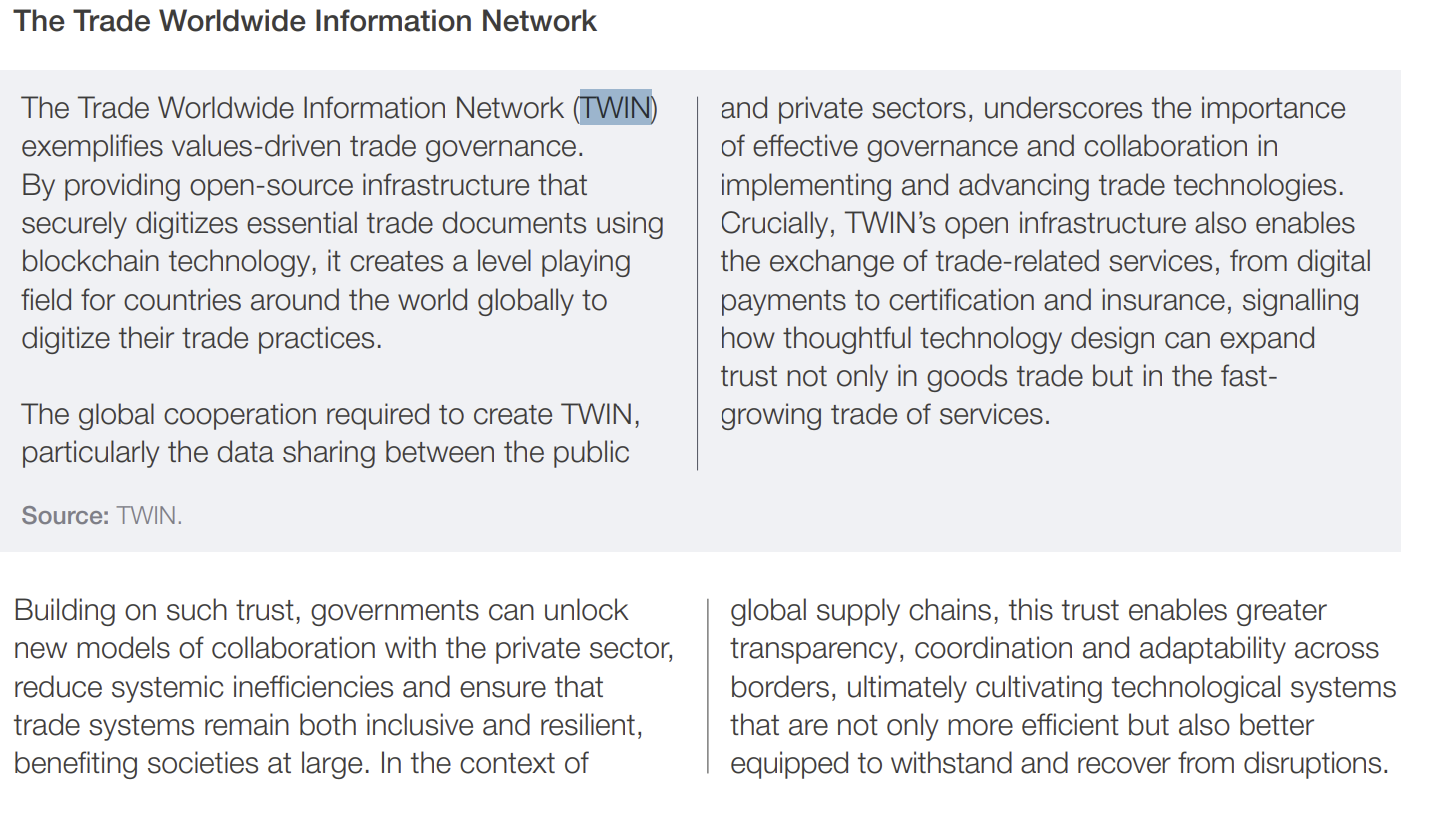
    The 38-page document is about how digital trade structures can support global trade of the future. TWIN is an open infrastructure that is intended to securely digitize essential trade documents. The technology provides a rules-based basis on which different states and systems can compete according to the same standards.

    Salima writes via X:

    “At the center of the document is TWIN = Trade Worldwide Information Network. They present it as an open infrastructure to securely digitize essential trade documents using blockchain – and literally as a ‘level playing field’ so that countries worldwide can compete under the same rules.”

    Trade Worldwide Information Network
    Trade Worldwide Information Network, Quelle: WEF

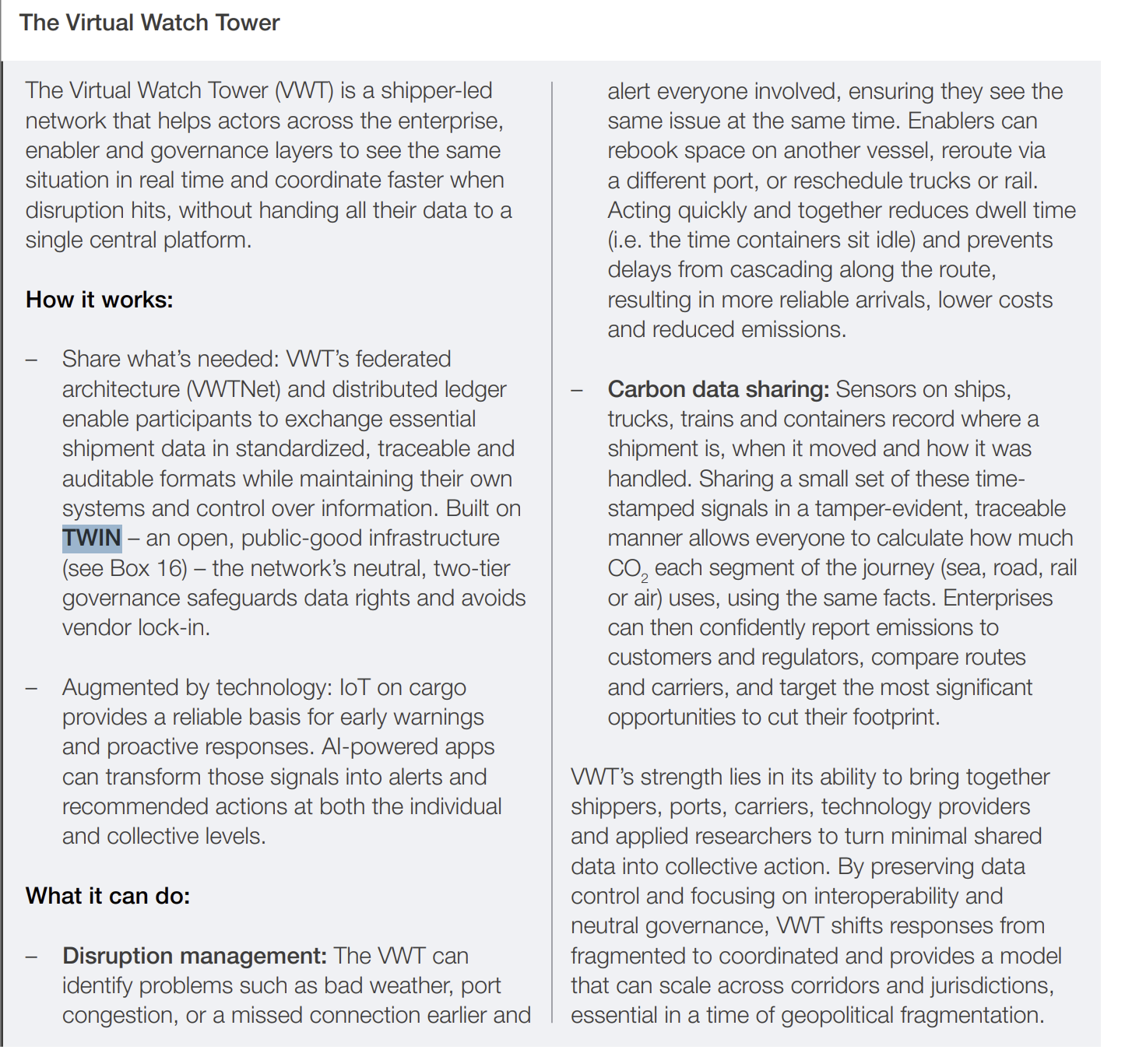
    In addition, Salima highlights another element: the so-called “Virtual Watch Towers”, which are based on TWIN. She describes this component as a mechanism that allows trading participants to coordinate without having to subordinate themselves to a single power center or dominant platform – and without revealing more data than necessary.

    “The Virtual Watch Tower, built on TWIN, is presented as the trustless foundation global commerce needs to coordinate without depending on a single center of power,” writes Salima. “Only the minimum necessary data is shared, in verifiable and traceable formats.”

    The Virtual Watch Tower
    The Virtual Watch Tower, Quelle: WEF

    Case studies: From Maersk to Bangladesh

    The post also identifies several regions and projects that the report highlights as examples of emerging “TradeTech” structures, including Maersk (digital layers for tariffs, compliance and emissions), the Shanghai Lingang Pilot Zone, a UAE-India digital corridor, the Bhomra Land Port in Bangladesh and the SCZone in Egypt.

    At the same time, Salima emphasizes a crucial limitation: “The document does not specify which infrastructures are specifically used in individual cases. However, they are all embedded in the same strategic framework in which TWIN is defined as a future level of trust and a ‘level playing field’ in world trade.”

    It is also important to note that IOTA is not mentioned by name in the WEF report; however, TWIN is mentioned five times. However, the WEF already had one in July 2025 Article published in which it stated that TWIN could save up to 25% of the costs of global trade.

    At the same time, authors Frank Matsaert (Global Head of Trade and Infrastructure, Tony Blair Institute) and Tim Stekkinger (Head of Digital Trade and Trade Technology, World Economic Forum) clarified that “TWIN is the result of a unique TradeTech collaboration between the Tony Blair Institute, TradeMark Africa, the IOTA Foundation, the Chartered Institute of Export & International Trade, the Global Alliance for Trade Facilitation and the World Economic Forum.”