Category: Coins

Digital assets, cryptocurrencies, blockchain, and currency news.

  • VeChain and GSTI bring CO₂ data onchain

    VeChain and GSTI bring CO₂ data onchain


    • The documentation “The blockchain that makes impacts measurable” shows the growing importance of blockchain technology for global sustainability strategies.
    • It becomes clear how VeChain can help to record the negative effects of industrial production and make them transparent and verifiable.

    The focus is on the question of how companies, institutions and consumers can work together to create a measurable, trustworthy basis for sustainable action. The documentation positions blockchains as a key technology that creates trust in complex supply chains and enables new forms of collaboration.

    Pioneer of a new ecosystem

    VeChain serves in the documentation as a case study for the practical application of this technology. In recent years, the company has earned a reputation as a provider of practical blockchain applications.

    Together with the Global Sustainable Trade Initiative GSTI, VeChain aims to transform the topic of sustainability from an abstract discussion into concrete, quantifiable processes.

    The documentation shows how VeChain securely digitally maps physical data – such as CO₂ savings and sustainable consumption decisions – and thus creates a basis on which companies and consumers can act equally.

    The partnership with CNBC brings additional visibility to the issue and underscores the growing relevance of digital technologies to global sustainability initiatives.

    VeBetter: Capturing everyday sustainability

    A particular focus is on the VeBetter project, in which millions of environmentally conscious people are already taking part and which serves as an example of how sustainable behavior can be measured in everyday life.

    The documentation shows how everyday actions – from conscious consumption to reducing personal emissions – are recorded and verified via the blockchain. This creates a system that makes individual contributions visible and at the same time creates incentives to make sustainable decisions.

    VeBetter is presented as a building block of a new, digitally supported circular economy in which everyone can actively participate. The documentation thus conveys a clear picture:

    Blockchains are not just a technological concept, but also tools whose use can have a measurable impact and accelerate sustainable transformation.


  • Hedera and McLAREN Racing cooperate on digital fan engagement

    Hedera and McLAREN Racing cooperate on digital fan engagement


    • Hedera is a DLT system that, in contrast to normal blockchains, is based on the hashgraph technology DAG. It processes thousands of transactions per second at a very low cost.
    • The Hedera network is managed by a committee in which Google, IBM and Deutsche Telekom are represented. It supports smart contracts, file service and RWA tokenization.

    Hedera becomes an official partner of the McLaren Mastercard Formula 1 team and the Arrow McLaren IndyCar team. The cooperation connects real racing scenes with the Web3 infrastructure to create new fan experiences and officially licensed digital offerings.

    The partnership brings together two leading players in their industries who operate at the highest level both on the racetrack and in the digital space. The collaboration will give fans access to a new program of digital experiences that will bring them closer to the team.

    The offers built on Hedera benefit from the trustworthiness, security and credibility of the network. McLaren Racing’s first use case on Hedera will be an NFT program. McLaren fans can look forward to a range of free collectibles released across Formula 1 Grand Prix weekends.

    Additionally, the partnership with Hedera marks the return of Arrow McLaren IndyCar digital NFTs for the 2026 racing season. The motorsports-related NFTs will also offer unique experiences and incentives to further connect fans to the world of racing.

    By building and developing the program together with fans, McLaren and Hedera aim to continually develop new offerings that bring the physical and digital worlds together. Interested fans can find out more via the McLaren Racing Discord server.

    The Hedera branding will appear on the McLaren Mastercard Formula 1 team’s vehicle and on the drivers’ racing suits, as well as on the Arrow McLaren Chevrolets with starting numbers 6 and 7 and on the team’s overalls. Nick Martin, Co-Chief Commercial Officer at McLaren Racing, says:

    “Innovation off the track is just as important as performance on the track. Partnering with Hedera allows us to offer our fans cutting-edge Web3 experiences. We are excited to welcome Hedera to the McLaren family as we continue to push boundaries on and off the track.”

    Charles Adkins, CEO, HBAR, Inc., comments:

    “Collaborating with one of the world’s most recognized sports brands is a big step for Hedera. It gives us the opportunity to show what Web3 can look like when it is built on a network that customers trust and when it is linked to experiences that fans really want. This partnership is the first phase of a long program that we will continue to develop together with McLaren Racing.”

  • Is Dogecoin threatened by a 51% attack? Qubic gives an update

    Is Dogecoin threatened by a 51% attack? Qubic gives an update


    • Qubic is actively developing Dogecoin mining. After the Monero “51% demo” this is causing unrest.
    • According to 21Shares, a direct 51% attack on DOGE is hardly feasible; there is a risk from “vampire mining”.

    Qubic has reignited the debate about a possible attack on Dogecoin: In a fresh post on The update is causing unrest in the DOGE community because Qubic was responsible for an alleged 51% attack on Monero last summer.

    On January 22nd referred the official Qubic account on

    “Dogecoin mining integration is actively in development. The community did not hesitate. The vote was clear: DOGE won with 301 votes.”

    At the same time, Qubic emphasized that the integration is labor-intensive, but very lucrative. The team did not give a specific release date:

    “This is not a plug-and-play upgrade. Integrating ASIC hardware into uPoW requires real engineering, deep protocol work, and time to implement everything correctly. But the potential is significant. DOGE represents one of the largest and most established mining economies in crypto. Integrating with Qubic’s proven proof-of-work model extends uPoW beyond theory and enables scaling. […] Development is ongoing. This is just the beginning.”

    As a reminder, DOGE was already discussed as the “next target” after Monero in August 2025, when Qubics Community selected Dogecoin. The news is that Qubic is now actively working on Dogecoin mining.

    Qubic publicly communicated a “51% takeover demo” in August 2025 and described itself as having achieved over 51% of the hashrate. The project used “selfish mining” as a tactic and reported several “orphaned blocks” and six “reorg blocks” occurring that shook the Monero blockchain.

    Could Dogecoin Suffer a 51% Takeover?

    The Swiss provider of exchange-traded crypto products 21Shares already examined what the danger situation for Dogecoin looks like in August last year. 21Shares explainedthat a classic 51% attack on DOGE is economically difficult to imagine.

    Dogecoin was (in August 2025) at around 2.78 PH/s hashrate according to 21Shares. Qubic would first have to reach and then exceed the entire existing hashrate. The company puts the cost at about $2.85 billion for hardware plus about $2.5 million per day in electricity costs. Logistics are not included. Ultimately, 21Shares concludes:

    “Such costs make a direct attack virtually impossible.”

    In addition to the hashrate arms race, this brings a second scenario to the fore, which 21Shares explicitly mentions: “vampire mining”. What is meant is an approach in which Qubic does not try to technically overrun Dogecoin, but rather uses additional economic incentives to pull existing miners into a routing or mining configuration that is advantageous for Qubic.

    Qubic also pursued exactly this approach with Monero: economic incentives and profitability. However, 21Shares cites several hurdles as to why even this indirect path is significantly harder to scale with Dogecoin than with Monero: from the sheer scale of the petahash-based mining economy to the ASIC hardware reality to the pool structure and the interests of existing miners.

  • New “IOTA Manifesto”: Schiener relies on trading instead of speculation

    New “IOTA Manifesto”: Schiener relies on trading instead of speculation


    • Dominik Schiener’s new “IOTA Manifesto” positions the project as a neutral infrastructure for global trade.
    • Real trading transactions should trigger fees and deposits and thus make IOTA scarce.

    IOTA co-founder Dominik Schiener has published a new “IOTA Manifesto” that is intended to position the project beyond speculative crypto markets. IOTA wants to position itself as an infrastructure for global trade, a market that the manifesto values ​​at $35 trillion.

    Schiener designated the step via X as a consequence of 15 years of experience in the crypto market:

    “In my 15-year career in crypto, I have seen our industry go through cycles of hype, noise and speculation – but also real, exciting and impactful innovation. One of the most important lessons is: you will only survive in this market if you have a deeply rooted conviction. We have been in the market with IOTA for ten years. It has certainly been a wild ride with extreme ups and downs, but one thing has never changed: our commitment to bringing the real world on-chain.”

    The manifesto is intended as a guideline: IOTA should consciously differentiate itself from pure crypto speculation. In the manifesto, trade is described primarily as a bureaucratic problem: too much paper, too many interfaces, too little standardization.

    To support this, the manifesto cites a number of frictions: four billion trade documents every day, up to 30 parties involved per trade and around 240 document copies per transaction. The administrative burden in cross-border trade is estimated at up to 20 percent, and annual losses due to document forgery range from 2 to 5 billion US dollars. The diagnosis is particularly stark when it comes to financing: an annual gap of $2.5 trillion.

    Although MLETR has been a legal framework for electronic documents since 2017, according to the manifesto, there is still a lack of a neutral technical basis on which everyone can agree. According to the manifesto, states and corporations would not bind themselves to “a competitor’s private blockchain”.

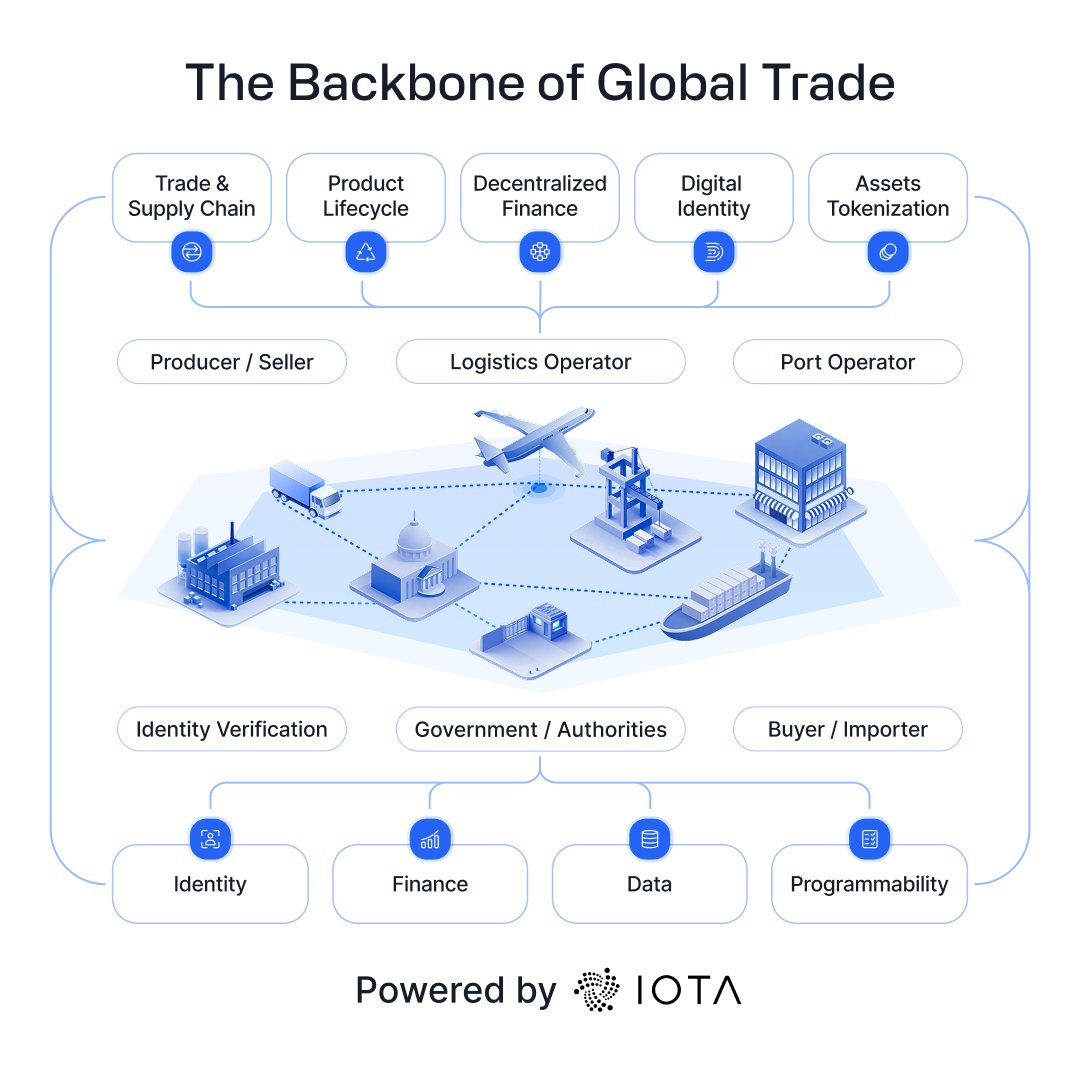
    IOTA as the backbone for global trade
    IOTA as a backbone for global trade, source: X @DomSchiener

    The failed IBM/Maersk TradeLens project is cited as an example of the limits of private sector models. IOTA draws a clear conclusion from this: the basis must be neutral and open, not the proprietary system of a single provider.

    Are IOTA’s TWIN and ADAPT the answer?

    The central solution is TWIN (Trade Worldwide Information Network) – a system on the IOTA mainnet that is intended to digitize documents and secure the flow of goods. The manifesto describes TWIN as “production-ready” and cites live use in Kenya and a UK pilot program as evidence.

    For Kenya, it is said that TWIN is live in the trading system and has started flower exports: “7 million stems per day” in the pilot. The expansion should follow “at the beginning of 2026” to all goods. In the UK, the summary refers to a Cabinet Office pilot to simplify UK-EU freight: In 2024-2025, “over 2,000 poultry shipments” from Poland to the UK were tracked on IOTA to give border authorities real-time visibility. A signal that IOTA clearly attaches importance to:

    “TWIN has been fully integrated into the IOTA mainnet since January 2026. Real transactions for goods crossing borders now run live on the public ledger.”

    Even larger is ADAPT (Africa Digital Access and Public Infrastructure for Trade), a project with the AfCFTA Secretariat, the World Economic Forum and the Tony Blair Institute. The goal is to connect 1.5 billion people by 2035; The source cites a reduction in border clearance from 14 days to hours as well as a reduction in cross-border payment fees by more than 50 percent as potential effects.

    The impact on the IOTA token

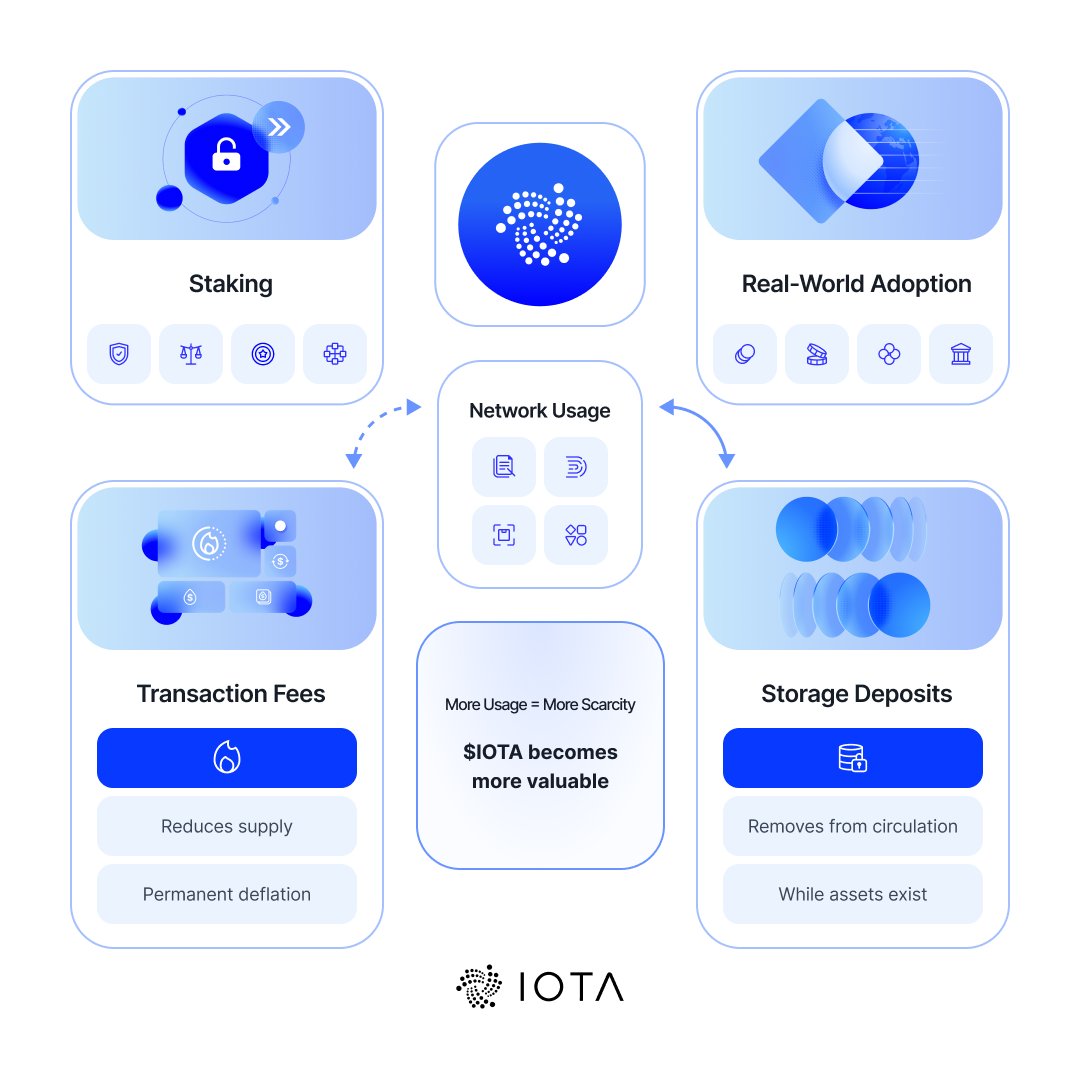
    The manifesto explicitly links the infrastructure story to the token economy. When trading processes run on-chain, the volume of transactions increases and with it the role of fees and deposits that bind or consume tokens.

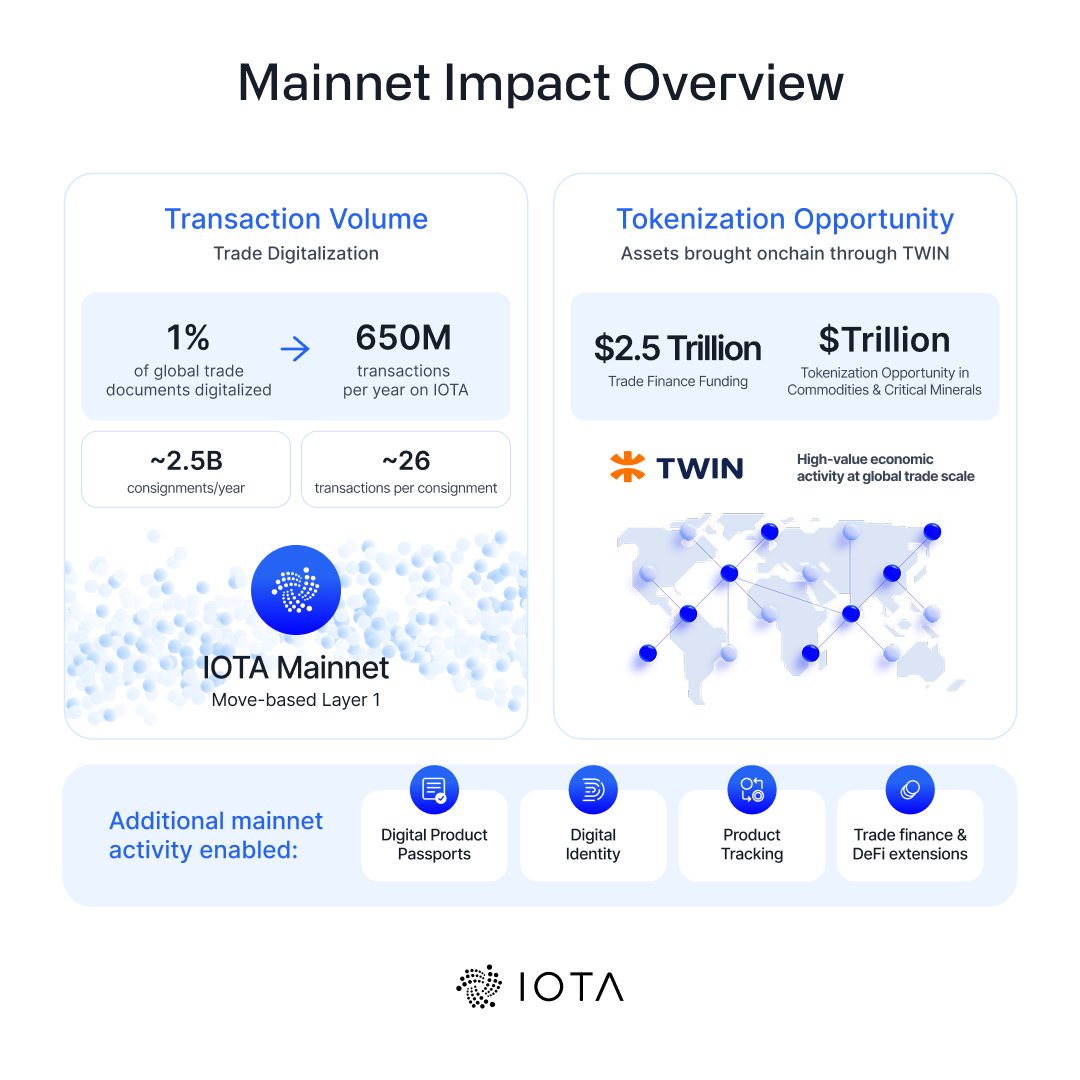
    Impact on the IOTA Mainnet
    Impact on the IOTA mainnet, source: X @DomSchiener

    The manifesto puts the transaction profile at “an average of 26 transactions” per shipment and deduces that just 1 percent of global trade documents could mean “650 million transactions per year” on the IOTA mainnet. Fees should “burn” IOTA, bind storage deposits tokens; Staking is quoted at around 11 percent APY.

    The value of the IOTA token comes from real adoption:

    “By connecting the physical and digital worlds, we bring data, assets and identities onchain. Instead of creating speculative or worthless tokens, we tokenize real-world assets – from raw materials and critical minerals to trade receivables and warehouse receipts – and make them available in dedicated DeFi applications and stablecoins on IOTA. This creates a new class of decentralized finance applications backed by real assets that generate real returns.”

    Effects on the IOTA course
    Effects on the IOTA course, source: X @DomSchiener

    However, Schiener also emphasizes that the global application of IOTA still means a lot of work, which the IOTA Foundation will only be able to accomplish with the help of its partners:

    “We have an incredibly exciting but challenging journey ahead of us. Together with our partners and our ecosystem, we are here to build technologies that create real positive change around the world.”

  • Ripple President Monica Long sees 2026 as the crypto year of institutions

    Ripple President Monica Long sees 2026 as the crypto year of institutions


    • Ripple President Monica Long sees 2026 as the year of institutions: stablecoins will become standard, Fortune 500 companies will professionalize their blockchain strategies, and on-chain capital markets will gain systemic importance for the first time.
    • Long argues that the “production era” of blockchains will begin in 2026: banks, payment service providers and corporations will move from pilot projects to full operation – a structural change that was already evident in 2025.

    In recent years, the crypto industry and legislation have laid the technical and legal foundations on which a phase of accelerated institutional adoption is now following. 2026 will be the first year in which tokenized assets, digital custody and AI automation are no longer promises of the future, but operational reality in the global financial system.

    Ripple President Monica Long is confident that most banks, companies and financial service providers have completed their pilot phase and Digital-Assets integrate into their core processes on a large scale for the first time.

    Stablecoins are becoming part of the financial infrastructure

    Stablecoins are evolving from an alternative payment channel to a primary channel. With the passage of the GENIUS Act in the USA, the age of the digital dollar officially begins.

    Regulated stablecoins like Ripple’s RLUSD set new standards for programmable, anytime payments. Institutions are increasingly using these instruments to mobilize collateral, which should lead to 24/7 liquidity by 2027.

    The B2B sector is proving to be the strongest growth engine: the annual transfer volume of institutional stablecoin payments has increased from less than $100 million to $76 billion within a year.

    At the same time, companies worldwide are sitting on hundreds of billions in tied up working capital that could be harnessed through real-time settlement and programmable liquidity.

    Digital assets are becoming standard on balance sheets

    Cryptocurrencies have evolved from speculative assets to an operational layer of modern financial markets. By the end of 2026, companies worldwide will hold over $1 trillion in digital assets, and approximately half of the Fortune 500 companies will have implemented formalized digital asset strategies.

    Tokenized assets, digital treasury structures, on-chain T-bills and programmable financial instruments are becoming an integral part of institutional portfolios. At the same time, the ETF market is opening up new inflows.

    Over 40 new crypto ETFs were launched in 2025, but only account for a fraction of the US ETF market – a clear signal of further growth potential. The capital markets themselves are also changing.

    In 2026, collateral mobility will become a key use case as clearinghouses and custodians use tokenization to modernize settlement processes.

    Automatic AI procedures shape the next phase

    Digital asset custody is becoming the strategic core of the industry. In 2025, M&A activity in the crypto sector reached a volume of $8.6 billion, driven by banks, fintechs and institutional service providers.

    Custody is increasingly becoming a commodity, forcing providers to vertically integrate or form strategic partnerships. At the same time, regulators are demanding multi-custody models, which is why more than half of the world’s largest banks are expected to establish new custody relationships in 2026.

    At the same time, the operational merger of blockchain and AI begins. Stablecoins and smart contracts automate treasury processes such as liquidity management, margin calls and return optimization in real time.

    Asset managers combine AI models with onchain infrastructures to dynamically manage exposures and take full advantage of the 24/7 nature of digital markets. Zero-knowledge technologies enable data protection-compliant risk assessments and create the basis for broader use of digital assets in regulated markets.

    2026 will be the end of shitcoins

    2026 will be the year in which crypto assets shed their experimental nature. Rather, they will begin to become the fundamental infrastructure of the global financial system.

    Stablecoins drive settlement, tokenized assets will move onto balance sheets, custody creates trust, and AI-supported automation takes process efficiency to a new level.

    It is the institutions that will actively shape this development – ​​and they will do so permanently.

  • Bitpanda: First a crypto exchange – now a multi-asset broker

    Bitpanda: First a crypto exchange – now a multi-asset broker


    • After the planned IPO was announced, Bitpanda surprised us with the next big step and will also be trading in stocks and ETFs from February.
    • It is a strategic milestone that turns what was once a pure crypto exchange into a fully-fledged multi-asset broker.

    Bitpanda, one of Europe’s best-known fintech companies, will begin trading around 8,000 stocks and 2,500 ETFs from February. The Vienna crypto exchange is thus expanding its existing range of cryptocurrencies and precious metals to include classic securities and is positioning itself as a fully-fledged investment service provider in the EU.

    Bitpanda is taking the next step

    The step is a clear signal to the competition. While other major crypto exchanges such as Kraken and Coinbase have taken similar paths, Bitpanda relies on a particularly wide range of tradable assets and the fully regulated EU infrastructure.

    Bitpanda will enable trading in both classic securities and equity shares, which is particularly attractive for small investors who would otherwise not be able to afford high-priced stocks. The so-called fractional shares are an instrument to democratize access to traditional markets and increase the level of use.

    The fee model is particularly noteworthy: there is a fixed fee of just one euro per trade – with no hidden costs, no order flow payments and no custody fees. Bitpanda is thus directly attacking established banks and neobrokers, who often offer more complex or expensive fee structures.

    At the same time, the company promises stable trading times, transparent costs and a clean custody structure, which is essential for user trust in the securities sector. The introduction of stock and ETF trading is also closely linked to the company’s long-term plans.

    Bitpanda is preparing for its IPO, which is expected to take place this year, probably on the Frankfurt Stock Exchange. By expanding its offering and positioning itself as a multi-asset platform, the company wants to increase its attractiveness for institutional investors and show that it is much more than a cycle-dependent crypto exchange.

    With this step, Bitpanda is sending a clear signal: the future of investing lies in integrated platforms that can bring together multiple asset classes in a single, intuitive app.

  • New DXC-Ripple cooperation with a signal effect for the financial world

    New DXC-Ripple cooperation with a signal effect for the financial world


    • A new strategic partnership between DXC Technology and Ripple aims to bring traditional banking infrastructures up to date.
    • DXC integrates Ripple’s institutional blockchain technology into its core “Hogan” banking structure, used by major banks worldwide.

    The new cooperation is intended to enable banks to use blockchain-based payment systems and digital assets without having to radically rebuild their existing systems.

    Sea Press release The aim is to create a technological basis that corresponds to the state of the blockchain, but is “downwardly compatible” enough to continue to control custody, RWA tokenization and programmable payments directly from the core banking platform in the future.

    A major hurdle has been removed for banks that previously shied away from high integration costs. DXC acts as an “interface” between traditional IT and modern blockchain infrastructure; and Ripple gains access to a market that was previously virtually monopolized – the core systems of major banks. This development is likely to significantly accelerate the spread of blockchain technologies in the institutional environment.

    Impact on Ripple, XRP and the crypto market

    Although the cooperation does not explicitly require the use of XRP tokens, it still has an impact on its use. Ripple is increasingly becoming a provider of institutional infrastructure, and any expansion of this infrastructure indirectly strengthens the XRP system. Banks that use Ripple technology for international payments and liquidity management in the future could opt for XRP-based applications in the long term, especially if efficiency and cost savings are the result.

    The crypto market reacts to such developments because institutions are seen as a stability factor. The partnership will therefore increase trust in blockchain applications and advance the discussion about the role of digital assets in the global financial system.

    Digitalized financial infrastructure is getting closer

    The cooperation between DXC and Ripple shows that blockchain technology has finally arrived in the traditional banking world. Banks gain access to new, beneficial functionality without replacing their core systems, while Ripple consolidates its position as a technology provider for institutional applications.

    Digital assets and tokenized financial instruments continue to make their way into the regulated financial world. The partnership could thus prove to be the initial spark that triggers the transition to a fully digitalized, more efficient and globally networked financial infrastructure.

  • ICP ensures maximum data sovereignty through the Swiss subnet

    ICP ensures maximum data sovereignty through the Swiss subnet


    • ICP operates its own subnet in Switzerland, which processes and stores data strictly within the country’s borders.
    • It is particularly suitable for authorities, banks and companies with the highest requirements for data protection, compliance and digital sovereignty.

    With the Swiss subnet, the Internet Computer Protocol (ICP) company implements its data protection and data security requirements without compromise. The new infrastructure, which consists exclusively of nodes operated in Switzerland, guarantees that all data processing processes remain within Swiss national borders.

    For industries with strict regulatory requirements – such as finance, healthcare and public administration – this creates a high-security technological variant that classic cloud models have not yet provided.

    ICP publishes the “Swiss bank account” of cloud computing

    The so-called Swiss Subnet is technically designed in such a way that only node operators based in Switzerland are allowed to participate. This restriction is technically anchored in the protocol and prevents data or computing processes from being outsourced to foreign servers.

    ICP is responding to a growing demand for applications that require the security of a blockchain and the control of a national infrastructure.

    Switzerland, which traditionally places great value on data protection, neutrality and regulatory clarity, is becoming a testing ground for a model that could also be attractive for other countries.

    A key feature of the subnet is the combination of blockchain integrity and local government regulation. While the subnet still belongs to the International ICP Network, it acts as an isolated unit with clearly defined geographical boundaries. This architecture makes it possible to operate sensitive applications without having to forego scalability, interoperability and modern smart contract functionality.

    This creates new scope for decision-making for institutions for which blockchain technology was previously out of the question for compliance reasons.

    The role of the subnet for AI applications is particularly highlighted. For ICP, Switzerland is the location of the “Swiss Cloud Engines”, which allow AI models and data-intensive workloads to be executed on sovereign infrastructure.

    In the medical field, government registries and other security-critical organizational processes, this can be the decisive criterion for achieving data protection and data security while using modern technologies.

    The security subnet can also provide new economic impetus. Companies gain access to an infrastructure that is compliant with regulations, technologically future-proof and scalable in the long term. Startups can benefit from a network that allows critical data processing to be kept within Swiss borders from the start.

    For Switzerland, the project means strengthening its position as a location with special data protection, special data security, innovation and digital neutrality.

  • New Dogecoin app aims to spread DOGE as a means of payment

    New Dogecoin app aims to spread DOGE as a means of payment


    • The Dogecoin Foundation and its merger partner Brag House are developing the Search app that allows customers to set up a wallet, purchase Dogecoin and make everyday payments with DOGE.
    • With the app, self-employed people and small businesses can present their offers and accept Dogecoin.

    A team of twenty in Melbourne has been working on the “SUCH” app since March 2025, led by CTO and Dogecoin Foundation Director Timothy Stebbing.

    Marco Margiotta, CEO of “House-of-Doge”, the foundation’s commercial company, explainedSUCH will be more than a classic wallet and will offer additional functions that will establish Dogecoin as a global, decentralized currency.

    Strategic goal: Dogecoin as a means of payment

    The SUCH app is open source and is intended to facilitate DOGE transactions of all kinds. It is equally suitable for retailers and private and professional customers. The company sees the expansion of practical application possibilities as a decisive factor for the long-term spread of Dogecoin.

    Brag House CEO Lavell Juan Malloy II describes “SUCH” as a tool that transforms social energy into economic value and opens up new opportunities for communities. A self-managed wallet, real-time transaction feed and merchant tools – “Hustles” – will be available at launch, with additional features in development.

    When started, the SEARCH app should have the following functions:

    • Self-managed wallet: A simple, easy-to-use wallet that allows customers to securely manage their Dogecoin.
    • Real-time transaction feed: A live view of transactions to track activity and see in real time where the DOGE being sent is going.
    • Trader tools: A feature called “Hustles” that allows merchants and private sellers to post their offers, engage with customers, and accept Dogecoin as payment.

    Beyond these launch features, House of Doge is developing additional features designed to give customers new ways to use their Dogecoin. Further details will be announced as development progresses.

  • VeChain rewards e-trips: Eearn launches smart car integration

    VeChain rewards e-trips: Eearn launches smart car integration


    • VeChain-based app Eearn (VeBetter) partners with Smartcar.
    • Verified electric and hybrid rides are rewarded with B3TR tokens.

    The VeChain Foundation reports a strategic partnership between the VeBetter app Eearn and the connected vehicle data provider Smartcar: drivers of electric and hybrid vehicles will be rewarded with B3TR tokens for verified, lower-emission journeys.

    The aim of the partnership is to record driving data uniformly, accurately calculate CO₂ savings and process rewards transparently on-chain.

    VeChain awards rewards for electric and hybrid drivers

    According to the VeChain Foundation, the cooperation links Smartcars vehicle interface to VeChain’s infrastructure. Everyday trips should be recorded as “verifiable signals of sustainable mobility” and linked to digital rewards. In one Post on X from January 21st it says:

    “Through this collaboration, Smartcar’s advanced connected vehicle technology enables Eearn users to seamlessly monitor the CO₂ saved on their journeys by using an electric or hybrid vehicle instead of a combustion-powered vehicle. VeChain’s blockchain infrastructure then ensures that rewards are accurately allocated based on verified vehicle data.”

    According to X-Post, the partnership includes more than 30 electric car and hybrid brands and is intended to enable tracking and rewards “in Europe and North America”.

    For the VeChain Foundation, the cooperation focuses on three central benefits. Firstly, “accuracy”: Smartcar should provide a reliable, standardized data connection across the supported brands so that driving behavior is recorded consistently.

    Secondly, “trust”: VeChain wants to document reward logic, allocation and proof of the amount of CO₂ saved per trip on a public blockchain.

    Thirdly, “Engagement”: Drivers should see a clear connection between daily trips and the rewards earned, which should make sustainable mobility “more tangible, visible and motivating”.

    Eearn describes Smartcar as a “data bridge” between vehicles and the platform. Users should connect their vehicle, and Smartcar enables “secure access to selected driving information under clear consent controls” without additional hardware or complex setup.

    At the same time, the VeChain Foundation emphasizes the protection of privacy:

    “User data remains protected, and Eearn only accesses odometer readings, not sensitive personal information.”

    Eearn determines reward eligibility based on this data. VeChain’s blockchain is then intended to secure the ‘final step’: the database for the calculation, the CO₂ proof per trip and transparent allocation rules. Users can also hold and manage the rewards as digital assets in the VeBetter ecosystem.