World Token made a 27% price jump yesterday. OpenAI boss Altman is said to be planning a social media project that verifies the human identity of its members and automatically locks out bots and AI accounts.
The report triggered a strong reaction and brought the controversial World ID project back into the public debate.
It is said to be an unofficial project that is being developed by a small team of fewer than ten people. The goal is a social network that only allows people – verified by Apple Face IDWorld Orb or other reliable biometric methods.
AI-generated content should be allowed, but only people with verified identities are allowed to set up an account. The idea behind this is a social media project that is aimed at countering the flood of AI bots and fake identities that are dehumanizing entire networks.
The World Token price reacted promptly. Within a few hours, Worldcoin (WLD) rose by over 27 percent, sales exploded and increased by more than 760 percent. The market capitalization reached $1.42 billion.
Image created with AI using ChatGPT (DALL·E)
Initiator Sam Altman is the founder of World, and OpenAI has the infrastructure to establish such a network globally. The combination of proof of personhood and AI moderation could become a new standard for digital identity.
At the same time, central questions remain unanswered. There is no official confirmation yet OpenAIand the regulatory risks are significant. Biometric data such as iris scans are considered particularly sensitive, and World has been under global scrutiny since its inception.
Several countries have already restricted or frozen Orb operations, including Spain, Portugal and Kenya. Critics warn of a global identity infrastructure that could be abused. Proponents, on the other hand, see this as a realistic approach to preserving the integrity of digital communication.
This results in an asymmetric scenario for the World Token: great advantages through potential integration into an OpenAI network, but equally great risks due to political and social resistance.
The coming weeks will show whether the new approach will develop into a viable, guaranteed humane social media model.
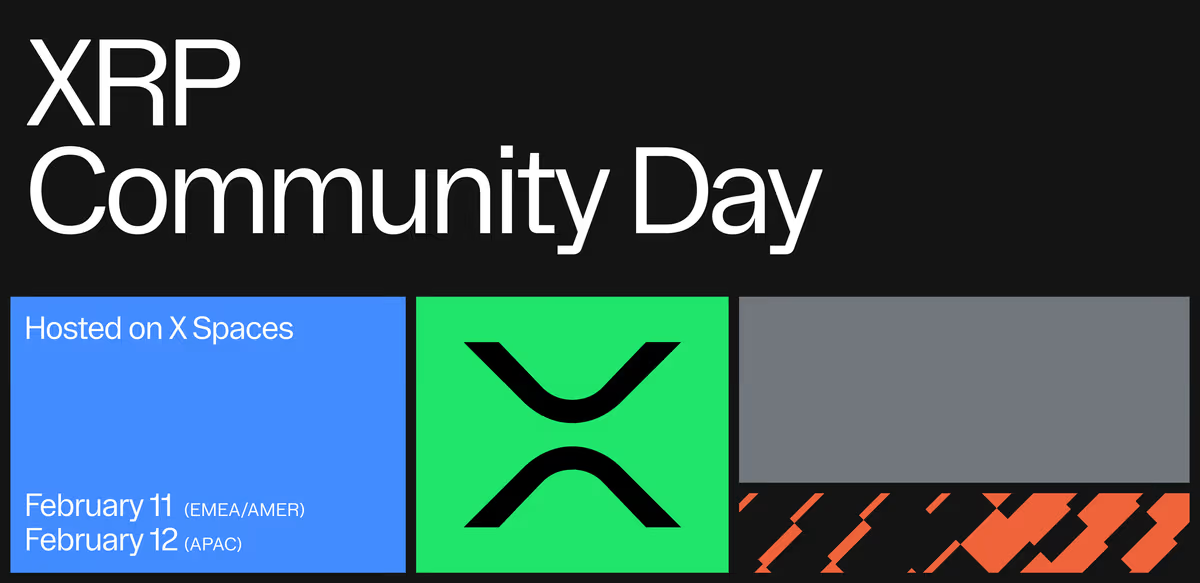
A strong XRPL system and a global showcase of XRP applications will characterize the XRP Community Day taking place on February 11th and 12th.
Ripple positions the event as a snapshot of a system that has matured through regulation and is becoming increasingly institutionally relevant.
CEO Brad Garlinghouse and President Monica Long set the tone: XRP is no longer just an asset, but a building block of modern financial infrastructure. One focus is on the growing role of XRP in regulated financial markets. Over 40 new crypto ETFs and ETPs launched in 2025 – including XRP – demonstrating institutional demand.
Panels will shed light on how custody solutions, structured products and market infrastructure around XRP are created and which trends will shape the next growth phase.
The event sends a clear signal to investors and market observers: XRP is establishing itself as a regulated investment instrument with global backing.
Ripple: Innovative through tokenization and multichain
The developer sessions show how broad the XRPL system is now. Projects showcase advances in tokenization, programmable functions, compliance features, privacy extensions, and the native lending protocol.
Particularly highlighted is the role of Wrapped XRP, which enables the use of XRP on chains such as Solana, thereby opening up liquidity, interoperability and new DeFi applications. The Innovation Spotlights give the community a stage to present real use cases.
2026: Priorities and the role of XRP in the financial system
What: Ripple
Ripple is using the event to outline its strategic priorities for 2026: regulated financial products, cross-chain liquidity, stablecoin synergies and the expansion of XRPL as an infrastructure for institutional applications.
Former CTO David Schwartz – now a member of the supervisory board – also provides a look at the technological future of XRPL and the evolution of XRP use cases. It’s for the community XRP Community Day Not just a meeting, but a programmatic outlook on the next steps of a global financial system that is increasingly gaining importance in the real economy.
21Shares has published an XRP price prediction for 2026 with several scenarios.
Key question for 2026: Will real usage and institutional demand come.
Crypto ETP provider 21Shares has released an XRP price prediction for 2026 in a new research note.
In the base scenario, 21Shares sees XRP at $2.45 by the end of the year (50% probability), in the bull scenario at $2.69 (30%) and in the bear scenario at $1.60 (-16%). 21Shares sees the values as a possible annual high in 2026, depending on how quickly adaptation increases, how the macro environment turns and how liquidity and market structure develop.
Here our own XRP predictions for 2026:
Base case – $2.45 (50%)
Bull case – $2.69 (30%)
Bear case – $1.60 (-16%)
21Shares research strategist Matt Mena sees XRP at an “institutional tipping point.” Since the agreement in the SEC proceedings in August 2025, the valuation discount has largely disappeared due to legal uncertainty. In 2026, price determination will have to be measured more closely against reliable fundamental data.
“Price forecasting is one of finance’s most enduring obsessions – this becomes even more appealing in crypto because the market is known for its volatility and rapid changes in sentiment. Although certainty is impossible, meaningful forecasts rely on both data-driven models and qualitative assessments.”
21Shares cites regulatory clarity as the most important lever for 2026. Mena explains that the legal proceedings with the US Securities and Exchange Commission have weighed on the XRP price for years.
“As we enter 2026, XRP is at a critical inflection point: a clear transition from speculative volatility to a valuation based on institutional fundamentals. The August 2025 settlement in the long-running SEC litigation has removed the structural ballast that had capped XRP’s price for years – regardless of its actual utility.”
From 21Shares’ perspective, this will make the market investable again for parts of US institutions, as well as for regulated funds/ETF issuers as well as banks and payment service providers who were previously hesitant due to compliance risks.
At the same time, Mena says: With the legal uncertainty gone, XRP can no longer live on the hype surrounding the court proceedings in 2026. If there is no measurable adoption by banks and financial institutions, a “sell-the-news” risk arises.
Driver two: Spot ETFs in the USA could stabilize demand. These raised more than $1.3 billion in assets in their first month and recorded a “historic series” of ongoing inflows. 21Shares sees this as a signal for more permanent inflows that do not stop immediately with every correction.
Additionally, XRP exchange reserves are at a seven-year low of 1.7 billion XRP. In combination with ETF purchases and a strong community, according to Mena, this is a robust basis for a price increase:
“With stock exchange reserves at a seven-year low of 1.7 billion
Third, 21Shares outlines the XRP Ledger as a potential settlement layer in an increasingly tokenized financial world, from stablecoins to tokenized bank deposits to interoperable settlement layers. The report notes that XRP is designed for fast, low-cost cross-border payments and that the XRP Ledger is already being used by financial institutions and payment providers.
At the same time, DeFi adoption on the XRPL has increased: the total value locked has increased by a factor of almost 100 in two years and recently exceeded the threshold of 100 million US dollars. For the tokenization of real assets, 21Shares refers to the Multi-Purpose Tokens standard, which is intended to allow institutions to map RWAs such as bonds or stocks with metadata and compliance rules directly at the protocol level.
Despite the fundamentally bullish outlook, 21Shares identifies several points that could turn the outlook bearish: Declining ETF inflows could weaken the central, reflexive price mechanism. If there is no significant RWA volume, the settlement thesis collapses, especially as the competition for tokenization increases in 2026. And if RLUSD fails to achieve the institutional traction it hopes for, XRPL would be missing a building block that 21Shares classifies as a high-quality collateral for professional applications.
The European Securities and Markets Authority ESMA in Paris has surprisingly referred two central technical standard catalogs for implementing the EU MiCA regulations back to the advisory committees. This means that the MiCAR implementation in 2026 has been canceled for the time being.
It may be delayed for a year or more. The project that was supposed to make the EU the global vanguard of crypto regulation has now become a laughing stock – and the consequences are hitting the German market particularly hard.
BaFin relies on technically formulated standards in order to finally examine MiCAR license applications. Without these requirements, there are no binding rules for the prevention of market abuse and for the interpretation of STOR reports, IT security requirements, governance structures and outsourcing models.
Although the authority can extend transitional regimes, it cannot guarantee complete harmonization. Germany is therefore in a regulatory limbo in which the MiCAR applies, but the detailed implementing regulations are missing.
For banks, the delay means an immediate operational burden. Institutions such as DZ Bank, Deka Bank, Commerzbank and Sparkassen-Finanzgruppe had planned their MiCAR products for 2025 and 2026. These schedules were based on the assumption that the Parisians ESMA delivers the technical standards in a timely manner – actually a given after years of planning.
Apparently not for the EU authorities. Now risk analyzes need to be reassessed, compliance architectures adjusted and outsourcing contracts revised. Product launches are postponed, resources are tied up and costs rise.
German crypto service providers are also coming under pressure. Providers such as BSDEX, Coinbase Germany and Bitvavo DE now have to comply with transitional rules while waiting for the final regulations. This leads to high costs and makes planning new products more difficult. While international competitors work in clear regimes, EU providers have to live in uncertainty.
disaster after years of preparation
The delay is grotesque. MiCAR was prepared for years, celebrated politically and presented as a global role model. MiCAR aimed to create the world’s first comprehensive set of crypto regulations.
The regulation must be issued at the same time as the Market Abuse Regulationanti-money laundering regulation, national IT security laws, existing securities rules, stablecoin rules and the EU data protection law be compatible.
ESMA probably underestimated these requirements. The technical standards are not just detailed rules, but the actual core of practical implementation. Any lack of clarity would have an immediate impact on banks, stock exchanges and custodians, not to mention all the legal proceedings that would have additionally burdened the judiciary, which is already overburdened.
Image created with AI using ChatGPT (DALL·E)
Added to this is the massive criticism from the industry. Banks, custodians, stock exchanges, FinTechs and international associations responded to the consultations. The feedback was unusually clear. Many requirements are technically difficult to implement, the costs are disproportionate, definitions are unclear and reporting requirements are contradictory.
The planned monitoring systems were also criticized as unrealistically complex. ESMA was faced with the choice of implementing an error-prone set of rules or setting up new standards. The authority chose the safer but slower route.
Political dynamics play another role. After the scandals surrounding FTX, Celsius and Terra, expectations are enormous. The EU Commission demands maximum legal certainty, robust market abuse monitoring and clear liability rules. In this climate, no one wants to risk a second Wirecard scandal. The result is an overly cautious regulatory culture that sacrifices timely processing to avoid errors.
To make matters worse, national supervisors have different traditions and risk cultures. BaFin, the Austrian FMA, the French AMF and the Italian CONSOB pursue sometimes opposing approaches to IT security, outsourcing, market abuse definitions and liquidity requirements. The Paris ESMA has to harmonize these differences, which further slows down the process.
Ultimately, the technical reality of the industry is more heterogeneous than the EU parliamentarians had expected. While some providers work with state-of-the-art MPC systems, HSM clusters and institutional custody stacks, others use simple hot wallet infrastructures or cloud wallets. A single standard that everyone could follow is difficult to define without overwhelming large parts of the industry.
EU prestige project failed for the time being
MiCAR should make the EU a global pioneer. Instead, those involved, but especially the crypto industry, are now faced with a chaos of rules that is slowing down banks, burdening crypto asset service providers, unsettling national supervisors and strengthening international competitors.
One wonders where all the experts who were involved got so much incompetence from.
Hayes sees Japan as a possible trigger for new liquidity if yen weakness and JGB stress force central banks to intervene.
Things will only become bullish for Bitcoin when the Fed’s balance sheet visibly grows, especially via rising foreign currency denominated assets.
BitMEX founder Arthur Hayes sees the next Bitcoin impulse emerging in Japan, more precisely: in the yen and the JGB market. In his current one Essay “Whoomp” from January 28th, Hayes argues: A weak yen plus falling JGBs would make the situation so dire that monetary policy resistance would be difficult to avoid. Hayes’ thesis is simple: Without a new liquidity narrative, Bitcoin cannot get out of the current range between $84,000 and $94,000.
“Financial markets went ‘woomph’ as the yen weakened and JGB prices collapsed. […] Many macro commentators smarter than me declared that Japan will be the match that sets the dirty fiat system on fire. […] Will a meltdown in the Yen and JGB markets trigger some form of money printing by the BoJ or Fed? The answer is yes.”
Hayes describes the trigger as Japanese authorities having lost “control of the long end of the yield curve”: the yen was falling against the dollar while at the same time JGB yields were rising. For Hayes, this is a breach of trust: The yen is falling while yields are rising – and both are increasing Japan’s inflation and refinancing stress. Additionally, he points to potentially growing losses at the Bank of Japan as it is the largest JGB holder.
From the US perspective, the risk is that stress in Japan can spill over into government bonds. Japanese investors are among the largest holders of U.S. government bonds; Overall, he puts Japan’s foreign asset portfolio at $2.4 trillion, “with a majority in Treasuries.” Rising JGB yields could attract capital back to Japan, making Treasuries a relevant selling pressure factor.
For Hayes, the core of the trade is a US intervention: New York Fed creates dollar reserves, exchanges them for yen and parks them in JGBs. “This would allow the yen to appreciate and JGB yields to fall as the Fed adds “currency and interest rate risk” to its balance sheet. Hayes names the item “Foreign Currency Denominated Assets” as a visible balance sheet signal, which would grow in the course of such purchases.
Legally, he anchors this with the Exchange Stabilization Fund (ESF), operationally via the New York Fed. According to Hayes, the Treasury Department can intervene in the FX market but needs help from the Fed because it “cannot print money” itself.
Hayes sees a first indication in a report from last Friday: The NY Fed asked prices from several primary dealers. For him, this is a deliberate sign for the financial markets. Specifically, he mentions January 23, 2026: The BoJ left interest rates unchanged, “even though by all standards they should have increased to defend the currency and the bond market.”
What this means for Bitcoin
This is relevant for Bitcoin in that a balance sheet expansion at the US Federal Reserve ensures more liquidity in the financial markets. “Bitcoin and high-value shitcoins will mechanically float higher in fiat terms as the supply of paper money increases,” he writes. At the same time, he warns: A rapidly strengthening yen often represents “risk-off” because yen-financed trades are being wound down.
His conclusion is therefore: Only when the Fed item “Foreign Currency Denominated Assets” increases will it want to increase the risk and expand Bitcoin exposures. He mentions having already been stopped out of leveraged Bitcoin proxies such as Strategy (MSTR) and Metaplanet and will be reinstated upon confirmation. At the same time, he explains that his Maelstrom fund is continuing to increase Zcash (ZEC) and, if the Fed’s balance sheet expansion is confirmed, would also increase existing DeFi positions (ENA, ETHFI, PENDLE, LDO).
Crucial to Hayes’ scenario is the pace: a gradual appreciation of the yen could create stability, while a rapid move would lead to chaos. Whether Bitcoin gets the expected impulse depends on whether Japan goes “woomph” again and the Fed’s balance sheet visibly reacts.
CT3 was founded in 2022 with the aim of reimagining the way data is stored. The company specializes in decentralized data storage and uses proprietary technologies whose performance clearly stands out from the competition.
The company has now completed the development of its decentralized storage solution and it is available to customers as a turnkey CT3 Secure Storage System.
CT3 Secure Storage combines Web3 ownership models with the ease of use of modern cloud services while eliminating the risks of centralized control and opaque pricing structures. CEO Leandro Gomez explains the CT3 Secure Storage System succinctly:
“This launch is more than just a product launch – it marks the beginning of a new chapter for distributed storage technology. We’re giving customers true ownership of their data and a system that can scale globally.”
System expansions and corporate partnerships
The public launch is just the beginning. CT3 will continue to expand its system – including dApp hosting, so that developers can deploy decentralized applications directly on the CT3 infrastructure. In parallel, CT3 is actively negotiating long-term storage contracts with corporate customers for large-volume data volumes.
Infrastructure migration to Polygon EVM
In the final development phase, CT3 made a strategic decision: to fully migrate from Solana to the Polygon EVM to further improve reliability and user experience.
The move was made for the following reasons:
More robust wallet interactions via widely used tools like MetaMask and Trust Wallet
Improved payment and reimbursement mechanisms as Polygon does not charge “rent”-like costs for generating individual payment addresses
Stronger marketplace integrations, allowing NFT keys to be managed and traded via platforms such as OpenSea
Low transaction costs that make standard ERC 721 NFTs affordable without relying on compressed formats
Easier NFT visibility and tracking in wallets and block explorers
This migration provides CT3 with a transparent infrastructure and a robust foundation for long-term growth.
System architecture and access model
CT3 introduces a novel model in which stored files are accessed via NFT keys. This gives customers a Web3-native way to securely manage or transfer file access – without re-uploading or central authorization systems.
The system supports
Files up to 1TB
Chunked uploads for stable transfers, including partial uploads
A transparent pay-as-you-go pricing model – billing is based solely on file size and storage duration, without subscription or unused capacity
Automatic refund in case of early deletion
Technically, the CT3 system is based on a 2 token model designed to ensure stable, predictable storage prices: one token is linked to the cost of storing 1 GB per day, while another token supports liquidity and long-term network growth. An automatic rebalancing mechanism stabilizes the system in times of strong market volatility.
The storage infrastructure also uses a reliable verification model that dynamically adapts the testing effort to the reputation and performance of the nodes – for better scalability at low costs.
Cheaper than traditional cloud storage
CT3 is designed to be cost-effective from the ground up. In contrast to centralized providers such as AWS or Google Cloud, CT3 relies on the decentralized capacities of independent miners and node operators. This allows the network to rely on truly market-driven storage offerings – without the high overhead costs of central data centers, complex pricing or subscription models.
CT3 as a company
At the heart of the company’s philosophy are three basic principles: security, anonymity and freedom of expression. CT3 believes that every customer has the right to protect their data, maintain their privacy and express their thoughts freely – without the risk of censorship or data leaks.
Ripple signed a memorandum of understanding with VAR’s Riyad Bank to develop and evaluate digital, international transfer processes.
A program for digital custody and asset tokenization will also be launched.
The cooperation with Ripple is part of the Saudi “Vision 2030” project, which envisages comprehensive digitalization of the national financial sector. While the United Arab Emirates is already considered a blockchain pioneer, Saudi Arabia is now also signaling increasing openness towards distributed ledger technology with this cooperation
Saudi Arabia open to financial innovation
In the center of the Cooperation There are three strategic fields of application:
Cross-Border Payments: Ripple brings its experience with fast, cost-effective international transactions – an area that is particularly relevant for banks with high transaction volumes.
Digital Asset Custody: Developing secure custody models for digital assets is a key issue for banks preparing to deal with tokenization and digital securities.
RWA tokenization: The tokenization of real assets, such as real estate, bonds and funds, opens up new possibilities for liquidity, trading and transparency.
Riyad Bank is one of the largest banks in Saudi Arabia with over $130 billion TVL. Their innovation department “Jeel” was set up in 2023 and is responsible for the smooth integration of new technologies into existing banking processes.
Ripple is expanding its Middle East presence
Ripple has significantly expanded its activities in the Middle East in recent years. The company has several licenses in the VAR, including for the RLUSD stablecoin, which has now reached a circulation of over $1.3 billion. The XRP Ledger, Ripple’s decentralized infrastructure, recently surpassed $1 billion in tokenized assets, a sign of growing institutional usage.
Image created with AI using ChatGPT (DALL·E)
The partnership with Riyad Bank strengthens Ripple’s position as an infrastructure partner for banks and financial institutions in the Gulf region. It could serve as a model for further collaborations, particularly with regard to regulation, scaling and integration into existing TradFi banking processes.
The cooperation between Ripple and Riyad Bank shows that blockchain technology is increasingly being incorporated into the strategic planning of major banks in the Middle East. While Western markets often operate in a fragmented manner in terms of regulation, countries like Saudi Arabia rely on targeted pilot projects with established technology partners.
For Ripple, it is a further step into the role of global infrastructure provider for digital payments, custody and tokenization.
Cardano founder Hoskinson claims that Midnight will overtake Zcash, Monero and Dash within 12 months.
Midnight is intended to combine privacy and compliance via selective disclosure and run as an additional layer on existing chains.
Cardano founder Charles Hoskinson kicked off his Japan tour with a midnight event on January 25th in Sapporo (Hokkaido).Workshop opened and announced that Midnight would become the leading privacy project in the crypto sector within a year.
Hoskinson positions Midnight as a bridge between privacy and compliance, with selective disclosure rather than a public data trail. Hoskinson’s core thesis is that the crypto industry has so far primarily built “the transparent side”, but not the private side, which is essential for real business processes.
“We only built one side of Yin and Yang. We only built the transparent side. We didn’t build the private side.”
Cardano/ Midnight Vs. Zcash, Monero und Co.
His point is less about technology than control: In many privacy systems it is difficult to control in a granular manner what is disclosed to whom and when. Regulation, he says, should not become permanent transparency: KYC/KYB/AML must be possible without personal data being visible to everyone.
His argument: As long as compliance on public chains means making personal data public, this is not acceptable for companies. He puts it drastically:
“If you share information about yourself on a public network, anyone in the world can […] see where you live, your name […] how much money you earn […] That doesn’t make any sense for trading.”
For Hoskinson, this is a structural advantage of Midnight: Midnight should integrate privacy-enhancing technology in such a way that compliance is possible without the user being doxxed globally. He calls the lack of privacy and disclosure foundations “one of the biggest barriers” why crypto is not yet anchored in everyday life everywhere.
Hoskinson also explained that Privacy Coins were built by engineers without a consistent focus on UX; Mainstream products would need “abstraction” and “intents”, i.e. the ability to give the system only one goal while solvers/networks optimize execution.
His bet is go-to-market: Midnight should not displace L1 as the new, but rather dock as an additional layer where users and liquidity already are. He points out that “11 million tokens” failed in 2025 alone and that large VC-funded launches achieved “no adoption.” At the same time, he describes Bitcoin, Ethereum, Solana and Cardano as particularly suitable because communities and capital do not simply migrate there.
Midnight should therefore not start as a replacement, but as an additional shift:
“You stay on Solana […] but it works on Midnight. You stay on Cardano […] works on Midnight. You can spend Bitcoin […] but it works on Midnight.”
Midnight wants to bring privacy functionality to where users and liquidity already are, rather than requiring migration. Technically, he sells Midnight as a best-of approach: Polkadot as the basis, supplemented by ideas from Aptos, Zcash and Near – without ideological overhead. Finally, Hoskinson makes the comparison explicit over the time horizon:
“Within a year, Midnight will surpass everyone in the privacy space because we know how to solve these problems.”
BREAKING NEWS
MIDNIGHT WILL ECLIPSE EVERY PRIVACY PROJECT WITHIN A YEAR@IOHK_Charles says within a year, Midnight is going to eclipse anybody in the privacy space because we know how to solve these problems. pic.twitter.com/fCiP2RD0dz
Hoskinson also referred to his team’s expertise: “Because we hired 168 scientists who have dedicated the last four decades of their lives to this goal. One of the developers wrote the first online computer game. He was at Stanford when the Internet was built there […]. He programmed Pong, the first online game. […] He’s working on it, as is the 22-year-old graduate student, the developer here in Japan, and everyone else involved. That’s why we’re going to win,” said Hoskinson.
The Cardano founder also makes it clear how Cardano will benefit. Although Cardano has decentralization and governance, the DeFi ecosystem does not apply. Midnight is intended to give Cardano applications that “Solana apps don’t bring or Ethereum applications don’t bring”: products like “a private DEX” or “a private prediction market” or “a private stablecoin”. This is exactly what Cardano is supposed to draw relevance and users from.
Kalalohko is joining the IOTA Business Innovation Program and wants to make the seafood supply chain more transparent and fair with verifiable data instead of labels.
For this, the project relies on IOTA Identity (actor identities), IOTA Notarization (unchangeable proof of origin/process) and the IOTA Gas Station (Kalalohko covers fees).
Kalalohko is new to the IOTA Business Innovation Program. The EU-funded project wants to clean up the seafood supply chain, not with a new seal, but with verifiable data. Kalalohko wants to use IOTA Identity, IOTA Notarization and the Gas Station for this.
According to the IOTA Foundation, the seafood industry is characterized by non-transparent, centralized structures, to the detriment of local fishermen, ecological stability and increasing import dependency.
And the market is gigantic. The IOTA Foundation quantifies the seafood market in its official press release for 2025 to around 262.26 billion US dollars. Furthermore it says:
“Falling prices, rising costs and market oligopolies have made fishing economically unviable for many and accelerated a decline in local activity that is harming both communities and marine biodiversity.”
According to IOTA, Kalalohko wants to build a supply chain that is not only efficient, but also enables transparency and fair conditions along the entire chain. And it’s about money and distribution, not just tracking.
As IOTA describes it, Kalalohko wants to enable “higher wages for fishermen and more work for local logistics players”. Ideally, the end result is “fresh, locally sourced fish” and “lower prices for end users such as restaurants and municipalities”.
Why IOTA and why a public DLT at all?
Tommi Lindholm, Chairman of Kalalohko, says in the press release:
“We are in the business of shaking up a very conservative industry with well-established, centralized power structures and fixed processes. From our perspective, IOTA wants to challenge exactly this mindset and bring transparency, decentralization and accountability to trading.”
As long as central gatekeepers have data sovereignty, an internal system remains just another control instrument. IOTA also provides a second reason: regulation and sustainability pressure.
The IOTA Foundation mentions “upcoming EU regulations” as well as a concrete signal from nature conservation: WWF Sweden has classified industrially farmed rainbow trout from “green” to “yellow”.
The message: Origin and sustainability must be reliably verifiable in the future – not as marketing, but verifiable.
Kalalohko wants to use three IOTA building blocks. IOTA Identity is intended to provide “a unique, tamper-proof digital identity” “for every actor in the logistics chain, from fishing operations to restaurants.”
IOTA Notarization is planned as an end-to-end protocol. The release says it is intended to “serve as a single, unchanging record of a fish’s entire journey” – ensuring “that its provenance is verifiable from the moment it leaves the net.”
And then comes the part that often decides in practice whether something like this is used: fees.
“IOTA Gas Station will ensure that all of these transactions are transparent and provide a seamless user experience by covering all transaction fees,” said the press release.
Kalalohko doesn’t just talk about seafood. The project wants to later transfer the model to other areas “with similar supply chain dynamics”, including “high-quality artisanal products” and “other protein verticals”. IOTA sells this as a scalable pattern: a setup that starts in a difficult market and is then intended to be transferable to other industries.
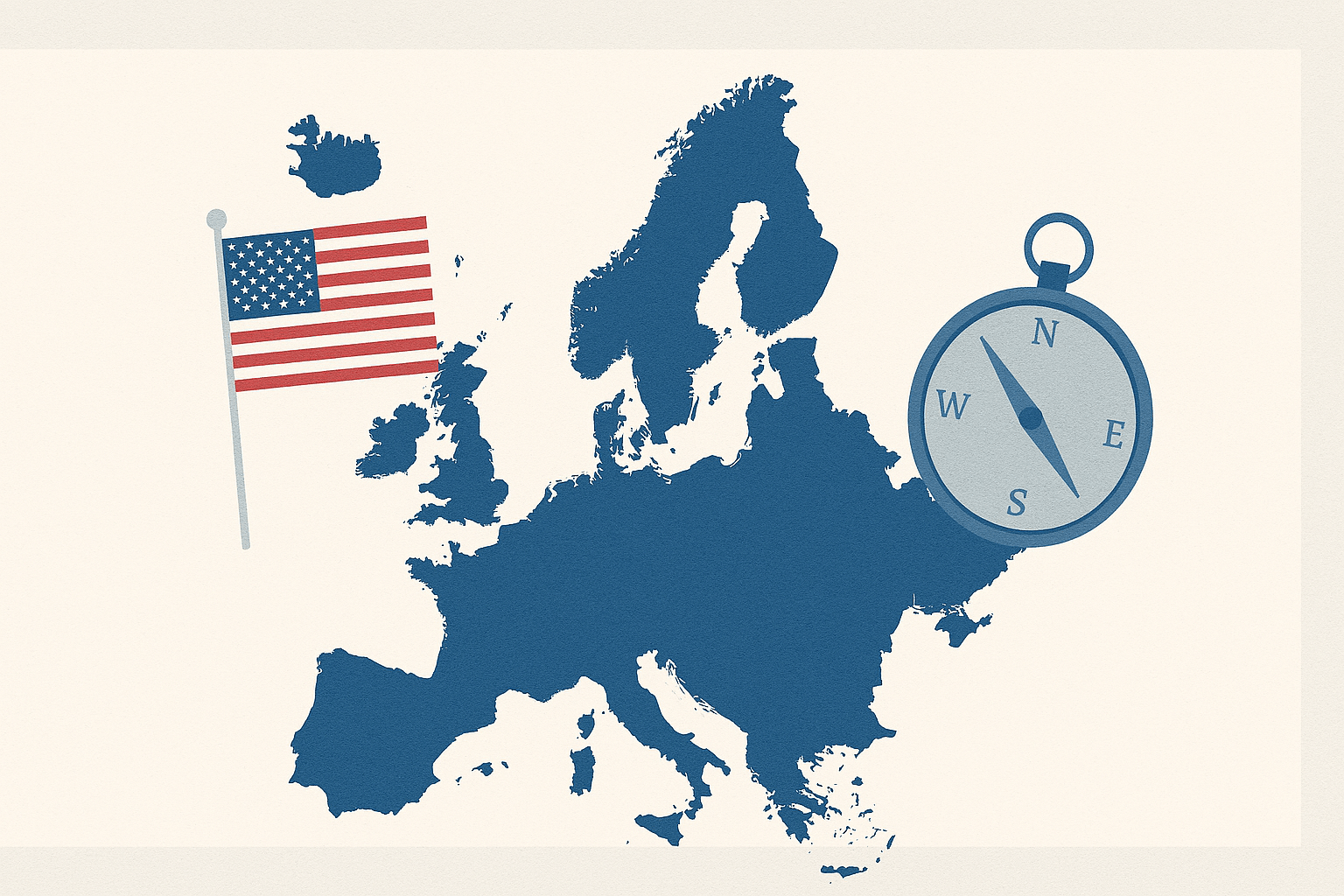
An analysis of Europe’s attitude toward the United States that appeared in yesterday’s Brussels edition of Bloomberg can best be described as disorienting. The White House is making brutal decisions that endanger the internal and external peace of the USA.
Meanwhile, those responsible in the EU are looking for ways to break the dependence on an ex-partner who died in just a year from Dr. Jekyll has mutated into Mr. Hyde – and will probably stay that way.
In the EU, those politically responsible are asking themselves how to do this EU dependence on the USA can at least reduce without endangering our own economic and security policy stability. The debate about “Strategic Autonomy” is an expression of an almost total loss of trust.
Europe: aspirations and reality
Bloomberg describes how European leaders are increasingly openly saying that the US is no longer a reliable partner under Trump. The dispute over Greenland, the threats of new punitive tariffs and the repeated disregard for multilateral rules have made this clear.
Spanish Prime Minister Pedro Sánchez is quoted as saying that the US no longer respects international law and is provoking tensions like never before.
At the same time, Bloomberg shows how difficult it is for Europe to derive concrete political consequences from this diagnosis. The The EU is closely linked economically with the USAfrom investment flows to financial markets to supply chains.
An abrupt break would be painful for both sides, but particularly risky for Europe. Dependence also remains high in terms of security policy: The NATO structuresnuclear deterrence and intelligence cooperation can hardly be replaced without Washington.
Image created with AI using ChatGPT (DALL·E)
Limits of European autonomy
Bloomberg emphasizes that Europe’s desire for “greater self-reliance” is faltering due to harsh realities. The technological dominance of the USA – from cloud infrastructure to semiconductors to software – leaves the EU little room for maneuver. Although there are initiatives such as GAIA-X and the debate about a European chip strategy, they are long-term and cannot compensate for the current dependency.
Added to this is the political fragmentation of the EU. While France has been promoting a more robust European defense architecture for years – preferably under French leadership – Eastern European states continue to clearly rely on the USA as a security guarantor. These divergences make it difficult to find a common line and make it easy for Washington to play European positions off against each other.
Geopolitical change without direction
Bloomberg concludes that while Europe has recognized how vulnerable its position is, it has not yet found a way to overcome this weakness. Alienation from the US is real, but real decoupling is illusory. Instead, wishful thinking prevails.
They want their own strategic autonomy without endangering the transatlantic partnership. This is a balancing act that is unlikely to succeed with Trump as a “partner”, apart from the fact that the transatlantic partnership has long been in danger.
For European politics, this means that old certainties no longer apply and new structures must first emerge. Bloomberg This paints a picture of a continent that has to reinvent itself, but whose protagonists would have to learn the art of squaring the circle to do so.