Category: Coins

Digital assets, cryptocurrencies, blockchain, and currency news.

  • Bitcoin Bear Markets Growing Milder, Signaling Potential Bull Market Ahead

    Bitcoin Bear Markets Growing Milder, Signaling Potential Bull Market Ahead

    Key Highlights

    • Bitcoin ETFs have shifted ownership toward financial advisers and professional investors who typically allocate around 2% of portfolios to the asset, compared to 20–30% or more for crypto-native retail investors.
    • Institutional rebalancing behavior—buying after declines and selling after surges to maintain target weights—is expected to soften sell-offs but also cap the magnitude of rallies.
    • Risk Dimensions CIO Mark Connors predicts smaller drawdowns than the 70–80% crashes of prior cycles, but warns that reduced volatility comes with moderated returns and “smaller blow-off tops.”

    ETFs Reshape Bitcoin Ownership From Retail to Professional Hands

    Before the launch of spot bitcoin exchange-traded funds, ownership of the largest cryptocurrency was concentrated among retail investors, crypto-native funds, and traders making tactical bets. According to Rasmussen, the introduction of ETFs provided financial advisers and other professional investors with a familiar, regulated vehicle to add bitcoin to traditional portfolios. This structural shift has fundamentally altered the composition of the investor base, bringing in participants who approach the asset through the lens of portfolio construction rather than speculative conviction.

    Allocation Discipline Creates Divergent Risk Profiles

    The difference in allocation size creates starkly different risk experiences. Rasmussen noted that a professional investor might allocate roughly 2% of a portfolio to bitcoin, whereas crypto-focused retail investors often commit 20%, 30%, or more of their capital to the asset. Consequently, a 50% price decline impacts these groups in vastly different ways. “If it goes down 50%, my portfolio is only down 1%,” Rasmussen said in an interview, describing how an investor with a 2% allocation might view the decline. For a retail holder with a 30% allocation, the same drop would erase 15% of total portfolio value.

    Rebalancing Mechanics May Dampen Volatility Cycles

    Beyond allocation size, the discipline of periodic rebalancing introduces a mechanical counter-cyclical force. An adviser targeting a 2% bitcoin weight may buy after a steep decline to restore the target allocation, providing a floor of demand during sell-offs. Conversely, if bitcoin surges and grows to 5% of the portfolio, that same investor may sell a portion at the next rebalancing date, creating natural supply at higher prices. This dynamic could soften the depth of corrections while simultaneously limiting the explosive upside that characterized earlier market cycles.

    Institutionalization Brings Trade-Offs: Smaller Drawdowns, Moderated Returns

    Mark Connors, chief investment officer at Risk Dimensions, expects growing institutional participation to contribute to smaller drawdowns than the 70–80% declines observed in previous bitcoin cycles. However, he cautioned that investors should not expect to get something for nothing. Connors said bitcoin’s volatility has fallen over time, but its returns have moderated as well. More institutional investors could mean “smaller blow-off tops due to rebalancing,” he said, highlighting the trade-off between reduced downside risk and capped upside potential as the asset matures within traditional financial infrastructure.

    Why This Matters

    The transition from a retail-dominated market to one with significant professional participation marks a structural maturation for bitcoin as an asset class. The introduction of spot ETFs in the United States has accelerated this shift by lowering operational and custody barriers for registered investment advisors, family offices, and institutional allocators. As these investors apply modern portfolio theory—fixed allocations, systematic rebalancing, and risk-budgeting frameworks—the statistical properties of bitcoin’s price action are likely to evolve. Historically, bitcoin’s boom-bust cycles were amplified by homogeneous, high-conviction holders prone to panic selling and euphoric buying. A more diverse holder base with differentiated time horizons and mandate constraints could produce a return profile that resembles other alternative assets: lower volatility, reduced tail risk, but also diminished alpha relative to the asset’s early years. For allocators, this raises strategic questions about bitcoin’s role in a portfolio—whether it remains a high-beta growth sleeve or transitions toward a diversifier with equity-like risk and modestly enhanced returns.

    Frequently Asked Questions

    How does a typical professional investor’s bitcoin allocation differ from a retail crypto investor’s?

    Professional investors such as financial advisers typically allocate around 2% of a portfolio to bitcoin, while crypto-focused retail investors often hold 20%, 30%, or more of their total capital in the asset.

    What effect does portfolio rebalancing have on bitcoin’s price cycles?

    Systematic rebalancing creates counter-cyclical flows: advisers buy bitcoin after price declines to restore target weights, supporting prices during corrections, and sell after sharp rallies to trim overweight positions, capping upside momentum.

    Will institutional adoption eliminate bitcoin’s volatility entirely?

    No. Mark Connors of Risk Dimensions notes that while institutional participation may reduce the severity of drawdowns compared to historical 70–80% crashes, volatility will persist and returns are likely to moderate, resulting in “smaller blow-off tops due to rebalancing.”

  • Data Proves Bitcoin Unfazed by Rising Bond Yields Long-Term

    Data Proves Bitcoin Unfazed by Rising Bond Yields Long-Term

    Key Highlights

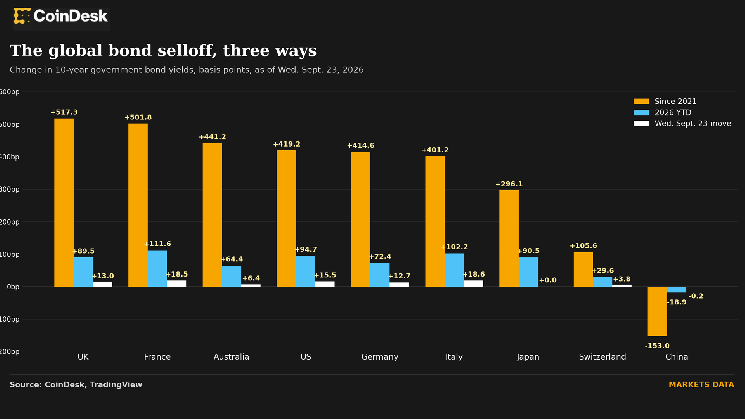
    • U.S. 10-year Treasury yield surged 15 basis points to 5.13%, the highest level since 2007, triggering global yield increases.
    • Bitcoin’s 90-day correlation with U.S. 10-year yield daily moves stands at just −0.18, with 180-day and 1-year correlations even closer to zero at −0.06 and −0.03 respectively.
    • Historical data analyzed by CoinDesk shows Bitcoin has demonstrated little to no consistent correlation with bond yields across multiple timeframes and international markets.

    Rising Yields Reignite Debate Over Bitcoin’s Macro Sensitivity

    The U.S. 10-year Treasury yield jumped 15 basis points on Wednesday to breach 5.13%, marking its highest level since the pre-financial crisis era of 2007. The move rippled across global fixed-income markets, pulling sovereign yields higher worldwide and reviving a familiar market narrative: that rising bond yields create a structural headwind for non-yielding assets like Bitcoin (BTC) and gold. The conventional logic posits that as risk-free returns become more attractive, the opportunity cost of holding zero-coupon assets increases, theoretically drawing capital away from crypto and toward government debt.

    Correlation Data Contradicts Conventional Wisdom

    While the theoretical framework appears sound on paper, empirical evidence fails to support a consistent inverse relationship. According to data analyzed by CoinDesk, the 90-day rolling correlation between Bitcoin’s daily returns and daily moves in the U.S. 10-year yield sits at just −0.18—a figure statistically indistinguishable from zero correlation. Extending the observation window does not strengthen the link; the 180-day correlation narrows further to −0.06, while the one-year correlation stands at a negligible −0.03. Across every measured timeframe, Bitcoin’s price action has exhibited virtually no linear dependence on the trajectory of U.S. benchmark yields.

    Global Yield Regimes Show Similar Disconnect

    The absence of correlation is not confined to the United States. Bitcoin has demonstrated an equally weak statistical relationship with the sovereign yields of other major economies. This global pattern suggests that Bitcoin’s valuation drivers operate independently of the interest rate channels that dominate traditional asset pricing models. Rather than functioning as a simple “risk-off” or “risk-on” proxy sensitive to the cost of capital, the asset’s historical behavior aligns more closely with a distinct, idiosyncratic return stream shaped by network adoption cycles, liquidity conditions specific to crypto markets, and evolving regulatory narratives.

    Why This Matters

    The persistent disconnect between Bitcoin and bond yields carries significant implications for portfolio construction and macro strategy. Investors and analysts who position Bitcoin strictly as a rate-sensitive speculative asset may be relying on a flawed mental model that has not held up over the asset’s history. As central banks navigate a potential “higher for longer” rate environment, understanding Bitcoin’s true correlation profile—effectively zero with respect to sovereign yields—becomes critical for accurate risk budgeting. The data suggests Bitcoin should be evaluated on its own fundamental merits and crypto-specific catalysts rather than through the lens of traditional duration risk.

    Frequently Asked Questions

    What is the current correlation between Bitcoin and the U.S. 10-year Treasury yield?

    As of the latest analysis by CoinDesk, the 90-day correlation is −0.18, the 180-day correlation is −0.06, and the one-year correlation is −0.03—all statistically near zero.

    Does Bitcoin correlate with bond yields in other countries?

    No. The data shows Bitcoin is equally uncorrelated with the sovereign yields of other nations, indicating this is a global phenomenon rather than a U.S.-specific anomaly.

    Why does the market still believe rising yields hurt Bitcoin?

    The narrative relies on theoretical opportunity cost logic: higher risk-free rates should make non-yielding assets less attractive. However, historical price data does not bear out this relationship, suggesting other factors dominate Bitcoin’s valuation.

  • Token Burns Continue for Popular Altcoin; Latest Burn Amount Revealed

    Token Burns Continue for Popular Altcoin; Latest Burn Amount Revealed

    Key Highlights

    • Polygon Foundation CEO Sandeep Nailwal announced on September 24 that 100 million $POL tokens have been permanently burned, removing approximately 1% of the total supply from circulation.
    • The tokens were sent to an inaccessible address in a process known as “token burning,” making them permanently unrecoverable and unable to re-enter the market.
    • Nailwal’s announcement did not disclose the specific reasons for the burn, its expected impact on Polygon’s token economy, or any new supply arrangements for $POL following the reduction.

    Polygon Foundation Executes 100 Million $POL Token Burn

    Polygon Foundation CEO Sandeep Nailwal confirmed on September 24 that the organization has permanently removed 100 million $POL tokens from circulation. In a social media post, Nailwal stated that the tokens were “permanently incinerated”, a phrasing that underscores the irreversible nature of the operation. The burned amount represents roughly 1% of the total $POL supply, marking a notable contraction in the token’s circulating float.

    Mechanics of the Supply Reduction

    The burn was executed by sending the 100 million tokens to an inaccessible wallet address, a standard cryptographic method for permanently destroying digital assets. Once transferred to such an address—often referred to as a “null” or “burn” address—the tokens can never be retrieved, spent, or reintroduced into the Polygon ecosystem. This operation directly reduces the total supply of $POL, the native token that powers network activities, staking, governance, and transaction fees across Polygon’s suite of scaling solutions.

    Strategic Context Remains Undisclosed

    Despite the significance of a 1% supply reduction, Nailwal’s statement offered no explanation for the decision. The post did not reference a scheduled burn mechanism, a governance proposal, a response to inflationary pressures, or any upcoming changes to $POL’s emission schedule. Similarly, the Polygon Foundation has not published details on whether this burn is a one-time event or part of a broader tokenomic redesign. The absence of forward-looking guidance leaves market participants without clarity on future supply dynamics.

    Why This Matters

    Token burns are a closely watched lever in crypto economics because they alter the supply side of the valuation equation without necessarily changing demand. For $POL, which succeeded MATIC as the ecosystem’s primary asset following the Polygon 2.0 upgrade, supply management is critical to its role in securing the AggLayer and incentivizing validators. A 1% reduction is modest in isolation, but if it signals the start of a programmatic burn schedule—similar to Ethereum’s EIP-1559 fee burn or BNB’s quarterly auto-burn—it could establish a deflationary narrative that influences long-term holder sentiment and staking yields. Until the Foundation provides a rationale or roadmap, the burn remains a discrete event rather than a confirmed policy shift.

    Frequently Asked Questions

    What exactly does it mean that 100 million $POL tokens were “permanently incinerated”?

    The tokens were sent to a cryptographic address with no known private key, making them mathematically impossible to access or spend. They are effectively destroyed and will never re-enter circulation.

    Did Sandeep Nailwal or the Polygon Foundation explain why this burn was conducted?

    No. The September 24 announcement did not include any reasoning, strategic context, or indication of whether further burns are planned.

    How does this burn affect the total and circulating supply of $POL?

    The operation reduces the total supply by approximately 1%. Since the tokens were removed from circulation entirely, the circulating supply decreases by the same amount, assuming the burned tokens were previously part of the circulating float.

  • AI Coding Slashes Quantum-Safe Bitcoin Transaction Cost Estimate from $320 to $66 in One Week

    AI Coding Slashes Quantum-Safe Bitcoin Transaction Cost Estimate from $320 to $66 in One Week

    Key Highlights

    • StarkWare has demonstrated a quantum-resistant Bitcoin transaction method that operates within current protocol rules, requiring no soft fork or network upgrade.
    • The approach uses hash-based cryptography to protect against quantum computers deriving private keys from exposed public keys, but costs approximately $320 in computing per transaction under current implementation.
    • Significant limitations remain: transactions must be submitted directly to miners, and the method cannot protect coins whose public keys are already exposed — the primary target for any quantum attacker.

    StarkWare Unveils Quantum-Resistant Bitcoin Transaction Method Without Protocol Changes

    Israeli blockchain scaling firm StarkWare has published research demonstrating a method to execute quantum-resistant transactions on Bitcoin without requiring a soft fork or any modification to the network’s consensus rules. The technique leverages hash-based cryptographic commitments — specifically leveraging the collision resistance of SHA-256 — to shield coins from a future scenario in which a sufficiently powerful quantum computer could derive a private key from an exposed public key using Shor’s algorithm.

    Because the construction fits entirely within Bitcoin’s existing script and transaction validity rules, it can be deployed immediately as an emergency mitigation if the quantum threat materializes before the broader ecosystem adopts a more comprehensive, protocol-level upgrade such as BIP-360 or similar proposals for post-quantum signature schemes. However, the current implementation carries a steep computational price tag: approximately $320 of computing resources per transaction, according to the cost breakdown published by StarkWare.

    Cost Claims and Independent Verification

    A third-party contest site associated with the research cites a lower figure of $66 per transaction, but this number remains an estimate drawn from a test computation and has not been validated by a subsequent transaction actually mined on the Bitcoin mainnet. The improved code referenced by the contest site has not been shown preparing another transaction that was successfully included in a block. Applying the speedups displayed on the contest site to StarkWare’s original $320 cost breakdown yields an estimated $83 per transaction, according to calculations performed by CoinDesk. The contest site states that later record-setting runs surpass those measurements, though it does not disclose which specific results underpin the $66 estimate.

    Operational Constraints Limit Practical Deployment

    Beyond cost, the method imposes structural constraints that reduce its utility as a general-purpose solution. Transactions constructed using this approach must be sent directly to a miner because they do not propagate through the Bitcoin peer-to-peer network in the standard manner. More critically, the protection only applies to coins whose public keys have not yet been exposed on-chain — such as those locked in pay-to-taproot (P2TR) or pay-to-witness-script-hash (P2WSH) outputs where the public key remains hidden until spending. Coins in pay-to-pubkey-hash (P2PKH) or reused pay-to-taproot addresses with revealed public keys — the very cohort a quantum adversary would target first — cannot be secured retroactively by this method.

    Why This Matters

    The research addresses a long-standing theoretical vulnerability in Bitcoin’s elliptic curve cryptography (secp256k1), which secures the vast majority of coins in circulation. While large-scale, fault-tolerant quantum computers capable of breaking ECDSA do not yet exist, advances in quantum error correction and qubit coherence have accelerated expert timelines. The National Institute of Standards and Technology (NIST) has already standardized post-quantum algorithms such as CRYSTALS-Dilithium and SPHINCS+, but integrating them into Bitcoin would require a contentious, multi-year soft fork process with broad miner, developer, and user consensus.

    StarkWare’s hash-based fallback offers a permissionless, immediate escape hatch — but only for a subset of unspent transaction outputs (UTXOs) and at a cost that currently limits use to high-value holdings. The requirement for direct miner submission also introduces trust and censorship considerations. As the ecosystem debates long-term quantum resistance — including proposals for quantum-resistant address formats and commit-reveal schemes — this work establishes a proven, if imperfect, bridge capability.

    Frequently Asked Questions

    Does this method require a Bitcoin soft fork or protocol upgrade?
    No. The construction operates entirely within Bitcoin’s existing consensus and script rules, meaning it can be used today without any network-level changes.
    Can this protect all Bitcoin holdings from a quantum attack?
    No. It only secures coins whose public keys have not yet been revealed on-chain — primarily Taproot and certain Script-based outputs. Coins in legacy P2PKH addresses or reused Taproot addresses with exposed public keys remain vulnerable.
    What is the real-world cost to use this quantum-resistant transaction method?
    StarkWare’s published breakdown estimates ~$320 in compute per transaction. Independent analysis by CoinDesk applying claimed optimizations suggests ~$83, while a contest site cites an unverified $66 figure. No subsequent mainnet transaction has confirmed the lower costs.
  • FedNow Prepares Cross-Border Support for U.S. Banks

    FedNow Prepares Cross-Border Support for U.S. Banks

    Key Highlights

    • Federal Reserve Financial Services launched early-adopter testing on September 23 for enhanced ISO 20022 messages that enable FedNow to settle the U.S. leg of cross-border payments while correspondent banks handle the international portion.
    • The model does not create a direct global FedNow network; it relies on existing correspondent-banking infrastructure and remains contingent on final approval of Regulation J amendments (docket R-1891) and updates to Operating Circular 8.
    • FedNow domestic volume surged 83.2% in Q2 2026 to nearly 5 million payments worth $274.66 billion, with over 1,500 participating institutions, as the Fed prepares a January 2027 discount program to further boost adoption.

    Federal Reserve Advances FedNow Cross-Border Testing with Correspondent-Banking Model

    Early Adopters Begin Testing Enhanced ISO 20022 Messages for International Payments

    Federal Reserve Financial Services announced on September 23 that a group of early-adopter financial institutions will begin testing new FedNow message formats designed to carry the data required when a payment involves a sender or recipient outside the United States. The enhanced ISO 20022 specifications have been available through the Fed’s MyStandards portal since April, allowing institutions active in international commerce to prepare system changes during 2026. Payall Payment Systems is among the named participants. President and CEO Gary Palmer said the company’s integration is intended to provide financial institutions with faster and more transparent processing for the U.S. portion of international payments while digitizing compliance and transaction-risk checks. Payall described its role as helping banks “un-nest” payment chains, screen parties and automate risk controls. Those are company claims about its infrastructure and do not establish that every international payment using the future FedNow capability will process faster or at lower cost.

    Correspondent Banks Retain Control of Foreign Leg Under Proposed Framework

    The Federal Reserve’s design keeps existing correspondent banking infrastructure at the center of the foreign portion of each transaction. A payment could begin abroad, move through correspondent arrangements, and use FedNow once it reaches the U.S. banking system. An outbound transaction could reverse that sequence, with FedNow processing the domestic transfer before an intermediary handles the payment beyond the U.S. The model resembles structures already used with Fedwire, according to Federal Reserve Financial Services. It does not create direct FedNow access for foreign banks that lack the required U.S. participation structure, nor does it establish a Federal Reserve foreign-exchange service. As one industry observer noted on social media: “FedNow going cross-border is not what it sounds like. The Fed’s own proposal: a correspondent bank handles the international leg, FedNow settles the US domestic leg in seconds. The foreign mile still runs on whichever rail the correspondent picks. So the slow, expensive part of…” — Wave of Innovation (@wave_of_innov), September 23, 2026.

    Regulation J Approval Remains Critical Unresolved Step Before Full Rollout

    The most important unresolved step is regulatory approval. The Federal Reserve Board’s current rulemaking portal still lists docket R-1891 as a “Rulemaking Proposal.” The public comment period closed June 9, but the Board has not posted a final rule replacing the proposal as of September 24. The September 23 FedNow announcement carries the same limitation: the functionality remains contingent on required amendments to Regulation J and corresponding changes to Operating Circular 8 receiving approval from the relevant Federal Reserve governing bodies. Operating Circular 8 contains the operating terms for transfers through FedNow; the April 1, 2026 version is currently listed as the effective circular, alongside operating procedures that took effect April 28. Industry feedback on the Regulation J proposal raised compliance questions that the final framework may need to address. The American Bankers Association, for example, recommended clarifying how sanctions, anti-money laundering and fraud checks should work when a FedNow payment forms part of a cross-border chain, and asked that banks be able to delay or reject payments where required to complete legally mandated screening. Stripe’s comment on the proposal separately argued that the existing FedNow operating framework contained a residency restriction for certain ultimate customers and said operating-rule changes would be needed alongside the Regulation J amendment for the proposal to achieve its full cross-border purpose.

    FedNow Domestic Volume Surges as Network Prepares for International Expansion

    FedNow enters the testing phase after rapid growth in domestic payment activity. Federal Reserve Financial Services reported 4.997 million settled customer payments during the second quarter of 2026, up 83.2% from the first quarter. Their combined value reached $274.66 billion, compared with $271.25 billion during the previous three months. Average daily volume rose from 30,317 payments in the first quarter to 54,921 in the second. Average payment size fell from $99,414 to $54,957 as transaction counts expanded more quickly than total dollar value. For all of 2025, FedNow processed 8.41 million payments worth $853.4 billion, representing 458.9% annual volume growth and more than 2,100% growth in settled value compared with 2024. The network now spans more than 1,500 participating financial institutions. Federal Reserve Financial Services keeps separate current lists of live institutions, settlement agents and certified service providers, with its participant and provider files most recently updated September 21. In a separate domestic adoption move, Federal Reserve Financial Services announced a new discount program beginning January 1, 2027, intended to encourage more institutions to activate and increase FedNow sending capabilities.

    Why This Matters

    The FedNow cross-border initiative represents a pragmatic evolution rather than a revolutionary overhaul of international payments. By leveraging the existing correspondent-banking network for the foreign leg while applying FedNow’s 24/7/365 instant settlement to the domestic portion, the Federal Reserve avoids the complexity and political sensitivity of building a direct global central-bank payment rail. This approach aligns with the Fed’s August review of U.S. cross-border payment work, which noted that FedNow had remained domestic since its July 2023 launch while demand from banks for international use increased as instant payments expanded globally. The migration of Fedwire to ISO 20022 in July 2025 created more common messaging across international payment chains, providing a technical foundation for the enhanced messages now under test. Potential use cases identified by the Federal Reserve include international payroll, corporate payments, property transactions, insurance disbursements and global treasury activity. However, the complete speed and cost of an international transaction will still depend on the foreign leg, correspondent relationships, compliance reviews and local payment infrastructure. As banks, stablecoin companies and blockchain networks compete to shorten international payment chains—with SWIFT testing a blockchain ledger with 17 global banks for round-the-clock cross-border payments using tokenized commercial-bank deposits—FedNow’s model remains based on conventional bank money settled through Federal Reserve accounts for its domestic portion. Cross-border testing is expected to proceed while the Regulation J process remains unfinished, with no general launch date published.

    Frequently Asked Questions

    Does FedNow now support direct cross-border payments to foreign banks?

    No. The Federal Reserve’s model does not create direct FedNow access for foreign banks that lack the required U.S. participation structure. FedNow settles only the U.S. domestic portion between participating domestic institutions, while correspondent banks or other approved intermediaries continue handling the overseas leg through their existing cross-border arrangements.

    When will the cross-border capability be generally available to all FedNow participants?

    No general launch date has been published. The functionality remains contingent on final approval of Regulation J amendments (docket R-1891) and corresponding changes to Operating Circular 8. Federal Reserve Financial Services says future progress updates will be provided to participants as testing, rule approval and Operating Circular changes advance.

    What role does Payall Payment Systems play in the testing phase?

    Payall Payment Systems is one of the named early-adopter participants. The company’s integration aims to provide financial institutions with faster and more transparent processing for the U.S. portion of international payments while digitizing compliance and transaction-risk checks. Payall describes its role as helping banks “un-nest” payment chains, screen parties and automate risk controls, though these are company claims about its infrastructure and do not guarantee that every international payment using the future FedNow capability will process faster or at lower cost.

  • Her Crypto ‘Godfather’ Ex Moved Millions; She Hid $2.6M From IRS

    Her Crypto ‘Godfather’ Ex Moved Millions; She Hid $2.6M From IRS

    Key Highlights

    • Iris Rabaya Au, 37, of Irvine, was sentenced to 18 months in federal prison and ordered to pay $1,484,343 in restitution after pleading guilty to filing a false tax return; prosecutors say she funneled over $2.6 million in unreported income into her personal accounts between 2020 and 2023.
    • Au acted as the financial architect for her former boyfriend, Adam Iza, creating shell companies, moving approximately $16 million into cryptocurrency, and directing roughly $1 million in cash payments to Los Angeles County sheriff’s deputies who provided private security and misused law enforcement tools on Iza’s behalf.
    • Adam Iza has already been sentenced to 15 years in federal prison in Connecticut for orchestrating a violent kidnapping plot tied to a bitcoin robbery, and faces a separate sentencing in California on October 5 for conspiracy, wire fraud, and tax evasion related to a Meta advertising credit-line scheme.

    Irvine Woman Sentenced for Tax Fraud in Scheme Linked to Crypto Figure Adam Iza

    Federal prosecutors have secured an 18-month prison sentence for Iris Rabaya Au, a 37-year-old Irvine resident who admitted to concealing more than $2.6 million in income from the Internal Revenue Service. The sentencing, announced by the Justice Department on September 21, caps a case that illuminates the financial machinery behind Adam Iza, a self-styled cryptocurrency entrepreneur known by the nickname “Godfather,” and reveals a network of shell companies, luxury asset purchases, and alleged corruption involving Los Angeles County sheriff’s deputies.

    Financial Infrastructure for a Fugitive Fortune

    According to Au’s plea agreement and a government sentencing memorandum, she established the banking and corporate framework that allowed Iza to move, spend, and hide millions of dollars in fraud proceeds. Between 2020 and 2023, more than $2.6 million flowed from company accounts into Au’s personal bank accounts, income she failed to report on her federal tax returns. U.S. District Judge Percy Anderson ordered her to pay $1,484,343 in restitution and to forfeit a portfolio of high-value assets that included luxury and high-performance vehicles, designer handbags, and three “Godfather” sculptures—a reference to Iza’s moniker.

    Prosecutors characterized Au’s role as essential to the operation. In their sentencing memorandum, they wrote:

    “[Au] set up the financial infrastructure that enabled Adam Iza to move, spend, and conceal millions of dollars in fraud proceeds while she personally benefited from the wealth.”

    Shell Companies, Sheriff’s Deputies, and $16 Million in Cryptocurrency

    The plea agreement details how Au, at Iza’s direction, created shell corporations and opened bank accounts in their names. Those accounts were used to pay approximately $1 million—largely in cash—to Los Angeles County sheriff’s deputies. The deputies provided private security for Iza, but prosecutors say the arrangement went far beyond protection. Deputies allegedly accessed confidential law enforcement databases and obtained court-authorized search warrants targeting individuals involved in Iza’s financial or personal disputes.

    The same financial pipeline funded a lavish lifestyle: luxury real estate, vehicles, jewelry, clothing, and nearly $10 million in recreational spending for the couple. Perhaps most significantly, Au used the shell-company accounts to acquire approximately $16 million in cryptocurrency for Iza, giving him digital assets he could hold, exchange, or transfer at will. The Justice Department emphasized that the $16 million in crypto purchases was distinct from the $2.6 million Au diverted to her own accounts and omitted from her tax filings.

    Deputy Convicted in Parallel Corruption Case

    The investigation has already produced a conviction inside the sheriff’s department. Former deputy David Anthony Rodriguez was sentenced to one year in prison after admitting he submitted a false warrant application to obtain a man’s cell-phone location data for a private client—further evidence, prosecutors say, of how police powers were weaponized on Iza’s behalf. Iza’s arrest in September 2024 brought the broader scheme into public view.

    Iza Faces Two Federal Sentencings Across Coast

    Adam Iza’s legal jeopardy spans two federal courts. In January 2025, he pleaded guilty in Los Angeles federal court to conspiracy against rights, wire fraud, and tax evasion stemming from a scheme to fraudulently obtain access to Meta advertising accounts and their associated credit lines, then sell that access to third parties. His sentencing in that case is scheduled for October 5.

    Before that date arrives, Iza has already received a 15-year sentence in Connecticut. On September 9, a federal judge there imposed the term for his role in an August 2024 plot to kidnap the parents of an individual linked to a large bitcoin theft. Authorities say Iza helped plan and fund the operation, which began with a violent carjacking and ended with the parents’ abduction. The Connecticut sentence will run before any additional time imposed in California.

    Why This Matters

    The case illustrates how cryptocurrency wealth—real or fabricated—can be laundered through traditional banking channels, shell entities, and complicit professionals, including law enforcement officers. It also highlights the IRS’s focus on unreported income from digital-asset transactions and the willingness of federal prosecutors to pursue both the principals and the facilitators of fraud. For the Los Angeles County Sheriff’s Department, the convictions of deputies who abused warrant authority and database access represent a significant internal accountability moment. As Iza awaits his California sentencing, the scope of his admitted schemes—spanning advertising fraud, tax evasion, and a violent kidnapping conspiracy—underscores the convergence of cyber-enabled financial crime and physical-world violence.

    Frequently Asked Questions

    What specific charges did Iris Rabaya Au plead guilty to?

    Au pleaded guilty in March 2025 to one count of filing a false federal tax return, admitting she failed to report more than $2.6 million in income that flowed into her personal accounts between 2020 and 2023.

    How were Los Angeles County sheriff’s deputies involved in the scheme?

    Prosecutors say Au directed roughly $1 million in cash payments to deputies who provided private security for Adam Iza. Beyond security, those deputies allegedly accessed confidential law enforcement information and obtained court-authorized search warrants targeting people involved in Iza’s disputes. Former deputy David Anthony Rodriguez was separately sentenced to one year in prison for using a false warrant application to obtain cell-phone location data for a private client.

    What is Adam Iza’s current sentencing status?

    Iza has already been sentenced to 15 years in federal prison in Connecticut for his role in a kidnapping plot connected to a bitcoin robbery. He separately pleaded guilty in Los Angeles federal court to conspiracy against rights, wire fraud, and tax evasion related to a Meta advertising credit-line fraud; his sentencing in that case is scheduled for October 5, 2025.

  • BlackRock’s IBIT Attracts $1 Billion Inflows as Bitcoin Retreats From $87K

    BlackRock’s IBIT Attracts $1 Billion Inflows as Bitcoin Retreats From $87K

    Key Highlights

    • BlackRock’s iShares Bitcoin Trust (IBIT) recorded approximately $1.02 billion in net inflows across four consecutive trading sessions from September 17 to 22, capturing 44% of total U.S. spot Bitcoin ETF flows.
    • Total U.S. spot Bitcoin ETFs attracted $2.31 billion during the same period, signaling sustained institutional and retail appetite for regulated crypto exposure despite Bitcoin’s pullback from $87,283.
    • Bitcoin retreated to roughly $84,175 after testing intraday highs near $87,283, but remains above key moving averages with critical support at $80,000; a break below could see a retest of the $75,000–$76,000 demand zone.

    BlackRock’s IBIT Leads Record Inflow Streak as Bitcoin ETF Demand Surges

    BlackRock’s iShares Bitcoin Trust (IBIT) has cemented its dominance in the U.S. spot Bitcoin exchange-traded fund landscape, drawing just over $1.02 billion in net inflows across four straight trading sessions between September 17 and September 22, according to data compiled by Farside Investors. The flagship fund captured 44% of the $2.31 billion that flowed into all U.S. spot Bitcoin ETFs combined during the window, underscoring its status as the primary vehicle for institutional and retail investors seeking regulated exposure to the world’s largest cryptocurrency.

    Daily Flow Breakdown Reveals Accelerating Momentum

    The inflow trajectory showed notable acceleration as the week progressed. IBIT opened the streak with $183.7 million on September 17, followed by $108.4 million on September 18. Momentum then surged dramatically, with $381.4 million entering the fund on September 21 and a further $350.3 million on September 22. The combined four-day total of roughly $1.02 billion represents one of the strongest sustained inflow runs since the ETF suite launched in January 2024. Farside Investors emphasized that these figures reflect investor capital allocated to the fund for Bitcoin exposure, not direct Bitcoin purchases by BlackRock itself.

    Bitcoin Price Action Diverges from ETF Demand Strength

    The robust ETF buying occurred against a backdrop of fading Bitcoin price momentum. After rallying to an intraday peak near $87,283, Bitcoin reversed course and slipped to approximately $84,175, marking a 2.35% intraday decline at the time of reporting. Despite the pullback, the asset continues to trade above its major moving averages, preserving the broader uptrend structure that has been in place since the summer lows. Technical analysts are closely monitoring the $80,000 level, which previously acted as stiff resistance before flipping to support during the recent breakout.

    Key Technical Levels Frame Next Directional Move

    Market structure suggests two primary scenarios. If Bitcoin holds above the $80,000 support zone, the breakout remains intact, potentially setting the stage for a fresh assault on the $87,300 high and, upon a successful breach, opening a path toward the psychologically significant $90,000 threshold. Conversely, a decisive daily close below $80,000 would signal structural weakening and could trigger a deeper correction back toward the $75,000–$76,000 region where buying interest previously emerged. The current price action reflects short-term profit-taking rather than a fundamental shift in demand, with the persistent ETF inflows providing a potential floor for further downside.

    Why This Matters

    The divergence between record ETF inflows and Bitcoin’s price consolidation highlights a maturing market dynamic: regulated investment vehicles are increasingly absorbing supply and smoothing volatility, even as spot markets digest gains. IBIT’s outsized share of flows — nearly half of all U.S. spot Bitcoin ETF capital — reinforces BlackRock’s distribution advantage and the trust institutional allocators place in its custody and operational infrastructure. For the broader crypto ecosystem, sustained inflows at these levels suggest the 2024–2025 adoption cycle is being driven less by speculative retail frenzy and more by strategic portfolio allocation, a development that could support higher equilibrium pricing over the medium term. Upcoming macroeconomic catalysts, including Federal Reserve policy decisions and quarterly earnings from major financial institutions, will likely determine whether the current accumulation phase transitions into the next leg higher or extends into a broader consolidation.

    Frequently Asked Questions

    How much did BlackRock’s IBIT ETF attract in the latest four-day inflow streak?

    IBIT recorded approximately $1.02 billion in net inflows across the four trading sessions from September 17 to September 22, with daily amounts of $183.7 million, $108.4 million, $381.4 million, and $350.3 million, respectively.

    What percentage of total U.S. spot Bitcoin ETF flows did IBIT capture?

    IBIT accounted for 44% of the $2.31 billion that flowed into all U.S. spot Bitcoin ETFs combined during the same four-day period, reinforcing its position as the dominant fund in the category.

    What are the key price levels to watch for Bitcoin following the recent pullback?

    Immediate support sits at $80,000, a former resistance level that now underpins the breakout structure. A hold above this zone keeps a move toward $87,300 and $90,000 in play, while a break below could see Bitcoin retest the $75,000–$76,000 demand area.

  • Frax Partners with Gearbox to Launch RWA Leverage Market

    Frax Partners with Gearbox to Launch RWA Leverage Market

    Key Highlights

    • Frax Finance integrates frxUSD as the foundational stablecoin for Gearbox Protocol’s new real-world asset (RWA) leverage market, targeting institutional liquidity.
    • The collaboration creates a one-click automated solution for DeFi users to gain leveraged exposure to RWAs, bridging traditional finance mechanisms with decentralized infrastructure.
    • Market observers are monitoring frxUSD adoption rates and liquidity dynamics within Gearbox’s RWA market as a potential benchmark for future DeFi–TradFi integrations.

    Frax Finance and Gearbox Protocol Launch RWA Leverage Market Powered by frxUSD

    Frax Finance has formally announced a strategic collaboration with Gearbox Protocol that positions frxUSD as the core stablecoin underpinning a newly launched real-world asset (RWA) leverage market. The integration, revealed via the projects’ official Twitter channels, is designed to streamline institutional access to DeFi-native leverage while deepening liquidity for tokenized real-world assets. By anchoring Gearbox’s leverage architecture to frxUSD, the partnership aims to reduce friction for capital allocators seeking automated, on-chain exposure to yield-bearing RWAs without navigating fragmented liquidity pools or manual rebalancing processes.

    Technical Architecture and Institutional Focus

    Gearbox Protocol, recognized for its generalized leverage framework that allows users to borrow against deposited collateral to amplify positions, will deploy frxUSD as the primary denomination for its RWA-specific credit markets. This design choice leverages frxUSD’s dual-collateral model—partially backed by Frax’s algorithmic monetary policy and partially by exogenous reserves—to provide a stable, deep-liquidity unit of account suited for institutional-scale transactions. The collaboration reflects a broader industry shift where DeFi primitives are being repurposed to accommodate regulated asset classes, including tokenized treasuries, corporate credit, and structured products, all of which require predictable settlement layers and capital-efficient leverage tooling.

    Market Context and Competitive Positioning

    The announcement arrives amid heightened institutional interest in RWA tokenization, with major asset managers and custodians actively exploring blockchain-based fund administration and distribution. Frax Finance’s frxUSD has recently gained traction as a DeFi-native stablecoin capable of supporting complex financial engineering, while Gearbox’s leverage engine offers composable, permissionless credit lines that can be customized for specific asset risk profiles. Together, the two protocols address a critical infrastructure gap: the ability to deploy leveraged strategies on RWAs within a fully on-chain, auditable environment that meets the operational standards of professional allocators.

    Why This Matters

    The Frax–Gearbox integration signals a maturation point for the DeFi sector, where stablecoin design and leverage protocols are converging to replicate—and potentially improve upon—traditional prime brokerage services. By standardizing frxUSD as the settlement and margin asset for RWA leverage, the partnership reduces counterparty fragmentation and creates a reference market for pricing leveraged RWA positions on-chain. Success metrics such as total value locked (TVL) in the new market, frxUSD borrow utilization rates, and the diversity of RWA collateral types onboarded will serve as leading indicators for whether DeFi can sustainably absorb institutional-grade credit demand. Regulatory clarity around tokenized securities and stablecoin issuance in key jurisdictions will further influence adoption velocity over the coming quarters.

    Frequently Asked Questions

    What role does frxUSD play in Gearbox’s new RWA leverage market?
    frxUSD serves as the underlying stablecoin for the market, functioning as the primary unit of account, margin collateral, and settlement asset for leveraged positions on tokenized real-world assets within Gearbox Protocol’s credit architecture.
    How does this collaboration benefit institutional participants?
    The integration provides institutions with a streamlined, automated pathway to access leveraged RWA exposure on-chain, reducing operational complexity, consolidating liquidity around a single stablecoin denominator, and enabling composable credit strategies without traditional prime broker intermediaries.
    What metrics should observers track to evaluate the partnership’s impact?
    Key indicators include frxUSD borrow utilization rates within Gearbox’s RWA markets, total value locked across supported RWA collateral types, institutional onboarding velocity, and the stability of frxUSD’s peg under leveraged demand conditions.
  • Former SEC Acting Chair: Agency Dropped Crypto Cases to Avoid Credibility Issues

    Former SEC Acting Chair: Agency Dropped Crypto Cases to Avoid Credibility Issues

    Key Highlights

    • The SEC dismissed enforcement actions against major cryptocurrency firms including Kraken, Ripple Labs, and Coinbase in early 2025 to preserve agency credibility ahead of a planned “180-degree change” in regulatory policy.
    • Former Acting Chair Mark Uyeda stated that allowing litigators to argue positions in court that contradicted forthcoming Commission interpretations would have damaged the SEC’s institutional credibility.
    • With Commissioner Hester Peirce’s expected departure in November 2025, the Commission will operate with only two of its five presidentially appointed members, and no replacement nominations have been announced.

    Uyeda Defends SEC’s Decision to Drop Crypto Enforcement Actions

    Credibility Concerns Prompted Case Dismissals

    Speaking at the Psaros Center for Financial Markets and Policy’s Financial Markets Quality Conference on Wednesday, SEC Commissioner Mark Uyeda provided the most detailed explanation to date for the agency’s abrupt dismissal of high-profile cryptocurrency enforcement actions in early 2025. Uyeda, who served as acting chair from January to April 2025 following Gary Gensler’s resignation, revealed that the Commission dropped cases against Kraken, Ripple Labs, Coinbase, and other firms because it was preparing a “180-degree change” in rulemaking. He argued that proceeding with litigation authorized under the prior administration would have forced SEC attorneys to advocate positions in court that were directly contrary to the policy framework the Commission intended to adopt.

    Uyeda emphasized that the decision was driven by institutional integrity rather than political pressure. “I’m not about to have our litigators, even though they’re having cases that were authorized under the prior administration, stand up in court and have a commission interpretation be issued that is a 180-degree change from what they’d been arguing for that court,” said the commissioner. “I think that hurts [our] credibility as an agency.” He further noted that there had been “significant concerns” that the cases against crypto companies were not “justifiable under law,” suggesting the prior enforcement approach lacked solid legal footing.

    Political Context and Industry Reaction

    The case dismissals occurred against a highly charged political backdrop. President Donald Trump had campaigned on a promise to fire former SEC Chair Gary Gensler “on day one” if elected, and Gensler resigned on Inauguration Day 2025. Many critics characterized the SEC’s retreat from crypto enforcement as payback for the industry’s substantial financial support of Trump’s 2024 campaign. However, Uyeda’s remarks frame the decision as a deliberate, credibility-preserving maneuver necessitated by a fundamental policy reversal, rather than a transactional political favor.

    Looming Leadership Gap at the Commission

    Beyond the immediate policy shift, the SEC faces a structural leadership challenge. Uyeda has served as a commissioner since 2022 and currently sits on the leadership panel alongside Chair Paul Atkins and Commissioner Hester Peirce. With Peirce’s term set to expire in November 2025, the five-member Commission will be reduced to just two sitting commissioners—Uyeda and Atkins—unless the White House moves swiftly to nominate and confirm replacements. As of the conference date, the Trump administration has not announced any nominations for the vacant seats, raising questions about the Commission’s capacity to advance its rulemaking agenda or maintain quorum for certain actions.

    Why This Matters

    The SEC’s abandonment of its aggressive crypto enforcement posture marks a watershed moment in U.S. digital asset regulation. By prioritizing institutional credibility over litigation momentum, the Commission signals a shift from enforcement-led regulation to a rulemaking-first approach—a move long advocated by industry stakeholders who argued the prior strategy created regulatory uncertainty through “regulation by enforcement.” However, the ensuing leadership vacuum threatens to stall the very rulemaking process Uyeda cites as justification for the dismissals. With only two commissioners seated after November, the SEC may lack the quorum needed to propose or adopt new rules, potentially leaving the crypto industry in a prolonged regulatory limbo. The administration’s delay in nominating replacements will be a critical indicator of how quickly the promised policy overhaul can materialize.

    Frequently Asked Questions

    Which cryptocurrency enforcement cases did the SEC drop in early 2025?

    The SEC dismissed civil actions against Kraken, Ripple Labs, Coinbase, and several other crypto firms that had been filed during the tenure of former Chair Gary Gensler.

    Why did Commissioner Uyeda say the cases were dropped?

    Uyeda stated the dismissals were necessary to avoid having SEC litigators argue positions in court that would contradict a planned “180-degree change” in the Commission’s regulatory policy, which he said would have damaged the agency’s credibility.

    What is the current composition of the SEC leadership?

    As of the conference, the Commission is led by Chair Paul Atkins and Commissioners Mark Uyeda and Hester Peirce. Peirce’s departure in November 2025 will leave only two commissioners, and no nominations for the three vacant seats have been announced.

  • Uniswap Holds Bullish at $9.50 Despite Market’s 4.86% Drop as Momentum Cools

    Uniswap Holds Bullish at $9.50 Despite Market’s 4.86% Drop as Momentum Cools

    Key Highlights

    • Uniswap ($UNI) holds at $9.50 USDT despite a 4.86% decline in total crypto market capitalization over 24 hours, trading well above its EMA20 ($7.55), EMA50 ($6.06), and EMA200 ($4.54) — a clean bullish stack on the daily timeframe.
    • Daily indicators flash overbought warnings: RSI at 71.76 and price pressing against the upper Bollinger Band ($9.95) suggest a pullback is probable, even as MACD remains positive with a 0.24 histogram.
    • Short-term momentum is fading across lower timeframes: 1-hour RSI at 42.36 and 15-minute RSI at 36.69 with negative MACD histograms confirm cooling participation, converging on a critical support cluster at $9.44.

    Market Context: UNI Defies Broad Crypto Sell-Off

    The broader cryptocurrency market contracted sharply on September 23, 2026, shedding 4.86% of its total capitalization in a single day. Against that backdrop, Uniswap’s native token $UNI demonstrated relative resilience, holding at 9.50 USDT. This divergence creates a decisive moment for the asset: the daily trend structure remains firmly bullish, yet shorter timeframes signal that buying pressure is exhausting, leaving traders to weigh whether the token can sustain its premium or must concede to the prevailing market gravity.

    Bitcoin dominance at 58.77% underscores a defensive rotation toward the market’s largest asset, a dynamic that historically pressures altcoins. For Uniswap, the tension is visible in the discrepancy between a daily chart that screams continuation and intraday charts that show sellers testing the floor.

    Daily Chart: Bullish Structure Meets Overbought Conditions

    On the daily timeframe, $UNI trades comfortably above a perfectly stacked moving average hierarchy: the EMA20 at 7.55, EMA50 at 6.06, and EMA200 at 4.54. This alignment typically signals a sustained uptrend rather than a counter-trend bounce. The MACD reinforces the constructive bias, with the line at 1.13 above the signal at 0.88 and a positive histogram of 0.24.

    However, two warning signs temper the optimism. The Relative Strength Index sits at 71.76, deep in overbought territory where continuation becomes statistically less probable. Simultaneously, price is hugging the upper Bollinger Band at 9.95 (mid-band 7.36, lower band 4.77). When an asset rides the upper band this tightly, even a brief pause often triggers a reversion toward the mean. A daily Average True Range of 0.93 confirms that near-dollar swings are normal, making a move toward the daily pivot support at 8.82 structurally insignificant in isolation — but meaningful if it coincides with a breakdown of shorter-term structure.

    Intraday Timeframes Signal Cooling Momentum

    1-Hour Chart: A Textbook Cooling-Off Pattern

    The 1-hour chart reveals a clear loss of upside momentum. Price at 9.50 now sits below the 1H EMA20 at 9.83 but remains above the EMA50 at 9.54 — a classic cooling-off formation after an extended advance. The RSI has retreated to a neutral 42.36, while the MACD histogram has flipped negative to -0.15 (line 0.04, signal 0.19).

    Bollinger Bands on this timeframe (upper 10.96, mid 10.08, lower 9.20) show price drifting toward the lower half of its recent range. A tight pivot cluster — resistance at 9.54 (R1) and support at 9.44 (S1) — creates a narrow battleground for the next directional move.

    15-Minute Chart: Sellers Testing the Floor

    The 15-minute view confirms defensive price action. $UNI trades below both the EMA20 (9.65) and EMA50 (9.87), with RSI at 36.69 and MACD essentially flat and negative at -0.19. This represents intraday chop rather than a decisive breakdown, but it validates that momentum has turned defensive in the very short term.

    Critically, the 15-minute pivot support at 9.44 aligns almost exactly with the 1-hour S1, making this level a confluence zone. A clean break on strong volume would carry outsized significance precisely because multiple timeframes agree on its importance.

    On-Chain Data Confirms Activity Slowdown

    DefiLlama fee data provides fundamental corroboration for the technical cooling. Uniswap V3 fees fell 38.52% in the last 24 hours and are down 8.9% over seven days. Meanwhile, Uniswap V4 fees dropped 10.99% daily but remain up 69.89% over 30 days.

    This divergence suggests a slow migration of activity toward the newer V4 protocol even as overall trading volume has cooled sharply in the near term. The fee slowdown across both versions mirrors the lower-timeframe technicals: less aggressive participation, consistent with a market taking a breath rather than making a decisive directional bet.

    Competing Scenarios: Key Levels to Watch

    Bullish Case Intact Above Structural Supports

    The bullish scenario remains valid as long as the daily uptrend structure holds. Buyers must defend the 1-hour EMA50 near 9.54 and, more critically, prevent a break below the daily pivot support at 8.82. A successful defense could see price target the daily R1 at 10.56, with the upper Bollinger Band at 9.95 as the first real test.

    Given the overbought daily RSI, any fresh leg higher would require genuine volume conviction rather than a thin, low-liquidity push — otherwise it risks simply re-testing the overbought ceiling without follow-through.

    Bearish Case Gains Traction Below $9.44

    The bearish thesis gains credibility if price cleanly loses the 9.44 confluence support. A decisive break would open the path toward the daily EMA20 at 7.55 and the Bollinger mid-band at 7.36 — a far deeper retracement than the current cooling phase suggests. This is well within normal volatility bounds given the daily ATR of 0.93 and ample room for RSI to unwind from 71.76 toward neutral.

    The scenario becomes more probable if broader market weakness persists. With capital rotating defensively (evidenced by BTC dominance at 58.77%), altcoins tend to underperform, and $UNI would not be immune to that dynamic.

    Why This Matters

    Uniswap remains the dominant decentralized exchange protocol by volume and liquidity, making $UNI a bellwether for DeFi sentiment. The current technical tension — a structurally bullish daily trend colliding with exhausted short-term momentum amid broad market risk-off — encapsulates the broader dilemma facing major altcoins in late 2026: whether protocol fundamentals and fee revenue migration (V3 to V4) can sustain valuations when macro liquidity tightens.

    The convergence of the 1-hour and 15-minute pivot supports at 9.44 represents a rare multi-timeframe agreement that lowers noise and raises the signal-to-noise ratio for traders. A hold here with volume renewal could signal that the uptrend has simply digested overbought conditions; a break would suggest the daily structure is vulnerable to a deeper mean reversion toward the EMA20/EMA50 zone. For market participants, the next 24–48 hours of price action at these levels will likely define the token’s trajectory through Q4 2026.

    Frequently Asked Questions

    What does the daily chart show for $UNI right now?

    The daily trend for $UNI remains firmly bullish as of September 23, 2026. Price trades well above the EMA20 at 7.55, EMA50 at 6.06, and EMA200 at 4.54, forming a clean bullish stack. However, RSI at 71.76 signals overbought conditions that increase the likelihood of a short-term pullback, even as the MACD histogram remains positive at 0.24.

    What are the key support levels for $UNI right now?

    The most immediate support sits at 9.44, where both the 1-hour and 15-minute pivot supports converge. Below that, the daily pivot support at 8.82 represents a more significant structural level. A break below 9.44 would open the path toward the daily EMA20 at 7.55 and the Bollinger mid-band at 7.36, representing a deeper retracement.

    Is short-term momentum for Uniswap bullish or bearish?

    Short-term momentum has turned defensive but is not yet bearish. On the 1-hour chart, RSI sits at a neutral 42.36 and the MACD histogram has flipped negative at -0.15. The 15-minute chart shows similar weakness with RSI at 36.69. These readings suggest cooling rather than reversal, with price still holding above the key support cluster at 9.44.

    Disclaimer: This article is for informational purposes only and does not constitute financial advice, an investment recommendation, or a solicitation to buy or sell any financial instrument or cryptocurrency. The analysis provided is not indicative of future results. Investing in crypto assets and financial markets carries a high risk of capital loss. Always do your own research (DYOR) and consult a qualified financial advisor before making any decision.