Category: Coins

Digital assets, cryptocurrencies, blockchain, and currency news.

  • Cosmos Joins Linux Foundation Decentralized Trust to Advance Open Source

    Cosmos Joins Linux Foundation Decentralized Trust to Advance Open Source

    Key Highlights

    • Cosmos joins LF Decentralized Trust alongside 14 other new members to advance open-source blockchain development and interoperability standards.
    • Co-CEO Barry Plunkett stated that the membership allows Cosmos to enhance its work in digital assets and interoperability through collective expertise.
    • The partnership reflects a growing industry trend toward collaborative frameworks for blockchain innovation amid mixed market conditions.

    Cosmos Announces Strategic Membership in LF Decentralized Trust

    Cosmos, the decentralized network designed to enable interoperability between independent blockchains, has officially announced its membership in LF Decentralized Trust, a Linux Foundation initiative dedicated to fostering open development of blockchain and distributed ledger technologies. The move positions Cosmos within a coalition that now includes 14 additional new members, all aligned around advancing transparent, community-governed infrastructure for digital assets. According to the announcement, the partnership will allow Cosmos to leverage shared resources and collective technical expertise to accelerate its core mission of connecting sovereign chains through the Inter-Blockchain Communication (IBC) protocol.

    Partnership Expands Open-Source Collaboration Across Blockchain Ecosystem

    Barry Plunkett, Co-CEO, stated that joining LF Decentralized Trust allows Cosmos to enhance its work in digital assets and interoperability. The LF Decentralized Trust framework is structured to support vendor-neutral governance, standardized tooling, and collaborative research across Layer 1 protocols, middleware, and application layers. By aligning with this initiative, Cosmos gains a formal channel to contribute to — and influence — emerging specifications for cross-chain messaging, cryptographic primitives, and decentralized identity. The current crypto market shows mixed signals, with varying momentum across major assets, potentially influencing how stakeholders perceive this move.

    Industry Context: Growing Momentum for Decentralized Governance Standards

    The announcement arrives amid a broader shift in the blockchain sector toward institutional-grade open-source governance. As regulatory scrutiny intensifies and enterprise adoption accelerates, protocols are increasingly seeking neutral foundations to host critical infrastructure code. LF Decentralized Trust, hosted under the Linux Foundation, provides that venue — offering legal entity support, trademark stewardship, and contribution workflows modeled on decades of successful open-source projects. Cosmos’s entry signals confidence in this model and may encourage other sovereign chains to pursue similar affiliations, reducing fragmentation in standards development.

    Why This Matters

    Cosmos’s membership in LF Decentralized Trust represents more than symbolic alignment — it operationalizes interoperability at the governance layer. By joining a foundation that also hosts projects like Hyperledger Besu and Cactus, Cosmos positions its IBC protocol as a candidate for cross-industry standardization. This could accelerate enterprise integration, particularly in supply chain, finance, and public sector use cases where auditability and vendor neutrality are prerequisites. Additionally, the 15-member cohort expansion suggests growing consensus that no single protocol can unilaterally define the future of decentralized infrastructure. For developers, the partnership may unlock shared tooling, grant programs, and interoperability testnets that lower barriers to building cross-chain applications.

    Frequently Asked Questions

    What is LF Decentralized Trust and why did Cosmos join?
    LF Decentralized Trust is a Linux Foundation-hosted initiative promoting open-source development of blockchain and distributed ledger technologies. Cosmos joined to enhance its work in digital assets and interoperability through collective expertise, standardized governance, and vendor-neutral collaboration with 14 other new members.
    How does this affect Cosmos’s Inter-Blockchain Communication (IBC) protocol?
    The partnership provides a formal venue for IBC to evolve as an open standard, potentially accelerating adoption beyond the Cosmos ecosystem. Shared tooling, testnets, and cross-project working groups under LF Decentralized Trust could improve IBC’s robustness and enterprise readiness.
    Will this partnership impact the ATOM token or Cosmos market position?
    The announcement does not reference tokenomics or market mechanics. While enhanced developer engagement and institutional credibility may influence long-term sentiment, no direct financial impact is implied. Traders are monitoring for collaborative project announcements that could affect community activity and investment strategies.

  • HYPE Token Drops From $98 Record High as Whales Signal Potential Deeper Selloff

    HYPE Token Drops From $98 Record High as Whales Signal Potential Deeper Selloff

    Key Highlights

    • Hyperliquid’s $HYPE token declined over 3% on September 24 to trade near $93.80, pulling back from a record high of $97.98 reached the previous day as Multicoin Capital moved another $12.15 million in tokens to Coinbase Prime.
    • Multicoin Capital has deposited approximately 4.23 million $HYPE worth $285 million to Coinbase Prime since July 28, while five other large addresses initiated unstaking of 983,600 $HYPE ($90.44 million) with a seven-day unlock period ending around October 1.
    • Derivatives data shows $3.30 million in long liquidations and a $74 million drop in open interest over two days, signaling leveraged position unwinding, though $HYPE remains up 18.4% on the week and holds above key exponential moving averages.

    Multicoin Capital Transfers Renew Selling Pressure on $HYPE

    Hyperliquid’s native token $HYPE retreated more than 3% during the September 24 session, slipping to approximately $93.80 after briefly dipping below $92 earlier in the day. The pullback interrupted a sharp rally that had carried the token to an all-time high of $97.98 on September 23, representing a roughly 25% surge from the September 17 level near $78. Despite the intraday decline, $HYPE retains substantial gains of 18.4% over the past seven days and 16.1% over the past 30 days, outperforming the broader cryptocurrency market which has also seen Bitcoin retreat from recent highs.

    The immediate catalyst for renewed selling concern came from onchain analytics platform Lookonchain, which reported that venture firm Multicoin Capital transferred another 130,331 $HYPE—valued at $12.15 million—to Coinbase Prime after a one-week pause in such transfers. Since July 28, Multicoin Capital has deposited approximately 4.23 million $HYPE worth an estimated $285 million to the institutional custody and execution platform. While transfers to Coinbase Prime do not confirm outright sales—the venue provides prime brokerage, custody, and execution services for institutional clients—the consistent flow of tokens from a single large holder has kept market participants focused on potential supply overhang.

    Large Holder Unstaking Adds to Supply Concerns

    Compounding the narrative, Lookonchain identified five addresses that began unstaking a combined 983,600 $HYPE worth approximately $90.44 million on September 24. The largest of these addresses initiated the unstaking of roughly 391,800 $HYPE valued near $36 million. Hyperliquid’s protocol imposes a mandatory seven-day waiting period on unstaking, meaning these tokens are not expected to become liquid until around October 1. This delayed timeline suggests any selling pressure from these specific positions would be staggered rather than immediate, though the sheer volume of tokens exiting staking contracts underscores a shift in large-holder positioning after the token’s rapid ascent.

    Derivatives Unwinding Accompanies Spot Pullback

    The spot price decline coincided with notable weakness in derivatives markets. Recent data indicates approximately $3.30 million in $HYPE long liquidations over 24 hours, accounting for roughly 93% of the token’s total liquidations during that period. Simultaneously, open interest fell by approximately $74 million over a two-day window. The combination of a falling price and declining open interest typically signals that leveraged long positions are being closed—either voluntarily or via forced liquidation—rather than new short positions being established. This dynamic suggests the current correction is being driven primarily by profit-taking and risk reduction among leveraged participants rather than aggressive new bearish bets.

    Technical Structure Remains Constructive Despite Near-Term Weakness

    Daily Timeframe: Uptrend Intact Above Key EMAs

    On the daily chart, $HYPE continues to trade well above its primary exponential moving averages despite the retreat from the $97.98 peak. At approximately $93.26, the token sits comfortably above the 20-day EMA at $87.12, while the 50-day, 100-day, and 200-day EMAs stand at $79.21, $71.24, and $60.50 respectively. The stacked ordering—each shorter EMA above the longer—remains a bullish configuration. The 20-day EMA near $87.12 represents the first major dynamic support if the pullback extends, with a daily close below that level bringing the 50-day EMA around $79.21 into focus, near the pre-breakout consolidation zone.

    The daily Relative Strength Index (RSI) has cooled to 62.84 after breaching the 70 overbought threshold during the late-September rally. While still above the neutral 50 level, the retreat from overbought territory confirms that buying momentum has eased meaningfully since the approach to $98.

    4-Hour Timeframe: Fibonacci Levels Frame Immediate Support and Resistance

    The shorter timeframe offers more granular levels around current prices. A Fibonacci retracement drawn from the September low at $75.19 to the recent high at $98.04 places the 23.6% retracement at $92.65. $HYPE was trading just above this level at approximately $93.34, making the $92.65 area the first support to watch. A decisive break below $92.65 would expose the 38.2% retracement at $89.31, followed by the 50% level at $86.62 and the 61.8% retracement at $83.92. A deeper correction could target the 78.6% level around $80.08.

    Momentum indicators on the four-hour chart have already turned bearish. The MACD line stood at 0.732, below the signal line at 1.319, with the histogram at minus 0.587. The negative histogram and bearish MACD crossover confirm that near-term momentum has shifted in favor of sellers following the rejection near the record high.

    Key Levels to Watch

    • Immediate Support: $92.65 (23.6% Fib retracement)
    • Secondary Support: $89.31 (38.2% Fib) / $86.60–$87.10 zone (50% Fib + 20-day EMA confluence)
    • Immediate Resistance: $94–$95 (recent consolidation area)
    • Upside Targets: $98.04 (record high) → $100 (psychological level)

    Holding above $92.65 would keep $HYPE in the upper portion of its recent range, leaving the door open for a recovery attempt toward $94–$95 and a potential retest of the $98.04 high. A clean break above the all-time high would put the psychological $100 level in play. Conversely, a failure at $92.65 opens the path toward the $89.31 and $86.62 Fibonacci levels, with the latter converging with the daily 20-day EMA to form a significant support zone around $86.60–$87.10.

    Why This Matters

    The $HYPE price action encapsulates a classic post-breakout dynamic: a rapid, low-float rally attracts speculative leveraged interest, large early backers begin distributing into strength, and the market digests the supply overhang through a correction that flushes excess leverage. Multicoin Capital’s sustained transfers to Coinbase Prime—totaling $285 million since late July—represent one of the largest identifiable distribution campaigns by a single institutional holder in the current cycle. Meanwhile, the coordinated unstaking by five large addresses signals that other major stakeholders are also preparing to reduce exposure or rebalance.

    For Hyperliquid, a high-performance decentralized perpetual exchange, $HYPE’s tokenomics tie staking rewards and governance to the platform’s fee revenue. The seven-day unstaking lock provides a structural buffer that prevents immediate dumping, but the sheer scale of tokens exiting staking (nearly 1 million $HYPE) suggests a meaningful shift in holder sentiment. The derivatives unwind—$74 million in open interest evaporation and 93% long liquidations—is a healthy reset that removes fragile positioning, potentially setting the stage for a more sustainable uptrend if spot demand reasserts itself at the 20-day EMA or Fibonacci confluence zones.

    Broader market context matters: Bitcoin’s simultaneous pullback from recent highs has weighed on risk appetite across crypto, and $HYPE’s outsized weekly gains (+18.4%) made it a natural candidate for profit-taking during a risk-off episode. The coming week will test whether the $86.60–$87.10 support zone holds and whether spot buyers step in to absorb the anticipated October 1 unlock supply.

    Frequently Asked Questions

    Has Multicoin Capital sold its $HYPE holdings?

    Not necessarily. Multicoin Capital has transferred approximately 4.23 million $HYPE worth $285 million to Coinbase Prime since July 28, but Coinbase Prime is an institutional custody and execution platform. Transfers to Prime do not confirm sales; the tokens may be held in custody, used for market-making, or deployed in other strategies. However, the consistent flow from a single large holder creates a perceived supply overhang that weighs on market sentiment.

    When will the unstaked $HYPE from the five large addresses become available for sale?

    Hyperliquid imposes a mandatory seven-day unstaking period. The unstaking transactions were initiated on September 24, meaning the approximately 983,600 $HYPE (worth ~$90.44 million) are expected to become liquid around October 1. They cannot be sold or transferred before the unlock completes.

    What are the key technical levels for $HYPE right now?

    On the 4-hour chart, the 23.6% Fibonacci retracement at $92.65 is the first support. A break below exposes $89.31 (38.2%) and the $86.60–$87.10 zone where the 50% Fibonacci level converges with the daily 20-day EMA. On the upside, $94–$95 is immediate resistance, followed by the all-time high at $98.04 and the psychological $100 level. The daily structure remains bullish as long as price holds above the 20-day EMA at $87.12.

  • New Wallet Withdraws $10 Million in Altcoins from Binance

    New Wallet Withdraws $10 Million in Altcoins from Binance

    Key Highlights

    • A newly created wallet address 0xC374 withdrew approximately $9.93 million in combined assets from Binance in a single transaction batch, per Lookonchain data.
    • Uniswap (UNI) dominated the allocation at 814,020 tokens (~$7.24 million), representing over 70% of the total position.
    • UNI has surged ~20% over the past week but remains 79% below its $44 all-time high; BNB sits 43% below its $1,370 peak.

    Whale Wallet 0xC374 Executes $9.93M Multi-Asset Withdrawal from Binance

    On-chain analytics platform Lookonchain has flagged a significant withdrawal event involving a freshly minted wallet address beginning with 0xC374. The entity behind the address moved three distinct altcoins off the Binance exchange in what appears to be a coordinated accumulation maneuver. The largest leg of the transaction involved 814,020 UNI tokens, valued at roughly $7.24 million at the time of transfer. This single asset accounted for more than 70% of the total capital deployed, signaling a pronounced conviction in the Uniswap governance token despite its distance from historical highs.

    Breakdown of Assets Moved Off-Exchange

    Beyond the UNI position, the whale address also transferred 2,382 BNB worth approximately $1.85 million and 12,397 Litecoin (LTC) valued near $841,000. The aggregate value of the three withdrawals reached $9.93 million, executed in a single transaction batch. Large-scale exchange outflows of this nature are typically interpreted by market observers as a bullish signal, suggesting the holder intends to custody assets long-term rather than trade actively, thereby reducing near-term sell-side pressure on the respective order books.

    Price Context: UNI and BNB Remain Deeply Discounted to All-Time Highs

    Despite the whale’s sizable bet, both primary assets in the portfolio continue to trade well below their respective peaks. UNI has gained roughly 2% in the last 24 hours and an impressive 20% over the trailing seven days, yet it remains 79% below its all-time high of $44 recorded during the 2021 bull cycle. BNB, the native token of the BNB Chain ecosystem, fares comparatively better but still sits 43% beneath its record high of $1,370. The whale’s entry point effectively captures both assets at significant historical discounts, a strategy often associated with long-horizon accumulation rather than short-term speculation.

    Why This Matters

    Large exchange outflows by newly created wallets are closely monitored by on-chain analysts because they frequently precede extended holding periods or strategic positioning ahead of protocol upgrades, governance votes, or macroeconomic catalysts. Uniswap’s upcoming v4 deployment and the anticipated fee switch activation have fueled speculative narratives around UNI’s value accrual mechanics, potentially motivating sophisticated actors to build positions early. Meanwhile, BNB’s correlation with the broader Binance ecosystem health and regulatory clarity in key jurisdictions adds a layer of fundamental scrutiny. The simultaneous accumulation of LTC—a legacy proof-of-work asset often viewed as a macro hedge—further diversifies the thesis. For retail participants, tracking such whale footprints offers a window into institutional-grade conviction, though it carries no guarantee of future performance.

    Frequently Asked Questions

    Who is behind wallet 0xC374?
    The identity of the entity controlling address 0xC374 is unknown. The wallet was newly created at the time of the withdrawals, and on-chain data does not reveal a known exchange, fund, or individual label.
    Why are large exchange withdrawals considered bullish?
    Moving tokens off centralized exchanges into self-custody reduces the available supply for immediate sale, signaling the holder expects higher prices long-term and has no intention to liquidate in the near term.
    What are the key price levels to watch for UNI and BNB?
    UNI’s all-time high stands at $44 (79% above current levels), while BNB’s peak is $1,370 (43% above current levels). Reclaiming psychological round numbers—$10 for UNI and $500 for BNB—would represent initial technical milestones toward those highs.

    Disclaimer: This article is for informational purposes only and does not constitute investment advice.

  • XRP Faces 1522% Liquidation Imbalance as Market Selloff Catches Bulls Off Guard

    XRP Faces 1522% Liquidation Imbalance as Market Selloff Catches Bulls Off Guard

    Key Highlights

    • XRP plunged 8.18% in 24 hours after a failed breakout above $1.65, triggering a 1,522% long-liquidation imbalance totaling $29.54 million.
    • The selloff coincided with broader crypto market declines driven by surging Treasury yields and renewed Federal Reserve rate-hike expectations.
    • On-chain data from Santiment shows XRP’s 365-day MVRV at -11.75%, signaling long-term holders remain deeply underwater and historically suggesting reduced downside risk.

    XRP Selloff Wipes Out Leveraged Longs After Failed $1.65 Breakout

    XRP suffered a sharp reversal on Thursday after a week-long rally collapsed under heavy profit-taking and macroeconomic pressure. The token, which had climbed from a September 16 low of $1.24 to a local high of $1.65 on September 23—marking six green days out of eight and forming its first daily-chart golden cross of 2024—surrendered those gains in a matter of hours. At the time of writing, XRP traded near $1.45, down 8.18% over the previous 24 hours. The sudden drop caught leveraged bulls off guard, triggering $29.54 million in long liquidations against just $1.94 million in shorts, a staggering 1,522% imbalance that underscored the one-sided positioning ahead of the reversal.

    Macro Headwinds Amplify Crypto-Wide Profit Taking

    The XRP decline did not occur in isolation. Across the digital asset sector, a broad-based selloff liquidated approximately $610 million in positions over the past day as traders reduced risk exposure. The catalyst stemmed from traditional markets: U.S. Treasury yields climbed to multi-decade highs after fresh economic data strengthened the case for additional Federal Reserve tightening. Futures markets now price in a greater than 75% probability that the Federal Open Market Committee will raise rates again at its October meeting. Reinforcing that view, New York Federal Reserve President John Williams stated in London on Thursday that it would be “reasonable” to expect another interest rate hike by year-end. The hawkish rhetoric pressured risk assets globally, with crypto markets among the most sensitive to shifting rate expectations.

    On-Chain MVRV Metric Suggests Limited Downside for Long-Term Holders

    Despite the near-term technical damage, on-chain analytics platform Santiment highlights a potentially constructive longer-term setup. XRP’s 365-day Market Value to Realized Value (MVRV) ratio sits at approximately -11.75%, indicating that the average holder who acquired the asset over the past year is sitting on an unrealized loss. Historically, deeply negative MVRV readings have coincided with periods of reduced selling pressure, since fewer participants are in profit and motivated to exit. Santiment notes that “buying during that pain has historically offered better long-term setups,” implying that the current discount could represent accumulation territory if demand fundamentals improve.

    Why This Matters

    The episode illustrates how crypto markets remain tightly coupled to Federal Reserve policy expectations, with even technically bullish structures—such as XRP’s golden cross—vulnerable to abrupt macro-driven reversals. The extreme long-liquidation imbalance reveals excessive leverage on the long side, a condition that often precedes short-term volatility but can also flush out weak hands, resetting the derivatives market for a cleaner trend. Meanwhile, the deeply negative long-term MVRV provides a rare on-chain signal that long-term holders are not sitting on large paper profits, reducing the likelihood of sustained distribution from that cohort. Market participants will now watch whether XRP can reclaim the $1.55-$1.60 zone as support and whether upcoming Fed communications validate or dispel the October rate-hike narrative.

    Frequently Asked Questions

    What caused XRP’s 8% drop in 24 hours?
    A failed breakout above $1.65 triggered cascading long liquidations totaling $29.54 million, amplified by a broad crypto selloff driven by surging Treasury yields and renewed Fed rate-hike expectations.
    What does the 1,522% liquidation imbalance indicate?
    It shows that leveraged traders were overwhelmingly positioned long ahead of the reversal, with $29.54 million in longs liquidated versus only $1.94 million in shorts, reflecting one-sided bullish positioning that exacerbated the downside move.
    Is XRP oversold based on on-chain data?
    Santiment’s 365-day MVRV of -11.75% suggests long-term holders are deeply underwater, a condition historically associated with reduced selling pressure and improved long-term risk/reward, though it does not guarantee an immediate rebound.
  • XRP Pulls Back to $1.50 as 50-Day SMA, RSI, Volume Profile Levels Take Focus

    XRP Pulls Back to $1.50 as 50-Day SMA, RSI, Volume Profile Levels Take Focus

    Key Highlights

    • XRP maintains a 15.96% weekly gain despite a 6.91% daily pullback to approximately $1.50 on September 24.
    • Daily trading volume reached $6.46 billion with a market capitalization of $94.6 billion, keeping XRP as the fifth-largest cryptocurrency.
    • Technical indicators show RSI at 59 and price trading 16% above the 50-day moving average, while the volume point of control sits at $1.37.

    XRP Retreats From Weekly High While Preserving Strong Seven-Day Performance

    XRP staged a notable pullback on September 24, surrendering a portion of its recent advance as the token declined 6.91% over the preceding 24 hours to trade near the $1.50 level. Despite the intraday weakness, the asset retained a substantial weekly gain of 15.96% according to CoinMarketCap data, with CoinGecko recording a comparable 15.9% increase over the seven-day window. The cryptocurrency’s seven-day trading range extended from $1.29 to $1.66, placing the current price approximately 9.6% below the weekly high. The 24-hour range reflected similar pressure, with CoinMarketCap logging a low of $1.48 and a high of $1.63, positioning XRP near the lower boundary of its daily session.

    Market Structure and Technical Indicators Signal Underlying Strength

    Beneath the surface decline, several technical metrics suggest the broader uptrend remains intact. The daily relative strength index (RSI) registered 59 during the weekly advance, positioning the momentum oscillator above its neutral midpoint of 50 but comfortably below the conventional overbought threshold of 70. This reading indicates positive momentum without excessive speculative froth. Additionally, XRP’s price traded approximately 16% above its 50-day moving average, a widely watched trend-following indicator that supports the bullish intermediate-term structure. The volume profile’s point of control—the price level where the highest trading volume occurred within the measured range—stood at $1.37. Unlike moving averages that track price over time, the point of control identifies where actual trading activity was most concentrated. With XRP holding above this level at $1.50, and the $1.37 point of control sitting between the current price and the seven-day low of $1.29, the volume architecture reinforces the notion that buyers have defended key demand zones.

    Daily Decline Outpaces Broader Market Weakness

    The token’s intraday retreat coincided with a broader risk-off session across digital assets. CoinMarketCap reported the total cryptocurrency market capitalization contracted 2.96% over 24 hours to approximately $2.86 trillion. XRP’s 6.91% decline exceeded the aggregate market’s percentage drop, indicating the asset faced idiosyncratic selling pressure or simply higher beta relative to the market during the correction. However, the weekly comparison tells a different story. Over the seven-day period, CoinGecko recorded a 9.6% increase in the broader cryptocurrency market, while XRP advanced 15.9%, meaning the token continued to outperform the general market on the weekly timeframe despite its larger daily retreat. This divergence suggests the weekly uptrend retains credibility even as short-term profit-taking or rebalancing flows pressure the price.

    Circulating Supply and Market Position Remain Stable

    Throughout the volatility, XRP’s fundamental market structure showed no material shifts. The circulating supply stood at approximately 62.88 billion tokens, supporting the $94.6 billion market capitalization that secures its position as the fifth-largest cryptocurrency by market value. The $6.46 billion in daily trading volume reflects healthy liquidity, ensuring that price discovery remains efficient even during corrective phases. The combination of elevated volume, sustained weekly outperformance, and technical indicators holding in constructive territory frames the current pullback as a consolidation within a larger advance rather than a trend reversal.

    Why This Matters

    XRP’s ability to maintain a near-16% weekly gain while the broader crypto market rose roughly half that amount underscores persistent relative strength, likely driven by a combination of Ripple-related legal developments, institutional interest, and technical breakout confirmation above key resistance levels. The volume point of control at $1.37—now acting as support—represents a high-conviction accumulation zone where significant trading activity occurred, suggesting institutional or whale participation. The RSI at 59 indicates room for further upside before overbought conditions emerge, while the 16% premium to the 50-day moving average signals a strongly trending market. Traders and investors should monitor whether the $1.48–$1.50 zone holds as support; a break below the point of control at $1.37 would shift the near-term bias toward deeper correction. The upcoming sessions will test whether XRP can resume its outperformance or if the daily decline marks the start of a more extended consolidation.

    Frequently Asked Questions

    What is XRP’s current price and weekly performance as of September 24?
    XRP traded near $1.50 on September 24, down 6.91% in 24 hours but still holding a 15.96% gain over the prior seven days according to CoinMarketCap.
    How does XRP’s performance compare to the broader cryptocurrency market?
    On a daily basis, XRP’s 6.91% decline exceeded the total crypto market’s 2.96% drop. However, on a weekly basis, XRP advanced 15.9% versus the broader market’s 9.6% gain, indicating continued outperformance over the longer timeframe.
    What do the key technical indicators suggest about XRP’s trend?
    The daily RSI at 59 shows positive momentum without being overbought, while the price trading 16% above the 50-day moving average confirms a strong uptrend. The volume point of control at $1.37 acts as a key support level between the current price and the weekly low of $1.29.
  • Barclays, HSBC, Lloyds and Other UK Banks Test Tokenized Deposits in First Live Customer Transactions

    Barclays, HSBC, Lloyds and Other UK Banks Test Tokenized Deposits in First Live Customer Transactions

    Key Highlights

    • Seven major UK banks—including Barclays, HSBC UK, Lloyds, Monzo, Nationwide, NatWest, and Santander—executed the first live customer transactions using tokenized sterling deposits through the Great British Tokenised Deposit initiative.
    • The pilots covered two remortgage completions and a consumer marketplace purchase, demonstrating automated fund locking and release that reduces settlement delays and counterparty risk.
    • Future phases aim to connect tokenized deposits with digital assets and test delivery-versus-payment-versus-reserves settlement on the Quant-developed GBTD platform.

    UK Banks Complete First Live Tokenized Deposit Transactions

    Britain’s largest retail and commercial banks have moved tokenized sterling deposits from concept to production, processing live customer payments through a shared industry platform. The milestone, disclosed in a September 24 statement, marks the first time programmable commercial bank money has been used for genuine retail transactions in the United Kingdom. The activity was coordinated under the Great British Tokenised Deposit (GBTD) initiative, convened by the trade association UK Finance, and involved a consortium of seven institutions: Barclays, HSBC UK, Lloyds Banking Group, Monzo, Nationwide Building Society, NatWest Group, and Santander UK.

    Remortgage and Marketplace Pilots Demonstrate Programmable Benefits

    The initial pilots focused on two high-value remortgage completions and a single consumer-to-consumer marketplace purchase. In the remortgage scenarios, funds were programmatically locked at the outset and released automatically only when legal completion was confirmed, eliminating the manual coordination that typically introduces settlement latency. Notably, customers continued to earn interest on their deposits during the pre-completion period, preserving the economic characteristics of a traditional bank account. For the marketplace transaction, the buyer’s funds remained immobilized until the goods were physically received, illustrating how conditional payment logic can mitigate counterparty risk in peer-to-peer commerce.

    Quant-Built Platform Provides Shared Infrastructure

    All transactions were executed on the GBTD platform, developed by enterprise blockchain firm Quant to serve as common infrastructure for tokenized commercial bank money. The architecture is designed to allow multiple issuers to operate interoperable tokenized deposits on a single network while maintaining each bank’s independent ledger and regulatory obligations. Participants emphasized that the model retains the trust, deposit protections, and regulatory framework associated with conventional sterling deposits, distinguishing it from stablecoins or crypto-assets that operate outside the commercial banking perimeter.

    Why This Matters

    The successful live trials represent a significant step toward the Bank of England’s broader exploration of wholesale and retail central bank digital currency (CBDC) coexistence with private-sector innovation. By proving that tokenized deposits can settle real-world obligations—such as property completions and e-commerce escrow—without sacrificing deposit insurance or interest accrual, the GBTD initiative addresses a critical gap in the digital money debate. The next phase, which will link tokenized deposits to digital asset settlement and test delivery-versus-payment-versus-reserves (DvPvR) mechanics, could lay the groundwork for instantaneous, atomic settlement of tokenized securities, foreign exchange, and syndicated loan facilities, potentially reducing systemic counterparty exposure across UK financial markets.

    Frequently Asked Questions

    What is the Great British Tokenised Deposit (GBTD) initiative?
    GBTD is an industry-led program convened by UK Finance that enables participating UK banks to issue, transfer, and settle tokenized sterling deposits on a shared platform developed by Quant. It aims to bring the functionality of programmable money to commercial bank deposits while preserving existing regulatory protections.
    Which banks participated in the first live transactions?
    The seven participating institutions are Barclays, HSBC UK, Lloyds Banking Group, Monzo, Nationwide Building Society, NatWest Group, and Santander UK.
    How do tokenized deposits differ from stablecoins?
    Tokenized deposits are liabilities of regulated commercial banks, carry standard deposit insurance protections, and exist within the existing monetary and regulatory framework. Stablecoins are typically issued by non-bank entities, may not offer deposit insurance, and operate under different regulatory regimes.
  • Aptos Releases Mainnet Node v1.49.1 as Validator Upgrade Cycle Continues

    Aptos Releases Mainnet Node v1.49.1 as Validator Upgrade Cycle Continues

    Key Highlights

    • Aptos Labs has published mainnet node software v1.49.1, a production release for validators and fullnode operators that consolidates execution, consensus, storage, and state-sync improvements.
    • The release rolls forward fixes from the prior v1.49 hotfix path into a standard public build, giving infrastructure operators a stable, maintainable baseline.
    • No action is required from $APT holders; the upgrade is purely infrastructure-focused and does not involve token migrations, wallet updates, or user-facing changes.

    Aptos Labs Delivers Mainnet Node v1.49.1 for Validator and Fullnode Operators

    Aptos Labs has shipped mainnet node software v1.49.1, a production-grade release targeted squarely at validator operators, fullnode providers, indexers, and RPC services. The update packages a broad set of changes spanning execution consistency, consensus behavior, storage handling, state synchronization, and the Move runtime environment. Crucially, it also incorporates fixes that previously existed only in the private v1.49 hotfix branch, giving the operator community a single, public baseline to deploy and maintain.

    Consolidating Hotfixes into a Standard Release Path

    The v1.49.1 changelog reflects work on validator recovery, database handling, and execution determinism—areas that directly affect network stability under load. By folding the emergency hotfixes into a standard mainnet build, Aptos Labs addresses a practical operational need: validators and infrastructure providers can now move off a narrowly distributed patch branch onto a versioned release with a complete changelog. This reduces version fragmentation across the network, which is essential when multiple parties need to reproduce bugs or coordinate upgrades against the same software baseline.

    Infrastructure Upgrade, Not a User-Facing Fork

    Despite the version increment, the release carries no user-facing implications. $APT holders do not need to swap tokens, update wallet balances, or interact with migration contracts. The practical work sits entirely with node operators planning their next maintenance window. For ordinary users, the optimal outcome is invisible—a network that continues running reliably without demanding any action on their part.

    Why This Matters

    Blockchain software releases are frequently labeled “network upgrades” even when the end-user experience is unchanged. In this case, the distinction is material: v1.49.1 is an operational consolidation effort. Aptos has been iterating rapidly through the 1.49 series, and moving emergency fixes into a supported mainline release is a necessary step toward long-term stability. For validators, RPC providers, and indexers, a common software target simplifies debugging, reduces the risk of consensus divergence, and provides a clearer upgrade cadence. While Aptos continues to address broader stability challenges under heavy load, establishing a clean production baseline after a hotfix cycle is a foundational part of that work.

    Frequently Asked Questions

    Do $APT token holders need to take any action for v1.49.1?

    No. The release is strictly for validator and fullnode operators. End users do not need to migrate tokens, update wallets, or interact with any contracts.

    What changes are included in the v1.49.1 release?

    The release covers execution consistency, consensus improvements, storage and database handling, state synchronization, validator recovery logic, and the Move environment. It also rolls forward all fixes from the prior v1.49 hotfix branch into a single public build.

    Who should upgrade to v1.49.1 and why?

    Validators, fullnode providers, indexers, and RPC operators should plan an upgrade. The release provides a stable, versioned baseline with a complete changelog, replacing the emergency hotfix branch and reducing version fragmentation across the network.

  • US Banks Shift From Bitcoin to Altcoins as Three Tokens Gain Attention

    US Banks Shift From Bitcoin to Altcoins as Three Tokens Gain Attention

    Key Highlights

    • Bitcoin’s share of US banks’ cryptocurrency exposure dropped sharply from 75.8% to 44.2%, according to new Basel Committee on Banking Supervision data cited by Ledger Insights.
    • Ethereum’s allocation surged to 38.5%, while Solana (7.8%) and XRP (5.6%) entered bank portfolios as notable holdings.
    • Client-driven crypto transaction volumes at American banks jumped 93% to €6.4 billion, contrasting with a 25% decline in Europe to €1.9 billion.

    US Banks Drastically Reduce Bitcoin Exposure in Favor of Ethereum, Solana, and XRP

    New regulatory data published by the Basel Committee on Banking Supervision (BCBS) reveals a profound rotation in how financial institutions across the Americas are allocating capital across digital assets. According to analysis by Ledger Insights, Bitcoin’s ($BTC) dominance within bank cryptocurrency risk portfolios has nearly halved, falling from 75.8% to 44.2% — a shift that signals growing institutional comfort with alternative Layer 1 networks and a diversification away from the original cryptocurrency as a sole reserve asset.

    Ethereum Emerges as Primary Beneficiary of Portfolio Rebalancing

    The decline in Bitcoin’s weighting has coincided with a substantial rise in Ethereum ($ETH) exposure, which now accounts for 38.5% of banks’ crypto risk portfolios in the Americas. This near-parity with Bitcoin marks a watershed moment for institutional adoption of the second-largest blockchain by market capitalization. Additionally, Solana ($SOL) and XRP have established measurable footholds, registering 7.8% and 5.6% allocations respectively. The presence of these assets in regulated bank portfolios suggests evolving risk frameworks that now accommodate a broader spectrum of crypto assets beyond Bitcoin.

    Total Crypto Risk Exposure Remains Stable Amid Allocation Shift

    Notably, the BCBS data indicates no material change in the aggregate cryptocurrency risk held by banks during the reporting period. This stability implies that the observed rebalancing reflects strategic asset rotation rather than a net reduction in digital asset engagement. Banks appear to be actively managing concentration risk by redistributing exposure across multiple protocols, a development consistent with maturing institutional custody and risk management practices.

    Client-Driven Trading Activity Surges in Americas, Contracts in Europe

    Beyond proprietary holdings, the data captures a sharp divergence in client-facing crypto activity. Transaction volumes executed by banks on behalf of customers in the Americas surged 93% period-over-period, reaching €6.4 billion. In contrast, European banks saw a 25% decline in similar client flows, falling to €1.9 billion. The asymmetry underscores differing regulatory climates and market appetites across jurisdictions, with U.S. institutions capturing a growing share of institutional and high-net-worth crypto order flow.

    Why This Matters

    The BCBS portfolio data offers the most transparent window yet into how globally systemically important banks are treating digital assets under the evolving Basel III prudential framework. The rotation from Bitcoin toward Ethereum, Solana, and XRP suggests that regulatory capital rules — which assign higher risk weights to less liquid or more volatile assets — may be influencing allocation decisions as much as market conviction. Meanwhile, the explosion in Americas-based client volumes signals that U.S. banks are increasingly acting as on-ramps for institutional capital, even as Europe’s Markets in Crypto-Assets (MiCA) regime continues to take shape. Future BCBS disclosures will be critical for tracking whether this diversification trend accelerates or stabilizes.

    Frequently Asked Questions

    What does the BCBS data measure exactly?
    The data tracks the composition of cryptocurrency risk exposures held by banks in the Americas, expressed as percentage allocations across specific assets, as reported under Basel Committee supervisory standards.
    Did banks sell Bitcoin to buy Ethereum, Solana, and XRP?
    The data shows a shift in portfolio weightings but does not confirm net buying or selling of any specific asset, as total crypto risk exposure remained stable. The rebalancing could reflect valuation changes, new allocations, or a combination of both.
    Why did client transaction volumes rise in the Americas but fall in Europe?
    The divergence likely reflects differences in regulatory clarity, institutional adoption curves, and market structure. The U.S. has seen growing custodial and prime brokerage services for crypto, while Europe’s MiCA framework is still being implemented.
  • Crypto Casino Duelbits Goes Offline After $7 Million Hot Wallet Hack

    Crypto Casino Duelbits Goes Offline After $7 Million Hot Wallet Hack

    Key Highlights

    • Crypto gambling platform Duelbits suffered a $7 million hot wallet exploit on Thursday, prompting the site to go offline while co-founder Joe confirmed “user funds are safe.”
    • Blockchain security firm Scam Sniffer identified a suspected private key compromise affecting wallets on Ethereum, BNB Chain, Tron, and Bitcoin, with 8.1 BTC also stolen.
    • The attack mirrors the 2023 Stake.com breach, where hackers stole $40 million using the same private key compromise method.

    Duelbits Takes Platform Offline After $7 Million Hot Wallet Drain

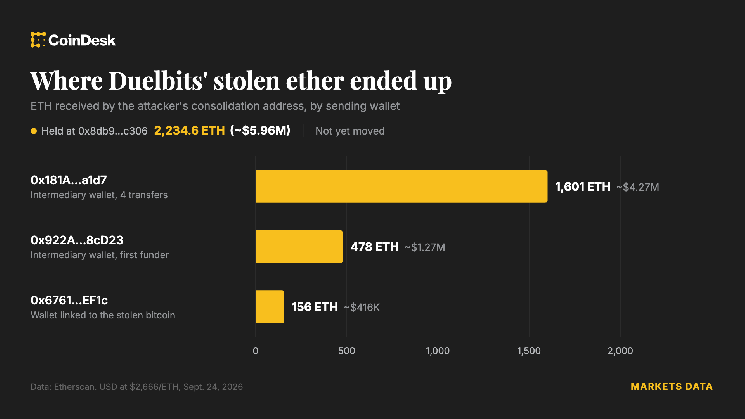
    Crypto gambling platform Duelbits went offline on Thursday after attackers drained approximately $7 million from its hot wallets across multiple blockchains. The incident was first flagged by blockchain security firm Scam Sniffer, which reported that Duelbits hot wallets on Ethereum, BNB Chain, and Tron had sent funds to newly created addresses in what appeared to be a private key compromise. The firm later confirmed the company’s Bitcoin hot wallet also lost 8.1 BTC in the attack.

    Co-Founder Confirms Breach, Assures User Funds Secure

    Duelbits co-founder Joe addressed the incident on X, stating: “Confirming a ~$7M hack. Still investigating exactly what happened and how,” adding that “user funds are safe.” He indicated the platform would remain offline until the investigation concludes and its hot wallets are refilled. The direct acknowledgment from leadership came as on-chain data continued to reveal the full scope of the asset movements.

    On-Chain Analysis Reveals Multi-Chain Asset Losses

    Etherscan data shows the Ethereum wallet labeled as a Duelbits hot wallet transferred 836 ETH, approximately 593,000 USDT, 97,000 USDC, 31,500 DAI, and 12.4 billion SHIB to the attacker within minutes. The compromised Ethereum wallet now holds less than $25 in ether. Scam Sniffer’s analysis indicates the simultaneous compromise across Ethereum, BNB Chain, Tron, and Bitcoin networks strongly points to a private key breach rather than a smart contract vulnerability.

    Attack Method Mirrors 2023 Stake.com Breach

    The suspected private key compromise mirrors the methodology used in the 2023 attack on Stake.com, the largest crypto casino by volume, where hackers made off with $40 million. That incident, also attributed to a private key compromise, raised significant concerns about key management practices across the crypto gambling sector. The recurrence of this attack vector suggests persistent operational security challenges for platforms managing large hot wallet balances.

    Why This Matters

    The Duelbits hack underscores the ongoing vulnerability of centralized hot wallet infrastructure in the crypto gambling industry. Despite high-profile incidents like the Stake.com breach, platforms continue to maintain substantial assets in internet-connected wallets secured by single points of failure. The multi-chain nature of this exploit—hitting Ethereum, BNB Chain, Tron, and Bitcoin simultaneously—demonstrates how a single private key compromise can cascade across an operator’s entire treasury. For users, the incident reinforces the importance of platform solvency transparency and the risks inherent in custodial gambling platforms. Regulators and industry watchdogs will likely scrutinize whether Duelbits’ claim that “user funds are safe” holds up during the investigation and whether the platform maintains sufficient cold storage reserves to cover the hot wallet losses without impacting customer balances.

    Frequently Asked Questions

    How much was stolen in the Duelbits hack?

    Approximately $7 million was drained from Duelbits hot wallets across Ethereum, BNB Chain, and Tron, plus an additional 8.1 BTC from the platform’s Bitcoin hot wallet.

    What caused the Duelbits security breach?

    Blockchain security firm Scam Sniffer identified a suspected private key compromise as the attack vector, noting that wallets across multiple chains sent funds to newly created addresses simultaneously.

    Is Duelbits currently operational?

    No, Duelbits has taken its platform offline. Co-founder Joe stated the site will remain offline until the investigation is finished and hot wallets are refilled.

  • Coinbase Issues Warning Following XRP Rally

    Coinbase Issues Warning Following XRP Rally

    Key Highlights

    • Coinbase Markets data shows XRP one-week call/put implied volatility skew hit 9.3 volatility points, placing it in the top 5% of readings over the past year, signaling heightened bullish derivative demand.
    • XRP futures open interest surged to $4.1 billion, with CME Group overtaking Binance as the leading venue, indicating growing institutional participation in the token’s derivatives market.
    • Analysts warn the concentration of long call positions after XRP’s 15–18% weekly rally creates “crowded positioning” risk, which could amplify downside volatility if sentiment reverses.

    XRP Derivatives Signal Aggressive Bullish Positioning Amid Market Pullback

    Bitcoin’s recent ascent above $87,000 and broad altcoin strength were abruptly halted this week as surging global bond yields—reaching levels last seen in 2007—triggered a sharp risk-off move across digital assets. While major cryptocurrencies retreated from local highs, on-chain and derivatives data for XRP tell a contrasting story of intensifying speculative conviction. Coinbase Markets, the institutional-facing arm of the Nasdaq-listed exchange, published a detailed analysis highlighting an extraordinary shift in XRP options pricing that suggests professional traders are betting heavily on continued upside.

    Options Skew Reaches Extreme Bullish Territory

    According to Coinbase Markets, the one-week implied volatility spread between XRP call and put options widened to 9.3 volatility points. This metric, known as the risk reversal or skew, sits in the 95th percentile of observations recorded over the trailing twelve months. In practical terms, the premium investors are willing to pay for upside protection (calls) versus downside protection (puts) has ballooned, reflecting a consensus expectation that XRP’s recent 15% to 18% weekly gain is a precursor to further appreciation rather than exhaustion. Coinbase cautions, however, that a 9.3-point volatility differential does not mathematically translate to a 9.3% price move; it merely quantifies the intensity of directional demand in the options market.

    Futures Open Interest Hits $4.1 Billion as CME Leads Institutional Flow

    Complementing the options signal, aggregate open interest across XRP futures contracts climbed to $4.1 billion. Notably, CME Group—the primary regulated venue for institutional crypto derivatives in the United States—surpassed Binance in XRP futures volume and open interest. This shift is widely interpreted by market structure analysts as evidence that regulated, compliance-first capital is allocating to XRP with greater conviction than retail-heavy offshore platforms. The CME’s leadership position in a specific altcoin’s futures complex is relatively rare and underscores the token’s evolving status among professional allocators.

    Why This Matters: Crowded Trade Dynamics and Macro Crosscurrents

    The confluence of extreme options skew and record futures open interest introduces a classic “crowded positioning” vulnerability. When a disproportionate share of market participants holds similar directional bets—here, long calls and long futures—any catalyst that challenges the thesis can trigger a violent unwind. Forced liquidation of leveraged futures and delta-hedging by options market makers can accelerate price declines, creating a feedback loop detached from spot fundamentals. This risk is amplified by the macro backdrop: the U.S. 10-year Treasury yield piercing 4.5% has already pressured risk assets broadly. Should yields continue climbing, the high-beta nature of altcoins like XRP could see disproportionate selling, testing the resolve of the very derivatives positions that currently appear so bullish. Traders and risk managers will monitor CME positioning reports and options expiry calendars closely for signs of de-risking.

    Frequently Asked Questions

    What does a 9.3-point call/put implied volatility skew mean for XRP?
    It indicates that options market participants are paying a significantly higher premium for one-week call options versus put options, placing current demand for upside exposure in the top 5% of the past year. It reflects sentiment, not a guaranteed price target.
    Why is CME surpassing Binance in XRP futures significant?
    CME is the primary regulated derivatives marketplace for U.S. institutions. Its leadership in XRP futures suggests professional, compliance-driven capital is actively building positions, which often correlates with longer holding periods and deeper liquidity than retail-dominated offshore venues.
    What is the primary risk highlighted by Coinbase Markets?
    Coinbase warns of “crowded positioning” risk: if a large number of investors hold similar long positions simultaneously, a sudden sentiment reversal can cause exaggerated price swings as participants rush to exit, amplified by futures liquidations and options dealer hedging.

    *This article summarizes third-party market analysis and does not constitute investment advice.