Category: Coins

Digital assets, cryptocurrencies, blockchain, and currency news.

  • Ethereum claim and reality: Vitalik Buterin calls for “refuge technology”

    Ethereum claim and reality: Vitalik Buterin calls for “refuge technology”


    • In a post on
    • Measured against the claim with which Ethereum came to the public in 2015, the project remained practically ineffective in dealing with key social conflicts, in contrast to some others, such as Starlink.

    Buterin explained in his X-Post from March 3rdthat political memecoins on Solana or speculative applications on other blockchains never bothered him.

    However, he is burdened by the fact that Ethereum has so far done little to strengthen freedom, informational self-determination, digital security and community self-organization – the values ​​that originally motivated the project.

    Freedom technologies lost sight of

    Some in the community are calling for Ethereum to focus on finance and ignore everything else. For Buterin, this is a dead end.

    Financial sovereignty is important, but it only solves a small part of the problems that plague people today. Anyone who focuses exclusively on DeFi leaves the big social questions to other actors – often those who monopolize power for themselves.

    At the same time, Buterin warns against false expectations: Ethereum cannot save the world. This is beyond the capabilities of technology. Beyond a certain point, any attempt to solve global problems would turn into political power projection – the opposite of a decentralized approach.

    Ethereum as part of a “refuge technology”

    Buterin therefore proposes a new self-image: Ethereum should become part of a network of free, open-source technologies that make people more resilient to external constraints.

    “Refuge technology” means digital spaces in which people can work, communicate, manage assets and act together – without states or mega-corporations taking over these spaces.

    It’s not about rebuilding the world according to Ethereum principles. It’s about preventing total control by individuals and creating stable digital islands in a chaotic time.

    Ethereum can provide the “digital surface” on which permanent social structures emerge: money, multi-signatures, markets, governance mechanisms and other forms of collective organization.

    Focus on one true digital refuge

    Buterin demands that Ethereum should neither emulate Apple nor Google. Instead, a complete technology alternative must be created – from wallets and applications via AI interfacess to endpoint operating systems, hardware and physical security.

    The message is clear: Ethereum should finally become a tool that gives people real freedom of action in an increasingly uncertain world.

  • Solana ETFs start relatively stronger than Bitcoin ETFs

    Solana ETFs start relatively stronger than Bitcoin ETFs


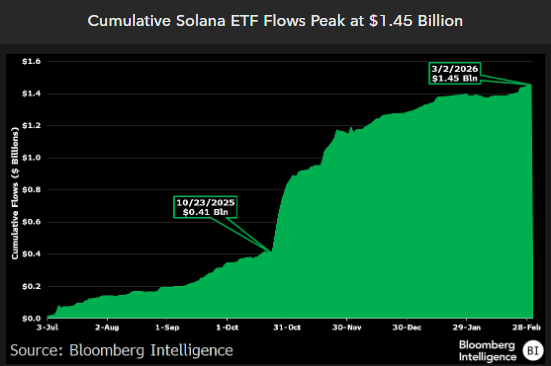
    • Solana ETFs have raised around $1.45 billion net since their launch despite a price decline of around 57%.
    • The US spot Bitcoin ETFs have also recently shown stronger momentum again.

    The American spot Solana ETFs have seen notable net inflows since their launch in July despite a sharp price decline and are even “bigger” than early US spot Bitcoin ETF flows in terms of Solana’s market size.

    Solana ETFs are off to a relatively better start than Bitcoin

    Bloombergs Senior-ETF-Analyst Eric Balchunas shared the data on Thursday via X. He explained that the Solana price has lost around 57% since the ETF launch in July, but the products are still attracting capital. In a post he wrote:

    “Solana has been 57% in the red since the spot ETFs were launched in July – that’s something like maximum bad luck in terms of timing in ETFs – and yet they have not only collected 1.5 billion US dollars in inflows, but have also given away hardly any of it. In addition, 50% of the assets come from 13F reporters – i.e. a serious group of investors. In my opinion, both are good signals for the future.”

    The Bloomberg Intelligence chart he shared shows cumulative Solana ETF inflows standing at $1.45 billion as of March 2, 2026. At the end of October 2025, the value was still at 0.41 billion US dollars – so the majority of the build-up took place later over time.

    Solana ETF data
    Solana ETF inflows since launch | Source: X @EricBalchunas

    But one thing is particularly striking for Balchunas: If you convert the inflows to Solana’s market capitalization, that would correspond to a significantly larger dollar amount for Bitcoin:

    “If we adjust these flows for the size of Solana compared to Bitcoin market cap, that equates to $54 billion in net new inflows – about twice as much as Bitcoin at the same time.”

    Bitcoin ETFs see possible trend reversal

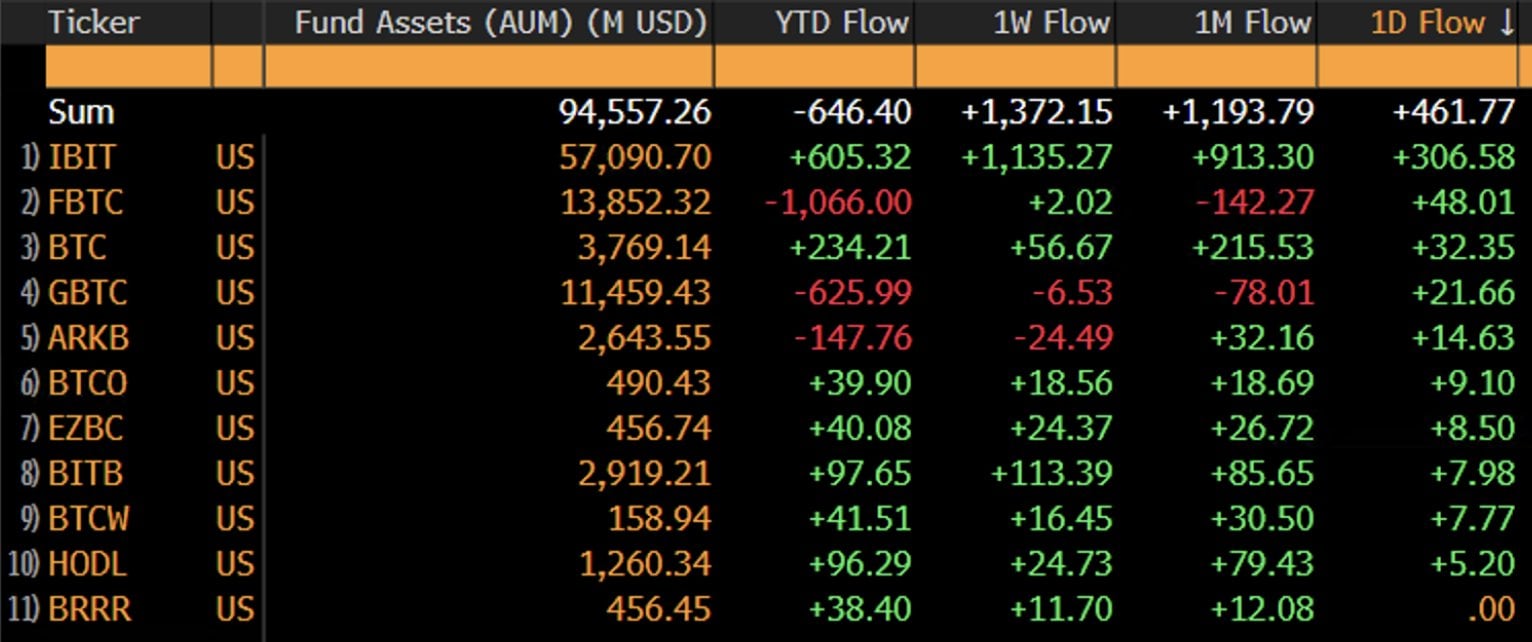
    In parallel, Balchunas explained on X yesterday that Bitcoin ETFs are also currently seeing strong momentum. Overall, all ETFs received inflows approaching half a billion dollars on Wednesday, with 10 of the 11 ETFs seeing inflows.

    To be precise, it was $461.77 million. On a weekly basis, inflows total +1.372 billion US dollars. On a monthly basis they are +1.194 billion US dollars. Since the beginning of the year there is still a loss of 646.40 million US dollars.

    Bitcoin ETF data from Wednesday
    Bitcoin ETF data from Wednesday | Source: X @EricBalchunas

    The main driver on Wednesday was BlackRock’s IBIT with +$306.58 million on the day and +$1.135 billion on the week. In contrast, Fidelity’s FBTC is at +$48.01 million on the day, but a YTD value of -$1.066 billion.

  • VeChain reveals the origin story of founder Sunny Lu

    VeChain reveals the origin story of founder Sunny Lu


    • VeChain dates back to 2012, when founder Sunny Lu first came into deeper contact with the technology after a failed Bitcoin purchase.
    • The idea for VeChain emerged from this early experience and a conversation with Vitalik Buterin.

    VeChain has published its origins story on From this, VeChain derives the path that later led to its founding.

    According to X-Post, Lu quickly needed in-game gold after changing servers in the game. He came across Bitcoin through a Google search and then came across a Taobao offer: 100 BTC for 300 US dollars. He paid, but the Bitcoin never arrived. VeChain writes:

    “But instead of Bitcoin, all he gets is disappointment. The Bitcoin never arrives – $300 gone, along with 100 BTC; a transaction that went unfulfilled. Most people would turn their back on crypto at this point and never look back.”

    How the idea for Vechain came about

    In response, Lu opened the Bitcoin white paper. He was particularly fascinated by the white paper because of its architecture: a register without intermediaries whose entries cannot be changed subsequently. In the narrative, this becomes less an ideology than a product issue: “A trustless registry without intermediaries and with records that no one can change.” He asks a different question: What can be built with it?

    At the time, according to VeChain, Lu was working as CIO/CTO at Louis Vuitton China, building track-and-trace systems. The idea that VeChain describes as the nucleus is pragmatic: What if multiple parties could read the same immutable data without a single entity having control over the data – and everyone looking at the same information in real time?

    VeChain cites a meeting in Shanghai in 2015 as the next turning point. Bo Shen from Fenbushi Capital brought Lu together with Ethereum founder Vitalik Buterin. They talked for hours about smart contracts, the EVM and possible applications.

    The conversation led to Lu wanting to develop a blockchain for companies that didn’t exist before. “Verification Chain” later became VeChain.

    VeChain then cites several references: Walmart China has tracked food from origin to shelf, BMW has built a digital passport against speedometer manipulation with VerifyCar, and the UFC has integrated NFC chips into gloves to verify authenticity at charity auctions. Since its founding, VeChain has achieved 100% uptime and processed over 530 million transactions.

  • Switzerland: You can now pay with ADA tokens at the checkouts of all SPAR stores

    Switzerland: You can now pay with ADA tokens at the checkouts of all SPAR stores


    • Cardano’s ADA as a payment currency in the 137 SPAR supermarkets in Switzerland is a great success in the effort to bring Cardano into stationary retail.
    • The customer at the checkout pays from his Cardano wallet, while the SPAR store receives the amount directly in Swiss francs – without a third institution and in real time.

    Open Crypto Pay forms the technical backbone of the new ADA payment option. Customers scan a QR code at checkout and confirm the payment in their wallet. The transaction is verified on the Cardano blockchain within seconds.

    Merchants use existing POS systems that do not need to be modified. Processing takes place via DFX.swiss and its standard Open Crypto Pay. A major advantage lies in the fees.

    According to DFX.swiss, the costs for merchants fall by around two thirds compared to classic payment card providers such as VISA and Mastercard.

    DFX.swiss also provides extended on-off ramps. Customers exchange ADA directly for Swiss francs, without external intermediaries.

    The Swiss crypto environment

    Switzerland has been a crypto-friendly location for years. SPAR has previously tested Bitcoin payments via Lightning pilot projects. However, the ADA introduction is the practical blockchain-based payment option for everyday life.

    The Cardano Foundation sees this as a major step forward: If payments with ADA become as commonplace as card payments, Cardano will move a lot closer to mass use in retail.

    Linking to ADA “Savings Account”

    In parallel to Cardano’s introduction of ADA for payment of purchases, the Swiss FinTech company Brick Towers is offering its app “Urble” for saving ADA in SPAR stores. This means customers can save ADA and spend it again at the SPAR store if necessary. This creates a consistent system network that enables paying and saving on the same technical basis.

    Technical assessment and market reaction

    Despite all this, the ADA price remained stable at around $0.27. Technical indicators such as the RSI and MACD show a wait-and-see attitude among market participants. So real-world retail utility doesn’t automatically lead to price movements, but it does show the importance of such applications for Cardano’s long-term direction as a company.

  • Google investigates potential iPhone mass hack

    Google investigates potential iPhone mass hack


    • Google has identified a sophisticated Apple iOS hacking toolkit that can be used to attack iPhone customers who have not updated to the latest version of the operating system.
    • Seed phrases and other financial app credentials stored in the devices are read. The so-called Coruna kit uses five full exploit paths and a total of 23 vulnerabilities in iOS versions 13.0 to 17.2.1.

    The attacks take place via prepared websites that are disguised as legitimate crypto and financial portals – also the name of the global crypto exchange WEEX was abused. As soon as a customer with a vulnerable iPhone opens such a website, JavaScript analyzes the operating system of the affected device and, if necessary, copies the malware to it.

    The Coruna kit then searches messages, notes, files and app containers for terms such as “seed phrase”, “backup phrase”, “login”, “wallet” etc.

    From security tool to crime tool

    The Coruna kit first appeared at the beginning of 2025 in the environment of a security provider who apparently used it for attacks to detect vulnerabilities. Experts later found Coruna on Ukrainian websites that installed the malware on iPhones operated in certain regions.

    At the end of 2025, Coruna was discovered more and more frequently on fraudulent Chinese financial websites – a clear indication that the tool from the security technology sector had reached the mass market of criminal wallet drain operations via state espionage.

    Security experts at iVerify believe it is possible that Coruna originally came from a US environment, while security specialist Kaspersky sees no clear evidence of this.

    One-Click-Attack auf 23 iOS‑Leaks

    Coruna uses WebKit vulnerabilities for remote code execution and then bypasses protection mechanisms such as Apple’s Pointer Authentication Code. Coruna then gains administrator rights, searches the file system for wallet strings, extracts QR codes from the image database and reads unencrypted notes.

    Customers who use self-custody wallets such as MetaMask, Uniswap or BitKeep on older iOS versions are particularly affected. The attacks are completely interactionless – just visiting the manipulated website is enough.

    According to experts, tools that were once reserved for secret services are now being used for “everyday” crypto thefts.

    Protective measures

    Apple has now closed the vulnerabilities in iOS 17.3 and later versions. However, this only protects iPhone customers who actually keep the operating system up to date – and that’s by no means all of them.

    Krypto Hack
    Image created with ChatGPT-AI (DALL-E)

    The threat remains significant as many devices continue to run on older operating system versions. Google strongly recommends updating to the latest iOS version or alternatively activating lockdown mode, which makes attacks more difficult.

    The case shows the crypto industry how attractive mobile wallets have become for attackers – and how quickly previously exclusive zero-day attack vectors fall into criminal hands. The combination of drive-by attacks with automated seed phrase extraction makes Coruna one of the most dangerous threats in recent years – and it is still relevant.

  • Cardano inventor Hoskinson doesn’t give a damn about the planned US crypto transparency law

    Cardano inventor Hoskinson doesn’t give a damn about the planned US crypto transparency law


    • Cardano founder Charles Hoskinson has attacked the draft Digital Asset Market Clarity Act with unusual vehemence, calling it “appalling garbage.”
    • The law is intended to create a comprehensive regulatory framework for digital assets, but Hoskinson sees it as a fundamental flaw.

    Charles Hoskinson says new crypto assets will automatically be considered securities, giving the SEC jurisdiction, and that the burden of proof to the contrary falls entirely on developers and project operators.

    He argues that even established networks such as Cardano, Ethereum or XRP would have fallen under this classification in their early phases and would therefore have had little chance of developing.

    SEC dominance as a core problem

    Hoskinson warns that the bill gives the SEC broad powers beyond what the industry has previously experienced. He considers the proposed separation between digital commodities under the supervision of the CFTC and digital securities under the supervision of the SEC to be dangerous.

    He describes the structure as a system that gives what he sees as a hostile authority additional points of attack. He is particularly critical of the fact that the path from security to commodity exists formally, but in practice depends on the SEC’s subsequent rulemaking.

    This could result in delays, unclear definitions and requirements that are difficult to meet, which slow down new projects and hinder innovation in the USA.

    No trust in politics

    In addition to the technical criticism, Hoskinson focuses on the political dimension. He accuses the current US government of acting contradictorily and not seriously involving the industry.

    Invitations to the White House were withdrawn at short notice, which he sees as a sign of lack of reliability.

    If the Democratic Party wins the next election, he fears that the Clarity Act could become a tool that structurally weakens the industry and further strengthens the SEC.

    Industry divided

    The reactions to Hoskinson’s statements show a clear division. While he sees the Clarity Act as a step backwards, other industry representatives such as Ripple CEO Garlinghouse support the law. They see it as progress compared to the previous regulatory patchwork.

    The debate illustrates how different interests are within the US crypto industry and how strongly the question of regulatory responsibility shapes the industry.

  • Netherlands relies on IOTA: Digital identities for the FIC 2026

    Netherlands relies on IOTA: Digital identities for the FIC 2026


    • The Netherlands is presenting digital identities with IOTA as the technical basis via Turing Certs at the INCYBER 2026 forum.
    • The timing fits with the EU roadmap, according to which digital identity wallets should be available in all member states by the end of 2026.

    The Netherlands is bringing the topic of digital identities to the big stage: the country will have its own pavilion at the INCYBER (FIC) 2026 Forum in Lille (March 31 to April 2). Via

    Turing Space (Turing Certs) is a trust tech company that offers a blockchain-based platform for issuing, managing and verifying digital certificates based on IOTA and W3C standards. CEO Jeff Hu wrote via X:

    “We are pleased to announce that Turing Certs will represent the Netherlands at the INCYBER forum in Lille. After establishing our EU headquarters, Turing Space is now strengthening eID and verifiable credentials across the EU. IOTA enables secure, decentralized identity management.”

    A post from the Dutch Embassy in France states:

    “In the NL Pavilion, 14 Dutch exhibitors will present innovative cybersecurity solutions and demonstrate the strength of the Dutch cyber ecosystem. We are honored that the Ambassador of the Netherlands to France, Jan Versteeg, will take part – together with Leah Postma, member of the management team of the Ministry of Economy and Climate Policy, and Ernst Noorman, the Dutch Special Ambassador for Cyber ​​Foreign Policy.”

    Turing Space, EU Hub and IOTA

    The INCYBER Forum is considered a European platform for cybersecurity and digital trust protection. For 2026 it will be the 18th edition at the Lille Grand Palais. The main theme is “Mastering Our Digital Dependencies”.

    The IOTA Foundation commented on Turing Space’s announcement via What this specifically means remains unclear in the announcements.

    A blog post from the IOTA Foundation from November last year reveals that Turing Space is part of the IOTA Business Innovation program. Here the company is described as a project that builds “secure digital credentials” that are intended to shorten verification processes. IOTA Identity is a central component as a product for verifiable credentials.

    The timing is also noteworthy: at the EU level, digital identity wallets are expected to become widely available by 2026. The EU Commission describes that every member state should provide at least one wallet to securely prove, share and sign identity and digital documents. In addition, the Bundesdruckerei refers to the eIDAS 2.0 framework and the requirement that all EU states must offer a wallet solution by the end of 2026.

    This creates a clear context for the appearance in Lille: When national delegations emphasize “digital resilience” and “cybersecurity by design” in 2026, identity and credentials stacks inevitably come to the fore.

    However, it remains to be seen whether IOTA will establish itself as a building block for such EU-compatible proof of trust via Turing Certs in the context of the INCYBER Forum.

  • Morgan Stanley Updates SEC Filing on Spot Bitcoin ETF

    Morgan Stanley Updates SEC Filing on Spot Bitcoin ETF


    • Morgan Stanley filed an SEC amendment with new details on its proposed spot Bitcoin ETF on March 4, 2026.
    • BNY Mellon and Coinbase assume central roles, while fees and some basket details are still open.

    Morgan Stanley filed with the U.S. Securities and Exchange Commission (SEC) on March 4, 2026 the change (Amendment No. 1) was filed to register the Morgan Stanley Bitcoin Trust, thereby submitting new details about the planned spot Bitcoin ETF. The focus is primarily on role distribution, custody and operational processing.

    How Morgan Stanley designs its Bitcoin ETF

    The updated prospectus explains that the spot ETF is intended to passively track the Bitcoin price. The price is measured based on the CoinDesk Bitcoin Benchmark 4PM NY Settlement Rate and adjusted for costs. It literally says:

    “The Trust is a passive investment vehicle that does not seek returns beyond tracking the price of Bitcoin. This means that the Delegated Sponsor will not sell Bitcoin speculatively when the price is high, nor will it buy speculatively when the price is low in anticipation of future price increases. Additionally, the Trust will not use leverage, derivatives or similar constructions to achieve its investment objective.”

    Several central service provider roles are new. BNY Mellon Bank will act as administrator, transfer agent and cash custodian for the trust’s cash and cash equivalents. At the same time, BNY Mellon also acts as custodian, together with Coinbase Custody Trust Company, LLC.

    In addition, the dependence on Coinbase in another function explicitly appears in the risk section: Coinbase Inc. is named as a prime broker, which, among other things, enables the sale of Bitcoin to pay the sponsor fee and certain expenses.

    The document mentions both cash and in-kind creations: Authorized participants can purchase shares for cash, after which a named counterparty purchases Bitcoin and deposits it with the custodians; Alternatively, direct delivery of Bitcoin is possible. Returns are also possible as cash or in-kind redemptions.

    It is also noticeable that important economic parameters are still listed as placeholders: The delegated sponsor fee is still specified in the document with a placeholder, and open fields for basket sizes or seed details also appear in several places.

    Reactions from the Bitcoin community

    On John Haar (Swan) summarized The most important points are summarized as follows: “More information about the Morgan Stanley Bitcoin ETF: Coinbase becomes custodian. BNY Mellon becomes administrator/transfer agent. Authorized participants are still open.”

    But the most important insight for him is:

    “Morgan Stanley would not launch its own Bitcoin ETF – in a world where there have already been 11 other Bitcoin ETFs for two years – unless MS is confident that Bitcoin will continue to be a consistent part of its wealth management clients’ portfolios.”

    Joe Consorti (Theya and Horizon) sees that similar. Morgan Stanley is sending a clear sales signal with this step:

    “Morgan Stanley has 16,000 wealth managers with $6 trillion in AUM. They’re launching their own Bitcoin ETF because they see where a relevant portion of that $6 trillion is going – and they want the fees. That’s the signal.”

    Jeff Park (ProCap/Bitwise) also interpreted the move as more than just another product in the already competitive spot ETF market. For him, it’s “the most bullish thing ever.”

    It is still unclear whether and when the ETF will launch. This depends on when the next amendments to fees, basket details and the AP schedule follow and how long the SEC takes to process them.

  • Netherlands relies on IOTA: Digital identities for the FIC 2026

    Netherlands relies on IOTA: Digital identities for the FIC 2026


    • The Netherlands is presenting digital identities with IOTA as the technical basis via Turing Certs at the INCYBER 2026 forum.
    • The timing fits with the EU roadmap, according to which digital identity wallets should be available in all member states by the end of 2026.

    The Netherlands is bringing the topic of digital identities to the big stage: the country will have its own pavilion at the INCYBER (FIC) 2026 Forum in Lille (March 31 to April 2). Via

    Turing Space (Turing Certs) is a trust tech company that offers a blockchain-based platform for issuing, managing and verifying digital certificates based on IOTA and W3C standards. CEO Jeff Hu wrote via X:

    “We are pleased to announce that Turing Certs will represent the Netherlands at the INCYBER forum in Lille. After establishing our EU headquarters, Turing Space is now strengthening eID and verifiable credentials across the EU. IOTA enables secure, decentralized identity management.”

    A post from the Dutch Embassy in France states:

    “In the NL Pavilion, 14 Dutch exhibitors will present innovative cybersecurity solutions and demonstrate the strength of the Dutch cyber ecosystem. We are honored that the Ambassador of the Netherlands to France, Jan Versteeg, will take part – together with Leah Postma, member of the management team of the Ministry of Economy and Climate Policy, and Ernst Noorman, the Dutch Special Ambassador for Cyber ​​Foreign Policy.”

    Turing Certs, EU Hub and IOTA

    The INCYBER Forum is considered a European platform for cybersecurity and digital trust protection. For 2026 it will be the 18th edition at the Lille Grand Palais. The main theme is “Mastering Our Digital Dependencies”.

    The IOTA Foundation commented on Turing Space’s announcement via What this specifically means remains unclear in the announcements.

    A blog post from the IOTA Foundation from November last year reveals that Turing Space is part of the IOTA Business Innovation program. Here the company is described as a project that builds “secure digital credentials” that are intended to shorten verification processes. IOTA Identity is a central component as a product for verifiable credentials.

    The timing is also noteworthy: at the EU level, digital identity wallets are expected to become widely available by 2026. The EU Commission describes that every member state should provide at least one wallet to securely prove, share and sign identity and digital documents. In addition, the Bundesdruckerei refers to the eIDAS 2.0 framework and the requirement that all EU states must offer a wallet solution by the end of 2026.

    This creates a clear context for the appearance in Lille: When national delegations emphasize “digital resilience” and “cybersecurity by design” in 2026, identity and credentials stacks inevitably come to the fore.

    However, it remains to be seen whether IOTA will establish itself as a building block for such EU-compatible proof of trust via Turing Certs in the context of the INCYBER Forum.

  • VISA card becomes stablecoin compatible in over 100 countries

    VISA card becomes stablecoin compatible in over 100 countries


    • VISA and the payment infrastructure provider Bridge, which specializes in stablecoins, are intensifying their cooperation and will bring stablecoin-compatible VISA cards onto the market.
    • It is building on pilot projects for which Bridge has already provided the infrastructure. Now they are going one step further and want to use stablecoins to process regular card transactions.

    The core of the process is this Use of stablecoins like USDC for settlement between issuing banks, merchants and VISA.

    Nothing changes for cardholders. You pay as usual, while the transaction between the parties involved is processed in the background using a stablecoin.

    Bridge provides the technical layer that connects different blockchains and automates processing. According to VISA, this is intended to reduce costs, shorten processing times and simplify international payments.

    Particularly in regions with weak banking infrastructure, there is potential for faster, more reliable processes while at the same time saving costs.

    Access for fintechs and banks

    A central element of the expanded cooperation is the opening up to FinTechs and banks that want to set up their own card programs.

    Bridge provides a modular infrastructure that includes both the issuance of cards and the management of stablecoin processing.

    VISA takes over the integration into the existing dealer network. What this means for companies is that they can offer digital payments based on stablecoins without their own blockchain integration.

    VISA ensures that all processes comply with applicable regulatory requirements, particularly with regard to money laundering prevention and proof of origin.

    Importance for global payment transactions

    Stablecoins are increasingly being used as a technical basis for international payments. For years, VISA has pursued the strategy of embedding digital assets into existing processes without making them more complicated for customers. Together with Bridge they now want to enter the mass market.

    If the model works in the initially targeted hundred countries, it will lead to broader acceptance of dollar stablecoins and increase competition in international payment transactions.

    The coming months will show whether and how quickly banks and fintechs will integrate the offer into their own products.