Category: Coins

Digital assets, cryptocurrencies, blockchain, and currency news.

  • BlackRock’s Staking Ethereum ETF gets off to a strong start

    BlackRock’s Staking Ethereum ETF gets off to a strong start


    • BlackRock’s Staking Ethereum ETF (ETHB) launched with over $100 million in assets and $15.5 million in trading volume.
    • The start was considered solid, but remained on the market without much hype.

    BlackRock entered the market with its staked Ethereum ETF (ETHB) and delivered notable numbers on the first day of trading. According to Bloomberg analyst James Seyffart, the fund started with just over $100 million in assets under management and reached $15.5 million in trading volume by the end of most of the first day of trading.

    At the start, BlackRock is also sending a clear signal regarding the price. Like Seyffart on X wrotethe new Ethereum staking ETF will have “the same fee as ETHA of 0.25%, but reduced to 0.12% for the first year or the first $2.5 billion in assets.” BlackRock is thus offering a fee incentive that is limited in time and volume, which should encourage early inflows.

    BlackRock’s new Ethereum ETF delivers strong start without hype

    From Seyffart’s perspective, the market launch on Thursday was significantly better than is usual for many new ETFs. First, he wrote that BlackRock’s staked Ether ETF “launched with just over $100 million in assets” and had turned over about $11.1 million as of about 2 p.m. Eastern time. According to Seyffart, this is “a pretty good start for any ETF”.

    He later fleshed out the day’s balance: “The majority of trading is done and we are at $15.5 million in trading volume on the BlackRock Staked Ethereum ETF – ETHB,” he wrote. “Very, very solid for an ETF launch on Day 1.” This is particularly notable for the ETF because ETHB is not entering an empty market, but rather a competitive one.

    The comparative figures that Seyffart placed next to it show how big the gap still is to the established sister product. ETHA, BlackRock’s existing spot ETF without a staking component, turned over $264.4 million and managed around $6.6 billion during the same period. Seyffart wrote that he would “monitor these two metrics over time.”

    At the same time, it is striking that the launch did not cause any major public excitement despite the prominent name of BlackRock. An X user asked Seyffart when the product was even approved and why the launch didn’t make much bigger headlines.

    Seyffart’s response was matter-of-fact and provides the context surrounding the muted reaction:

    “Two things. First: It’s not huge news because there are already several other ETH staking ETFs that have been on the market for months. Second: There is no longer an ‘approval process’ with fixed dates because the SEC changed the rules for crypto ETFs.”

    Public support also came from Coinbase CEO Brian Armstrong, whose company takes over custody, among other things. He congratulated BlackRock:

    “We’re making crypto more accessible through familiar, established platforms. Wider access means more opportunity.”

  • SwissBorg: Swiss crypto service provider moves into the EU league thanks to the MiCAR license

    SwissBorg: Swiss crypto service provider moves into the EU league thanks to the MiCAR license


    • SwissBorg is one of the most present crypto asset managers in Switzerland. The company positioned itself early in the private investor segment with its own mobile app for iOS and Android smartphones.
    • SwissBorg has now received the EU MiCA license from the French financial regulator AMF. This makes the company one of the first providers to be approved under the new EU regulations.

    In the European context, SwissBorg is moving into a new dimension. With around one million customers, the company is one of the larger crypto service providers in the private customer segment. The MiCA license is provided SwissBorg also institutional connectivity, which facilitates cooperation with banks, brokers and FinTechs.

    At the same time, the MiCA license strengthens the position in Germany, Italy, Spain and the Netherlands, which have the largest private customer segments in the EU.

    The MiCA approval is a turning point for the company. SwissBorg emphasizes that the approval is not just a formal step, but evidence of its own standards in security, transparency and compliance that it has long practiced.

    Swissborg CEO Cyrus Fazel speaks of a decisive moment for the company’s European perspective. The MiCA license enables innovations under a clear legal framework and increases investor protection in connection with digital assets.

    Why France was chosen

    SwissBorg consciously decided to submit an application to the French Autorité des Marchés Financiers (AMF). The French financial regulator is considered one of the strictest and most active supervisory authorities in Europe.

    It has prioritized investor protection for years and has long called for better European regulation. According to Justine Lamberger, head of Swissborg’s legal department, the MiCA license granted to Swissborg confirms the effectiveness of its existing controls and risk management.

    outlook

    Nothing will change for customers for the time being. You use your mobile app as before. SwissBorg announces that it will support the transition to EU law transparently and provide timely information about the process and schedule. With approval in one of the most demanding supervisory regimes in Europe, SwissBorg sees itself well positioned to further develop its crypto services and secure them in the long term.

    Swissborg currently has around one million verified customers and a TVL in the range of over a billion dollars. This means that they are not at the level of the large crypto banks in the Swiss market, but they are one of the largest providers in the private investor segment.

    SwissBorg is developing from a regionally present Swiss crypto service provider into an EU-wide regulated asset manager. The MiCA approval from the French AMF was the key to this.

  • XRP ETF data shows: Goldman Sachs has the largest position

    XRP ETF data shows: Goldman Sachs has the largest position


    • Goldman Sachs is the largest reported holder of US spot XRP ETFs as of December 31, 2025, according to 13F data.
    • Despite the sharp decline in XRP price, the cumulative inflows add up to around $1.44 billion.

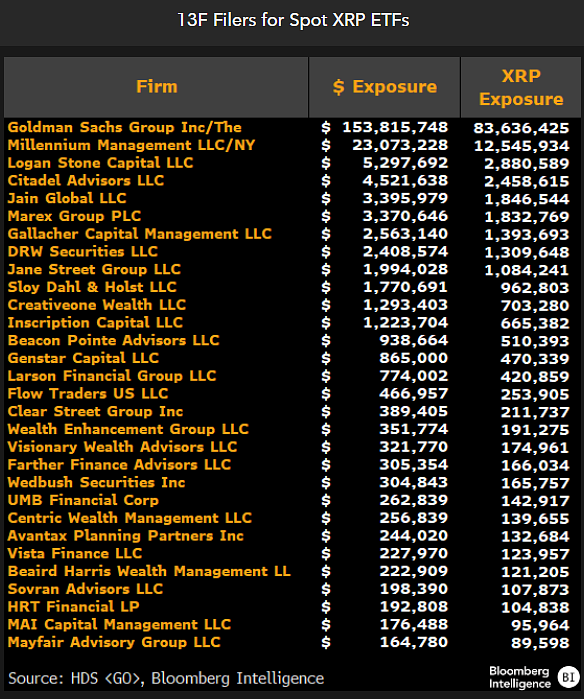
    Goldman Sachs is the largest reported institutional holder of US spot XRP ETFs, according to the latest 13F data. Bloomberg Intelligence published by Bloomberg ETF analyst James SeyffartData show that the bank held $153.8 million in XRP ETF exposure as of December 31, 2025, equivalent to 83.6 million XRP.

    This makes Goldman the largest disclosed 13F holder of US spot XRP ETFs. Seyffart emphasized on X that the XRP ETFs are a positive surprise:

    “The XRP ETFs have actually held up pretty well despite the massive price drop. They have raised a cumulative $1.4 billion since their launch.”

    Who is buying the spot XRP ETFs?

    The chart he shared shows cumulative inflows as of March 4, 2026 at $1.44 billion. For comparison: in the initial phase, on November 13, 2025, they were around $150 million. The steepest increase in inflows occurred from mid-November last year.

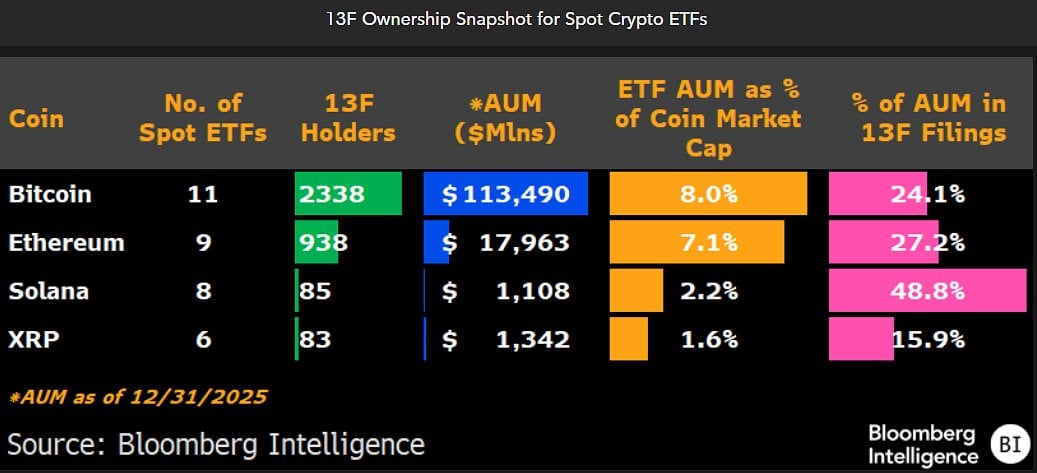
    The total of six spot ETFs have a total of $1.342 billion in assets under management as of December 31, 2025. This corresponds to 1.6 percent of the XRP market capitalization.

    Following Goldman in the 13F data are Millennium Management with $23.1 million in XRP ETF exposure and Logan Stone Capital with $5.3 million. Also among the larger reported holders: Citadel Advisors, Jain Global, Marex Group and Jane Street.

    Top Institutional XRP ETF Holders
    Top Institutional XRP ETF Holders, Source: @JSeyff on X

    The list shows that well-known names are involved, although on a much smaller scale than Goldman. At the same time, Seyffart made it clear that this data only shows a section:

    “Who are these buyers or holders? Well, we only know a small portion of them because the overwhelming majority do not file 13F reports. But here are the holders as of December 31, 2025.”

    In Seyffart’s comparison of the four largest spot crypto ETFs, Bitcoin has 2,338 reported 13F holders, Ethereum has 938, Solana has 85 and

    13F comparison spot crypto ETFs
    13F comparison spot crypto ETFs, source: @JSeyff on X

    Bloomberg’s ETF expert Eric Balchunas interpreted this as an indication of a different investor structure:

    “Like Solana, this is really impressive considering these products have entered a brutal 45 percent decline. Normally, ETF inflows in such a reverse shiny object phase are almost impossible, especially when the products are brand new. My guess is that this is driven primarily by XRP superfans and not casual retail investors.”

    The contrast with Solana is striking. Balchunas had already pointed out there on Monday that around 50 percent of the ETF assets come from 13F reports and thus, in his view, indicate a “serious investor base”. Goldman Sachs also appears prominently in the Solana data, as the second-largest 13F holder with $107.4 million.

    For the time being, a double signal remains for XRP: the ETFs continue to attract capital, even in a difficult market environment. At the same time, the data available so far speaks more for retail-driven demand than for a broadly established institutional buyer base.

  • Stuttgart Stock Exchange and Nasdaq optimize trading in digital assets

    Stuttgart Stock Exchange and Nasdaq optimize trading in digital assets


    • Stuttgart Stock Exchange and Nasdaq cooperate on EU trading in digital assets. Its processing is the responsibility of Seturion GmbH, the operator of the DLT system of the same name, through which Nasdaq trading takes place in the EU.
    • The Seturion system supports public and restricted distributed ledger networks and processes central bank money as well as digital on-chain cash as soon as the necessary tools are available.

    To start with, the collaboration in trading digital assets will focus on products that are linked to the Nasdaq and its outlets traded become. After a trade has been concluded, it is processed by Seturion GmbH.

    Both companies emphasize that this is only the first step. The technical environment is designed to integrate additional asset classes and connect additional EU financial institutions.

    The aim is a uniform technical framework that harmonizes digital securities processes across the EU.

    Inconsistent processing in the EU

    For historical reasons, the EU capital markets have heterogeneous post-trading structures. Different national systems, divergent legal requirements and complex processes make uniform, cross-border processes difficult.

    The cooperation aims to eliminate these structural weaknesses. A common DLT-supported processing environment is intended to reduce risks, accelerate processes and standardize operational procedures.

    The technical basis for this is fully compatible with MiFID II and the EU DLT pilot regime, which is applicable to regulated financial institutions.

    Advantages for issuers and institutional customers

    Issuers benefit from shorter settlement cycles, reduced operational complexity and greater transparency.

    Institutional investors benefit from a clearly defined EU regulatory framework and the opportunity to purchase tokenized securities via established trading venues, while settlement takes place via a modern DLT operation.

    The combination of trading at Nasdaq and its settlement via Seturion GmbH creates a coherent process that combines classic market structures with digital technology.

    New unofficial EU framework

    The cooperation fits in with a growing trend. Exchange operators are modernizing their market infrastructure to embed digital assets into existing trading environments.

    Nasdaq is working on a technical gateway that will connect tokenized stocks with DLT networks from 2027.

    And last but not least: The Stuttgart Stock Exchange is positioning Seturion GmbH as a DLT-supported settlement authority in the EU.

    If it is possible to integrate further institutions, a network can emerge that significantly strengthens the competitiveness of the European Union internationally.

    After all, the USA is on board as a partner in the form of Nasdaq, and that is a constellation that is rare these days and should therefore not be underestimated.

  • Patrick Witt: Law for US Bitcoin reserve still possible, schedule open

    Patrick Witt: Law for US Bitcoin reserve still possible, schedule open


    • The White House is committed to anchoring the US Strategic Bitcoin Reserve in law.
    • Patrick Witt sees bipartisan support in Congress.

    According to the White House, the legal anchoring of a US strategic Bitcoin reserve remains on the table. Patrick Witt, executive director of the President’s Council of Advisers for Digital Assets, said March 9 at Economic Club of New Yorkthere is still cross-party support for such projects, even if the timetable is uncertain.

    Witt thus brought an important question into focus: whether the Bitcoin reserve created under President Donald Trump can also be permanently secured by Congress. When asked what is politically important under the current crypto laws, Witt specifically mentioned “further legislation to codify the strategic Bitcoin reserve.”

    US Bitcoin reserve could be enshrined in law

    Witt explained that the Trump administration still intends to establish a legal basis for the strategic Bitcoin reserve, even though the project has become very quiet in recent months. As Witt emphasized, the focus was initially on the Genius Act (stablecoins), and currently on the Clarity Act (market structure).

    However, the White House advisor also said that there is no guarantee that the Bitcoin reserve will be legally anchored in this legislative period:

    “There is some bipartisan support for this.”

    At the same time, he said it was unclear whether Congress would take up the issue during the current term of office or only later. Witt explained literally:

    “Whether we can do that in this Congress is an open question. There is some bipartisan support for this. Many of these bills can be flagged and prepared in advance of the next Congress and then dealt with later either individually or as part of a mandatory legislative package.”

    However, it is still unclear when a specific bill on the BTC reserve will actually be put to the vote. However, Witt’s statements point to a longer political process.

    It is also questionable what will become of US President Donald Trump’s promise from the Executive Order (EO) to investigate how Bitcoin can be purchased in a “budget-neutral” manner. There has been silence on this since the EO of March 6, 2025.

    Likewise, the Trump administration has yet to disclose to the public how much BTC the reserve actually contains. The relevant deadlines for this expired last year and there have been no public statements so far.

  • Swiss crypto bank AMINA is the first crypto bank active on 21X

    Swiss crypto bank AMINA is the first crypto bank active on 21X


    • As a company, 21X is functionally equivalent to a crypto exchange – i.e. an infrastructure operator without its own trading function – but is legally classified as a trader that uses distributed ledger technology.
    • The hybrid therefore required a new EU category. The Brussels languagesebelwerfer did a great job and the result was: “DLT trading and settlement system”, a term that doesn’t give the slightest hint of what it means.

    Die Swiss crypto bank AMINA is now the first bank to be active on the DLT trading and settlement system 21X. It is a special first in the modernization of the EU capital market. For the first time, there is a complete infrastructure of custody, tokenization and regulated primary and secondary markets under the umbrella of a single company.

    21X operates under the so-called EU pilot regime and combines exchange functionality, trading and settlement in a single process based entirely on smart contracts.

    AMINA Bank in the new market model

    AMINA takes over the function of listing assets on X21, thereby enabling issuers to access a regulated onchain market. The crypto bank also takes care of the custody of the underlying assets and supports issuers during onboarding.

    This eliminates a key bottleneck of recent years: Institutional issuers have long needed a bank that can both store traditional assets and support their digital representation in a regulated environment. With the AMINA bank, both are now directly available.

    Crypto technology and regulation

    Tokenization is carried out via Tokeny based on the ERC 3643 standard. The standard enables automated compliance mechanisms, rights management and a clear separation between assets and regulatory requirements.

    Based on this, 21X is the regulated trading and settlement venue that is approved by BaFin and monitored by ESMA. The EU pilot regime allows traditional market infrastructure to be replaced or supplemented by distributed ledger technology.

    Distributed Ledger
    Image created with ChatGPT-AI (DALL-E)

    Market participants see the cooperating trio of AMINA, Tokeny and 21X as practical proof that regulated onchain capital markets can be implemented from a technical and regulatory perspective.

    Consequences for issuers and institutions

    Institutional investors have been calling for regulated secondary markets for tokenized bonds, fund shares and other financial instruments for years. Previous projects failed due to a lack of market infrastructure or a lack of connection between custody, issuance and secondary market.

    By including an appropriately regulated bank, the barrier to entry for issuers drops significantly. The unified structure allows assets to be stored in a regulated manner, represented digitally and then traded on a regulated market.

    This creates the conditions for higher liquidity and broader institutional crypto demand.

    EU position and international perspective

    With this model, the EU is positioning itself as a pioneer in the implementation of digital market infrastructures.

    While other regions are still proceeding in a fragmented manner, the interaction between AMINA and 21X shows that a regulated onchain capital market is already operationally usable in the EU.

    The coming years will show whether the pilot regime will work in the long term and whether the new complete infrastructure, with its hybrid character, will attract enough sales to establish itself as the new standard in the long term.

  • Indonesian study proposes IOTA based patient record system

    Indonesian study proposes IOTA based patient record system


    • A study by the Institut Teknologi Bandung suggests IOTA as a building block for electronic patient records in Indonesia.
    • The proposed framework “DecMed” is intended to strengthen patient-centered access control, but is so far only an academic research contribution.

    A new specialist study from the Institut Teknologi Bandung (ITB) in Bandung, Indonesia brings IOTA into play as an infrastructure for electronic patient records. the work, published am 24. February 2026 in der Fachzeitschrift Sensors, stammt von Hari Purnama, Putu Bakta Hari Sudewa, Tazkia Nizami, Bagas Sambega Rosyada, Pradipta Rafa Mahesa und Nur Ahmadi und trägt den Titel „Access Control Development Within the Framework of an IOTA-Based Electronic Medical Record Management System.”

    IOTA as the basis for the Indonesian medical record

    The study proposes “DecMed”, a decentralized framework for the management of electronic medical records in Indonesia. According to the authors, the need for this arises from the general conditions in Indonesia: Electronic medical records are mandatory in Indonesia, while centralized systems and third-party providers continue to generate significant risks in terms of access control, data protection and data integrity, according to the study. The problem formulation is:

    “Electronic health records are mandatory in Indonesia under Ministry of Health guidelines, which poses significant challenges in data security and patient-centered access control. Current implementations rely on centralized healthcare systems or third-party providers, creating risks of unauthorized access, data leaks and uncertain data integrity.”

    It is precisely in response to this that the study proposes DecMed, “a decentralized EMR management framework based on IOTA Distributed Ledger Technology”.

    Technically, the model is not designed as a mere on-chain storage of medical records. According to the study, DecMed combines Capability-Based Access Control, Proxy Re-Encryption and IPFS while implementing smart contracts in Move on the IOTA ledger.

    The goal is to shift more data sovereignty to the patients themselves. The authors also formulate this very clearly:

    “Patients actively grant or revoke access, set the duration of access, and selectively share data with medical staff.”

    The study is particularly relevant for IOTA because it suggests a practical use case in a sensitive sector. In their evaluation, the authors point out that unit tests with different unauthorized access scenarios showed that DecMed could effectively enforce fine-grained access rules while maintaining data confidentiality and integrity.

    However, this is not yet an introduction to the Indonesian healthcare system, but rather a research contribution. This is exactly where the real significance lies. It shows that IOTA is receiving attention in academic research worldwide.

  • Coinbase brings futures for private investors into the EU internal market

    Coinbase brings futures for private investors into the EU internal market


    • Coinbase is offering private investors in the EU trading in futures contracts for the first time. Access is via Coinbase Advanced and is open to customers in EU member countries, except Sweden.
    • This is a big step for the German market, as derivatives on digital assets have so far mostly been traded via non-EU providers who do not have to be MiCAR-compliant.

    Coinbase uses its EU securities license for its offering, which consists of two different derivatives: The first category is fixed-term futures, which have a term of five years and are settled daily.

    An hourly funding mechanism ensures that the price of the contract is closely aligned with the market.

    With this model, experienced traders can build long-term positions without having to pay attention to the typical expiry dates of classic contracts.

    The second category includes contracts with fixed monthly or quarterly maturities. These are valued daily based on official settlement prices and settled in cash when due.

    With the two variants, Coinbase covers a wide spectrum, ranging from Bitcoin and Ethereum to Solana and selected stock indices.

    The company is thus expanding its profile beyond pure crypto assets and creating an offering that takes both digital assets and traditional assets into account.

    Access, Fees and Leverage

    Depending on the contract, four to ten times leverage is possible. Fees start at 0.02 percent per contract, although additional exchange and clearing costs may apply.

    Access is tied to an “aptitude test” that tests trading experience and risk awareness. Interested investors must go through a full KYC process and fund their account with euros or the stablecoin USDC before trading futures. Coinbase specifically notes that these derivatives involve significant risks and are not suitable for all investors.

    Expansion of the EU offer

    For the EU market, the introduction of regulated futures means a noticeable expansion of the available trading instruments.

    Largest market EU
    Image created with ChatGPT-AI (DALL-E)

    Coinbase emphasizes that the EU’s MiCA rules make it easier to market and that they want to follow up with further product lines.

    This gives traders access to derivatives that were previously only available through providers outside the European Union.

  • 20 million Bitcoin have been mined: the supply bottleneck is getting closer

    20 million Bitcoin have been mined: the supply bottleneck is getting closer


    • Bitcoin has reached the 20 million coin mark, with only around 1 million BTC remaining.
    • The supply bottleneck comes much earlier than 2140: 99 percent of all Bitcoin could be mined by 2035.

    The Bitcoin network has reached the mark of 20 million BTC mined. This means that 95.24 percent of the maximum total amount of 21 million Bitcoin has already been spent; There are only around 1 million BTC left. According to Mempool, the block cameData aus dem US-Mining-Pool Foundry USA.

    “Most people see that there is 1 million BTC left and think Bitcoin will continue to be mined at a significant rate for another century. Here’s what the math actually looks like: 99 percent of all Bitcoin will be mined by 2035.”

    With this Classification The X-Account Milk Road made a point that is often lost in the debate: the remaining quantity sounds large, but the actual output rhythm is no longer that.

    The Bitcoin supply shortage is getting closer

    The reason is the halving, which is firmly anchored in the protocol. The block subsidy is halved every 210,000 blocks, roughly every four years. Since the halving on April 20, 2024, it has been 3.125 BTC per block; With around 144 blocks per day, this only corresponds to around 450 new Bitcoins per day. This is already a completely different order of magnitude than in previous cycles.

    According to current estimates, the next cut is expected on April 17, 2028 at block height 1,050,000. Then the block subsidy drops to 1.5625 BTC, which means that the daily new issue will mathematically fall to around 225 BTC. Another halving will follow in 2032. Based on this issuance plan, the 99 percent mark of the total will be reached just under three years after the halving in 2032 – i.e. around 2035. Milk Road explained via X:

    “The figure of 114 years until full issuance is technically correct. But it is misleading. Bitcoin’s effective supply plateau will be reached in the next decade.”

    This is exactly where the real meaning of the 20 million milestone lies: 2140 is not the economically relevant turning point, but the fact that the additional supply will be pushed further and further towards zero in the coming years.

    The popular statement that the “last Bitcoin” will be mined in 2140 is useful as a shorthand, but technically inaccurate. Fidelity points out that the issuance is asymptotic: after 32 halvings, the subsidy from the smallest Bitcoin unit, the satoshi, practically drops to a trivial remainder; the 33rd halving pushes it below 1 sat, so 21 million Bitcoin will never be reached exactly.

  • IOTA plans to expand TWIN to seven countries by the end of the year

    IOTA plans to expand TWIN to seven countries by the end of the year


    • IOTA wants to expand its TWIN trading infrastructure to around seven countries by the end of the year.
    • The focus is on the digitalization of supply chains, trade financing and payments.

    IOTA wants to expand its TWIN trading infrastructure to a total of around seven countries this year. Co-founder Dom Schiener said this in a subsequently published statement Videointerview after the World Crypto Forum in South Korea. The focus is on the digitization of cross-border supply chains, trade financing and payments.

    Will IOTA become the SWIFT of global trade?

    Schiener sees TWIN as the answer to a structural problem in world trade: central processes between companies, ports, customs authorities and financial institutions still run on paper:

    “We have been in the market for ten years and have worked in many different industries and use cases. We have found the greatest use of blockchain in cross-border trade because there are clear issues of mutual trust between countries and no standard for digital data solutions. That is why trade and supply chain infrastructure to this day is based on paper documents.”

    And Schiener has a great vision. TWIN should not only digitize individual processes, but also establish itself as a global base layer for trade.

    “Our focus with TWIN is to become the SWIFT of global trade. We make it possible for countries, companies and financial institutions to actually export in a global context. That is exactly what we see our role as.”

    The origin of this strategy lies in a project in Kenya. The IOTA Foundation began digitizing trading infrastructure there around five years ago. The success of this project gave rise to the insight that global trade was the biggest problem area that IOTA could solve with its technology:

    “The success of this project made us realize that global trade is the biggest problem we can solve. At the same time, we realized we can’t do it alone. That’s why we brought together diverse partners, including the Tony Blair Institute, the World Economic Forum, Trademark Africa and other major NGOs and trade thought leaders.”

    This collaboration resulted in the TWIN Foundation in Geneva, which is currently hosted under the umbrella of the World Economic Forum. According to Schiener, your task is to bring additional governments and institutional partners on board and gradually bring countries onchain.

    These countries are in focus

    Schiener put the funding gap in the trade finance market at $2.5 trillion. In Africa and the United Kingdom, IOTA is already working to tokenize physical assets such as critical minerals, raw materials and trade receivables and thereby make them financeable. The aim is to provide smaller and medium-sized companies as well as larger companies with better access to financing.

    Schiener cited the export process in Kenya as a practical example. Traders would no longer have to print out documents and physically hand them over to authorities, but could automatically submit export declarations and trade documents digitally to customs and ports.

    “Instead of customs and ports receiving data in physical form as paper documents, they receive this data in digital form, tokenized on IOTA. So a trader no longer has to print out a paper document and hand it over to customs, but instead submits the export declaration or other trade documents automatically using our technology. This allows customs and ports to release the data immediately, and we can even use AI to fully automate this entire process.”

    Schiener is targeting further expansion for 2026. In addition to Kenya and the United Kingdom, five other countries are to be connected via pilot projects:

    “We will go country by country and bring the whole world onchain. We will not stop until the whole world is trading digitally through IOTA. This year we will connect five more countries in addition to Kenya and the UK, so by the end of the year we will probably be at around seven countries connected through pilots.”

    A particular focus is on South Korea. According to him, IOTA wants to set up a pilot there together with a local industrial company, government support, port authorities and financial institutions, probably for a trade corridor with the United Kingdom or the USA.

    In the coming months, stablecoin companies will also be integrated to process cross-border payments via TWIN immediately and with lower fees.