Author: Evan Mercer

  • DOJ Strike Force Seizes Scam Marketplace, Restrains $52M in Crypto

    DOJ Strike Force Seizes Scam Marketplace, Restrains $52M in Crypto

    Justice Department Seizes Xinbi Guarantee Scam Marketplace, Restrains $52 Million in Cryptocurrency

    The Justice Department’s Scam Center Strike Force, in coordination with the Treasury Department, seized the Chinese-language scam marketplace Xinbi Guarantee and restrained approximately $52 million in cryptocurrency in a single day, U.S. Attorney Jeanine Pirro announced this week. The operation brings the total assets the Strike Force has restrained since its inception to roughly $938 million.

    A separate Strike Force team simultaneously assisted authorities in Madagascar in dismantling 13 Chinese-run scam compounds, expanding the crackdown launched last November well beyond its original Southeast Asian footprint.

    Inside the Xinbi Guarantee Takedown

    Xinbi operated almost exclusively on Telegram in Chinese, functioning as a marketplace where vendors advertised services to scam center operators. These services included building custom fraud investment websites, laundering money stolen through wire fraud, and recruiting trafficking victims to staff scam compounds.

    The platform held payments in escrow until vendors completed their jobs. Prosecutors say this mechanism allowed them to trace specific victim funds to vendors who posted wallet addresses on the channel. A federal court in Washington authorized the seizure of those Telegram channels on September 7, and prosecutors unsealed the warrant Wednesday.

    Investigators seized two crypto wallets Xinbi used to collect vendor payments, valued at roughly $12 million, and sought restraint of 47 additional wallets tied to the network. The total assets taken from the platform and its vendors exceeds $52 million.

    The Treasury’s Office of Foreign Assets Control (OFAC) separately designated Xinbi a transnational criminal organization the same day, along with two other entities accused of supporting it, freezing any property they hold in the United States.

    Pirro emphasized the broad risk to ordinary Americans:

    “Every American with a retirement account is in the blast radius,” she stated. “My Strike Force will continue to dismantle Chinese organized crime, those who facilitate it, and protect Main Street America.”

    Madagascar Deployment Signals Global Expansion

    Alongside the Xinbi action, U.S. Attorney Michael Heyman of Alaska said the Strike Force’s two-week deployment to Madagascar, which helped process more than 3,200 devices and interview about 400 arrested individuals, reflects the direction of the enforcement effort.

    “Transnational criminal organizations don’t care about borders, and the Department of Justice won’t either,” he said.

    Xinbi’s Operations Predate Current Crackdown

    In March, the British government sanctioned Xinbi. Blockchain analytics firm Chainalysis estimated the platform had processed nearly $20 billion in cryptocurrency between 2021 and 2025, facilitating sales ranging from stolen personal data to satellite equipment used to reach fraud victims.

    That earlier sanction barely slowed the operation. The criminal group simply opened new Telegram channels and continued its activities. The Strike Force itself dates to November 2025, when Pirro established it to target Chinese organized crime running scam centers.

    Federal data cited in Wednesday’s announcement placed reported crypto investment fraud losses at $8.65 billion in 2025, up 89% from $4.57 billion in 2023. The FBI notes these figures are “significantly under-represented,” as most fraud victims do not report the crimes.

  • Hackers Mint Trillions in Fake Bitcoin; 15 BTC Bridge Recovery Leaves Liquidity Providers Unpaid

    Hackers Mint Trillions in Fake Bitcoin; 15 BTC Bridge Recovery Leaves Liquidity Providers Unpaid

    Symbiosis Recovers 15 BTC After Bitcoin Bridge Exploit; Liquidity Providers Await Compensation Details

    Cross-chain protocol Symbiosis has recovered approximately 15 BTC following an attack on its native Bitcoin Bridge, though affected liquidity providers still lack compensation terms as a September 13 bounty window approaches an unspecified cutoff.

    Attack Timeline and Scope

    The vulnerability was exploited at approximately 04:28 UTC on September 11, according to the protocol’s incident statement. Symbiosis confirmed that only the Bitcoin Bridge was affected, stating that its other routes and components remained operational. The protocol specifically listed routes spanning EVM chains, TRON, and TON as unaffected, and noted that its relayer group continued operating to secure the network. The recovered bitcoin is currently secured in a team-controlled multisig wallet.

    The 15 BTC figure represents the amount Symbiosis says it has recovered to date. The protocol indicated that final accounting remains in progress and that it would publish confirmed figures in a subsequent update.

    Security Analysis from Blockaid

    Security firm Blockaid reported that a transaction accepted as signed by Symbiosis’s BridgeV2 system minted approximately 2^62 raw units of syBTC, a synthetic representation of bitcoin, to a newly created wallet on BNB Chain.

    Blockaid said the same beneficiary sold about 4.39 WBTC on Ethereum, realizing roughly $336,000 in WBTC proceeds at the time of its alert. That figure covers value Blockaid observed the attacker convert. It does not establish Symbiosis’s final loss or the total exposure of liquidity providers.

    Service Restoration and Bridge Status

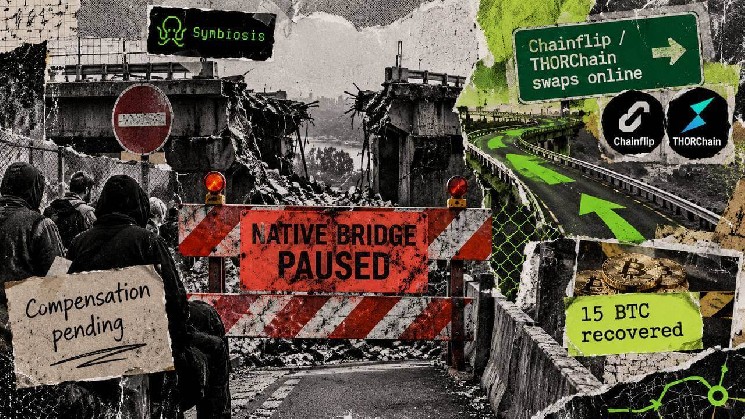
    Symbiosis initially said Bitcoin-related swaps were unavailable while it deployed updates. In a later operational update, the protocol said Bitcoin swaps routed through partners Chainflip and THORChain were back online, while the native Symbiosis Bitcoin Bridge remained paused.

    That distinction determines what users can access. Partner-routed Bitcoin swaps are available, according to Symbiosis, but the protocol has not announced the return of the affected bridge. The split keeps traffic off Symbiosis’s paused bridge while users access alternative Bitcoin routes.

    Compensation Framework and Bounty Program

    Symbiosis said it was contacting every affected liquidity provider directly and building a compensation framework, with criteria to follow. It has not disclosed who will qualify, how compensation will be calculated, or when payments could begin.

    The protocol also offered the attacker a 20% white-hat bounty through September 13. After that window, Symbiosis said the same percentage would be offered to anyone providing information that leads to recovery. The statement did not specify an exact cutoff time or timezone.

    Outstanding Disclosures

    Affected liquidity providers are now waiting for three key disclosures: confirmed loss and exposure figures, compensation criteria, and any change to the native bridge’s status. Until Symbiosis publishes that information, the recovered funds and Blockaid’s proceeds estimate should not be treated as a final loss tally.

  • CLARITY Act Seeks Emergency Meeting With Senate Democrats Today Before Sept. 15 Vote

    CLARITY Act Seeks Emergency Meeting With Senate Democrats Today Before Sept. 15 Vote

    Senate Democrats are scheduled to convene on Sunday as pressure mounts ahead of a critical vote on the CLARITY Act. According to individuals familiar with the discussions, Senate Minority Leader Chuck Schumer initiated the caucus meeting to align members on strategy.

    Democrats Navigate Internal Divisions on CLARITY Act

    The gathering comes at a pivotal moment for the legislation, which has sparked debate within the Democratic ranks over its regulatory framework for digital assets. Lawmakers are weighing concerns from constituent groups, industry stakeholders, and progressive advocates who argue the bill lacks sufficient consumer protections.

    Schumer’s decision to call the meeting signals the leadership’s urgency to secure a unified position before the measure reaches the floor. The closed-door session will allow senators to address amendments, procedural tactics, and the political ramifications of supporting or opposing the act in an election year.

    While the exact agenda remains confidential, sources indicate the discussion will focus on bridging differences between members who view the legislation as a necessary step toward market clarity and those demanding stronger safeguards against fraud and market manipulation.

  • Weekly Crypto Winners and Losers: VVV, LSK, ARB, ENA

    Weekly Crypto Winners and Losers: VVV, LSK, ARB, ENA

    Crypto Market Shifts to Defensive Posture Amid Rising Yields and Rate-Hike Fears

    This week, the cryptocurrency market adopted a more defensive setup. Rising Treasury yields, climbing oil prices, and growing expectations for Federal Reserve rate hikes pressured risk assets, pushing Bitcoin (BTC) below the $77,000 threshold. However, the sell-off was not uniform across the board. Capital continued to rotate into utility-based narratives, specifically DeFi and privacy tokens, signaling where investors are allocating capital during the current uncertainty.

    Weekly Winners: Privacy AI and DeFi Lead Gains

    Venice Token (VVV): Privacy-Focused AI Platform Hits New All-Time High

    Venice Token (VVV) emerged as the best-performing cryptocurrency this week, surging more than 35% to break into a new all-time high. The critical question now is whether this bullish momentum can sustain into next week.

    Two technical signals suggest continuation is likely. First, VVV’s Relative Strength Index (RSI) on the weekly chart remains well below the overbought threshold. This contrasts sharply with the token’s early-May rally, which drove the RSI into overbought territory and appeared to cap price action near the $20 level.

    Source: TradingView (VVV)

    Consequently, VVV is currently in a stronger technical position than it was in May. The price has successfully broken through the crucial $20 resistance during the past week, suggesting the next leg higher may have significantly more room to run. If VVV holds above $20, a continued breakout could open the path toward the $25–$30 range in the coming week.

    Bitway (BTW): Bitcoin Infrastructure Project at a Technical Crossroads

    Bitway (BTW) secured the second-largest weekly gain, rising 22%. Unlike VVV, BTW has yet to enter the price discovery phase. The asset has climbed for six consecutive weeks, making it technically due for a correction.

    Technically, BTW appears extended at current levels. The token is encountering resistance near $0.60, and the RSI has already entered overbought territory. These factors suggest the rally is unlikely to continue unabated. If this setup holds, BTW is expected to correct shortly before attempting to overcome resistance once again. For the bullish trend to remain intact, buyers must withstand near-term selling pressure.

    Injective (INJ): DeFi Blockchain Tests Key Resistance

    Injective (INJ) claimed the third spot among weekly winners, climbing 10% on Thursday. INJ displays a more robust weekly uptrend compared to VVV and BTW, having steadily climbed since a mid-August correction that saw prices drop to $5.30.

    On the technical front, the RSI indicator sits at a neutral level, leaving room for the rally to extend. Furthermore, INJ rebounded nearly 20% following a late-August bearish correction that dropped the price over 6%. This resilience supports the potential for further gains in the upcoming weeks, with a target range of $6–$7 by the end of September.

    Other Notable Gainers

    Outside the major caps, smaller altcoins posted explosive moves:

    • Lisk (LSK): +877%
    • GreenHood (HOOD): +455%
    • Stonk (STONK): +237%

    Weekly Losers: Major L2s and Synthetic Dollars Under Pressure

    Arbitrum (ARB): Ethereum Layer-2 Faces Profit-Taking

    Arbitrum (ARB) was the week’s biggest loser, plummeting 27%. However, context is critical: this decline follows a 124% weekly increase the prior week, framing the move as a cooldown rather than a structural breakdown. Resistance is forming in the $0.20 zone.

    The key question is whether this sell-off evolves into a deeper correction or remains a minor adjustment. Technical analysis offers clues. Despite the massive 124% rally, ARB’s RSI never entered the overbought area, indicating the long weekly increase never became technically overextended. Simultaneously, the rally pushed price into mid-January resistance near $0.20, suggesting the pullback is a reaction to that level rather than a bearish trend shift.

    Source: TradingView (ARB/USDT)

    If buyers defend key support, ARB could stabilize and stage another assault on the $0.20 resistance.

    Ethena (ENA): Synthetic Dollar Protocol Loses Reversal Momentum

    Ethena (ENA) finished the week down 21%, marking the second-worst performance. Unlike ARB, ENA appears intent on holding the $0.15 level, which it has tested for three consecutive weeks—a sign buyers may be accumulating dips.

    That said, ENA’s RSI has turned lower, signaling cooling buyer enthusiasm. The current setup favors either a prolonged accumulation period or a potential bull trap. The first critical level to watch is $0.10. A break below this level would confirm the recent corrective rally was a trap. Conversely, holding $0.15 with a rising RSI would indicate strengthening buying pressure.

    Dash (DASH): Privacy Payment Coin Rejected at Key Resistance

    Dash (DASH) closed as the third-largest weekly loser, recording a 21% drawdown. Its weekly profile closely mirrors ARB, hinting that the action is a short-lived consolidation rather than a bearish trend reversal.

    Technically, the 21% correction followed a 70% rebound the previous week—the strongest rally since early January. The sell-off was triggered by rejection from the $80 area, a level DASH has failed to retest since the early Q1 cycle. With the RSI remaining overextended and resistance intact, bears may capitalize to lock in profits. However, bulls could regain control at current levels, shaking out weak hands and fueling the next move toward $80.

    Other Notable Decliners

    Broader market volatility punished several lower-cap assets:

    • Safebit (SAFE): -67%
    • Basecat (BASECAT): -66%
    • Cluster Protocol (CP): -54%

    Market Summary

    This week delivered a rollercoaster session characterized by explosive pumps, sharp dips, and nonstop action. As the macro backdrop remains heavy, market participants are advised to stay vigilant, conduct independent research, and manage risk carefully.

    Final Weekly Scorecard

    • Top Gainers: Venice Token (VVV), Bitway (BTW), Injective (INJ)
    • Top Losers: Arbitrum (ARB), Ethena (ENA), Dash (DASH)
  • Cosmos Back Online After Outage, but Ledger Users Still Unable to View or Send ATOM

    Cosmos Back Online After Outage, but Ledger Users Still Unable to View or Send ATOM

    Ledger Wallet Cosmos ($ATOM) Outage Enters Fifth Day as Network Recovers

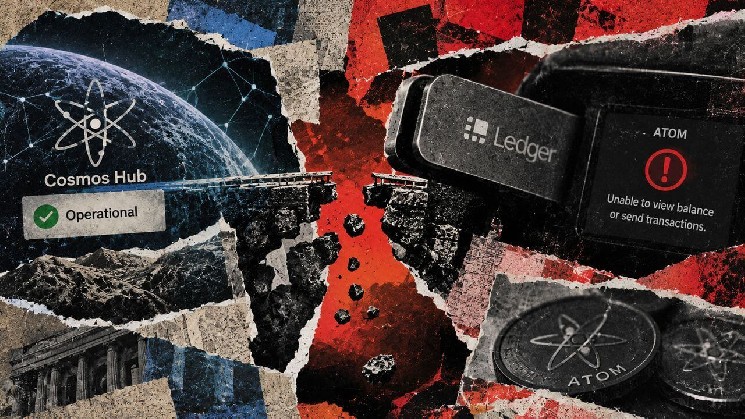
    Ledger’s status page continued to list Cosmos ($ATOM) as a major outage on September 13, leaving users unable to view $ATOM balances or transaction history and unable to submit transactions through Ledger Wallet more than four days after the incident began.

    Incident Timeline and Current Status

    The company opened the incident at 19:41 CEST on September 8. As of press time, its latest update, posted at 16:12 CEST on September 10, said restoration work was continuing and that the affected features remained unavailable. Ledger has not disclosed a cause or an estimated restoration time.

    The continuing warning does not mean Cosmos Hub is still halted. It shows that Ledger Wallet’s service path for retrieving account data and sending $ATOM transactions has not recovered with the network itself.

    Cosmos Hub Recovered Before Ledger Wallet

    QuickNode reported that Cosmos Mainnet stalled at block 32,878,318 at 18:12 UTC on September 8. The infrastructure provider said its nodes had returned to the chain tip by 14:26 UTC on September 9, then marked its incident resolved at 00:24 UTC on September 12.

    The Cosmos Hub RPC endpoint was above block 32.9 million on September 12 and reported that the node was not catching up. That placed the chain tens of thousands of blocks beyond the height in QuickNode’s initial alert.

    Together, those readings separate two layers of the problem. Cosmos Hub resumed producing blocks, while Ledger Wallet access remained unavailable. Users may therefore see missing balances or history in Ledger Wallet even though the network is processing new blocks.

    QuickNode’s resolution applies to its infrastructure, while Ledger’s separate incident remains identified. Those states can coexist because a wallet interface can stay unavailable after network nodes have caught up. Ledger has not said which part of its service path is responsible.

    Workarounds for Urgent Transactions

    For users who need to move $ATOM urgently, Ledger’s incident notice points to its alternative-methods guide. The company lists Cosmostation and Keplr as compatible third-party interfaces that can connect to a Ledger device.

    Ledger’s Keplr instructions tell users to open the Cosmos app on their device and choose Keplr’s hardware-wallet connection option. That route uses another interface to access the same blockchain account while keeping the Ledger device in the transaction flow.

    Critical Security Distinction

    The safety distinction is critical: connecting a hardware wallet is not the same as importing its recovery phrase. Ledger’s security guidance says users should never enter the phrase into a computer or smartphone and should never share it, including with Ledger.

    Users who do not need to transact urgently can continue monitoring Ledger’s status page. Because the incident remains open and could change without notice, its status should be refreshed before any workaround is attempted.

  • Senate Democrats Hold Last-Minute Meeting Ahead of Crucial Crypto Vote

    Senate Democrats Hold Last-Minute Meeting Ahead of Crucial Crypto Vote

    Senate Democrats Convene Emergency Caucus on Crypto Clarity Act Ahead of Critical Tuesday Vote

    Senate Democrats are holding a last-minute caucus meeting Sunday evening to discuss the Clarity Act, a landmark cryptocurrency market structure bill, ahead of a crucial procedural vote scheduled for Tuesday. Senate Majority Leader Chuck Schumer convened the session as lawmakers continue working to resolve several major disagreements surrounding the legislation, according to Politico.

    Procedural Vote Will Determine Bill’s Path Forward

    The Tuesday vote is expected to determine whether the legislation can advance to broader Senate consideration. The outcome remains uncertain as a group of roughly a dozen Democratic senators has spent months negotiating over the bill, but several major issues remain unresolved.

    Among the lawmakers involved in the discussions are Senators Kirsten Gillibrand, Mark Warner, Ruben Gallego, Lisa Blunt Rochester, Andy Kim, and Angela Alsobrooks, according to crypto commentator Chad Steingraber.

    60-Vote Threshold Requires Bipartisan Support

    The legislation will need 60 votes to advance. Assuming all voting Republicans back the measure, at least several Democratic senators would also have to support the procedural motion. Democrats are pushing for stricter conflict-of-interest restrictions, which remain the key obstacle so far.

    The Senate Banking Committee previously advanced the legislation in May in a bipartisan 15-9 vote. A fresh version of the roughly 630-page bill was unveiled on Thursday.

    Weekend Negotiations Continue as Deadline Looms

    Galaxy Digital CEO Mike Novogratz said earlier on Sunday that negotiations were continuing over the weekend. Tuesday’s procedural vote would make it possible for the legislation to move toward full Senate consideration.

    As reported by U.Today, Senator Cynthia Lummis has warned that failure to advance the legislation could delay comprehensive cryptocurrency market structure legislation for years.

  • XPR Network Suffers $9M proton.swaps Exploit – Can Confidence Recover?

    XPR Network Suffers $9M proton.swaps Exploit – Can Confidence Recover?

    $XPR Network Exploit Drains $9 Million from Proton Swaps

    $XPR Network, a layer 1 blockchain, suffered a major exploit after an attacker drained approximately 1.56 billion $XPR tokens, valued at roughly $4.03 million, from proton.swaps. The attacker exploited a critical flaw in the withdrawal function that accepted negative amounts, enabling manipulation of internal balances before withdrawing real tokens.

    Attack Spreads Across Multiple Asset Pools

    The attacker applied this technique across multiple asset pools, including XUSDC, XMD, METAL, LOAN, and bridged assets. Within just 11 minutes of launching the attack, the exploiter stole more than $9 million in liquidity.

    Subsequently, 563 million $XPR worth roughly $1.46 million moved through the LOAN protocol after the attacker borrowed against stolen stablecoins. This raised the total $XPR touched to roughly 2.12 billion, representing approximately 6.5% of the circulating supply.

    Later, the attacker moved 764 million $XPR (worth roughly $1.98 million) and 150,000 METAL (worth approximately $195,000) to another account. Network producers identified the exploit and patched the contract, highlighting how weak input validation can rapidly amplify losses across interconnected liquidity pools.

    $XPR Sell-Off Tests Market Confidence

    The on-chain drain quickly spilled into $XPR’s price action, with sellers taking control as confidence weakened. On September 11, $XPR traded near $0.00276 before falling sharply the following day. The sell-off pushed the price to an intraday low near $0.00242, marking a decline of about 6.5%. However, buyers stepped in after the drop, lifting $XPR back toward $0.00259. That rebound remained limited because the token traded below the $0.00271 support level.

    Meanwhile, the Relative Strength Index (RSI) fell to 27.47, placing $XPR in oversold territory and signaling heavy selling pressure. Trading activity increased, with turnover approaching $4 million. The rebound signals buying interest, but sustained recovery requires $XPR to reclaim $0.00271 and stabilize sentiment.

    Producers Secure Majority of Affected Funds

    The funds’ movement after the exploit offers a clearer picture of the damage and recovery prospects. Of the 2.12 billion $XPR touched, about 1.80 billion remained in attacker-controlled accounts. Only 319.5 million $XPR reached external venues, limiting the amount that moved beyond network control. This allowed producers to take action prior to any additional $XPR leaving the network. Producers applied a patch to their contract at 21:32 UTC.

    Then, at 23:26 UTC, producers seized the 1.80 billion $XPR and placed it under community control. As a result, most of the affected funds remained recoverable. $XPR also stabilized near $0.00261–$0.00262 on September 13, suggesting selling pressure had eased.

    Focus Shifts to Rebuilding Liquidity and Trust

    With most funds secured, the focus now shifts to whether $XPR can rebuild liquidity and user confidence. The incident underscores the critical importance of robust input validation in smart contract design, particularly for protocols managing interconnected liquidity pools.


    Key Takeaways

    • $XPR Network lost $9 million in the proton.swaps exploit, while $XPR fell 6.5% before stabilizing.
    • Most stolen $XPR was secured by network producers, leaving the network focused on restoring liquidity and trust.
    • The exploit originated from a withdrawal function accepting negative amounts, enabling balance manipulation across multiple pools.
    • Producers patched the contract and seized 1.80 billion $XPR within hours, placing funds under community control.
  • AI’s 2026 Slowdown Dilemma: Nationalize or Decentralize?

    AI’s 2026 Slowdown Dilemma: Nationalize or Decentralize?

    Anthropic CEO Proposes Three-Stage Plan for Coordinated AI Safety Limits

    On September 12, Anthropic CEO Dario Amodei called for coordinated limits on frontier AI advancement and outlined a three-stage governance framework. The proposal begins with inviting external evaluators into the company with access comparable to internal risk teams, progresses to U.S. regulatory coordination, and ultimately seeks verifiable international agreements.

    Stage One: External Evaluators With Publication Rights

    Under the first stage, a proposed review team would receive company equipment, workspace access, and opportunities to speak with employees. The evaluators’ contract would permit publication of key findings without Anthropic controlling the conclusion, subject to defined legal, security, privacy, and commercial constraints. This arrangement would allow outsiders to test whether the company’s safety commitments shape real training and deployment decisions.

    Amodei acknowledged that access inside one lab cannot slow a competitive field. Anthropic may open its systems to review while rival companies and governments continue to accelerate.

    Stage Two: U.S. Regulatory Coordination

    The second stage calls for regulation and government-mediated coordination across a critical mass of U.S. frontier developers. Amodei argues that a public-benefit charter can authorize safety-minded decisions inside Anthropic but cannot bind a competitor that rejects the same trade-off. His proposal addresses that gap with common rules rather than a transfer of company ownership.

    Stage Three: International Verification

    The third stage seeks verifiable agreements among states, with democracies preserving enough strategic room relative to China to pace development. The framework distinguishes between three different powers often merged in the nationalization-versus-decentralization debate: public ownership of economic gains, independent access for inspection, and legally enforceable halts on advancement speed.

    Anthropic’s Existing Governance Structure

    Anthropic operates as a Public Benefit Corporation under Delaware law, which requires its directors to balance stockholders’ pecuniary interests, the interests of people materially affected by the business, and its specified public benefit. Its Long-Term Benefit Trust holds board-selection powers intended to support the company’s mission. While this structure authorizes safety-minded decisions internally, it does not extend to competitors.

    Ownership and Control Are Different Levers

    Sanders Proposal Illustrates Partial Nationalization

    A June 2026 proposal from Sen. Bernie Sanders illustrates what partial nationalization could look like. His American AI Sovereign Wealth Fund would take a 50% public stake in the largest U.S. AI companies, with an independent commission exercising the voting rights. The measure remains a proposal, not enacted law.

    Public equity could redirect part of the industry’s gains and give the commission influence over company decisions. However, capability thresholds, outside verification, and enforceable stop orders would still require separate legal rules.

    Legal Scholars Propose Narrow Halt Power

    An August 2026 legal paper by Yonathan Arbel, Simon Goldstein, and Peter Salib separates economic claims from control over decisions that ordinary rules did not anticipate. The authors propose a narrow, discretionary, and temporary government power to halt frontier training or deployment when catastrophic risk or what they call “hard” corporate power is involved. They favor conventional regulation or taxation for monopoly, inequality, and other harms.

    A halt order reaches the pacing decision more directly than public equity. The state would not need to own every model or operate every laboratory before suspending covered training or deployment. Clear statutory triggers, technical competence, independent review, and limits on discretion would be needed for that authority to claim democratic legitimacy.

    Government Control Creates Concentration Risk

    Moving every frontier laboratory under state ownership could place model development and the decision to stop it in the same institution. A bounded halt power leaves companies in private hands while reserving an emergency intervention for defined extreme risks.

    Open-Weight Models Complicate Enforcement

    Open-weight models press in the opposite direction by widening access. Researchers can inspect and adapt systems without relying on a handful of corporate gatekeepers. The U.S. National Telecommunications and Information Administration concluded in 2024 that the available evidence did not justify blanket restrictions on widely available model weights.

    Frontier capability changes the enforcement problem. The European Commission requires providers of general-purpose models with systemic risk to evaluate and mitigate risks, report serious incidents, and maintain cybersecurity even when a model is open-source. The Commission warns that mitigation can become harder after an advanced model has been released openly.

    Open release can expand outside scrutiny and complicate later enforcement at the same time. Replication across jurisdictions makes mitigations harder to apply consistently. Distributed auditing gives more institutions the ability to challenge a captured regulator or company; unrestricted distribution of frontier weights can weaken the control points a lawful pause would need.

    The Public Brake Needs Plural Oversight

    State and Supranational Models

    California and the European Union demonstrate how public rules can govern privately owned developers. California’s SB 53, signed in September 2025, requires large frontier developers to publish safety frameworks, provides a channel for reporting potential critical safety incidents, and protects whistleblowers. The EU imposes risk-management duties on providers of systemic-risk models, including open models.

    Amodei’s proposed evaluators would provide deeper access for testing whether comparable duties affect internal decisions. A narrow, temporary halt power would give public authorities an enforcement option when a covered system crosses a legally defined risk threshold.

    Hybrid Governance Structure

    In this hybrid structure, governments would set binding rules for systemically significant developers, external evaluators would verify compliance, and public authorities could pause specified training or deployment. Researchers, whistleblowers, and regulators in multiple jurisdictions would retain separate routes for contesting the evidence.

    The brake would need public intervention criteria tied to demonstrated capabilities or safety failures, review outside the office invoking it, and explicit expiry and renewal rules. Evaluators would need freedom to report unfavorable findings, with redactions limited to legitimate legal, security, privacy, and narrowly tailored commercial needs. Those safeguards would reduce the chance that a temporary safety intervention becomes permanent political control over general-purpose research.

    Credible Pacing Requires Common Boundaries

    Private development could continue inside a common regulatory boundary for as long as frontier systems remain identifiable and enforceable control points remain available. Independent institutions would inspect compliance and expose either corporate or regulatory capture.

    A public stake can redistribute AI’s wealth and boardroom influence, but ownership does not specify when training must stop. Open distribution can broaden access and scrutiny, but it cannot supply an enforceable stopping rule after frontier weights have spread.

    Credible pacing therefore requires every covered frontier developer to face the same public boundary. Democratic legitimacy requires independent evaluators, researchers, whistleblowers, and regulators to inspect the evidence and contest both the line and any order to halt.

  • Malicious Bots Probe Exposed Bitcoin Payment Servers to Steal Master Admin Keys

    Malicious Bots Probe Exposed Bitcoin Payment Servers to Steal Master Admin Keys

    BTCPay Server Warns of Bot Probing Exposed Lightning Nodes

    Bitcoin payment processor BTCPay Server has warned that automated bots are actively probing exposed Lightning Network nodes for a potential path to administrative control. The activity follows a separate critical vulnerability exploited in August that allowed attackers to obtain credentials protecting LND nodes and drain merchant wallets.

    New Attack Vector Targets LND Restart Window

    The latest mechanism differs from the August vulnerability but could lead to a similar outcome: an attacker obtaining credentials that control an LND node. BTCPay said the opening appears during a short interval after LND restarts, while its wallet remains locked. During that period, the targeted password-change method does not require a macaroon, the credential LND normally uses to authorize administrative actions.

    Older BTCPay LND wallets compounded the risk by using a shared default password. An attacker who could reach the interface before BTCPay’s internal unlocker could potentially submit that password first, replace it, and request an administrator macaroon that gives control over the node. BTCPay has not reported a successful takeover through the newly observed activity or linked the bots to the attackers behind the August thefts.

    August Vulnerability and Response

    The renewed probing extends a difficult security stretch for BTCPay. On Aug. 7, the project acknowledged that attackers had exploited a vulnerability affecting all versions before 2.4.2. That flaw allowed unauthenticated attackers to obtain LND macaroon files and use them to move funds. BTCPay’s standard on-chain wallets were unaffected.

    Days later, the project and its supporters offered a bounty equal to 10% of recovered bitcoin, capped at 3 BTC, then worth about $190,000. BTCPay also enlisted exchanges, blockchain analytics firms, and law enforcement in efforts to trace the stolen funds.

    Version 2.4.4 Mitigations

    Version 2.4.4, released Sept. 7, now addresses the conditions behind the latest attack path. New LND wallets receive unique random passwords, while older installations using the shared credential are migrated and have their passwords rotated. BTCPay’s standard reverse proxy also blocks unauthenticated wallet setup and unlock methods, closing the restart-time opening through its managed public network path.

    Custom Deployments Remain at Risk

    Those controls cannot secure infrastructure operators configure independently. Administrators who created their own reverse proxy or otherwise exposed LND publicly can still bypass BTCPay’s protections. BTCPay has urged administrators to install version 2.4.4 and remove manually exposed LND routes. A route-control change merged Sept. 11 provides a supported option for remote access while keeping LND and Core Lightning interfaces disabled by default.

    That leaves custom deployments as the immediate concern. Operators using them must audit their proxy rules and migrate remote connections behind BTCPay’s managed controls while automated systems continue searching for reachable nodes.

  • Critical Week Ahead: Economic Data and Altcoin Events Detailed in Day-by-Day, Hour-by-Hour Schedule

    Critical Week Ahead: Economic Data and Altcoin Events Detailed in Day-by-Day, Hour-by-Hour Schedule

    The cryptocurrency market ended last week in negative territory as hawkish U.S. economic data increased the probability of a Federal Reserve interest rate hike. Bitcoin declined more than 3% over the week, with altcoins recording comparable losses. Below is the curated cryptocurrency calendar for the week of September 14–18, compiled by Bitcoinsistemi.com. All times are listed in UTC+3 (Turkey time).

    Monday, September 14

    • Ubpit will delist the STORJ and JASMY tokens.
    • Spark is discontinuing its SparkLend lending protocol on the Gnosis Chain.
    • The Standard Reserve, an on-chain reserve protocol, is launching.

    Tuesday, September 15

    • GHST – DAO onchain voting begins.
    • Voting on the Clarity Act commences in the United States.
    • Solana is rolling out Transaction V1 on its mainnet-beta network.
    • Withdrawal deadline for the DeFi yield protocol Pyra.

    Wednesday, September 16

    • European Blockchain Convention takes place.
    • The ARC mainnet goes live.
    • VET – Interstellar receives a major update.
    • The SEC and CFTC are scheduled to release new rules.
    • The Standing Committee on Finance of the Indian Parliament holds a key session on virtual digital asset regulation.
    • 21:00 – Federal Reserve announces its interest rate decision.
    • 21:30 – Fed Chairman Kevin Warsh holds a press conference.

    Thursday, September 17

    • 15:30 – U.S. Initial Jobless Claims (Expected: 209k, Previous: 206k).

    Friday, September 18

    • 06:00 – Bank of Japan announces its interest rate decision; a 25 basis point increase is expected.

    Disclaimer: This content is for informational purposes only and does not constitute investment advice.