Author: Evan Mercer

  • Zcash holders overwhelmingly back faster transactions and bitcoin-style halvings

    Zcash holders overwhelmingly back faster transactions and bitcoin-style halvings

    Zcash Ironwood Upgrade Introduces Private On-Chain Governance with Shielded Voting

    Only $ZEC held in Ironwood—Zcash’s newest private transaction pool—was eligible to participate in the latest governance vote. The mechanism leverages the network’s shielded architecture to verify that coins exist and are spent correctly without publicly revealing wallet balances or transaction details.

    “Shielded” simply means the blockchain can verify that the coins exist and are being spent correctly without publicly showing the wallet balance or the details of the transaction.

    That privacy extends directly into the voting process. In a typical token-weighted vote, a wallet casting 500,000 votes effectively announces to the world that it controls 500,000 tokens and which side it supported. Zcash’s system allows that economic weight to count without publishing the holder’s balance or identity alongside their choice.

    How Shielded Voting Works

    Ballots were encrypted and split into 16 separate pieces before being counted. Validators could aggregate the final result without being able to reconstruct which holder cast which vote or how much $ZEC that person controlled. In practical terms, holders could use their actual economic stake to vote on Zcash’s monetary policy and technical roadmap while keeping the size of that stake hidden.

    Significant Increase Over Previous Governance Participation

    This represents a major jump from Zcash’s earlier coinholder polling. February’s NU7 sentiment poll drew participation equal to just 7.25% of circulating $ZEC and exposed sharp disagreements between coinholders and Zcash’s Community Advisory Panel, known as ZCAP.

    Read More: Zcash seals $1.7 billion shielded pool as Ironwood upgrade activates

  • Kamino appoints Michael Weisz CEO as RWA strategy pivots to credit

    Kamino appoints Michael Weisz CEO as RWA strategy pivots to credit

    On Tuesday, Kamino appointed Michael Weisz as chief executive and announced the formation of an institutional team in New York City. The move signals a strategic shift toward unlocking lending demand for the approximately $4 billion in real‑world assets (RWAs) now residing on Solana, rather than simply tokenizing them.

    Solana’s RWA Milestone and Kamino’s Next Step

    Solana has already proven that RWAs can be tokenized at scale. In August, the total value of RWAs on the network surpassed $4 billion across more than 350,000 wallets. As the largest borrowing protocol on Solana, Kamino views the next phase as converting that tokenized value into continuous, productive credit demand.

    Why a Yieldstreet Veteran Is Leading a Solana Protocol

    Weisz co‑founded Yieldstreet (operating as Willow Wealth), where he helped expand distribution for private‑market investments. Announcing his move on LinkedIn, he stressed that tokenization is only the starting point — functioning markets also require liquidity, credit, distribution, and infrastructure. Kamino echoed the appointment on its X account:

    We are thrilled to announce Michael Weisz (@WeiszM) as the new CEO of Kamino After more than a two decades in fintech & private markets, Michael joins Kamino to lead us into our next chapter of institutional growth, and expand Kamino to the US market A letter from Michael below https://t.co/FjxtkN1dvn
    — Kamino (@kamino) September 15, 2026

    Kamino’s institutional framework rests on four pillars: distribution, legal and compliance, asset‑manager operations, and credit and liquidity. The new Manhattan‑based team will recruit professionals from finance, law, product, compliance, and business development to sit closer to the asset managers, financial platforms, and capital providers Kamino aims to serve.

    Market Size Does Not Equal Market Utility

    Despite Solana’s impressive RWA headcount, trading activity and credit availability remain limited. For the one‑year period ending August 18, Solana accounted for 32% of on‑chain RWA spot trading and 47% of all RWA transactions, yet held only 12% of total RWA market capitalization. In dollar terms, Solana processed $14.7 billion of the $46 billion total volume. The median RWA trade on Solana was $29 versus $70 on other chains, and BlackRock’s $741 million BUIDL fund executed zero trades on the network.

    A July FinTech journal study on Ethereum‑based RWAs reached a similar conclusion: tokenization alone does not create liquidity, and higher asset values do not guarantee greater trading activity. Because that research focused on Ethereum, the comparison with Solana is directional rather than direct.

    Galaxy Research framed the disconnect succinctly:

    “Capability now runs ahead of adoption, and H2 2026 will test whether that gap closes.” — Galaxy Research

    According to Galaxy, much of Solana’s tokenized value remains idle, and lending markets have yet to transform the growing asset pool into sustainable loan demand.

    The Figure Test Case and Kamino’s Own Data

    The clearest early example is PRIME, a liquid‑staking product linked to an on‑chain lending framework used by Figure. In December 2025, Figure launched an RWA consortium on Solana with Kamino as its exclusive on‑chain credit and lending partner. Figure claims to have issued over $19 billion in on‑chain loans and to control 70% of the RWA private‑credit market. PRIME generates yield from pools that include Figure’s home‑equity loans, tying returns directly to real borrower cash flows.

    Yet Kamino’s August figures reveal how far credit utilization has to go. RWAs made up 17.2% ($426.1 million) of Kamino Lend supply, while total RWA and liquid‑staking‑token debt stayed below $3 million. PRIME also recorded $13.6 million in net outflows, and ONyc surpassed it as the top RWA asset by supplied value.

    Chart: Solana RWA Activity vs Credit Use – Kamino Supply, Debt and PRIME Outflows

    A Capacity Upgrade Underneath the Pitch

    Solana’s infrastructure is evolving to support more complex institutional workflows. On Tuesday, the network activated Transaction V1 on mainnet, increasing the maximum transaction size from 1,232 to 4,096 bytes — roughly 3.3 times more capacity, according to Cryptopolitan. This extra room allows complex instructions, larger multisig operations, and proof‑heavy workloads to fit into a single atomic transaction instead of being split across multiple transactions.

    Greater capacity alone does not guarantee adoption. Kamino’s real test is whether asset managers, lenders, and borrowers begin routing meaningful credit through Solana. Closing that gap is precisely the challenge Michael Weisz has been brought in to solve.

  • Solana V1 Upgrade Expands Transaction Size 3.3x: What It Means for SOL

    Solana V1 Upgrade Expands Transaction Size 3.3x: What It Means for SOL

    Solana V1 Upgrade Expands Transaction Capacity 3.3x, Fueling Record On-Chain Activity

    High transaction throughput remains a leading indicator of blockchain network strength, and Solana is demonstrating significant momentum following its V1 upgrade. The protocol enhancement increases maximum transaction size from 1,232 bytes to 4,096 bytes — a 3.3x expansion that effectively gives each transaction substantially more data capacity.

    Transaction Volume Reaches Historic Levels

    To visualize the change, consider a transaction as a data container with limited space. The previous 1,232-byte limit constrained complex operations, while the new 4,096-byte ceiling accommodates significantly larger payloads. This upgrade arrives as Solana enters the final quarter with exceptional on-chain activity, positioning 2026 for potential record-breaking performance.

    According to data from Blockworks, non-vote transactions surpassed 10 billion in Q1, reaching an all-time high before settling near 9.7 billion in Q2. This translates to an average of nearly 10 billion quarterly transactions excluding governance votes — a baseline that the V1 upgrade now amplifies by enabling each transaction to carry 3.3x more data.

    Technical Implications for Complex Applications

    The Solana Foundation highlights that this expanded capacity is particularly critical for zero-knowledge proof (ZKP) verification, large multisignature transactions, and other compute-intensive operations. Previously, these activities required splitting logic across multiple transactions; they can now execute atomically within a single transaction. This reduction in complexity lowers barriers for developers and could onboard a new wave of users and applications.

    Financial Metrics Show Accelerating Growth

    Solana’s economic diversification across memecoins, decentralized exchanges (DEXs), and derivatives platforms provides a broad revenue base. The V1 upgrade arrives as on-chain economy revenue across these segments reached $327 million in Q3, up from $265 million in Q2 — a 23.4% quarter-over-quarter increase, per DeFiLlama data.

    While the upgrade doesn’t guarantee higher revenue automatically, the additional transaction capacity creates headroom for sustained growth across DeFi, stablecoins, DEXs, and derivatives. If current activity trends continue, increased fee generation could strengthen network revenue and, by extension, the $SOL token’s fundamental valuation.

    Key Takeaways

    • 3.3x transaction data increase: V1 upgrade raises max transaction size from 1,232 to 4,096 bytes.
    • Record transaction volume: ~10 billion non-vote transactions per quarter (Q1: 10B+, Q2: 9.7B).
    • Revenue accelerating: Q3 on-chain economy revenue hit $327M, up 23.4% from Q2’s $265M.
    • New application scope: Atomic execution for ZKPs, large multisigs, and complex DeFi logic.
    • Economic catalyst: Expanded capacity supports fee growth across diversified crypto verticals.

    The true test ahead is whether this technical capacity translates into sustained economic value capture for the Solana ecosystem and its native token.

  • Bitcoin ETFs Record $450M Outflow, Biggest Since June

    Bitcoin ETFs Record $450M Outflow, Biggest Since June

    Spot Bitcoin ETFs See Largest Outflows Since June as Senate Crypto Bill Stalls

    U.S.-listed spot Bitcoin exchange-traded funds recorded their most significant day of net outflows since late June on Tuesday, reversing the previous day’s inflows after a major cryptocurrency legislative effort stalled in the Senate.

    Net Outflows Top $450 Million

    The 13 U.S.-listed funds saw a net $450.4 million outflow on Tuesday, according to data from Farside Investors. This follows a $159.9 million net inflow on Monday. The single-day withdrawal marks the largest since June 24, when the funds lost $469 million amid a broader technology stock sell-off that pressured risk assets.

    Fund-by-Fund Breakdown

    Fidelity’s FBTC led the outflows, shedding $214.8 million. The BlackRock iShares Bitcoin Trust followed with $161.7 million in withdrawals. Other notable outflows included:

    • Grayscale Bitcoin Trust ETF (GBTC): $44.1 million
    • ARK 21Shares Bitcoin ETF (ARKB): $17.4 million
    • Bitwise Bitcoin ETF (BITB): $12.4 million

    Bitcoin Price Reacts

    At the time of writing, Bitcoin is trading at $75,700, representing a 2.5% decline over the last 24 hours, according to CoinMarketCap data. The price movement coincides with the ETF flow reversal and the legislative setback in Washington.

    Legislative Context

    The sharp reversal in fund flows comes as a major crypto market structure bill stalled in the U.S. Senate, removing a near-term catalyst that had supported positive sentiment around regulated crypto investment products.

  • Crypto Longs Worth $570 Million Wiped Out as Clarity Act Fails

    Crypto Longs Worth $570 Million Wiped Out as Clarity Act Fails

    Crypto traders holding long, or bullish, futures positions suffered significant losses over the past 24 hours following the failure of the Clarity Act in a Senate procedural vote.

    Liquidation Data Reveals Heavy Long-Side Damage

    Exchanges liquidated approximately $571 million in long positions during this period, marking the highest total since August 22, according to data from CoinGlass. In contrast, short, or bearish, positions accounted for only about $100 million of the total wipeout.

    Bitcoin and Ether Lead Liquidation Tally

    Bitcoin and ether longs absorbed the heaviest damage, with roughly $190 million liquidated in each asset. XRP longs lost about $30 million, while Solana longs saw approximately $22 million in liquidations.

    Market Positioning Reflected Legislative Optimism

    The liquidation data indicates markets were positioned for continued upside, largely driven by hopes that the Clarity Act would advance. Analysts had previously flagged ether and DeFi tokens as the assets most likely to outperform bitcoin if the Senate voted in favor of the legislation.

    Trump Concession Reports Fueled Recent Rally

    Optimism strengthened earlier this week after reports that President Donald Trump was willing to make concessions on the bill’s ethics provisions. The market responded positively: bitcoin, the largest cryptocurrency by market value, rose to nearly $80,000 from about $77,000 on Monday.

  • Crypto Sector Surges 213% Since Bitcoin’s 2025 Peak as One Coin Leads the Rally

    Crypto Sector Surges 213% Since Bitcoin’s 2025 Peak as One Coin Leads the Rally

    Privacy Coins Surge 213% Since Bitcoin’s October 2025 Peak, Led by Zcash Rally

    Privacy-focused cryptocurrencies have climbed 213% since Bitcoin’s October 2025 high, even as BTC remains significantly below that level, according to a market breakdown published today by analyst Wise Crypto. The sector’s combined market capitalization has grown from $7.1 billion a year ago to $33.6 billion currently, though the gains are heavily concentrated in a single asset.

    Zcash Dominates Privacy Sector Growth

    Zcash (ZEC) accounts for roughly 62% of the privacy category’s total market cap on its own, rising 25x over the past year. Its market-cap ranking surged from #82 to as high as #7 at one point, though CoinGecko data currently places it at #9. Glassnode data published last week corroborated the trend, finding that privacy was the only crypto sector trading above its October peak, with every other category still down by double digits.

    Grayscale’s Zcash ETF, trading under the ticker ZCSH, crossed $500 million in assets within two weeks of launch. Monero (XMR), the second-largest privacy asset, has approximately doubled over the same period despite facing delistings from several exchanges. Among the 25 largest crypto assets, Wise Crypto noted that only four — ZEC, HYPE, XMR, and WBT — are still trading above their October levels.

    Investors Highlight Diversification Beyond Major Chains

    Investor Dan Tapiero told The Wolf of All Streets on September 11 that the moves in ZEC and HYPE this cycle demonstrate crypto is no longer just a Bitcoin, Ethereum, and Solana story. “Zcash has been an enormous winner this year,” he said, pointing to broader activity building outside the three largest chains.

    A day later, Egor Sidelska of Infinex argued that privacy is one of the only parts of crypto that hasn’t already been built out and cloned across other chains, calling ZEC “the last 100x in crypto that isn’t a random meme coin.”

    Valuation Debate Continues Amid Rapid Appreciation

    Not all analysts are convinced the rally is fully justified. Analyst filbfilb recently pushed back on how far the Zcash advance can be trusted, sharing valuation models that compared ZEC’s transaction activity against Bitcoin’s at a similar stage of issuance. Those models implied a price around $944 — below current levels — though convergence scenarios place fair value much higher if Zcash continues closing the gap.

    At the time of writing, ZEC was changing hands at approximately $1,140, flat on the day but up 32% over the last two weeks and more than 2,100% over the past year. The token remains well off its 2016 all-time high near $3,190. Meanwhile, Bitcoin traded near $77,000, down just over 1% in 24 hours and about 34% over one year, leaving it roughly 39% below its own October 2025 all-time high.

  • Cardano Joins Mastercard Crypto Program: Can ADA Drive Mainstream Adoption?

    Cardano Joins Mastercard Crypto Program: Can ADA Drive Mainstream Adoption?

    Mastercard’s engagement with Cardano signals potential collaboration rather than direct integration of the blockchain into the payments giant’s core platform. The development opens avenues for future use cases, though it stops short of an established institutional relationship. Should discussions progress into live payment applications, Cardano would gain a notable level of institutional recognition.

    Cardano’s Stablecoin Liquidity Faces Critical Test

    A primary hurdle for Cardano’s payment ambitions is stablecoin liquidity. The network’s stablecoin market currently holds approximately $60 million, but data from Cardanoscan.io shows that USDCx accounts for over 70% of that total, representing roughly $43 million in dollar-denominated assets.

    Most current activity stems from decentralized finance (DeFi) applications rather than real-world payments. This distinction matters because Mastercard’s program targets cross-border transfers, B2B payments, and settlement. Despite Cardano’s low fees, the limited liquidity constrains the network’s ability to process significant payment volumes. Growth in USDCx circulation, active user wallets, and overall transfer volumes would signal stronger payment demand and help convert theoretical potential into practical utility.

    Can Cardano Scale for Global Payments?

    The viability of Cardano as a payment rail will be tested through user adoption. According to Token Terminal data, daily active users hover near 10,000, while monthly active accounts reached 323,600. This suggests a large base of users retains access and interacts with the network intermittently.

    Cardano’s average transaction fee of $0.06 supports small, high-volume cross-border transfers. However, the central question remains whether users are actively employing stablecoins for payments. If daily activity stays low, payment capacity remains largely theoretical. Rising stablecoin transfer counts, payment-focused wallets, and transaction frequency would demonstrate growing demand and give the Mastercard partnership tangible significance.

  • XRP Sinks 10% as Clarity Act Fails, Bitcoin Slides Toward $76,000

    XRP Sinks 10% as Clarity Act Fails, Bitcoin Slides Toward $76,000

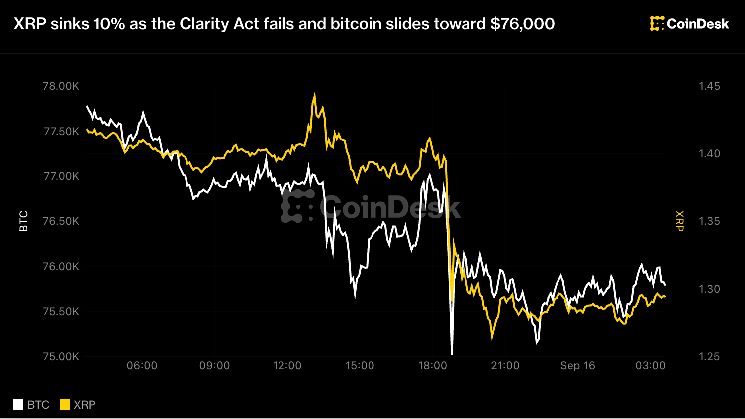
    XRP led a broad cryptocurrency sell-off Wednesday morning, plunging nearly 10% to $1.30 during Asian trading hours after the U.S. Senate failed to advance the Clarity Act, according to CoinDesk data.

    Major Tokens Slide Across the Board

    Ether followed with a decline of nearly 5% to approximately $2,410. Solana dropped 5% to just above $97, while Dogecoin fell nearly 5%. Zcash and Hyperliquid’s HYPE each slipped close to 4%, and Bitcoin retreated nearly 3% to just above $76,000. BNB and Tron proved the most resilient, each down only about 1%.

    Clarity Act Fails on Cloture Vote

    The legislation fell short on a 49-50 cloture vote, the procedural threshold requiring 60 senators to move a bill to debate. Multiple Republicans joined Democrats in voting against the measure. Negotiators had produced more than 600 pages of compromise text, but the provision that ultimately derailed the bill centered on ethics language designed to prevent senior government officials from maintaining crypto business interests.

    Senator Slotkin Cites Ethics Concerns

    Senator Elissa Slotkin, a Michigan Democrat, explained her opposition by stating the “the ethics provisions in this bill are simply too thin,” pointing to President Donald Trump, his children and his Cabinet earning money in crypto.

    She also said the Commodity Futures Trading Commission lacks the staffing to implement the law, and that the bill left gaps on money laundering and terrorist financing.

    Today, I voted no on the Clarity Act, legislation meant to regulate cryptocurrency in America.The ethics provisions in this bill are simply too thin. President Trump, his children, and his Cabinet are making billions of dollars in the crypto space, in part from bilking everyday…

    — Sen. Elissa Slotkin (@SenatorSlotkin) September 15, 2026

    Crypto Equities Hit Harder Than Tokens

    Publicly traded crypto companies suffered steeper losses than the underlying assets. Coinbase shares fell nearly 9% to $174.42, while Circle dropped more than 9% to $88.26. Galaxy Digital declined 8% and Gemini slid 7%. Bullish and Riot Platforms each lost 5%, eToro fell 4%, and Robinhood, MARA Holdings, CleanSpark, IREN and Core Scientific all dropped between 3% and 4%.

    Regulatory Path Forward Shifts to SEC

    Attention now turns to the regulators the bill was intended to constrain. The Securities and Exchange Commission is already advancing its proposed Reg Crypto framework and rules for tokenized securities, which now represents the primary pathway to the regulatory certainty the industry sought from Congress.

    Political and Market Implications

    Industry political action committees, including Fairshake, must now decide how to approach senators who voted against the legislation ahead of the November 3 election. A new Congress will convene in January 2027.

    Meanwhile, the Federal Reserve is scheduled to announce its rate decision later Wednesday, with traders leaning toward a quarter-point hike. The decision lands on a market that has just watched its legislative push collapse and is already selling risk assets.

  • Mike Novogratz Critiques Crypto Legislative Breakdown

    Mike Novogratz Critiques Crypto Legislative Breakdown

    Novogratz Slams Congress Over Clarity Act Failure

    Prominent crypto investor Mike Novogratz has sharply criticized Congress for failing to advance the Clarity Act, legislation designed to establish a regulatory framework for digital assets in the United States. In a recent social media post, Novogratz detailed how 18 months of bipartisan negotiations collapsed, leaving the industry without the regulatory clarity it has long sought.

    Bipartisan Deal Collapses Amid Ethics Disputes

    According to Novogratz, a compromise on the Clarity Act was within reach before political intransigence derailed the process. He emphasized that ethics concerns became a focal point of disagreement, causing both Republicans and Democrats to prioritize partisan positioning over the long-term health of the cryptocurrency sector. The breakdown underscores deep divisions in Washington over how to regulate digital assets.

    Market Reaction: Uncertainty Persists

    The broader crypto market has shown mixed signals, with major assets lacking substantial price momentum. Traders appear cautious, reflecting the uncertainty highlighted by Novogratz’s comments. Without clear legislative direction, many investors are holding back, awaiting concrete signals from Congress regarding the future of crypto regulation.

    Election Year Dynamics Could Delay Crypto Legislation

    As the U.S. elections approach, Novogratz suggested that crypto policy may not rank as a top-tier issue for voters, overshadowed by pressing concerns such as inflation and immigration. This political reality could further sideline legislative efforts, prolonging the regulatory vacuum that currently hampers industry growth and investor confidence.

    What Traders Should Watch Next

    Market participants should monitor how ongoing political discourse influences sentiment. The regulatory uncertainty could lead to increased volatility in digital asset prices. Shifts in legislative focus as the election nears may either hinder or facilitate progress on crypto legislation, directly impacting the trajectory of the market.

    This article is for informational purposes only and does not constitute financial advice.

  • World Liberty Financial: Can $6M Whale Buying Push WLFI Back to $0.06?

    World Liberty Financial: Can $6M Whale Buying Push WLFI Back to $0.06?

    World Liberty Financial ($WLFI) Price Analysis: Whale Accumulation Counters Founder Sell Concerns

    World Liberty Financial ($WLFI) reached a local high of $0.061 four days ago before retracing sharply. At press time, the token trades around $0.058 with trading volume down 13% to $42 million, signaling a market slowdown.

    Whale Accumulates $6.18 Million in $WLFI

    Despite cooling momentum, on-chain data reveals significant whale accumulation. According to Arkham Intelligence data highlighted by Nazoku, a single whale withdrew 90 million $WLFI from Binance and received an additional 18.7 million $WLFI from other wallets, totaling 108.45 million $WLFI worth approximately $6.18 million.

    This sustained buying pressure suggests strong optimism from major holders anticipating further gains.

    Exchange Netflows Confirm Accumulation Trend

    CoinGlass data shows Spot Netflow has remained negative for 12 consecutive days, indicating consistent withdrawal of tokens from exchanges into private wallets. Historically, extended periods of negative netflow have often preceded stronger price performances.

    Founder Token Movements Raise Selling Pressure Concerns

    Market caution persists due to reported actions by the Trump family and co-founders. The Washington Sun reported that Trump and other founders moved 20 billion $WLFI into new vesting contracts, a structural step that would enable future cash-outs and payouts.

    This development has intensified concerns among market participants and watchdogs regarding potential conflicts of interest and significant selling pressure if major holders decide to liquidate positions.

    Technical Indicators: Bullish Structure With Reversal Risks

    Current technical analysis presents a mixed but cautiously optimistic picture:

    • Bulls vs. Bears (BvB) indicator: Positive at 5, indicating buyer dominance
    • Relative Strength Index (RSI): Hovering above 50, suggesting active buyers and trend continuity

    Key price levels to watch:

    • Bullish scenario: If whale demand holds, $WLFI could close above $0.058–$0.06
    • Bearish scenario: Persistent slowdown could push RSI below 50, signaling trend reversal with potential decline to $0.054

    Summary

    • A World Liberty Financial whale purchased 108 million $WLFI worth $6.18 million across recent transactions.
    • Market structure remains bullishly cautious amid allegations that Trump family and founders are preparing to sell holdings via new vesting contracts.