Author: Evan Mercer

  • Ripple CEO Brad Garlinghouse Unveils 5-Year Crypto Strategy Featuring Bitcoin, XRP, Three Altcoins

    Ripple CEO Brad Garlinghouse Unveils 5-Year Crypto Strategy Featuring Bitcoin, XRP, Three Altcoins

    Key Highlights

    • Ripple CEO Brad Garlinghouse proposes a simple five-year “buy and hold” strategy focusing on the top five cryptocurrencies by market capitalization: Bitcoin, Ethereum, Tether, BNB, and XRP.
    • Garlinghouse emphasizes he is not an “XRP maximalist,” reveals he personally holds a small amount of Solana, and argues different blockchain projects can succeed simultaneously without being direct competitors.
    • The executive cites “trust, utility, speed, and liquidity” as the fundamental drivers of XRP’s long-term value, asserting that the most liquid assets tend to become the most valuable over time.

    Garlinghouse Unveils Long-Term ‘Top Five’ Crypto Portfolio Strategy

    Speaking at a recent industry event, Ripple CEO Brad Garlinghouse outlined a straightforward investment thesis for long-term cryptocurrency holders, suggesting that a diversified basket of the five largest digital assets by market capitalization could yield “great results” over a five-year horizon. The strategy moves away from concentrated bets on single tokens, instead advocating for exposure to the established market leaders: Bitcoin (BTC), Ethereum (ETH), Tether (USDT), BNB, and XRP.

    XRP Inclusion Notable Amid ‘Non-Maximalist’ Stance

    The inclusion of XRP in Garlinghouse’s proposed top-five basket draws particular attention given his previous public stance. The Ripple chief has explicitly stated in the past that he does not define himself as an “$XRP maximalist,” signaling a broader market perspective rather than singular allegiance to the token native to the Ripple ecosystem. This approach underscores a philosophy of market-cap-weighted diversification rather than thematic or ecosystem-specific concentration.

    Solana Acknowledged as Valid, Non-Competitive Peer

    Addressing the inevitable comparisons between XRP and other high-throughput blockchains, specifically Solana (SOL), Garlinghouse declined to frame the relationship as a zero-sum competition. When asked why an investor should prefer XRP over Solana, he stated he was not trying to convince anyone to choose one over the other. He revealed he personally owns a small amount of Solana and maintains a positive view of various cryptocurrencies for different reasons. “He stated that he does not see Solana as a direct competitor to $XRP and that different crypto projects can be successful simultaneously,” reinforcing a multi-chain future thesis.

    Liquidity, Trust, and Utility Cited as XRP Value Drivers

    Concluding his remarks, Garlinghouse expressed strong optimism regarding XRP’s specific fundamentals. He argued that the determinants of a currency’s enduring value are “trust, utility, speed, and liquidity“—effectively, how liquid the asset is. He posited a direct correlation between liquidity and value, asserting that the most liquid currencies tend to be the most valuable because liquidity is the primary reason investors seek to hold an asset. This framework positions XRP’s design for institutional cross-border payments as its core competitive advantage.

    Why This Matters

    Garlinghouse’s comments arrive as institutional adoption of digital assets accelerates, with major financial firms increasingly treating cryptocurrency as a distinct asset class requiring diversified allocation strategies rather than speculative single-token bets. His “top five” framework mirrors traditional finance index-investing principles applied to the crypto market cap leaderboard. Furthermore, his explicit refusal to engage in tribalistic “maximalist” rhetoric—and his acknowledgment of holding Solana—signals a maturing industry leadership mindset focused on interoperability and collective ecosystem growth. For market participants, the remarks reinforce the narrative that regulatory clarity (particularly surrounding XRP’s status in the U.S.) and deepening liquidity pools are critical milestones for the next phase of crypto market development.

    Frequently Asked Questions

    What are the five cryptocurrencies Brad Garlinghouse includes in his proposed long-term strategy?
    The basket consists of Bitcoin (BTC), Ethereum (ETH), Tether (USDT), BNB, and XRP, ranked by current market capitalization.
    Does Brad Garlinghouse consider himself an XRP maximalist?
    No. Garlinghouse has previously stated he does not define himself as an “$XRP maximalist,” and he confirmed he personally holds a small amount of Solana (SOL).
    What fundamental factors does Garlinghouse believe drive XRP’s value?
    He cites “trust, utility, speed, and liquidity” as the primary drivers, arguing that the most liquid assets tend to become the most valuable over time.
  • KelpDAO Developer Sues LayerZero, CEO Over $292M Exploit and Blame-Shifting

    KelpDAO Developer Sues LayerZero, CEO Over $292M Exploit and Blame-Shifting

    Key Highlights

    • Evercrest Technologies, developer of KelpDAO, filed a lawsuit on September 24 against LayerZero Labs, its Canadian entity, and CEO Bryan Pellegrino over the April 2026 rsETH bridge exploit that caused approximately $292 million in losses.
    • The complaint alleges the exploit stemmed from a compromised LayerZero developer device, poisoned RPC data, and a 1-of-1 Decentralized Verifier Network (DVN) configuration that Evercrest claims LayerZero reviewed and instructed them to implement.
    • Evercrest is seeking damages covering a 2,000 ETH recapitalization, over $650 million in user withdrawals, lost fee revenue, KERNEL token declines, the shutdown of its sbUSD vault, a delayed stablecoin product, legal costs, and reputational harm.

    Evercrest Technologies Sues LayerZero Labs Over $292 Million rsETH Bridge Exploit

    Evercrest Technologies, the entity behind the KelpDAO liquid restaking protocol, has initiated legal action against LayerZero Labs, its Canadian subsidiary, and Chief Executive Officer Bryan Pellegrino. The complaint, published on September 24, centers on the April 18, 2026 exploit of KelpDAO’s rsETH bridge on Unichain, which resulted in approximately $292 million in losses. Evercrest contends the incident was not caused by a vulnerability in its own smart contracts but rather by a combination of poisoned RPC data, a compromised LayerZero developer machine, and a single-verifier DVN architecture that LayerZero allegedly endorsed.

    Attack Timeline and Technical Root Cause

    According to the filing, the attack chain began on March 6, 2026, when an attacker compromised a LayerZero developer’s machine. In April, the threat actor targeted the RPC infrastructure underpinning LayerZero’s Decentralized Verifier Network. The manipulated RPC endpoints allegedly caused LayerZero’s sole DVN to falsely attest that 116,500 rsETH had been locked on Unichain, despite no such lock occurring on the source chain. Because LayerZero served as the exclusive verifier for the Unichain Bridge, this false attestation triggered the minting of $292 million worth of rsETH on Ethereum mainnet.

    Evercrest states it detected the anomalous activity within one hour, immediately suspended its LayerZero-powered bridges, froze the attacker’s wallet, and prevented a second minting attempt of 40,000 rsETH. The rapid response limited further damage, but the initial exploit had already executed.

    Dispute Over Bridge Configuration and Responsibility

    A central point of contention in the lawsuit is the bridge’s verification architecture. Evercrest asserts that LayerZero reviewed and endorsed KelpDAO’s bridge configuration and explicitly instructed the team to operate its own DVN in a 1-of-1 setup. The complaint alleges that after the exploit, LayerZero shifted its public narrative, blaming KelpDAO’s single-verifier design. CEO Bryan Pellegrino reportedly stated that applications should not rely on a sole DVN, a position Evercrest says contradicts LayerZero’s prior written guidance. Evercrest maintains it followed LayerZero’s documented instructions throughout the integration process.

    Today we filed a lawsuit against LayerZero and its co-founder, Bryan Pellegrino, to right the wrongs associated with the exploit of rsETH’s LayerZero bridge earlier this year. For more details, please refer to the statement below.https://t.co/gPQTPeM0Zh
    — Kelp (@KelpDAO) September 25, 2026

    Damages Sought and Operational Fallout

    The complaint itemizes extensive damages, including a 2,000 ETH recapitalization requirement, more than $650 million in user withdrawals following the incident, lost protocol fee revenue, declines in the KERNEL governance token, the forced shutdown of KelpDAO’s sbUSD vault, and the delay of a planned stablecoin product. Evercrest also cites legal expenses, migration costs to alternative infrastructure, and reputational harm to the protocol and its stakeholders.

    Why This Matters

    The lawsuit highlights growing tensions in the cross-chain infrastructure layer as protocols seek accountability for exploits involving interoperability messaging. LayerZero’s DVN model, which allows applications to configure their own verification quorums, places significant responsibility on both the infrastructure provider and the integrating team. This case may set a precedent for how liability is allocated when a messaging layer’s off-chain components—such as RPC endpoints and developer environments—are compromised, and whether written integration guidance creates enforceable obligations. The outcome could influence how DeFi protocols evaluate bridge risk, negotiate service-level agreements with messaging providers, and structure multi-verifier architectures going forward.

    Frequently Asked Questions

    What specific failures does Evercrest attribute to LayerZero?

    Evercrest alleges three interlocking failures: a compromised LayerZero developer device on March 6, 2026; poisoned RPC data fed to LayerZero’s Decentralized Verifier Network in April; and a 1-of-1 DVN configuration that LayerZero reportedly reviewed, endorsed, and instructed KelpDAO to implement for the Unichain Bridge.

    How did Evercrest respond to the exploit?

    Evercrest states it identified the attack within one hour, suspended all LayerZero bridges, froze the attacker’s wallet, and blocked a second minting attempt of 40,000 rsETH, preventing additional losses beyond the initial $292 million exploit.

    What damages is Evercrest seeking in the lawsuit?

    The complaint seeks recovery for a 2,000 ETH recapitalization, over $650 million in user withdrawals triggered by the incident, lost fee revenue, KERNEL token value declines, the shutdown of the sbUSD vault, a delayed stablecoin launch, legal and migration costs, and reputational harm to the KelpDAO protocol and Evercrest Technologies.

  • Bond Volatility Surges While Bitcoin and Wall Street Remain Calm

    Bond Volatility Surges While Bitcoin and Wall Street Remain Calm

    Key Highlights

    • The U.S. 10-year Treasury yield briefly touched 5.2% on Thursday before settling at 5.163%, driven by Middle East conflict pushing oil and diesel prices higher and complicating the global inflation outlook.
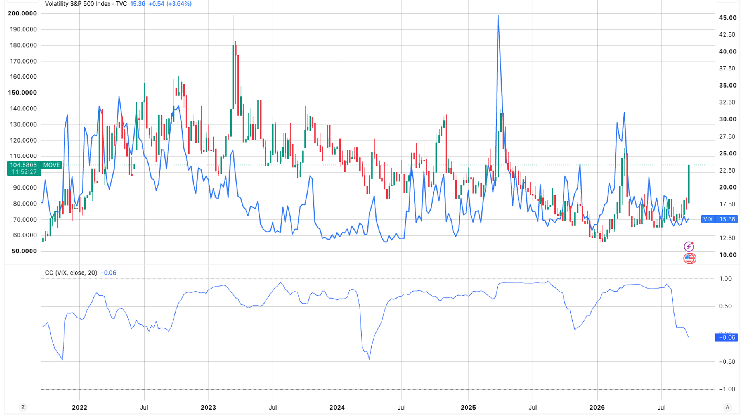
    • The ICE BofA MOVE Index ($MOVE) shows bond traders are paying significantly more for interest-rate volatility protection despite the S&P 500 rising roughly 21% since March when $MOVE was last at similar levels.
    • The 20-day correlation between the VIX and $MOVE turned negative (-0.06) for the first time since April 2024, while the BVIV-$MOVE correlation sits at -0.37, indicating a historic divergence between equity and bond volatility expectations as Bitcoin’s implied volatility hovers near yearly lows.

    Global Bond Yields Surge Amid Middle East Tensions

    A broad-based climb in government bond yields is rippling through global markets this week, with the benchmark U.S. 10-year Treasury yield briefly piercing the 5.2% threshold on Thursday before retreating slightly to 5.163%. The selloff in fixed income comes as the widening conflict in the Middle East drives crude oil and diesel prices higher, injecting fresh uncertainty into the inflation outlook and prompting traders to reassess how much further major central banks may need to tighten monetary policy. The move underscores the fragile nature of the disinflation narrative that had previously anchored market expectations for rate cuts.

    MOVE Index Signals Rising Rate Volatility Premium

    The ICE BofA MOVE Index, a widely watched gauge of expected volatility in U.S. Treasury markets, has climbed to levels last seen in March. However, the equity market backdrop has shifted dramatically: the S&P 500 stood near 6,350 when $MOVE previously traded at this level, but the index has since surged to 7,704, a gain of approximately 21%. This divergence highlights a critical shift—bond traders are now paying a considerably higher premium for protection against interest-rate swings even as equity markets rally, suggesting fixed-income participants see risks that stock investors are currently disregarding.

    Correlation Breakdown Between Asset Class Volatility

    The structural relationship between equity and bond volatility measures is showing signs of fracture. Over a 20-day rolling window, the correlation between the Cboe Volatility Index (VIX) and the MOVE Index has slipped to -0.06, turning negative for the first time since April 2024, though the reading remains statistically close to zero. The correlation between the Cboe Bitcoin Volatility Index (BVIV) and $MOVE is more distinctly negative at -0.37, marking one of its lowest readings in years. This decoupling occurs as bond volatility rises while Bitcoin’s expected volatility remains anchored near its yearly low, a dynamic that challenges traditional cross-asset hedging assumptions.

    Bitcoin’s Detachment from Yield Narrative

    Adding to the complexity, recent analysis from CoinDesk indicates that rising yields alone have demonstrated little consistent relationship with Bitcoin’s returns. The cryptocurrency’s implied volatility, as measured by BVIV, has failed to respond to the spike in rate volatility, remaining near annual lows. This suggests that Bitcoin is currently trading on idiosyncratic drivers—such as ETF flow dynamics and regulatory developments—rather than macroeconomic interest-rate sensitivity, further isolating the digital asset from traditional fixed-income turbulence.

    Why This Matters

    The simultaneous rise in bond yields and volatility premiums, coupled with a breakdown in cross-asset correlations, signals a potential regime shift for multi-asset portfolios. For institutional investors, the negative VIX-MOVE correlation undermines the traditional negative equity-bond correlation that has underpinned 60/40 portfolio construction for decades. The fact that Bitcoin volatility remains suppressed while rate volatility spikes suggests the asset is not currently functioning as a macro hedge against inflation or rate uncertainty. Market participants should monitor whether the $MOVE index sustains these elevated levels, as persistent bond volatility could force a repricing of risk assets broadly, including equities and digital assets, particularly if the Federal Reserve signals a higher-for-longer rate stance in response to energy-driven inflation pressures.

    Frequently Asked Questions

    What is the MOVE Index and why is it important?

    The ICE BofA MOVE Index ($MOVE) measures the implied volatility of U.S. Treasury securities across the 2-, 5-, 10-, and 30-year maturities. It serves as the bond market’s equivalent of the VIX, reflecting how much traders are paying to hedge against interest-rate swings. A rising $MOVE indicates growing uncertainty about the path of monetary policy and inflation.

    Why has the correlation between VIX and MOVE turned negative?

    The 20-day correlation between the VIX (equity volatility) and MOVE (bond volatility) fell to -0.06, its first negative reading since April 2024. This suggests equity traders are complacent—pricing in a soft landing and continued rally—while bond traders are hedging aggressively against sticky inflation and higher-for-longer rates, creating a rare divergence in risk perception across asset classes.

    Is Bitcoin acting as a hedge against rising yields?

    According to CoinDesk’s analysis, rising yields alone have shown little consistent relationship with Bitcoin’s returns. Currently, Bitcoin’s implied volatility (BVIV) is near yearly lows while bond volatility ($MOVE) spikes, and the BVIV-MOVE correlation sits at -0.37. This indicates Bitcoin is not currently functioning as a macro hedge against interest-rate volatility.

  • MOVE Index Surges Past 130, Fueling Bailout Speculation

    MOVE Index Surges Past 130, Fueling Bailout Speculation

    Key Highlights

    • The $MOVE Index has surged above 130, signaling heightened implied volatility in bond markets and growing liquidity concerns.
    • Traders and analysts, including prominent voice @CryptoHayes, are flagging the move as a potential precursor to policy intervention or regulatory action.
    • Historical patterns show similar index spikes have preceded central bank support measures, making current levels a critical watchpoint for market participants.

    $MOVE Index Breaches 130 Threshold, Triggering Policy Speculation

    The $MOVE Index — a widely tracked gauge of implied volatility in U.S. Treasury markets managed by ICE (Intercontinental Exchange) — has climbed above the 130 level, a threshold that market veterans associate with acute stress in fixed-income liquidity. The move was amplified across financial social media after a post by @CryptoHayes, the pseudonymous founder of BitMEX and a closely followed macro commentator, drew attention to the index’s rapid ascent. His tweet catalyzed a wave of discussion among rates traders, hedge fund managers, and crypto-market participants who monitor the $MOVE as a leading indicator of systemic funding pressure.

    Unlike the VIX, which reflects equity volatility, the $MOVE Index captures expected swings in Treasury yields across the 2-, 5-, 10-, and 30-year maturities. A reading above 130 has historically coincided with episodes such as the March 2020 pandemic liquidity crunch, the September 2022 U.K. gilt crisis, and the regional banking turbulence of early 2023. In each case, the Federal Reserve or other major central banks responded with emergency lending facilities, quantitative easing restarts, or explicit backstops — actions that subsequently stabilized markets but also reshaped asset-price trajectories across equities, credit, and digital assets.

    Mixed Crypto Signals Complicate the Picture

    The broader cryptocurrency market is sending conflicting signals as the $MOVE rises. Bitcoin (BTC) has shown resilience near recent range highs, while Ethereum (ETH) and major altcoins exhibit divergent momentum, reflecting uncertainty over whether tighter financial conditions or imminent policy relief will dominate. Liquidity in on-chain markets remains thinner than in 2021, and the correlation between crypto risk assets and rates volatility has strengthened since the 2022 bear market. Traders are parsing whether a sustained $MOVE elevation will force the Federal Reserve to signal a pause or pivot — a development that could inject fresh risk appetite into digital assets — or whether the index simply reflects transient positioning ahead of key economic data.

    Market structure analysts note that the $MOVE’s jurisdiction falls under the purview of the SEC, CFTC, and the Federal Reserve Bank of New York, all of which monitor fixed-income volatility as a barometer of dealer balance-sheet capacity. With primary dealers already managing elevated Treasury supply, a further $MOVE spike could strain market-making ability, widening bid-ask spreads and increasing the odds of an official-sector response.

    Why This Matters

    The $MOVE Index’s breach of 130 is not merely a technical milestone — it is a signal that the world’s deepest, most liquid bond market is pricing in exceptional uncertainty around interest-rate paths. For institutional allocators, this raises the specter of forced deleveraging in strategies reliant on stable funding, from basis trades to mortgage-backed securities hedging. For crypto-native funds, it underscores the growing integration of digital-asset pricing with traditional macro liquidity cycles. Policymakers at the Fed and Treasury will likely reference the $MOVE in upcoming FOMC discussions and Financial Stability Oversight Council (FSOC) meetings as they assess whether current market functioning warrants intervention. The next two weeks — featuring CPI, PPI, and retail sales data — will be decisive in determining whether the index retraces or consolidates at elevated levels, setting the stage for either a policy calm or a repeat of 2020-2023 crisis playbooks.

    Frequently Asked Questions

    What is the $MOVE Index and why does 130 matter?
    The $MOVE Index (Merrill Lynch Option Volatility Estimate) measures implied volatility across key U.S. Treasury maturities. A level above 130 has historically signaled severe fixed-income stress, often preceding central bank liquidity interventions.
    Who is @CryptoHayes and why did his post move markets?
    @CryptoHayes is Arthur Hayes, co-founder of BitMEX and chief investment officer of Maelstrom. His macro commentary commands a large following among crypto and rates traders, and his highlight of the $MOVE surge amplified institutional attention to the signal.
    How could a policy response affect cryptocurrency markets?
    If the Fed or Treasury acts to ease funding pressure — via swap lines, standing repo facilities, or balance-sheet expansion — risk assets including Bitcoin and Ethereum typically benefit from improved dollar liquidity. Conversely, inaction could prolong volatility and correlation-driven selloffs.
  • Stonk Narrative Around LaunchOnSF Surges Amid Growing Competition

    Stonk Narrative Around LaunchOnSF Surges Amid Growing Competition

    Key Highlights

    • LaunchOnSF is rapidly gaining market traction on Solana, directly challenging Pumpfun’s established dominance in the token launch sector.
    • The narrative shift is driven by holder rewards and systematic buyback mechanisms creating a positive feedback loop for participant incentives.
    • Influential analyst @SolanaFloor has highlighted the evolving trader sentiment, signaling a potential restructuring of trading strategies across the ecosystem.

    LaunchOnSF Challenges Pumpfun as Solana Token Launch Narrative Shifts

    The competitive landscape of Solana-based token launch platforms is undergoing a notable transformation as LaunchOnSF accelerates its market presence, mounting a credible challenge to Pumpfun‘s long-standing dominance. This development has been underscored by prominent market commentator @SolanaFloor, who identifies a measurable shift in trader sentiment and capital allocation patterns. The emerging narrative centers on LaunchOnSF’s structural incentives—specifically recurring holder rewards and protocol-level buyback programs—which analysts suggest are generating a self-reinforcing demand cycle distinct from the purely speculative dynamics that have characterized the sector.

    Holder Incentives and Buyback Mechanics Drive New Feedback Loop

    Unlike traditional launchpad models that rely heavily on initial hype cycles, LaunchOnSF’s architecture integrates continuous value accrual mechanisms for token holders. The platform’s reward distribution framework, combined with automated buyback operations funded by protocol revenue, creates a dual incentive structure: immediate yield participation and long-term supply compression. Market observers note this design directly addresses a persistent criticism of earlier generation launch platforms—namely, the misalignment between platform success and token holder returns. As capital rotates toward models demonstrating sustainable tokenomics, the competitive pressure on established players like Pumpfun to adapt or risk market share erosion intensifies.

    Market Context: Cautious Optimism Amid Mixed Sector Signals

    The broader cryptocurrency market continues to display divergent momentum across major assets, creating a backdrop of selective risk appetite. Within this environment, LaunchOnSF’s traction is particularly significant because it represents a fundamentals-driven narrative shift rather than a purely momentum-based rally. While specific price data for LaunchOnSF’s native assets remains limited in public discourse, on-chain analytics suggest growing wallet concentration and increased interaction with the platform’s reward contracts. This accumulation pattern, occurring alongside the highlighted buyback activity, implies that sophisticated participants are positioning ahead of a potential broader retail recognition phase.

    Why This Matters: The Evolution of Solana’s Launch Infrastructure

    The rivalry between LaunchOnSF and Pumpfun encapsulates a broader maturation of the Solana token launch ecosystem. For over a year, Pumpfun has functioned as the de facto standard for low-barrier token deployment, capturing immense volume but facing criticism for enabling high-turnover, low-accountability projects. LaunchOnSF’s rise signals market demand for infrastructure that aligns platform incentives with long-term community value. If the current trajectory holds, the sector may bifurcate: one tier optimizing for volume and speed (Pumpfun’s model), and another competing on sustainability, holder alignment, and narrative depth (LaunchOnSF’s model). This segmentation would mirror the evolution seen in Ethereum’s launchpad landscape, where platforms like Polkastarter and DAO Maker eventually differentiated on vetting rigor and post-launch support. For traders and builders, the immediate implication is a need to reassess platform-specific risk parameters—liquidity depth, contract audit status, and tokenomic durability—rather than treating all Solana launches as a monolithic asset class.

    Frequently Asked Questions

    What is LaunchOnSF and how does it differ from Pumpfun?

    LaunchOnSF is a token launch platform operating within the Solana ecosystem that emphasizes holder rewards and protocol-driven buybacks as core tokenomic features. Unlike Pumpfun, which prioritizes frictionless, high-volume token deployment, LaunchOnSF structures its incentives around long-term holder alignment and supply dynamics, aiming to create sustainable demand rather than purely speculative launches.

    Why is @SolanaFloor’s commentary significant for this narrative?

    @SolanaFloor is a widely followed on-chain analyst and market commentator focused on the Solana ecosystem. Their endorsement of the LaunchOnSF narrative signals to a large audience of active traders and developers that the platform’s momentum is backed by observable on-chain behavior—specifically holder accumulation and buyback execution—rather than social media hype alone.

    What should traders monitor in the coming weeks regarding this competition?

    Key metrics to watch include: (1) wallet growth and holder retention rates on LaunchOnSF versus Pumpfun, (2) the consistency and scale of buyback executions relative to protocol revenue, (3) any response from Pumpfun—such as new incentive programs or tokenomic adjustments—and (4) volatility spikes during high-profile launches on either platform, which will test liquidity depth and market structure resilience.

  • Positive Trend Continues for US Spot Bitcoin and Ethereum ETFs, Latest Data Shows

    Positive Trend Continues for US Spot Bitcoin and Ethereum ETFs, Latest Data Shows

    Key Highlights

    • U.S. spot Bitcoin ETFs posted a sixth straight day of net inflows on September 24, totaling approximately $190.7 million, led by BlackRock’s IBIT with $162.6 million.
    • Spot Ether ETFs extended their winning streak to five consecutive sessions, attracting roughly $66.1 million in net inflows, with BlackRock’s ETHA ($26.8M) and Fidelity’s FETH ($21.5M) pacing the category.
    • While most Bitcoin funds saw inflows, WisdomTree’s BTCW recorded a $4 million net outflow, highlighting divergent investor preferences within the product lineup.

    Bitcoin ETF Momentum Extends to Six Sessions as BlackRock Dominates Flows

    U.S. spot Bitcoin exchange-traded funds maintained their upward trajectory on September 24, marking the sixth consecutive trading session of positive net capital inflows. According to data compiled by SoSoValue, the cohort of Bitcoin investment products attracted approximately $190.7 million in combined net inflows during the session. The momentum underscores sustained institutional and retail appetite for regulated Bitcoin exposure amid a constructive macro backdrop for digital assets.

    BlackRock’s iShares Bitcoin Trust (IBIT) continued to function as the primary conduit for new capital, capturing $162.6 million of the day’s total — representing roughly 85% of aggregate inflows across all spot Bitcoin ETFs. The fund’s dominance reflects its first-mover advantage, deep liquidity profile, and widespread adoption across advisory platforms. Trailing significantly behind, Fidelity’s Wise Origin Bitcoin Fund (FBTC) recorded $12.9 million in net subscriptions, while Morgan Stanley’s Bitcoin Trust (MSBT) added $10.2 million. Franklin Templeton’s Digital Holdings Trust (EZBC) and Bitwise’s Bitcoin ETF (BITB) rounded out the positive contributors with $4.9 million and $4.1 million, respectively.

    WisdomTree BTCW Bucks Trend With Modest Outflow

    Not every fund participated in the rally. WisdomTree’s Bitcoin Fund (BTCW) registered a net outflow of $4 million, the sole negative print among Bitcoin ETFs on the day. The divergence suggests investors are discriminating based on factors such as expense ratios, custodial arrangements, or distribution reach. Despite the single-fund redemption, the category’s overall net flow remained firmly in positive territory, reinforcing the broader accumulation narrative.

    Ether ETFs Build on Momentum With Fifth Straight Day of Inflows

    A parallel trend emerged in the spot Ether ETF complex, where net inflows reached approximately $66.1 million on September 24 — extending the positive streak to five consecutive trading sessions. BlackRock’s iShares Ethereum Trust (ETHA) led the category with $26.8 million in net creations, followed closely by Fidelity’s Ethereum Fund (FETH) at $21.5 million. Grayscale’s Mini Ethereum Trust (ETHE), the lower-fee successor to the firm’s legacy Grayscale Ethereum Trust, continued to attract capital with a $17.8 million net inflow, signaling successful migration of assets from its higher-cost predecessor.

    The synchronized inflows across both Bitcoin and Ether vehicles indicate broadening demand for diversified crypto exposure within traditional portfolio frameworks. Market participants note that the dual-asset momentum coincides with improved regulatory clarity, evolving institutional custody infrastructure, and growing advisor comfort with digital asset allocations.

    Why This Matters

    The six-day Bitcoin ETF inflow streak and five-day Ether ETF streak represent the longest sustained periods of simultaneous positive flows since the products launched earlier this year. This consistency suggests the initial post-launch volatility has given way to a more structural demand phase, where allocators treat spot crypto ETFs as core portfolio building blocks rather than tactical trades. BlackRock’s outsized share of flows across both asset classes highlights the asset manager’s distribution advantage and the trust advisors place in its brand. Meanwhile, Grayscale’s Mini ETHE success demonstrates that fee competition can recapture assets even from entrenched incumbents. Going forward, market observers will monitor whether inflows persist during periods of price consolidation or if they remain tightly correlated with bullish price action. The next inflection point may come from options approvals on spot ETFs, which could unlock additional institutional strategies and deepen liquidity.

    Frequently Asked Questions

    Which spot Bitcoin ETF attracted the most capital on September 24?

    BlackRock’s iShares Bitcoin Trust (IBIT) led all spot Bitcoin ETFs with a net inflow of $162.6 million on September 24, accounting for the vast majority of the category’s $190.7 million total.

    How many consecutive days of inflows have spot Ether ETFs recorded?

    Spot Ether ETFs posted net inflows for the fifth consecutive trading session on September 24, with total inflows of approximately $66.1 million on that day.

    Did any spot Bitcoin ETFs see outflows on September 24?

    Yes. WisdomTree’s Bitcoin Fund (BTCW) recorded a net outflow of $4 million, making it the only spot Bitcoin ETF with negative flows for the session.

  • Unprecedented Bitcoin Event Occurs on Binance for First Time Since 2023

    Unprecedented Bitcoin Event Occurs on Binance for First Time Since 2023

    Key Highlights

    • Binance recorded its highest single-day net Bitcoin outflow since 2023, exceeding 13,800 BTC, while exchange reserves dropped by roughly 20,000 BTC in four days.
    • Bitcoin has surged approximately 45% since July, holding above $82,000 for consecutive sessions and clearing key technical resistance levels.
    • CryptoQuant analyst Darkforth suggests the outflows signal a shift toward long-term holding and potential FOMO-driven re-entry, reducing available supply and limiting near-term selling pressure.

    Binance Sees Record Bitcoin Outflows as Price Surges Past $82,000

    Bitcoin’s sustained rally above the $82,000 threshold has triggered a historic withdrawal wave from Binance, the world’s largest cryptocurrency exchange by volume. According to on-chain data highlighted by CryptoQuant analyst Darkforth, the platform recorded a single-day net outflow surpassing 13,800 BTC, marking the largest such movement since 2023. Over the preceding week, Binance averaged roughly 2,000 BTC in daily net outflows, but the recent spike suggests a notable acceleration in investor behavior as the asset consolidates gains of approximately 45% from its July lows.

    Exchange Reserves Drop 20,000 BTC in Four Days, Tightening Market Supply

    The outflow surge has directly depleted Binance’s Bitcoin reserves, which fell from approximately 705,000 BTC to 685,000 BTC in just four days—a reduction of 20,000 BTC. Given that Binance holds an estimated 30% of all Bitcoin custodied on centralized exchanges accessible to retail investors, this drawdown represents a meaningful contraction in the immediately available supply. Darkforth notes that the persistent movement of coins off exchanges typically indicates a preference for long-term cold storage over active trading, a dynamic that structurally reduces the liquid supply available to meet potential sell orders.

    Analyst Flags FOMO Re-Entry as Potential Driver Behind Sudden Withdrawal Spike

    While the broader trend supports a bullish accumulation narrative, Darkforth cautions that the sudden magnitude of the latest outflows may also reflect a psychological shift. The analyst observes that investors who remained sidelined during prior bear-market declines—anticipating further drops—may now be re-entering the market driven by fear of missing out (FOMO) as prices break out. This behavior could amplify volatility if new holders lack conviction, but the net effect remains a reduction in exchange-held coins, which historically correlates with upward price pressure when demand remains steady.

    Why This Matters

    The confluence of technical breakout, declining exchange reserves, and record outflows from the industry’s dominant trading venue underscores a potential supply shock in the making. With Binance commanding nearly a third of centralized exchange Bitcoin holdings, its reserve trends serve as a bellwether for broader market liquidity. A sustained decline in exchange balances typically precedes periods of reduced sell-side pressure, as fewer coins are readily accessible for immediate liquidation. However, the mixed signals—genuine accumulation versus speculative FOMO inflows—warrant close monitoring of on-chain metrics such as coin days destroyed and holder unrealized profit/loss ratios to gauge the durability of the current holder base. The next critical test will be whether Bitcoin can maintain its footing above $82,000 during inevitable profit-taking episodes, or if the recent outflow spike proves to be a local peak in conviction.

    Frequently Asked Questions

    What caused the record Bitcoin outflow from Binance?
    The outflow coincided with Bitcoin’s rally above $82,000 and a 45% gain since July. Analysts attribute the movement to a combination of long-term accumulation (moving coins to cold storage) and potential FOMO-driven buying from investors re-entering the market after missing earlier lows.
    How much Bitcoin does Binance hold compared to other exchanges?
    Binance holds approximately 30% of all Bitcoin custodied on centralized exchanges accessible to investors, making its reserve levels a significant indicator of overall market liquidity.
    Does the outflow guarantee Bitcoin’s price will keep rising?
    Not necessarily. While declining exchange reserves reduce immediate selling pressure and are historically bullish, price direction depends on sustained demand. The analyst notes that some outflows may stem from speculative FOMO buying, which could reverse quickly if sentiment shifts.

    This is not investment advice.

  • Bitcoin ETFs Erase $5.8 Billion Hole

    Bitcoin ETFs Erase $5.8 Billion Hole

    Key Highlights

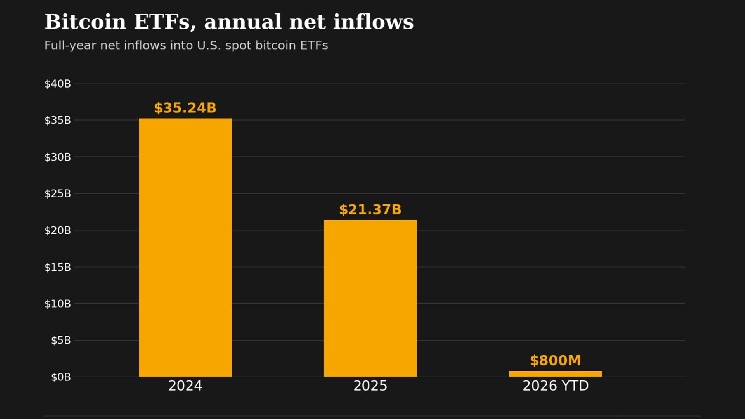
    • U.S. spot Bitcoin ETFs have reversed a $5.8 billion year-to-date deficit to post nearly $800 million in net inflows, per SoSoValue data.
    • Nearly $4 billion of inflows arrived after Treasury Secretary Scott Bessent’s August announcement of increased bond purchases amid surging yields.
    • Despite a six-day winning streak, 2025 inflows remain far below the $35.2 billion recorded in 2024 and $21.4 billion in 2025 full-year totals.

    Bitcoin ETFs Stage Dramatic Turnaround as Net Inflows Turn Positive for 2025

    Investors in U.S.-listed spot Bitcoin exchange-traded funds have engineered a remarkable reversal. After sitting on a staggering $5.8 billion year-to-date outflow as recently as July 13, according to CoinDesk’s analysis of SoSoValue data, the funds now boast nearly $800 million in net inflows for the year. The swing coincides with Bitcoin’s price recovery to approximately $85,000 from a June low below $58,000, a movement that has led several analysts to declare a new bull market is already underway.

    Liquidity Injection Catalyzes $4 Billion Inflow Surge

    The inflection point aligns closely with a pivotal macroeconomic shift. Since U.S. Treasury Secretary Scott Bessent’s August announcement detailing increased bond purchases—a liquidity management tool deployed as bond yields climbed to multi-year highs—nearly $4 billion has flowed into the ETF complex. This policy-driven liquidity expansion appears to have provided the tailwind necessary to overcome the persistent selling pressure that defined the first half of the year.

    Six-Day Winning Streak Tests Resistance at $85,000

    Momentum remains visible in recent trading sessions. The ETF suite has recorded six consecutive days of net inflows, a streak that has persisted even as Bitcoin’s price rally has stalled near the $85,000 level since Tuesday. The decoupling of fund flows from immediate price action suggests institutional allocation decisions are increasingly driven by strategic portfolio positioning rather than short-term momentum chasing.

    Why This Matters

    The shift from deep negative territory to positive year-to-date flows marks a critical psychological and structural threshold for the digital asset ecosystem. The 2024 calendar year saw $35.2 billion in total net inflows, while the source cites a $21.4 billion figure for 2025—indicating that despite the recent rebound, the current pace remains well below the run-rate established during the peak adoption phase. The sustained inflows following the Treasury’s bond-buying program highlight the sensitivity of Bitcoin-linked products to global liquidity conditions, reinforcing the narrative that Bitcoin functions as a liquidity-sensitive risk asset. Market participants will closely monitor whether the six-day streak can extend into a sustained trend capable of closing the gap with prior-year totals, and whether Bitcoin can decisively break above the $85,000 resistance that has capped gains this week.

    Frequently Asked Questions

    How much have U.S. spot Bitcoin ETFs attracted in net inflows for 2025?

    As of the latest data from SoSoValue, the funds hold nearly $800 million in net inflows year-to-date, a dramatic reversal from a $5.8 billion deficit recorded on July 13.

    What triggered the recent surge in ETF inflows?

    Approximately $4 billion of the inflows occurred after U.S. Treasury Secretary Scott Bessent’s August announcement of increased bond purchases, implemented as bond yields reached multi-year highs.

    How do current 2025 inflows compare to previous years?

    Despite the turnaround, the $800 million year-to-date figure remains significantly smaller than the $35.2 billion recorded for full-year 2024 and the $21.4 billion cited for 2025.

  • Bitget’s $352M Hack Stemmed from Spoofed Transfers, Not Private Keys, CEO Gray Chen Says

    Bitget’s $352M Hack Stemmed from Spoofed Transfers, Not Private Keys, CEO Gray Chen Says

    Key Highlights

    • Bitget exchange detected unauthorized transfers from hot wallets at 18:31 UTC on September 24, with the breach extending to the warm-wallet layer.
    • Loss containment is confirmed and no further unauthorized transfers are possible, though the specific intrusion method remains under active investigation.
    • A full technical report will be released once the investigation is confirmed, according to Bitget representative Chen.

    Breach Detection and Immediate Containment

    Bitget’s security systems flagged unauthorized transfers originating from several exchange hot wallets at 18:31 UTC on September 24, triggering an immediate response from the platform’s security team. A hot wallet, which remains connected to the internet to facilitate rapid fund movement for instant trades, deposits, and withdrawals, functions as a temporary liquidity hub analogous to an online cash drawer. The breach did not remain confined to this layer; Chen confirmed the intrusion also reached the warm-wallet tier, a semi-connected buffer that sits between automated hot wallets and fully offline cold storage, managing liquidity top-ups and pulling excess deposits off the internet to limit capital exposure.

    Anatomy of the Attack: Forged Digital Withdrawal Slips

    Describing the breach mechanism, Chen likened the exploit to the digital equivalent of slipping forged withdrawal slips through a bank’s own teller window. In this analogy, the vault keys never left the building; instead, an attacker gained access to the office responsible for preparing the slips, created paperwork that appeared official, and routed it through the same approval window the bank uses daily. To the system processing the approvals, the transactions looked like routine payouts, allowing the unauthorized outflow to proceed undetected until internal monitoring flagged the anomaly.

    Containment Confirmed, Investigation Underway

    Chen provided a definitive update on the platform’s status, stating: “Loss containment is confirmed. No further unauthorized transfers are possible. The specific method of system intrusion remains under active investigation. A full technical report will follow once confirmed,” she said. The confirmation that the outflow has been stopped and no further unauthorized transfers can occur addresses the most immediate concern for users and stakeholders. However, the root cause—the specific vector used to penetrate the warm-wallet layer and manipulate the approval logic—has not yet been publicly disclosed, pending the completion of the forensic investigation.

    Why This Matters

    The incident underscores the persistent operational risk inherent in the multi-tier wallet architecture employed by centralized cryptocurrency exchanges. While cold storage remains the gold standard for asset security, the necessity of hot and warm wallets for liquidity creates attack surfaces that sophisticated actors continue to probe. Bitget’s experience highlights how attackers are shifting from brute-force key theft to logic-layer exploits—subverting legitimate approval workflows rather than cracking encryption. For the broader industry, the breach serves as a reminder that security audits must extend beyond key management to include rigorous testing of transaction validation logic, access controls for internal tooling, and real-time anomaly detection across all wallet tiers. The forthcoming technical report will be closely watched by security teams across the sector for indicators of compromise and mitigation strategies applicable to similar infrastructure.

    Frequently Asked Questions

    What wallets were affected in the Bitget breach?
    The unauthorized transfers originated from Bitget’s hot wallets—internet-connected wallets used for immediate liquidity—and the intrusion extended to the warm-wallet layer, which acts as a semi-connected buffer between hot wallets and offline cold storage.
    Has the breach been fully contained?
    Yes. According to Bitget representative Chen, loss containment is confirmed and no further unauthorized transfers are possible. The platform has secured the affected infrastructure.
    When will details on how the attack happened be released?
    A full technical report will be published once the active investigation into the specific method of system intrusion is confirmed and complete.
  • Brazil Sets $10K Self-Custody Crypto Reporting Rule

    Brazil Sets $10K Self-Custody Crypto Reporting Rule

    Key Highlights

    • Brazil’s Central Bank published Resolution BCB No. 588 on September 23, 2026, requiring covered institutions to report virtual-asset transfers of $10,000 or more to or from self-custody wallets starting October 1, 2026.
    • The rule amends Article 49 of Circular No. 3,978, placing qualifying self-custody transfers alongside large cash operations and foreign-currency transactions that must be communicated to the Financial Activities Control Council (Coaf) by the next business day.
    • Resolution 588 is distinct from Resolution BCB No. 584, which introduces a 24-hour hold on certain outbound transfers and uses same-day aggregation; Resolution 588 applies per-transfer without automatic aggregation but does not remove separate suspicious-activity reporting obligations.

    Brazil Mandates Reporting for High-Value Self-Custody Crypto Transfers

    Brazil’s central bank has formally extended its anti-money-laundering and counter-terrorist-financing framework to cover significant virtual-asset movements involving user-controlled wallets. On September 23, 2026, the Banco Central do Brasil published Resolution BCB No. 588, amending Circular No. 3,978 to require that institutions under its supervision report any transfer of virtual assets to or from a self-custody wallet when the value equals or exceeds the equivalent of $10,000. The requirement takes effect on October 1, 2026.

    Scope and Mechanics of the New Reporting Obligation

    The amended Article 49 of Circular 3,978 now lists “transfers of virtual assets to or from self-custodied wallets” valued at $10,000 or more among the specific operations that covered institutions must communicate to the Conselho de Controle de Atividades Financeiras (Coaf), Brazil’s financial intelligence unit. The rule applies bidirectionally—covering both outbound transfers sent to a self-custody wallet and inbound transfers received from one. According to the central bank, the measure addresses the reduced visibility that arises when users hold private keys directly, stating that self-custody can reduce the availability of information for monitoring and risk assessment purposes. The statement distinguishes user-controlled wallets from assets held by authorized institutions where customer and transaction records remain inside a supervised entity.

    Importantly, Resolution 588 does not prohibit self-custody, impose a cap on transfer amounts, or mandate that qualifying transactions be blocked. The $10,000 threshold functions strictly as a mandatory reporting trigger, not a transaction limit. Covered institutions must file the required Coaf communication by the next business day after the transaction occurs, integrating the new category into an existing compliance workflow. The circular also prohibits institutions from informing customers or third parties that a Coaf communication has been made. The reporting duty falls on the supervised institution handling the transfer, not on the individual wallet holder directly.

    Distinction from the 24-Hour Hold Rule (Resolution BCB No. 584)

    The October 1 reporting requirement operates separately from Resolution BCB No. 584, an anti-fraud measure published in August 2026. Resolution 584 covers certain outbound virtual-asset transfers to foreign service providers or self-custody wallets and permits a temporary retention period of up to 24 hours under defined risk controls, effective January 1, 2027. A critical technical difference lies in threshold calculation: Resolution 584 expressly aggregates same-day transfers by the same customer, meaning the $10,000 threshold can be reached through multiple smaller transfers in one day. Resolution 588, by contrast, refers to a single transfer with a value equal to or above $10,000 and contains no equivalent automatic aggregation language.

    Brazilian regulatory analyses published after the September rules confirm this distinction. However, the absence of an automatic aggregation clause in Resolution 588 does not eliminate institutions’ separate obligations to monitor for suspicious activity. Circular 3,978 continues to require covered entities to assess transactions or situations that may indicate money laundering or terrorist financing, with suspicious cases subject to a distinct reporting process.

    Broader Regulatory Context and Companion Measures

    Resolution 588 arrives amid a staged rollout of virtual-asset supervision in Brazil. Since 2025, the central bank has introduced capital requirements, licensing, governance, security, and compliance mandates for crypto service providers. A separate 2026 rule restricted virtual assets from settling payments inside regulated cross-border electronic foreign-exchange (eFX) channels, targeting the supervised eFX system without banning ordinary crypto transfers outside that channel.

    On the same day as Resolution 588, the central bank issued Resolution BCB No. 589, which modifies rules for virtual-asset service providers (VASPs). Resolution 589 mandates supervisory information submissions covering customer balances, custody positions, proof of reserves, and customer assets committed to staking, with those data submissions taking effect on January 1, 2027. It also sets a November 6, 2026 deadline restricting financial institutions, payment institutions, and other central-bank-authorized entities from carrying out or facilitating virtual-asset market operations with counterparties not authorized to operate in Brazil, subject to regulatory exceptions.

    Resolution 588 itself does not create a new crypto tax rate, fee, or transaction levy. Crypto taxation in Brazil operates under separate tax rules, including provisions affecting gains from assets held in self-custody, which have been previously detailed by the finance ministry and tax authorities.

    Why This Matters

    Brazil’s move signals a maturing regulatory approach that targets information gaps rather than restricting self-custody outright. By folding high-value self-custody transfers into the existing Coaf reporting infrastructure—alongside large cash and foreign-currency operations—the central bank is leveraging a proven AML/CFT pipeline instead of building a parallel crypto-specific regime. The clear separation between Resolution 588 (reporting) and Resolution 584 (temporary hold with aggregation) gives compliance teams distinct operational playbooks: one for next-business-day filing on single large transfers, another for potential 24-hour risk reviews on aggregated outbound flows. For VASPs and traditional financial institutions bridging fiat and crypto, the November 6 counterparty-authorization deadline under Resolution 589 adds urgency to onboarding and due-diligence processes. Collectively, these rules shape a compliance landscape where self-custody remains legal but becomes significantly more visible to regulators at scale, aligning Brazil with Financial Action Task Force (FATF) travel-rule expectations while preserving the operational integrity of its payments and foreign-exchange systems.

    Frequently Asked Questions

    Does Resolution BCB No. 588 ban or limit self-custody wallet usage in Brazil?

    No. The resolution does not prohibit self-custody, cap the amount a user can transfer, or require that qualifying transactions be blocked. The $10,000 figure is a mandatory reporting threshold for covered institutions, not a transaction limit on individuals.

    How does the reporting trigger in Resolution 588 differ from the 24-hour hold rule in Resolution 584?

    Resolution 588 applies per individual transfer valued at $10,000 or more, without automatic same-day aggregation. Resolution 584, effective January 1, 2027, aggregates a customer’s outbound transfers over a single day to determine if the $10,000 threshold is met and permits a temporary retention of up to 24 hours for risk review.

    Who is responsible for filing the Coaf report—the wallet holder or the institution?

    The reporting duty falls on the covered institution (e.g., a crypto exchange, payment institution, or bank) that handles the qualifying transfer and is supervised under the central bank’s AML/CFT framework. The individual controlling the self-custody wallet does not have a direct filing obligation under Resolution 588.