Author: Evan Mercer

  • Flop Labs Launches Trading Competition on HyperliquidX

    Flop Labs Launches Trading Competition on HyperliquidX

    Key Highlights

    • Flop Labs launches a $1 million FLOP token trading competition on HyperliquidX starting today at 12:00 UTC.
    • Top three traders will share the prize pool, with participants required to review rules and claim trading currency before competing.
    • Event centers on agent-based trading within the Technocore environment, aiming to stimulate platform engagement and trading volume.

    Flop Labs Initiates High-Stakes Trading Contest on HyperliquidX

    The cryptocurrency trading community is turning its attention to HyperliquidX today as Flop Labs officially opens a major trading competition at 12:00 UTC. The event offers a substantial prize pool of $1 million denominated in FLOP tokens, allocated exclusively to the top three performing traders. According to the announcement detailed by CryptoHayes, the competition is structured to incentivize active participation within the platform’s perpetual contracts marketplace, marking a significant push to drive liquidity and user engagement on HyperliquidX.

    Competition Mechanics and Participation Requirements

    Traders intending to compete must first familiarize themselves with the official rule set and complete the necessary steps to claim their designated trading currency. The contest framework is built around the concept of agent-based trading on Technocore, a distinctive feature that differentiates this event from standard volume-based leaderboards. By focusing on autonomous or semi-autonomous trading agents, Flop Labs is targeting a sophisticated segment of the market that combines algorithmic strategy with on-chain execution. This approach aligns with HyperliquidX’s core infrastructure, which is purpose-built for perpetual contract trading and provides the technical throughput required for high-frequency competitive environments.

    Market Context and Anticipated Volume Impact

    Current trading volume metrics for assets on HyperliquidX remain unreported, suggesting a period of relative dormancy ahead of the competition’s launch. However, historical precedent for such incentivized events indicates a high probability of a sharp, immediate surge in activity as participants deploy capital and algorithms to capture leaderboard positions. The $1 million prize pool—paid in the native FLOP token—introduces a direct economic incentive that could attract both established quantitative firms and independent developers. The distribution mechanism, rewarding only the top three finishers, creates a winner-takes-most dynamic likely to encourage aggressive, high-risk strategies during the competition window.

    Why This Matters

    The Flop Labs competition arrives at a pivotal moment for decentralized perpetual trading platforms. As the sector matures, exchanges like HyperliquidX are increasingly relying on gamified liquidity bootstrapping—trading competitions, point systems, and token incentives—to differentiate themselves and deepen order books. The focus on agent-based trading via Technocore signals a broader industry shift toward AI-integrated finance, where autonomous agents execute complex strategies without constant human oversight. For market observers, the immediate metrics to monitor include the total value locked (TVL) flowing into HyperliquidX during the event, the volatility profile of FLOP token as prizes are distributed, and whether the competition successfully onboards new, persistent users or merely attracts mercenary capital that exits post-event. The outcome will serve as a case study for the efficacy of high-value, short-duration incentives in the current market cycle.

    Frequently Asked Questions

    When does the Flop Labs trading competition start and how long does it run?
    The competition begins today at 12:00 UTC. The source material does not specify an end date or duration; participants should consult the official rules linked via the CryptoHayes announcement for the complete schedule.
    What is the prize structure and in what asset is it paid?
    The total prize pool is $1 million, paid entirely in FLOP tokens. Only the top three ranked traders will receive a share of this pool, with the exact split determined by the competition rules.
    What is Technocore and how does it relate to the competition?
    Technocore is the environment within which the competition takes place, specifically designed for agent-based trading. Participants deploy trading agents—automated strategies—that operate on HyperliquidX’s perpetual contracts infrastructure, distinguishing this contest from manual trading tournaments.
  • Fed Drafts Stablecoin Rules: Who Qualifies to Issue Them?

    Fed Drafts Stablecoin Rules: Who Qualifies to Issue Them?

    Key Highlights

    • The Federal Reserve published two stablecoin rule proposals on September 24, 2026, creating distinct application paths for insured state member banks and operating rules for issuers under Fed supervision.
    • Proposals establish a $5 million initial capital floor for new issuers with a 2% capital charge on uninsured reserve deposits, plus a 360-day transition for state issuers crossing $10 billion in outstanding tokens.
    • Rules remain proposals open for a 60-day comment period; final requirements depend on feedback and interagency coordination with the OCC and FDIC.

    Fed Unveils Dual Stablecoin Framework Targeting Bank Subsidiaries and Issuer Operations

    The Federal Reserve Board of Governors released two sweeping stablecoin proposals on September 24 at 2:30 p.m. Eastern time, marking the most detailed federal blueprint yet for dollar-token issuance in the United States. The 60-page application notice (Docket R-1900, RIN 7100-AH30) governs how an insured state member bank seeks approval for a stablecoin subsidiary. A separate 392-page notice would implement reserve, capital, redemption, custody and related requirements under the $GENIUS Act. Both documents are proposals open for comment, not licenses granted or final regulations. The comment period closes 60 days after publication in the Federal Register, a date the notices had not supplied when released.

    The scope deserves care. The application notice addresses an insured state member bank seeking permission for a subsidiary to issue payment stablecoins. It does not offer every fintech a direct route to the Fed. The broader operating notice covers issuers supervised by the Board through the paths described in that proposal. As the source text emphasizes, “An OCC application, a state-qualified issuer and a state member bank subsidiary do not become the same legal entity simply because all three propose dollar tokens.”

    Application Process Centers on Insured State Member Banks, Not Direct Fintech Access

    The Bank Is the Applicant, the Subsidiary Is the Issuer

    The $GENIUS Act permits three domestic issuer categories described in the Fed’s application notice: a qualifying subsidiary of an insured depository institution approved by its primary federal regulator, a federal qualified issuer approved by the Office of the Comptroller of the Currency, and a state-qualified issuer approved by its state regulator. Different supervisors handle the different paths. An insured state member bank applies to the Federal Reserve for approval of its subsidiary under section 5 of the statute, codified at 12 U.S.C. 5904.

    That legal distinction can be obscured by a familiar phrase, a bank stablecoin. In the Fed’s proposed application procedure, the bank is the applicant and its controlled subsidiary is the contemplated issuer. A technology company supplying wallets or software is not the applicant on that basis. A bank with a national charter has a different primary regulator. An uninsured state member bank does not use the insured-bank procedure in this notice. The notice says such a bank may approach its home state stablecoin regulator, while its existing Federal Reserve obligations continue to apply.

    Control Definitions and Consortium Questions

    The proposed rule defines control using existing bank holding company concepts. Ownership or voting power of at least 25% of a class of voting securities is one path; control over a majority of directors is another; a controlling influence determined by the Board after notice and hearing is a third. A prospective issuer formed by multiple banks raises a practical question: which bank controls the company, and which regulator reviews it? The Fed asks that question explicitly in Questions 1 through 4 of its application notice.

    For a consortium, the Board says it may accept one application on behalf of multiple insured state member banks if the venture counts as a subsidiary of each. The notice does not say that every multi-bank venture automatically meets that test. A structure in which a bank owns a small minority interest and a separate commercial company directs issuance needs analysis of who actually controls the issuer. A named bank on a consortium’s promotional list does not settle the question.

    The distinction is timely because 21 financial institutions committed in September to form a stablecoin company, with a proposed launch in the first half of 2027 subject to conditions. The announcement is evidence of a planned venture, not evidence that its eventual entity will apply through the Fed’s insured state member bank route. Banks can collaborate through a company that uses another licensing path. The proposal leaves the legal design consequential.

    Two-Stage Review Clock: 30-Day Completeness Check Then 120-Day Decision Window

    The proposed application process contains two clocks. Under section 247.30, the Board would tell an applicant within 30 days of receiving its materials whether the filing is substantially complete and identify missing information if it is not. The 120-day decision period runs from the submission date of a substantially complete application. If the Board does not decide a complete application within that period, the proposal restates the statute’s deemed-approval provision.

    Filing a letter on day one therefore does not guarantee approval on day 120. The Fed says the submission date is the date its Reserve Bank received the final material needed for substantial completeness, not the later date when the Board sends its completeness notice. An application with omitted material needed to evaluate statutory factors is not substantially complete. A material change can cause a previously complete application to be treated as new if the information on hand is no longer sufficient.

    The notice supplies examples: deteriorating financial condition, a material change to the issuer’s business plan, or another change affecting review. This is a procedural limit on a headline claim that applications are approved automatically if the Fed waits. Automatic approval is tied to a complete application and a defined 120-day period. A company cannot make the clock run by sending an incomplete business plan and calling it a filing.

    Nor can the Board deny a substantially complete application for any reason it likes. The $GENIUS Act, as described in the notice, limits denial to a determination that the applicant’s activities, including those of the proposed issuer, would be unsafe or unsound based on statutory factors. The proposal supplies a process for a denied applicant to seek a hearing and appeal. Those limits support the opposing reading of the application rule: the 30-day notification, 120-day decision period, limited denial grounds and appeal procedures constrain regulatory delay as much as they screen applicants.

    There is an important difference between missing a deadline and refusing an application. The deemed-approval provision addresses a regulator’s failure to issue a decision on a complete file within 120 days. A timely denial triggers a separate process in which the applicant can contest the grounds. The proposed procedural rule details hearings and final determinations, while the statute restricts the substance of a denial. A prospective issuer should therefore distinguish three statuses in any public account of its progress: submitted, substantially complete and approved. None can safely be substituted for another. A press release that says an application was filed tells readers nothing by itself about when the 120-day clock began.

    The Board says an applicant should send its letter to the appropriate Federal Reserve Bank, which would forward a copy to the Board. The applicant has to sign, describe the proposal, state the action sought and explain why approval meets the statutory factors. Existing information that the supervisor already holds can in some cases reduce duplication, but the proposed rule still requires the information needed to assess the stablecoin subsidiary. The detail becomes especially relevant where an established bank launches a new entity: examination history for the parent does not itself supply a business plan, governance scheme and redemption process for the proposed issuer.

    The disclosure burden remains substantial. The proposed application includes a business plan, financial information, policies and procedures, relevant agreements, governance and material third-party relationships. It asks who does what across the proposed program. A bank can outsource technical tasks, but the Board still wants to see the issuer’s operating structure and the bank’s oversight of it. The notice invites pre-filing feedback for complex proposals, an option that does not itself constitute approval.

    Capital Requirements Link Reserve Composition to Risk-Based Minimums

    Reserve Backing and Capital Are Separate Layers

    The operating proposal separates the dollars backing outstanding tokens from the issuer’s own loss-absorbing capital. A dollar of qualifying reserves for a dollar of coins is a backing requirement. Capital is a second layer, intended to absorb risks to the issuer’s continued operations and certain exposures. Describing a fully reserved issuer as needing no capital confuses those two accounts.

    The Fed proposes a $5 million initial minimum during a three-year de novo period, indexed to nominal U.S. GDP. The applicable minimum would be the higher of that floor and a calculated risk-based requirement. The Board could set a different amount in specified circumstances, including when the calculated minimum does not match an issuer’s exposures. The $5 million is neither an application fee nor a universal final capital requirement. It is a proposed floor for a newly approved Board-supervised issuer in its initial period.

    Uninsured Deposits Trigger a 2% Capital Charge

    One line of the 392-page notice makes the reserve decision measurable. Proposed section 247.17(a)(1) assigns a 2% capital requirement to uninsured eligible deposit claims held as reserve assets. The Fed links that treatment to bank credit risk. A bank failure could delay recovery or leave a loss in the issuer’s reserves. The notice specifically recalls Circle’s approximately $3.3 billion in uninsured USDC reserves held at Silicon Valley Bank when regulators closed that lender in March 2023.

    Apply the proposed rate to simple, hypothetical exposures. If an issuer holds $250 million in uninsured eligible deposits, the 2% component is $5 million. At $1 billion, it is $20 million. At $3.3 billion, matching the approximate historical exposure cited in the notice without implying that today’s Circle would hold that sum in such accounts, the arithmetic reaches $66 million. These are illustrations of one proposed component, not complete regulatory capital calculations, final costs or findings about a named issuer.

    The arithmetic exposes the point at which the initial $5 million floor ceases to tell a reader much about the reserve bank choice. Even before operational risk and any other applicable charges enter, a hypothetical $1 billion uninsured deposit exposure produces a $20 million component. The proposal asks whether the 2% calibration should instead range from 1% to 4%, or vary with the credit standing of the deposit bank. At 1% the same $1 billion example produces $10 million; at 4% it produces $40 million. Those alternative rates are questions for commenters, not adopted rules.

    Operational Risk and Custody Add Further Dimensions

    The Fed’s framework considers other categories as well, including undercollateralized reverse repurchase agreements, eligible funds, operational risk and non-reserve assets. The calculation uses different measurement periods for some exposures. It would be false precision to treat the deposit example as the entire capital bill. The comparison does show why a prospective issuer should model its custody and reserve structure alongside its licensing application. A plan naming a reserve bank but leaving the size of uninsured exposure unspecified omits information central to its capital needs.

    The proposal’s treatment of operating risk cannot be replaced with the usual argument that short Treasury bills have little credit risk. A redemption desk must work on weekends when a Treasury market does not; software access, failed transfers, custody controls, reconciliation and customer screening can each demand money even when reserves remain intact. The Fed’s separate capital calculation for operational risk therefore depends on inputs other than the market value of government securities. The agency proposes quarterly measurement for the revenue-based component and asks whether other measurement frequencies would work better.

    The choice between depositing cash at a bank and holding short government securities is not binary in practice. An issuer needs settlement balances to pay redemptions, while it can hold another part of its backing in permissible liquid instruments. A design promising rapid redemptions but putting every dollar into instruments that must first be sold depends on the sale and payment chain working when customers want out. Conversely, an issuer that keeps large uninsured bank deposits may have immediate access to cash in normal conditions but incurs the proposed deposit credit-risk component. Neither observation proves one reserve mix is right for every program. Both follow from the Fed’s distinct treatment of liquidity and bank exposure.

    Custody creates another decision. Proposed sections on covered custodians describe protection for reserve property and for the private keys that allow token issuance. An issuer that relies on an outside bank to hold Treasury securities and a separate technology firm to manage minting permissions needs to map which party controls each asset, who can authorize movement, and how the issuer reconciles outstanding coins with eligible backing. The application asks for material third-party relationships and relevant agreements for that reason. A marketing statement that the reserves are safe does not disclose the chain of authority.

    The Fed describes a possible increase or decrease in the de novo capital requirement when it finds a different amount sufficient to support operations. It asks commenters whether the three-year period is appropriate and whether the initial $5 million level, indexed to nominal GDP, should be higher or lower. For a prospective issuer, a model that merely budgets $5 million as a fixed, permanent cost misses both the proposed higher-of test and the regulator’s reserved authority. The precise requirement would emerge from the adopted rule and the issuer’s actual exposures.

    Different agencies have already taken their own steps. The FDIC proposed bank issuer standards in April, and the OCC published its stablecoin proposal in February. The Fed notice compares its proposed $5 million starting floor with those agencies’ approaches. Similar figures across proposals do not remove the differences in jurisdiction, application process or final text. None of these proposals should be described as a final license for a specific company.

    $10 Billion Threshold Triggers Federal Transition for State-Supervised Issuers

    The $10 billion boundary is a second eligibility test. State supervision is a route for eligible issuers below a statutory scale threshold. Proposed section 247.51 addresses a state-qualified issuer whose consolidated outstanding issuance passes $10 billion. The Board proposes a transition to its federal framework within 360 days, unless the issuer stops issuing new payment stablecoins on a net basis while above the line or obtains an available waiver permitting continued state supervision.

    The notice asks an issuer crossing that level to notify the Board within five calendar days. Its notice would identify the supervising state, the outstanding amount, the crossing date and whether it has stopped net new issuance. A capital analysis would follow within 270 days. A request for a waiver, if sought, would be due within 240 days under the proposed procedure. A transition is not simply a new label on the same business; the issuer would need to meet the applicable federal requirements within the timetable.

    Consider an issuer at $9.9 billion. A $200 million net issuance would take it to $10.1 billion, above the threshold, under a simple point-in-time calculation. The proposal asks whether measurement should instead use a rolling average and whether issuance by nonconsolidated affiliates should count. Those questions remain open. It is therefore premature to assert that splitting tokens among subsidiaries would keep a program permanently below the line. The Board expressly asks commenters how affiliated issuance should be treated.

    The U.S. stablecoin licensing landscape already includes different supervisors and unfinished implementing rules. A growing state issuer faces the timing question earlier than a startup seeking its first license. It may need to prepare for federal supervision while current growth, reserve composition and capital remain moving targets. The $10 billion provision does not mean a coin above that value instantly becomes illegal. The notice specifies a transition period, a possible waiver and an alternative of halting net new issuance.

    Redemption and Custody Rules Add Operational Demands Beyond Reserve Backing

    A promise to redeem has its own operating requirements. The proposed reserve rule would require eligible assets backing outstanding coins on a one-to-one basis. The Board would require a public redemption policy setting out a timeframe, fees, minimum redemption quantity and procedures. Proposed section 247.12 says timely redemption may not exceed two business days after a request, subject to applicable requirements. Onboarding and customer screening still apply. An exchange customer who can sell a token in seconds is not necessarily the same person as an eligible customer redeeming directly with its issuer.

    That distinction can be missed when an issuer’s market price stays close to one dollar. Secondary-market trading shows what buyers and sellers will accept; it does not answer who has a contractual redemption claim on the issuer and through which channel. The application notice asks about redemption policies precisely because the issuer needs an operational route from token presentation to payment. A banking partner, custodian and transfer system sit in that route.

    Safekeeping requirements in the other notice reach reserve assets, tokens used as collateral and private keys used to issue payment stablecoins. The Fed would apply requirements to certain Board-supervised custodians holding covered assets, including protections intended to keep customer property separate from a custodian’s creditors. The scope differs from a generic wallet software provider that does not control the customer’s keys. The proposal asks where those boundaries should fall.

    Governor Michael Barr, in his September 24 statement accompanying the notices, supported safeguards that address runs and payment system risks. The strongest case for the Fed’s approach is therefore operational: clear redemption terms, eligible liquid reserves, capital where bank deposits are uninsured and documented custody arrangements could make an issuer’s promise easier to evaluate before a stress event. The strongest concern from a prospective entrant is the amount of upfront work and uncertainty while separate agencies finish rules that are meant to fit together. Both readings are compatible with the text; the eventual requirements depend on comments and final decisions.

    What the Proposal Cannot Tell Applicants Yet

    The Fed has not published a list of approved issuers under these new proposals. Its application notice does not reveal which prospective companies will apply through a state member bank, an OCC-supervised entity or a state regulator. A charter, a pending application, a partnership announcement and permission to issue under a final regime are distinct milestones.

    Several variables remain open on the face of the notices: the final capital calibration, whether the $10 billion threshold uses a momentary observation or an average, how multi-bank issuers document control, and how final rules across agencies line up. The notices are extensive because the Board is asking questions on these points, not because it has resolved all of them. A claim that a specific issuer qualifies today would require its organizational documents, supervisory status, application and regulator decision.

    There is a checkable way to follow the process. Federal Register publication starts the stated 60-day comment period. Final rule text determines whether the proposed $5 million floor and 2% deposit charge survive. Application notices and decisions would show which banks actually seek approval. Consortium ownership documents would show whether a bank controls the issuer. Outstanding issuance disclosures would identify state issuers nearing $10 billion.

    The Fed’s application notice says it will notify an applicant within 30 days whether its filing is substantially complete. Once the final required materials reach the appropriate Reserve Bank, the proposal defines the submission date from that receipt, which starts the statutory 120-day decision period.

    What to Watch

    • Federal Register publication: Check the publication date to calculate the 60-day comment deadline.
    • Final Fed rules: See whether the $5 million initial floor, 2% deposit charge and 360-day state-issuer transition survive.
    • Public application decisions: Look for an identified insured state member bank and the subsidiary it proposes to control.
    • Issuer ownership disclosures: Check public filings for who controls any multi-bank venture before assigning it a Fed application route.
    • Outstanding coin disclosures: Track whether a state-qualified issuer approaches or crosses $10 billion in consolidated issuance.

    Why This Matters

    The Federal Reserve’s dual-proposal release represents the most concrete federal framework to date for stablecoin issuance in the United States, but it arrives amid a fragmented regulatory landscape. The Office of the Comptroller of the Currency, under Comptroller Jonathan Gould, expects final $GENIUS Act rules by November and could begin processing applications in 2027, while the FDIC proposed its own bank issuer standards in April. This multi-agency approach means prospective issuers face overlapping but distinct rulemaking timelines, application procedures, and supervisory standards.

    The proposals’ emphasis on legal structure—specifically which entity holds the charter and which regulator holds the pen—creates immediate strategic questions for the 21 financial institutions that announced a stablecoin consortium in September. Whether that venture applies through the Fed’s insured state member bank route, the OCC’s federal qualified issuer path, or a state regulator will depend on ownership, control, and charter decisions that remain unresolved. Meanwhile, the $10 billion transition threshold introduces a new milestone for existing state-supervised issuers, forcing them to model federal capital and operational requirements well before they cross the line.

    Critically, the Fed’s separation of reserve backing from risk-based capital, and its explicit 2% charge on uninsured deposit reserves, signals that reserve composition decisions carry direct capital consequences. The reference to Circle’s $3.3 billion uninsured exposure at Silicon Valley Bank in March 2023 underscores that the rule is calibrated to real-world stress events. For the industry, the 60-day comment period is the primary window to shape final calibrations on capital floors, deposit charges, control definitions, and the $10 billion measurement methodology before the rules harden.

    Frequently Asked Questions

    Can any stablecoin company apply directly to the Fed?

    No. The proposed application route in Docket R-1900 addresses an insured state member bank seeking approval for a subsidiary. Other potential issuers use the regulator applicable to their legal structure.

    Does the bank or its subsidiary submit the application?

    The insured state member bank submits it. The proposed subsidiary would issue the payment stablecoin if the relevant approvals are obtained.

    Is an application approved automatically after 120 days?

    The statute’s deemed-approval provision applies when the Board does not decide within 120 days of a substantially complete application’s submission date. The Fed proposes a separate 30-day notice about completeness and can identify missing information.

    Is $5 million enough capital for every issuer?

    No. The proposed $5 million floor applies during an initial three-year period, and an issuer would need the higher of that figure and its calculated requirement. The Board could require a different amount in specified circumstances.

    How would uninsured reserve deposits affect capital?

    The proposal assigns a 2% component to eligible uninsured deposit claims held in reserves. On a hypothetical $1 billion exposure, that component alone is $20 million, before other applicable requirements.

    Can a bank consortium apply through one filing?

    The Fed says it may accept one filing on behalf of multiple insured state member banks if the issuer qualifies as a subsidiary of each. The notice seeks comment on how control works in a consortium.

    What happens when a state issuer passes $10 billion?

    The proposal describes a 360-day transition to federal supervision, an option to stop net new issuance while above the threshold, and a possible waiver. It asks for notification within five calendar days of crossing the line.

    Are the Fed’s September 24 rules already in force?

    No. They were published as proposals for comment, and the actual comment deadline depends on Federal Register publication. This is educational analysis, not investment advice.

    Disclaimer: This article is for information and educational purposes only and does not constitute financial or investment advice. Figures reflect regulatory filings and reporting available at the time of writing and change with each disclosure. Nothing here is a recommendation to buy, sell, or hold any security or asset. Always do your own research. Information is accurate as of September 25, 2026.


  • Jumper to Launch JUMP Token Sale on Legion on September 29

    Jumper to Launch JUMP Token Sale on Legion on September 29

    Key Highlights

    • Jumper’s JUMP token sale runs September 29 to October 2 on Legion, marking the crosschain trading platform’s first independent capital raise as it transitions to a standalone “super-app for onchain finance.”
    • The platform has processed over $40 billion in lifetime volume with 100,000+ monthly active users, and is expanding beyond bridging and swaps into yield, advanced trading, tokenized real-world assets, and perpetual futures.
    • JUMP will serve as the sole asset for user, contributor, and investor participation—no separate equity exists—and the token is expected to launch separately after the fundraising concludes.

    Jumper Launches JUMP Token Sale as It Builds an Onchain Finance Super-App

    Crosschain trading application Jumper is preparing to conduct its first independent token sale next week, offering the JUMP token through the Legion platform from September 29 at 1:00 PM UTC through October 2 at 1:00 PM UTC. The sale represents a pivotal moment for the company, which is simultaneously spinning out as an independent business and repositioning itself from a bridging-and-swaps utility into what it describes as a “super-app for onchain finance.” Eligible participants will be able to submit pledges via Legion, though the company emphasizes that pledging does not guarantee an allocation.

    A Unified Token Model Without Separate Equity

    Unlike many crypto projects that maintain a dual structure of equity for investors and tokens for community members, Jumper has declared there will be no separate Jumper equity. The JUMP token is designed to be the single asset through which users, contributors, and investors all participate in the platform’s growth. This approach aligns incentives across stakeholder groups and reflects the company’s ambition to monetize the distribution network it has built since inception. According to company figures, Jumper has already facilitated more than $40 billion in lifetime crosschain volume and serves over 100,000 monthly active users.

    Expanding Into Yield, Advanced Trading, RWAs, and Perpetuals

    The fundraising coincides with a deliberate product expansion strategy. Alongside its core swap and bridging infrastructure, Jumper is developing four new verticals. Jumper Earn provides one-click access to onchain yield strategies and has already attracted more than $10 million in attributed total value locked. Jumper Advanced targets active traders with professional-grade tools including limit orders, time-weighted average price (TWAP) execution, and dollar-cost averaging automation. The company has also launched an interface for trading tokenized stocks and other real-world assets, while Jumper Perps is slated to aggregate perpetual futures venues under the same unified frontend. The overarching goal is to retain users within the Jumper ecosystem for a broader share of their onchain activity, converting each additional product line into a new source of transaction volume and revenue.

    Geographic Restrictions and Post-Sale Token Launch

    The token sale carries notable geographic limitations. Participants located in the United States, United Kingdom, United Arab Emirates, Russia, Iran, Syria, North Korea, Cuba, and sanctioned regions of Ukraine are excluded. Access within the European Union is also subject to additional restrictions enforced through the Legion platform. Jumper has indicated that the JUMP token itself will launch separately following the conclusion of the fundraising process, suggesting a phased rollout that separates capital formation from public market debut.

    Why This Matters

    Jumper’s evolution mirrors a broader trend in crypto infrastructure: successful middleware providers leveraging their existing user bases and order flow to expand vertically into higher-margin financial services. By consolidating bridging, swapping, yield, advanced trading, tokenized assets, and perpetual futures under one interface, Jumper is betting that convenience and composability will create a defensible moat against specialized point solutions. The decision to forgo traditional equity in favor of a single token model also tests whether a fully token-aligned capital structure can sustain a complex, multi-product financial platform over the long term. Investors and observers will watch closely whether the $40 billion in historical volume translates into sustained engagement across the new verticals, and how regulatory constraints on token distribution shape the project’s global reach.

    Frequently Asked Questions

    When does the JUMP token sale take place and how can I participate?

    The sale runs from September 29 at 1:00 PM UTC to October 2 at 1:00 PM UTC on the Legion platform. Eligible users can submit pledges during this window, though pledging does not guarantee an allocation. Residents of the United States, United Kingdom, UAE, Russia, Iran, Syria, North Korea, Cuba, sanctioned regions of Ukraine, and certain EU jurisdictions (subject to Legion restrictions) are not permitted to participate.

    What is the relationship between the JUMP token and Jumper equity?

    There is no separate Jumper equity. The company has stated that JUMP will be the sole asset through which users, contributors, and investors participate in the platform’s growth, consolidating all stakeholder alignment into a single token.

    What new products is Jumper launching beyond bridging and swaps?

    Jumper is expanding into four verticals: Jumper Earn for one-click yield strategies (already over $10M TVL), Jumper Advanced for professional trading tools (limit orders, TWAP, DCA), an interface for tokenized real-world assets including stocks, and Jumper Perps for aggregated perpetual futures trading. The strategy aims to keep users within the Jumper ecosystem for a wider range of onchain financial activity.

  • Canary Capital Amends Staked Injective ETF Filing with SEC, Sparking INJ Price Rally Speculation

    Canary Capital Amends Staked Injective ETF Filing with SEC, Sparking INJ Price Rally Speculation

    Key Highlights

    • Canary Capital has amended its S-1 filing with the SEC for a staked Injective (INJ) exchange-traded fund, signaling progress toward a regulated crypto investment product.
    • The updated prospectus details structural changes designed to offer investors direct exposure to the Injective token and its native staking yield within a regulated framework.
    • INJ token price surged approximately 5% to reach $8.60 over the last 24 hours, reflecting positive market sentiment toward the filing’s advancement.

    Canary Capital Advances Staked Injective ETF Filing with Revised Prospectus

    Digital asset investment firm Canary Capital has formally amended its registration statement with the U.S. Securities and Exchange Commission (SEC) for a proposed exchange-traded fund centered on the Injective (INJ) blockchain protocol. The amendment, filed as an updated S-1 registration statement, introduces significant revisions to the fund’s prospectus that clarify how the vehicle will provide regulated exposure to both the INJ token and the staking rewards generated by the network’s proof-of-stake consensus mechanism.

    Prospectus Updates Target Regulated Staking Yield Access

    According to the amended filing, the issuer has restructured the product’s operational framework to address regulatory considerations surrounding the distribution of staking rewards to shareholders. The revised prospectus outlines mechanisms for the fund to stake a portion of its INJ holdings through validated network validators, with the resulting yields intended to accrue to the fund’s net asset value. This approach marks a notable evolution in the structure of crypto ETF filings, which have historically focused solely on spot price exposure without incorporating native protocol yield.

    Market Reacts Positively to Filing Progress

    Financial markets responded favorably to the news of the amended filing. The INJ token experienced a measurable price rebound, appreciating roughly 5% to trade near $8.60 within the 24-hour period following the disclosure. Trading volume data suggests heightened investor interest correlated with the SEC filing update, indicating that market participants view the amendment as a constructive step toward potential approval. The price action underscores the sensitivity of layer-one protocol tokens to regulatory developments surrounding structured investment products.

    Why This Matters

    The Canary Capital filing represents a critical test case for the integration of proof-of-stake yield mechanics into U.S.-listed exchange-traded products. While the SEC has approved spot bitcoin and ether ETFs, it has yet to greenlight a fund that explicitly passes through staking rewards—a feature that introduces tax, custody, and securities law complexities. A successful approval could establish a precedent for a new category of “yield-bearing” crypto ETFs, expanding the toolkit for traditional investors seeking exposure to digital asset ecosystems beyond simple price speculation. Conversely, a rejection or prolonged delay would signal continued regulatory hesitation around the classification and distribution of protocol-native yields. Industry observers are monitoring the SEC’s response timeline closely, as the agency’s feedback on this amended S-1 will likely inform the strategy of other issuers preparing similar staked-asset filings for protocols such as Solana, Cardano, and Avalanche.

    Frequently Asked Questions

    What is the Canary Capital Staked Injective ETF?

    It is a proposed exchange-traded fund filed with the SEC by Canary Capital that seeks to hold Injective (INJ) tokens and stake a portion of them to earn network rewards, passing that yield through to fund shareholders within a regulated wrapper.

    How does the amended filing differ from the original?

    The amendment introduces significant changes to the prospectus, specifically detailing the operational structure for staking INJ holdings, validator selection, and the accrual of staking rewards to the fund’s net asset value—details that were less defined in the initial submission.

    Why did INJ price move on this news?

    The 5% price increase to $8.60 reflects market optimism that the amended filing demonstrates productive engagement with the SEC review process, increasing the perceived probability of eventual approval for a product that could unlock new institutional demand for the token.

  • Tokenized Shareholders Surge to 4.3 Million, Up 43x in a Year

    Tokenized Shareholders Surge to 4.3 Million, Up 43x in a Year

    Key Highlights

    • Tokenized stock wallet addresses surged 43-fold year-over-year to 4.3 million, with BNB Chain (1.8M), Robinhood Chain (1.3M), and Solana (997K) dominating holder counts.
    • Trading volume exploded from $237 million in January to $7.9 billion in August, while BNB Chain and Robinhood Chain captured 88.2% of tracked on-chain volume by September.
    • The SEC granted a conditional Innovation Exemption on September 17 for limited on-chain trading of NMS stocks, while Binance’s zero-maker-fee promotion ends September 30, testing demand sustainability.

    Tokenized Equity Adoption Accelerates Across Major Blockchains

    The race to bring public equities on-chain has moved decisively from niche experiment to mainstream infrastructure competition. Data from Token Terminal shows wallet addresses holding tokenized stocks have ballooned from roughly 100,000 a year ago to 4.3 million as of late September, a 43-fold increase that underscores rapidly growing user engagement. BNB Chain leads with 1.8 million holders, followed by Robinhood Chain at 1.3 million and Solana at 997,000. A parallel tracker, RWA.xyz, recorded 3.89 million holders by September 25, reflecting a 70.9% month-over-month jump.

    Token Terminal highlighted the milestone in a September 25 post: Tokenized stock holders have grown from ~100K a year ago to 4.3M today, led by $BNB Chain with 1.8M, Robinhood Chain with 1.3M, and Solana with 997K pic.twitter.com/MysBNJWacP — Token Terminal 📊 (@tokenterminal) September 25, 2026

    Incentive Programs Drive Wallet Growth, Not Necessarily Unique Investors

    The raw holder numbers require careful interpretation. Blockchain addresses are not verified individuals; a single user operating multiple wallets is counted repeatedly. Cryptopolitan noted earlier in August that the record spike coincided with Binance’s zero-maker-fee campaign and the launch of Robinhood Stock Tokens, suggesting promotional incentives are a primary catalyst for wallet creation rather than organic investor acquisition. The two chains together accounted for approximately 73% of total holders in August, a concentration that persisted into September.

    Trading Volume and DeFi Utility Outpace Asset Growth

    Market activity is expanding even faster than the holder base. Binance Research pegged the market capitalization of active tokenized equity at roughly $4 billion as of September 9, a 314% increase since the start of the year. Monthly trading volume surged from $237 million in January to $7.9 billion in August. The combined share of tracked chain volume commanded by BNB Chain and Robinhood Chain rocketed from 2.3% in June to 88.2% in September month-to-date.

    Utility is beginning to match speculation. Total value locked (TVL) in decentralized finance protocols tied to tokenized equities has jumped 1,242% year-to-date to $289.1 million. Of that, 65.4% sits in liquidity pools and 28.1% in lending markets, indicating these assets are increasingly functioning as collateral and on-chain liquidity sources rather than idle holdings.

    Regulatory Frameworks and Structural Risks Take Shape

    SEC Innovation Exemption Sets Guardrails for On-Chain Equities

    Regulators are actively shaping the market’s plumbing. On September 17, the U.S. Securities and Exchange Commission approved a temporary, conditional Innovation Exemption permitting limited trading of tokenized National Market System (NMS) stocks on selected on-chain venues. The framework includes volume caps, symbol limits, and information disclosure requirements. Commissioner Mark Uyeda stated the exemption will enable regulators and market participants to “experiment responsibly, learn, and translate old protections to new contexts.”

    Ownership Rights and Legal Ambiguities Persist

    Token ownership does not equate to direct equity ownership. Research from Crypto.com explains that tokens may be backed by assets held in custody or created synthetically, but holders typically do not receive shareholder voting rights or direct claim on the underlying stock. An International Monetary Fund note has warned about risks surrounding the legal link between a token and its reference asset. Meanwhile, the European Central Bank launched Project Pontes on September 21 to enable wholesale tokenized-asset transactions to settle in central bank money, signaling institutional infrastructure development.

    Why This Matters

    The tokenized equity sector is at an inflection point where retail-driven speculative growth, fueled by aggressive fee subsidies, is colliding with emerging regulatory guardrails and the gradual build-out of DeFi utility. The 43-fold wallet growth and near-$8 billion monthly volume demonstrate genuine demand for on-chain exposure to traditional stocks, but the concentration on two incentivized chains and the looming expiration of Binance’s zero-fee promotion on September 30 create a near-term stress test for retention. Citi’s Tokenization 2030 report frames the long-term prize: a base case of $5.5 trillion and an upside scenario of $8.5 trillion in tokenized asset value by 2030, with a potential $2.6 trillion demand catalyst if just 10% of U.S. retail allocations shift on-chain. The weeks following the incentive roll-off will reveal whether the current momentum reflects durable product-market fit or transient mercenary capital.

    Frequently Asked Questions

    What is the difference between a tokenized stock holder count and actual investor count?

    Holder counts track unique blockchain addresses, not verified individuals. One person using multiple wallets is counted multiple times, and incentive programs like zero-fee trading can inflate wallet creation without reflecting a proportional increase in unique investors.

    Do tokenized stock holders receive dividends or voting rights?

    Typically, no. Owning a tokenized stock token generally does not confer direct ownership of the underlying equity, shareholder voting rights, or dividend entitlements. Tokens may be backed by custodial assets or synthetic structures, but the legal link varies by issuer.

    What happens when Binance’s zero-maker-fee promotion ends on September 30?

    The promotion’s expiration will test how much of the recent wallet and volume growth is sustainable without fee subsidies. A significant drop in activity would suggest the surge was primarily incentive-driven, while stability would indicate stronger organic demand for on-chain equity exposure.

  • Bitcoin Enters Critical Period as BTC Braces for Historically Bullish Month, Data Shows

    Bitcoin Enters Critical Period as BTC Braces for Historically Bullish Month, Data Shows

    Key Highlights

    • Bitcoin is on track to close September in positive territory, completing a rare three-month uninterrupted uptrend stretching back to July.
    • Historical data since 2013 shows October — often dubbed “Uptober” — has delivered monthly gains in the vast majority of years, with only three negative Octobers recorded.
    • Options market activity signals bullish sentiment, highlighted by a notable trade targeting a $95,000 price level by October 30, though analysts caution that a single trade does not guarantee the outcome.

    Bitcoin’s Three-Month Winning Streak Nears Completion

    The leading cryptocurrency, Bitcoin, has sustained an upward trajectory since July, posting positive monthly closes for both July and August. As September draws to a close, BTC is poised to secure a third consecutive monthly gain, a feat that would mark a rare three-month uninterrupted uptrend for the July-through-September period. Historically, such a streak has occurred only a limited number of times, underscoring the significance of the current momentum as the market transitions into the final quarter of the year.

    Historical Patterns Favor October Gains

    Seasonal analysis of Bitcoin’s monthly returns reveals a distinct pattern: March, August, and September have frequently been declining months, while February, July, October, and November have tended to produce gains. October in particular stands out as a key period in Bitcoin’s historical performance. Since 2013, the asset has mostly ended October with positive returns, with only three Octobers registering a monthly decline. This track record has earned the month the moniker “Uptober” among market participants, raising expectations as the calendar flips.

    Market Focus Shifts to “Uptober” Narrative

    If Bitcoin finalizes its three-month winning streak in September, investor attention will pivot sharply to October’s performance. The combination of consecutive price increases and October’s historical reputation for strength has elevated bullish sentiment. Some market cycle models suggest a new bull run could commence in October or November, though analysts emphasize that past cycles alone do not constitute a definitive bullish signal. The narrative is further fueled by the question: “Does Bitcoin like October? How has it performed in previous Octobers?” — a query that encapsulates the data-driven optimism surrounding the month.

    Options Market Bets on $95,000 Target

    Adding to the bullish chorus, a notable options trade recently surfaced in which a trader positioned for Bitcoin to trade around $95,000 by October 30. The transaction stands out as one of the more aggressive bets in the options market, reflecting heightened confidence among certain participants. However, market observers stress that a single investor’s options activity does not necessarily translate into a guaranteed price trajectory. The trade serves as a sentiment indicator rather than a predictive guarantee.

    Why This Matters

    The convergence of a rare three-month winning streak, strong historical seasonality, and elevated options market positioning creates a unique technical and psychological setup for Bitcoin entering Q4. For institutional and retail investors alike, October’s track record since 2013 provides a statistical backdrop that often influences allocation decisions and risk appetite. Meanwhile, the $95,000 options strike highlights the growing sophistication of derivatives markets in expressing directional views. As the cryptocurrency approaches key psychological and technical resistance levels, the interplay between historical precedent and real-time derivatives positioning will likely dictate near-term price action. Traders should monitor whether September’s close confirms the three-month uptrend, as a confirmed streak could amplify the “Uptober” narrative and attract fresh capital inflows.

    Frequently Asked Questions

    How many times has Bitcoin posted a negative return in October since 2013?
    According to historical data, Bitcoin has experienced a monthly decline in October only three times since 2013, with the majority of years showing positive returns.
    Does the $95,000 options trade guarantee Bitcoin will reach that price by October 30?
    No. The trade reflects a single investor’s bullish bet and indicates sentiment in the options market, but it does not guarantee the price will reach $95,000. Options positions can be speculative and are not predictive certainties.
    What is the significance of a three-month winning streak from July to September?
    A three-month uninterrupted uptrend during the July-through-September period is historically rare for Bitcoin. Completing such a streak would signal sustained momentum heading into Q4, a period often associated with stronger seasonal performance.
  • Circle and Tether Freeze Hacker Wallet After Massive Bitget Crypto Heist

    Circle and Tether Freeze Hacker Wallet After Massive Bitget Crypto Heist

    Key Highlights

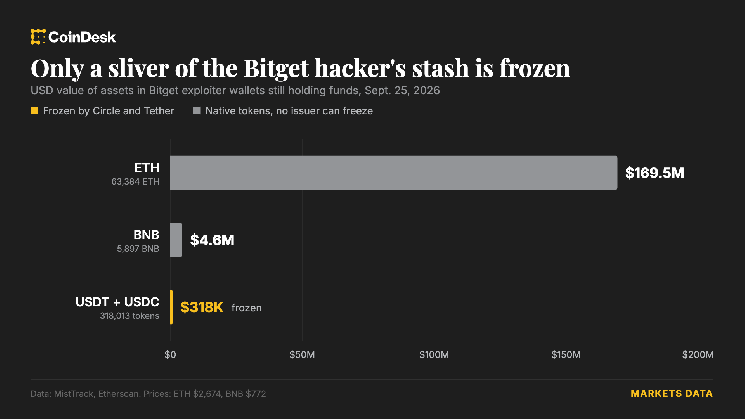
    • Circle and Tether froze approximately $318,000 in stablecoins (218,023 USDT and 99,990 USDC) held in a wallet labeled “Bitget Exploiter 8” on Etherscan, linked to Thursday’s $351.6 million Bitget exchange hack.
    • The frozen assets represent a small fraction of the total haul; blockchain analytics firm MistTrack confirms other exploiter addresses still hold over 63,000 ETH (valued at roughly $200 million+), which no issuer can freeze because they are native ether, not permissioned stablecoins.
    • Bitget CEO Gracy Chen stated the breach stemmed from a compromised backend system in the exchange’s wallet infrastructure that allowed attackers to spoof transaction data and trigger the authorization process, ruling out a private key compromise. She confirmed the exchange’s $464 million user protection fund covers the loss.

    Rapid Stablecoin Freeze by Circle and Tether

    Circle moved swiftly to blacklist the Ethereum address tagged as “Bitget Exploiter 8” at 05:00 UTC on Friday, according to onchain data. The wallet contained 170.47 ETH, 218,023 USDT, and 99,990 USDC at the time of the freeze. Blockchain security firm MistTrack reported that Tether subsequently banned the same wallet, effectively immobilizing the USDT and USDC balances—totaling roughly $318,000. While the action demonstrates the ability of centralized stablecoin issuers to intervene when funds hit permissioned tokens, the vast majority of the stolen assets remain in ether, which operates without a central freeze mechanism.

    Breach Mechanics: Backend Compromise, Not Private Key Theft

    Bitget CEO Gracy Chen provided a technical post-mortem, explaining that attackers compromised a backend system in the exchange’s wallet infrastructure, spoofed transaction data and triggered its authorization process to move funds out. Chen explicitly ruled out a private key compromise, distinguishing this incident from typical hot-wallet private key thefts. She added that Bitget’s user protection fund, which holds over $464 million, covers the loss, aiming to reassure users that deposits remain fully backed.

    Contrast with April’s Drift Protocol Incident

    The response stands in sharp contrast to Circle’s handling of the April $285 million Drift hack, where the attacker moved about $232 million in USDC from Solana to Ethereum using Circle’s own cross-chain transfer protocol. At the time, critics including onchain investigator ZachXBT argued Circle could have moved faster to blacklist wallets and freeze funds. Circle maintained that it freezes assets when legally required, underscoring the regulatory and procedural constraints that govern stablecoin issuers’ intervention policies.

    Why This Matters

    The Bitget hack highlights the persistent vulnerability of centralized exchange infrastructure—specifically backend authorization layers—even when private keys remain secure. It also illustrates the asymmetric power of stablecoin issuers: they can neutralize a portion of stolen funds once they touch USDC or USDT, but they have no control over native assets like ETH. For the broader crypto market, the incident reinforces the importance of exchange solvency reserves and user protection funds, while reigniting debate over the speed and transparency of stablecoin freeze decisions in the absence of uniform legal mandates.

    Frequently Asked Questions

    How much of the stolen $351.6 million has been frozen?
    Only about $318,000—comprising 218,023 USDT and 99,990 USDC—has been frozen. The remaining assets, primarily over 63,000 ETH held in other exploiter wallets, cannot be frozen by any issuer.
    What caused the Bitget security breach?
    According to CEO Gracy Chen, attackers compromised a backend system in the exchange’s wallet infrastructure, spoofed transaction data, and triggered the authorization process to withdraw funds. A private key compromise was explicitly ruled out.
    Will Bitget users lose funds?
    Bitget says no. The exchange’s user protection fund holds over $464 million, which CEO Gracy Chen confirmed is sufficient to cover the entire $351.6 million loss.
  • Tether Confirms Minimal EQIBank Exposure After $89M US Asset Seizure

    Tether Confirms Minimal EQIBank Exposure After $89M US Asset Seizure

    Key Highlights

    • Tether confirms exposure to EQIBank is less than 0.034% of total group assets, approximately $64 million based on its June 2024 attestation of $187.75 billion.
    • U.S. authorities seized funds from Capstone, a payment processor used by EQIBank to move customer money through Wells Fargo and JPMorgan Chase accounts, alleging misrepresentation of business activities.
    • Tether states it had no knowledge of the alleged conduct by Capstone cited in the Department of Justice civil forfeiture case.

    Tether Limits EQIBank Exposure Amid U.S. Asset Seizure

    Stablecoin issuer Tether has moved to reassure markets regarding its exposure to EQIBank, a Dominica-licensed lender caught in a U.S. law enforcement action. According to a company spokesperson, assets held at EQIBank represent less than 0.034% of Tether’s total group assets. Based on the firm’s June 2024 attestation reporting $187.75 billion in consolidated assets, that percentage translates to roughly $64 million at risk. The disclosure comes after reports by the Financial Times and The Information detailed a U.S. asset seizure that could potentially force EQIBank into liquidation.

    Capstone Payment Processor at Center of Civil Forfeiture Case

    The regulatory action centers on Capstone, a U.S.-based payment processor that EQIBank utilized to hold funds and facilitate customer money movements through correspondent banking accounts at Wells Fargo and JPMorgan Chase. Court filings indicate that U.S. prosecutors seized funds from those Capstone accounts and filed a civil forfeiture complaint. The Department of Justice alleges that Capstone misrepresented the nature of its business to the banking institutions involved, a characterization that triggered the enforcement action and the subsequent freezing of assets flowing through the processor’s channels.

    Tether Denies Prior Knowledge of Alleged Misconduct

    In a statement provided to CoinDesk, a Tether spokesperson explicitly distanced the company from the allegations facing Capstone. “Tether had no knowledge of the conduct by Capstone alleged by the Department of Justice,” the spokesperson said via email. The company further clarified that its assets held at EQIBank were limited to “less than 0.034% of the assets of the group,” though it declined to specify the exact dollar figure. The response underscores Tether’s effort to contain reputational fallout as the stablecoin giant navigates heightened scrutiny over its reserve composition and banking partnerships.

    Why This Matters

    The episode highlights the persistent counterparty and banking-layer risks inherent in the stablecoin ecosystem, even for the largest issuer by market capitalization. Tether’s reserve attestations have historically shown a mix of cash, Treasury bills, and other assets held across a network of global financial institutions. The EQIBank situation illustrates how enforcement actions against second- or third-tier payment processors—entities often invisible to end users—can create sudden liquidity constraints for custodial partners. For the broader digital asset industry, the case reinforces regulatory focus on the “on-ramp/off-ramp” infrastructure connecting crypto markets to the traditional financial system, particularly regarding anti-money laundering compliance and know-your-customer obligations at the payment processor level. Market participants will likely monitor whether other stablecoin issuers disclose similar exposures and how EQIBank’s potential liquidation proceedings unfold in the coming weeks.

    Frequently Asked Questions

    How much money does Tether have at risk in EQIBank?
    Based on Tether’s June 2024 group asset figure of $187.75 billion and the disclosed exposure limit of less than 0.034%, the at-risk amount is approximately $64 million. Tether has not provided an exact dollar amount.
    What triggered the U.S. seizure of funds connected to EQIBank?
    The U.S. Department of Justice seized funds from accounts held by Capstone, a payment processor used by EQIBank, at Wells Fargo and JPMorgan Chase. Prosecutors filed a civil forfeiture case alleging Capstone misrepresented its business activities to those banks.
    Did Tether know about Capstone’s alleged misconduct?
    No. A Tether spokesperson stated explicitly: “Tether had no knowledge of the conduct by Capstone alleged by the Department of Justice.”
  • Ethereum Exchange Supply Hits Record Low, Fueling ETH Price Speculation

    Ethereum Exchange Supply Hits Record Low, Fueling ETH Price Speculation

    Key Highlights

    • Ethereum exchange reserves have fallen to a historic low of 3.49% of total supply, with 1.16% withdrawn since June 1, according to Santiment data.
    • Approximately 35% of ETH is now staked, while decentralized finance (DeFi) protocols absorb significant additional supply, reducing centralized exchange liquidity.
    • Analysts caution that declining exchange balances alone do not guarantee price appreciation, as staking withdrawals or renewed exchange deposits could quickly reverse the supply dynamic.

    Ethereum Exchange Supply Hits Record Low Amid Staking and DeFi Migration

    On-chain analytics provider Santiment reports that the percentage of Ethereum (ETH) held on centralized cryptocurrency exchanges has dropped to just 3.49% of the total circulating supply, marking the lowest level recorded. The data reveals that an amount equivalent to 1.16% of the entire ETH supply has been withdrawn from trading platforms since June 1, signaling a sustained shift away from custodial holdings. This decline follows a volatile period for the asset: after breaking its 2021 all-time high in August 2025, ETH experienced a sharp correction in 2026, falling to price levels around $1,500.

    Staking and DeFi Drive Structural Supply Shift

    The migration of ETH off exchanges is not solely driven by holder sentiment. Santiment highlights that staking and decentralized finance (DeFi) activity play a major role in the supply redistribution. Approximately 35% of all ETH is currently staked, locking those tokens into the network’s consensus mechanism rather than leaving them available for immediate sale on centralized venues. Additional supply is deployed across DeFi protocols for lending, borrowing, and yield generation, further reducing the float accessible on traditional order books. This structural relocation means a growing portion of ETH is utilized within blockchain-native applications instead of sitting on exchange wallets.

    Price Implications: Sensitivity Over Certainty

    A shrinking exchange reserve typically indicates a reduction in the immediately available sell-side supply, which can amplify price movements during periods of strong buying pressure. With fewer coins on order books, large market orders may produce more pronounced price swings. However, Santiment and market observers emphasize that low exchange balances should not be interpreted as an outright bullish signal. The liquid supply can rebound rapidly if stakers unstake en masse, DeFi positions are liquidated, or holders redeposit funds to exchanges to capture profits or hedge risk. Consequently, the trajectory of ETH price depends on the interplay between exchange flows, staking participation rates, DeFi utilization, and fresh demand entering the market.

    Why This Matters

    The ongoing decline in Ethereum exchange reserves reflects a maturation of the asset’s holder base and infrastructure. As staking becomes mainstream — reinforced by the Shanghai and subsequent upgrades enabling withdrawals — and DeFi ecosystems deepen, the traditional metric of exchange supply loses some of its predictive power for short-term price action. Investors and analysts must now monitor a broader dashboard: validator queue dynamics, liquid staking token (LST) adoption, DeFi total value locked (TVL), and net exchange flows in concert. The current 3.49% exchange supply ratio represents a multi-year low, but the market’s next directional move will hinge on whether new demand absorbs the illiquid supply or whether latent supply re-enters centralized venues.

    Frequently Asked Questions

    What percentage of Ethereum supply is currently on exchanges?

    According to Santiment, only 3.49% of the total Ethereum supply is held on centralized exchanges as of the latest data, the lowest level on record.

    Why is ETH leaving exchanges if the price fell to $1,500 in 2026?

    The outflow is driven primarily by structural factors: approximately 35% of ETH is staked for network security, and significant additional supply is deployed in DeFi protocols. These movements are largely independent of short-term price action.

    Does low exchange supply guarantee ETH price will rise?

    No. While reduced exchange reserves can increase price sensitivity to buying pressure, supply can return to exchanges quickly through staking withdrawals, DeFi liquidations, or holder deposits. Price direction depends on the balance of all supply sources and demand.

  • Whitehats Rescue $5.7 Million in NFTs After Limit Break Payment Processor Exploit

    Whitehats Rescue $5.7 Million in NFTs After Limit Break Payment Processor Exploit

    Key Highlights

    • Limit Break’s Payment Processor V2 was exploited at 9 AM EST on September 25, 2026, resulting in the theft of 10 Meebits, 50 Otherdeeds, 10 World of Women NFTs, and 235 Desperate ApeWives before a whitehat operation rescued 23,155 NFTs valued at over $5.7 million.
    • The vulnerability extended to ApeChain assets approved to Payment Processor V3, while a related exploit left 660 WETH at risk and unrecovered.
    • Magic Eden confirmed it discontinued Payment Processor V2 in October 2024 and shut down its EVM marketplace in Q1 2026, stating no live listings were affected, but urged users who listed NFTs between February and October 2024 to revoke “approved for all” permissions.

    Exploit Discovery and Initial Impact

    The security incident came to light through a public disclosure by 0xQuit, known publicly as Quit, the pseudonymous vice president of blockchain at Yuga Labs. In a post on X at 9 AM EST on September 25, 2026, Quit detailed the attack timeline:

    At 9AM EST today somebody abused a bug in Payment Processor V2 to steal 10 Meebits, 50 Otherdeeds, 10 WoW, and 235 Desperate Apewives.
    It wasn’t until over 12 hours later that somebody reported it to me, and upon digging in I realized that a great many NFTs were subject to the…

    According to Quit, the exploit remained undetected for more than 12 hours before being reported. Upon investigation, researchers determined that the vulnerability affected a far broader set of NFT collections than initially compromised. The stolen assets included high-profile collections: Meebits, Otherdeeds (Otherside metaverse land deeds), World of Women (referenced as “WoW” in the tweet), and Desperate ApeWives.

    Whitehat Rescue Operation and Scope of Vulnerability

    Limit Break responded by immediately pausing Payment Processor V3 after being alerted to the vulnerability. However, Payment Processor V2 could not be paused due to its architectural design, necessitating a whitehat rescue operation to move affected assets to safety. The operation ultimately secured 23,155 NFTs with a combined value exceeding $5.7 million.

    The investigation revealed that a similar vulnerability existed on ApeChain, where some assets that had approved Payment Processor V3 also required emergency securing. Additionally, researchers identified a related exploit vector that could be used to steal WETH (Wrapped Ether). As of the disclosure, 660 WETH remained at risk and had not been recovered.

    Magic Eden’s Response and User Guidance

    Magic Eden issued a statement clarifying its exposure to the vulnerability. The marketplace confirmed it stopped using Payment Processor V2 in October 2024 and subsequently shut down its EVM marketplace in the first quarter of 2026. The company emphasized that no live Magic Eden listings were affected by the exploit.

    However, Magic Eden warned that NFTs listed on its EVM platform between approximately February and October 2024 may still be exposed to the vulnerability. The marketplace urged affected users to revoke “approved for all” permissions granted during that period to mitigate ongoing risk.

    Why This Matters

    This incident underscores persistent smart contract risks in NFT infrastructure, particularly in permissioned approval systems like “setApprovalForAll” that grant broad spending authority. The fact that Payment Processor V2 could not be paused highlights a critical design limitation in upgradeable contract architectures where older versions remain immutable and operational. The 12-hour detection gap also reveals monitoring gaps in high-value asset protocols. With 660 WETH still at risk from a related vector, the situation remains active. Marketplaces like Magic Eden discontinuing legacy processors reduces surface area, but historical approvals create long-tail exposure requiring user action. The cross-chain impact on ApeChain demonstrates how shared infrastructure vulnerabilities can cascade across ecosystems.

    Frequently Asked Questions

    Which NFT collections were initially stolen in the Payment Processor V2 exploit?

    The initial theft involved 10 Meebits, 50 Otherdeeds, 10 World of Women NFTs, and 235 Desperate ApeWives, as reported by 0xQuit (Quit) of Yuga Labs.

    Can users still protect assets that were listed on Magic Eden’s EVM marketplace in 2024?

    Yes. Magic Eden advises users who listed NFTs on its EVM platform between approximately February and October 2024 to revoke any “approved for all” permissions granted during that period to mitigate exposure.

    What is the status of the 660 WETH at risk from the related exploit?

    As of the disclosure, the 660 WETH remains at risk and has not been recovered. The related exploit vector is distinct from the primary Payment Processor V2 vulnerability but was identified during the same investigation.