Key Highlights
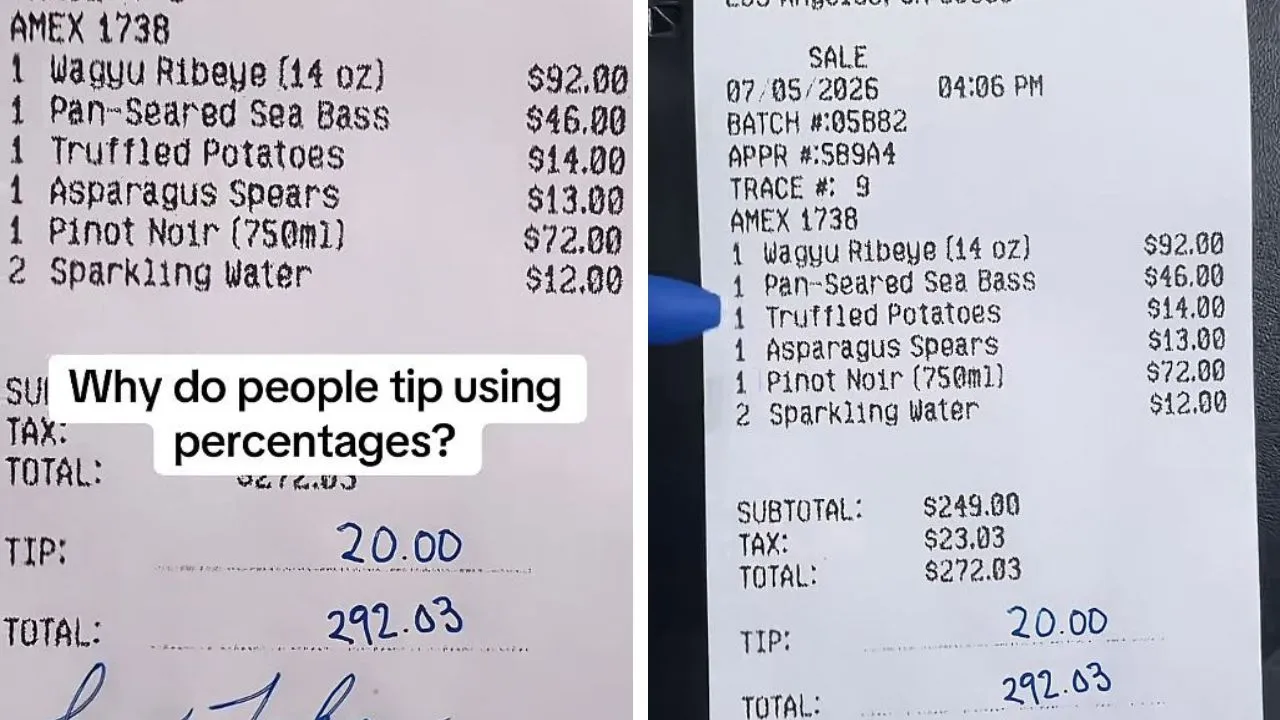
- TikTok creator @captain.t.roll posted a receipt from Ember & Vine in Los Angeles showing a $249 subtotal and a handwritten $20 tip, sparking a viral debate over tipping norms.
- The creator argues tipping should be a flat dollar amount based on service effort, not a percentage of the bill, stating the industry has “brainwashed” diners into treating 20% as mandatory.
- Commenters were divided, with some calculating a 20% tip would equal $58 ($50/hour for the server), while a self-identified cook criticized servers for expecting large tips while kitchen staff endure harder conditions.
TikTok Receipt Ignites Debate Over Percentage-Based Tipping Culture
A viral TikTok posted by user @captain.t.roll has reignited a heated conversation about American tipping customs after the creator shared a receipt from Ember & Vine, a restaurant in Los Angeles. The bill showed a subtotal of $249 for a meal that included a wagyu ribeye, pan-seared sea bass, truffled potatoes, asparagus spears, and a bottle of Pinot Noir. After tax, the total reached $272.03, and the diner added a handwritten tip of $20, bringing the final amount to $292.03. As of publication, the video had amassed more than 43,600 likes, 8,000 comments, and 6,700 shares, according to The Daily Dot.
Creator Argues Service Effort Does Not Scale With Menu Prices
In the video, @captain.t.roll challenged the prevailing expectation that tips should be calculated as a fixed percentage of the total bill. He argued that diners have been “brainwashed by the restaurant industry” into treating 20 percent as a mandatory standard rather than a voluntary gesture. The creator explained that he calculates tips based on the subtotal, not the post-tax total, and that his $20 tip represented less than 10 percent of the $249 subtotal. He maintained that this logic applies universally, whether dining at a fast-casual establishment or a higher-end venue like Ember & Vine, because the physical service—carrying food from the kitchen to the table—remains the same regardless of the restaurant’s pricing tier.
The TikToker further contended that a higher-priced dish does not require additional labor from the server. “Any added value tied to a more expensive dish belongs to the kitchen staff who prepared it, not the person delivering it,” he stated, adding that his $20 tip equated to $20 an hour if his table was the only one served during that period. He pushed back against the notion that tipping norms are immutable, asserting that diners are free to set their own standard for what constitutes appropriate compensation for table service.
Comment Section Erupts With Competing Calculations and Perspectives
The comment section quickly became a forum for competing arithmetic and ideological positions. One commenter calculated that a 20 percent tip on the $292 total would amount to $58, remarking that the server “just made $50 an hour to carry out food to you.” Another user agreed with the creator’s premise, arguing that a $75 bottle of wine requires the same effort to serve as a $20 bottle, and therefore the tip should remain consistent rather than fluctuate with the menu price.
A commenter identifying as a cook introduced a different dimension to the debate, criticizing the focus on server compensation while kitchen staff labor under more difficult conditions. The commenter wrote that servers expecting large tips ignore kitchen workers who are “sweating hot standing getting yelled at having to cook” while servers wait on tables and use their phones between orders. The Daily Dot noted it was unable to independently verify the identity of the customer in the video, the server involved, or the accuracy of the receipt shown, and emphasized that the details reflect the creator’s account and commenters’ opinions as shared on TikTok.
Why This Matters
The viral spread of this receipt underscores a growing cultural friction point in the United States: the expanding expectation of tipping across more service categories and at higher percentage thresholds, often termed “tipflation.” As menu prices rise with inflation, percentage-based tipping automatically increases server earnings without a corresponding increase in service labor, fueling arguments that the model is outdated. Simultaneously, the disparity between front-of-house and back-of-house compensation remains a structural issue in the restaurant industry, with kitchen staff often earning significantly less than servers who receive tips. The debate touches on broader questions about wage fairness, the responsibility of employers versus customers to compensate workers, and whether social pressure has transformed a voluntary gratuity into a de facto mandatory surcharge.
Frequently Asked Questions
What was the total bill and tip amount shown in the viral TikTok?
The receipt from Ember & Vine in Los Angeles showed a subtotal of $249, a total of $272.03 after tax, and a handwritten tip of $20, bringing the final total to $292.03.
What is the creator’s argument against percentage-based tipping?
@captain.t.roll argues that tipping should be a flat dollar amount reflecting the labor of service, which does not change based on menu prices. He calculates tips on the subtotal, not the post-tax total, and believes diners have been “brainwashed by the restaurant industry” into treating 20% as mandatory.
Has the receipt or the identities involved been verified?
The Daily Dot reported it was unable to independently verify the identity of the customer in the video, the identity of the server, or the accuracy of the receipt shown. The details reflect the creator’s account and commenters’ opinions as shared on TikTok.
Leave a Reply