Tag: Zcash

  • Chinese Whale May Have Made Another Large Altcoin Purchase as Token Surges

    Chinese Whale May Have Made Another Large Altcoin Purchase as Token Surges

    Key Highlights:

    • Garret Jin accumulated 202,080 ZEC worth approximately $88.3 million in December 2024; holdings now valued near $320 million as ZEC trades at $1,580.
    • The investor moved the full stack into Zcash shielded addresses before returning funds to transparent addresses within minutes, keeping all 202,080 ZEC under single-wallet control.
    • A concurrent short position of roughly 38,000 ZEC on Hyperliquid (current notional ~$60 million) carries a $34.5 million unrealized loss, functioning as a partial hedge against the much larger spot exposure.

    Whale Accumulation: December 2024 Withdrawals from Binance and Zcash

    Blockchain data and a screenshot shared by Garret Jin on X reveal a coordinated accumulation of Zcash ($ZEC) in late December 2024. On December 24, a wallet linked to Jin withdrew 68,080 ZEC from Binance when the asset traded near $436, valuing that tranche at roughly $29.7 million. Minutes earlier, the same wallet pulled 134,000 ZEC directly from the Zcash network, worth approximately $58.6 million at prevailing prices. Combined, the two transactions delivered 202,080 ZEC into a single address with a total cost basis near $88.3 million.

    Shielded Address Activity and Rapid Return to Transparency

    On-chain records show Jin subsequently moved the entire 202,080 ZEC balance into Zcash shielded addresses, leveraging the protocol’s zero-knowledge privacy feature. However, the assets were transferred back to transparent addresses within minutes, and the full position has remained in that wallet continuously since. The brief shielding event did not obscure the ultimate ownership or aggregate size of the holding, which remains publicly verifiable on transparent addresses.

    Price Surge Lifts Paper Gain to $232 Million

    With ZEC appreciation to $1,580, the spot position has swelled to an estimated $320 million in current market value. That translates to an unrealized dollar-denominated gain of approximately $232 million against the December acquisition cost. The magnitude of the appreciation underscores the volatile upside potential in privacy-focused crypto assets during broader market rallies.

    Hyperliquid Short Position Acts as Partial Hedge

    Simultaneously, Jin maintains a short position of roughly 38,000 ZEC on the decentralized perpetuals exchange Hyperliquid. At current prices, the short carries a notional value near $60 million and an unrealized loss of about $34.5 million. Analysts interpret the short as a deliberate hedge: should ZEC decline, profits on the perpetual contract would offset a portion of the spot drawdown, while the net exposure remains strongly long given the 202,080 ZEC spot holding versus the 38,000 ZEC short.

    Why This Matters

    The episode highlights how sophisticated participants manage concentrated positions in lower-liquidity privacy coins. Zcash’s dual address architecture—transparent and shielded—allows large holders to test privacy features without relinquishing auditability, a dynamic relevant for regulators and compliance teams monitoring anti-money-laundering (AML) risks. Meanwhile, the use of Hyperliquid for on-chain perpetual hedging demonstrates the growing role of decentralized derivatives venues in institutional-scale risk management. Market observers should watch whether the short position is adjusted, expanded, or closed as ZEC price action evolves, as changes could signal shifting conviction or risk appetite from one of the asset’s largest identifiable holders.

    Frequently Asked Questions

    Who is Garret Jin?

    Garret Jin is a pseudonymous cryptocurrency investor who publicly shares on-chain activity via his X (formerly Twitter) account. He is known for sizable positions in privacy-focused assets and for utilizing decentralized derivatives platforms such as Hyperliquid for hedging.

    Why did the ZEC move to shielded addresses and then back so quickly?

    The brief transfer to Zcash shielded addresses likely served as a functional test of the network’s privacy features or a tactical step for transaction privacy. Returning to transparent addresses within minutes kept the full balance visible on-chain, preserving verifiability of the total holding size.

    How does the Hyperliquid short position hedge the spot holding?

    The short position of ~38,000 ZEC represents roughly 19% of the 202,080 ZEC spot stack. If ZEC falls, gains on the short partially compensate for losses on the much larger long position, reducing net downside exposure while maintaining a predominantly bullish directional bet.

  • Bitcoin Bounces as Markets Brace for the Fed’s Next Move

    Bitcoin Bounces as Markets Brace for the Fed’s Next Move

    Key Highlights

    • The Federal Reserve raised its benchmark interest rate by 25 basis points to 3.75%–4% on a unanimous 12–0 vote, marking the first hike since July 2023.
    • Bitcoin held near $76,300, largely unmoved by the decision, while the broader crypto market capitalization stabilized around $2.63 trillion.
    • Zcash (ZEC) surged up to 23% to a multi-year high near $1,425 after Paradigm co-founder Matt Huang disclosed his firm’s stake, calling it “a private complement to Bitcoin.”

    Fed Delivers Expected Hike; Crypto Markets Absorb Move With Composure

    Bitcoin traded sideways near $76,300 on Thursday, showing remarkable resilience a day after the Federal Reserve executed its first interest rate increase since July 2023. The Federal Open Market Committee lifted the federal funds rate by 25 basis points to a target range of 3.75% to 4%, a decision backed by all 12 voting members. Heading into the announcement, CME’s FedWatch tool indicated traders had priced in a 93% probability of the move, which helped mute immediate volatility across digital asset markets.

    While traditional markets reacted more sharply—the Dow Jones Industrial Average fell roughly 1.2% and the S&P 500 declined 0.4% to 0.5% on Wednesday—cryptocurrency prices steadied by Thursday morning. The 10-year Treasury yield, which had breached 5% earlier in the week for the first time since 2007, retreated slightly, and equity futures turned positive. Oil prices also pulled back from highs above $100 a barrel driven by the Israel–Iran conflict. These developments eased the dual headwind of a stronger dollar and higher risk-free yields that typically pressure non-yielding assets like Bitcoin and gold.

    Zcash Breaks Out on Paradigm Endorsement and Privacy Narrative

    While major tokens traded in tight ranges, Zcash (ZEC) erupted as much as 23% to trade near $1,425, hitting a multi-year high. The catalyst came after Paradigm co-founder Matt Huang disclosed on X that his venture firm holds a position in ZEC and has invested in the Zcash Open Development Lab. Huang called Zcash “a private complement to Bitcoin” and argued its inflation-funded developer fund deserves continued backing as AI-driven cyber threats and quantum computing advance.

    The rally extends a powerful run for the privacy-focused cryptocurrency. ZEC has gained approximately 160% over the past month, vastly outperforming Bitcoin’s 18.2% climb in the same period, and is up nearly 3,000% over the trailing 365 days. In May, Multicoin Capital’s Tushar Jain revealed a position built since February, describing the token as “the cleanest way” to express a privacy thesis rooted in wealth-seizure fears. Those disclosures have helped make Zcash the standout performer among the top 10 cryptocurrencies by market capitalization this week.

    Broader Market Context: Liquidations, Legislative Setback, and Sentiment Shift

    Elsewhere in the top 50, gains were more modest. BNB traded near $724 (up 2%), Solana held just above $100 for a 3.3% increase, and XRP lagged at $1.29—up 2% on the day but still down more than 6% for the week. XRP’s weekly decline followed the failure of the crypto Clarity Act to secure a Senate cloture vote days earlier. The legislation would have legalized most crypto activity in the United States and provided more meaningful regulatory clarity for altcoins such as Solana and XRP than for Bitcoin, which is widely recognized to occupy a distinct regulatory category.

    Leveraged positions felt the pressure as prices ground higher into the rate decision. Roughly $373 million in crypto liquidations hit the market over 24 hours, with short positions accounting for the larger share. Sentiment indicators reflect the cooling enthusiasm: the Crypto Fear and Greed Index read 50, exactly in “neutral” territory, a significant drop from the “extreme greed” readings recorded just three weeks ago.

    Why This Matters

    The Fed’s latest hike signals that the central bank remains vigilant on inflation despite growing risks to economic growth. The median “dot plot” projection places the federal funds rate at 4.1% by the end of 2026, leaving room for one more quarter-point move this cycle. The next FOMC meeting is scheduled for October 27–28, and markets will closely parse incoming labor and inflation data for clues on whether that final hike materializes.

    For crypto, the relatively muted reaction suggests the rate path was well-telegraphed and that the market is increasingly focused on idiosyncratic catalysts—such as the privacy narrative driving Zcash—rather than macro surprises. The failure of the Clarity Act underscores that regulatory uncertainty remains a persistent overhang for altcoins, even as Bitcoin continues to decouple from traditional risk assets in the eyes of some investors. With the Fear and Greed Index resetting to neutral, the stage is set for the next directional move to be driven by either a macro shock or a breakthrough in protocol-level adoption.

    Frequently Asked Questions

    How did Bitcoin react to the Fed’s rate hike?

    Bitcoin briefly touched $76,499 after the announcement before settling near $76,300, roughly flat on the day. The muted response reflects the fact that traders had priced in a 93% probability of the 25-basis-point increase, per CME’s FedWatch tool.

    Why did Zcash (ZEC) surge while other cryptocurrencies were flat?

    Zcash jumped as much as 23% after Paradigm co-founder Matt Huang disclosed his firm’s stake and investment in the Zcash Open Development Lab. Huang called ZEC “a private complement to Bitcoin”, and the token has benefited from a growing privacy narrative amid concerns over AI-driven cyber threats and quantum computing.

    What is the Fed’s projected rate path and next meeting date?

    The Fed’s median projection sees the federal funds rate at 4.1% by the end of 2026, implying one more potential quarter-point hike. The next FOMC meeting is scheduled for October 27–28.

  • Zcash Aims to Burn Fees, Recycle Them Into Miner Rewards

    Zcash Aims to Burn Fees, Recycle Them Into Miner Rewards

    Zcash Advances Network Sustainability Mechanism for NU7 Upgrade

    The Network Sustainability Mechanism (NSM) proposal is gaining momentum on the Zcash network as a core component of the upcoming NU7 upgrade. This protocol redesign removes a portion of $ZEC from active circulation through transaction fees and recycles that value into future validator rewards, marking a departure from the traditional token-burning model that permanently destroys digital assets.

    NSM Core Proposal: Solving the Security Budget Crisis

    The NSM proposal defines the deployment parameters for Zcash’s NU7 upgrade and has attracted support for addressing the network’s long-standing “security budget” crisis. By routing 60% of transaction fees into a secondary protocol reserve, the mechanism establishes a permanent capital pool designed to sustain block subsidies over time. This structure decouples network security from the volatility of daily fee markets, providing predictable funding for validators regardless of short-term demand fluctuations.

    Beyond economic stability, the upgrade positions $ZEC as a differentiated asset signaled for multi-decade durability. The proposal also lays technical groundwork for a potential future transition to a Proof-of-Stake (PoS) consensus algorithm, while satisfying community governance requirements without expanding the token supply.

    A Circular Strategy: Recycling Value Instead of Burning

    Zcash’s NSM introduces a multi-pronged approach to counter the long-term decline of block subsidies:

    • Value recycling replaces permanent token destruction with a reserve-and-redistribution model.
    • Issuance smoothing prevents hashrate shocks by storing fee revenue during high-traffic periods and releasing it gradually during extended bear markets.
    • Security decoupling insulates validator incentives from speculative fee volatility.

    Under this design, the protocol accumulates fees during network congestion and smoothly pays out the stored capital to validators when fee revenue drops, ensuring consistent security funding across market cycles.

    Hard Cap Preserved: No New Token Minting

    Despite the protocol alterations, Zcash’s maximum hard cap of 21 million $ZEC remains unchanged. The NSM does not authorize new coin creation. Instead, it withdraws already-minted $ZEC from active circulation into a reserve pool, temporarily reducing the circulating supply. Those same coins are then slowly re-issued to validators over time, maintaining the fixed supply ceiling while improving token velocity dynamics.

    Block Time Slashed to 25 Seconds for Faster Finality

    A complementary core decision approved alongside the NSM for NU7 reduces the target block time from 75 seconds to 25 seconds. This tripling of block production speed fundamentally transforms the network’s user experience and operational profile.

    Benefits for Exchanges, Merchants, and Wallets

    The faster block interval delivers several practical advantages:

    • Improved finality: Transactions reach irreversible confirmation significantly faster, helping exchanges and merchants mitigate chain reorganization risk.
    • Responsive wallet experience: Balance updates and transaction confirmations occur three times faster, reducing user anxiety during retail and peer-to-peer payments.
    • Modern network feel: The shift moves Zcash from a deliberate, slower transactional model to a highly responsive chain aligned with current user expectations for speed.

    Looking Ahead: NU7 as a Foundation for Long-Term Viability

    Together, the NSM’s economic redesign and the block time reduction form a cohesive upgrade package aimed at securing Zcash’s relevance for decades. By recycling fee value, preserving the hard cap, and accelerating throughput, the NU7 upgrade addresses structural challenges in security funding, tokenomics, and usability—positioning the protocol for a sustainable, competitive future.

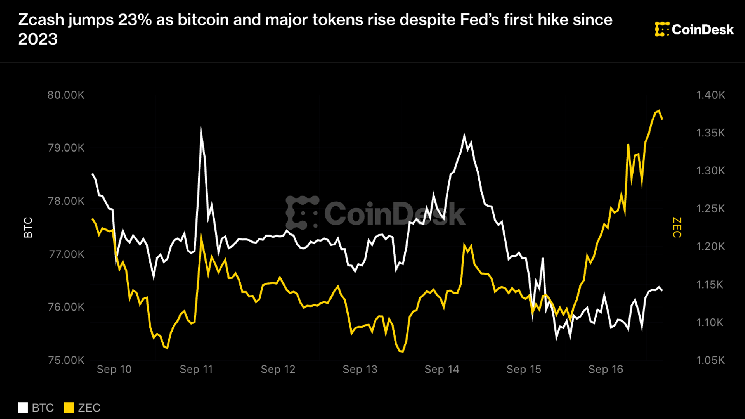
  • Zcash Surges 23% as Bitcoin, Major Tokens Rally Despite Fed’s First Rate Hike Since 2023

    Zcash Surges 23% as Bitcoin, Major Tokens Rally Despite Fed’s First Rate Hike Since 2023

    Privacy-focused cryptocurrency Zcash (ZEC) surged 23% over the past 24 hours, leading gains across major digital assets as Bitcoin and the broader crypto market rallied overnight into Asian trading hours Thursday. The move coincided with a recovery in U.S. stock futures following the Federal Reserve’s first interest-rate increase since 2023.

    Market Snapshot: ZEC Leads, Bitcoin Holds Near $76K

    At the time of writing, ZEC traded near $1,369, significantly outperforming the market. Bitcoin edged up less than 1% to approximately $76,258, while Solana (SOL) gained nearly 3% to just below $100. BNB and HYPE, the native token of the crypto trading platform Hyperliquid, each added more than 2%. Ether (ETH), XRP, and Dogecoin (DOGE) posted gains between 1% and 2%.

    Paradigm Co-Founder Highlights Zcash as Bitcoin Privacy Complement

    The sharp rally in ZEC followed public comments from Matt Huang, co-founder of prominent crypto investment firm Paradigm. In a post on X, Huang discussed Zcash’s role as a privacy layer for Bitcoin and disclosed that his firm holds a position in the token.

    “a private complement to Bitcoin.”

    Huang, whose firm owns ZEC, described the protocol as “a private complement to Bitcoin.” He expressed support for continued funding of Zcash’s core developers while advocating that governance votes by coin holders should be combined with other decision-making mechanisms for network upgrades.

    Zcash Governance and Monetary Policy in Focus

    Zcash enables users to transact without publicly revealing sender, recipient, or transaction amounts. Its community recently backed proposals aimed at accelerating payment speeds while maintaining the protocol’s scheduled reductions in new coin issuance—a disinflationary feature shared with Bitcoin’s halving cycle.

    The convergence of positive macro tailwinds, high-profile institutional endorsement, and ongoing protocol improvements appears to be driving renewed investor interest in privacy-preserving digital assets.

  • Zcash holders overwhelmingly back faster transactions and bitcoin-style halvings

    Zcash holders overwhelmingly back faster transactions and bitcoin-style halvings

    Zcash Ironwood Upgrade Introduces Private On-Chain Governance with Shielded Voting

    Only $ZEC held in Ironwood—Zcash’s newest private transaction pool—was eligible to participate in the latest governance vote. The mechanism leverages the network’s shielded architecture to verify that coins exist and are spent correctly without publicly revealing wallet balances or transaction details.

    “Shielded” simply means the blockchain can verify that the coins exist and are being spent correctly without publicly showing the wallet balance or the details of the transaction.

    That privacy extends directly into the voting process. In a typical token-weighted vote, a wallet casting 500,000 votes effectively announces to the world that it controls 500,000 tokens and which side it supported. Zcash’s system allows that economic weight to count without publishing the holder’s balance or identity alongside their choice.

    How Shielded Voting Works

    Ballots were encrypted and split into 16 separate pieces before being counted. Validators could aggregate the final result without being able to reconstruct which holder cast which vote or how much $ZEC that person controlled. In practical terms, holders could use their actual economic stake to vote on Zcash’s monetary policy and technical roadmap while keeping the size of that stake hidden.

    Significant Increase Over Previous Governance Participation

    This represents a major jump from Zcash’s earlier coinholder polling. February’s NU7 sentiment poll drew participation equal to just 7.25% of circulating $ZEC and exposed sharp disagreements between coinholders and Zcash’s Community Advisory Panel, known as ZCAP.

    Read More: Zcash seals $1.7 billion shielded pool as Ironwood upgrade activates

  • Crypto Sector Surges 213% Since Bitcoin’s 2025 Peak as One Coin Leads the Rally

    Crypto Sector Surges 213% Since Bitcoin’s 2025 Peak as One Coin Leads the Rally

    Privacy Coins Surge 213% Since Bitcoin’s October 2025 Peak, Led by Zcash Rally

    Privacy-focused cryptocurrencies have climbed 213% since Bitcoin’s October 2025 high, even as BTC remains significantly below that level, according to a market breakdown published today by analyst Wise Crypto. The sector’s combined market capitalization has grown from $7.1 billion a year ago to $33.6 billion currently, though the gains are heavily concentrated in a single asset.

    Zcash Dominates Privacy Sector Growth

    Zcash (ZEC) accounts for roughly 62% of the privacy category’s total market cap on its own, rising 25x over the past year. Its market-cap ranking surged from #82 to as high as #7 at one point, though CoinGecko data currently places it at #9. Glassnode data published last week corroborated the trend, finding that privacy was the only crypto sector trading above its October peak, with every other category still down by double digits.

    Grayscale’s Zcash ETF, trading under the ticker ZCSH, crossed $500 million in assets within two weeks of launch. Monero (XMR), the second-largest privacy asset, has approximately doubled over the same period despite facing delistings from several exchanges. Among the 25 largest crypto assets, Wise Crypto noted that only four — ZEC, HYPE, XMR, and WBT — are still trading above their October levels.

    Investors Highlight Diversification Beyond Major Chains

    Investor Dan Tapiero told The Wolf of All Streets on September 11 that the moves in ZEC and HYPE this cycle demonstrate crypto is no longer just a Bitcoin, Ethereum, and Solana story. “Zcash has been an enormous winner this year,” he said, pointing to broader activity building outside the three largest chains.

    A day later, Egor Sidelska of Infinex argued that privacy is one of the only parts of crypto that hasn’t already been built out and cloned across other chains, calling ZEC “the last 100x in crypto that isn’t a random meme coin.”

    Valuation Debate Continues Amid Rapid Appreciation

    Not all analysts are convinced the rally is fully justified. Analyst filbfilb recently pushed back on how far the Zcash advance can be trusted, sharing valuation models that compared ZEC’s transaction activity against Bitcoin’s at a similar stage of issuance. Those models implied a price around $944 — below current levels — though convergence scenarios place fair value much higher if Zcash continues closing the gap.

    At the time of writing, ZEC was changing hands at approximately $1,140, flat on the day but up 32% over the last two weeks and more than 2,100% over the past year. The token remains well off its 2016 all-time high near $3,190. Meanwhile, Bitcoin traded near $77,000, down just over 1% in 24 hours and about 34% over one year, leaving it roughly 39% below its own October 2025 all-time high.

  • Zcash: Will $13.65M Whale Buying Propel ZEC Price Toward $1,500?

    Zcash: Will $13.65M Whale Buying Propel ZEC Price Toward $1,500?

    Whale Accumulation Signals Strong Demand for Zcash

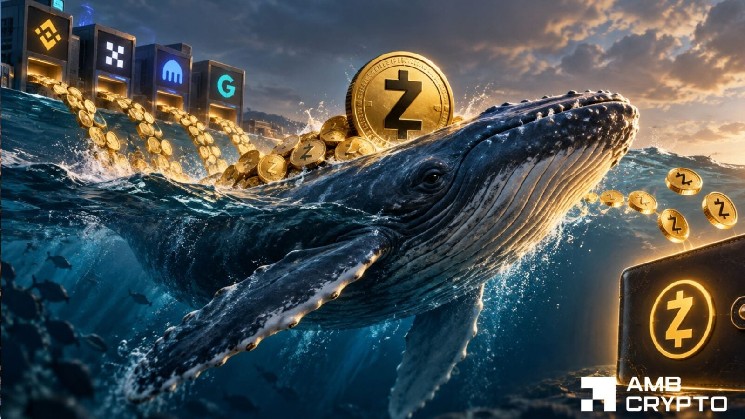
    Zcash ($ZEC) whale accumulation outlook strengthened significantly, with a $13.65 million position complementing aggressive spot-market buying throughout the latest price recovery. According to Onchain Lens, one whale accumulated roughly 12.87K $ZEC from four major exchanges over the past week.

    Notably, the purchases originated from Binance, OKX, Kraken, and Gate, reflecting accumulation across several liquidity platforms. The whale later transferred the 12.86K $ZEC into a fresh wallet, completing the broader accumulation sequence. This activity removed a sizable position off the exchanges where the whale initially acquired it. The accumulation arrived as $ZEC attempted to stabilize after its latest price pullback.

    Spot Market Buying Supports Accumulation

    Whale accumulation did not stand alone; broader spot-market activity reinforced the demand picture. The Spot Taker CVD remained taker-buy dominant, providing another demand element alongside the whale accumulation. This metric typically tracks whether aggressive market buyers or sellers control executed spot volume over a measured period.

    Buyer dominance implied that market participants increasingly crossed the spread to acquire $ZEC rather than awaiting lower prices. Crucially, such activity broadened the demand picture beyond one whale’s purchases across centralized exchanges. The whale accumulation reflected large-holder conviction, while Spot Taker CVD highlighted aggressive buying across the spot market. Combined, both developments implied that bulls actively absorbed available $ZEC during recent price volatility.

    Source: CryptoQuant

    Mining Economics Drive Network Participation

    Stronger network economics provided another support component to Zcash’s improving fundamental backdrop. Specifically, Zcash mining economics improved substantially as higher profitability attracted considerably greater network participation throughout 2026.

    According to Grayscale, Zcash miner rewards were estimated near $2 million daily, compared with roughly $35 million for Bitcoin miners. Despite the huge disparity, Zcash delivered nearly twice Bitcoin’s mining rewards per rig. Additionally, the $ZEC protocol generated around four times Bitcoin’s rewards per megawatt-hour, improving its relative energy economics. This profitability helped explain why Zcash mining activity increased by more than 250% throughout 2026. The mining-power chart showed particularly rapid expansion during the latest phase of the year, complementing demand-side developments.

    Source: X

    Elliott Wave Analysis: Wave 5 Confirmation Needed

    On the 24-hour chart at press time, Zcash’s price structure had completed four stages of a developing Elliott impulse wave sequence, with Wave (5) awaiting confirmation.

    • Wave (1) advanced towards the $850 region after breaking out of its consolidation range.
    • Wave (2) retraced towards the $813.95 support zone.
    • Wave (3) drove sharply higher, with the $ZEC price reaching the $1,295–$1,298 resistance region. This third-wave impulse remained the strongest leg, satisfying a key condition for the developing motive structure.
    • Wave (4) pulled $ZEC towards the $1,054.72 zone without overlapping the Wave (1) peak, protecting the bullish sequence.

    At press time, Zcash price had reversed to $1,138.89, as RSI cooled to 62.37 from recent overbought conditions. The five-wave cycle still needs Wave (5) confirmation. A sustained advance above the $1,295–$1,298 supply zone would strengthen that confirmation and open a path to a $1,500 possible target. Alternatively, losing the $1,054.72 support would challenge the current wave count and raise the risk of a truncated Elliott impulse wave.

    Source: TradingView

    Summary

    Whale accumulation and taker buying strengthened $ZEC’s demand during its latest recovery. Zcash’s developing Elliott impulse wave now awaits Wave 5 to confirm the bullish cycle structure.

  • Decoding Zcash’s $1.35B Leverage Flush: Can ZEC Rebound to $1,200?

    Decoding Zcash’s $1.35B Leverage Flush: Can ZEC Rebound to $1,200?

    Zcash (ZEC) entered a sharp correction after an extended rally pushed the cryptocurrency toward the $1,300 price region. At the time of reporting, ZEC had dropped 14.36% over 24 hours, erasing a portion of its recent gains following a rapid price uptrend. This decline reflects a notable shift from the strength that had recently driven ZEC toward new highs.

    Leveraged Long Liquidations Trigger Forced Selling

    The previous rally attracted considerable speculative activity, with Open Interest hitting $1.35 billion. This elevated leverage left bulls increasingly exposed once the price retreated from its highs. Lookonchain reported that two leveraged ZEC longs were fully liquidated as the token pushed lower. The whale’s combined losses totaled around $4.33 million, highlighting the scale of forced position closures.

    Historically, long liquidations usually accelerate declines since leveraged positions get automatically closed when traders fail to maintain sufficient collateral. Such forced selling likely amplified ZEC’s price correction as existing supply pressure triggered further liquidations. Removing excessive leverage could, however, limit forced selling if ZEC stabilizes and speculative positioning resets.

    Macro Pressure Compounds Overbought Correction

    The leverage flush unfolded as broader market conditions remain unfavorable for risk assets. Bitcoin, the leading cryptocurrency, has also been facing selling pressure and weakening sentiment following recent gains. ZEC entered this environment after an exceptional price advance, making profit-taking significant as the token approached the $1,300 region.

    Notably, technical conditions also seemed stretched before the reversal, with the daily Relative Strength Index (RSI) previously moving above the 75 level. This combination exposed Zcash to broader weakness after buyers struggled to extend the recent rally. However, the correction has now cooled those stretched conditions, bringing technical support areas into focus.

    ZEC Holds Key Fair Value Gap as RSI Cools

    On daily timeframe charts, Zcash swept liquidity around the $1,300 level before failing to sustain its move above the $1,245 resistance zone. The rejection resulted in a sharp price correction toward the $1,075–$1,100 fair value gap (FVG), where buyers are attempting to respond. The price has since rebounded toward the $1,099 area, suggesting the immediate support region is attracting renewed demand.

    At the time of analysis, the RSI has fallen to 63.85 after cooling from its previous overbought readings while remaining above neutral territory. On the Directional Movement Index (DMI), the +DI signal at 35.68 remained above the -DI signal at 11.80, preserving the broader bullish directional structure. Furthermore, the Average Directional Index (ADX) signal remains elevated around 56.84, showing the prevailing trend still carries substantial directional strength.

    A strong hold of the $1,075 support could encourage a recovery move toward $1,245 before another potential attempt at the $1,295 liquidity region. A breakdown below that support, however, could instead expose the lower FVG around $970 and eventually the $800 order block.

    Liquidation Pools Could Pull ZEC Toward $1,200

    The technical recovery potential aligns closely with considerable liquidation liquidity sitting above Zcash’s current market price. The 24-hour Binance Liquidation Heatmap highlights dense liquidity concentrations around the $1,180–$1,200 price zone. These clusters could likely become an upside price magnet if ZEC extends its rebound, triggering forced closures on leveraged short positions.

    A successful break through $1,200 could then expose the additional liquidity cluster around the $1,240–$1,250 area, aligning closely with technical resistance. Considerable downside liquidity also sits around $1,050, making the current FVG significant for ZEC’s next directional move.

    Outlook: $1,075 Support Determines Next Leg

    Ultimately, a successful defense of the $1,075 support would preserve a recovery path toward the overhead liquidity, while losing it would weaken that outlook.

    Key Takeaways

    • ZEC’s 14.36% correction has flushed leveraged longs after its extended rally.
    • Holding $1,075 could reopen a recovery path toward the $1,180–$1,200 liquidity zone.
  • Zcash Price Prediction 2026: Can ZEC Reach $2,200 After 2,000% Rally as MemeToro Targets AI Crypto Growth?

    Zcash Price Prediction 2026: Can ZEC Reach $2,200 After 2,000% Rally as MemeToro Targets AI Crypto Growth?

    Zcash Surges 2,000% to Multi-Year High, Fueling 2026 Price Debate

    Zcash ($ZEC) has become a focal point for cryptocurrency traders after climbing thousands of percent over the past year to reach a multi-year high near $1,254. The rally has pushed the privacy-focused cryptocurrency’s market capitalization to approximately $20 billion and ignited intense debate around Zcash price predictions for 2026.

    Key Drivers Behind the $ZEC Rally

    The extraordinary performance stems from a convergence of institutional adoption and market mechanics:

    • Institutional ETF Access: The approval of the Grayscale Zcash Trust (ZCSH) on NYSE Arca created a regulated pathway for traditional investors to gain exposure to $ZEC.
    • Short-Squeeze Momentum: Forced covering of short positions amplified buying pressure as the price ascended rapidly.
    • Shift in Market Narrative: The conversation has moved from whether $ZEC could recover from a prolonged decline to whether it can sustain momentum after an explosive advance.

    Can $ZEC Reach $2,200 or Higher in 2026?

    Analysts are now modeling scenarios that see $ZEC targeting $2,200, with some discussing a potential $2,500 objective by year-end 2026. Achieving these levels would require:

    • Sustained institutional demand through the ZCSH vehicle
    • Supportive broader cryptocurrency market conditions
    • Continued risk appetite among digital asset investors

    A move from the current $1,254 area to $2,200 represents an additional 75% gain, while $2,500 would require roughly a 100% increase from recent highs. However, rapid rallies often trigger profit-taking, and sentiment shifts can precipitate sharp corrections. The 2026 outlook is best viewed through probability-based scenarios rather than fixed price targets.

    Institutional Demand as a Structural Catalyst

    The ZCSH ETF represents more than a short-term catalyst—it structurally broadens the investor base beyond crypto-native participants. This development arrived concurrently with short-seller distress, creating a feedback loop that propelled $ZEC above $1,200.

    Market observers emphasize that the Zcash price prediction for 2026 hinges on whether ETF-driven demand persists after initial excitement subsides. Liquidity conditions, macroeconomic sentiment, and sustained inflows will determine if the rally has staying power.

    MemeToro Pursues AI Crypto Infrastructure on BNB Chain

    While Zcash captures attention through price action, MemeToro is advancing a fundamentally different strategy: building open-source infrastructure for AI-driven memecoin launches on BNB Chain.

    Stage 7 Presale and Transparent Launch Mechanics

    The project has progressed to Stage 7 of its presale, reporting over $121,171 raised according to its latest update. A core technical component is the FairLaunchEscrow Solidity contract, which is open-source and designed with zero insider allocation to prevent hidden developer distributions and support transparent community token launches.

    AI Agent Scripts and Ecosystem Development

    MemeToro is also developing open-source AI agent scripts as part of its broader vision for AI-powered memecoin deployment. This positions the project at the intersection of two dominant crypto narratives: artificial intelligence and community-driven token launches.

    Two Distinct Market Narratives

    The contrast is clear: Zcash is riding a mature asset’s explosive re-rating driven by institutional access and short-covering dynamics, while MemeToro is attempting to establish foundational infrastructure for a nascent AI-crypto niche. Both reflect shifting capital flows and narrative evolution within digital asset markets.

    MemeToro ($MT) Presale Resources

  • Bitcoin Below $77,000, Zcash Leads Losses as Traders Bet on Fed Rate Hike

    Bitcoin Below $77,000, Zcash Leads Losses as Traders Bet on Fed Rate Hike

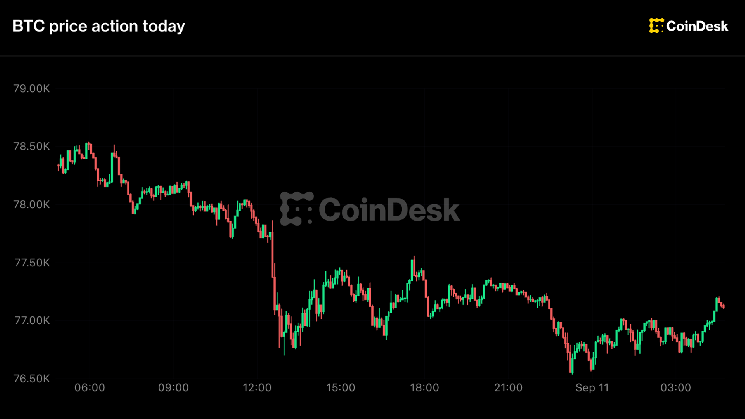
    Bitcoin hovered near a critical technical threshold Thursday as risk assets sold off broadly on surging oil prices, rising Treasury yields, and mounting expectations for another Federal Reserve interest-rate hike.

    Key Support Level in Focus

    Bitget analyst Lewis Huang marked the line before the print, saying “$76,270 is an important technical support level.” Bitcoin is now less than $800 above it.

    Energy Shock Ripples Through Markets

    Brent crude ripped above $107 a barrel, up more than 6%, with West Texas Intermediate near $102. The energy shock feeds directly into the inflation data the Fed is watching. The 10-year Treasury yield pushed toward 5% and the two-year above 4.5%.

    Gold slipped toward $4,330, the dollar index firmed near 99, and the S&P 500 closed lower at about 7,594, a fourth straight decline. Asian equity futures followed, with Japan down nearly 2%, Korea more than 3% and Hong Kong close to 1%.

    Higher Real Yields Pressure Crypto

    Higher real yields drain crypto through two channels at once. They make government debt competitive with an asset that pays nothing, and they raise the cost of carrying leverage.

    U.S. spot bitcoin ETFs are already showing it, with $120 million of outflows on Wednesday, more than double Tuesday’s, while ether, $XRP and solana funds all took in money the same day.

    CPI Data and Fed Expectations

    August CPI lands at 8:30 a.m. ET, with headline inflation expected at 3.4% year over year and core at 2.4%. Interest rate futures put the odds of a hike at the Sept. 15-16 meeting near 70%, up from roughly a coin flip two weeks ago.