Tag: Zcash

  • New ETF Filing Seeks Zcash Options Income, Backed by Grayscale

    New ETF Filing Seeks Zcash Options Income, Backed by Grayscale

    Key Highlights

    • Grayscale has filed for the ZCSH High Income ETF, an options-based fund tied to Zcash designed to deliver biweekly income payouts to shareholders.
    • The fund structure relies on derivatives strategies rather than direct Zcash custody, distinguishing it from traditional spot crypto ETFs.
    • The filing remains subject to regulatory review, with no confirmed launch date; details may evolve during the approval process.

    Grayscale Expands Crypto ETF Lineup With Income-Focused Zcash Product

    Digital asset manager Grayscale Investments has filed registration paperwork for a new exchange-traded fund called the ZCSH High Income ETF, marking the firm’s latest effort to diversify beyond straightforward spot-exposure products. According to reports from Coinfomania, TronWeekly, AMBCrypto, BlockchainReporter, and Bitcoin.com News, the proposed fund will employ an options-based strategy linked to Zcash, the privacy-focused cryptocurrency, to generate recurring income for investors rather than simply tracking the token’s market price.

    Options-Based Structure Targets Biweekly Distributions

    Unlike a conventional spot ETF that holds the underlying asset directly, the ZCSH High Income ETF is structured around derivatives. Reports from AMBCrypto and Bitcoin.com News indicate the fund aims to make biweekly payouts to shareholders, a distribution cadence that sets it apart from most existing crypto funds, which typically do not offer regular income streams. The strategy mirrors covered-call and premium-selling approaches common in traditional equity markets, where funds sell options contracts against holdings to collect premiums that are then distributed to investors. Applying this model to Zcash represents a notable departure from the bitcoin- and ether-centric products that have dominated crypto ETF filings in recent years.

    Regulatory Review and Market Context

    The filing initiates a standard regulatory review process for U.S.-listed ETFs, and the timeline for approval remains uncertain. As with other crypto-related fund applications, the product may be amended or withdrawn during review, meaning details reported at this stage could evolve. BlockchainReporter’s coverage emphasizes the fund’s reliance on derivatives rather than direct token custody as its primary return driver, while TronWeekly characterizes the filing as adding a new income-focused structure to Grayscale’s portfolio, suggesting the firm sees demand for yield-generating products alongside standard price-tracking funds.

    Why This Matters

    The ZCSH High Income ETF filing signals a broader industry shift toward specialized crypto investment products that go beyond basic spot exposure. Options-based income ETFs have already gained significant traction in equity markets, with funds built around stocks like Apple and Tesla generating premium income through covered-call strategies. Extending this structure to a digital asset like Zcash introduces a familiar income-oriented wrapper to a market segment still developing standardized product offerings. If approved, the fund could provide investors with Zcash-linked exposure without the operational complexities of direct token custody, while delivering periodic cash flow—a demand pattern well-established in traditional equity income ETFs. The move may also encourage other issuers to explore derivative-based income structures around additional digital assets, further expanding the strategic toolkit available to crypto-focused portfolios.

    Frequently Asked Questions

    What is the Grayscale ZCSH High Income ETF?

    It is a proposed exchange-traded fund filed by Grayscale that uses an options-based strategy tied to Zcash to generate income for investors.

    How does the fund plan to generate income?

    Reports indicate the fund will use options strategies rather than simply holding Zcash directly, aiming to produce biweekly payouts from premiums collected.

    Is the ZCSH ETF the same as a spot Zcash ETF?

    No. It is structured around options tied to Zcash rather than direct custody and price tracking of the token, distinguishing it from a standard spot fund.

    When will the ETF launch?

    The fund has been filed but must go through regulatory review before it can trade, and no confirmed launch date has been reported.

    Originally reported by AltcoinGordon, written by Liam Carter. Republished with permission.

  • Grayscale Files for ZCSH High Income ETF, an Options-Based Zcash Fund

    Grayscale Files for ZCSH High Income ETF, an Options-Based Zcash Fund

    Key Highlights

    • Grayscale filed a registration statement with the SEC on September 25 for the ZCSH High Income ETF, an actively managed fund using a synthetic covered-call strategy on Zcash exchange-traded products.
    • The fund will not hold ZEC directly, instead investing at least 80% of net assets in options contracts referencing The Zcash ETF (ticker: ZCSH) to generate income from premiums.
    • The filing proposes effectiveness 75 days after submission (around early December), but no ticker or listing exchange has been assigned, and the SEC has not approved or disapproved the securities.

    Grayscale Files for ZCSH High Income ETF with Synthetic Covered-Call Strategy

    Grayscale Investments has taken another step in expanding its Zcash product suite, filing a registration statement with the U.S. Securities and Exchange Commission on September 25 for the ZCSH High Income ETF. The proposed fund, structured under Grayscale Funds Trust, is designed as an actively managed exchange-traded fund that seeks current income while maintaining prospects for capital appreciation through a synthetic covered-call strategy. Unlike the firm’s existing spot Zcash ETF, this new vehicle will not purchase the privacy coin directly. Instead, it intends to trade options contracts on Zcash exchange-traded products, primarily The Zcash ETF (ticker: ZCSH), which Grayscale listed on NYSE Arca in August as the first U.S. spot ETF holding a privacy coin.

    Mechanics of the Synthetic Covered-Call Approach

    According to the post-effective amendment to its Form N-1A registration statement, the fund will invest at least 80% of its net assets, plus borrowings for investment purposes, in options contracts that use a Zcash exchange-traded product as the reference asset, valuing each derivative at its notional amount. The strategy involves writing, or selling, call options to collect premiums, while simultaneously pairing bought calls with sold puts to replicate the underlying fund’s price movements. This 80% investment policy is designated as non-fundamental, meaning it can be changed with at least 60 days of written notice to shareholders. The prospectus explicitly states that the fund will not invest in digital assets directly, will not hold ZEC, and will not maintain a digital-asset wallet or control private keys.

    Indirect Exposure and Tracking Considerations

    Because the fund’s exposure runs entirely through derivatives, the filing cautions that it may not track the price of ZEC. The Zcash ETF (ZCSH), by contrast, operates as a grantor trust sponsored by an affiliate of the fund’s adviser for the sole purpose of holding ZEC directly. Options on ZCSH began trading in September, providing the necessary derivatives market for the new income fund’s strategy. The registration statement proposes that the filing take effect 75 days after submission, which would place the potential launch around early December, though the prospectus does not yet assign a ticker symbol or specify a listing exchange.

    Why This Matters

    This filing represents a notable evolution in the cryptocurrency ETF landscape, moving beyond simple spot exposure into structured derivative strategies. By launching a covered-call product on a privacy-coin ETF, Grayscale is offering investors a way to monetize volatility and generate yield without the operational complexities of direct digital asset custody, such as private key management. The move also signals growing maturity in the crypto derivatives ecosystem, as the availability of options on the recently launched ZCSH enables such synthetic strategies. However, the fund’s indirect structure means performance may deviate from the spot price of ZEC, introducing basis risk that investors must weigh against the income potential. The SEC’s eventual decision on effectiveness will be a key milestone for derivative-based crypto ETFs in the United States.

    Frequently Asked Questions

    What is the ZCSH High Income ETF’s primary investment strategy?

    The fund employs a synthetic covered-call strategy, writing call options on The Zcash ETF (ZCSH) to collect premiums while using combinations of bought calls and sold puts to replicate the underlying ETF’s price movements. It invests at least 80% of its net assets in these derivatives.

    Will the fund hold ZEC directly?

    No. The prospectus explicitly states the fund will not invest in digital assets directly, will not hold ZEC, and will not maintain a digital-asset wallet or control private keys. Exposure is achieved solely through options contracts on Zcash exchange-traded products.

    When could the fund launch?

    The filing proposes effectiveness 75 days after the September 25 submission, targeting early December. However, the SEC has not approved or disapproved the securities, and no ticker or listing exchange has been assigned yet.

  • Researchers Propose Zcash-Style Privacy for Bitcoin Without a Soft Fork

    Researchers Propose Zcash-Style Privacy for Bitcoin Without a Soft Fork

    Key Highlights

    • Researchers from Alloc Init proposed “Shielded Bitcoin,” a metaprotocol that hides BTC transfer amounts and counterparties using zero-knowledge proofs without altering Bitcoin’s consensus rules or requiring trusted bridges.
    • The design adapts Zcash’s encrypted-note model directly on Bitcoin’s base layer, allowing anyone to run indexers that verify proofs and track nullifiers to prevent double-spending.
    • Grayscale research head Zach Pandl recently warned that AI advances are making wallet-to-identity linking easier, suggesting shielded transaction tools may become essential for privacy-focused users.

    Alloc Init Researchers Unveil Shielded Bitcoin Privacy Metaprotocol

    A team of researchers behind Alloc Init has introduced “Shielded Bitcoin,” a novel metaprotocol designed to bring transaction privacy to Bitcoin’s base layer without modifying the network’s consensus rules or relying on trusted bridge operators. Presented by Clara Shikhelman, Mikhail Komarov, and Aleksei Moskvin, the proposal addresses a fundamental limitation of Bitcoin’s public ledger: amounts, transaction timing, and links between transactions remain visible and can often be associated with known wallets through blockchain analysis.

    How Encrypted Notes and Zero-Knowledge Proofs Enable Private Transfers

    The Shielded Bitcoin design borrows the encrypted-note approach pioneered by Zcash but implements it directly on Bitcoin’s existing infrastructure. When a user such as Alice pays Bob, her wallet publishes encrypted notes to the Bitcoin blockchain alongside a zero-knowledge proof. These notes contain the transfer amount and the recipient’s receiving information, while the cryptographic proof serves three critical functions: it confirms the notes being spent exist, verifies Alice’s authorization to spend them, and validates that input and output amounts balance — all without exposing any of these details publicly.

    Software components called indexers read these transfers, verify the zero-knowledge proofs, and track nullifiers — unique serial numbers that prevent the same note from being spent twice. According to the researchers, anyone can operate indexers, ensuring no single party controls the ledger state. The design also separates spending authority from viewing capabilities, allowing wallets to split into distinct keys: one for spending funds, a read-only key for detecting incoming transfers, and a third key for recovering a user’s own transaction history. This key hierarchy enables users to share limited transaction details with auditors or counterparties without surrendering spending control.

    Where Shielded Bitcoin Fits Among Existing Privacy Solutions

    Comparison With CoinJoin, Silent Payments, and Zcash

    Shielded Bitcoin enters a landscape of existing privacy-enhancing techniques for Bitcoin, each with distinct tradeoffs. Methods like CoinJoin, PayJoin, and Silent Payments operate within Bitcoin’s current transaction format and can obscure ownership trails, but transaction amounts and much of the transaction graph remain publicly visible. The researchers identified Zcash as the closest precedent due to its use of encrypted notes, nullifiers, and zero-knowledge proofs. However, Zcash operates on its own independent blockchain with separate consensus rules, whereas Shielded Bitcoin derives its state entirely from Bitcoin’s history.

    This architectural distinction carries implications: while Shielded Bitcoin avoids the need for a trusted intermediary or separate consensus mechanism, transaction patterns, distinctive wallet behaviors, and repeated publication fees could still allow observers to narrow down relationships over time through traffic analysis and heuristic clustering.

    Why This Matters

    The proposal arrives amid growing concern about the erosion of financial privacy on public blockchains. Grayscale’s research head, Zach Pandl, recently highlighted that advances in artificial intelligence are making it significantly easier to link wallet addresses to real-world identities. Pandl suggested that tools employing shielded transaction models — like those used by Zcash — could become “close to a necessity for privacy-minded users.” Shielded Bitcoin represents an attempt to bring similar cryptographic privacy guarantees to Bitcoin natively, without requiring users to move funds onto a separate chain or trust centralized mixing services. If adopted, it could shift the baseline for on-chain privacy on the world’s largest cryptocurrency network, though deployment would require wallet and indexer software development, as well as community consensus on the metaprotocol’s standards.

    Frequently Asked Questions

    Does Shielded Bitcoin require a soft fork or consensus change to Bitcoin?

    No. The researchers explicitly designed Shielded Bitcoin as a metaprotocol that operates on Bitcoin’s existing base layer without altering consensus rules. It uses cryptographic proofs published as transaction data rather than requiring protocol-level modifications.

    How does Shielded Bitcoin differ from using Zcash directly for private transactions?

    While both use encrypted notes, nullifiers, and zero-knowledge proofs, Zcash runs on its own independent blockchain with separate consensus rules. Shielded Bitcoin derives its state from Bitcoin’s history, meaning users stay on the Bitcoin network and do not need to bridge assets or trust a different validator set.

    Can observers still trace Shielded Bitcoin users through metadata analysis?

    Yes, the researchers acknowledge that transaction timing patterns, wallet behavior fingerprints, and fee publication rhythms could still allow sophisticated observers to correlate activity and narrow down relationships over time, even though amounts and counterparties are cryptographically hidden.

  • Bitcoin Could Soon Gain Zcash-Style ‘Shielded’ Privacy Without Rule Changes

    Bitcoin Could Soon Gain Zcash-Style ‘Shielded’ Privacy Without Rule Changes

    Key Highlights

    • Zcash shielded pools now hold approximately 4.9 million ZEC—roughly 29% of total supply worth $7.8 billion—marking a 14% increase since late July.
    • The network processed 63,000 shielded transactions last week, its highest weekly private transfer count since 2022, while total transfer volume topped $23 billion.
    • ZEC prices have surged more than 2,300% over the past year, breaking $1,000 in early September and pushing above $1,600 by mid-month.

    Privacy Demand Drives Shielded Adoption

    Privacy has shifted from a theoretical ideal to a practical requirement for developers building cryptocurrency payroll systems, business payment rails, and everyday spending tools. On fully transparent chains such as Bitcoin, every transaction permanently exposes amounts and addresses; once an address is linked to a company or individual, all associated payments become trivially traceable. Ethereum is now evaluating a shared private pool proposal that would allow ether and token transfers without publicly revealing payment details, citing payroll, treasury management, and donations as use cases poorly served by fully public ledgers.

    Zcash’s Dual Architecture Gains Traction

    Zcash offers users a choice between transparent payments—where addresses and amounts are public—and shielded payments that encrypt those details. According to CoinDesk calculations based on ZecStats data, shielded pools held about 4.9 million ZEC as of Friday, up 14% from July 30. That represents roughly 29% of all issued coins, valued at approximately $7.8 billion following the recent price rally. The network recorded roughly 63,000 shielded transactions last week, its busiest week for private transfers since 2022 and the fourth-highest on record. Across the entire network, reported transfer volume exceeded $23 billion, the largest weekly total since 2021 and the second-highest in Zcash history.

    Market Momentum Reflects Growing Confidence

    Investor interest has tracked the on-chain metrics. By early September, ZEC had gained more than 2,300% over the preceding twelve months and crossed the $1,000 threshold. The rally extended above $1,600 on Wednesday, underscoring market confidence in privacy-preserving infrastructure as a durable narrative rather than a speculative flare.

    Why This Matters

    The convergence of rising shielded-pool balances, record private transaction counts, and multi-billion-dollar weekly volumes signals that enterprises and individuals are actively migrating value into privacy-preserving rails. With Ethereum exploring native privacy pools and Bitcoin’s transparency limiting commercial adoption, Zcash’s mature shielded architecture positions it as a reference implementation for confidential finance. The next inflection points will likely come from wallet integrations, exchange support for shielded withdrawals, and regulatory clarity around privacy coins—factors that could either accelerate mainstream adoption or constrain on-ramps.

    Frequently Asked Questions

    What is the difference between transparent and shielded Zcash transactions?
    Transparent transactions publish sender, receiver, and amount on the public blockchain, similar to Bitcoin. Shielded transactions encrypt all three data points using zero-knowledge proofs, revealing nothing to outside observers.
    How much ZEC is currently held in shielded pools?
    As of the latest data, shielded pools hold approximately 4.9 million ZEC, representing roughly 29% of the total circulating supply and worth about $7.8 billion at current prices.
    Why are businesses increasingly interested in private crypto payments?
    Public ledgers expose payroll amounts, vendor relationships, and treasury flows to competitors and bad actors. Shielded transactions allow companies to settle obligations confidentially while still benefiting from blockchain finality and auditability for authorized parties.
  • Wall Street Interest in Altcoin Grows as Fund Reaches $1 Billion

    Wall Street Interest in Altcoin Grows as Fund Reaches $1 Billion

    Key Highlights

    • Grayscale Zcash Trust (ZCSH) nears $1 billion in assets under management, marking a major milestone for the first U.S. exchange-traded product offering direct ZEC exposure.
    • Fund growth is driven by a combination of new investor inflows and a sharp rise in the market value of ZEC tokens held by the trust.
    • Launched on NYSE Arca on August 25, ZCSH surpassed $500 million in assets by early September, reflecting rapid institutional and retail interest in privacy-focused crypto assets.

    Grayscale Zcash Trust Surges Toward $1 Billion AUM

    Grayscale’s Zcash-focused exchange-traded product, trading under the ticker ZCSH on NYSE Arca, has approached the $1 billion mark in assets under management (AUM). The milestone comes just weeks after the fund began trading on August 25, making it the first U.S. exchange-traded product to provide direct exposure to the price of ZEC, the native token of the privacy-centric Zcash network. According to the fund’s trajectory, assets surpassed $500 million in early September, underscoring a swift accumulation of capital.

    Price Appreciation and Inflows Drive Asset Growth

    The rapid expansion in fund size is attributed to two distinct factors: fresh investor subscriptions and a substantial increase in the dollar-denominated value of the ZEC tokens already held in the trust. ZEC recently entered a rapid growth cycle, distinguishing itself from other altcoins through its privacy-focused architecture. However, market observers caution that the rising AUM figure alone does not exclusively reflect net cash inflows. The appreciation of ZEC’s market price automatically inflates the value of the trust’s existing holdings, meaning net inflow data must be monitored separately to accurately gauge genuine investor demand.

    First U.S. Direct ZEC Exposure Vehicle

    ZCSH represents a structural milestone for digital asset accessibility in traditional markets. As the first exchange-traded product in the United States to offer direct exposure to ZEC, it provides investors with a regulated, familiar wrapper to gain access to a privacy-preserving cryptocurrency without the operational complexities of self-custody or exchange counterparty risk. The product’s listing on NYSE Arca places it within the established equity market infrastructure, subject to standard reporting and custody standards.

    Why This Matters

    The swift ascent of ZCSH highlights growing institutional comfort with privacy-focused digital assets, a category often scrutinized by regulators. Zcash’s use of zero-knowledge proofs (zk-SNARKs) allows for shielded transactions while maintaining auditability—a feature that may appeal to compliance-conscious allocators. The fund’s trajectory also serves as a real-time indicator of demand for single-asset crypto exposure products beyond Bitcoin and Ethereum. As the SEC continues to evaluate a wave of cryptocurrency ETF filings, ZCSH’s performance could influence the regulatory outlook for similar niche-asset trusts. Investors should note that the trust structure carries premium/discount dynamics to net asset value (NAV) and does not offer the creation/redemption mechanism typical of ETFs, which can affect tracking efficiency.

    Frequently Asked Questions

    What is ZCSH and how does it differ from buying ZEC directly?
    ZCSH is the Grayscale Zcash Trust, an exchange-traded product listed on NYSE Arca that holds ZEC tokens. It allows investors to gain exposure to ZEC’s price movements through a traditional brokerage account without managing private keys or interacting with crypto exchanges.
    Does the near-$1 billion AUM mean $1 billion in new cash entered the fund?
    No. The AUM increase reflects both new investor subscriptions and the rising market value of ZEC tokens already held. A portion of the growth is purely from price appreciation, not net inflows.
    Why is ZEC outperforming other altcoins recently?
    The source attributes ZEC’s rapid growth cycle to its privacy-focused structure, which distinguishes it from many other altcoins. However, specific catalysts or fundamental drivers beyond this general characterization were not detailed in the report.
  • Researchers Propose Zcash-Style Private Bitcoin Transfers Without Soft Fork

    Researchers Propose Zcash-Style Private Bitcoin Transfers Without Soft Fork

    Key Highlights

    • Alloc Init researchers propose Shielded Bitcoin, a metaprotocol bringing Zcash-style private transfers to Bitcoin without a soft fork, using encrypted notes and zero-knowledge proofs.
    • The system relies on Bitcoin as a “neutral publication and ordering layer” while separate indexers verify ZK-proofs and prevent double-spending, avoiding base-layer consensus changes.
    • Critics highlight a small initial anonymity set and lack of quantum resistance; supporters including Eli Ben-Sasson see it advancing the original Zerocash vision of privacy on Bitcoin.

    Alloc Init Unveils Shielded Bitcoin: Privacy Metaprotocol Without Soft Fork

    Cryptography research firm Alloc Init has published a proposal for Shielded Bitcoin, a metaprotocol designed to bring Zcash-style shielded transactions to the Bitcoin network without requiring a soft fork or consensus changes to the base protocol. The paper, released Thursday by researchers Clara Shikhelman, Mikhail Komarov, and Aleksei Moskvin, outlines a system that would conceal transaction amounts, senders, receivers, and links to previously spent funds using encrypted notes and zero-knowledge proofs.

    Architecture: Bitcoin as Publication Layer, Indexers as Verifiers

    Unlike Zcash, which operates its own blockchain and consensus mechanism, Shielded Bitcoin would not launch a separate chain. Instead, the design explicitly uses Bitcoin as “a neutral publication and ordering layer,” the researchers wrote. Transaction data—encrypted notes, public nullifiers marking notes as spent, and zero-knowledge proofs attesting to validity—would be posted to Bitcoin blocks. Separate software components called indexers would then verify the zero-knowledge proofs, check that funds have not been double-spent, and reconstruct the state of the shielded system off-chain.

    This approach mirrors Zcash’s core cryptographic primitives—encrypted notes, nullifiers, and ZK-proofs—while offloading consensus and finality to Bitcoin’s existing proof-of-work chain. The researchers argue this offers a potential path to stronger privacy for Bitcoin users without the political and technical hurdles of a base-layer protocol upgrade.

    Developer Reactions: Anonymity Set Concerns and Quantum Resistance

    The proposal drew immediate and varied reactions from prominent cryptographers and developers. Vadim Zavodil, a developer, criticized the design on X, arguing that much of its privacy stack had already been implemented by Zcash and questioning the practical anonymity a newly launched system could provide.

    “Privacy is a function of the crowd. Zcash has a real shielded pool built over years,”

    — Vadim Zavodil

    “A brand new metaprotocol starts at zero, so your first private transfer hides in a crowd of one.”

    — Vadim Zavodil

    In a companion post, the Shielded Bitcoin researchers acknowledged a similar limitation, stating that large deposits do not automatically create a large anonymity set. They noted observers may still narrow down relationships between transfers if a small number of actors create most notes or if wallets exhibit distinctive behavior.

    Pierre-Luc Dallaire-Demers, founder of post-quantum cryptography firm Pauli Group, raised a separate concern, describing the construction as interesting but “not quantum resistant at all.” Dallaire-Demers later indicated he was exploring what a fully post-quantum version could look like, assuming Bitcoin eventually adopts a post-quantum signature scheme.

    Support from Zerocash Co-Author Eli Ben-Sasson

    Not all feedback was critical. Eli Ben-Sasson, co-author of the original Zerocash paper and CEO of StarkWare, offered a supportive perspective. In response to Alloc Init’s announcement, Ben-Sasson said the original intent behind the Zerocash paper—which preceded Zcash—was to bring privacy to Bitcoin. He added that he had not yet read the Shielded Bitcoin paper but would like to see the vision of privacy and scalability through zero-knowledge proofs materialize on Bitcoin’s base layer.

    Why This Matters

    Shielded Bitcoin represents a novel attempt to solve Bitcoin’s long-standing privacy limitations without the contentious governance process of a soft fork. By treating Bitcoin as a data-availability and ordering layer—similar to how rollups use Ethereum—the proposal sidesteps the need for miner or node operator consensus on privacy rules. However, the design inherits the bootstrapping challenge common to all new shielded pools: without a large, diverse set of participants, the anonymity set remains small, potentially undermining the very privacy it promises. The quantum-resistance critique also underscores a growing focus in the cryptography community on post-quantum readiness, especially for systems intended to operate for decades. If Bitcoin eventually activates a post-quantum signature scheme, metaprotocols like Shielded Bitcoin would need to migrate their cryptographic primitives accordingly. For now, the proposal adds a concrete, research-grade option to the expanding landscape of Bitcoin privacy tools, joining efforts such as Silent Payments, PayJoins, and second-layer solutions like Lightning Network with Taproot Assets.

    Frequently Asked Questions

    Does Shielded Bitcoin require a Bitcoin soft fork?
    No. The proposal explicitly avoids base-layer consensus changes. It uses Bitcoin only as a publication and ordering layer, with off-chain indexers handling verification of zero-knowledge proofs and double-spend prevention.
    How does Shielded Bitcoin differ from Zcash?
    While it adopts Zcash’s cryptographic architecture—encrypted notes, nullifiers, and ZK-proofs—Shielded Bitcoin does not operate its own blockchain or consensus mechanism. It relies entirely on Bitcoin for finality and data availability.
    What are the main criticisms of the proposal?
    Critics highlight two primary concerns: (1) a newly launched shielded pool starts with an anonymity set of near zero, limiting early privacy, and (2) the current construction is not quantum-resistant, posing long-term risk if large-scale quantum computers become viable.
  • Monero and Zcash Rally as MemeToro Introduces Public Smart Contract Rules for BNB Chain Memecoin Launches

    Monero and Zcash Rally as MemeToro Introduces Public Smart Contract Rules for BNB Chain Memecoin Launches

    Key Highlights

    • Monero (XMR) breaks a multi-month descending trendline, trading near $580 with a critical resistance level at $585.37 that could open a path toward a modeled $650 target.
    • Zcash (ZEC) surges over 200% in three months to hold above $1,500, fueled by Grayscale’s $900M+ ETF holdings, a planned 3-for-1 stock split, and the upcoming NU7 network upgrade.
    • MemeToro releases 1,373 lines of public Solidity code under an MIT license for a BNB Chain fair-launch memecoin platform, aiming to eliminate insider allocations, though the project remains pre-deployment and unaudited.

    Privacy Coins Reassert Market Strength Amid Technical Breakouts

    The privacy coin sector is commanding renewed market attention as both Monero and Zcash demonstrate robust technical structures and fundamental catalysts. Monero has decisively broken a descending trendline that had capped rallies since January, while Zcash has posted a staggering 200% gain over three months. These moves represent live-market rallies anchored by clear technical levels and network-level developments, distinguishing them from purely speculative narratives.

    Monero Targets $585 Resistance After Trendline Break

    Monero is currently trading close to $580 after slicing through a descending trendline that had acted as a ceiling since the start of the year. This breakout is a bullish technical development, signaling that buyers have overwhelmed sellers at a level where supply previously dominated. The immediate focus is the $585.37 resistance level; a daily close above this price would validate the broader breakout structure. Algorithmic models suggest a potential weekly target near $650.40 if this level holds, though such a move requires sustained demand and a constructive broader market backdrop. Momentum indicators remain neutral to bullish, indicating room for upside but offering no guarantees. As with all privacy assets, XMR remains sensitive to regulatory shifts, liquidity conditions, and sudden changes in market sentiment.

    Zcash Rally Powered by Institutional Demand and Protocol Upgrade

    Zcash has surged above $1,500, capping a powerful three-month ascent. Institutional interest has been a primary driver, with Grayscale’s Zcash ETF reportedly managing over $900 million in assets under management. A planned 3-for-1 stock split for the fund aims to enhance accessibility and liquidity for investors. On the protocol layer, the NU7 network upgrade, scheduled for November 5, is a major catalyst. The upgrade targets a reduction in block-generation times from 75 seconds to 25 seconds, a change designed to significantly improve the user experience for private payments. While ZEC eyes resistance near $1,700, the velocity of the rally introduces correction risk. Market participants are closely monitoring whether demand can be sustained after such a large, rapid move.

    MemeToro Unveils Public Smart Contract Framework for BNB Chain Launches

    Distinct from the established privacy assets, MemeToro represents an early-stage project focused on restructuring the memecoin launch process on BNB Chain. The project has published 1,373 lines of Solidity code across 17 files under an MIT license, including a FairLaunchEscrow contract, interfaces, tests, and documentation. The stated objective is to enforce transparent, immutable launch conditions from inception. Key proposed rules include fixed contributor and liquidity allocations, the elimination of developer-insider allocations in the fair-launch split, defined refund and liquidity pathways, and public functions for claims and finalization.

    For buyers, this framework promises improved transparency regarding tokenomics and fund flows. For creators, it offers a structured, rule-based launch alternative to the often opaque processes prevalent in the sector. However, the project is at a nascent stage: the code requires deployment, rigorous testing, liquidity execution, and independent security review. Public code availability is a meaningful transparency step, but it does not equate to a live, audited, or battle-tested platform.

    Illustrative $MT Token Economics Highlight Risk/Reward Profile

    MemeToro has provided illustrative scenarios for its native $MT token. A $1,000 purchase at a hypothetical price of $0.00430 would yield approximately 232,558 tokens before fees. If the token reaches a displayed launch target of $0.05186, the holding would carry a paper value near $12,060—a 12.06x multiple. At a theoretical $1 billion fully diluted valuation across the 1.2 billion token supply, the implied price would be near $0.8333, valuing the same allocation at roughly $193,798. The project explicitly states these are not guaranteed returns or investment advice. Realized outcomes depend on taxes, fees, slippage, liquidity depth, token supply mechanics, market demand, and successful product delivery. Prospective buyers are directed to the official MemeToro purchase guide for full details.

    Why This Matters

    The divergence between Monero, Zcash, and MemeToro underscores the widening spectrum of risk and maturity within the crypto asset class. Monero and Zcash are established Layer 1 networks with deep liquidity, proven cryptographic primitives, and live ecosystems; their current price action reflects technical analysis and institutional product dynamics. MemeToro, by contrast, is a pre-launch application-layer project attempting to solve the “fair launch” problem for memetic assets via transparent smart contract logic. While the privacy coins offer a “live price discovery story with visible support and resistance,” MemeToro’s value proposition is entirely contingent on future execution—specifically, whether AI-guided creation tools and public contract rules can attract a critical mass of creators and traders to BNB Chain. Investors and users must apply fundamentally different risk standards: one set for battle-tested monetary assets, another for unaudited, pre-revenue platform bets.

    Frequently Asked Questions

    What is the key breakout level for Monero (XMR)?

    Monero needs to hold above $585.37 to validate its breakout from the January descending trendline. A successful hold could open a path toward a modeled weekly target near $650.40, though this remains speculative and dependent on broader market conditions.

    Why is Zcash (ZEC) rising significantly?

    Zcash’s rally is supported by three primary catalysts: strong institutional demand evidenced by Grayscale’s Zcash ETF holdings exceeding $900 million; a planned 3-for-1 stock split for the fund to improve liquidity; and the upcoming NU7 network upgrade on November 5, which will reduce block times from 75 to 25 seconds.

    Does MemeToro’s public code eliminate the risks of memecoin launches?

    No. While the public smart contract rules aim to improve transparency—fixing allocations, removing insider splits, and defining refund paths—they cannot guarantee liquidity, market demand, smart contract security, or future token prices. The code is currently unaudited and the platform is not yet live.

  • NEAR Intents Launches Unified Liquidity Solution for DeFi

    NEAR Intents Launches Unified Liquidity Solution for DeFi

    Key Highlights

    • NEAR Protocol launches NEAR Intents to create a unified liquidity layer for cross-chain DeFi operations.
    • ZCash users gain access to Cash App and PayPal transactions through NEAR Intents integration.
    • Traders monitor NEAR’s ecosystem growth as cross-chain volume rises across the cryptocurrency market.

    NEAR Protocol Unveils NEAR Intents to Unify Cross-Chain Liquidity

    NEAR Protocol has officially introduced NEAR Intents, a new architectural concept designed to function as a unified liquidity layer across blockchain networks. The announcement, published via the official NEAR Protocol Twitter account, signals a strategic push to streamline decentralized finance (DeFi) interactions by reducing fragmentation between previously isolated ecosystems. As cross-chain transaction volumes climb industry-wide, the initiative positions NEAR as a foundational infrastructure provider for next-generation liquidity routing.

    ZCash Integration Expands Real-World Payment Utility

    A practical demonstration of the technology’s reach is already live: ZCash users can now transact through mainstream financial applications including Cash App and PayPal, enabled by NEAR Intents integration. This development bridges privacy-focused cryptocurrency holdings with widely adopted consumer payment rails, broadening the scope of DeFi usability beyond native crypto interfaces. The integration underscores NEAR Protocol’s long-standing focus on facilitating seamless transactions and interoperability between disparate blockchain networks.

    Market Context: Mixed Signals Amid Growing Cross-Chain Momentum

    The broader cryptocurrency market is currently displaying mixed momentum across altcoins, yet cross-chain activity continues to accelerate. NEAR Intents arrives at a pivotal moment when liquidity solutions are becoming a critical component of the DeFi stack. Regulatory clarity around decentralized finance remains an evolving landscape that influences how projects like NEAR Protocol develop technologies and expand market reach. By targeting the interoperability layer directly, NEAR aims to capture value from the increasing demand for frictionless asset movement across chains.

    Why This Matters

    Unified liquidity layers represent a structural shift in DeFi architecture, moving away from fragmented, chain-specific liquidity pools toward aggregated, intent-based settlement. NEAR Intents could reduce slippage, lower transaction costs, and simplify user experience by abstracting away the complexity of bridging and routing. For developers, the framework may lower barriers to building cross-chain applications. For users, it brings crypto closer to the seamless payment experiences found in traditional finance. The ZCash-to-Cash App/PayPal pathway illustrates how such infrastructure can unlock real-world utility for privacy coins and other niche assets.

    Frequently Asked Questions

    What is NEAR Intents?

    NEAR Intents is a concept introduced by NEAR Protocol to create a unified liquidity layer that enables cross-chain transactions and DeFi interactions across multiple blockchain networks.

    How does the ZCash integration work with Cash App and PayPal?

    Through NEAR Intents integration, ZCash users can now transact via popular platforms like Cash App and PayPal, bridging privacy-focused cryptocurrency with mainstream payment applications.

    Why are traders watching NEAR Protocol’s developments closely?

    Traders are monitoring the impact of NEAR Intents on cross-chain liquidity, as successful implementation could drive increased engagement and liquidity within NEAR’s ecosystem amid rising cross-chain volumes.

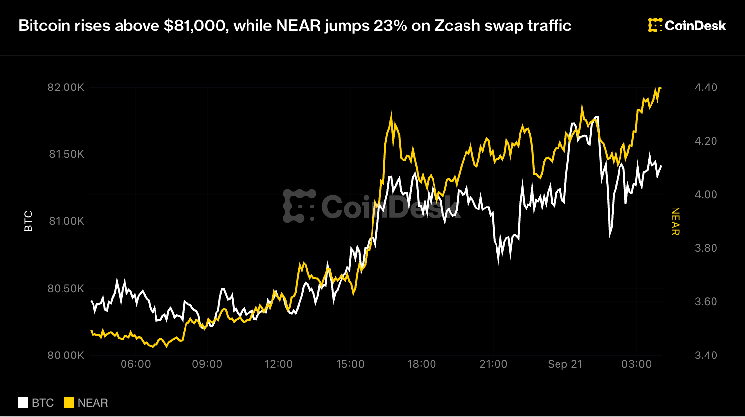
  • Bitcoin Surges Past $81,000 as NEAR Jumps 23% on Zcash Swap Traffic

    Bitcoin Surges Past $81,000 as NEAR Jumps 23% on Zcash Swap Traffic

    Key Highlights:

    • Bitcoin holds above $81,000 in Monday Asian trading, extending gains after the SEC greenlit onchain trading of tokenized U.S. equities.
    • NEAR token surges roughly 23% to above $4 as its cross-chain swap service, NEAR Intents, becomes a primary routing layer for Zcash (ZEC) volume.
    • Major consumer wallets ZODL and Vizor have integrated NEAR Intents, driving a sixfold jump in daily ZEC volume routed through the protocol in the past week.

    Bitcoin Consolidates Above $81K as SEC Tokenized Stock Ruling Lifts Sentiment

    Bitcoin traded just above $81,000 during Monday morning hours in Asia, marking a gain of less than 1% over the preceding 24 hours according to CoinDesk data. The cryptocurrency has been adding to its recovery since Thursday, when the U.S. Securities and Exchange Commission cleared a regulatory path for the onchain trading of tokenized U.S. stocks. The move is widely seen as a landmark step toward bridging traditional equity markets with blockchain-based settlement, providing a fresh catalyst for digital-asset risk appetite.

    NEAR Token Leads Major-Cap Gains on Cross-Chain Routing Demand

    The standout performer among major tokens was NEAR, which climbed approximately 23% to trade just above $4. The rally traces directly to NEAR Intents, a swap service built on the NEAR blockchain that enables a wallet to exchange one token for another across different chains without requiring the user to move funds between networks first. The abstraction of cross-chain complexity has turned NEAR into a de facto routing layer for one of the most heavily traded assets in the market.

    Wallet Integrations Drive Sixfold Volume Spike for ZEC

    Major consumer wallets, including ZODL and Vizor, have plugged NEAR Intents into their interfaces to offer Zcash (ZEC) swaps. Since those integrations went live, daily ZEC volume routed through the service has jumped sixfold in a single week. The surge in order flow has created a positive feedback loop for the NEAR token itself, which has followed the traffic as the underlying settlement and gas asset for the routing activity.

    Broader Market Moves Remain Measured

    Outside of NEAR’s outsized move, the rest of the major-cap complex posted modest advances. ZEC itself gained 3% to just above $1,500, while BNB rose 2% to nearly $777. Ether and HYPE each added roughly 2%. The remaining large-cap cohort — XRP, DOGE, SOL, and TRX — all rose 1% or less, indicating a market digesting the SEC news selectively rather than chasing a broad risk-on impulse.

    Why This Matters

    The SEC’s decision to allow onchain trading of tokenized U.S. equities represents a structural shift: it legitimizes the use of public blockchains as settlement rails for regulated securities. For protocols like NEAR that have invested in chain-abstraction infrastructure, the ruling arrives as tailwinds build for cross-chain liquidity aggregation. The sixfold volume increase on NEAR Intents demonstrates real user demand for seamless interoperability — a prerequisite if tokenized stocks are to trade natively onchain at scale. Watch for further wallet integrations and whether other Layer 1s deploy similar intent-based routing to capture order flow.

    Frequently Asked Questions

    What is NEAR Intents and why is it driving NEAR’s price higher?

    NEAR Intents is a cross-chain swap service on the NEAR blockchain that lets users trade tokens across different networks without manually bridging funds. Wallets ZODL and Vizor have integrated it for ZEC swaps, causing a sixfold volume spike that increases demand for NEAR as the routing layer’s native gas and settlement token.

    How did the SEC’s tokenized stock decision affect Bitcoin?

    Bitcoin has extended gains since Thursday’s SEC ruling, trading above $81,000 on Monday. The decision is viewed as a bullish regulatory signal for the broader digital-asset ecosystem, though Bitcoin’s own move has been modest — up less than 1% in 24 hours — suggesting the market is still calibrating the long-term implications.

    Which other major tokens moved on Monday?

    ZEC gained 3% to above $1,500; BNB rose 2% to near $777; Ether and HYPE each added about 2%; while XRP, DOGE, SOL, and TRX all rose 1% or less.

  • 30-Year Veteran Analyst: “This Trend Could Fuel Bitcoin in the Coming Period”

    30-Year Veteran Analyst: “This Trend Could Fuel Bitcoin in the Coming Period”

    Key Highlights

    • Macro investor Jordi Visser argues AI agents will drive Bitcoin adoption by requiring blockchain infrastructure for machine-to-machine transactions.
    • Visser predicts tokenization will unlock dormant assets as programmable collateral, creating a growth dynamic independent of traditional liquidity cycles.
    • The analyst identifies privacy-focused projects like Zcash and NEAR as early beneficiaries of the AI-agent economy.

    AI Agents Poised to Reshape Cryptocurrency Fundamentals, Says Macro Investor Jordi Visser

    Experienced macro investor Jordi Visser has articulated a thesis positioning artificial intelligence agents as a transformative catalyst for Bitcoin and the broader cryptocurrency market. In a detailed analysis, Visser contends that evaluating Bitcoin’s trajectory exclusively through conventional macroeconomic lenses—global liquidity, interest-rate regimes, or money-supply metrics—is becoming an increasingly incomplete framework. While acknowledging that Bitcoin’s price history shows strong correlation with liquidity conditions, he argues that the maturation of genuine cryptocurrency utility could decouple the asset class from traditional economic cycles.

    Blockchain as Essential Infrastructure for Machine-to-Machine Economies

    Central to Visser’s argument is the inevitability of advanced AI agents interacting directly with one another, a dynamic he asserts will require blockchain settlement rails. “Agents will interact with each other. Blockchain is necessary,” Visser stated, emphasizing that the proliferation of autonomous software actors is “extremely positive for the cryptocurrency sector.” He envisions these agents evolving from analytical tools into full-fledged economic participants capable of executing purchases, payments, reservations, and complex financial decisions. Digital wallets controlled by such agents, he predicts, could become critical infrastructure in the emerging machine-to-machine economy.

    Tokenization and Programmable Finance Unlock Dormant Capital

    Visser further argues that this shift will accelerate the tokenization of assets currently dormant within the traditional financial system, enabling them to serve as programmable collateral. He describes a mechanism distinct from legacy liquidity indicators, where automated, code-driven financial transactions become commonplace. This programmable layer, he suggests, could foster competition between corporate-owned AI agents and consumers’ personal agents over pricing, privacy protections, and transaction terms—creating novel use cases for privacy-centric crypto projects and decentralized finance applications.

    Why This Matters: The Convergence of AI and Crypto Economics

    Visser’s framework highlights a structural inflection point: as AI agents multiply, traditional employment and productivity metrics may lose relevance. He notes his own firm operates with fewer than 15 human employees while deploying nearly 100 digital AI agents, illustrating how current economic statistics struggle to capture this transformation. For Bitcoin specifically, Visser maintains a 30-year conviction horizon, viewing the convergence of AI autonomy and blockchain verification as a powerful拓展 of real-world cryptocurrency utility that could sustain value appreciation independent of fiat monetary cycles. The heightened September interest in privacy-oriented protocols such as Zcash and NEAR, he suggests, reflects early market recognition of this AI-agent privacy narrative.

    Frequently Asked Questions

    How does Jordi Visser believe AI agents will use blockchain technology?

    Visser argues that advanced AI agents will need to transact directly with each other—making purchases, payments, and financial decisions autonomously—and that blockchain provides the necessary trust-minimized settlement layer for these machine-to-machine interactions.

    What is the significance of tokenization in Visser’s thesis?

    Tokenization, according to Visser, will bring currently dormant assets into active economic circulation as programmable collateral, creating a new growth mechanism for crypto that operates independently of traditional liquidity indicators like interest rates or money supply.

    Which crypto projects does Visser associate with the AI-agent privacy trend?

    Visser specifically links increased September interest in Zcash and NEAR to the strengthening narrative around AI agents requiring privacy-preserving transaction infrastructure for commercial negotiations.

    This is not investment advice.