Tag: USDC

  • Corn Launches Exclusive Members Club for Digital Asset Holders Following Bitcoin Layer-2 Pivot

    Corn Launches Exclusive Members Club for Digital Asset Holders Following Bitcoin Layer-2 Pivot

    Corn Shuts Bitcoin Layer-2, Launches Private Members Club for Digital Asset Holders

    Corn has launched a private members club for digital asset holders after retiring its Bitcoin layer-2 network, a move backed by a third investment from Polychain Capital that brings the company’s total funding to $19 million.

    Bitcoin Layer-2 Closure Precedes New Direction

    The launch follows Corn’s decision to retire the Bitcoin layer-2 network on which the company was originally built. Although the network held around $1 billion in deposits at its peak, founder Chris Spadafora said much of the capital had arrived to collect incentives rather than use the network over time.

    “We built serious infrastructure and it worked. At peak the network held around a billion dollars in deposits. What it taught me is the difference between usage and demand,” Spadafora said.

    According to the founder, much of the capital moved elsewhere once the incentives returned to normal. Watching the deposits leave changed how the team assessed product demand and eventually led it to reconsider Corn’s business model.

    The network ceased operations on June 30, 2026, Spadafora said. Corn notified its community in advance and provided an extended withdrawal period before the shutdown. Step-by-step guides explained how users could bridge assets out of the network, close protocol positions, and claim locked tokens. Withdrawals remained available through Corn’s self-service bridge until the sequencer went offline.

    Spadafora said the experience also showed the team that Bitcoin had settled into a role as an asset people saved, while stablecoins had become a tool for transfers, spending and settlement.

    “Private banks don’t recognize self-custody. Concierge services don’t take stablecoins. So instead of shipping more rails, we built what sits above them: a private members club purpose-built for digital asset holders.”

    Polychain’s Third Investment Brings Total Funding to $19 Million

    Polychain Capital has invested in Corn for a third time, bringing the company’s total funding to $19 million. Corn declined to break out the amount supplied through the latest investment.

    Before securing the new backing, Corn told Polychain that the thesis behind its original funding had not found product-market fit, Spadafora said. The company then presented its findings on how crypto holders store and use their money, along with a plan for a membership club tied to a stablecoin card.

    “Their latest investment shows their conviction not only in our new direction, but in our team as a whole. Funds don’t make a third investment out of politeness,” Spadafora said.

    According to the founder, the money will support the concierge operation, card rollout, and member experience. He described the spending plan as focused on “depth, not reach,” with personal service forming the main product.

    Polychain co-chief investment officer Luke Pearson said:

    “We’re deepening our support for Corn because we believe their approach stands out from the rest. They’ve taken the private-client service and concierge relationship only found at the top tier of traditional finance products, and are building and reimagining it for people whose money lives in stablecoins and whose lives operate around the world.”

    Stablecoin Card Offers Variable Limits Based on Holdings

    Corn’s new model replaces blockchain infrastructure with a service business built on existing payment and stablecoin systems. Every member receives one assigned concierge who keeps track of their preferences, portfolio, and priorities, according to the company.

    The company has positioned the club as an alternative to crypto cards that compete mainly through fees, rewards, and interest rates. Instead, Corn is pairing stablecoin spending with invitation-only services and direct support from a named concierge.

    Applications can be submitted through Corn’s website, but the company will review each request before granting membership. A prospective member’s holdings form part of the assessment, although Corn has no published asset threshold or fixed approval formula.

    Approved members receive a Visa card with variable spending limits based on the digital assets they hold. Corn said the assets are not pledged as collateral because spending settles against the member’s stablecoin balance.

    Members can deposit $USDC and $USDT from major blockchain networks, according to Spadafora. Regardless of the deposit network or supported stablecoin, balances settle in $USDC on Base.

    Corn said members place their stablecoins in an embedded wallet controlled by the user rather than a pooled company account. The available balance determines the card’s spending threshold, while the funds remain in the wallet until a purchase occurs.

    “Corn never holds the balance and there’s no pooled account anywhere in the system,” Spadafora said. “Spend settles against the member’s own balance, which stays in their wallet until the moment of spend.”

    A card transaction is authorized through Visa in real time against a limit linked to the deposited balance. Settlement then draws from the member’s stablecoins through the infrastructure operating behind the card.

    Rain, a regulated card platform, issues and processes Corn’s cards, Spadafora said. Members must complete full know-your-customer checks through a regulated identity provider before using the product.

    According to the founder, identity documents do not touch Corn’s servers. Withdrawals from the card path require authorization from the member and a co-signature from the card platform, meaning neither party can move funds alone.

    The card will be available to members in more than 50 countries, including the United States. Corn plans additional market-by-market rollouts through the fall.

    Growing Demand for Stablecoin-Linked Cards

    Demand for stablecoin-linked cards has risen alongside their availability. As crypto.news reported in August, tracked crypto card spending reached $759 million in July, up from $306 million a year earlier.

    Cardholders completed nearly 9 million purchases during the month, with an average value of about $86, according to Paymentscan data cited by a16z crypto. $USDC accounted for 58% of the tracked volume, while $USDT handled another 26%.

    Optimism processed about 29% of the tracked blockchain settlement, followed by Solana and Base at 19% each. Corn’s use of Base for $USDC settlement places the card on one of the three largest networks in Paymentscan’s July dataset.

    A separate August report on stablecoin card forecasts cited a Paymentscan headline total of about $1.04 billion for July. Variations in reporting methods can produce different totals, particularly when datasets combine transactions observed onchain with figures supplied by card providers.

    Membership Includes Concierge and Quarterly Experience Programs

    Alongside the card, Corn’s membership includes private dinners and events in cities where members live or travel. Requests go through the member’s assigned concierge rather than a general support channel.

    The company is also introducing two quarterly programs. Impossible Moments will present private openings, limited seats, and other experiences that are not ordinarily available for public booking, with each listing offered at a stated price.

    Under Corn Curated, a guest tastemaker will select restaurants, hotels, and travel experiences for the following three months. Members can arrange items from the list through their concierge, while each curator will introduce the person responsible for the next quarter.

    The first program experiences will roll out this quarter, according to Corn. Future offerings will cover sporting events, travel, private dining and cultural experiences arranged through the company’s network.

    Regulatory Framework Supports Stablecoin Infrastructure

    For US users, Corn enters a market where stablecoin infrastructure now operates under a federal framework created by the GENIUS Act. An earlier report on the Open USD initiative noted that the law established national rules for payment stablecoin issuers after President Donald Trump signed it in 2025.

    Visa said at its June 2026 Payments Forum that its stablecoin settlement run rate had reached about $7 billion as of March. More than 160 stablecoin-linked card programs were live or under development at the time, according to figures included in the same report.

  • Circle Acquires Tazapay in $400M All-Stock Deal

    Circle Acquires Tazapay in $400M All-Stock Deal

    Circle Agrees to Acquire Tazapay for $400 Million in All-Stock Deal

    Circle has agreed to acquire Singapore-based payments company Tazapay for $400 million in an all-stock transaction, according to a September 8 announcement and accompanying U.S. regulatory filing. The acquisition is expected to close in 2027, subject to customary conditions and regulatory approvals, including clearance from the Monetary Authority of Singapore (MAS).

    Circle plans to leverage Tazapay’s banking connections and local payout infrastructure to extend USDC-based payments across Asia-Pacific and emerging markets. According to Circle, Tazapay processes more than $25 billion in annualized payment volume and supports payout rails across over 100 markets.

    Circle has signed an agreement to acquire @Tazapay. 60+ banking and fintech partners. 100+ payment markets. 60%+ stablecoin TPV as of July 31, 2026. This accelerates the breadth and depth of CPN globally. https://t.co/L1AufIzus7

    — Jeremy Allaire – jerallaire.arc (@jerallaire) September 8, 2026

    Transaction Structure and Payment Terms

    Circle disclosed the purchase terms through a Form 8-K filing with the U.S. Securities and Exchange Commission. The agreement was signed on September 4 through Taurus Acquisition, an indirect wholly owned Circle subsidiary. The $400 million consideration will consist entirely of Circle Class A common stock, with the final number of shares calculated using Circle’s volume-weighted average closing price over the 20 trading days preceding completion.

    The price remains subject to adjustments for Tazapay’s unpaid debt, transaction expenses, and available cash. Circle will initially withhold shares equal to 5% of the consideration for specified indemnification claims, with another 3% held for additional claims. The first holdback is scheduled for release in stages over 18 months after closing, while the additional shares could remain restricted for up to four years, subject to any unresolved claims.

    Circle also plans to grant $25 million in restricted stock units to selected Tazapay employees after completion. Those awards will vest in eight quarterly installments, beginning around 27 months after closing.

    Tazapay’s Payment Infrastructure and Market Reach

    Tazapay provides cross-border payment infrastructure to payment service providers, financial institutions, online marketplaces, and technology platforms. Its network includes more than 60 banking and fintech partners. Circle said approximately 60% of Tazapay’s transaction volume already involves stablecoins, and combining the platform with USDC could connect blockchain settlement with local bank accounts and payment methods in markets where recipients still require domestic currencies.

    Tazapay’s reported payment volume has expanded quickly. The company stated in an August 2025 funding release that it processed more than $10 billion annually; Circle now places the figure above $25 billion. These numbers are company-reported metrics and have not been presented as independently audited transaction data. The companies also did not disclose Tazapay’s revenue, profit, or contribution expected after completion.

    Circle Ventures previously invested in Tazapay. The Singapore company also raised capital from Ripple, Peak XV Partners, Norinchukin Capital, GMO VenturePartners, January Capital, and ARC180.

    Strategic Fit with Circle Payments Network

    Tazapay has worked as a design partner for Circle Payments Network (CPN) since 2025. Circle introduced the network to support cross-border transactions using stablecoins and compatible domestic payment systems. As previously reported, Circle Payments Network introduced real-time stablecoin settlement for business payments, remittances, treasury transfers, and payroll. Acquiring Tazapay would give Circle direct ownership of infrastructure that already connects to that network.

    Circle has also expanded through partnerships, including Nium connecting USDC settlement with payouts across 190 countries and a Fireblocks integration opening local currency payouts across more than 50 countries. The Tazapay transaction differs because Circle is acquiring the provider rather than connecting through a commercial partnership. Ownership could give Circle greater control over product development, routing, and institutional integrations, though whether it produces those benefits depends on regulatory approval and successful integration.

    Circle claimed the combination would help make USDC the default payment rail for cross-border commerce. That statement is forward-looking. USDC still competes with bank transfers, card networks, other stablecoins, and regional payment systems.

    Regulatory Approval and Closing Conditions

    MAS approval is the clearest outstanding requirement. The SEC filing also refers to other regulatory clearances, employee retention conditions, and the absence of a material adverse change before closing. The agreement allows either party to terminate the transaction if it has not closed within an initial nine-month period. That deadline may be extended, but not beyond 15 months, when specified regulatory approvals remain outstanding. The agreement does not include a termination fee.

    Circle said Tazapay customers should experience no immediate changes to their services, APIs, pricing, or support. The companies have not announced an integration schedule or identified which payment corridors will receive USDC support first.

    Market Reaction and Next Steps

    Circle shares closed at $96.18 on September 8, down approximately 5.8%. The shares traded between $95.20 and $101.14 during the session. The broader decline cannot be attributed solely to the acquisition without additional evidence.

    The next verified developments will likely include regulatory filings, MAS approval, and Circle’s issuance of shares at closing. Circle must also file a prospectus supplement covering the resale of shares delivered to Tazapay sellers and equity holders.

  • Next currency crisis may be harder to contain due to stablecoins, New York Fed report finds

    Next currency crisis may be harder to contain due to stablecoins, New York Fed report finds

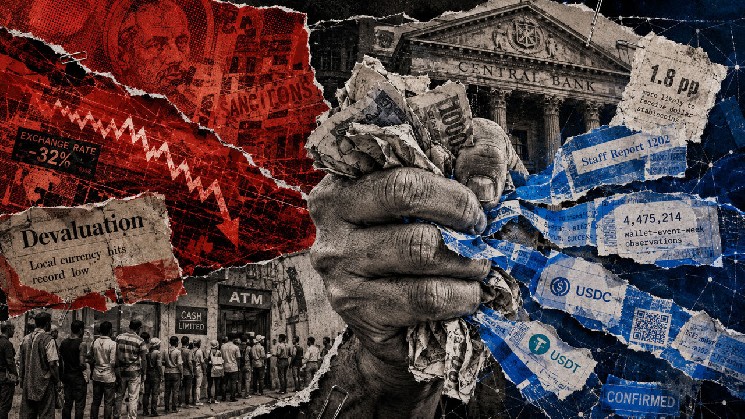
    A new study from the Federal Reserve Bank of New York reveals that dollar-pegged stablecoins flow more aggressively into digital wallets linked to countries undergoing currency or banking crises, highlighting a growing challenge for central banks attempting to manage capital flight.

    Crisis-Linked Wallets Show Higher Stablecoin Receipts

    Researchers Pablo Azar, Maryam Farboodi, and Nish Sinha found that wallets associated with nations experiencing financial distress were 1.8% more likely to receive dollar stablecoins during the week a crisis began. Receipt volumes across these wallets also increased significantly during those periods, according to an August staff paper published by the New York Fed.

    The analysis covered nine crisis episodes across eight countries between 2021 and 2025, including monetary disruptions, banking restrictions, sanctions, and devaluations affecting Argentina, Egypt, Iran, Myanmar, Nigeria, Russia, Turkey, and the United Kingdom.

    Methodology: Linking On-Chain Activity to Country Signals

    To trace stablecoin flows, the researchers linked Ethereum Name Service (ENS) registrations carrying country indicators—such as languages, scripts, and national identifiers—with transfer histories for 19 major dollar-pegged stablecoins.

    During crisis weeks, tagged wallets recorded both a higher probability of receiving stablecoins and larger receipt volumes. A separate specification found no significant increase in the two weeks before the shocks, while the probability of receiving stablecoins rose 1.9% during the crisis week itself.

    Sending activity increased later, with wallets becoming 1.3% more likely to send stablecoins two weeks after the crisis began. The sequence supports the researchers’ argument that demand for blockchain-based dollars rises when confidence in domestic financial arrangements comes under pressure.

    Data Limitations and Scope

    The dataset does not represent every resident or crypto wallet in the countries studied. Its roughly 4.5 million observations are wallet-event-week records, and the sample focuses on wallet-country pairs that received stablecoins at some point within a 53-week window around each crisis.

    The result therefore captures a change in behavior among wallets already connected to stablecoin activity rather than showing that stablecoin adoption rose by 1.8% across an entire national population.

    Stablecoins Complicate the Capital-Control Playbook

    The findings feed directly into a longstanding constraint on monetary policy described by the Mundell-Fleming framework: countries cannot simultaneously maintain a fixed exchange rate, unrestricted capital mobility, and independent control over domestic interest rates.

    Governments seeking to protect a currency while retaining monetary autonomy have traditionally restricted capital movement through banks and other regulated intermediaries. The New York Fed researchers model stablecoins as weakening that enforcement channel.

    A household facing restrictions on buying or transferring dollars through its bank may instead receive dollar-denominated tokens into a blockchain wallet. As access to those rails expands, the government must devote more resources to enforcement or allow more of the pressure to emerge through currency depreciation or domestic interest rates.

    The paper does not establish that stablecoins caused particular currencies to weaken during the nine episodes. Instead, the observed wallet activity supports the model’s central assumption that financial stress encourages stablecoin adoption. Its broader monetary-policy consequences remain theoretical.

    Centralized Issuers and Regulated Exchanges Remain Control Points

    Governments retain significant points of control. Major dollar tokens such as USDT and USDC are issued by centralized companies that can freeze addresses, while regulated exchanges can be required to restrict transactions or identify customers.

    Those powers shift enforcement away from a country’s banking system toward a wider network of issuers, exchanges, and blockchain addresses. Transfers between self-custodied wallets can leave governments with fewer immediate domestic chokepoints even when issuers retain the ability to intervene at other stages.

    Market Growth Amplifies Policy Challenge

    The policy challenge becomes more consequential as stablecoins expand from a niche crypto product into a global dollar-payment network. The market has already grown beyond $300 billion and is expected to reach trillions of dollars before the end of the decade.

    Blockchain analysis firm Chainalysis projects an even steeper rise in activity, estimating that adjusted stablecoin transaction volume could reach $719 trillion by 2035 through organic growth alone and approach $1.5 quadrillion if broader macro and adoption trends accelerate usage.

    That growth would increase the number of routes available to households seeking dollar exposure during periods of domestic financial stress, but it would not put stablecoins entirely beyond government reach.

    Regulatory Warnings Highlight Enforcement Gaps

    Federal Reserve Vice Chair for Supervision Michael Barr warned in June that U.S. stablecoin legislation left an illicit-finance vulnerability around secondary-market transfers involving unhosted wallets.

    The Bank for International Settlements (BIS) has identified a similar problem for monetary policy, arguing that stablecoin dollarization can threaten monetary sovereignty while restrictions may prove less effective when bearer-like tokens circulate through self-custodied wallets.

    That creates a more fragmented enforcement map. Governments can exert substantial control over banks, stablecoin issuers, and regulated trading venues, but may have less visibility or immediate reach when dollar tokens move between private wallets without returning to those intermediaries.

    Stablecoins Becoming a Macroeconomic Constraint

    The distinction becomes particularly important during a currency crisis, when demand for an alternative store of value and payment rail can rise just as authorities try to restrict capital movement.

    The New York Fed paper suggests that this choice of financial infrastructure is becoming part of the macroeconomic constraint itself. As stablecoin networks grow, effective capital mobility increasingly depends on both the controls governments impose and the blockchain rails households can still access.

    At the scale projected for the next decade, that could turn stablecoins from an alternative payment mechanism into a material constraint on how governments defend currencies during periods of financial stress.