Tag: USDC

  • Binance Deal Boosts Circle in Stablecoin Race With Tether, Analysts Say

    Binance Deal Boosts Circle in Stablecoin Race With Tether, Analysts Say

    Key Highlights

    • Binance processed $5 million to $10 billion in daily USDC spot trading volume throughout 2026, capturing 10-20 times more activity than most other exchanges which typically stay below $500 million daily.
    • USDC’s market capitalization reaches approximately $74 billion, remaining the second-largest dollar stablecoin behind Tether’s USDT at roughly $140 billion.
    • Circle is expanding beyond issuance with its Circle Payments Network and a $400 million acquisition of Singapore-based Tazapay to build payment infrastructure across emerging markets.

    Binance Drives USDC Trading Dominance in 2026

    Binance has cemented its position as the primary venue for USDC spot trading throughout 2026, consistently capturing the largest share of daily volume according to data from market research firm Kaiko. The exchange processed between $5 million and $10 billion in USDC spot trading activity each day, a figure that dwarfs the competition. Most other trading venues typically remain below $500 million in daily USDC volume, making Binance’s throughput roughly 10 to 20 times greater than its nearest rivals.

    “Throughout 2026, Binance has consistently captured the largest share of $USDC spot trading activity, processing $5 million-$10 billion in daily volume, roughly 10-20 times more than most other trading venues, which typically stay below $0.5 billion,” said Anastasia Melachrinos, head of research at Kaiko.

    Exchange Landscape Remains Static as Binance Expands

    Kaiko’s analysis indicates that other major exchanges have largely maintained their previous USDC trading ranges, suggesting that Binance itself has been the primary driver of the volume increase. The concentration of activity on a single platform underscores the exchange’s outsized influence on stablecoin liquidity and market structure. As Binance continues to push USDC adoption in emerging markets, researchers expect this dominance to intensify further.

    “As Binance accelerates $USDC’s reach in emerging markets, that dominance is likely to grow even further,” Melachrinos said.

    Circle Counters Tether with Infrastructure Play

    The trading dynamics unfold against a backdrop of intensifying competition between the two leading dollar-pegged stablecoins. USDC currently holds a market capitalization of about $74 billion, positioning it as the second-largest U.S. dollar stablecoin behind Tether’s USDT, which commands roughly $140 billion. Industry observers see a clear mutual incentive for both Binance and Circle, USDC’s issuer, to expand the stablecoin’s footprint through the exchange’s global user base and infrastructure.

    “There is a clear incentive on both sides to grow $USDC through Binance’s user base and infrastructure,” said Martins Benkitis, co-founder and CEO of Gravity Team.

    Circle has been actively building beyond its core issuance business. The company’s Circle Payments Network aims to connect financial institutions for stablecoin-based payments, while its recently announced $400 million acquisition of Singapore-based Tazapay would add local banking relationships and payment rails across emerging markets. This strategy arrives as the stablecoin competitive landscape broadens beyond the traditional Circle-Tether duopoly, with major banks and payment companies including Visa, Mastercard, and Stripe pushing further into stablecoin payments and infrastructure.

    Why This Matters

    The concentration of USDC trading volume on Binance highlights the evolving market structure of stablecoin liquidity, where a single centralized exchange acts as the primary price discovery venue for a major digital asset. For Circle, the partnership with Binance and the Tazapay acquisition represent a strategic pivot toward becoming a payments infrastructure company, not just a stablecoin issuer. This shift coincides with increasing regulatory clarity in major jurisdictions and the entry of traditional financial giants like Visa and Stripe, signaling a maturation of the stablecoin sector from speculative trading instruments to settlement layers for global commerce. The coming months will test whether Circle’s infrastructure investments can translate USDC’s trading dominance into broader adoption for cross-border payments and institutional settlement.

    Frequently Asked Questions

    How much USDC trading volume does Binance handle compared to other exchanges?
    Binance processes $5 million to $10 billion in daily USDC spot trading volume, which is roughly 10-20 times more than most other trading venues that typically stay below $500 million daily, according to Kaiko research.
    What is Circle’s strategy beyond stablecoin issuance?
    Circle is building the Circle Payments Network to connect financial institutions for stablecoin payments and has announced a $400 million acquisition of Singapore-based Tazapay to gain local banking relationships and payment rails across emerging markets.
    How does USDC’s market cap compare to USDT?
    USDC has a market capitalization of about $74 billion, making it the second-largest U.S. dollar stablecoin behind Tether’s USDT at roughly $140 billion.
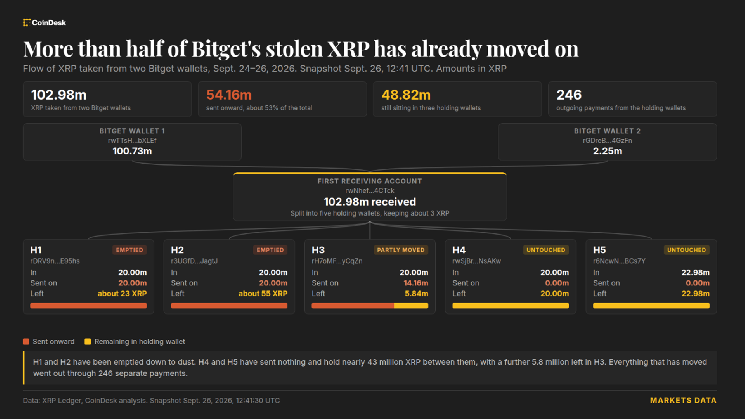
  • Bitget Hacker Moves $83 Million in Stolen XRP That Ripple Cannot Freeze

    Bitget Hacker Moves $83 Million in Stolen XRP That Ripple Cannot Freeze

    Key Highlights

    • Circle and Tether froze approximately $320,000 in USDC and USDT stablecoins linked to the Bitget exchange hack, leveraging built-in blacklist controls.
    • The attacker moved roughly 54 million XRP from the original five holding wallets overnight, reducing the balance from 70 million to 49 million tokens in eight hours.
    • XRP traded near $1.54 on Saturday, down 4% in 24 hours but retaining a 9% weekly gain, with the stolen haul valued at approximately $160 million.

    Stablecoin Issuers Intervene to Block Illicit Funds

    Circle and Tether, the operators behind the leading dollar-pegged stablecoins USDC and USDT, have taken swift action to mitigate the fallout from the massive Bitget crypto exchange breach. The companies froze roughly $320,000 worth of stablecoins associated with the hacker’s wallet addresses. Both tokens possess programmable controls that allow the issuers to blacklist specific addresses, effectively preventing the frozen assets from being transferred or redeemed. This intervention highlights the centralized enforcement layer that exists within major fiat-backed stablecoins, a feature often cited by regulators and critics alike.

    Attacker Accelerates XRP Distribution Across Wallets

    On-chain data shows the perpetrator significantly sped up the movement of stolen XRP tokens during the early hours of Saturday. At 04:32 UTC, approximately 70 million XRP remained in the original five accounts identified as the initial holding points for the stolen funds. Roughly eight hours later, that aggregate balance had dropped to 49 million, indicating a rapid dispersal strategy. The transfers reveal the attacker distributing the assets across a growing number of wallets, a common tactic to obfuscate the trail and complicate recovery efforts.

    Transaction Patterns Suggest Automated Scripting

    Analysis of the transfer flows shows certain payments replicating routes previously used by the first wallet. In one notable instance, an attempted transfer of about 521,000 XRP failed because the sending account lacked sufficient funds. Approximately one hour later, a second wallet executed an identical transfer of 521,000 XRP to the same intended recipient. This pattern suggests the use of automated scripts or predetermined routing logic rather than purely manual intervention, with the attacker managing multiple wallets in parallel to drain the holdings.

    Market Absorbs Supply Overhang Amid Price Resilience

    Despite the significant movement of stolen funds, XRP markets displayed relative stability on Saturday. The token traded around $1.54, representing a 4% decline over the preceding 24 hours but maintaining a weekly gain of approximately 9%, according to data from CoinGecko. At the prevailing price, the original XRP haul—estimated at roughly 100 million tokens based on the 54 million moved and 49 million remaining—was worth approximately $160 million. That figure equates to roughly 4% of XRP’s reported $4.4 billion in daily trading volume, suggesting the market possesses sufficient liquidity to absorb potential sell pressure, though actual price impact will depend on the depth of buy orders at the time of execution.

    Why This Matters

    The Bitget hack and subsequent fund movements underscore several critical dynamics in the crypto ecosystem. First, the ability of Circle and Tether to freeze assets demonstrates the “off-switch” capability inherent in centralized stablecoins, providing a rapid response mechanism for illicit flows that does not exist for native blockchain assets like XRP. Second, the speed and sophistication of the XRP laundering—evidenced by automated multi-wallet distribution and retry logic—illustrates the operational maturity of modern cybercriminal groups targeting exchanges. Finally, the market’s muted price reaction reflects XRP’s deep liquidity and the market’s growing desensitization to large-scale exchange breaches, though the ultimate impact hinges on whether the attacker opts for rapid liquidation via decentralized exchanges or slower over-the-counter channels.

    Frequently Asked Questions

    How much XRP was stolen in the Bitget hack?

    Based on on-chain analysis, the original haul held in five primary wallets totaled approximately 119 million XRP (70 million remaining at 04:32 UTC plus 49 million moved subsequently). At Saturday’s price of $1.54, the total value was roughly $160 million.

    Can Circle and Tether freeze XRP tokens?

    No. Circle and Tether can only freeze assets issued on their respective contracts—USDC and USDT. XRP is a native asset on the XRP Ledger and does not have a centralized freeze function. The $320,000 freeze applied only to stablecoin balances held in the hacker’s wallets.

    Will the stolen XRP dump crash the price?

    The stolen amount represents about 4% of XRP’s reported daily trading volume ($4.4 billion). While a sudden market sale could cause short-term slippage, the depth of the order books across major exchanges suggests the market could absorb the supply without a catastrophic price collapse, especially if distributed over time or via OTC desks.

  • Circle Mints $500M USDC on Solana in 6 Hours

    Circle Mints $500M USDC on Solana in 6 Hours

    Key Highlights

    • Circle minted approximately $500 million USDC on the Solana blockchain within a six-hour window, signaling strong stablecoin demand.
    • The minting activity was flagged by on-chain analyst @SolanaFloor and coincides with Solana’s expanding role in tokenized finance and DeFi.
    • Increased USDC supply on Solana is expected to boost network liquiduity, potentially influencing trading volumes and DeFi protocol activity.

    Circle Accelerates USDC Supply on Solana Amid Growing Ecosystem Demand

    Circle Internet Financial has minted roughly $500 million worth of USD Coin (USDC) on the Solana blockchain over a six-hour period, according to on-chain data highlighted by prominent crypto commentator @SolanaFloor. The substantial issuance underscores accelerating demand for dollar-pegged stablecoins within Solana’s rapidly expanding decentralized finance (DeFi) and tokenized asset ecosystem. As one of the two dominant regulated stablecoins globally—alongside Tether’s USDT—USDC’s supply dynamics on high-throughput chains like Solana serve as a real-time barometer for institutional and retail capital flows into on-chain financial applications.

    Strategic Liquidity Expansion in a Mixed Market Environment

    The minting surge arrives while the broader cryptocurrency market exhibits divergent momentum across major assets such as Bitcoin and Ether. Circle’s decision to preemptively expand USDC supply on Solana appears to be a proactive liquidity management strategy, ensuring adequate stablecoin reserves are available for trading, lending, and settlement as Solana continues to attract capital allocated to tokenized real-world assets (RWAs), payment rails, and high-frequency DeFi strategies. The Solana network’s sub-second finality and low transaction fees have positioned it as a preferred execution layer for market makers and quantitative funds rotating stablecoin inventories across venues.

    USDC’s Regulatory Framework and Cross-Chain Utility

    Issued by Circle under a regulated framework that includes regular attestations of reserve assets—primarily short-term U.S. Treasuries and cash held at regulated financial institutions—USDC maintains a 1:1 peg to the U.S. dollar. This regulatory clarity, combined with native issuance on networks including Ethereum, Solana, Arbitrum, Polygon, and Avalanche, allows USDC to function as interoperable settlement infrastructure. The latest Solana minting reinforces Circle’s multi-chain distribution strategy, which aims to meet demand where transaction activity concentrates rather than relying solely on cross-chain bridges that introduce latency and smart-contract risk.

    Why This Matters

    Stablecoin minting volumes on high-performance blockchains like Solana are increasingly viewed as leading indicators of on-chain economic activity. A $500 million injection in six hours suggests market participants are positioning for elevated trading volumes, new DeFi protocol launches, or expanded tokenized treasury and money-market fund offerings on Solana. For traders and liquidity providers, deeper USDC pools reduce slippage on decentralized exchanges such as Orca and Raydium and improve capital efficiency for basis trades and funding-rate arbitrage. For the broader industry, the move signals confidence in Solana’s infrastructure maturity following network upgrades that have improved reliability and throughput consistency.

    Frequently Asked Questions

    Who reported the $500 million USDC minting on Solana?

    The on-chain activity was identified and publicized by @SolanaFloor, a widely followed CryptoTwitter commentator and analytics account that tracks Solana ecosystem metrics in real time.

    What does a large USDC mint typically indicate?

    Large minting events generally reflect anticipation of increased demand for the stablecoin—whether for trading, DeFi lending, payments, or as collateral for tokenized asset issuance—rather than immediate circulation. Circle mints USDC in response to authorized institutional redemption requests.

    How might this affect Solana’s DeFi ecosystem?

    Additional native USDC supply deepens liquidity on Solana-based decentralized exchanges and lending protocols, potentially lowering borrowing costs, tightening spreads, and enabling larger position sizes for market makers and yield strategies operating on the network.

  • Coinbase Launches Fixed-Rate USDC Loans Backed by Bitcoin

    Coinbase Launches Fixed-Rate USDC Loans Backed by Bitcoin

    Key Highlights

    • Coinbase launches fixed-rate USDC loans backed by Bitcoin, offering borrowers certainty on interest costs and repayment dates.
    • The new product runs on Morpho Midnight, a decentralized fixed-rate lending protocol that settles on Coinbase’s Base layer-2 network.
    • Fixed-rate loans sit alongside Coinbase’s existing variable-rate Morpho Blue offering, which currently holds over $1.4 billion in active loans.

    Coinbase Expands Crypto Lending With Fixed-Rate Bitcoin-Backed USDC Loans

    Nasdaq-listed cryptocurrency exchange Coinbase (COIN) has introduced a fixed-rate borrowing option that allows users to mint dollar-pegged stablecoin USDC against their Bitcoin (BTC) holdings. Announced on Tuesday, the new product sets both the interest rate and the repayment date at the moment of borrowing, providing a predictable alternative to the exchange’s existing variable-rate loans. The move signals a significant evolution in how centralized platforms are integrating decentralized finance primitives to offer more sophisticated credit products.

    Morpho Midnight Powers the Fixed-Rate Infrastructure

    The fixed-rate offering operates on Morpho Midnight, a decentralized, non-custodial lending protocol designed specifically for fixed-rate and fixed-term crypto loans. Launched in July of this year, Morpho Midnight enables borrowers to lock in borrowing costs for a defined period, shielding them from the rate volatility inherent in utilization-based models. All transactions settle on Base, Coinbase’s Ethereum layer-2 network, combining the efficiency of a rollup with the composability of onchain lending markets.

    Contrast With the Existing Variable-Rate Model

    Until now, Coinbase’s lending functionality has relied exclusively on the Morpho Blue protocol, where interest rates fluctuate algorithmically based on real-time supply and demand dynamics. During periods of heightened borrowing demand, those variable rates can climb sharply, introducing uncertainty for users managing leveraged positions or liquidity needs. “The move takes onchain borrowing beyond the predominantly variable-rate model, giving users greater certainty over the cost and duration of their borrowing,” according to an announcement on Tuesday. The floating-rate market remains substantial, with more than $1.4 billion in active loans backed by nearly $3 billion of collateral, and will continue to operate alongside the new fixed-term option.

    Why This Matters

    The introduction of fixed-rate, Bitcoin-backed loans on a regulated exchange venue represents a meaningful bridge between traditional finance expectations and decentralized finance architecture. For retail and institutional users alike, the ability to borrow against BTC without selling—and with a known cost of capital—mirrors the term-loan structures common in traditional credit markets. By leveraging Morpho Midnight’s immutable smart contracts and settling on Base, Coinbase reduces counterparty risk while maintaining a compliant, user-friendly interface. This development also underscores the growing role of purpose-built lending protocols like Morpho in powering the next generation of onchain credit, moving the ecosystem beyond the purely variable-rate paradigm that has dominated DeFi lending since its inception.

    Frequently Asked Questions

    What is the difference between Coinbase’s new fixed-rate loans and its existing variable-rate loans?

    Fixed-rate loans lock in the interest rate and repayment date at the time of borrowing, providing cost certainty. Variable-rate loans on Morpho Blue have interest rates that change based on supply and demand and can increase when borrowing demand spikes.

    Which protocol and network power the new fixed-rate USDC loans?

    The fixed-rate loans run on Morpho Midnight, a decentralized fixed-rate lending protocol launched in July, and settle on Base, Coinbase’s Ethereum layer-2 network.

    How large is Coinbase’s existing variable-rate lending market?

    The floating-rate loans on Morpho Blue currently have more than $1.4 billion in active loans backed by nearly $3 billion of collateral.

  • Binance Acquires $100M Circle Stake in Five-Year USDC Promotion Deal

    Binance Acquires $100M Circle Stake in Five-Year USDC Promotion Deal

    Key Highlights

    • Binance acquired $100 million worth of Circle Class A shares at $80.84 per share in a private placement that closed September 17, per an SEC filing.
    • The equity purchase accompanies a five-year expanded partnership where Circle will pay Binance monthly incentive fees tied to USDC holdings via Circle’s Modular Smart Contract Wallet.
    • Binance faces a two-year lockup on selling, transferring, or hedging the shares but retains full voting rights throughout the restriction period.

    Binance Deepens Ties with Circle Through $100 Million Equity Investment

    Binance has acquired 1.24 million Class A shares of Circle Internet Financial at $80.84 per share, committing $100 million in a private placement that closed on September 17, according to a U.S. Securities and Exchange Commission filing published Tuesday. The transaction price represented a discount to Circle’s market valuation prior to the sale, the stablecoin issuer confirmed. The equity stake comes with a contractual lockup preventing Binance from selling, transferring, or hedging the shares for up to two years, subject to certain exceptions, though the exchange retains the right to vote its shares during the restriction period.

    Strategic Partnership Expansion Anchors USDC Growth on Binance

    The equity purchase coincides with a significant expansion of the companies’ existing partnership around USD Coin (USDC), Circle’s dollar-pegged stablecoin. Under the new five-year agreement, Circle will pay Binance a monthly incentive fee calculated as a percentage of the USDC held through Circle’s Modular Smart Contract Wallet service. In exchange, Binance will execute promotional activities designed to drive adoption and usage of USDC across its global trading platform. The arrangement effectively aligns Binance’s financial interests with the growth of USDC reserves custodied through Circle’s infrastructure.

    Lockup Terms Preserve Voting Rights While Limiting Liquidity

    The share restrictions impose a notable constraint on Binance’s ability to manage its investment position. For a period extending up to two years from closing, the exchange is prohibited from selling, transferring, or entering into hedging transactions involving the Circle shares. However, the agreement explicitly preserves Binance’s voting rights attached to the Class A shares, allowing the exchange to participate in corporate governance matters throughout the lockup. Certain exceptions to the transfer restrictions apply, though the filing does not specify their precise nature.

    Why This Matters

    This deal signals a deepening institutional alignment between the world’s largest cryptocurrency exchange by volume and the second-largest stablecoin issuer. By taking an equity stake, Binance gains a direct financial interest in Circle’s trajectory—potentially including a future public listing—while securing favorable economics on USDC distribution. For Circle, the partnership guarantees prime placement and promotional support on Binance’s platform, which remains a critical liquidity venue for stablecoins despite regulatory headwinds in multiple jurisdictions. The structure also reflects a broader trend: stablecoin issuers competing aggressively for distribution through incentive programs, with Tether’s USDT still commanding the dominant market share. Regulators will likely scrutinize the incentive fee mechanism, which ties payments to custodial volumes, for potential conflicts of interest or market manipulation concerns.

    Frequently Asked Questions

    How much did Binance pay per share for its Circle stake?

    Binance purchased 1.24 million Class A shares at $80.84 per share, totaling $100 million. The price reflected a discount to Circle’s pre-sale market valuation.

    What restrictions apply to Binance’s Circle shares?

    Binance cannot sell, transfer, or hedge the shares for up to two years, subject to certain unspecified exceptions. The exchange retains full voting rights during the lockup period.

    How does the incentive fee structure work in the USDC partnership?

    Circle will pay Binance a monthly fee calculated as a percentage of USDC held through Circle’s Modular Smart Contract Wallet service. Binance will conduct promotional activities for USDC in return.

  • Circle Launches Bitcoin-Backed USDC Borrowing Service

    Circle Launches Bitcoin-Backed USDC Borrowing Service

    Key Highlights

    • Circle has launched Digital Asset-Backed Borrowing for eligible Circle Mint institutions, enabling them to deposit Bitcoin, mint cirBTC, and borrow USDC through third-party DeFi lending markets on Arc and Ethereum.
    • Morpho is the first supported protocol, with an 86% liquidation loan-to-value threshold on Arc; Circle indicates Aave and other platforms will follow, though no timetable has been announced.
    • The service keeps native Bitcoin in regulated custody via Circle National Trust while cirBTC circulates as collateral through user-controlled Smart Wallets, separating DeFi credit risk from Circle Mint balances.

    Circle Unveils Institutional Bitcoin-Backed USDC Borrowing via DeFi Protocols

    Circle announced on September 21, 2026, the launch of Digital Asset-Backed Borrowing for eligible Circle Mint LLC customers, introducing a streamlined workflow that allows institutions to deposit native Bitcoin ($BTC), mint Circle Wrapped Bitcoin (cirBTC), and borrow $USDC through third-party lending markets on the Arc and Ethereum networks. The product combines what were previously separate steps—custody, wrapping, and DeFi borrowing—into a single coordinated interface, with Morpho serving as the inaugural supported lending protocol.

    Digital Asset-Backed Borrowing is now available in Circle Mint for eligible Circle Mint LLC customers.Deposit $BTC. Mint cirBTC. Borrow $USDC.Through one coordinated workflow, customers can use $BTC-backed cirBTC as collateral through supported third-party lending markets on Arc… the company posted on its official X account on September 21.

    How the Borrowing Workflow Operates

    Under the new workflow, an eligible institution deposits Bitcoin into Circle Mint and mints cirBTC, a 1:1 Bitcoin-backed token. The customer then transfers cirBTC into a user-controlled Smart Wallet, posts the token as collateral with a supported protocol such as Morpho, and borrows USDC. Borrowed funds move automatically from the Smart Wallet into the customer’s Circle Mint balance. Repayment follows the same path: USDC sent from Circle Mint into the Smart Wallet repays part or all of the outstanding debt, freeing collateral subject to the lending protocol’s rules.

    Circle emphasizes that it does not provide the underlying credit. Its legal terms state that Circle Technology Services supplies the interface and Smart Wallet technology, while lending, collateral management, and liquidations occur entirely through third-party DeFi protocols and their smart contracts. Assets moved into the Smart Wallet are no longer held within the regulated Circle Mint environment. Circle Mint remains an institutional service; individual retail users cannot open standard Mint accounts, and Digital Asset-Backed Borrowing carries additional jurisdiction and eligibility requirements. Circle confirmed that New York customers are excluded from the borrowing product.

    Morpho Leads on Arc with Live cirBTC-USDC Markets

    Morpho provides the first lending infrastructure integrated with the Circle Mint borrowing workflow. On Arc, the protocol operates a USDC market using cirBTC as collateral with an 86% liquidation loan-to-value threshold. Live Morpho data viewed on September 22 showed $18.86 million in outstanding borrowing against $157.85 million of available liquidity. The market held $176.71 million in total size with utilization at 10.67%, and no realized or unrealized bad debt was displayed at the time of verification. These figures fluctuate as users supply liquidity, borrow, repay, or withdraw funds.

    Circle’s terms make clear that displayed rates and protocol parameters come from third parties and can change without Circle’s control. Automatic liquidation can occur if collateral values, oracle readings, interest charges, or protocol settings push a position beyond the applicable limit. Morpho had moved onto Arc when Circle’s Layer 1 went public on September 16. As previously reported, the Arc mainnet launched with USDC as its native gas asset, while Morpho and Aave supplied lending infrastructure alongside applications for trading and tokenized assets. Morpho had indicated before the Digital Asset-Backed Borrowing release that institutional Circle Mint customers would gain access to its Arc credit markets directly through Circle’s interface, and the protocol has separately proposed a $50,000 monthly incentive budget for Arc borrowing activity under its governance process.

    cirBTC Reserves Verified Above Outstanding Supply

    cirBTC serves as the collateral bridge connecting native Bitcoin with the Ethereum and Arc smart-contract environments. Circle first introduced the asset on Ethereum in June before bringing it to Arc on September 21. The launch on Ethereum introduced 1:1 Bitcoin backing alongside Chainlink Proof of Reserve, allowing market participants to inspect reserve information while native Bitcoin remains held separately from circulating wrapped tokens.

    Current Circle data showed 948.7508 cirBTC outstanding against 951.2586 BTC in reserves at the time of verification. Arc accounted for 396.9919 cirBTC, while Ethereum carried 551.7590 cirBTC. The displayed reserve value stood at roughly $77.19 million. Circle states the underlying Bitcoin is held through its Bermuda affiliate and safeguarded by Circle National Trust in segregated accounts for cirBTC holders. Circle National Trust received final approval from the Office of the Comptroller of the Currency (OCC) in July to operate as a federally chartered national trust bank. The OCC charter permits the trust bank to provide regulated digital asset custody services; it does not accept deposits or make loans, and digital assets held there are not FDIC insured.

    Circle affirms that cirBTC reserves are not lent, pledged, or rehypothecated. Chainlink Proof of Reserve publishes reserve information onchain, while Circle lists Bitcoin reserve addresses so counterparties can compare native BTC holdings with circulating cirBTC supply.

    Regulatory Perimeter and Risk Disclosures

    Circle’s legal documentation draws a clear line between the Circle Mint account and the DeFi borrowing position. Once collateral leaves Circle Mint for the Smart Wallet, Circle Internet Financial no longer holds those assets under the controls applying to balances kept inside Mint. Customers control the Smart Wallet through a two-of-two multiparty computation key-management system. Circle says it cannot independently initiate, reverse, or cancel blockchain transactions from the wallet. Borrowers remain responsible for monitoring their positions, maintaining collateral, and reviewing protocol risks.

    Liquidations are controlled entirely by the selected lending protocol. Circle warns that falling collateral values, changing rates, oracle movements, or revised market parameters can trigger an automatic liquidation without prior notice, potentially resulting in penalties or collateral losses.

    Why This Matters

    The launch represents a significant step in bridging regulated institutional custody with decentralized finance credit markets. By enabling institutions to unlock dollar liquidity from Bitcoin holdings without selling the underlying asset, Circle addresses a core treasury management need for crypto-native firms and traditional financial institutions entering digital assets. The architecture—keeping native Bitcoin in an OCC-chartered trust while cirBTC circulates through audited smart contracts—offers a compliance-forward model that separates custodial risk from DeFi protocol risk.

    Morpho’s immediate integration on Arc, just five days after the network’s public mainnet launch, demonstrates the velocity at which lending infrastructure can deploy on new chains when native gas assets (USDC) and wrapped collateral (cirBTC) are natively available. The forthcoming addition of Aave and other protocols would deepen liquidity and provide institutions with protocol choice, a key requirement for treasury diversification. Meanwhile, Circle’s expanding institutional USDC network—evidenced by BNY’s June launch of USDC minting, redemption, and custody and Standard Chartered’s July introduction of bank-led USDC access—signals a broader strategy to embed USDC into regulated financial plumbing while using DeFi as a complementary, opt-in yield and credit layer.

    Frequently Asked Questions

    Who is eligible to use Circle’s Digital Asset-Backed Borrowing?

    Only eligible Circle Mint LLC customers—institutional entities that meet jurisdiction and compliance requirements—can access the product. Individual retail users cannot open standard Circle Mint accounts, and New York customers are explicitly excluded from the borrowing service.

    What happens to the Bitcoin deposited as collateral?

    Native Bitcoin is held through Circle’s Bermuda affiliate and safeguarded by Circle National Trust, an OCC-chartered national trust bank, in segregated accounts. The Bitcoin is not lent, pledged, or rehypothecated. cirBTC is minted 1:1 against these reserves, and Chainlink Proof of Reserve provides onchain verification of the backing.

    Does Circle control the lending terms or liquidation process?

    No. Circle provides the interface and Smart Wallet technology through Circle Technology Services. Lending, collateral management, interest rates, liquidation thresholds, and liquidation execution are controlled entirely by the third-party DeFi protocol (currently Morpho) and its smart contracts. Circle cannot initiate, reverse, or cancel transactions from the user-controlled Smart Wallet.

  • NEAR Surges 21% on Launch of Historic Confidential Perps Powered by Hyperliquid

    NEAR Surges 21% on Launch of Historic Confidential Perps Powered by Hyperliquid

    Key Highlights

    • Near Protocol launches the industry’s first “Confidential by Default” perpetuals trading, masking all position details including asset types, sizes, entry times, and trading direction.
    • The feature runs on Near’s multi-chain Confidential Intents pipeline, which recently surpassed $70 million in total value locked (TVL), with Hyperliquid serving as the chief execution and liquidity layer.
    • NEAR token surges 21.36% to $3.21 while HYPE gains 10.82% to $86.72 following the announcement and Kraken parent Payward’s plans to bring Hyperliquid to the US market.

    Near Protocol Pioneers Confidential Perpetuals Trading on Blockchain

    Near Protocol has unveiled what it describes as the decentralized finance industry’s first “Confidential by Default” perpetuals trading environment, a development that directly addresses a fundamental tension in blockchain architecture: the conflict between radical transparency and competitive trading execution. The new feature, accessible via near.com, completely obscures all perpetual position data—including asset types, position sizes, entry timestamps, and directional bias—from public view.

    While transparency remains a foundational principle of blockchain technology, Near’s development team argues that complete visibility creates structural disadvantages for significant market participants. The protocol identifies three specific vulnerabilities inherent in fully transparent order books: front-running by on-chain bots that detect pending orders and execute ahead of them, strategy copying that allows competitors to mirror profitable approaches, and forced liquidations where malicious actors target public liquidation prices to push traders out of positions.

    Technical Architecture and Strategic Partnerships

    The confidential perpetuals infrastructure operates on Near’s multi-chain Confidential Intents pipeline, which recently achieved a $70 million total value locked milestone. The system combines high-speed execution with selective disclosure capabilities designed to satisfy regulatory compliance requirements. Integration with Circle’s USDC stablecoin enables inter-agentic payments, while Hyperliquid functions as the primary execution and liquidity layer, providing access to over 50 perpetual markets with leverage up to 40x.

    This architecture effectively merges the privacy characteristics traditionally associated with centralized exchanges—where order books and position data remain opaque—with blockchain’s core value propositions of speed, decentralization, and non-custodial asset control.

    Why This Matters: The Evolving Privacy Landscape in DeFi

    Near’s launch reflects accelerating industry demand for private transaction capabilities that maintain regulatory compliance. The competitive landscape now includes Ethereum-based confidential DeFi yield vaults, optional privacy wrappers from platforms such as Zama and Fhenix, and Cardano’s Midnight chain which offers what its developers term “rational privacy.” Each approach represents a different philosophical and technical solution to the privacy-transparency spectrum.

    However, Near’s confidential perpetuals trading remains restricted in the United States and Canada due to regulatory considerations, highlighting the ongoing tension between privacy-preserving financial infrastructure and jurisdictional compliance requirements. The geographic limitation underscores that technical innovation in this space continues to outpace regulatory clarity.

    Market Response and Price Action

    Following the announcement, NEAR token appreciated 21.36% intraday to trade at $3.21, according to CoinMarketCap data. The move coincides with broader sector rotation toward artificial intelligence-linked crypto assets. Technical analysis suggests that if NEAR maintains support above $3.00, the token could retest the $3.33 incentive threshold, while a break below $2.80 might trigger a decline toward the $2.57 Fibonacci support level.

    Simultaneously, HYPE token—native to the Hyperliquid ecosystem—gained 10.82% to reach $86.72 after Kraken’s parent company Payward announced plans to introduce Hyperliquid to the United States market, potentially expanding the protocol’s regulatory footprint and user base.

    Frequently Asked Questions

    What makes Near’s perpetuals trading “Confidential by Default”?

    All perpetual position data—including asset types, position sizes, entry times, and trading direction—is automatically masked from public view without requiring users to opt into privacy features.

    Which partners power the execution and liquidity for Near’s confidential perpetuals?

    Hyperliquid serves as the chief execution and liquidity layer, providing access to over 50 perpetual markets with up to 40x leverage, while USDC integration enables stablecoin settlements.

    Is Near’s confidential perpetuals trading available to users in the United States?

    No, the service remains restricted in the US and Canada due to regulatory reasons, despite the underlying technical infrastructure being operational globally.

  • Nu Launches U.S. Banking and USDC Global Account

    Nu Launches U.S. Banking and USDC Global Account

    Nu Launches U.S. Banking and Global Stablecoin Products as Latin American Leader Expands North

    Latin America’s largest digital bank, Nu, officially entered the United States on September 10 with two distinct product lines: a domestic banking suite backed by Lead Bank and a separate global offering, Nu Global, that converts customer deposits into stablecoins. The rollout was disclosed through a company release and a corresponding SEC filing, with both products described as releasing in stages beginning on the announcement date.

    U.S. Banking Through Lead Bank Partnership

    Nu’s U.S. operation provides deposit accounts, debit cards, credit cards, and domestic or international transfers through Lead Bank, a member of the Federal Deposit Insurance Corporation (FDIC). Lead Bank supplies the regulated banking and card services, while Nu operates as a financial technology company.

    Deposit Account and Savings Features

    The U.S. deposit account pays a 3.50% annual percentage yield (APY) on available dollar balances. Interest is calculated and credited daily, and customers retain immediate access to money placed in designated savings goals. Deposits are held by Lead Bank and receive FDIC insurance subject to applicable legal limits and eligibility requirements.

    A limited-edition metal debit card accompanies the account. Domestic transfers carry no fee, while international transfers initially cover Brazil, Mexico, and Colombia. Nu plans to add more countries but has not published a full expansion schedule.

    Credit Card and Future Yield Tiers

    Nu’s Mastercard World Elite credit card carries no annual fee and pays 1.5% unlimited cashback. Customers who meet conditions that have not yet been fully detailed may eventually increase the rate to 2%.

    A future feature promises a 4.50% APY savings goal capped at $10,000 for customers who pair the deposit account with the credit card and complete qualifying transactions. Because Nu repeatedly uses “soon” to describe these higher rates, neither the 4.50% yield nor the 2% cashback should be treated as available to every customer at launch.

    “capturing even a small share of the U.S. market will be transformative for our business,”

    said Cristina Junqueira, co-founder and CEO of Nu’s U.S. operation. She added that the company wants its app to become customers’ primary banking relationship, though Nu has not issued a U.S. customer, deposit, or revenue target.

    Nu Global Converts Deposits into Stablecoins

    Nu Global operates separately from the Lead Bank offering. According to the SEC filing, funds deposited through the global account are converted into Circle-issued $USDC or $EURC stablecoins.

    Yield Rates and Spending Features

    $USDC balances receive an advertised 3.50% APY, while $EURC balances receive 2.20%. Nu says both rates accrue daily but has not committed to maintaining either rate for a fixed period. The account includes a virtual Mastercard for global purchases, and Nu says users can spend at competitive exchange rates without an added foreign-exchange markup, subject to the product’s terms and availability in each jurisdiction.

    Transfer Corridors and Digital Asset Access

    Transfers are initially focused on corridors between Europe and Latin America. Connections with Nu’s systems in Brazil, Colombia, Mexico, and the U.S. are planned for later, but the company has not supplied individual launch dates. Customers can hold and trade a limited selection of digital assets through the same app, including Bitcoin and Ethereum. Nu has not published the complete asset list, supported blockchain networks, or withdrawal conditions in its announcement.

    Swiss Regulatory Framework and Insolvency Protection

    Nu Global AG is a member of VQF, a self-regulatory organization recognized by the Swiss Financial Market Supervisory Authority. Nu’s website says customer balances are covered by a Swiss bank default guarantee to the extent required by law if Nu Global AG becomes insolvent.

    This guarantee differs from FDIC deposit insurance. Nu’s announcement does not identify the guaranteeing bank, state a coverage amount, or explain how claims involving changes in stablecoin value would be calculated.

    Yield Source Undisclosed

    Nu has not identified the source of the advertised $USDC and $EURC yields in its release or SEC filing. It has not said whether the return comes from issuer rewards, reserve income, lending, treasury assets, or a subsidy funded by Nu. In related coverage, crypto.news reported that yield attached to stablecoins can carry risks outside ordinary bank-deposit protections, depending on which entity produces the return and how customer funds are deployed. Nu has not described its product as a decentralized finance strategy.

    National Bank Charter Remains in Organization Stage

    Nu applied to establish Nubank, National Association, on September 30, 2025. The Office of the Comptroller of the Currency (OCC) granted preliminary conditional approval on January 29, 2026. The OCC letter authorizes Nu to continue organizing the proposed bank but does not permit Nubank, N.A. to begin banking operations immediately.

    Before receiving final authorization, the proposed bank must meet the OCC’s preopening conditions, obtain FDIC deposit insurance, and apply for stock in a Federal Reserve Bank. The regulator retains authority to modify, suspend, or withdraw the preliminary approval.

    Nu said in January that it expected to capitalize the bank within 12 months and open it within 18 months, as required by the approval process. Those time frames point to regulatory work continuing into 2027 unless the company completes the requirements earlier.

    Once authorized, Nubank, N.A. expects to provide deposits, credit, lending, and digital-asset custody. The OCC letter says the proposed bank plans to support customer-directed purchases, sales, and on-chain transfers of bank-custodied digital assets, along with staking services. As crypto.news explained in its review of how OCC national charters govern crypto businesses, conditional approval does not equal authorization to begin operating. Applicants must complete capital, management, compliance, and operational requirements before receiving final approval.

    Nu is using Lead Bank to enter the market while its own charter remains in the organization stage. Customers opening current U.S. products therefore receive services from the partner bank, not from the proposed Nubank, N.A.

    Expansion Builds on Latin American Scale

    Nu reported more than 140 million customers across its existing markets when it announced the new products. The company operates in Brazil, Mexico, and Colombia, while its parent, Nu Holdings, has traded on the New York Stock Exchange since 2021.

    In Brazil, Nu says it serves more than 60% of the adult population. The company describes itself as Mexico’s largest digital bank and Colombia’s fourth-largest financial institution by deposits. Each ranking comes from Nu’s corporate announcement.

    The expansion follows Nu’s previous work with digital assets in Latin America. Its Brazilian crypto platform had more than 7 million customers by March 2026, when the company introduced staking-based rewards for Solana. Nucoin provided an earlier link between the company’s banking and token products. As crypto.news previously reported, Nubank created Nucoin as a blockchain-based customer rewards asset before adding more conventional crypto trading and stablecoin services.

    For its latest reported quarter, Nu said net income exceeded $1 billion and return on equity surpassed 32%. Its announcement did not provide separate spending estimates, customer projections, or profitability deadlines for the U.S. and Nu Global businesses.

    Staged Rollout Continues

    Access will expand through a staged release. Nu said early U.S. applicants may receive limited-edition metal Mastercard cards, while transfers to more countries, enhanced cashback, and the higher savings yield remain scheduled for later releases without firm public dates.

  • Nu Launches in U.S. with USDC, EURC Accounts, Reports Say

    Nu Launches in U.S. with USDC, EURC Accounts, Reports Say

    Nu, Latin America’s Largest Digital Bank, Launches U.S. Operations with Multi-Currency Nu Global Account

    Nu, the leading digital bank in Latin America, has officially entered the United States market in a strategic expansion move. The launch introduces Nu Global, a multi-currency digital account designed for cross-border users that supports USDC and EURC stablecoins alongside traditional banking services.

    Comprehensive U.S. Banking Offering Through Lead Bank Partnership

    The U.S. market entry includes a full suite of financial products: deposit accounts, credit cards, and international transfers facilitated through Nu’s banking partner, Lead Bank. The Nu Global account enables users to convert deposits into USDC or EURC, facilitating transactions across more than 35 countries. This capability directly addresses the growing demand for seamless digital banking experiences among users who operate across borders.

    Scale and Strategic Context

    With over 140 million customers globally, Nu brings substantial scale to its U.S. expansion. The move reflects a broader trend toward cryptocurrency integration within traditional finance, positioning the bank at the intersection of digital banking and stablecoin utility. The expansion specifically targets enhanced cross-border financial services, a segment experiencing accelerated adoption.

    Market Dynamics and USDC Integration

    The broader cryptocurrency market currently presents mixed signals, which may influence USDC’s performance as it integrates into conventional banking frameworks. USDC remains a prominent stablecoin, though specific trading volumes are not publicly disclosed at this time. Market dynamics for USDC could shift as Nu’s digital banking services drive potential demand increases for cross-border transactions. The current landscape reflects cautious optimism among traders, particularly as institutions evaluate stablecoin integration into their offerings.

    Forward Outlook: Adoption Metrics and Competitive Precedent

    Market observers should monitor adoption rates of USDC within Nu’s new services, as increased usage could drive sustained demand. Additionally, tracking how Nu’s offerings affect existing digital banking services will provide critical insights into evolving market dynamics. The success of this expansion could establish a precedent for other financial institutions considering similar stablecoin integrations.

    This article is for informational purposes only and does not constitute financial advice.

  • Circle Puts USDC on Chelsea Jersey, FCA Does Not Intervene

    Circle Puts USDC on Chelsea Jersey, FCA Does Not Intervene

    Circle’s Chelsea Shirt Deal Exposes a 14-Month Regulatory Gap in UK Stablecoin Oversight

    On August 31, 2026, roughly 40,000 spectators inside Stamford Bridge watched Chelsea players take the pitch wearing shirts emblazoned with “$USDC by CIRCLE.” Millions more viewed the broadcast across 189 countries. The moment marked the first regulated cryptocurrency company to secure a Premier League front-of-shirt sponsorship, arriving just three months after the Financial Conduct Authority warned clubs against signing “dodgy” crypto sponsors.

    Circle is not dodgy. The company trades publicly on the New York Stock Exchange, holds licenses across four continents, and posts quarterly earnings that rival established fintechs. Yet the product advertised on the shirt—$USDC, a dollar-pegged stablecoin with a circulating supply of 73.7 billion dollars—exists in a regulatory gap that UK law will not close until October 2027.

    Why Chelsea Was Available

    Chelsea has entered each of the last four seasons without a principal shirt sponsor, an anomaly for a club of its stature. The vacancy traces to the sanctions imposed on former owner Roman Abramovich, the subsequent 4.25 billion pound sale to a consortium led by Clearlake Capital and Todd Boehly in May 2022, and the departure of long-time partner Three.

    The sponsorship carousel that followed—Infinite Athlete, DAMAC Properties, IFS—featured short terms and modest figures, nothing matching the 40 million pounds per year Yokohama Tyres paid or the equivalent sum from Three. Clearlake owns 61.5 percent of the club; Boehly holds 18.5 percent. Aggressive player spending had pushed the wage bill past 350 million pounds, creating urgent need for shirt revenue.

    A crypto sponsor willing to pay north of 33 million pounds for a single season solved an immediate problem. Circle solved it while possessing the credentials to survive due diligence. Chelsea’s commercial team had searched since mid-2025, approaching traditional sponsors in automotive, airlines, and financial services. Several balked at the price; others hesitated at the reputational volatility surrounding the club’s ownership transition. Circle was not the default option—it was the option that could write the check, pass compliance review, and move fast enough to brand kits before the season opener.

    In a market where top-six Premier League shirt deals routinely exceed 40 million pounds per season, the estimated 33.6 million to 50 million pound range is competitive but not premium. Both sides were slightly desperate in complementary ways.

    What the FCA Actually Said

    In late May 2026, FCA Director of Consumer Investments Lucy Castledine sent a pointed letter to every Premier League club. The language was unusually direct for a regulator that tends toward bureaucratic circumlocution. Clubs, she wrote, “should not let unauthorised financial firms exploit that loyalty.”

    The word “unauthorised” did the heavy lifting. It was a line drawn in sand, not in statute, but clubs heard it. The letter landed on desks already burned by history: FTX’s collapse in November 2022 turned its 135 million dollar Miami Heat naming rights deal into a global cautionary tale. Binance explored Premier League sponsorships but never signed, partly because it lacked FCA authorization. Crypto.com had advanced talks with Manchester City for a reported 100 million pound-plus deal that died after FCA pressure. The regulator did not formally block it—it did not need to. The letter was enough.

    The pattern was clear: without FCA authorization, a crypto firm would not reach a Premier League shirt. Compliance teams flagged crypto proposals. Legal departments added new checklists. The path appeared closed. Then Circle walked through it.

    How Circle Passed the Test

    Circle did not sneak past the regulator. It entered through the front door carrying a stack of licenses substantial enough to stop a bullet. The company received the UK’s first virtual currency license in 2016, two years before most traditional finance professionals could define “stablecoin.” It obtained FCA Electronic Money Institution authorization in 2018 (license number 900480), placing it in the same regulatory category as Revolut and Wise.

    By the time the Chelsea deal was signed, Circle also held a French EMI license, CASP registration under MiCA, a Singapore Major Payment Institution license, a US OCC bank charter granted in July 2026, and more than 46 US state-level licenses. This is a company that has spent the better part of a decade collecting regulatory credentials the way some people collect stamps.

    The FCA’s letter targeted “unauthorised firms.” Circle is authorized. That distinction is the entire reason the deal exists. eToro had already demonstrated the model, sponsoring several UK football clubs without FCA pushback because it holds FCA authorization. The principle is simple: if the regulator knows who you are and has approved your operations, you can put your name on a shirt. Circle applied the same logic at a larger scale.

    The 14-Month Window Nobody Is Talking About

    Here is the part that deserves more attention than it has received. Circle is FCA-authorized as an Electronic Money Institution. That is a fact. $USDC, the product advertised on the Chelsea shirt, is a different matter.

    Circle’s own legal disclosures contain a sentence that should be projected onto the side of the FCA’s headquarters on Endeavour Square: “$USDC is not issued or regulated under the laws of the United Kingdom.”

    Read that again. The company is regulated. The product on the shirt is not.

    This is not a contradiction in the way a lawyer would define one. Circle operates legally in the UK under its EMI license, which covers electronic money services. But $USDC itself—the dollar-pegged stablecoin backed one-to-one by US Treasuries held in the BlackRock-managed Circle Reserve Fund—is issued under US law. The FCA’s current framework lacks a specific regime for regulating stablecoins used as means of payment.

    That regime is coming. The FCA announced in 2025 that a comprehensive crypto asset regulatory framework would take effect in October 2027. When it does, stablecoins used as payment in the UK will fall under direct FCA oversight. But between now and then lies a 14-month window where a regulated company can promote an unregulated product to millions of football fans, and no rule on the books explicitly prevents it.

    Circle is threading a needle. The company’s FCA authorization gives it institutional credibility. The absence of stablecoin-specific regulation gives it commercial freedom. The Chelsea deal sits at the intersection of those two realities, and it is a perfectly legal place to stand. Whether it is the place the FCA intended sponsors to stand is a different question, and one the regulator has not yet answered.

    Consider the practical implications. A fan watching Chelsea on a Saturday afternoon sees “$USDC by CIRCLE” on the shirt. If that fan downloads the Circle app and buys $USDC, that transaction falls outside the FCA’s current crypto promotional rules because $USDC is not classified as a restricted mass market investment in the way a volatile token would be. The Financial Promotions Order, amended in 2023 to cover crypto assets, applies to communications that invite or induce investment activity. Circle would argue that $USDC is a payment instrument, not an investment. The FCA has not publicly disagreed. That ambiguity is the oxygen the deal breathes.

    The October 2027 deadline is not arbitrary. The Treasury and the FCA spent 2025 and early 2026 consulting on a framework that would bring stablecoins used for payment under the same regulatory umbrella as other forms of electronic money. Once that framework is live, $USDC would need specific FCA authorization to be marketed to UK consumers. Circle would almost certainly obtain that authorization, given its existing EMI license. But the point is that today, in September 2026, it does not need to. The 14-month window is not a loophole in the pejorative sense. It is simply the gap between where regulation is and where regulation is going. Circle planted its flag in that gap, and 4.7 billion pairs of eyes will see it before the gap closes.

    The Numbers Behind the Deal

    Circle can afford this bet because the company prints money in a way most crypto firms do not. In the second quarter of 2026, Circle reported 791 million dollars in revenue and 267 million dollars in net income. Those are not speculative projections—those are audited results from a public company trading on the NYSE under ticker CRCL, priced at 31 dollars per share at its April 2024 IPO and trading between 42 and 48 dollars through August 2026.

    The economics of $USDC are elegant in their simplicity. Every $USDC token in circulation represents one US dollar held in reserve, primarily in short-dated US Treasuries. When interest rates sit above four percent, a 33 billion dollar reserve fund generates substantial yield. Circle keeps the yield. $USDC holders get stability and liquidity. The spread between those two things is Circle’s margin, and at current rates, it is enormous.

    Compare that revenue engine to the cost of a Chelsea shirt deal. Even at the high end of estimates, 50 million pounds represents roughly 63 million dollars, or less than one quarter’s net income. For that price, Circle gets its product name on the chest of one of the five most globally recognized football clubs, broadcast into 189 countries, viewed by a cumulative audience the Premier League pegs at 4.7 billion per season. The cost per impression is trivially small.

    This is not a speculative startup burning venture capital on brand awareness. This is a profitable public company making a calculated media buy. The distinction matters because it explains why the deal survived scrutiny that killed its predecessors.

    What the Graveyard Teaches

    The history of crypto sports sponsorships is a field of tombstones, and reading the inscriptions is instructive.

    • FTX paid 135 million dollars over 19 years for Miami Heat arena naming rights. The company collapsed 18 months into the deal. The arena reverted to its previous name. Sam Bankman-Fried went to prison.
    • Crypto.com’s 700 million dollar Staples Center deal survived because Crypto.com survived, but the company laid off hundreds and retreated from multiple markets—a lesson in overpaying for brand awareness during a bull market.
    • In the Premier League specifically, the regulatory environment proved even more hostile than the financial one. Crypto.com’s reported 100 million pound Manchester City deal collapsed under FCA scrutiny. Binance never got close. Clubs that signed smaller deals with lesser-known crypto firms found themselves fielding uncomfortable questions from the FCA’s enforcement team.

    Circle’s deal is different in kind, not just in degree. The company is profitable, publicly traded with quarterly audited financials, holds the specific regulatory authorization the FCA demanded, and survived the crypto winter, FTX fallout, and regulatory crackdown without a single enforcement action. If the graveyard teaches anything, it is that survival requires a business model that does not depend on token prices going up. Circle’s business model depends on interest rates staying positive. That is a meaningfully different bet.

    The Crypto.com UFC deal (reported 175 million dollars) and Coinbase NBA deal persisted because those companies, like Circle, hold regulatory credentials and remained operational through the bear market. The pattern across all surviving crypto sports deals is identical: regulated entity, profitable operations, product that does not depend on speculative mania. Circle fits every criterion. Most of its Premier League predecessors fit none.

    Stablecoins as the Quiet Winner

    The Chelsea deal is a symptom of a larger shift the crypto industry has been slow to acknowledge publicly. Stablecoins won.

    Not Bitcoin. Not Ethereum. Not the thousands of tokens promising to revolutionize supply chains and social media. The product that achieved genuine mass-market utility is the boring one: a digital dollar that holds its peg and moves fast.

    $USDC’s market capitalization hovers between 33 and 35 billion dollars. Its circulating supply reached 73.7 billion dollars by late August 2026. Tether’s USDT remains larger, but $USDC has carved out a distinct niche as the compliance-first alternative preferred by institutional users and regulated platforms. Circle’s decision to obtain an OCC bank charter in July 2026—making it the first crypto-native company to achieve that status—reinforced the positioning.

    The Premier League shirt deal is Circle telling the world that stablecoins have graduated from crypto infrastructure to consumer brand. $USDC is not competing with Bitcoin for speculative attention. It is competing with PayPal, Wise, and Western Union for payment flows. Putting the name on a football shirt is a consumer marketing play, and consumer marketing plays only make sense when you have a consumer product.

    That framing explains why the FCA did not blink. A stablecoin backed by US Treasuries and managed by a publicly traded, FCA-authorized company is categorically different from a volatile token promoted by an offshore exchange. The regulator may not have explicitly blessed the deal, but its silence is a form of communication. The FCA knows Circle. The FCA authorized Circle. The FCA chose not to intervene.

    What Competitors Cannot Replicate

    No other crypto company on Earth could have signed this deal. That is not hyperbole—it is a consequence of a specific combination of factors no competitor possesses simultaneously.

    • Tether is larger but has never held an FCA license and faces persistent questions about reserve attestations.
    • Binance has brand recognition but lacks FCA authorization and withdrew its UK registration application in 2023.
    • Coinbase holds some UK permissions but is primarily a US exchange, not a stablecoin issuer.
    • Crypto.com tried the Premier League route and failed.

    Circle occupies a unique position: the only company simultaneously a publicly traded US corporation, an FCA-authorized EMI, a MiCA-compliant EU operator, an OCC-chartered bank, and the issuer of a top-three stablecoin by market cap. That combination is the product of eight years of regulatory accumulation and cannot be replicated quickly by a competitor deciding to pivot toward compliance.

    The Chelsea deal is a moat made visible. Every match broadcast, every kit photo, every social media post from the club reinforces that Circle got there first. For a company whose product is trust, being first on a Premier League shirt is not just marketing—it is a competitive barrier built from polyester and broadcast rights.

    The timing amplifies the advantage. Any competitor beginning the FCA licensing process today faces a timeline measured in years, not months. The FCA’s EMI application process averages 12 to 18 months, assuming a clean submission with no remediation requests. A crypto firm without existing UK authorization would need to build compliance infrastructure, appoint a UK-based Money Laundering Reporting Officer, set up local safeguarding arrangements for customer funds, and submit to an FCA assessment that has grown more rigorous since the 2022 crypto collapses. By the time a hypothetical competitor clears those hurdles, the October 2027 regulatory framework will be live, and the rules for stablecoin promotion will have changed entirely. Circle did not just beat its competitors to the shirt—it arrived during the only window in which the shirt deal was possible under the current regulatory architecture. That window will not reopen.

    What to Watch

    • FCA public statements before October 2027: Any guidance specifically addressing stablecoin advertising through sports sponsorships would signal whether the regulator views Circle’s approach as a template or a loophole.
    • Circle’s Q3 and Q4 earnings calls: Management commentary on the Chelsea deal’s ROI and whether a multi-year extension is under discussion will reveal if this is a one-season experiment or a long-term brand strategy.
    • Competing crypto firms applying for FCA EMI licenses: A wave of applications would confirm that the market reads the Circle deal as a playbook, not an anomaly.
    • Premier League policy on crypto sponsors for 2027/28: Whether the league adopts formal criteria beyond the FCA’s informal letter will determine how many more crypto shirts appear next season.
    • The FCA’s stablecoin regulatory framework details: Specific rules around stablecoin promotion and advertising, expected in draft form by mid-2027, will define whether Circle’s current approach remains viable or requires modification.

    Key Deal Facts

    What is the Circle Chelsea deal worth?

    The deal is estimated at between 33.6 million and 50 million pounds for one season. Circle becomes Chelsea’s Principal Partner, with “$USDC by CIRCLE” branding on men’s, women’s, and academy shirts for the 2026/27 campaign.

    Why did the FCA warn clubs about crypto sponsors?

    The FCA wrote to Premier League clubs in late May 2026, cautioning that “unauthorised financial firms” were “using sponsorship to target unwitting fans.” Director Lucy Castledine stated that clubs should not let unauthorised firms exploit fan loyalty. The warning followed years of failed crypto deals and the FTX collapse.

    Is Circle authorized by the FCA?

    Yes. Circle holds FCA Electronic Money Institution license number 900480, granted in 2018. It also received the UK’s first virtual currency license in 2016. This authorization is the primary reason the Chelsea deal proceeded where others failed.

    Is $USDC regulated in the UK?

    No. Circle’s own disclosures state that “$USDC is not issued or regulated under the laws of the United Kingdom.” The FCA’s comprehensive crypto asset regime, which would cover stablecoins, does not take effect until October 2027.

    How does Circle make money from $USDC?

    Circle holds $USDC reserves, primarily in short-dated US Treasuries through the BlackRock-managed Circle Reserve Fund. The company earns yield on those reserves while $USDC holders receive stability. In Q2 2026, Circle reported 791 million dollars in revenue and 267 million dollars in net income.

    What happened to other crypto Premier League deals?

    Crypto.com’s reported 100 million pound deal with Manchester City collapsed under FCA pressure. Binance explored Premier League sponsorships but never signed one, partly due to lacking FCA authorization. The FTX collapse in 2022 made crypto sponsorships broadly toxic across all sports.

    When did the Chelsea shirt debut with $USDC branding?

    The kit debuted on August 31, 2026, during Chelsea’s home match against Brighton. It was Xabi Alonso’s first Premier League home game as Chelsea manager.

    Should I buy $USDC or Circle stock based on this deal?

    This is educational analysis, not investment advice.


    Disclaimer: This article was published on September 9, 2026 and is intended for informational purposes only. It does not constitute financial, investment, or legal advice. Cryptocurrency investments carry significant risk. Always conduct your own research before making any financial decisions.