Tag: Tokenized Equities

  • Robinhood Chain Sets Record with $875M in DEX Volume as Tokenized Stocks Surge

    Robinhood Chain Sets Record with $875M in DEX Volume as Tokenized Stocks Surge

    Robinhood Chain processed a record 5.52 million transactions on Aug. 30 as decentralized exchange activity and tokenized stock trading reached new highs.

    DEX volume on the network climbed to a record $875 million, according to the Wu Blockchain Data Center. Uniswap v4 accounted for $432 million of the total, while Uniswap v3 generated a further $357 million.

    Activity also surged on Pons, Robinhood Chain’s largest token launchpad. The platform recorded 22,600 token creations and $187 million in trading volume on Aug. 30, with both figures representing all-time highs.

    Source: Wu Blockchain Data Centre

    Tokenized Stocks Drive New DEX Volume

    The most significant development may be the source of the network’s growing activity.

    Data from Token Terminal shows that the seven most-traded tokenized stocks generated $4.3 billion in decentralized exchange volume over the past 30 days. Three of those assets are traded on Robinhood Chain.

    Uniswap alone has processed approximately $1.5 billion in tokenized stock volume on Robinhood Chain in around six weeks.

    Source: Token Terminal

    The figures point to a broader shift in the real-world asset market. Tokenized equities give investors blockchain-based access to traditional securities while also generating trading fees for decentralized exchanges, issuance revenue for asset providers, and transaction demand for the networks that support them.

    For decentralized finance, tokenized stocks create a new category of activity beyond crypto-native assets. Decentralized markets can increasingly capture trading tied to securities originating in traditional finance, rather than competing only for memecoin, stablecoin, or perpetual-futures volume.

    Robinhood Chain Revenue Surges

    The impact is already visible in blockchain application revenue. On Aug. 31, applications on Robinhood Chain generated $2.66 million over 24 hours, ahead of Hyperliquid L1 at approximately $1.7 million and Ethereum at $1.27 million.

    Robinhood Chain’s 24-hour revenue was also nearly six times higher than Base’s approximately $438,000 during the same period.

    A single day of revenue does not establish a lasting lead, particularly against networks with deeper liquidity and longer operating histories. However, the figures show how quickly tokenized securities can influence blockchain economics when trading volumes reach scale.

    Robinhood Chain’s recent growth suggests that tokenized stocks could become more than a distribution product for investors. They may also develop into a significant source of fees, liquidity, and transaction demand across the decentralized finance ecosystem.

  • Beyond the Crypto Rally: 4 Trends to Watch This Cycle

    Beyond the Crypto Rally: 4 Trends to Watch This Cycle

    When crypto prices surge, market commentary often focuses on green candles and central bank policy. But beneath the immediate rally, a deeper structural shift is unfolding on-chain.

    Robinhood CEO Vlad Tenev brought global attention to this shift with the launch of Robinhood Chain, joining a broader movement by major platforms to bring mainstream retail equity investors directly into native on-chain execution.

    Macroeconomic stress provides the backdrop, but technological innovation is the catalyst. Beneath the price action, four key trends are defining the current crypto cycle and reshaping how global wealth is owned, accessed, and stored.

    Trend 1: The Retail Ownership Supercycle

    At a recent White House summit, Vlad Tenev summarised his platform’s mission in a single word: “ownership.” Broad asset ownership is essential to a free and prosperous society, and Robinhood Chain is putting that principle into practice.

    Novel mechanisms such as The Index illustrate how this model works. Holding the single token automatically delivers fractional tokenised equities directly to a user’s wallet. In just a few clicks, crypto-native traders can gain diversified exposure to traditional stock portfolios, extending their investments beyond crypto alone.

    Retail culture is a crucial force behind this movement. Memecoins such as Popcat, Pepe, and Doge demonstrated strong mass-market retail appetite on tier-one exchanges. Today, that same energy is driving on-chain execution.

    On Robinhood Chain, Cashcat has emerged as the leading token and unofficial mascot. Coinbase’s listing of Basecat on Base, together with community-led initiatives built around Cate on Solana, points to a broader, multi-chain “cat season.”

    These community movements are becoming a primary onboarding engine for crypto and tokenised real-world asset ownership.

    Trend 2: CeDeFi and Infrastructure Convergence

    While Robinhood Chain renewed retail interest in on-chain markets, another major development was taking shape at the infrastructure level. In previous cycles, centralised exchanges focused on building isolated, walled-garden blockchains and proprietary wallets. This cycle marks a fundamental shift toward Centralised-Decentralised Finance, or CeDeFi, through direct liquidity integration.

    Two parallel moves demonstrate this trend: Robinhood’s integration of Lighter and VALR’s integration of Hyperliquid.

    If Robinhood’s mission is to expand ownership for everyday retail investors, VALR’s focus is global access. By connecting directly to Hyperliquid’s high-performance order book, VALR gave more than two million users across Africa and emerging markets seamless access to over 200 liquid markets spanning crypto, equities, stock indices, commodities, precious metals, and foreign exchange.

    Trend 3: The Two-Phase Transformation of Money

    This expansion of global market access is laying the foundation for a much larger monetary transition. The evolution of money is unfolding in two distinct phases.

    Phase 1 is already taking place through stablecoins. While the long-term outlook for fiat currency appears bleak, stablecoins make it easier to store, transfer, and spend value. They are becoming practical payment and settlement rails for everyday users, global companies, and international trade.

    However, stablecoins only digitise fiat currency; they do not protect against chronic currency debasement. When it becomes clear to everyone that inflation is indeed not transitory, but long-lasting and ever-worsening, Phase 2 will take hold. The transition to sound money will be swift and violent, with stablecoins providing the off-ramp.

    Tokenised gold such as XAUt and, fundamentally, Bitcoin are natural destinations for this capital. The transition is still in its early stages.

    Trend 4: Agentic Finance and Human Purpose

    Alongside the evolution of money, agentic finance is gaining momentum. Autonomous AI agents and algorithmic execution systems are expected to handle increasingly complex market mechanics, liquidity deployment, and trading strategies.

    The full impact of AI on the global economy is still unfolding. Personally, I would rather focus on painting and tending a rose garden, letting the world figure out the question of AI and robots. Optimistically, that is the true promise of technology anyway: outsourcing the mundane to machines so humans can focus on service, kindness, creativity, and contemplation.

    Beyond Rotation: The Conviction Cycle

    Speculative token-hopping and short-term player-versus-player trading have shaped much of recent crypto culture. Yet, amid this cycle of constant rotation, a simple phrase is taking root: “believe in something.”

    The platforms, protocols, and participants that endure through the next phase of the market will not be those chasing fleeting trends. In addition to ownership and access, this cycle will be defined by conviction.

    About the Author

    Ben Caselin is Chief Marketing Officer at VALR.com, Africa’s largest crypto exchange and infrastructure provider by trade volume. Headquartered in Johannesburg, VALR serves over 1900 corporate and institutional clients and more than 1.9 million traders worldwide.

    Drawing on years of experience in the digital asset sector, primarily in Hong Kong, the UAE, and South Africa, Ben focuses on driving Bitcoin adoption in emerging markets. He advocates for an approach to innovation grounded in spiritual principles.

    Source: cryptonews.net

  • Uniswap Stock Token Volume on Robinhood Chain Surpasses $1.5 Billion in Six Weeks

    Uniswap Stock Token Volume on Robinhood Chain Surpasses $1.5 Billion in Six Weeks

    Uniswap has processed approximately $1.5 billion in stock-token trading on Robinhood Chain since the platform launched about six weeks ago, according to data from Crypto Briefing. The decentralized exchange now represents 99% of stock-token liquidity on Robinhood’s proprietary layer-2 network, highlighting the rapid adoption of tokenized equities across the DeFi ecosystem.

    Uniswap Sets Record for Stock-Token Trading

    Uniswap’s daily stock-token trading volume exceeded $130 million on Aug. 29, setting a new record, according to the report. The milestone follows the exchange surpassing $1 billion in cumulative volume in mid-August, signaling accelerating demand from users.

    Approximately 60% of the trading activity takes place outside regular U.S. stock-market hours. The figure underscores the 24/7 nature of crypto markets and the appeal of tokenized assets to traders worldwide.

    Tokenized Equities Bring Traditional Finance to DeFi

    The rapid growth of stock tokens on Robinhood Chain reflects the expanding convergence of traditional finance and decentralized trading. Tokenized equities can enable fractional ownership and round-the-clock trading, offering flexibility that conventional stock exchanges cannot provide.

    Regulatory clarity remains a key concern. Tokenized securities may need to comply with existing securities laws across multiple jurisdictions. Uniswap’s dominant position also raises questions about liquidity concentration and systemic risk in the emerging stock-token market.

    What Uniswap’s Growth Means for Crypto and TradFi Investors

    The surge in Uniswap’s stock-token volume demonstrates demand for hybrid financial products that combine traditional assets with blockchain-based trading. It also highlights the technical capabilities of layer-2 networks such as Robinhood Chain, which offer lower fees and faster settlement than the Ethereum mainnet.

    As more platforms explore tokenized equities, competition could intensify. Increased competition may lead to improved pricing and more innovative features for users, although liquidity distribution and regulatory compliance will remain important considerations.

    Frequently Asked Questions

    What is Robinhood Chain?

    Robinhood Chain is a proprietary layer-2 blockchain developed by Robinhood. It is designed to provide faster and cheaper transactions for tokenized assets, including stocks.

    How does Uniswap dominate stock-token trading on Robinhood Chain?

    Uniswap accounts for 99% of stock-token liquidity on Robinhood Chain. This means it provides most of the trading pairs and liquidity pools for these assets, attracting the majority of trading volume.

    What are the risks of trading stock tokens on decentralized exchanges?

    Risks include regulatory uncertainty, potential smart-contract vulnerabilities and increased volatility resulting from 24/7 trading. Investors should conduct thorough research and understand the legal status of tokenized securities in their jurisdiction.

    Related Reading

    • BIT-Linked Addresses Boost ETH Long to 29,500 on Hyperliquid, Data Shows
    • Avici Hack Losses Surpass $1M as Stolen Funds Laundered via Tornado Cash
    • Stock-Token Trading on DEXs Tops 4% as Uniswap Volume Climbs $325M in a Week
    • Decentralized Perp Exchange Volume Climbs 9.1% to $423B, Hyperliquid Dominates with 58% Share
    • Ethena expands beyond crypto to tap booming equity perpetuals market
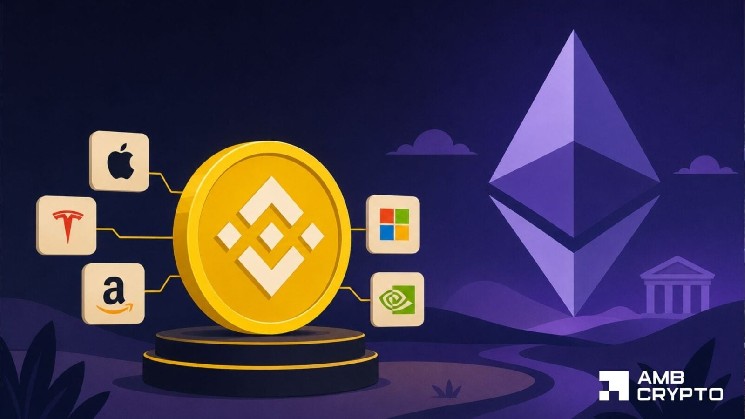
  • BNB Chain Captures 50% of Tokenized Equities: What’s Driving the Surge?

    BNB Chain Captures 50% of Tokenized Equities: What’s Driving the Surge?

    BNB Chain has emerged as the leading blockchain for tokenized equities after the launch of bStocks, overtaking Ethereum in total tokenized-equity supply. Before bStocks launched, Ethereum held the largest supply, while BNB Chain remained below $500 million despite months of gradual growth.

    Growth accelerated after June. By the end of August, BNB Chain’s tokenized-equity supply had surpassed $1.3 billion, compared with approximately $800 million on Ethereum. Solana also increased its tokenized-equity supply to around $550 million, while Avalanche remained near $170 million and smaller networks attracted only minimal amounts.

    According to BlockWorks data, BNB Chain now accounts for nearly 50% of the sector’s total supply, which stands at approximately $2.9 billion. In addition to providing greater liquidity, bStocks offers two advantages that traditional shares do not: 24/7 settlement and composability.

    bStocks drives BNB Chain’s tokenized-equity growth

    BNB Chain’s broader lead is largely concentrated in bStocks rather than being evenly distributed across the network’s tokenized-equity ecosystem.

    bStocks has accumulated more than $500 million in assets under management (AUM) since June and now supports more than 67 active assets, according to data from BNBChain.org.

    Trading volume has already exceeded $19 billion, indicating that the assets are actively circulating rather than simply remaining issued on-chain. On a narrower measure of tokenized equities and assets, bStocks typically represents more than half of the available tokenized-equity supply.

    Continued use of bStocks for new issuances and trading could further strengthen BNB Chain’s position as the leading decentralized exchange platform. However, a slowdown in bStocks activity would highlight the network’s reliance on the bStocks product family.

    BNB Chain’s broader RWA market share still trails Ethereum

    BNB Chain’s tokenized-equity lead becomes less dominant when viewed across the wider real-world asset (RWA) market. BNB Chain represents $5.7 billion of the $38.4 billion total distributed RWA market, giving it approximately 15% of the sector.

    Ethereum remains the largest RWA network, with $17.27 billion and an estimated 45% market share. Solana follows BNB Chain with $4.06 billion. As a result, BNB Chain’s leadership in tokenized equities has not yet translated into comparable dominance across the broader RWA market, according to RWA.xyz.

    BNB Chain continues to expand in tokenized equities, while Ethereum attracts capital across multiple asset classes. That broader diversification increases Ethereum’s overall liquidity and reduces its reliance on a single RWA segment.

    Expansion into Treasuries and funds could help BNB Chain diversify demand and retain more capital. Without that growth, a slowdown in tokenized-equity activity could limit BNB Chain’s ability to close Ethereum’s overall RWA lead.

    Key takeaway

    BNB Chain now leads the tokenized-equity market, largely because of bStocks’ rapid growth. Ethereum, however, continues to dominate the broader RWA market with an approximately 45% share.

  • Bybit Launches 24/7 Options Trading for SpaceX and Nvidia

    Bybit Launches 24/7 Options Trading for SpaceX and Nvidia

    Bybit, one of the world’s largest cryptocurrency exchanges by trading volume, is launching 24/7 options trading linked to SpaceX and Nvidia shares. The move brings traditional equity derivatives to a crypto-native platform where traders can access markets at any time, including weekends.

    The offering challenges the limited trading hours and settlement windows of traditional stock markets. Instead of waiting for an exchange to open, traders will be able to buy and sell options contracts tied to SpaceX and Nvidia around the clock.

    Bybit’s 24/7 stock options offering

    The SpaceX options are particularly notable because the company remains privately held. SpaceX shares are difficult to access through conventional investment channels, with trading typically taking place through secondary markets that offer limited transparency.

    Nvidia, by contrast, is one of the world’s most actively traded public companies, driven largely by investor demand linked to the artificial intelligence boom. Options trading outside Nasdaq’s regular operating hours could allow traders to respond to breaking news without waiting for the next market opening.

    Bybit’s always-on approach reflects the way cryptocurrency markets operate. Bitcoin and other digital assets trade continuously, including on weekends, and the exchange is betting that equity traders will also value uninterrupted market access.

    Crypto exchanges expand into traditional finance

    Bybit is not the first cryptocurrency platform to introduce stock-related products. However, combining 24/7 availability with options trading, rather than offering only spot exposure, increases the significance of the move.

    Several exchanges have experimented with tokenized equities and pre-IPO contracts in recent years. Regulatory scrutiny, however, has prevented the sector from becoming fully mainstream.

    The SpaceX product will be closely watched. Because Elon Musk’s rocket company is not listed on a public exchange, price discovery generally takes place through less transparent secondary markets. A more liquid options market, even one hosted by a crypto exchange, could influence how investors value one of the world’s most prominent private companies.

    What Bybit’s stock options mean for traders

    For crypto-native traders, the appeal is clear: familiar infrastructure and interfaces combined with access to new asset classes. Equity traders seeking alternatives to market closures and settlement delays may also find features that traditional brokerages do not offer.

    The risks are equally significant. Crypto exchanges operate under regulatory frameworks that differ from those governing traditional securities venues, and protections available to traders on regulated stock exchanges may not apply. The way these products are structured, whether as synthetic contracts, tokenized derivatives, or another form of exposure, will likely influence the regulatory response.

    Bybit is betting that demand for continuous trading will grow faster than regulatory resistance. As cryptocurrency platforms expand further into traditional finance throughout 2025, the exchange’s strategy could mark another step toward round-the-clock access to equity-linked markets.

  • Mantle Stablecoins and Tokenized Assets Hit $880M

    Mantle Stablecoins and Tokenized Assets Hit $880M

    Mantle’s Onchain Asset Base Nears $880 Million as Tokenized Equities and Stablecoin Supply Expand

    Mantle has accumulated roughly $880 million in stablecoins and tokenized assets, reflecting rapid growth across equities, U.S. Treasuries, funds, and yield-bearing products. According to Blockworks Research data, the network’s stablecoin circulating supply stands at approximately $550 million, while tokenized assets account for another $330 million.

    Stablecoin Composition Heavily Weighted Toward USDT0

    Stablecoins provide the bulk of liquid capital on Mantle. The latest dashboard readings show a combined circulating supply of about $553.7 million, with USDT0 dominating at $440.03 million—nearly 80% of the total. USDe ranks second at $57.93 million, followed by USDC at $34.15 million and conventional USDT at $12.96 million. Smaller contributions come from AUSD ($5.15 million), World Liberty Financial’s USD1 ($2.29 million), and Aave’s GHO ($1.23 million).

    Recent flow data highlights strong inflows for the two largest assets: a daily net inflow of $18.42 million for USDT0 and $9.94 million for USDC. Over a 30-day period, USDC supply grew 33.93% while USDT0 rose 9.51%. Smaller tokens posted sharper percentage gains from lower bases—GHO surged 203.5% and USD1 jumped 190.89%—while USDe, standard USDT, and AUSD each saw modest declines.

    Tokenized Equities Catalog Grows to 155 Products

    Equities have become a larger segment of Mantle’s tokenized-asset lineup. Nansen counted 155 tokenized equities on the network at the end of June, up from just 10 in April, per an August 25 report. The selection spans public companies, private businesses, and exchange-traded funds, including instruments tied to SpaceX and Franklin Templeton’s U.S. Equity Index ETF.

    In November 2025, Mantle integrated Backed’s xStocks via an arrangement with Bybit, bringing tokens linked to Apple, Nvidia, and Strategy shares onto the network. Bybit facilitated direct deposits and withdrawals between its centralized exchange and Mantle. Backed stated its xStocks platform had processed over $1.6 billion in tokenized equity volume, with each token backed one-to-one by an underlying security held through licensed Swiss custodians.

    Investors should assess each product individually, as tokenized equities do not uniformly confer legal ownership, voting rights, or shareholder protections. Some offerings deliver only synthetic price exposure. Backed’s one-to-one model differs from derivative-based tokens that track share prices without transferring a claim on the underlying stock.

    RWA Yield Vault Opens to DeFi Users

    Mantle is also deploying stablecoin liquidity into yield products. On August 25, the network launched its RWA vault to DeFi users after a Bybit-distributed version surpassed $200 million in assets under management. The vault accepts USDC and USDT0 through Fluxion, employing a non-leveraged strategy designed by CIAN. Grove connects deposits to yield from the Sky ecosystem, while Fluxion provides the user interface.

    Deposited assets gain exposure to returns from sUSDS, the savings version of Sky’s USDS stablecoin. The savings rate is set by Sky governance and can fluctuate. Mantle’s launch materials cited a target annual percentage yield of up to 6.5%, inclusive of campaign incentives such as Fluxion Points and an allocation of 5.14 million GROVE tokens—actual rewards depend on participation rules and token prices.

    Without leverage, the vault eliminates one liquidation risk vector, though users remain exposed to smart-contract failures, stablecoin price volatility, liquidity conditions, and changes to Sky’s governance-set rate. The self-custodial version also shifts control: Fluxion users approve transactions from their own wallets and manage private keys, unlike the prior exchange-account model via Bybit.

    Broader Network Metrics Show Scale

    Additional Blockworks figures underscore Mantle’s growth: treasury value of approximately $1.8 billion, cumulative spot decentralized exchange volume of $20 billion, and more than 150 deployed decentralized applications.

    U.S. Investors Face Access and Regulatory Constraints

    For U.S. participants, the availability of tokenized American equities on a public blockchain does not guarantee legal access in every state or for every investor. Eligibility hinges on issuer terms, distribution controls, and applicable federal and state securities regulations.

    Stablecoin yield raises separate regulatory questions. The GENIUS Act bars payment stablecoin issuers from paying interest or yield directly to holders, while rewards from exchanges, brokers, and DeFi protocols remain under congressional review. Mantle and its partners characterize the vault’s return as strategy-generated yield from sUSDS—not a direct payment from a stablecoin issuer—with Fluxion Points and GROVE incentives provided separately.

    Tokenized-stock models vary in their treatment of U.S. securities. In August, Crypto.com introduced tokenized derivatives linked to 1,500 U.S. equities and ETFs for eligible users in the European Economic Area and other approved markets, offering price exposure without legal ownership or shareholder rights.

    Meanwhile, regulated U.S. market infrastructure is advancing. The Depository Trust Company received an SEC no-action letter in December 2025 for a defined tokenization service covering eligible assets held in DTC custody for three years. Potential assets include Russell 1000 stocks, major index ETFs, U.S. Treasuries, and certain corporate bonds. DTC has selected Stellar for part of its multi-chain strategy, targeting deployment in the first half of 2027.