Tag: TikTok viral video

  • Man Claims Server Left Insulting Note on Bill Over Tip: ‘Maybe You Should Consider Eating Fast Food’

    Man Claims Server Left Insulting Note on Bill Over Tip: ‘Maybe You Should Consider Eating Fast Food’

    Key Highlights

    • TikTok creator @captain.t.roll shared a receipt showing a server’s handwritten note criticizing an $11 tip on a $220 bill, calling it a “5% tip” and suggesting the party “consider eating fast food.”
    • The video amassed 1.2 million views and over 14,000 comments, igniting a polarized debate over tipping culture, mandatory gratuities, and server wages.
    • The Daily Dot could not independently verify the events, which rely solely on the creator’s account and the receipt image shared on TikTok.

    TikTok Video Exposes Server’s Receipt Note Criticizing Tip Amount

    TikTok creator @captain.t.roll posted a video recounting a dining experience at a recently opened restaurant that quickly went viral, accumulating 1.2 million views and more than 14,000 comments. According to the creator, he and two friends visited the establishment for a meal that included appetizers, entrees, and dessert, requiring the server to make several trips to their table throughout the service. The creator suggested the frequency of service may have contributed to tension, but emphasized that serving customers is the server’s job and such workload is expected, particularly at a new restaurant.

    Receipt Shows Handwritten Message Questioning Tip Adequacy

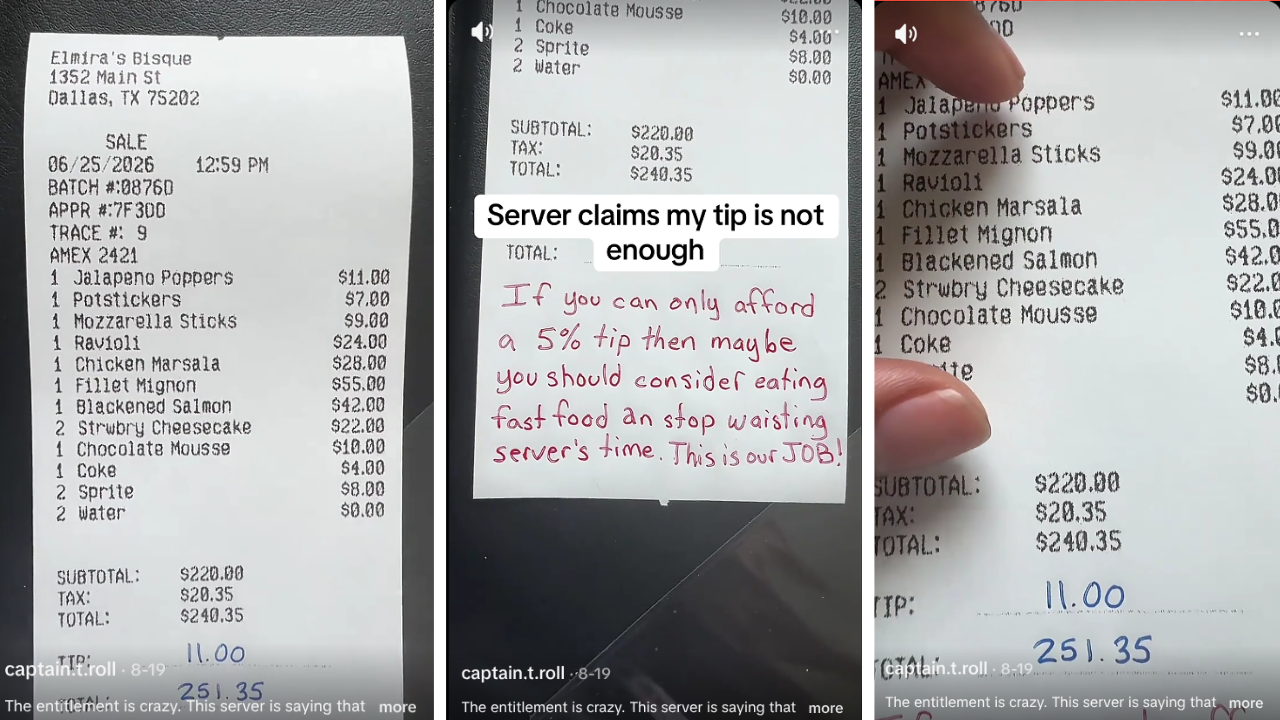
    While recording the receipt, the creator displayed the itemized order and stated the pre-tax bill totaled $220. He added an $11 tip, bringing the final charge to $251.35. The creator said he considered the $11 tip fair. However, the server apparently disagreed and wrote a message in red ink at the bottom of the receipt. The note read:

    “If you can only afford a 5% tip then maybe you should consider eating fast food and stop wasting server’s time. This is our JOB!”

    The message explicitly references the tip percentage — approximately 5% of the pre-tax total — and frames the gratuity as insufficient for the labor involved.

    Online Reaction Splits Over Tipping Norms and Obligations

    The video triggered a sharp divide among viewers. Some commenters sided with the creator, arguing that tipping is voluntary and the server’s note was inappropriate. One commenter wrote:

    “I would ask back for the receipt and adjust it to $0.00 tipping. . . DO NOT ALLOW ANYONE TO BULLY, GUILT, OR PRESSURE YOU INTO TIPPING. . .TIPPING IS NOT MANDATORY.”

    Another echoed that sentiment:

    “Normalize leaving 0 dollars, tipping is NOT mandatory.”

    Conversely, other viewers contended the tip was unreasonably low for a $220 bill with extensive table service. One commenter stated:

    “You had a bill for $220 and left an $11 tip?????! Yea you’re in the wrong the server has every right to be mad.”

    The discourse reflects broader cultural friction over tipping expectations in the United States, where customary gratuities for full-service dining typically range from 15% to 20%.

    Why This Matters: Tipping Culture Under Scrutiny

    The incident highlights escalating tensions around tipping practices in the U.S. hospitality industry. With federal tipped minimum wage remaining at $2.13 per hour in many states, servers often depend on gratuities to earn a living wage. Simultaneously, consumers face “tip fatigue” as digital payment prompts solicit tips for counter service, takeout, and other previously non-tipped interactions. Viral confrontations like this one amplify public debate over whether tipping should remain a discretionary reward for service or transition toward a service-included model with higher base wages. The Daily Dot noted it was unable to independently verify the events, which are based solely on @captain.t.roll’s account and the receipt image shared on TikTok.

    Frequently Asked Questions

    What was the exact tip amount and percentage left by the TikTok creator?

    The creator left an $11 tip on a $220 pre-tax bill, which equals exactly 5%. The server’s note explicitly references this percentage.

    Has the restaurant or server been identified publicly?

    No. The Daily Dot reported it could not independently verify the events, and the TikTok video does not name the restaurant or the server. The account relies entirely on @captain.t.roll’s narration and the receipt image he shared.

    Is tipping legally mandatory in the United States?

    No. Tipping is not legally mandatory under federal or state law. It is a customary practice, though many service workers depend on tips due to lower tipped minimum wages. The debate in the comments reflects differing views on social obligation versus legal requirement.
  • Woman Says Best Friend Discovered Something About Her Boyfriend While She Was in Italy: ‘I Didn’t Want to Ruin Your Trip’

    Woman Says Best Friend Discovered Something About Her Boyfriend While She Was in Italy: ‘I Didn’t Want to Ruin Your Trip’

    Key Highlights

    • TikTok creator Sarai Jones (@krazysarai) revealed her best friend Marissa discovered her boyfriend holding hands with another woman at a Dallas bar called Cowgirls while Sarai was vacationing in Positano, Italy.
    • Marissa confronted the boyfriend and the other woman, who reportedly confirmed they had been kissing, while Marissa captured photo and video evidence that contradicted the boyfriend’s claim that the bar was crowded.
    • The viral video amassed over 554,000 views, with commenters overwhelmingly praising Marissa as a “real MVP” and true friend for revealing the betrayal despite the potential to ruin Sarai’s vacation.

    Vacation Interrupted by a 2 A.M. Call from Dallas

    TikTok creator Sarai Jones, known as @krazysarai, shared a detailed storytime video recounting how she learned her boyfriend was allegedly cheating on her while she was on a trip to Italy. The video, which has garnered more than 554,000 views and 600 comments, outlines a sequence of events that began on the fourth day of her vacation in Positano. At 11 a.m. local time, Jones received a call from her best friend, Marissa. Jones immediately found the timing unusual, noting that due to the time difference, it was 2 a.m. in the United States.

    When Jones answered, she said Marissa was “crying hysterically.” According to Jones, Marissa initially hesitated to share the news, explaining she “did not want to ruin her friend’s vacation with bad news because she knew it would be devastating.” Jones insisted, prompting Marissa to reveal she had gone to a bar in Dallas, Texas, called Cowgirls, where she spotted Jones’s boyfriend holding hands with another woman.

    Confrontation and Contradictory Evidence

    Marissa confronted the boyfriend while still on the phone with Jones. Jones described the boyfriend as appearing caught off guard and unable to respond initially. Marissa then questioned the woman accompanying him, asking whether they had kissed or been intimate. According to Sarai, the woman confirmed that she and her boyfriend had been kissing. Sarai said her boyfriend denied it.

    Marissa documented the encounter, sending photos and videos to Jones as evidence. Jones stated her boyfriend continued arguing with Marissa for approximately 45 minutes outside the establishment. After processing the information, Jones attempted to call her boyfriend directly. When he did not answer, she contacted his best friend, who eventually handed the phone over.

    The boyfriend offered an explanation for the physical contact, claiming the bar was crowded and he was merely guiding the woman through the crowd. He denied kissing her. He also argued that holding hands did not necessarily signify anything serious. However, Jones said the visual evidence Marissa provided told a different story. According to Sarai, the footage showed that the bar was relatively empty, contradicting his claim that he had been guiding the woman through a crowded space. The discrepancy left Jones questioning his account of the events that transpired while she was abroad.

    Online Community Rallies Around the Whistleblower

    The comment section of the viral post became a forum for support, with the vast majority of reactions focusing on Marissa’s role. Viewers commended the best friend for prioritizing honesty over the comfort of the vacation. One commenter wrote, “You better hold on tight to Marissa, what a wonderful person/friend.”

    Another echoed the sentiment, writing, “Marissa is the real MVP. That’s a great friend right there.” Additional comments offered comfort to Jones, emphasizing her worth. One user stated, “Girl no one deserves this, you’re too bad for him and he couldn’t handle it. You dodged a bullet for sure but I am sorry you had to go through this.”

    Why This Matters

    This incident highlights the evolving dynamics of relationship accountability in the digital age, where location tracking, social media documentation, and viral storytelling intersect. The scenario underscores how bystanders—particularly close friends—can become critical witnesses in real time, using smartphones to capture evidence that challenges deceptive narratives. For content creators like Jones, the decision to share personal betrayal publicly transforms a private heartbreak into a communal discussion about loyalty, gaslighting, and the complexities of long-distance trust. The Daily Dot noted it was unable to independently verify the events described, which are based solely on Jones’s account and the media she said her friend provided, a standard disclaimer for user-generated viral content.

    Frequently Asked Questions

    Where did the alleged cheating take place?
    The encounter occurred at a bar named Cowgirls in Dallas, Texas, while Sarai Jones was vacationing in Positano, Italy.
    What evidence was presented to support the claim?
    Marissa, the best friend, sent photos and videos showing the boyfriend holding hands with another woman. Jones stated the footage showed the bar was relatively empty, contradicting the boyfriend’s claim that he was guiding the woman through a crowd.
    How did the boyfriend respond to the confrontation?
    He initially appeared caught off guard, denied kissing the woman, claimed the bar was crowded and he was just guiding her through, and argued that holding hands was not serious. He argued with Marissa for about 45 minutes outside the bar.
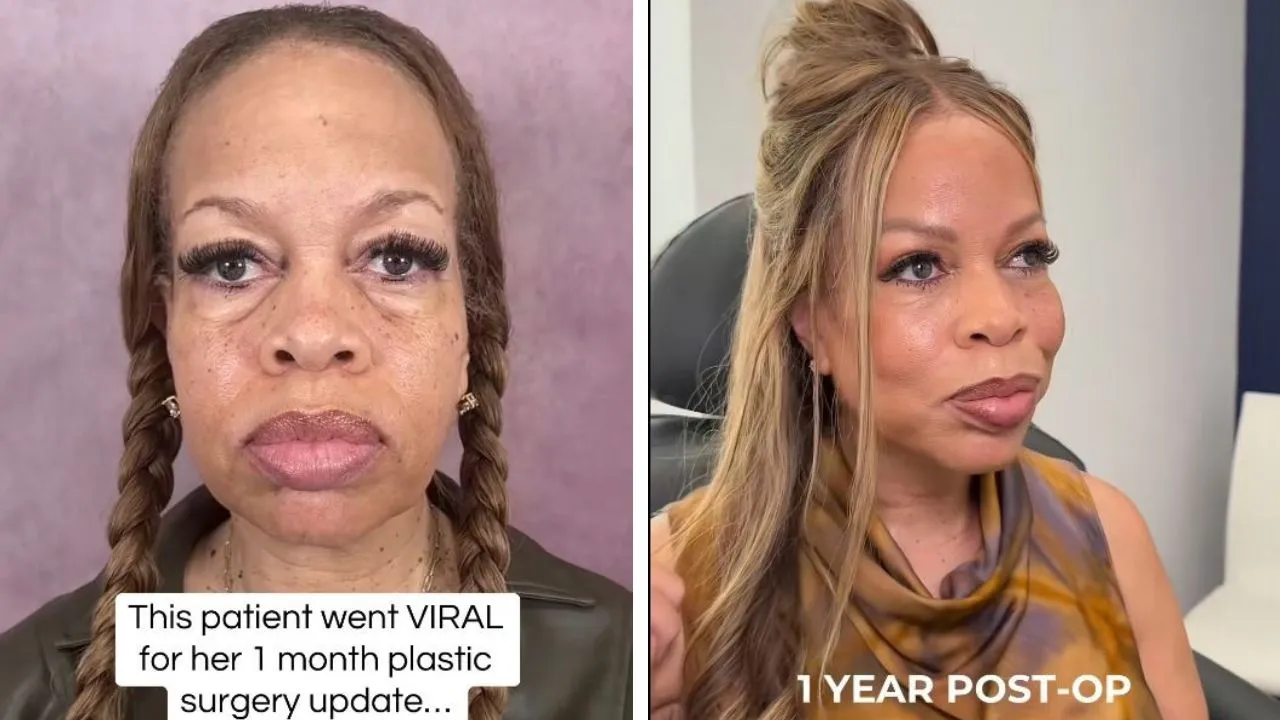
  • Student’s ‘Are You Old?’ Question Prompts 57-Year-Old Educator’s Viral Facial Rejuvenation Before-and-After

    Student’s ‘Are You Old?’ Question Prompts 57-Year-Old Educator’s Viral Facial Rejuvenation Before-and-After

    Key Highlights

    • Beverly Hills facial plastic surgeon Dr. Carl Truesdale’s TikTok showcasing a full facial rejuvenation on 57-year-old educator Patricia has garnered over 148,000 likes and gone viral.
    • Patricia underwent a combination of procedures — including eyelid surgery, endoscopic brow lift, facial fat transfer, face and neck lift, and a permanent chin implant — partly to address scarring from a prior cervical fusion surgery.
    • The patient, who is preparing to begin a PhD program, said a student’s question — “are you old” — prompted her to seek a refreshed look for public speaking engagements, and she specifically chose a surgeon experienced with the needs of Black patients.

    Viral TikTok Documents Educator’s Facial Rejuvenation Journey

    A TikTok posted by Dr. Carl Truesdale, a Beverly Hills facial plastic surgeon, has drawn widespread attention after documenting the results of a comprehensive facial rejuvenation performed on a patient identified as Patricia, a 57-year-old educator preparing to begin a PhD program. As of publication, the video had accumulated 148,400 likes, 934 comments, and 4,362 saves. Patricia first appeared on Dr. Truesdale’s YouTube series Beyond the Surface in Season 2 Episode 3, where her surgical plan was initially detailed.

    Combination of Procedures Addresses Aging and Surgical Scarring

    According to the video, Patricia underwent a combination of procedures including upper and lower eyelid surgery, an endoscopic brow lift, facial fat transfer, a face and neck lift, and a permanent chin implant. The neck lift specifically addressed skin laxity that developed following a cervical fusion surgery — performed through a front-of-neck incision after an earlier accident — which had left visible scarring. Dr. Truesdale’s approach aimed to correct both the signs of aging and the residual effects of the prior medical procedure.

    Student’s Candid Question Sparked Decision

    Patricia said a comment from one of her students made her reconsider her appearance, recalling that a child had asked her, “are you old,” which led her to notice she looked tired without makeup. She wanted a refreshed look heading into public speaking engagements and her upcoming graduate coursework, and she wanted her presence to read as energized rather than tired to her audience. She specifically sought a surgeon experienced with the needs of Black patients, saying doctors “don’t necessarily understand the unique needs that we have” when it comes to issues like hyperpigmentation. She said Dr. Truesdale worked to preserve her natural features throughout the procedure rather than altering them.

    One-Month Follow-Up Shows Early Results

    The video includes a follow-up appointment roughly one month after surgery, in which Dr. Truesdale reviewed her results, pointing to her jawline definition, under-eye contour, and the integration of the chin implant. He told her that some remaining asymmetry in swelling was normal at that stage and would continue to improve. Patricia said she no longer felt the need to wear makeup to leave the house, saying she could now go out with just “tinted sunscreen and sunglasses” and feel confident in public.

    Why This Matters

    The viral response to Patricia’s case highlights several intersecting trends in aesthetic medicine and social media. First, it underscores the growing influence of platforms like TikTok and YouTube in shaping patient expectations and surgeon visibility, with educational series such as Beyond the Surface blurring the line between clinical documentation and marketing. Second, Patricia’s emphasis on finding a surgeon who understands the specific needs of Black patients — including concerns around hyperpigmentation and scar management — reflects a broader demand for culturally competent care in plastic surgery. Third, the case illustrates how personal catalysts, such as a child’s blunt question, can drive elective surgical decisions, particularly among professionals entering new public-facing roles. The Daily Dot notes it was unable to independently verify Patricia’s medical history, the specific procedures performed, or Dr. Truesdale’s credentials beyond what was stated in the video, reinforcing the importance of consulting a board-certified surgeon and verifying credentials independently before pursuing cosmetic procedures.

    Frequently Asked Questions

    What procedures did Patricia undergo?

    Patricia underwent a combination of upper and lower eyelid surgery, an endoscopic brow lift, facial fat transfer, a face and neck lift, and a permanent chin implant, as shown in Dr. Truesdale’s TikTok and YouTube series Beyond the Surface.

    Why did Patricia choose Dr. Truesdale?

    She specifically sought a surgeon experienced with the needs of Black patients, stating that doctors “don’t necessarily understand the unique needs that we have” regarding issues like hyperpigmentation, and she said Dr. Truesdale worked to preserve her natural features rather than alter them.

    What was the catalyst for Patricia seeking surgery?

    A student asked her, “are you old,” which made her notice she looked tired without makeup. She wanted a refreshed, energized appearance for upcoming public speaking engagements and her PhD program coursework.

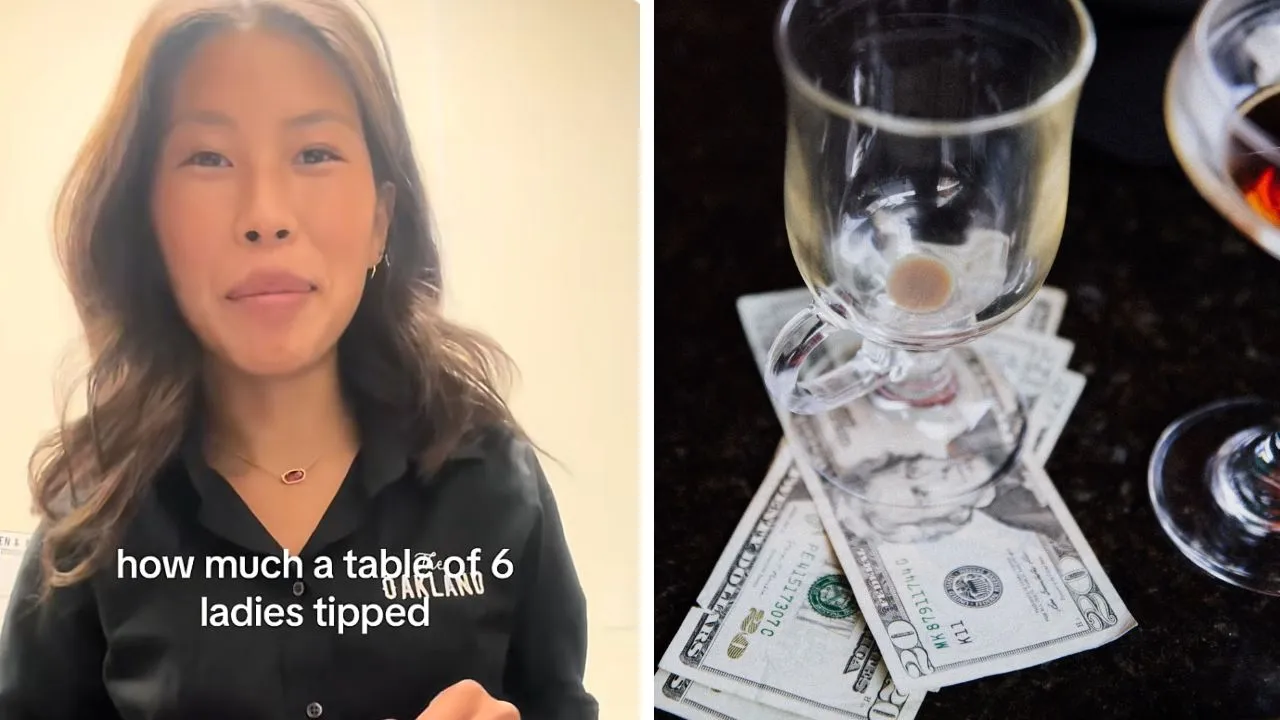
  • ‘Doctors Don’t Get a Tip, Why You Want Tips?’: Server Says She’d Prefer 20% Tip After Table of 6 Women Leaves Little

    ‘Doctors Don’t Get a Tip, Why You Want Tips?’: Server Says She’d Prefer 20% Tip After Table of 6 Women Leaves Little

    Key Highlights

    • TikTok creator @Andjjj.7 posted a video on May 8, 2025, showing itemized tips from a table of six women, revealing multiple $0 tips on bills ranging from $32 to $60.
    • The video amassed 12.7 million views, 802,500 likes, and 21,700 comments, igniting a polarized debate over tipping expectations versus earned gratuity.
    • A separate viral clip from creator @lovee.leahh_ captured a retail customer refusing a tip prompt with “Hell no!” — further fueling the national conversation on tip fatigue.

    Server’s Itemized Receipt Breakdown Sparks Massive Tipping Debate

    TikTok user @Andjjj.7 — identified in the video as a server in restaurant uniform — uploaded a clip on May 8, 2025, that has since garnered 12.7 million views, 802,500 likes, and 21,700 comments. In the video, she flips through six separate checks from a single table of six women, narrating the tip amount left on each. The first bill, $51, carried a $9 tip. The second, $32, received $0. The third, $55, also received $0. The fourth, $60, left a $6 tip. A $21 bill yielded a $7 tip, and a final $23 bill left $4. Summarizing the experience, she stated directly to the camera:

    “I am grateful for any tip but will prefer 20 percent.”

    The on-screen caption accompanying the post read:

    @andjjj.7 their bill was $250. tipping culture may have gotten out of hand but I didn’t know we’re normalizing no tips. ♬ original sound – Andj

    Comment Section Erupts With Divergent Views on Gratuity Norms

    The comment section quickly became a battleground for opposing philosophies on tipping culture. One user challenged the expectation of tips altogether, writing:

    “doctors dont get a tip; why u want tips? Bruh.”

    Another commenter echoed the sentiment that gratuity should reflect service quality, not obligation:

    “You earn tips not expect them.”

    A third contributor offered a detailed personal anecdote illustrating a performance-based approach:

    “There’s only been one time I haven’t tipped a server and it was because he never refilled my drink. there was no one else in the restaurant to serve I gave him the change he brought me back which was like 9cents. I’ll give a $20 tip on a $50 total just because the server was amazing. you leave me to eat without a drink to wash it down your getting Pennies.”

    Yet another voice acknowledged systemic issues while defending the practice of tipping service workers:

    “I get that the tipping culture is getting out of hand but not tipping servers is crazyyyyyy.”

    Parallel Viral Moment: Retail Tip Prompt Rejection Goes Viral

    The discourse gained additional momentum from a separate TikTok posted by creator @lovee.leahh_ (Leah Danzy), which documented a confrontation at a mall retail counter. In the clip, a female customer completes a purchase when the shop employee asks twice, “Do you want to tip?” The customer responds emphatically:

    “Hell no!”

    She continues, “No tip.” After the shopkeeper replies, “Ok! I just asked,” the customer counters, “I know, and I just told you,” and begins walking away. She adds, “Thank you! Have a good day,” then turns toward the camera and appears to address the person filming:

    ‘They are talking about f—- tip,’

    before the video ends. Danzy captioned the post: “I still can’t get over this? Ariel was so embarrassed #fypシ゚viral #fyp #grandmagonewild ♬ original sound – Leah Danzy.”

    Why This Matters

    The dual viral moments underscore a growing cultural flashpoint in the United States: the expansion of tip prompts beyond traditional full-service dining into counter service, retail, and self-checkout environments. While the federal tipped minimum wage remains $2.13 per hour in many states — making tips essential income for servers — consumers increasingly report “tip fatigue” amid inflation and ubiquitous digital prompts. The @Andjjj.7 video highlights the tension between servers who depend on 20% gratuity as a professional standard and diners who view tipping as discretionary or excessive. Meanwhile, the @lovee.leahh_ clip illustrates how tip requests in non-service contexts can provoke hostility. Neither TikTok experience has been independently verified by The Daily Dot, but together they reflect a nationwide debate over who should be tipped, how much, and whether the burden of fair wages should fall on customers or employers.

    Frequently Asked Questions

    What were the exact tip amounts left by the table of six women in the @Andjjj.7 video?

    The server showed six checks: $51 bill with $9 tip; $32 bill with $0 tip; $55 bill with $0 tip; $60 bill with $6 tip; $21 bill with $7 tip; $23 bill with $4 tip. The total bill was approximately $250.

    How did the retail customer in the @lovee.leahh_ video respond when asked to tip?

    The customer said “Hell no!” and “No tip.” After the employee said “Ok! I just asked,” she replied “I know, and I just told you,” wished them a good day, and told the camera, “They are talking about f—- tip.”

    Has The Daily Dot verified the events shown in these TikTok videos?

    No. The Daily Dot explicitly stated it was “unable to independently verify the experiences described by commenters on this video” and noted the details reflect the creators’ stated views and commenters’ individual accounts as shared on TikTok.

  • ‘Somewhat Toxic’ Households More Common Than People Realize, Woman Says: ‘It’s Like Every Other Week’

    ‘Somewhat Toxic’ Households More Common Than People Realize, Woman Says: ‘It’s Like Every Other Week’

    Key Highlights

    • TikTok creator @smoothoperator3k coined the term “somewhat toxic” households to describe homes where toxic behavior occurs intermittently—sometimes “every other week”—rather than daily, a concept that resonated with nearly 90,000 viewers.
    • Commenters shared experiences of financial control by parents, emotional inconsistency, and the guilt of feeling “ungrateful” for complaining, with several arguing these environments are more damaging than overtly toxic ones due to the constant uncertainty.
    • The Daily Dot reported on the viral discussion but noted it could not independently verify the personal anecdotes shared in the video or comments, which are based solely on user-submitted descriptions.

    TikTok Creator Defines ‘Somewhat Toxic’ Households as Intermittent but Damaging

    A viral TikTok video has sparked widespread conversation about a category of family dynamics that often flies under the radar: households that are not overtly abusive every day but where toxic patterns recur frequently enough to erode well-being. The creator, known as @smoothoperator3k, introduced the label “somewhat toxic” to describe homes where negative behavior happens “every other week” or on a regular but inconsistent basis. The video amassed 89,600 likes and 1,147 comments, indicating the concept struck a nerve with a large audience.

    Financial Control and the Barrier to Independence

    @smoothoperator3k highlighted a specific scenario common among young adults: individuals who live with their parents while contributing to household bills, yet remain subject to parental control over their finances. According to her description, this dynamic can limit a person’s ability to save enough money to move out, creating a cycle of dependence masked as mutual support. She acknowledged that this may “not look as severe as some other experiences people have in toxic households,” but argued that financial control combined with an expectation to support the family still creates significant psychological and practical problems.

    Emotional Inconsistency Creates a ‘Walking on Eggshells’ Dynamic

    Beyond finances, the creator pointed to emotional volatility as a hallmark of these environments. She described a pattern of “emotional back-and-forth”—periods where family members “genuinely love and care about you” followed by moments where “it seems like they don’t care at all.” This inconsistency, she explained, makes it difficult to understand where one stands, fostering a state of chronic hypervigilance. The environment “may not feel toxic all the time,” she noted, but the negative behavior still affects residents cumulatively.

    Commenters Validate the Concept and Describe Hidden Toll

    The comment section became a forum for users to articulate experiences they said mirrored the creator’s framework. One commenter wrote: “Emotional abuse, neglect, petty with things around the house, nosy, silent treatment, can’t explain anything cuz you sound ungrateful. Killing you softly, basically,” capturing the insidious nature of the dynamic. Another user challenged the comparative mindset that often silences victims: “Hot take but I feel like this cases are slightly more damaging because in a basic toxic environment, you know what to expect. In THESE households, you’re walking on eggshells, putting yourself through hell trying to figure out whether you’re tripping,” they wrote. A third added: “I think this type is worse cus you just be confused your whole life,” while others described the guilt of fearing they sound “ungrateful” for raising concerns.

    The ‘It Could Be Worse’ Trap and Silence

    A recurring theme in the discussion was the role of minimization. Several commenters identified the belief that “it could be worse” as a primary barrier to acknowledging or discussing their struggles. Because the household offers occasional warmth or baseline provision of needs, residents may feel they have no right to complain, leading to isolation and self-doubt. @smoothoperator3k suggested these situations “may be more common than people realize because those experiencing them don’t always feel comfortable talking about them.” The volume of relatable comments supports the idea that this is a widespread but under-discussed phenomenon.

    Why This Matters

    The viral spread of the “somewhat toxic” label reflects a growing public effort to name and validate subtle forms of family dysfunction that fall outside clinical definitions of abuse but carry real mental health consequences. Mental health professionals increasingly recognize that unpredictable, intermittent reinforcement—alternating care with neglect or control—can produce complex trauma responses similar to those seen in more overtly abusive homes. The discussion on TikTok illustrates how social media platforms are becoming primary venues for peer-to-peer psychoeducation, allowing users to crowdsource language for experiences that previously lacked terminology. However, as The Daily Dot noted, these are self-reported anecdotes without independent verification, underscoring the need for further research into the prevalence and long-term impacts of this specific household dynamic.

    Frequently Asked Questions

    What defines a ‘somewhat toxic’ household according to the viral TikTok?

    According to creator @smoothoperator3k, a “somewhat toxic” household is one where toxic behavior—such as financial control, emotional inconsistency, or guilt-inducing dynamics—occurs intermittently (e.g., “every other week”) rather than daily. The environment alternates between periods of genuine care and moments of neglect or control, creating confusion and chronic stress for residents.

    Why do some commenters believe these households are more damaging than overtly toxic ones?

    Several commenters argued that the unpredictability is uniquely harmful. In a consistently toxic environment, they said, “you know what to expect.” In a “somewhat toxic” home, the oscillation between love and indifference forces residents to constantly monitor the emotional climate—”walking on eggshells”—which erodes trust in their own perception and makes it harder to validate their own distress.

    Has The Daily Dot verified the claims made in the video and comments?

    No. The Daily Dot explicitly stated it “was unable to independently verify the personal experiences shared in the comments or the claims made in the video, which are based solely on @smoothoperator3k’s description.” The article reports on the viral conversation and its resonance, not on verified facts about specific households.

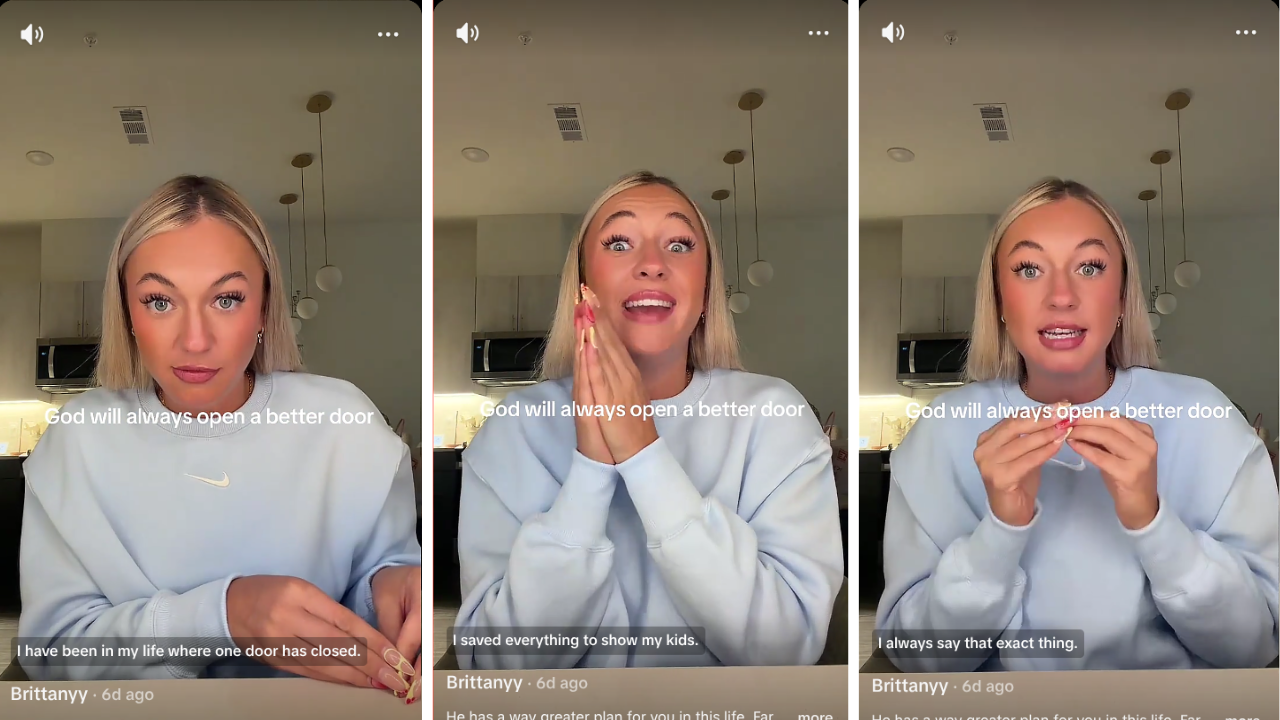
  • Woman Learns to Trust God After Losing Dream Job: ‘He Already Opened Another Door’

    Woman Learns to Trust God After Losing Dream Job: ‘He Already Opened Another Door’

    Key Highlights:

    • TikTok creator @brittanyybowen shared a viral video (187K+ views) explaining how losing her dream job as a Dallas Cowboys NFL reporter redirected her toward entrepreneurship and motherhood.
    • She frames the career setback as divine redirection, stating a closed door often signals God opening a better, unanticipated opportunity.
    • Commenters resonated deeply, sharing similar stories of painful endings that later revealed greater purpose.

    TikTok Creator Shares How Losing Dream NFL Job Became Divine Redirection

    Content creator Brittanyy Bowen, known as @brittanyybowen on TikTok, has struck a chord with nearly 200,000 viewers after posting a candid reflection on faith, career disruption, and the unexpected blessings that followed. In a video that has garnered over 187,000 views and 784 comments, Bowen recounts how the abrupt end of her tenure as a sports reporter for the Dallas Cowboys—a role she had pursued since childhood—ultimately paved the way for entrepreneurial success and the family life she always envisioned.

    From Childhood Dream to Sudden Career Halt

    Bowen’s journey began with a singular focus: becoming an NFL sports reporter. She earned a degree in sports broadcasting and journalism, and by age 24 had secured a reporting position with the Dallas Cowboys organization. Although she acknowledges the role did not pay particularly well, she emphasized it was the career she had always wanted. “Then, according to Brittanyy, that opportunity unexpectedly came to an end,” the source notes, describing a moment that initially left her crushed and uncertain about her future.

    Reframing Closed Doors as Divine Protection

    Rather than viewing the termination as a failure, Bowen says she developed a “track record of seeing unexpected opportunities appear after something in her life comes to an end.” She articulates a theology of redirection: “He has a way greater plan for you in this life. Far more than you can imagine.” In her telling, God closes doors she would never have chosen to close herself, only to direct her toward opportunities already prepared. This perspective, she says, transformed how she approaches major life changes, teaching her to embrace “pivoting” rather than resist it.

    Entrepreneurship and Motherhood as the Open Doors

    The narrative Bowen shares connects the loss of her reporting job directly to two major life achievements. She states she had always believed she would either become a successful sports reporter or build a successful business; the end of the former catalyzed the latter, yielding a level of financial success she believes would have been impossible on her original trajectory. Additionally, she cites motherhood as a core life goal—wanting to provide her children opportunities she lacked growing up—and asserts the career setback “ultimately helped make that possible.”

    Why This Matters: Faith Narratives in the Creator Economy

    Bowen’s video exemplifies a growing trend where digital creators blend personal testimony with spiritual frameworks to process professional volatility. The resonance—evident in the comment volume and sentiment—signals an audience hungry for meaning-making narratives amid economic uncertainty. While The Daily Dot notes it “was unable to independently verify the personal experiences shared in the video, which are based solely on @brittanyybowen’s account,” the phenomenon reflects how social platforms amplify individualized theologies of work and purpose. For brands and media observers, the engagement metrics underscore the influence of authentic, faith-inflected storytelling in shaping audience trust and community formation online.

    Frequently Asked Questions

    Who is Brittanyy Bowen and what was her former career?

    Brittanyy Bowen (@brittanyybowen) is a TikTok creator who previously worked as an NFL sports reporter for the Dallas Cowboys. She held a degree in sports broadcasting and journalism and achieved the role by age 24.

    What is the central message of her viral TikTok video?

    Bowen shares that losing her dream job was a divine redirection. She believes God closes doors to open better opportunities—leading her to entrepreneurship, financial success, and the ability to provide for her children in ways her reporting career could not.

    How did viewers respond to the video?

    Comments overwhelmingly affirmed her perspective. One user wrote, “Every door that closes later on makes so much sense when the other door opens and it’s HELLO BEAUTIFUL!” Another added, “I believe this so much. The door closing feels soul destroying… But looking back… I’m so happy it was closed. The next door was the plot twist.” Many shared parallel experiences of painful endings revealing greater purpose.

  • Best Friend Urged Her to Dump Boyfriend — Now They’re Engaged

    Best Friend Urged Her to Dump Boyfriend — Now They’re Engaged

    Key Highlights

    • TikTok creator @hottgirlseatpickles (Natalie) alleges her ex-boyfriend and best friend of nearly six years began a relationship shortly after advising her to end her own, culminating in their engagement.
    • The viral video detailing the betrayal has amassed 14 million views, 1.6 million likes, and 13,500 comments, sparking widespread discussion about friendship boundaries and relationship red flags.
    • The creator states she received no clear timeline or explanation for the affair, discovering the engagement only after a mutual friend spotted the pair together following her move to Pennsylvania.

    Viral TikTok Exposes Alleged Betrayal Between Ex-Partner and Best Friend

    TikTok user Natalie, known by her handle @hottgirlseatpickles, has captivated millions with a multi-part “story time” series recounting a devastating personal betrayal. As of publication, the initial video has garnered over 14 million views, 1.6 million likes, and 13,500 comments. In the emotional narration, Natalie details how her boyfriend of approximately a year and a half and her best friend of nearly six years—whom she considered a sister and confided in completely—are now engaged to each other.

    Relationship Struggles and the Best Friend’s Pivotal Role

    Natalie explains that she and her boyfriend shared a home and a dog, but consistent issues led them to realize the relationship was not working. She recounts two specific trips planned for late last year: a visit to her mother in Pennsylvania and a Christmas trip to New York City. On both occasions, she says her boyfriend refused to attend. Consequently, her best friend accompanied her instead. During these trips, Natalie confided in her friend about the relationship turmoil. “I told her pretty much everything about my life,” she stated in the video. The friend ultimately advised Natalie to end the relationship. Following that advice, Natalie broke up with her boyfriend and, by mid-January, moved in with her best friend.

    A Confusing Reconciliation and a Valentine’s Day Discovery

    The dynamic shifted when Natalie and her ex-boyfriend admitted they struggled to stay apart and briefly reconciled. However, the day before Valentine’s Day, sensing distance, Natalie asked her ex if he was seeing someone else. That night, he left her alone and stopped answering her calls. She drove to their former shared apartment, only to find he was not there. “They basically lied to my face,” she said, referring to the aftermath of her calling her best friend for support. The next morning, Natalie confronted her ex at his workplace, where he confessed he had been talking to another woman for over a week. When she informed her best friend, the friend began distancing herself immediately.

    Relocation, Confrontation, and the Engagement Revelation

    Natalie was preparing to move to Pennsylvania with her parents and attempted to see her best friend one last time, but the friend avoided her. After the move, a mutual friend reported spotting the best friend and the ex-boyfriend together. Natalie texted them both a lengthy message expressing her feelings. She recounts the friend’s response: “I texted them both a paragraph about how I felt about that situation, and she kind of like said that this was never supposed to happen. I’m so sorry, and I know you’re never gonna talk to me again.” Natalie emphasized the lack of closure: “I never really got answers as to how, when, why, where- any of the things. And then I found out that they are now engaged.” She suspects the pair were together the night before Valentine’s Day when her ex disappeared. Despite the profound hurt, Natalie concluded her video with a message of resignation and grace: “If people can do that to each other, then they deserve each other. I wish them nothing but blessings and pray for them.”

    Why This Matters

    The massive engagement on Natalie’s TikTok series underscores the public’s intense interest in narratives of interpersonal betrayal and the complexities of modern relationship dynamics. The story resonates deeply because it touches on the violation of the “girl code” and the “bro code”—unspoken social contracts regarding loyalty among friends and former partners. Commenters on the video echoed this sentiment, with one user writing, “anytime a man talks bad about a friend (and not because theyre a bad person) it’s because they like them.” Another added, “I’ll never understand how people find their friends partner attractive like ever.” The phenomenon highlights how social media platforms like TikTok have become modern-day public squares for processing trauma, seeking validation, and crowdsourcing judgment on ethical dilemmas. The Daily Dot was unable to independently verify the personal opinions and experiences shared in this video; the details reflect the personal account shared by @hottgirlseatpickles and represent her individual perspective.

    Frequently Asked Questions

    Who is the TikTok creator sharing this story?
    The creator is Natalie, who posts under the handle @hottgirlseatpickles.
    What is the current status of the ex-boyfriend and the best friend?
    According to Natalie’s account, the pair are now engaged to be married.
    Has The Daily Dot verified these allegations?
    No. The Daily Dot explicitly states it was unable to independently verify the personal opinions and experiences shared in the video. The report is based solely on Natalie’s perspective.
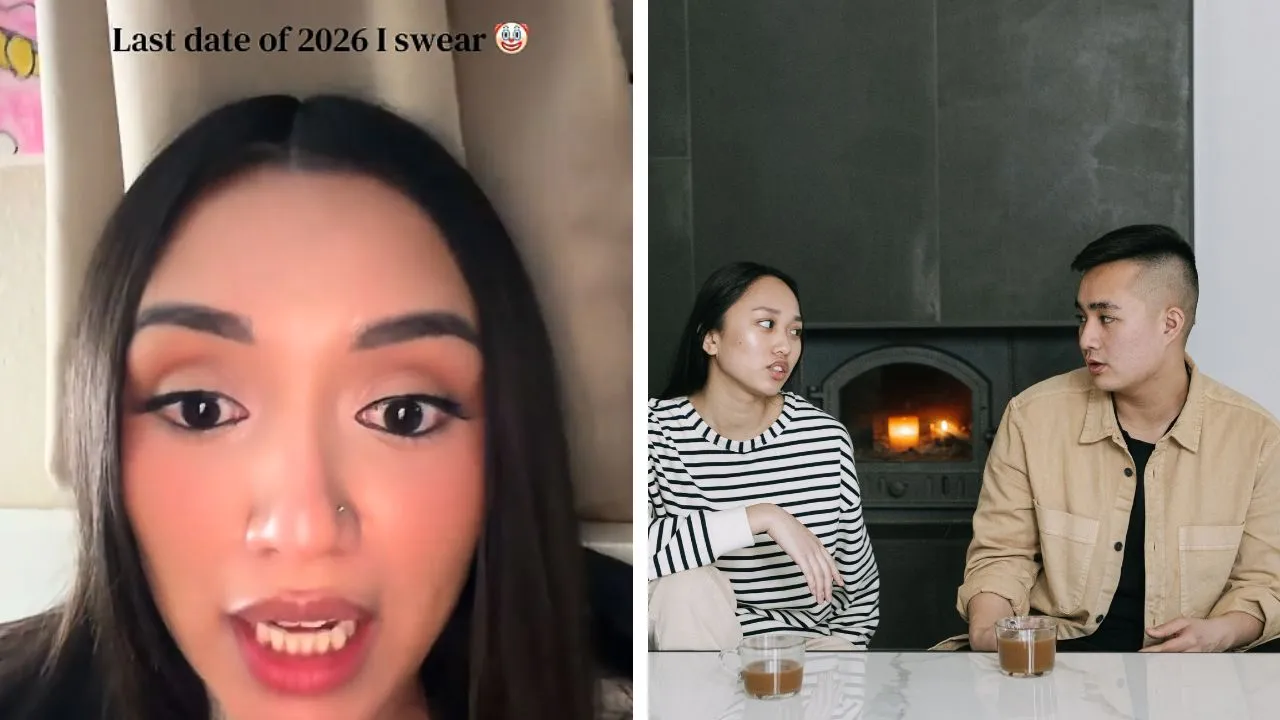
  • Woman’s Date Asked What She’d Offer in Return for Dinner Before Ordering — She Paid for Her Appetizer and Went Boot Shopping

    Woman’s Date Asked What She’d Offer in Return for Dinner Before Ordering — She Paid for Her Appetizer and Went Boot Shopping

    Key Highlights

    • TikTok creator @caldo.de.les went viral after sharing a first date where the man asked what she could “offer” him in return for paying the bill — before they had even ordered main courses.
    • The date at Texas Roadhouse featured repeated financial probing, including questions about other diners’ credit scores, her 2023 Toyota Camry, and his claim that he chose the restaurant because it was “in your budget.”
    • She paid for her own appetizer and drink (~$17), left a $40 tip for the waitress, blocked the man, and bought herself boots — declaring she is “done dating” for now.

    TikTok Creator Walks Out on First Date After Man Demands Reciprocity Before Dinner Arrives

    A first date that began with multiple invitations and a trip to Texas Roadhouse unraveled into a viral TikTok story about entitlement, financial scrutiny, and modern dating expectations. The creator, who posts under the handle @caldo.de.les, posted the story on August 22, labeling it her “last date of 2026.” As of publication, the video had amassed more than 24,000 likes and ignited a wide-ranging debate in the comments about who should pay, what constitutes a red flag, and whether walking out mid-date is justified.

    Escalating Discomfort Over Finances and Status

    According to the creator, the man had asked her out several times before she agreed. Once seated at Texas Roadhouse — a restaurant she said she already knew she liked — the conversation quickly turned uncomfortable. He began by asking what she thought the credit scores of other patrons were and continued talking about finances. He then asked what kind of car she drove; when she replied she had a 2023 Toyota Camry, he compared it to his own vehicle, which she did not name in the video, and spoke about his goal of becoming a millionaire within a year.

    The conversation shifted to her career as a nurse. She said he told her she should be grateful because nurses earn more than other workers, then added that he had chosen Texas Roadhouse because he thought it was “in your budget.” The turning point came when they had only ordered an appetizer and a drink — no main courses yet — and he asked what she could “offer” him in return for paying the bill.

    Exit Strategy and a $40 Tip for the Waitress

    The creator said she replied that she had nothing to offer him and no intention of establishing a physical relationship in exchange for food. He had been drinking alcohol while she declined, citing the need to drive and other obligations afterward. Recognizing the situation was deteriorating, she waited for him to go to the restroom, then took her purse and spoke with the waitress — who, she noted, had also been wondering whether she would stay or leave. She paid for her appetizer and drink, which totaled around $17, and left a $40 tip for the waitress before blocking the man and heading out to buy herself a pair of boots as a treat.

    Why This Matters: Dating Norms, Financial Entitlement, and Viral Accountability

    The video struck a nerve because it encapsulates several flashpoints in contemporary dating culture: the expectation of transactional reciprocity, the weaponization of financial status as a control mechanism, and the increasing willingness of women to document and exit unsafe or demeaning situations publicly. The man’s line of questioning — credit scores, car comparisons, income comparisons, and a pre-dinner demand for what she could “offer” — reads less like courtship and more like an audition for a transactional arrangement. Commenters largely backed her decision, with one urging people to normalize “getting up and walking out at the very first red flag.” Others debated whether the person who initiates the date should pay, or if splitting the bill is acceptable. The creator’s final statement — that she is “done dating” for now — reflects a growing sentiment among singles who feel the risk-reward calculus of modern dating has tilted too far toward exhaustion.

    Frequently Asked Questions

    What exactly did the man ask that prompted the creator to leave?
    He asked what she could “offer” him in return for paying the bill — before they had ordered their main courses, while they had only an appetizer and a drink on the table.
    Did the creator pay for anything on the date?
    Yes. She paid for her own appetizer and drink, which came to about $17, and left a $40 tip for the waitress before leaving.
    What was the reaction on TikTok?
    Most viewers applauded her decision to leave. One commenter said to normalize “getting up and walking out at the very first red flag.” Others debated who should pay on a first date, while a few questioned her credit score and income.
  • ‘I Will Kill You’: Woman’s ‘Worse Than Cheating’ Dealbreakers Include Giving Someone a Ride Home

    ‘I Will Kill You’: Woman’s ‘Worse Than Cheating’ Dealbreakers Include Giving Someone a Ride Home

    Key Highlights

    • TikToker Laila Hakim (@ulovelailahakim) viral video outlines four relationship behaviors she considers “worse than cheating,” including sending money to other women and giving female friends rides home.
    • The video amassed over 237,400 likes and 1,274 comments, sparking heated debate in the comments section about trust, boundaries, and gender dynamics in relationships.
    • Hakim explicitly stated none of the four scenarios constitute actual infidelity, but rather represent boundaries that would upset her more than cheating itself.

    TikTok Creator Laila Hakim Sparks Viral Debate With “Worse Than Cheating” Relationship Boundaries

    Content creator Laila Hakim, known on TikTok as @ulovelailahakim, ignited a firestorm of discussion after posting a video enumerating four specific behaviors she considers dealbreakers “worse than cheating.” The video, which had garnered 237,400 likes and 1,274 comments as of publication, features Hakim delivering her list with a mix of hyperbolic humor and firm conviction, preemptively acknowledging the backlash she expected to receive.

    Financial Boundaries and Transportation Rules Top the List

    Hakim opened her list with a hard line on finances: a man sending money to another woman who is not a family member. “I will f—— literally kill you,” she said, “in a clearly exaggerated, joking tone. ‘I’ll have to. I’ll have to.’” She immediately followed with a prohibition on giving other women rides home, dismissing the concept entirely. “I don’t give a f-ck. I don’t give a f—, ‘She can Uber home. She can Uber. She can f—— Uber.’”

    Anticipating pushback, Hakim addressed the audience directly mid-video. “I can’t believe you guys are gonna fight me on this sh-t, too,” Hakim said, adding that she trusted her boyfriend “with my whole heart and soul” even while laying down the rule.

    Dancing and Disclosure Round Out the Four Dealbreakers

    The third item drew on Hakim’s personal background. Identifying herself as a dancer, she issued an ultimatum regarding her partner dancing with anyone else. “If you want to dance with anyone, you can dance with me.” She characterized any violation as relationship-ending. “That would disturb me to another level. I would have to break up with you,” she said.

    The final scenario involved a woman expressing interest in her boyfriend who remains unaware of his relationship status. Hakim drew the line not at reciprocation, but at omission. “Especially if you don’t tell her you have a girlfriend,” she said. “Oh, f-ck that, f-ck that, f-ck that.”

    Throughout the video, Hakim emphasized repeatedly that none of the four scenarios actually constitute cheating. Rather, she framed them as behaviors that would upset her more than infidelity itself — a distinction that became a focal point of the ensuing comment section debate.

    Comment Section Splits on Trust, Context, and Gender Dynamics

    The response in the comments revealed a sharply divided audience. One commenter defended the logic behind the ride-sharing rule, writing: “She trusts her bf she doesnt trust the girls around him espesically in his car [sic].”

    Another pushed back forcefully on the same point: “To everyone who is confused, giving someone in need a ride home is not cheating and you all need to grow up fr.”

    A third commenter challenged the financial boundary by introducing a hypothetical scenario involving menstrual products, then establishing their own separate red line: “Now I’d kill him for paying for someone’s Uber.”

    Why This Matters

    The viral spread of Hakim’s video illustrates how relationship boundary discourse has become a dominant genre of social media content, particularly on TikTok where algorithmic amplification turns personal preference lists into referendum-style debates. The video’s engagement metrics — nearly a quarter-million likes and over a thousand comments — demonstrate the high emotional resonance of trust, fidelity, and gendered expectations in modern dating culture.

    The divided reaction also highlights a broader cultural tension: whether relationship boundaries should be understood as expressions of individual security needs or as controlling behaviors that isolate partners from platonic social networks. Hakim’s explicit framing — that these are “worse than cheating” yet “not cheating” — encapsulates the ambiguity that fuels such debates. The Daily Dot was unable to independently verify whether the scenarios described reflect real events in Hakim’s relationship, underscoring the performative nature of much creator-led relationship content.

    Frequently Asked Questions

    Who is Laila Hakim and what is her TikTok handle?
    Laila Hakim is a TikTok content creator who posts under the handle @ulovelailahakim. She identifies herself as a dancer in the video.
    What are the four dealbreakers she listed?
    The four behaviors Hakim considers “worse than cheating” are: (1) a man sending money to a woman who isn’t a family member, (2) giving other women rides home, (3) dancing with someone other than her, and (4) not telling an interested woman that he has a girlfriend.
    Does Hakim consider these behaviors to be cheating?
    No. Hakim explicitly stated repeatedly throughout the video that none of the four scenarios count as cheating. She framed them as boundaries that would upset her more than infidelity itself.
  • Boss Allows Unlimited Lunch Breaks If Work Gets Done — Workers Take Notice

    Boss Allows Unlimited Lunch Breaks If Work Gets Done — Workers Take Notice

    Key Highlights

    • TikTok creator Zero Dollar Coach went viral advocating for unlimited paid lunch breaks — up to two hours — provided employees complete their work and don’t burden teammates.
    • The business owner argues companies that strictly time lunch breaks while ignoring unpaid overtime, shortened breaks, or after-hours work are applying a double standard.
    • The video amassed 312,000 likes and sparked widespread debate, with healthcare workers and other commenters contrasting the policy against rigid 30-minute breaks on 12-hour shifts.

    Viral Management Philosophy Challenges Conventional Break Policies

    A TikTok creator known as Zero Dollar Coach has ignited a widespread conversation about workplace autonomy after sharing his unconventional lunch-break policy. In a video that had garnered 312,000 likes as of publication, the business owner stated plainly: “I don’t care how long of a lunch my employees take.” His only conditions: the work must get done, customers must be taken care of, and the employee’s absence cannot negatively impact the rest of the team.

    The creator, who identifies as a boss and business owner, explained that his employees receive paid lunch breaks and that he does not use a stopwatch to monitor their time away. He cited real-world examples from his workplace, such as an employee spending an extended lunch with a visiting relative or taking extra time after a difficult morning. According to him, the system balances out naturally: someone who takes a two-hour lunch one day might eat at their desk, skip lunch entirely, or stay late to handle time-sensitive tasks on another.

    Critique of Asymmetric Time Tracking

    Zero Dollar Coach directed pointed criticism at organizations that rigorously police lunch durations while overlooking the extra time employees routinely contribute. He argued that companies tracking every minute of a long lunch should equally account for every minute employees give back — through shorter breaks, work-related phone calls during meals, or staying past their scheduled hours.

    “You don’t get to count every minute an employee takes from you and completely ignore every minute they give back,” he said. His framework shifts the focus from input-based metrics — how long someone sits at a desk or eats a sandwich — to outcome-based measures: completed work, satisfied customers, and fair distribution of labor among colleagues.

    Summarizing his philosophy, he added: “If the work gets done and the customers are taken care of and you’re not screwing over the rest of the team, I genuinely do not care how long it took you to eat a sandwich.”

    Public Response Highlights Industry Divides

    The video drew thousands of comments, many expressing a strong preference for managers who grant such autonomy. One commenter wrote: “Treat adults like adults, and you get an adult,” while another noted their most productive employees were those they treated “like adult humans.”

    However, the discussion also exposed sharp contrasts across industries. Numerous healthcare workers responded that they receive only 30-minute lunch breaks during 12-hour shifts and are sometimes prevented from taking even those. Others raised practical concerns about coverage in roles where team members depend on one another to maintain operations. Zero Dollar Coach acknowledged these coverage issues as valid and stated he would address any individual who misused the flexibility rather than imposing blanket restrictions on the entire staff.

    Why This Matters

    The viral moment reflects a growing tension between traditional, time-based management models and emerging expectations for trust-based, results-oriented workplaces. As labor markets tighten and younger workers prioritize autonomy, policies like Zero Dollar Coach’s serve as a litmus test for organizational culture. The stark contrast with sectors like healthcare — where rigid scheduling is often dictated by regulatory and patient-safety requirements — underscores that “flexibility” is not universally feasible. However, even in constrained environments, the core principle — accounting for total employee contribution rather than isolated time increments — offers a framework for rethinking fairness in labor practices. The conversation is likely to influence ongoing debates about work-life balance, productivity measurement, and the future of hourly versus salaried compensation structures.

    Frequently Asked Questions

    Who is Zero Dollar Coach?
    Zero Dollar Coach is a TikTok creator and business owner who shares management and leadership advice. His real name is not disclosed in the source article.
    What is his exact lunch-break policy?
    Employees may take paid lunch breaks of any length — up to two hours or more — as long as their work is completed, customers are served, and their absence does not burden coworkers. No stopwatch or time-tracking is used.
    How did viewers react to the video?
    The video received 312,000 likes and thousands of comments. Many praised the autonomy and said they would prefer working under such a policy. Some, particularly healthcare workers, contrasted it with their own rigid 30-minute breaks on 12-hour shifts. Others raised concerns about coverage in team-dependent roles, which the creator acknowledged and said he would handle case by case.