Tag: Ripple

  • Ripple Prepares XRP Ledger for Quantum Computing Before ‘Q-Day’ Arrives

    Ripple Prepares XRP Ledger for Quantum Computing Before ‘Q-Day’ Arrives

    Quantum computing could force financial institutions to overhaul how they protect transactions, identities, assets and sensitive information, Ripple executive Akinyele said.

    “The financial system was not built with quantum computing in mind,” Akinyele said. “As quantum capabilities advance, institutions will need to rethink how they secure transactions, identities, assets and sensitive data.”

    Ripple’s four-stage quantum-resistance plan

    Ripple has outlined a four-stage plan for the $XRP Ledger that covers the period before and after a serious quantum-computing threat emerges. The first steps involve identifying which parts of the network could be vulnerable and testing alternative cryptographic methods against the blockchain’s current workload.

    Later stages would operate existing security systems alongside quantum-resistant alternatives before transitioning the wider network to the new technology.

    The plan also includes an emergency response if quantum computing develops faster than expected. Ripple says the network would need a mechanism to act before attackers could exploit older cryptographic protections.

    The $XRP Ledger already enables users to replace the keys that control an account without changing the account itself. Ripple says this feature could simplify a future migration, although the network’s independent validators would still need to coordinate any broader changes to transaction rules.

    “That upgrade will go well beyond swapping out one cryptographic algorithm for another,” Akinyele said. “It will require more agile infrastructure, stronger key management, clearer upgrade paths and systems that can evolve without disrupting the financial activity they support.”

    Source: cryptonews.net

  • XRPL Native Bridge Faces Shutdown as Ripple Targets 10,000+ Lines of Dead Code

    XRPL Native Bridge Faces Shutdown as Ripple Targets 10,000+ Lines of Dead Code

    Ripple Recommends Retiring XLS-38 Cross-Chain Bridge Amendment on XRP Ledger

    Ripple has formally requested that the XRP Ledger community retire XLS-38, the long-pending native cross-chain bridge amendment. The recommendation was published on August 27, 2026, by RippleX engineer David Fuelling, signaling a strategic shift in the blockchain’s interoperability roadmap.

    Low Developer Demand Cited as Primary Reason

    According to the formal recommendation, the decision stems from insufficient developer demand for the native bridge functionality. Fuelling noted that the ecosystem has increasingly gravitated toward alternative interoperability solutions, reducing the necessity for a built-in cross-chain bridge at the protocol layer.

    Axelar Integration Reduces Need for Native Bridge

    The recommendation highlights that Axelar, a decentralized cross-chain communication network, has established a strong presence on the XRP Ledger. This external integration provides robust bridging capabilities, making the native XLS-38 amendment largely redundant for current developer needs.

    Community Governance Process Next Steps

    As with all protocol amendments on the XRP Ledger, the retirement of XLS-38 will follow the network’s established governance process. Validators and community members will review the recommendation before any formal action is taken. The proposal does not affect existing XRP Ledger functionality or other pending amendments.

    Strategic Focus Shifts to Core Ledger Enhancements

    By retiring XLS-38, RippleX aims to concentrate development resources on core ledger improvements, including transaction throughput, security enhancements, and support for emerging tokenization use cases. This aligns with the broader strategy of maintaining a lean, high-performance base layer while leveraging specialized third-party protocols for cross-chain functionality.

  • Ripple Reports 80% of Users Donate to Humanitarian Causes

    Ripple Reports 80% of Users Donate to Humanitarian Causes

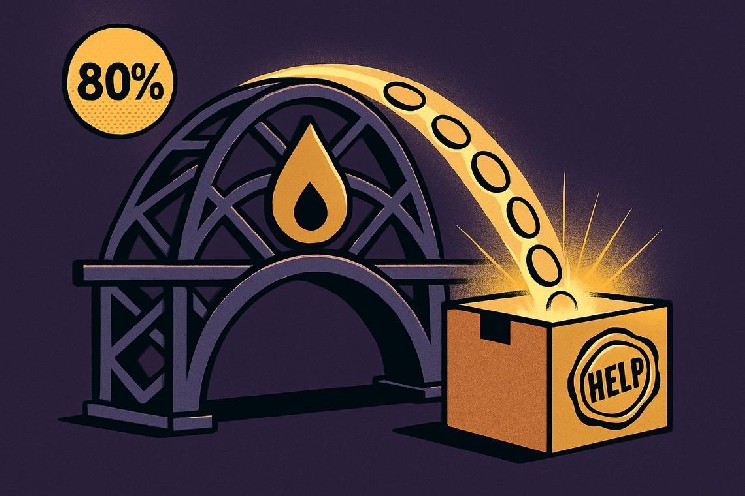
    Ripple Highlights User Humanitarian Engagement as 80% Report Donating or Volunteering

    Ripple is generating industry discussion this week not through a product launch or regulatory filing, but via a striking claim about its community: 80% of its users actively donate money or volunteer for humanitarian causes. The statistic, shared in a recent company post, has thrust Ripple humanitarian donations into the crypto spotlight, prompting debate over whether user goodwill can translate into stronger market positioning for the payments firm.

    Key Takeaways

    • Ripple states 80% of its users participate in humanitarian donating or volunteering, per a company post.
    • The claim aligns with Ripple’s core pitch: faster, cheaper cross-border payments that aid distribution.
    • Analysts are monitoring whether the community response lifts Ripple’s reputation and XRP market sentiment.
    • Future crypto donation regulations could shape how Ripple and peers manage philanthropic activity.
    • The humanitarian push coincides with Ripple’s expansion via EDX Markets integration and RLUSD stablecoin growth in Turkey.

    Community Ethos Drives Ripple’s Humanitarian Narrative

    Ripple frames the 80% figure as evidence of a user base motivated by more than price speculation. The data originates from the company’s own reporting rather than an independent survey, yet it has ignited conversation about how deeply Ripple’s community is embedded in social causes.

    Reputation in crypto often hinges on community behavior as much as technology. High participation in humanitarian efforts could differentiate Ripple from competitors focused solely on institutional deals. If the trend persists, it may pressure other platforms to spotlight or incentivize similar philanthropic engagement among their users.

    Technology Infrastructure for Aid Distribution

    Ripple’s humanitarian pitch rests on a practical advantage: moving aid funds faster and cheaper than traditional banking rails allow. The company positions its cross-border payment network as critical for organizations needing to transfer funds rapidly during emergencies.

    By explicitly tying its settlement speed and low transaction costs to humanitarian outcomes, Ripple gives its infrastructure a mission-driven narrative. That framing matters for adoption, as nonprofits and institutions evaluating crypto rails often weigh mission alignment alongside technical performance.

    Market Sentiment and Regulatory Outlook

    For traders, the immediate question is whether goodwill drives demand. Ripple’s values-driven story arrives amid mixed crypto market signals, where narrative shifts can influence sentiment even without fundamental changes.

    Observers should track Ripple’s humanitarian initiatives as a potential driver of user engagement and market perception. A positive community response could increase demand for Ripple’s services over time. This narrative runs parallel to concrete business moves, including the EDX Markets integration expanding institutional brokerage access and the RLUSD stablecoin surpassing a $1.7 billion market cap following its Turkey launch.

    Separate analysis from The Motley Fool noted XRP’s price briefly dipped below $1 in August 2026 before recovering, with the token’s market cap near $91 billion — a reminder that Ripple’s corporate and philanthropic momentum does not always correlate directly with XRP price action, given the token’s structural independence from the company’s daily operations.

    Regulatory Uncertainty Remains a Wild Card

    Future rules governing crypto donations could reshape how Ripple and similar firms operate, especially if regulators increase scrutiny of digital asset flows through charitable channels. For now, the humanitarian angle provides Ripple a distinct narrative in a market saturated with technical upgrades and partnership announcements — one built on crypto community philanthropy rather than infrastructure alone.

    Frequently Asked Questions

    What percentage of Ripple users participate in humanitarian aid?

    Ripple reports that 80% of its users are actively donating or volunteering for humanitarian aid.

    How does Ripple support humanitarian efforts using technology?

    Ripple focuses on enabling faster and cheaper cross-border payments that facilitate humanitarian aid distribution.

    What impact could Ripple’s humanitarian initiatives have on the market?

    Strong community participation in humanitarian aid could enhance Ripple’s reputation and positively influence market sentiment.

    Are there regulatory considerations related to Ripple’s humanitarian aid efforts?

    Future regulatory developments around crypto donations may affect Ripple’s operations and how it engages in humanitarian initiatives.

  • Ripple Moves to Scrap Key XRPL Amendment

    Ripple Moves to Scrap Key XRPL Amendment

    Ripple has recommended that the XRP Ledger community withdraw the long-running XChainBridge amendment, known as XLS-38, which was designed to bring native cross-chain bridging capabilities to the network. According to the company, the technology is no longer required for its primary intended use case and has failed to attract sufficient developer demand.

    Ripple Cannot Unilaterally Remove the Amendment

    Because Ripple controls only a single validator vote on the XRP Ledger, the company cannot remove the feature on its own. The withdrawal must proceed through the network’s standard amendment process, requiring broader validator consensus.

    Original Purpose of XLS-38

    XLS-38 was created to provide a native bridging framework for the XRP Ledger. The proposal would have allowed assets to move between the XRPL mainnet and connected sidechains with the assistance of “witness servers.” The system was designed to support custom sidechains, including private and permissioned networks as well as experimental chains. It was also originally intended to serve as the bridge connecting the XRP Ledger to the XRPL EVM Sidechain.

    Axelar Selected as the Alternative

    Ripple has instead selected the Axelar network to power the XRPL EVM Sidechain. Axelar’s network currently operates with more than 75 validators and supports broad interoperability with over 50 blockchain networks.

    Ripple initially decided to use Axelar for the XRPL EVM Sidechain in June 2024. At the time, the company stated it would continue leaving XLS-38 available for a community vote. However, Ripple now says there is little evidence that such demand exists.

    “The primary use case that motivated XLS-38’s development is fully addressed, and we believe better addressed, by the Axelar integration,” RippleX said.

    Code Maintenance Cited as Liability

    The company also argued that maintaining the dormant implementation has become a liability. Removing XChainBridge would allow developers to eliminate more than 10,000 lines of code from the codebase.

    Decision Remains Reversible

    Ripple indicated that its decision could be reversed. Developers who are actively building around XLS-38 have been asked to present compelling use cases that could convince the company to change its position.

  • Ripple-Finastra Deal Connects 11,000 SWIFT Members

    Ripple-Finastra Deal Connects 11,000 SWIFT Members

    Ripple-Finastra Partnership Opens Potential Pathway Into Global Banking Infrastructure

    Ripple’s strategic partnership with Finastra is attracting renewed attention from market analysts, who suggest the deal could provide the blockchain payments firm with a scalable entry point into a vast network of financial institutions. The collaboration gains additional significance following Finastra’s recent designation as a Nacha Preferred Partner for ACH experience, ISO 20022 migration, and risk and fraud prevention.

    Finastra’s Payment Modernization Suite

    Finastra’s modern ACH solutions — including Global PAYplus and Payments To Go — are engineered to help financial institutions manage rising payment volumes, support Same Day ACH, and modernize legacy payment processes. These capabilities align with the industry-wide push toward ISO 20022 adoption and real-time payment infrastructure upgrades.

    Distribution Potential Across 11,000 SWIFT-Connected Institutions

    For Ripple, the strategic value lies in distribution. Finastra supplies banking software and payments infrastructure to financial institutions worldwide. This established footprint could allow Ripple to integrate its technology into platforms already embedded in bank operations, potentially reducing the need to negotiate individual relationships with each institution.

    Industry observers frequently reference the 11,000 SWIFT member figure when discussing this partnership’s reach. However, the Ripple-Finastra agreement does not grant Ripple direct access to all 11,000 SWIFT members. Such a claim would exceed what the partnership formally establishes. Instead, Finastra’s global network provides Ripple with a potential route into a much larger ecosystem of institutions connected to the international payments infrastructure — a distinction that makes the opportunity more credible rather than less.

    Finastra as a Strategic Distribution Channel

    Finastra’s payments infrastructure emphasizes high-volume processing, automation, ISO 20022 readiness, and legacy system modernization — all priorities for banks upgrading their payment stacks. Many institutions require solutions that integrate with existing infrastructure rather than replace it entirely, creating a natural opening for Ripple’s interoperability-focused technology.

    Ripple has steadily expanded beyond its original XRP-centric identity, building a broader institutional presence across payments, digital assets, and financial infrastructure. Partnerships with established banking technology providers accelerate this strategy by placing Ripple’s capabilities closer to the systems financial institutions already rely on daily.

    Institutional Reach: The Core Value Proposition

    The Finastra relationship addresses one of the most persistent challenges in enterprise blockchain adoption: distribution. If Ripple can embed its technology into platforms serving thousands of financial institutions, it may avoid the slow, resource-intensive process of pursuing each bank individually. A single strategic infrastructure partnership could unlock opportunities across multiple downstream institutions simultaneously.

    Finastra’s new Nacha Preferred Partner status further strengthens its position within the evolving payments landscape, particularly around ACH modernization, ISO 20022 compliance, and fraud prevention frameworks.

    Outlook: Closer to Traditional Finance Plumbing

    The bullish case centers on Ripple moving closer to the core plumbing of traditional finance. The 11,000-SWIFT-member narrative should be interpreted as potential reach rather than guaranteed access. As Ripple continues embedding its technology into established financial infrastructure, its institutional footprint could extend well beyond the banks it signs directly — making the Ripple-Finastra connection a partnership warranting close observation.

  • Illegal influence on sec? In addition to XRP, Ethereum should also be classified as securities

    Illegal influence on sec? In addition to XRP, Ethereum should also be classified as securities


    • Coinbase reveals internal discussions of the SEC about the security status of XRP and New York’s advance for ETH classification.
    • The developing attitude of the SEC for crypto regulation in the middle of the XRP and ETH debates generate uncertainty.

    Coinbase has published more than 10,000 documents that disclose the internal communication of the US Securities and Exchange Commission (SEC) with regard to the regulatory status of XRP and Ethereum (ETH). These documents received by inquiries about the Freedom of Information Act (FOIA) show the ongoing discussions about whether XRP should be classified as securities.

    They also revealed the pressure from the New York general prosecutor’s office to classify ETH as security. The disclosure throws a light on regulatory uncertainty in connection with digital assets in the United States.

    Internal SEC debate about the status of XRP

    One of the most important findings from the publication The Coinbase document is an internal SEC discussion about whether XRP can be classified as security. In 2021, the SEC officials examined whether XRP has the characteristics of a securities. An e-mail revealed an inquiry about possible risks for the XRP blockchain if Ripple, the company behind XRP, “went away or disappear.”

    This question arose as part of the ongoing legal dispute of the SEC with Ripple, which began in December 2020 when the SEC Ripple accused a non -registered securities offer.

    The documents show that the SEC has weighed the classification of XRP for years. The ongoing legal case that has attracted great attention in the crypto industry. These internal emails throw a light on the uncertainties with which the regulatory authorities are faced with the determination of the legal status of certain cryptocurrencies.

    New York Attorney General is committed to the classification of ETH as security

    The New York general prosecutor’s office has put pressure on the Sec as securities classifying ETH. This print came to light in a recently published document of Coinbase. In June 2023 demanded Shamiso maswawn, derHead of the investor Protection Bureau in the office of the New York General Prosecutor’s Attorney, the SEC to submit an Amicus letter in which he argues that ether is a securities. This application was part of the state’s procedure against Kucoin, which was accused of violating state securities and goods laws.

    Maswoswe said that the participation of the SEC in the case would have no direct influence on the result, but that a court ruling that ETH classifies as security would be a big cause for the efforts to protect investors. She wants this clarity.

    The SEC has not yet taken a fixed point of view on this matter. First of all, the authority indicated that ETH was probably a goods. Since then, however, she has not made any final statements.

    Further effects of the SEC approach for crypto regulation

    The authority has been trying to classify certain digital assets as securities for some time. But the crypto industry has opposed it and claims that these classifications are unclear and inconsistent. This has led to increased uncertainty in crypto regulation in the United States.

    As shown in our latest reporting, Gary Gensler pursued a more aggressive approach to crypto regulation during his term as a SEC chairman. However, the latest developments indicate a shift towards a more moderate and more flexible approach.

    This change is shown in the recent round table discussion of the SEC entitled “Between a Block and a Hard Place: Tailoring Regulation for Crypto Trading”, which took place in April 2025.

    In the meantime, the SEC recently dropped charges against large crypto companies such as Coinbase. This is followed by Ripple’s legal victory, which forced the Sec to rethink its unclear and inconsistent approach to crypto regulation.

    The Chief Legal Officer of Ripple, Stuart Alderoty, said that the SEC’s decision to drop the XRP case shows that the authority recognizes its failure to determine clear regulations. He believes that it is time for the SEC to go beyond the courtroom and work with the congress in order to create effective, permanent regulations.

    Ripple is progressing. The Hidden Roads takeover worth $ 1.25 billion has been completed and now focuses on the growth of the company and the cooperation with the regulatory authorities in order to create a clear regulatory framework for the industry.

  • Morgan Stanley calls Ripple “key player” for replacing the interbank system Swift

    Morgan Stanley calls Ripple “key player” for replacing the interbank system Swift


    • Morgan Stanley sees Ripple’s technology the modern alternative to the aging old systems from Swift.
    • The DLT of Ripple reduces fraud and delays and is equally well received by banks and right -wing experts.

    Large financial institutions are increasingly signaling their support for blockchain-based solutions to overhaul the global payment systems. Morgan Stanley has again spoken with a remarkable recommendation in which Ripple is referred to as a convincing alternative to Swift.

    This recognition underlines the growing interest in the distributed Ledger technology (DLT) as a solution for the long existing inefficiencies in cross-border transactions. In view of the increasing pressure on the financial markets, Ripple’s model is very important for both industry leaders and in academic circles.

    Morgan Stanley emphasizes Ripple’s disruptive potential

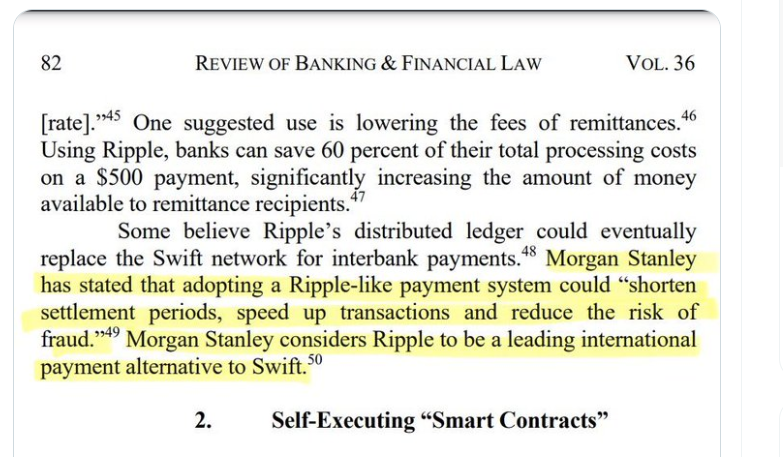
    Morgan Stanley’s analysis, originally in her report Blockchain in Banking: Disruptive Threat or Tool? Published in Volume 36 of the Boston University Review of Banking & Financial Law.

    According to the bank’s findings, the introduction of a “ripple-like payment system” could shorten the settlement times, accelerate transactions and reduce fraud risks-important pain points in today’s global payment infrastructure.

    In the report, in particular, it is emphasized that the Ripple DLT model makes correspondence banking superfluous, a procedure on which Swift is still relating to. This traditional method often leads to delays when processing 3-5 days.

    In contrast, the infrastructure of Ripple offers almost immediate handling while at the same time drastic reduction in operating costs. Morgan Stanley found that Ripple’s approach has the potential to change the way in which banks handle international payments, since it enables real -time processing without intermediate institutions.

    Industry -wide recognition for Ripple is growing

    The growing institutional recognition of Ripple’s payment model is not limited to Morgan Stanley. JPMorgan has already identified Ripple and XRP as important players in solving inefficiencies in cross -border payments.

    According to her analysis, $ 120 billion is lost in the current system due to delays, currency reductions and liquidity traps. At $ 23.5 trillion, which are moved every year by outdated networks, such inefficiencies are no longer portable.

    In the JPMorgan report, Ripple, Swift and the CLS Group were compared. It was emphasized that Swift is still heavily dependent on an outdated infrastructure and that the CLS Group only supports 18 currencies worldwide.

    In the meantime, the real-time system of Ripple, which is based on the XRP Ledger, was recognized for its efficiency despite the concerns about the volatility of cryptocurrencies. With the earlier conclusion of Morgan Stanley, these observations coincide that Ripple is one of the most serious candidates for modernizing international banking.

    In the legal examination of the Boston University, Ripple was cited as part of a wider blockchain revolution in addition to the Smart Contract capabilities of Ethereum. The paper underlines the potential of DLT to improve compliance with regulations, transparency and regulatory supervision in the entire financial sector. Such academic recognition further strengthens Ripple’s position as a credible alternative to conventional systems.

    While Ripple continues to develop his own Swift alternative, institutional support from leading banks such as Morgan Stanley and JPMorgan gives additional weight to its vision. These developments indicate that the perspective of the traditional financial actors changes to blockchain – not as a threat, but as an instrument for eliminating the inefficiency of the global banking system. With the increasing distribution of blockchain, the dynamics behind the cross -border payment solutions from Ripple increase in both companies and science.

  • Ripple’s banking ambitions can lead to a leading role as a global financial service provider

    Ripple’s banking ambitions can lead to a leading role as a global financial service provider


    • As a bank, Ripple would have direct access to central banks, the issue of stable coins and all services for digital assets.
    • XRP could develop into a central settlement level for tokenized assets and CBDCs if Ripple receives full banking status.

    Ripple strives to become a licensed financial institution, which represents a big change compared to his previous focus on cross -border transfers. According to analysts, the company’s striving for a banking license will enable him to work directly with central banks, to output stable coins under official supervision and to offer a wide range of custody and handling services.

    A banking license would enable ripple to act on regulated financial markets without relying on intermediaries. This would give the company the legal authority to keep assets, offer credit services and to handle Fiat crypto shops over a single licensed area.

    Such access could simplify the interaction between traditional institutions and emerging blockchain-based systems, including digital central bank currencies (CBDCs), tokenized securities and stable coins.

    Analysts note that Ripple with banking status could establish a direct connection to real-time gross billing systems of national central banks. According to the CNF report is this access Currently licensed banks reserved, which restricts the role that non-banking fintech companies can play in systemic financial processes.

    By eliminating this barrier, Ripple could enable regulated transactions via Fiat and digital networks and thus support financial markets that are increasingly relying on token-based instruments and distributed LEDGER technology.

    Strategic expansion through acquisitions and partnerships

    Ripple has already taken steps to support a transition to banking transactions. In 2023, Ripple Metaco acquired a platform for the custody of digital assets that are often used by banks and financial institutions. The purchase gave Ripple storage capacities of institutional quality, a key component of the infrastructure of every bank, which deals with tokenized assets or cryptocurrencies.

    It is also reported that Ripple has shown interest in taking over Circle, the issuer of the USDC stable. Although this is not confirmed, such a step Ripple would give a significant leverage in the StableCoin ecosystem.

    In addition to the acquisitions, Ripple participates in various pilot programs associated with the development of digital currencies. Bhutan, Palau and Montenegro work with the company to explore the possible uses for CBDC. These initiatives are an indication that Ripple is willing to support both public digital currencies and private token systems and to meet the changing regulations and the needs of the central banks.

    The regulatory positioning of Ripple has also changed according to the partial legal victory in the case of the US Securities and Exchange Commission (SEC). Although the case has not yet been completed, the judgment has clarified the classification of XRP, which means that Ripple can act more confidently in regulated environments.

    The potential role of XRP as a global settlement bridge

    When Ripple becomes a licensed bank, XRP could be the liquidity medium that connects tokenized markets worldwide. Market analysts suspect that the reason is that neutral assets are necessary in every regulated financial system in order to transmit values ​​across borders and between blockchain networks. If the use of the assets by institutions and central banks as a bridge creates demand and not through speculation in retail, XRP could take on this role.

    However, XRP would define this as part of a larger financial infrastructure. It would no longer just be a crypto asset, but a necessary instrument in the paradigm of the future financial world. Real estate, stocks and public digital currencies, all token, need a processing mechanism that XRP could provide, supported by a handling infrastructure with the supervision of a fully licensed ledger of a bank.

  • Ripple Quartals Report sets a new XRP price target-$ 3 possible

    Ripple Quartals Report sets a new XRP price target-$ 3 possible


    • XRP forms an interest bully wedge pattern and signals an outbreak towards $ 3.
    • The institutional interest increases with XRP ETF registrations and the ripple takeover of Hidden Road for $ 1.25 billion.

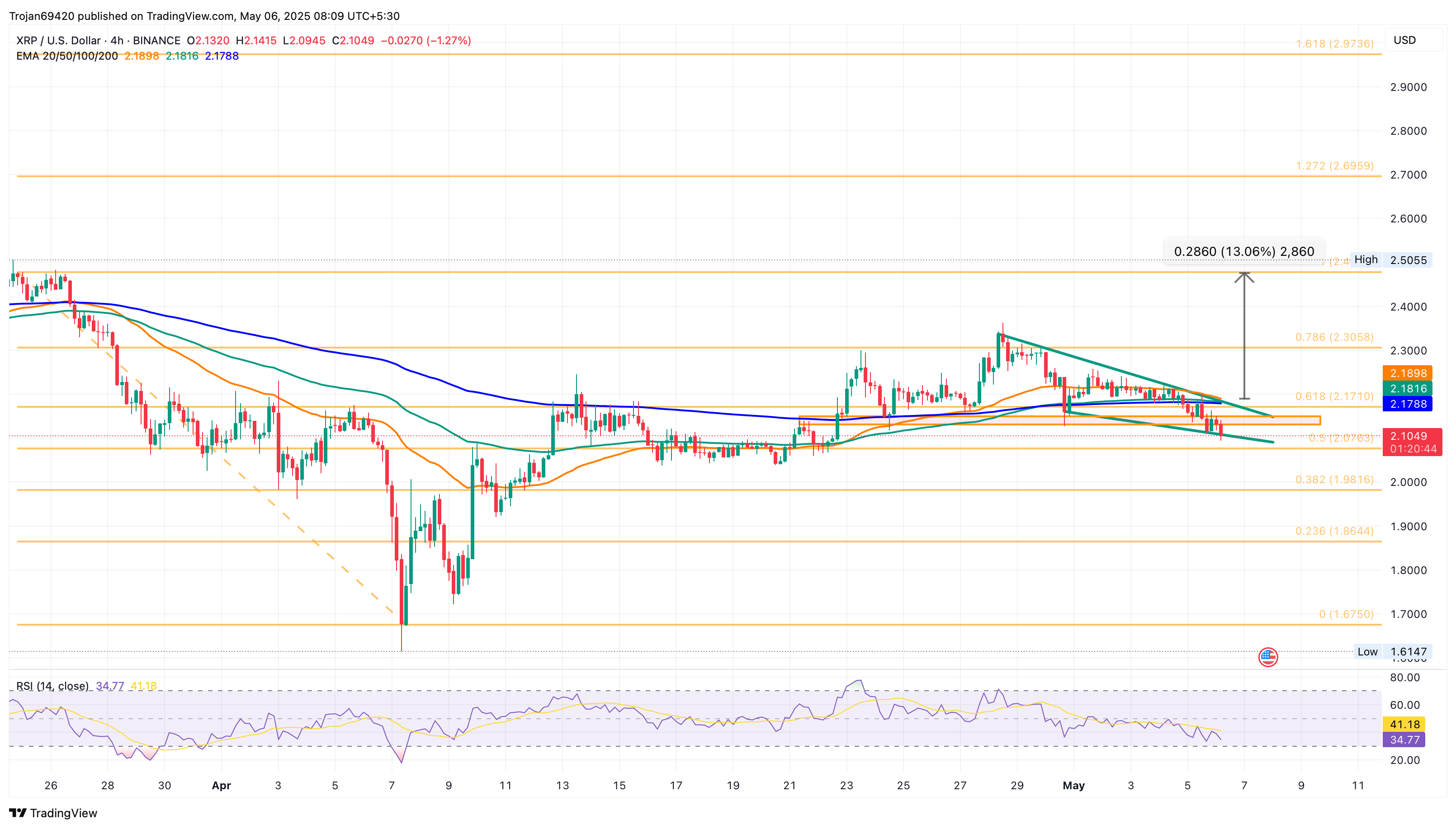
    Despite a volatile week, the XRP token stays stable at the wider cryptoma market at $ 2.13. The mood of the investors has significantly improved after the publication of the XRP market report Q1 2025 by Ripple, which emphasizes a number of strategic success. From institutional support to regulatory breakthroughs, XRP seems to be positioned for a bullish outbreak. Technical indicators, coupled with a strong macroeconomic outlook, indicate that the token could soon test the $ 3-resistance brand.

    When writing this article, XRP is traded at $ 2.09 and had fallen by 3.74% in the last 24 hours.

    Falling wedge pattern signals outbreak

    The technical analysis shows that a falling wedge pattern has formed between April 28 and May 6th. XRP recorded lower highs and lower lows during this period, with the trend lines merging at $ 2.14. Analysts see this constellation as interest bully, which usually leads to an outbreak when the down momentum subsides. A confirmed outbreak could drive XRP up to 10 % with a target of $ 2.36.

    Despite a decline of 10 % last week, XRP maintained support above the $ 2 threshold. According to market analysts, this stability strengthens the outbreak potential. The general market conditions will remain a key factor for whether XRP can reach the $ 3 brand in the coming weeks.

    Institutional movements strengthen market trust

    The Q1 2025 XRP Markets Report by Ripple outlines important developments that support long -term optimism. The report leads several positive measures in the US leadership, including a implementation regulation of Donald Trump, which supports crypto innovations. The appointment of Paul Atkins as SEC chairman and the cross-party dynamics for stablecoin legislation have further improved regulatory clarity.

    The institutional activities have increased. Franklin Templeton submitted an S-1 application for an XRP ETF, while Volatility Shares suggested three other XRP-based ETFs. The Brazilian CVM approved a special XRP ETF, and the CME Group introduced XRP futures, which further anchored the institutional legitimacy of XRP.

    Despite weekly drains of $ 37.7 million, XRP system products have recorded $ 214 million in tribes this year. This means that XRP only lacks $ 1 million to exceed global Ethereum fund inflows, which underlines the increasing demand from investors.

    The on-chain indicators reflect a cooling phase in the first quarter, whereby the creation of wallets and the transaction volume decreased by 30-40 %. The activity of the decentralized stock exchange (Dex) also decreased by 16 % in the quarterly comparison. The USD-based stable coin from Ripple, Rlusd, has proven to be a growth catalyst. RLUSD’s market capitalization exceeded $ 90 million, while the cumulative Dex volume was over $ 300 million.

    The report also confirms the takeover of Hidden Road, a large Prime broker, with Ripple worth $ 1.25 billion. This step is seen as a strategic attempt to position RLUSD as a stable coin for companies with real benefits. With its plans to enable cross-margining between traditional and digital asset markets, Ripple wants to combine the institutional financial world with the blockchain infrastructure.

  • The merger of Ripple and Circle would change the entire industry

    The merger of Ripple and Circle would change the entire industry


    • The bid of Ripple for Circle could make XRP from a bridge currency a central financial infrastructure and redefine its role in global payment transactions.
    • The integration of USDC and RLUSD would reduce frictional losses on the market and strengthen institutional acceptance.

    Ripple’s offer of $ 4 to $ 5 billion for the takeover of Circle, the issuer of USD Coin (USDC), raises questions about the dynamics of the StableCoin market and the future role of XRP in global finance.

    According to crypto analysts who observe the development, such a deal would not only trigger a price reaction from XRP. It could also mark the beginning of a structural development. The possibility of integrating USDC into the Ripple network could redefine the application of XRP. It would go far beyond its current role as a bridge currency.

    Ripplenet is currently using XRP to enable quick and cost -efficient cross -border payments. Analysts assume that the takeover of circle and the addition of USDC liquidity of $ 61 billion could consolidate the infrastructure for digital payments. Ripple could create a more flexible and liquider environment for cross -border value transmissions. This would be achieved by accommodating both a native asset and a stable coin under the same roof.

    This possible shift is not seen as a replacement for XRP, but rather as an upgrading of its role. “XRP would not only react to the takeover, but would develop further,” said a market expert. The asset would act as an underlying settlement level in addition to USDC and enable more smooth interactions between tokenized assets and real currencies.

    Such integration could reduce the instability of the market-an important step for blockchain-based financial systems that strive for broad acceptance. Ripple has already introduced his StableCoin RLUSD. By merging with USDC, Ripple would get control over two large digital currencies bound to the Fiat.

    Institutional and regulatory leverage

    One of the biggest trump cards is his established relationships with bank partners and supervisory authorities in various legal systems. The takeover of Circle would enable ripple to take this frame and strengthen its position in markets in which the consent of the regulatory authorities is crucial for acceptance. This would probably also make XRP more attractive for institutional investors who value compliance and regulatory clarity.

    In addition, the takeover could enable Ripple to expand its role beyond the private sector and to venture into broader financial applications such as Defi, salary statement and on-chain credit allocation. USDC and stable coins are already widespread in these sectors. They could be integrated into the XRP network to reduce operational friction and increase the efficiency of financial networks.

    Even if Circle is said to have rejected the original offer, the offer shows that Ripple is increasingly relating to the infrastructure around stable coins. Lately the company has made other strategic acquisitions, such as: B. a crypto brokerage company, which indicates a concerted effort for the integration of digital assets and the ecosystem of the keys.

    Market observers say that the offer fits into a more comprehensive plan: Ripple should become the heart of the global payment infrastructure. The message is clear: control of the stable coin liquidity is now an important goal whether Ripple renews or not.

    Something that was successful, XRP, may not be viewed as a transaction activum if Ripple is successful in this project. Rather, it could be the basis for the financial infrastructure and the long -term values ​​and the role in which it is.