Tag: Ripple

  • Why XRP’s Best Q3 in 4 Years Won’t Save Bulls This October

    Why XRP’s Best Q3 in 4 Years Won’t Save Bulls This October

    Key Highlights

    • XRP posted its strongest third-quarter performance since 2022 with a +48.1% return, closing at $1.54 and erasing first-half losses.
    • Historical CryptoRank data shows October is statistically XRP’s worst month, averaging a -5.14% return with the token closing lower in both 2024 and 2025.
    • Analysts warn the futures market is overloaded with leverage, making a technical pullback to the $1.30–$1.40 support zone likely before any sustained Q4 rally.

    XRP Defies ‘Uptober’ Optimism as Historical Data Signals October Correction

    As the cryptocurrency market enters the fourth quarter amid widespread anticipation of a seasonal “Uptober” rally, Ripple’s XRP token appears poised to decouple from the broader bullish sentiment. Despite delivering its best quarterly close in four years—a +48.1% surge that pushed the asset to $1.54 and triggered bullish weekly technical signals—on-chain and derivatives data suggest the token faces an immediate period of consolidation or correction rather than an instant breakout.

    Short-Squeeze Rally Leaves Market Overleveraged

    The third-quarter rally was fueled significantly by a short squeeze, where the forced closure of bearish futures positions amplified upward price action. While this dynamic helped XRP reclaim the $1.54 level, it simultaneously loaded the futures market with excessive leverage. For a sustainable uptrend to resume, analysts argue the market requires a healthy technical reset. The current structure points toward a necessary pullback to retest the $1.30–$1.40 support range, a zone that would flush out weak longs and restore a healthier balance between spot buying and derivatives positioning.

    Seasonality Data Warns Against Immediate Breakout

    Historical metrics compiled by CryptoRank present a compelling counter-narrative to the “Uptober” thesis for XRP specifically. October carries a historical average return of -5.14% and a median return of -2.97%, making it statistically the worst calendar month for the asset. This pattern has held firm in recent cycles, with XRP closing October lower in both 2024 and 2025. While the full fourth quarter boasts an impressive average return of +133.3%, that figure is heavily skewed by explosive moves in late autumn; the quarterly median sits at -8.00%, underscoring that the majority of gains arrive in a concentrated window later in the year.

    Why This Matters: The Late-Autumn Liquidity Cycle

    The divergence between XRP’s strong Q3 close and its weak October seasonality highlights a critical market structure dynamic: the delay between initial risk-on sentiment and actual capital deployment. Historical data shows November leads the quarter with a median return of +80.2%, followed by December at +63.1%. This suggests the “real” Q4 rally for XRP has historically been a November-December phenomenon, driven by macro liquidity flows and year-end positioning rather than October momentum. Traders positioning for an immediate October continuation risk fighting both historical probability and an overleveraged derivatives market that is structurally primed for a reset.

    Frequently Asked Questions

    Why did XRP rally so hard in Q3 if October is historically weak?

    The Q3 surge was driven by a combination of capital inflows into U.S. spot ETFs and a pronounced short squeeze in the futures market, which forced bearish traders to buy back positions, accelerating the price rise. This mechanical buying pressure created a strong quarterly close but left the derivatives market overleveraged.

    What price levels should investors watch for the predicted pullback?

    Analysts identify the $1.30–$1.40 range as the key support zone for a healthy technical retest. A pullback to this area would alleviate overbought conditions and reduce excessive futures leverage before a potential sustained rally in November.

    Does the negative October history guarantee XRP will drop this month?

    No. Historical averages and medians represent probabilistic tendencies, not certainties. However, the confluence of negative seasonality, current overbought weekly conditions, and an overleveraged futures market increases the statistical likelihood of consolidation or correction over an immediate continuation higher.
  • Peter Brandt Labels XRP “Fool Coin” in Controversial Comments

    Peter Brandt Labels XRP “Fool Coin” in Controversial Comments

    Key Highlights

    • Veteran trader Peter Brandt reiterated his long-standing skepticism toward XRP, labeling it a “dumb coin” and questioning its tokenomics despite Ripple’s expanding bank partnerships.
    • Brandt draws a sharp fundamental distinction between Bitcoin as a “store of value” and XRP as a transaction-focused asset, arguing utility alone does not drive token price appreciation.
    • The trader expressed a more favorable view on Ethereum and Solana, calling Ethereum a “good asset” with upside potential, while maintaining Bitcoin as his preferred core portfolio holding.

    Brandt Doubles Down on XRP Skepticism Amid Ripple Progress

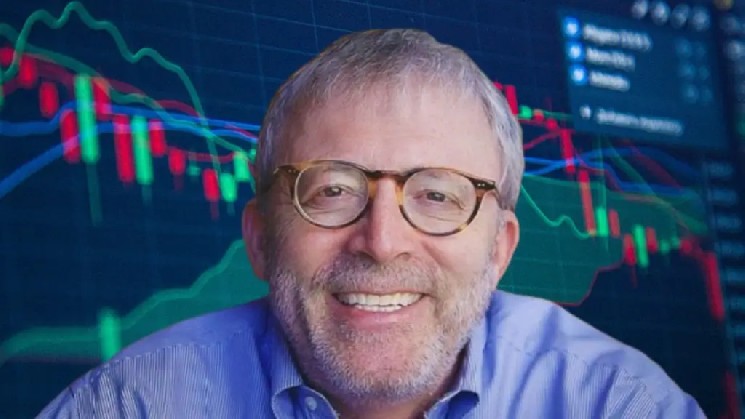
    Senior market trader Peter Brandt has reaffirmed his bearish stance on XRP, stating that recent developments within the Ripple ecosystem—including widespread collaborations with global banking institutions—have failed to alter his fundamental assessment of the asset. During a recent interview, Brandt was pressed on whether Ripple’s institutional momentum and technological advancements warranted a reassessment. He responded by maintaining his skepticism, emphasizing that structural questions surrounding the token’s supply dynamics and value accrual mechanism remain unresolved.

    A Fundamental Taxonomy: Store of Value vs. Transaction Utility

    Central to Brandt’s thesis is a categorical distinction between crypto assets based on their primary utility. He characterizes Bitcoin primarily as a “store of value,” acknowledging its current speculative trading nature while attributing to it monetary properties akin to digital gold. In contrast, he views XRP as an asset designed explicitly for transactional throughput and cross-border settlement. This classification leads him to a blunt appraisal: he directly referred to XRP as a “dumb coin,” arguing that its transactional efficiency does not inherently translate into investment merit.

    Utility Does Not Equal Value Accrual

    When challenged on XRP’s proven ability to facilitate cheap, rapid transactions, Brandt conceded the technical point but rejected the investment conclusion. He cited the U.S. dollar as a parallel: a fiat currency used globally for highly effective transactions that no holder expects to appreciate in value solely because of its velocity. “Just because something can be used in transactions doesn’t automatically mean it has to be more valuable,” Brandt stated. He posited that the critical unanswered question for XRP is at what inflection point transactional volume converts into genuine economic value for the token itself, rather than merely benefiting the Ripple network infrastructure.

    Diverging Views on Ethereum and Solana

    Brandt’s critique does not extend uniformly across the altcoin landscape. He spoke positively of Ethereum, describing it as a “good asset” and expressing confidence that both Ethereum and Solana possess the potential to reach higher valuation levels. He places these networks in a separate category from both Bitcoin and XRP—platforms upon which applications are built—suggesting they warrant a distinct valuation framework. Ultimately, Brandt disclosed a personal portfolio preference heavily weighted toward Bitcoin, reinforcing his conviction in the premier cryptocurrency’s monetary role over utility-focused alternatives.

    Why This Matters

    Peter Brandt’s commentary carries weight due to his decades-long track record in commodity and futures trading, offering a traditional market perspective on digital asset classification. His insistence on separating “store of value” narratives from “utility token” mechanics highlights a persistent debate in crypto valuation methodologies. As Ripple continues to secure regulatory clarity—most notably the July 2023 court ruling that XRP is not inherently a security—and expands its On-Demand Liquidity (ODL) corridors with financial institutions, the market is actively testing whether enterprise adoption creates token holder value. Brandt’s dollar analogy underscores a critical tokenomics question: velocity and utility are necessary but not sufficient conditions for price appreciation without a mechanism capturing that value (e.g., fee burns, staking yields, or supply constraints). Meanwhile, his endorsement of Ethereum and Solana reflects growing institutional comfort with smart contract platforms as programmable settlement layers, a narrative driving ETF filings and allocation shifts in 2024.

    Frequently Asked Questions

    What specific concerns did Peter Brandt raise about XRP’s tokenomics?
    Brandt highlighted “question marks regarding the total supply and whether it would expand in the future,” suggesting uncertainty over XRP’s emission schedule and escrow release mechanism undermines its credibility as a scarce store of value.
    How does Brandt differentiate Bitcoin from XRP and Ethereum?
    He categorizes Bitcoin as a “store of value” asset, XRP as a transaction-focused utility token, and Ethereum (alongside Solana) as an application platform layer—arguing each requires a distinct valuation framework rather than a one-size-fits-all approach.
    Does Peter Brandt hold any XRP or recommend it as an investment?
    No. Brandt explicitly maintained his skepticism, called XRP a “dumb coin,” and stated he prefers Bitcoin for the majority of his cryptocurrency portfolio. The source includes a disclaimer: “This is not investment advice.”
  • Ripple CEO Brad Garlinghouse Unveils 5-Year Crypto Strategy Featuring Bitcoin, XRP, Three Altcoins

    Ripple CEO Brad Garlinghouse Unveils 5-Year Crypto Strategy Featuring Bitcoin, XRP, Three Altcoins

    Key Highlights

    • Ripple CEO Brad Garlinghouse proposes a simple five-year “buy and hold” strategy focusing on the top five cryptocurrencies by market capitalization: Bitcoin, Ethereum, Tether, BNB, and XRP.
    • Garlinghouse emphasizes he is not an “XRP maximalist,” reveals he personally holds a small amount of Solana, and argues different blockchain projects can succeed simultaneously without being direct competitors.
    • The executive cites “trust, utility, speed, and liquidity” as the fundamental drivers of XRP’s long-term value, asserting that the most liquid assets tend to become the most valuable over time.

    Garlinghouse Unveils Long-Term ‘Top Five’ Crypto Portfolio Strategy

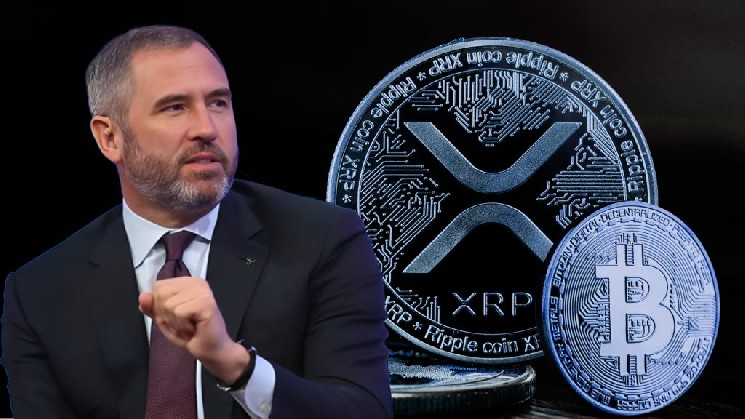
    Speaking at a recent industry event, Ripple CEO Brad Garlinghouse outlined a straightforward investment thesis for long-term cryptocurrency holders, suggesting that a diversified basket of the five largest digital assets by market capitalization could yield “great results” over a five-year horizon. The strategy moves away from concentrated bets on single tokens, instead advocating for exposure to the established market leaders: Bitcoin (BTC), Ethereum (ETH), Tether (USDT), BNB, and XRP.

    XRP Inclusion Notable Amid ‘Non-Maximalist’ Stance

    The inclusion of XRP in Garlinghouse’s proposed top-five basket draws particular attention given his previous public stance. The Ripple chief has explicitly stated in the past that he does not define himself as an “$XRP maximalist,” signaling a broader market perspective rather than singular allegiance to the token native to the Ripple ecosystem. This approach underscores a philosophy of market-cap-weighted diversification rather than thematic or ecosystem-specific concentration.

    Solana Acknowledged as Valid, Non-Competitive Peer

    Addressing the inevitable comparisons between XRP and other high-throughput blockchains, specifically Solana (SOL), Garlinghouse declined to frame the relationship as a zero-sum competition. When asked why an investor should prefer XRP over Solana, he stated he was not trying to convince anyone to choose one over the other. He revealed he personally owns a small amount of Solana and maintains a positive view of various cryptocurrencies for different reasons. “He stated that he does not see Solana as a direct competitor to $XRP and that different crypto projects can be successful simultaneously,” reinforcing a multi-chain future thesis.

    Liquidity, Trust, and Utility Cited as XRP Value Drivers

    Concluding his remarks, Garlinghouse expressed strong optimism regarding XRP’s specific fundamentals. He argued that the determinants of a currency’s enduring value are “trust, utility, speed, and liquidity“—effectively, how liquid the asset is. He posited a direct correlation between liquidity and value, asserting that the most liquid currencies tend to be the most valuable because liquidity is the primary reason investors seek to hold an asset. This framework positions XRP’s design for institutional cross-border payments as its core competitive advantage.

    Why This Matters

    Garlinghouse’s comments arrive as institutional adoption of digital assets accelerates, with major financial firms increasingly treating cryptocurrency as a distinct asset class requiring diversified allocation strategies rather than speculative single-token bets. His “top five” framework mirrors traditional finance index-investing principles applied to the crypto market cap leaderboard. Furthermore, his explicit refusal to engage in tribalistic “maximalist” rhetoric—and his acknowledgment of holding Solana—signals a maturing industry leadership mindset focused on interoperability and collective ecosystem growth. For market participants, the remarks reinforce the narrative that regulatory clarity (particularly surrounding XRP’s status in the U.S.) and deepening liquidity pools are critical milestones for the next phase of crypto market development.

    Frequently Asked Questions

    What are the five cryptocurrencies Brad Garlinghouse includes in his proposed long-term strategy?
    The basket consists of Bitcoin (BTC), Ethereum (ETH), Tether (USDT), BNB, and XRP, ranked by current market capitalization.
    Does Brad Garlinghouse consider himself an XRP maximalist?
    No. Garlinghouse has previously stated he does not define himself as an “$XRP maximalist,” and he confirmed he personally holds a small amount of Solana (SOL).
    What fundamental factors does Garlinghouse believe drive XRP’s value?
    He cites “trust, utility, speed, and liquidity” as the primary drivers, arguing that the most liquid assets tend to become the most valuable over time.
  • Ripple News and XRP Price Update: September 25

    Ripple News and XRP Price Update: September 25

    Key Highlights

    • Spot XRP ETFs have attracted roughly $1.75 billion in cumulative net inflows across 10 consecutive positive weeks, with new filings from T. Rowe Price and Exchange Listed Funds Trust signaling expanding institutional appetite.
    • Whales accumulated over 1.54 billion XRP tokens in approximately 96 hours following the CLARITY Act’s failure, viewing the resulting pullback as a strategic entry point.
    • Ripple’s RLUSD stablecoin has reached a $2.37 billion market capitalization—ranking ninth among stablecoins—while XRP itself corrected 8% to $1.47 after touching a 2026 high near $1.65.

    Institutional Momentum Builds Around XRP ETFs

    Spot XRP exchange-traded funds continue to draw substantial capital from conservative investors, underscoring sustained institutional confidence in Ripple’s cross-border token despite recent price volatility. According to data reported by CryptoPotato, these financial vehicles have posted ten straight weeks of positive flows, pushing cumulative net inflows to approximately $1.75 billion. The past two sessions extended the streak, suggesting the upward trajectory remains intact. Current issuers include Bitwise, Franklin Templeton, Canary Capital, 21Shares, and Grayscale, while additional managers await regulatory clearance to launch their own products.

    The pipeline of forthcoming funds highlights growing sophistication in crypto-linked investment strategies. T. Rowe Price recently amended its crypto ETF filing to include a 9.15% allocation to XRP within a multi-asset basket. Separately, Exchange Listed Funds Trust submitted the “CYBER HORNER S&P 500® and $XRP 75/25 Strategy ETF” to the U.S. Securities and Exchange Commission. If approved, the product would offer investors blended exposure to the broad equity benchmark and Ripple’s native token in a fixed 75/25 ratio, marking a notable convergence of traditional and digital asset structures.

    Whale Accumulation Signals Confidence Amid Regulatory Uncertainty

    Large-scale holders have seized on recent weakness to aggressively increase positions. Over a roughly four-day window last week, whales acquired more than 1.54 billion XRP units. The accumulation began shortly after the CLARITY Act failed to advance in the United States, an event that triggered a market pullback. On-chain behavior suggests these investors interpreted lower prices as a buying opportunity rather than a signal to exit, reinforcing the narrative that long-term conviction remains undimmed by legislative setbacks.

    Ripple Expands Stablecoin Strategy at MESA Forum

    Ripple’s institutional outreach took center stage at the MESA Forum, where Reece Merrick, Managing Director for the Middle East & Africa, appeared alongside representatives from financial heavyweights BlackRock and HSBC. The panel addressed stablecoins, tokenized deposits, and tokenized money-market funds—areas where traditional finance and blockchain infrastructure increasingly intersect. Merrick emphasized the strategic rationale behind Ripple’s dollar-pegged stablecoin, stating: “Stablecoins: The always-on layer moving value between institutions without existing relationships (why $RLUSD was built not to replace bank money, but to let it travel).”

    Merrick also signaled Ripple’s deepening footprint in the United Arab Emirates, noting the jurisdiction is “open for business” and “actively building.” In summer 2025, the Dubai Financial Services Authority formally recognized RLUSD as a crypto token within the Dubai International Financial Center. Since its December 2024 launch, the stablecoin has secured backing from prominent exchanges and institutions, propelling its market capitalization to $2.37 billion—making it the 43rd-largest cryptocurrency overall and the ninth-largest stablecoin by market value.

    Price Correction Tests Key Technical Levels

    After rallying to nearly $1.65 earlier this week—the highest level since the start of 2026—XRP succumbed to a broad-market correction, sliding approximately 8% to $1.47 according to CoinGecko data. Technical observers are now watching whether bulls can reclaim the $1.50 threshold to reignite upward momentum. Pseudonymous analyst Diana identified $1.61 as the critical resistance level that must be cleared to open a path toward the $1.70–$2.00 range. The token’s ability to stabilize above current levels will likely determine whether the recent ETF and whale-driven fundamentals can override near-term macro headwinds.

    Why This Matters

    The convergence of regulated ETF products, sovereign-grade stablecoin adoption, and persistent whale accumulation paints a picture of maturing institutional infrastructure around the XRP ecosystem. While legislative efforts like the CLARITY Act stall in Washington, market participants are advancing practical solutions—tokenized deposits, multi-asset ETFs, and cross-border stablecoin rails—that bypass the need for immediate regulatory perfection. Ripple’s engagement with entities such as BlackRock, HSBC, and the DFSA signals that major financial centers are treating blockchain-based value transfer as an operational reality rather than a speculative experiment. For investors, the key question becomes whether the current correction represents a healthy consolidation within a longer uptrend or a deeper repricing driven by macro liquidity conditions.

    Frequently Asked Questions

    Which firms have launched spot XRP ETFs so far?
    Bitwise, Franklin Templeton, Canary Capital, 21Shares, and Grayscale currently offer spot XRP ETFs. Additional issuers, including T. Rowe Price and Exchange Listed Funds Trust, have filed for new products awaiting SEC approval.
    What is RLUSD and how large has it grown?
    RLUSD is Ripple’s U.S. dollar-pegged stablecoin, launched in December 2024. It has reached a $2.37 billion market capitalization, ranking as the ninth-largest stablecoin and the 43rd-largest cryptocurrency overall. The Dubai Financial Services Authority recognized it within the DIFC in summer 2025.
    What price levels are analysts watching for XRP’s next move?
    After falling to $1.47, traders are monitoring a reclaim of $1.50 as the first step toward renewed bullish momentum. The key resistance sits at $1.61; a decisive break above that level could open the door to a $1.70–$2.00 target zone, according to technical analysis cited in the market.
  • XRP Surges 8.7% as Peter Brandt’s Chart Analysis Points to $5.40 Target

    XRP Surges 8.7% as Peter Brandt’s Chart Analysis Points to $5.40 Target

    Key Highlights

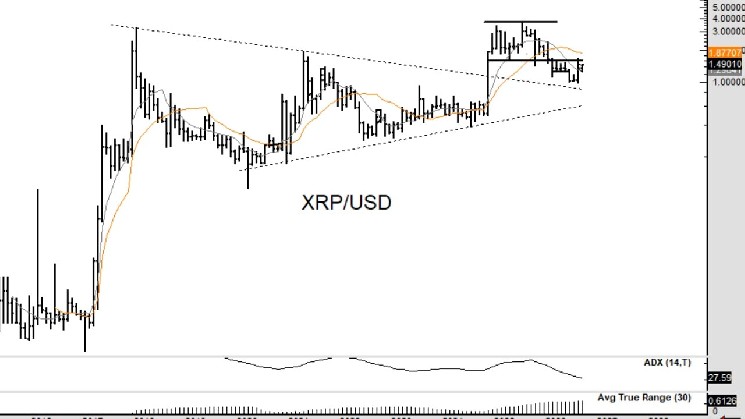
    • Veteran trader Peter Brandt projects XRP could reach $5.40 based on long-term monthly chart analysis, implying approximately 251% upside from current levels.
    • XRP surged 8.7% to $1.54 in 24-hour trading, reaching a session high of $1.57 before pulling back, with the token trading in an 11% range between $1.41 and $1.57.
    • Institutional developments accelerated as South African banking giant Absa launched digital asset custody built on Ripple technology, while the U.S. Senate rejected cloture on the CLARITY Act in a 49-50 vote.

    Peter Brandt’s Technical Analysis and $5.40 Price Target

    Veteran commodity trader Peter Brandt shared a bullish long-term projection for XRP on September 21, posting a monthly chart on X that he says implies an eventual advance to $5.40. The target would represent a substantial premium over recent trading ranges, requiring approximately 251% appreciation from the $1.54 level where XRP traded at the time of publication.

    Brandt, who entered the commodity trading business in 1976 and founded Factor Trading in 1980, emphasized the distinction between a public chart presentation and an executed trade. “This is my long-term chart of $XRP It implies an eventual advance to $5.40.” he wrote. “A claim of a ‘call’ or simple presentation of a chart is $NOT a trade. People who claim ‘trades’ need to provide proof or else the claims are BS. An X post is $NOT proof,” he added. His use of the term “eventual” frames the $5.40 objective as a long-term technical target rather than a near-term prediction, and he explicitly noted that proving an actual trade would require verifiable records showing entry, exit, and result.

    XRP Price Action and Market Performance

    Bitcoin.com Markets data confirmed XRP trading at $1.54, up 8.7% or $0.12 over the preceding 24 hours. The token established a session low of $1.41 early in the period before climbing steadily through most of the trading day. The advance peaked at $1.57 late in the session, after which XRP eased back to the $1.54 level, leaving it approximately 2% below its 24-hour high and roughly 9% above its low. The session’s full trading range spanned about 11% from low to high, reflecting heightened volatility accompanying the price discovery.

    Institutional Infrastructure Expansion and Regulatory Context

    The price rally coincided with significant institutional infrastructure developments. South African lender Absa, one of Africa’s largest banking groups, launched Absa Digital Asset Custody on September 21, built on Ripple’s custody technology. The launch occurred 11 months after Ripple and Absa announced their partnership, marking a concrete step in institutional adoption across the African continent.

    Asset manager 21Shares outlined a four-pillar investment case for XRP centered on regulatory clarity, institutional access, measurable utility, and fixed supply. The firm noted that while expanding XRP Ledger (XRPL) activity may not directly translate into sustained XRP demand, growing network activity could support demand through transaction fees, account reserves, and bridge transfers. 21Shares cited approximately $4 billion in tokenized assets and roughly $1.6 billion in RLUSD supply, with more than half circulating on the XRPL.

    On the regulatory front, the U.S. Senate rejected cloture on the CLARITY Act in a 49-50 vote. Ripple maintained that the failed vote did not alter XRP’s established legal position or disrupt demand across payments, stablecoins, and institutional markets, suggesting the token’s regulatory framework remains intact despite legislative setbacks.

    Why This Matters

    The convergence of technical analysis from a respected veteran trader, meaningful price appreciation with elevated volume, and tangible institutional infrastructure deployment creates a multi-layered bullish narrative for XRP. Brandt’s $5.40 target, while framed as a long-term technical implication rather than a trading recommendation, draws attention to the monthly chart structure that has historically preceded major trend advances in commodity and digital asset markets. The Absa custody launch demonstrates Ripple’s expanding institutional footprint beyond North America into African financial markets, while 21Shares’ analytical framework highlights the fundamental metrics—institutional access, on-chain utility, and regulatory standing—that professional allocators increasingly prioritize. The Senate’s CLARITY Act outcome, while a legislative disappointment for broader crypto regulatory clarity, appears to have had minimal immediate market impact on XRP specifically, reinforcing Ripple’s assertion that the token’s legal classification is settled. Market participants will likely monitor whether XRP can sustain above the $1.50 psychological level and build a higher base for the next leg toward Brandt’s long-term projection.

    Frequently Asked Questions

    What is Peter Brandt’s track record in technical analysis?

    Peter Brandt has over 45 years of commodity trading experience, founding Factor Trading in 1980 after beginning his career in 1976. He has managed institutional trading operations and authored two books on commodity trading and classical chart patterns, establishing him as a recognized authority in traditional technical analysis applied to digital assets.

    Does the Absa Digital Asset Custody launch directly increase XRP demand?

    Not necessarily. The custody service is built on Ripple’s technology infrastructure, but 21Shares notes that expanding XRPL activity may not translate directly into sustained XRP demand. However, the firm argues that growing network activity could support demand indirectly through transaction fees, account reserves, and bridge transfer mechanisms on the ledger.

    How significant was the Senate CLARITY Act vote for XRP specifically?

    According to Ripple, the failed cloture vote on the CLARITY Act did not change XRP’s established legal position or disrupt demand across its core use cases in payments, stablecoins, and institutional markets. The token’s regulatory classification remains intact regardless of the legislative outcome.

  • Ripple: Asset Managers Preparing for XRP Ledger’s Next Payments Upgrade

    Ripple: Asset Managers Preparing for XRP Ledger’s Next Payments Upgrade

    Key Highlights

    • The XRP Ledger’s Batch V1.1 amendment has secured support from 30 of 35 tracked validators, exceeding the 28-vote threshold to begin a 14-day activation countdown.
    • Batch enables exchanges, wallets, and marketplaces to attach service fees directly to customer transactions, processing payments and platform charges as a single atomic operation.
    • Activation is projected for September 29, 2024, provided validator support remains at or above 80%; the original Batch V1.0 was withdrawn in February after researchers discovered a critical signature-validation vulnerability.

    Batch Amendment Enters Activation Countdown With Strong Validator Consensus

    The XRP Ledger’s Batch amendment has officially entered its activation countdown after securing support from 30 of the network’s 35 tracked validators—well above the 28-vote supermajority required to trigger the two-week finalization window. The countdown commenced on September 15 at 14:06:41 UTC, positioning Batch V1.1 for projected activation shortly after the same time on September 29, provided validator backing holds at or above the 80% threshold throughout the period. Because validators retain the ability to change their votes, the activation date remains conditional until the window closes.

    Single-Operation Fee Attachment Streamlines Platform Economics

    Batch introduces a structural improvement for businesses operating on the XRP Ledger by allowing exchanges, wallets, and marketplaces to attach their service charges directly to a customer’s transaction. Rather than requiring separate transfers for the payment and the platform fee, both components are processed as one atomic operation. This design reduces operational complexity, lowers transaction overhead, and improves the user experience for applications that embed fee logic at the protocol layer.

    “Some projects are already being built with Batch in mind, so activation would allow that work to move closer to production,” Akinyele shared. “We’ll share more on specific partners and launch timing as those plans are finalized.”

    Security Remediation Paves Way for V1.1 Release

    The path to this activation follows a significant security intervention earlier this year. In February, researchers identified a critical flaw in Batch V1.0’s signature-validation process. Under certain conditions, the code could terminate signature checks prematurely, potentially allowing an attacker to include transactions from another account without the owner’s authorization. The vulnerability prompted developers to withdraw the original version entirely, delaying the feature’s deployment while a corrected implementation was developed and audited. Batch V1.1 incorporates the necessary fixes and has since undergone renewed validator scrutiny.

    Why This Matters

    Batch represents a meaningful evolution in the XRP Ledger’s native capabilities for composable, fee-aware transactions. By embedding platform economics directly into the ledger’s transaction model, the amendment reduces reliance on off-chain accounting or multi-step settlement flows—benefiting decentralized exchanges, custodial wallets, and payment processors that currently manage fee logic externally. The strong validator consensus signals network confidence in both the feature’s utility and the remediation of the V1.0 vulnerability. Successful activation would mark the restoration of functionality originally pulled over safety concerns, demonstrating the network’s governance process in action: identify, remediate, re-propose, and achieve supermajority approval.

    Frequently Asked Questions

    When will Batch V1.1 activate on the XRP Ledger?

    Batch V1.1 is projected to activate shortly after September 29, 2024, at 14:06:41 UTC, provided validator support remains at or above 80% for the full 14-day countdown window that began September 15.

    What was the critical flaw in Batch V1.0?

    Researchers discovered in February that Batch V1.0’s signature-validation process could stop checking signatures early under certain conditions, potentially allowing an attacker to include unauthorized transactions from another account. The original version was withdrawn and replaced by the corrected V1.1.

    How does Batch change fee processing for platforms on the XRP Ledger?

    Batch allows exchanges, wallets, and marketplaces to attach service fees directly to a customer’s transaction so that the payment and platform fee are processed as a single atomic operation, eliminating the need for separate transfers and reducing operational complexity.

  • XRP $2 Roadmap: Weekly Close Could Trigger 35% Rally

    XRP $2 Roadmap: Weekly Close Could Trigger 35% Rally

    Key Highlights

    • XRP is forming a technically precise inverse head-and-shoulders pattern on the daily chart with a neckline at $1.55, projecting a 35% upside target near $2.00 upon confirmed breakout.
    • On-chain data shows 1.5–1.6 billion XRP moved to Binance over 30 days—a six-month high—yet price remains stable in the right shoulder range, signaling strong absorption by buyers.
    • A potential golden cross is developing as the 50-day EMA approaches the 200-day EMA, while Ripple advances XRP Ledger integration with Stripe and Tempo for AI-driven micropayments.

    Inverse Head-and-Shoulders Pattern Nears Completion on Daily Chart

    XRP is on the verge of confirming a major bullish reversal structure that has been developing throughout the summer. According to analysts, including well-known chart tracker Ali Martinez, the token has carved out a mathematically precise inverse head-and-shoulders formation on the daily timeframe. The pattern’s anatomy is clearly defined: the left shoulder formed during June’s consolidation phase, the head marked the absolute bottom at the August lows around $1.00, and the right shoulder is currently taking shape in a tight plateau between $1.32 and $1.36.

    The $1.55 Neckline Is the Critical Trigger

    The decisive level is the pattern’s neckline at $1.55. A daily candle close above this resistance would technically complete the formation and activate a measured move projection of approximately 35%, targeting the psychological $2.00 threshold. Martinez’s chart annotation, shared via X.com, displays the emerging structure with a price objective of $2.10. Adding confluence to the setup, the 50-day exponential moving average (EMA) has moved within 2% of the 200-day EMA, teasing a medium-term golden cross that would further validate the bullish bias.

    On-Chain Data Reveals Massive Whale Deposits Absorbed Without Panic

    While technical geometry paints an optimistic picture, on-chain metrics from CryptoQuant provide the fundamental underpinning. Over the past 30 days, large investors have transferred a six-month record of 1.5–1.6 billion XRP to Binance. In exchange operations, deposits of this magnitude typically serve as margin collateral, derivatives backing, or fuel for over-the-counter transactions rather than immediate spot selling. The critical observation is that this enormous liquidity influx has failed to trigger price collapse or panic; instead, XRP has held firmly within the right-shoulder boundaries. This resilience suggests buyers are aggressively absorbing supply, potentially creating a structural shortage once whale inflows subside.

    Regulatory Clarity and Utility Expansion Bolster Confidence

    Buyer conviction is further reinforced by a stabilizing regulatory and developmental backdrop. The U.S. Senate’s rejection of the CLARITY Act on September 15 delivered a short-term negative headline, yet the Commodity Futures Trading Commission (CFTC) continues to classify XRP as a digital commodity, largely insulating it from Securities and Exchange Commission (SEC) enforcement ambiguity. Simultaneously, Ripple is advancing the token’s core utility: beta testing of XRP Ledger integration into Stripe and Tempo infrastructure commenced on September 17, carving a dedicated niche for XRP in instant micropayments between autonomous AI agents—a rapidly emerging use case.

    Why This Matters

    The convergence of a textbook technical breakout, unprecedented on-chain absorption capacity, and expanding real-world utility positions XRP at a pivotal inflection point. For market participants, the $1.32–$1.33 right-shoulder support represents the line in the sand; a defense here keeps the $2.00 roadmap intact. A confirmed daily close above the $1.55 neckline would shift the burden of proof to bears and likely accelerate momentum as algorithmic and trend-following strategies engage. Beyond the immediate trade, the Stripe and Tempo integration signals a strategic pivot toward machine-to-machine economies, potentially unlocking a structural demand vector independent of speculative cycles. Traders and investors should monitor the neckline breakout, golden cross confirmation, and whale deposit trends as the primary validation signals for the next leg higher.

    Frequently Asked Questions

    What price level confirms the inverse head-and-shoulders breakout for XRP?

    A daily candle close above the $1.55 neckline resistance confirms the pattern completion and activates the measured move target toward $2.00.

    Why did 1.5–1.6 billion XRP move to Binance recently, and is it bearish?

    Large transfers to exchanges often serve as collateral for derivatives or OTC deals rather than spot selling. The fact that price held firm during this record inflow suggests strong buyer absorption, which is generally interpreted as bullish.

    How does the Stripe and Tempo integration affect XRP’s long-term outlook?

    The beta integration enables XRP Ledger to facilitate instant micropayments between autonomous AI programs, creating a fundamental utility driver in the emerging agent-to-agent economy that could sustain demand beyond speculative trading.

  • Ripple CEO, Wall Street Heavyweights Head to Swell 2026: Agenda Revealed

    Ripple CEO, Wall Street Heavyweights Head to Swell 2026: Agenda Revealed

    Key Highlights

    • Swell 2026 merges Ripple’s Swell and Apex conferences into a three-day event in New York (October 27–29) with over 100 speakers and 80 sessions.
    • High-profile speakers include Ripple CEO Brad Garlinghouse, CME Group’s Terrence Duffy, Bullish CEO Tom Farley, actor Matt Damon, and executives from BNY, Coinbase, Robinhood, Barclays, State Street, and Jump Trading.
    • Agenda focuses on institutional crypto adoption: tokenized real-world assets, stablecoin infrastructure, AI-driven payments, post-quantum security, and the first year of spot XRP ETFs.

    Swell 2026 Agenda Unveiled: Ripple Merges Flagship Conferences for New York Event

    Ripple has published the full agenda for Swell 2026, a three-day conference running October 27–29 in New York City that combines the company’s Swell and Apex events for the first time. The program features more than 100 speakers across 80 sessions and three stages, targeting the intersection of traditional finance and blockchain infrastructure.

    The announcement was made via the official Swell X account on September 16, 2026:

    The Swell 2026 agenda is live.Join us in New York, October 27–29, with Brad Garlinghouse, Terrence Duffy of CME Group, Tom Farley of Bullish, Matt Damon of @Water, leaders from @BNYglobal, @coinbase, @RobinhoodApp, @Barclays, @StateStreet, @jumptrading and many more.See the…
    — Swell (@RippleSwell) September 16, 2026

    Speaker Lineup Bridges Traditional Finance and Crypto

    The roster reflects Ripple’s strategy of convening decision-makers from both established financial institutions and digital-asset natives. Confirmed participants include:

    • Brad Garlinghouse, CEO, Ripple
    • Terrence Duffy, Chairman and CEO, CME Group
    • Tom Farley, CEO, Bullish
    • Matt Damon, Actor and Co-founder, Water.org
    • Senior leaders from BNY, Coinbase, Robinhood, Barclays, State Street, and Jump Trading

    Three Thematic Tracks Define the Program

    Content is organized around three core pillars that signal where institutional crypto is heading:

    Liquidity and Settlement

    Sessions will examine how blockchain rails are reshaping cross-border payments, wholesale settlement, and the role of regulated market infrastructure.

    Tokenization of Real-World Assets

    A major focus on bringing traditional assets—treasuries, commodities, credit—on-chain with bank-grade compliance and custody.

    Stablecoins in Bank-Grade Production

    Practical discussions on issuance, regulation, interoperability, and adoption by financial institutions.

    Day 1 Highlights: Opening Remarks, AI Agents, and XRPL Roadmap

    The opening day packs several high-signal sessions:

    • Brad Garlinghouse delivers opening remarks followed by a 20-minute conversation.
    • Monica Long, Ripple President, converses with Johann Kerbrat, SVP and GM of Crypto at Robinhood.
    • Terrence Duffy (CME Group) takes the main stage for a dedicated conversation.
    • Aanchal Malhotra, Ripple research scientist, presents on the next frontier for XRPL research.
    • Jasmine Cooper, Head of Product at RippleX, outlines the XRPL roadmap for building an institutional DeFi stack.
    • Panel “What Happens When AI Moves Money” features Massimo Cervesato (Mastercard), Nilesh Dusane (AWS), Henri Stern (Privy co-founder), and Edward Woodford (ZeroHash) on AI agents, crypto infrastructure, and payments.
    • Mayukha Vadari, Ripple software engineer, introduces a new paradigm for building on the XRP Ledger with “smart features.”
    • David Schwartz, Ripple CTO Emeritus, and JA Akinyele discuss “Building What’s Next for XRPL.”
    • Jack McDonald, Ripple SVP of Stablecoins, and Brett Tejpaul, Coinbase Institutional co-CEO, cover advancement of crypto infrastructure.

    Day 2: Garlinghouse and Farley on Stage

    Day two features a main-stage conversation between Brad Garlinghouse and Tom Farley, CEO of Bullish, offering further insights into exchange infrastructure and institutional market structure.

    Additional Agenda Themes

    Beyond the day-one highlights, the program also addresses:

    • The first year of spot XRP ETFs — market dynamics, flows, and regulatory evolution.
    • AI agents that move money — autonomous economic agents, payment rails, and risk frameworks.
    • Post-quantum security — preparing blockchain cryptography for quantum-era threats.

    Why This Matters

    Swell 2026 signals a maturation milestone for enterprise blockchain adoption. By merging Swell (Ripple’s traditional finance-focused conference) with Apex (its developer-centric event), Ripple is explicitly positioning the XRP Ledger and its associated infrastructure—stablecoins, tokenization, custody—as production-ready for banks, asset managers, and market infrastructure providers. The speaker roster, heavy on C-suite executives from CME Group, BNY, Barclays, State Street, and major crypto exchanges, indicates that institutional deployment is moving from pilot to scale. Agenda topics like spot XRP ETFs, AI-agent payments, and post-quantum cryptography reflect the three vectors—capital markets, automation, and long-term security—that will define the next phase of crypto integration into global finance.

    Frequently Asked Questions

    When and where is Swell 2026 taking place?

    Swell 2026 runs October 27–29, 2026, in New York City. It combines Ripple’s Swell and Apex conferences into a single three-day event.

    Who are the headline speakers?

    Key speakers include Ripple CEO Brad Garlinghouse, CME Group Chairman Terrence Duffy, Bullish CEO Tom Farley, actor Matt Damon (Water.org), and executives from BNY, Coinbase, Robinhood, Barclays, State Street, and Jump Trading.

    What are the main themes on the agenda?

    The program centers on liquidity and settlement, tokenization of real-world assets, and stablecoins in bank-grade production. Additional tracks cover the first year of spot XRP ETFs, AI agents that move money, post-quantum security, and the XRP Ledger roadmap.

  • XRP Slides Below $1.30 Support as Traders Turn Bearish Short-Term

    XRP Slides Below $1.30 Support as Traders Turn Bearish Short-Term

    Ripple’s XRP token suffered a sharp 9.82% single-day decline on Tuesday, September 15, dropping from $1.42 to $1.28. The sell-off caught many market participants off guard, as the altcoin had spent much of late August repeatedly testing the $1.45 local resistance zone.

    Derivatives Data Signals Waning Speculative Interest

    According to data from CryptoQuant, XRP’s Open Interest (OI) has contracted significantly over the past month. OI fell from $1.128 billion in late August to $871 million at the time of writing, representing a 23% decline equivalent to roughly $257 million.

    This reduction in open derivatives contracts coincided with XRP’s rejection from the $1.50 higher-timeframe supply zone. The data suggests that derivatives positions were either voluntarily closed or forcibly liquidated in large numbers. The combination of decreasing speculative interest and a price slide below the $1.30 support level paints a cautious picture for the near term.

    Institutional Demand vs. Market Headwinds

    On-chain metrics reveal a divergence between institutional appetite and price action. Throughout September, XRP spot ETF flows have remained positive, with growing fund balances acquiring more tokens and reducing available supply.

    Despite this institutional demand, price action has lagged. AMBCrypto reported earlier this month that the disconnect was partly attributed to declining Bitcoin (BTC) prices, as the broader market priced in increasing odds of a rate hike.

    Key Technical Levels Under Pressure

    The $1.30 level had been identified as a critical short-term support zone. However, aggressive selling in the futures markets—accompanied by the declining Open Interest—overwhelmed buyers, causing XRP to lose this foothold in recent sessions.

    Daily Timeframe Structure and Fibonacci Analysis

    Analyzing the XRP/USDT pair on TradingView, the daily swing structure remains technically bullish. An earlier downtrend established a lower high at $1.184 (dotted green line), which was subsequently breached by the August rally, flipping the market structure to the upside.

    Price action has since tested the 61.8% Fibonacci retracement level. At the time of writing, the former $1.30 support is being retested as resistance. Without a renewed influx of strong demand across both spot and futures markets, XRP could continue its retracement toward the $1.14 level.

    Exchange Supply Ratio Holds Steady

    The exchange supply ratio—which measures the proportion of XRP’s circulating supply held on centralized exchange wallets—declined steadily from April through July. Since then, the metric has stabilized around 2.6%.

    If the ratio resumes its previous downtrend, analysts typically interpret it as a sign of accumulation and a shift of coins into cold storage. Conversely, a further price decline accompanied by a rising supply ratio would undermine the current bullish bias, which has already been damaged by the rejection at the key $1.50 supply zone.

    Summary

    • XRP failed to breach the $1.50 supply zone and dropped below the $1.30 support level.
    • Derivatives data shows increased sell pressure and declining speculative interest, signaling short-term bearish sentiment.
    • Spot ETF inflows remain positive, highlighting a divergence between institutional accumulation and current price weakness.
    • Technical structure suggests a potential retracement toward $1.14 if buying pressure does not return.
  • Ripple Integrates XRP Payments With Stripe, Tempo AI Standard in New Developer Kit

    Ripple Integrates XRP Payments With Stripe, Tempo AI Standard in New Developer Kit

    Ripple has expanded its XRP Ledger developer toolkit to support a new payments standard designed for artificial intelligence agents, broadening the options for machines to pay for data, computing power, and other digital services using cryptocurrency.

    XRPL AI Starter Kit Adds Machine Payments Protocol Support

    Version 1.1 of the XRPL AI Starter Kit now integrates the Machine Payments Protocol (MPP) and the Open Wallet Standard, according to a blog post from RippleX developers. The Open Wallet Standard enables software to manage wallets across multiple blockchains through a single, unified interface.

    The update positions both XRP and RLUSD—Ripple’s dollar-pegged stablecoin—as native payment options for developers building AI-driven services.

    RippleX Commits to Multi-Standard Strategy

    “Our job is to make $XRP and $RLUSD first-class options wherever developers are building,” RippleX head of product Jazzi Cooper wrote on X.

    Ripple previously added support for x402, a separate web payments standard, in June. By backing both MPP and x402, the company is pursuing a multi-standard approach rather than betting on a single protocol.

    How MPP Enables AI Commerce

    The Machine Payments Protocol, co-authored by payments giant Stripe and Tempo—a blockchain purpose-built for payments—gives AI agents a standardized way to transact autonomously. An AI agent, defined as software that executes tasks on a user’s behalf, can now request a resource, receive a price quote, authorize payment, and receive the requested service in a seamless flow.

    Why This Matters for the Agent Economy

    As developers build services that charge machines per request, those AI agents need a currency the seller accepts and the software rails to send it. Ripple’s latest move aims to ensure XRP and RLUSD are among the default choices for this emerging machine-to-machine economy.