Tag: Kalshi

  • Kalshi Loses Another Major Court Fight as States Win Power to Regulate Sports Prediction Markets

    Kalshi Loses Another Major Court Fight as States Win Power to Regulate Sports Prediction Markets

    Key Highlights

    • The 6th U.S. Circuit Court of Appeals ruled unanimously that Ohio and Tennessee can enforce state gambling laws against Kalshi’s sports prediction markets, rejecting the platform’s claim that its contracts fall under exclusive federal CFTC jurisdiction.
    • The decision reverses a Tennessee federal district court ruling that had favored Kalshi while upholding an Ohio district court decision siding with state regulators, creating a split that may push the issue toward the U.S. Supreme Court.
    • Ohio’s Casino Control Commission has issued a cease-and-desist order demanding Kalshi stop offering sports contracts to Ohio residents and warned licensed sportsbooks against partnering with the exchange.

    Sixth Circuit Hands States Major Victory in Prediction Market Jurisdiction Fight

    A unanimous three-judge panel of the 6th U.S. Circuit Court of Appeals dealt a significant blow to Kalshi on Friday, ruling that states retain the authority to apply local gambling statutes to the platform’s sports event contracts. The decision marks the second major legal setback for the prediction-market industry as the regulatory battle over whether event contracts constitute federally regulated financial derivatives or state-governed gambling products inches closer to the U.S. Supreme Court.

    Court Rejects Kalshi’s ‘Swap’ Classification Argument

    Kalshi and other prediction-market operators have long contended that their event contracts qualify as “swaps”—a category of financial derivatives falling under the exclusive regulatory purview of the Commodity Futures Trading Commission (CFTC) under the Commodity Exchange Act (CEA). The states, led by Ohio and Tennessee, countered that sports-event contracts are fundamentally gambling products subject to state sports-betting licensing regimes. The appeals court sided decisively with the states.

    “We hold that Kalshi has not shown that its sports-event contracts satisfy the statutory definition of a ‘swap’ so as to fall within the scope of the CFTC’s ‘exclusive jurisdiction,’” the judges wrote in their opinion. The panel went further, establishing an alternative holding that even if the contracts were deemed swaps, federal commodities law would not displace state gambling regulations. “Even assuming that Kalshi’s sports-event contracts are swaps, we alternatively hold that the CEA neither expressly nor impliedly preempts Ohio’s or Tennessee’s gambling laws,” the opinion stated.

    Tennessee Attorney General Accuses Kalshi of Regulatory End Run

    The ruling reverses a Tennessee federal district court decision that had backed Kalshi while leaving intact an Ohio district court ruling favoring the states. Tennessee Attorney General Jonathan Skrmetti characterized the platform’s strategy as a deliberate attempt to circumvent consumer protections and tax obligations. “Kalshi attempted an end run around Tennessee law to avoid any of the rules or taxes associated with sports gambling. They failed,” Jonathan said. He emphasized the public-policy rationale behind strict gambling oversight: “Sports wagering is heavily regulated because it can do a lot of harm, and I’m glad we thwarted Kalshi’s efforts to remove every safeguard and put Tennessee sports bettors at risk.”

    Ohio Regulator Escalates Enforcement With Cease-and-Desist Order

    Parallel to the appellate proceedings, the Ohio Casino Control Commission (OCCC) has taken direct administrative action. The commission sent Kalshi a cease-and-desist letter asserting that the exchange offered sports event contracts to Ohio residents without obtaining a required sports gaming license. The notice, documented in court filings as Schuler, DE 1-1, includes a demand on Page ID 26 ordering the company to “immediately cease offering these sports wagering products unlawfully in Ohio.”

    Age-Verification Violations and Warnings to Licensed Operators

    The OCCC further accused Kalshi of making unlicensed sports products available to individuals under 21, Ohio’s legal gambling age. On Page ID 27 of the same filing, the regulator cited Ohio Revised Code Section 3775.99(A)(2), calling the practice “a flagrant disregard of Ohio’s statutory gambling age limit.” In a related move, the commission warned licensed Ohio sportsbooks—in Schuler, DE 1-5, Page IDs 57-59—that assisting an unlicensed operator could jeopardize their own licenses. The OCCC stated it would “consider whether a licensed operator chose to work with a company it viewed as operating illegally and could take administrative action against any operator that did.”

    Kalshi responded in court filings (Schuler, DE 1-2, Page IDs 29-30) by citing the now-reversed district court rulings in its favor, describing itself as “a federally licensed exchange . . . authorized to operate its market in all 50 states” and asserting that no state could regulate its activities. The company labeled the OCCC’s warning to sportsbooks a “clear attempt” to limit its business relationships, including those with no nexus to Ohio, and disputed the commission’s characterization of its operations as “online sports gaming.”

    Why This Matters: Federalism, Consumer Protection, and the Future of Event Contracts

    The Sixth Circuit’s decision deepens a circuit split on the central question of whether the CEA grants the CFTC exclusive jurisdiction over event contracts, effectively preempting state gambling laws. Other circuits have reached differing conclusions, and the CFTC itself has sued nine states arguing for federal primacy—a position the Sixth Circuit explicitly rejected. This judicial fragmentation creates a “state-by-state patchwork” that Kalshi spokesperson Dani Lever warned makes market operation untenable. “Courts can’t agree on the basics: Some say federal law covers these contracts, and others say it doesn’t. Some recognize that sports have real economic impact, while others (incorrectly) claim they don’t,” Dani said. “Markets can’t operate when the rules change at every state line, which is why Congress created a single federal regulator with nationwide rules.” The practical consequence is immediate: Kalshi must exit or seek licenses in Ohio and Tennessee, while other states emboldened by the ruling may pursue similar enforcement. The next flashpoint will likely be a petition for certiorari to the U.S. Supreme Court, which could finally resolve the statutory interpretation of “swap” and the scope of CEA preemption.

    Frequently Asked Questions

    What exactly did the Sixth Circuit decide regarding Kalshi’s sports contracts?
    The court held that Kalshi’s sports-event contracts do not meet the statutory definition of a “swap” under the Commodity Exchange Act, so the CFTC does not have exclusive jurisdiction. Even if they were swaps, the CEA does not expressly or impliedly preempt Ohio’s or Tennessee’s gambling laws, allowing those states to enforce their sports-betting regulations against Kalshi.
    Does this ruling apply nationwide or only in Ohio and Tennessee?
    The binding precedent applies within the Sixth Circuit (Kentucky, Michigan, Ohio, and Tennessee). However, the reasoning is persuasive authority elsewhere and encourages other states to pursue similar enforcement. The CFTC’s pending lawsuits against nine states remain active in other circuits.
    What immediate actions must Kalshi take following the cease-and-desist order?
    Kalshi must immediately stop offering sports wagering products to Ohio residents. The OCCC also warned that any licensed Ohio sportsbook partnering with Kalshi risks administrative action against its own license, effectively pressuring the industry to sever ties with the exchange in Ohio.

  • Another Appeals Court Rules Against Kalshi, Finds Sports Contracts Subject to State Regulations

    Another Appeals Court Rules Against Kalshi, Finds Sports Contracts Subject to State Regulations

    Key Highlights

    • A federal appeals court ruled that Kalshi’s sports-event contracts are not federally regulated swaps, rejecting the prediction market’s argument that they fall under Commodity Futures Trading Commission jurisdiction.
    • The three-judge panel agreed Kalshi had standing to sue but determined its contracts do not depend on events “associated with a potential financial, economic, or commercial consequence” as required by statute.
    • The decision intensifies the regulatory clash between states and federally regulated prediction markets over taxation, age restrictions (18 vs. 21), and market competition since the 2024 election.

    Appeals Court Rejects Kalshi’s Swap Classification for Sports Contracts

    A three-judge federal appeals panel delivered a significant setback to prediction market operator Kalshi on Friday, ruling that its sports-event contracts do not qualify as federally regulated swaps under the Commodity Exchange Act. The decision marks a pivotal moment in the escalating regulatory battle between state gambling regulators and federally overseen prediction markets that have surged in prominence following the 2024 presidential election.

    Core Legal Dispute Centers on Statutory Definition

    The court acknowledged that Kalshi had legal standing to bring its case, but parted ways with the platform on the central statutory interpretation. In its written opinion, the panel stated: “While we agree with Kalshi that its sports-event contracts are conditioned on the occurrence of ‘event[s],’ we conclude that Kalshi’s contracts do not depend on events that are ‘associated with a potential financial, economic, or commercial consequence’ within the meaning of the statute.” This distinction effectively removes Kalshi’s sports offerings from the protective umbrella of federal derivatives regulation, leaving them exposed to state-level gambling enforcement.

    New York Giants Example Illustrates Judicial Reasoning

    To clarify its reasoning, the ruling employed a concrete illustration involving the New York Giants. The court explained that the classification hinges on how the “event” is defined. If the event is defined as the Giants winning a Super Bowl, then that outcome would be described as “that event having occurred.” However, the panel determined that such a sporting outcome lacks the requisite financial, economic, or commercial consequence necessary to transform the contract into a regulated swap.

    Why This Matters

    The ruling arrives amid intensifying friction between state gambling authorities and prediction markets like Kalshi, PredictIt, and Polymarket. Since the 2024 election cycle drove unprecedented volume and public attention to these platforms, states have moved aggressively to bring them under local regulatory frameworks. State regulators argue that prediction markets offer functionally identical products to licensed sportsbooks—wagering on game outcomes—yet enjoy structural advantages: they avoid state gaming taxes, operate under lighter compliance burdens, and in many cases accept customers as young as 18, whereas state-licensed operators universally enforce a 21-year-old minimum. Friday’s decision strengthens states’ hand by confirming that, at least for sports-event contracts, federal derivatives law does not preempt their authority. The case is likely to accelerate legislative and enforcement efforts in multiple states seeking to either tax, restrict, or ban these markets outright.

    Frequently Asked Questions

    What specific products did the court rule on?

    The ruling addresses Kalshi’s sports-event contracts—derivative-style instruments that pay out based on the outcomes of sporting events such as the Super Bowl. It does not directly address the platform’s political, economic, or weather-related contracts.

    Does this mean Kalshi must shut down its sports markets immediately?

    The decision removes the federal regulatory shield Kalshi claimed for these products. While not an injunction, it clears the path for state regulators to pursue enforcement actions, cease-and-desist orders, or litigation to halt the offering of sports contracts within their jurisdictions.

    How does the age restriction difference affect the regulatory fight?

    State gambling laws uniformly set the minimum betting age at 21. Kalshi and some other prediction platforms have allowed users as young as 18. States cite this discrepancy as a consumer-protection concern and a competitive inequity, arguing that younger adults are being exposed to gambling-like products without the safeguards required of licensed operators.

  • U.S. Regulator Warns of Cheating Risks in ‘Mention Markets’ on Prediction Platforms

    U.S. Regulator Warns of Cheating Risks in ‘Mention Markets’ on Prediction Platforms

    Key Highlights

    • The CFTC issued a staff advisory warning that “mention markets” — betting on what a specific individual might say or do — are “presumptively readily susceptible to manipulation.”
    • The regulator distinguishes these markets from standard event contracts because outcomes depend on “the discrete conduct of a named person” rather than independently generated, externally verifiable events.
    • Prediction platform operators including Kalshi and Polymarket are reminded they may only list derivative contracts that are not readily susceptible to manipulation.

    CFTC Targets ‘Mention Markets’ in New Supervisory Advisory

    The Commodity Futures Trading Commission has drawn a sharp regulatory line around a growing category of prediction-market contracts, issuing a staff advisory on Tuesday that labels wagers on an individual’s future statements or actions as “presumptively readily susceptible to manipulation.” The guidance, released by the agency’s Division of Market Oversight, signals a potential narrowing of the event-contract universe that can clear the CFTC’s supervisory hurdles, directly affecting operators such as Kalshi and Polymarket.

    How ‘Mention Markets’ Differ From Standard Event Contracts

    Unlike traditional event contracts that settle on “independently generated, externally verifiable outcomes that are outside the control of any single person,” the CFTC staff advisory explains that mention markets pivot on “the discrete conduct of a named person, and that conduct may be neither independently generated nor externally verifiable.” Because the outcome hinges on one person’s behavior — or the actions of those in their orbit — the agency warns that the individual or people around them could shift the result based on their own knowledge of the betting activity.

    Regulatory Reminder: Only Non-Manipulable Contracts Permitted

    The advisory serves as a formal reminder to prediction-platform operators that they are “only allowed to trade derivative contracts that are not readily susceptible to manipulation.” By classifying mention markets as presumptively problematic, the CFTC is effectively placing the burden on exchanges to demonstrate why any contract tied to a specific person’s conduct should be permitted, or to delist such markets altogether. The move underscores the agency’s focus on market integrity as prediction platforms expand their offerings beyond traditional economic and political indicators.

    Why This Matters

    The CFTC’s advisory arrives as prediction markets gain mainstream traction and attract significant volume during major news cycles. By targeting contracts tied to individual conduct, the regulator is addressing a structural vulnerability: markets where a single actor — or their associates — can influence the outcome create clear incentives for insider trading and market manipulation. For platforms like Kalshi and Polymarket, the guidance implies a compliance review of existing “mention market” listings and stricter vetting for future contracts. The decision also sets a precedent for how U.S. regulators may treat novel event-contract categories as the sector evolves, balancing innovation with the statutory mandate to prevent manipulation and protect market participants.

    Frequently Asked Questions

    What are “mention markets” according to the CFTC?
    Mention markets are wagers on what a specific, named individual might say or do — for example, whether a public figure will utter a certain phrase or take a particular action. The CFTC considers these distinct from standard event contracts because the outcome depends on the discrete conduct of one person.
    Why does the CFTC consider mention markets prone to manipulation?
    The advisory states that because the outcome pivots on “the discrete conduct of a named person,” that person or people around them could influence the result based on their own knowledge of the betting, making the market “presumptively readily susceptible to manipulation.”
    What must prediction platforms like Kalshi and Polymarket do in response?
    Operators are reminded they may only list derivative contracts that are not readily susceptible to manipulation. They will likely need to review existing mention-market contracts for compliance and apply stricter criteria before launching similar markets in the future.
  • CFTC Scrutinizes Kalshi After $5 Billion in Near-Identical Ether Perpetual Trades, WSJ Reports

    CFTC Scrutinizes Kalshi After $5 Billion in Near-Identical Ether Perpetual Trades, WSJ Reports

    Key Highlights

    • The Commodity Futures Trading Commission is reviewing unusual trading patterns on Kalshi involving nearly one million ether perpetual futures trades clustered around $5,500, representing over $5 billion in volume.
    • Kalshi denies wash trading allegations, attributing the pattern to market makers maintaining fixed resting orders and hundreds of distinct traders participating in the transactions.
    • Jump Trading and Wintermute were identified among firms involved in the rapid transactions, with Jump stating it trades for profit and uses self-match prevention tools.

    CFTC Scrutinizes Concentrated Trading Activity on Kalshi Ether Perpetuals

    The Commodity Futures Trading Commission is examining unusual trading activity on the Kalshi exchange after an analysis by The Wall Street Journal revealed nearly one million ether perpetual futures trades executed in almost identical amounts. According to the Journal’s review of public data, more than one-third of trades in the market during recent weeks clustered around the $5,500 price level, accounting for over $5 billion in ether perpetual volume over the past month. The regulatory review comes at a pivotal moment for Kalshi, which launched its crypto perpetual futures business in May and has since sought approval to offer similar contracts tied to individual U.S. stocks.

    Allegations of Wash Trading Prompt Regulatory Review

    The trading pattern has prompted allegations of wash trading—a practice involving trades lacking genuine economic purpose that can create a misleading impression of market activity. The CFTC is reviewing the activity before determining whether to open an enforcement investigation, according to a person familiar with the matter cited by the Journal. The agency said it could not comment on whether an investigation is underway. Kalshi has categorically denied the allegations, stating that hundreds of distinct traders participated in the transactions and arguing that the repeated trade sizes resulted from market makers maintaining fixed resting orders that were repeatedly hit by faster traders.

    Kalshi Defends Market Structure and Liquidity Programs

    In its defense, Kalshi emphasized that self-trading is mechanically blocked on its platform and that coordinated wash trading is both prohibited and actively monitored. The company said its liquidity programs compensate market makers for maintaining orders at specific sizes and spreads rather than rewarding trading volume. A temporary program also refunds trading fees for qualifying self-clearing members but does not allow traders to receive more in rebates than they paid in fees. According to the Journal, Jump Trading and Wintermute were among the firms involved in the rapid transactions. Jump said it trades for profit, uses self-match prevention tools, and does not coordinate its activity with other traders.

    Why This Matters

    The CFTC’s scrutiny of Kalshi highlights the growing regulatory focus on crypto derivatives markets as they expand beyond traditional cryptocurrency exchanges into regulated venues. Kalshi, designated as a contract market by the CFTC, operates under a different regulatory framework than many offshore crypto platforms, making this review particularly significant for the evolution of U.S.-regulated crypto derivatives. The outcome could set precedents for how market-making activities, liquidity incentives, and high-frequency trading patterns are policed in crypto perpetual futures markets. As Kalshi seeks to expand into single-stock perpetual futures, the resolution of this review will likely influence the pace and conditions of that regulatory approval process.

    Frequently Asked Questions

    What triggered the CFTC’s review of Kalshi trading activity?

    The Wall Street Journal’s analysis of public data revealed nearly one million ether perpetual futures trades clustered around $5,500 in almost identical amounts, representing over $5 billion in volume over the past month. This concentration—accounting for more than one-third of recent market trades—prompted the CFTC to review the activity for potential wash trading.

    How has Kalshi responded to the wash trading allegations?

    Kalshi has denied the allegations, stating that hundreds of distinct traders participated in the transactions. The exchange attributes the repeated trade sizes to market makers maintaining fixed resting orders that were repeatedly executed by faster traders. Kalshi also noted that self-trading is mechanically blocked, coordinated wash trading is prohibited and monitored, and its liquidity programs reward order maintenance rather than volume.

    Which firms were identified as participants in the trading pattern?

    According to The Wall Street Journal, Jump Trading and Wintermute were among the firms involved in the rapid transactions. Jump Trading stated it trades for profit, uses self-match prevention tools, and does not coordinate its activity with other traders.

  • Kalshi Faces ‘fake crypto volume’ Allegations as Critic Flags Identical $5,500 Trades

    Kalshi Faces ‘fake crypto volume’ Allegations as Critic Flags Identical $5,500 Trades

    Key Highlights

    • Analyst Beni alleges wash trading on Kalshi’s ether perpetual market, citing repetitive $5,500 trade sizes accounting for up to 58% of volume across four days as “undeniable proof” of manipulation.
    • The allegations center on a CFTC-filed rebate schedule allowing Self-Clearing Members to trade at net-zero fees via a 0.3-basis-point maker rebate offsetting a 0.3-basis-point taker fee.
    • Kalshi representative IcoBeast.eth initially dismissed concerns on X but later issued a detailed rebuttal as the discussion gained traction.

    Wash Trading Allegations Surface Around Kalshi Ether Perpetuals

    Market structure analyst Beni has leveled serious accusations of volume manipulation against Kalshi’s ether perpetual futures market, presenting data patterns he characterizes as conclusive evidence of wash trading. The core of the argument rests on the identification of highly unusual, repetitive trade sizes of exactly $5,500 that appeared across four distinct trading sessions. According to Beni’s analysis, these uniform transactions single-handedly constituted up to 58% of the platform’s total ether perpetual trading volume during those periods, a statistical anomaly he labeled undeniable proof of artificial volume inflation.

    Zero-Cost Trading Incentives Under Scrutiny

    The allegations draw a direct line between the observed trading patterns and Kalshi’s fee structure, specifically a rebate schedule filed with the Commodity Futures Trading Commission (CFTC). The schedule permits Self-Clearing Members to operate at a net-zero fee cost, balancing a 0.3-basis-point maker rebate against a 0.3-basis-point taker fee. In standard market mechanics, rebates serve as financial incentives—typically partial fee refunds or cash payments—designed to compensate high-volume market makers for providing liquidity. However, Beni argues that when the marginal cost of trading against oneself drops to zero, the economic barrier to self-dealing evaporates, creating a powerful incentive for participants to artificially inflate volume metrics without incurring transaction costs.

    Platform Response Evolves From Dismissal to Detailed Rebuttal

    The response from Kalshi, voiced through the pseudonymous account IcoBeast.eth on X, followed a two-stage trajectory. Initially, the platform brushed off the wash trading concerns, asserting that its existing fee structure alone should act as a sufficient deterrent against manipulative behavior. As the analytical thread gained viral momentum within the crypto trading community, the tone shifted. IcoBeast.eth subsequently published a comprehensive, point-by-point breakdown intended to refute the methodology and conclusions of the wash trading analysis, signaling the seriousness with which the platform now treats the reputational challenge.

    Why This Matters

    The controversy touches on a fundamental tension in the rapidly evolving crypto derivatives landscape: the reliability of volume as a metric for market health and the regulatory adequacy of rebate structures overseen by the CFTC. Kalshi operates as a designated contract market (DCM) under CFTC jurisdiction, placing it under a stricter regulatory umbrella than many offshore competitors. If allegations of systemic wash trading on a regulated U.S. venue are substantiated, it could prompt regulatory review of rebate programs that enable zero-cost self-trading. For market participants, the episode underscores the difficulty of distinguishing genuine organic liquidity from incentivized or fabricated volume, a distinction critical for risk management, price discovery, and institutional adoption of crypto derivatives.

    Frequently Asked Questions

    What specific pattern did Beni identify as evidence of wash trading?
    Beni identified repetitive trade sizes of exactly $5,500 that accounted for up to 58% of Kalshi’s ether perpetual volume across four separate days, calling this pattern undeniable proof of manipulation.
    How does Kalshi’s rebate structure allegedly enable wash trading?
    A CFTC-filed rebate schedule allows Self-Clearing Members to pay a net-zero fee via a 0.3-basis-point maker rebate offset by a 0.3-basis-point taker fee, which Beni argues removes the cost barrier to trading against oneself.
    How has Kalshi responded to the allegations?
    Kalshi representative IcoBeast.eth initially dismissed the concerns on X, citing the fee structure as a deterrent, but later issued a detailed rebuttal as the analysis gained widespread attention.
  • Polymarket $10 Million Fraud Scare Tests Whether Growth Outran Compliance

    Polymarket $10 Million Fraud Scare Tests Whether Growth Outran Compliance

    Key Highlights

    • Polymarket faced a $10 million fraud attempt in February involving stolen debit cards and an 80% deposit rejection rate, prompting the resignation of its U.S. compliance chief and the firing of the U.S. division CEO and other compliance executives.
    • Despite the fraud episode and ongoing CFTC investigations into potential insider trading on events including Biden pardons and Iran contracts, a Sullivan & Cromwell review concluded Polymarket complied with regulations, and the company says fraud rates normalized by May after adding controls and hiring former Amazon finance chief Warren Jenson as CFO.
    • Prediction markets generated $63.5 billion in volume in 2025, with Polymarket and Kalshi handling $52.7 billion in the first 86 days of 2026, drawing heightened scrutiny from senators, JPMorgan, and the New York City Council over marketing practices and regulatory compliance.

    Fraud Attempt Exposes Compliance Gaps at $21 Billion Valuation

    In February, Polymarket became the target of a coordinated fraud attempt that sought to extract at least $10 million from its U.S. application, according to reporting by the Wall Street Journal. Attackers linked stolen debit cards to thousands of newly created accounts, placed wagers, and attempted to cash out to accounts they controlled. At the peak of the activity, more than 80% of deposits were rejected as fraudulent—a rate vastly exceeding the industry norm of roughly 1%. The bulk of the suspicious activity was traced to seven users, with one individual making nearly 4,000 deposits. The episode reached senior management quickly, and CEO Shaney Coplan reportedly instructed employees to proceed with business expansion plans regardless of any subsequent sanctions.

    Leadership Shakeup and Internal Warnings

    The fallout was immediate. Andrew Clifford, who oversaw compliance in the United States, resigned after publishing an internal report detailing the fraud issues. Justin Hertzberg, CEO of Polymarket’s U.S. division, was dismissed along with other executives responsible for regulatory compliance and anti-money-laundering policies. Some employees had warned that relaxing the rule requiring withdrawals to be sent back to the original funding source could increase money-laundering risk, but executives maintained that other internal controls were sufficient. A subsequent review by law firm Sullivan & Cromwell concluded that Polymarket had complied with applicable regulations.

    Strengthened Controls and Ongoing Investigations

    Polymarket says it has since bolstered its defenses. The company added risk personnel, including a former FBI agent, hired former Amazon finance chief Warren Jenson as its first chief financial officer, limited the number of debit-card users it could link, and engaged fraud-prevention firm Riskified. The company states that fraud rates returned to industry norms by May. However, the fraud episode is only one facet of mounting scrutiny. The New York Times reported that more than 80 Polymarket accounts have been flagged for questionable trading across nearly 30 subjects, including 13 users who wagered $140,000 on an Israeli military action against Iran and profited more than $600,000.

    CFTC Probes Insider Trading Allegations and Market Integrity

    Federal investigation activity has intensified. WIRED reported that Commodity Futures Trading Commission Chairman Michael Selig authorized investigations into trades made on Polymarket associated with Biden pardons, contracts with Iran, and Google’s search results. Additionally, a U.S. Special Forces soldier has been accused of using classified information to gain over $400,000 from bets related to Venezuelan President Nicolás Maduro. The CFTC has indicated that misuse of material nonpublic information could constitute a violation of commodities law. Blockchain analytics firm Chainalysis notes that the transparency of blockchain technology enables law enforcement to trace suspicious operations and investigate wallet connections.

    Marketing Practices Draw Congressional and Banking Scrutiny

    Polymarket’s promotional tactics have also attracted regulatory attention. A June 25 letter from Senators John Curtis and Adam Schiff asked the CFTC to investigate allegations that Polymarket paid creators to stage trades on lookalike websites without clearly disclosing the payments. The Wall Street Journal detailed how fake bets were promoted online. In August, JPMorgan closed Polymarket’s bank account over regulatory concerns, and the New York City Council opened a probe into prediction-market marketing practices.

    Why This Matters

    The stakes extend well beyond a single company. Prediction markets generated $63.5 billion in volume in 2025, while Kalshi and Polymarket together handled $52.7 billion in the first 86 days of 2026, according to Artemis. Intercontinental Exchange’s stake in Polymarket was valued at approximately $1.6 billion, representing roughly 22% of the company. Academic research underscores the systemic implications: a Stanford-SMU study found that Polymarket’s five-minute Bitcoin contracts were associated with settlement-time spikes in spot order flow and sharp price reversals, with retail traders absorbing most losses during manipulated cycles. The effect was far weaker in 15-minute contracts. For banks, regulators, and institutional traders, weak controls at major prediction-market platforms can raise the cost of entering the sector, fragment liquidity across jurisdictions, and slow the broader integration of prediction markets with crypto finance.

    Frequently Asked Questions

    Did Polymarket actually lose $10 million in the fraud attempt?

    No. The $10 million figure represents the amount attackers attempted to steal using stolen debit cards. Polymarket’s systems rejected more than 80% of deposits as fraudulent at the peak, and the company states it did not lose the funds.

    What regulatory actions are currently targeting Polymarket?

    The CFTC has authorized investigations into trades linked to Biden pardons, Iran contracts, and Google search results. Senators Curtis and Schiff have requested a CFTC probe into undisclosed payments to creators for staged trades. JPMorgan closed Polymarket’s bank account, and the New York City Council is investigating prediction-market marketing practices.

    How large is the prediction market sector, and who are the major players?

    Prediction markets generated $63.5 billion in volume in 2025. Polymarket and Kalshi together processed $52.7 billion in the first 86 days of 2026. Intercontinental Exchange holds a stake in Polymarket valued at roughly $1.6 billion, representing about 22% of the company.

  • Riot Games Holds Sponsorship Talks With Polymarket, Kalshi

    Riot Games Holds Sponsorship Talks With Polymarket, Kalshi

    Riot Games Explores Prediction Market Sponsorships Ahead of League of Legends World Championship

    Riot Games has entered discussions with prediction market operators Kalshi and Polymarket regarding potential esports sponsorship agreements, according to a Bloomberg report published on September 11. The talks come weeks before the League of Legends World Championship kicks off in October.

    Riot Evaluates Emerging Prediction Market Space

    The Tencent-owned developer, which operates competitive tournaments for League of Legends and Valorant, has not committed to either platform. Sources familiar with the private discussions told Bloomberg that any agreement would involve Riot’s esports business.

    “Prediction markets are an emerging space that we’re evaluating with a focus on safeguarding competitive integrity, potential value for teams, impact on the fan experience, and alignment with our broader ecosystem goals,” Riot Games spokesperson Joe Hixson told Bloomberg.

    Kalshi declined to comment on the discussions, while Polymarket did not respond to Bloomberg’s request for comment.

    Official Esports Data Requirement Through GRID

    Any prediction market sponsor approved by Riot would be required to obtain official betting data through GRID Esports, one person familiar with the discussions told Bloomberg. GRID already maintains ties to Polymarket, having partnered with the prediction market operator in June. That agreement granted Polymarket access to official esports data and included plans for faster streams, a redesigned esports section, and data taken directly from game servers.

    The requirement would place official game data within any sponsorship arrangement as Riot considers bringing prediction markets closer to its competitive ecosystem.

    Massive Esports Betting Market Drives Interest

    League of Legends and Valorant tournaments draw millions of viewers globally, with esports audiences skewing younger than those of traditional sports. Riot has previously cited Sportradar data showing betting tied to its two major titles reached $10.7 billion in 2024. Most of that activity took place through unregulated markets and unlicensed bookmakers, according to Riot.

    The company began permitting sponsorships from traditional sports betting operators in 2025, subject to restrictions intended to protect competitive integrity. Prediction markets already offer contracts on esports matches, allowing traders to take positions on game outcomes without a formal sponsorship relationship with Riot.

    Kalshi has been recruiting for an esports-focused position tasked with forming league partnerships and increasing its presence in the sector. Polymarket had employees working on esports by at least 2025, according to LinkedIn information cited by Bloomberg.

    Prediction Markets Expand Across Professional Sports

    The Riot discussions would extend a series of deals bringing prediction markets into professional sports and entertainment. At the end of August, Kalshi secured an exclusive U.S. Open partnership with the U.S. Tennis Association. The agreement gave the company prediction market partner status and restricted competing platforms from advertising at the tournament venue and across its television coverage.

    Kalshi had already gained FIFA World Cup exposure through an agreement with ADI Predictstreet, FIFA’s official prediction market partner for the 2026 tournament. The World Cup partnership placed Kalshi branding alongside ADI Predictstreet across stadium, television and digital coverage during the competition.

    Polymarket has pursued a similar strategy, signing agreements spanning Major League Baseball, the Bundesliga and other sports properties. Its Bundesliga agreement made Polymarket the league’s exclusive U.S. prediction market partner and included the use of market data during pay-per-view programming.

    NBA star LeBron James became one of the latest prominent athletes connected with the company when he confirmed a Polymarket partnership through a video posted on X on September 5. The initial campaign is expected to focus on American football, according to CNBC.

    Record Trading Volumes Fuel Competition

    Prediction market operators have been competing for sports users as trading activity across the sector has climbed. Combined monthly volume across Kalshi, Polymarket and Polymarket US reached a record $50.59 billion in July, with Kalshi accounting for $37.7 billion.

    Integrity Concerns Shape Riot’s Evaluation

    Riot’s consideration of prediction market sponsors comes as sports organizations take different positions on partnerships with the sector. The National Football League has held back from signing prediction market sponsorships, citing concerns over inadequate regulation and ongoing legal challenges, Bloomberg reported earlier this month.

    Riot has its own concerns because betting activity can create integrity risks around professional matches. Its evaluation of prediction markets is therefore considering competitive integrity alongside the possible financial benefits for esports teams and effects on fans, according to Hixson.

    Sponsorship income remains an important source of revenue for esports organizations. NewZoo estimates that sponsorships can account for as much as 60% of an organization’s revenue, while the industry has historically struggled to generate sufficient income from merchandise and ticket sales.

    Prediction market companies have spent heavily to place their brands around major sporting events while developing systems intended to detect prohibited trading. Kalshi uses its proprietary Poirot detection system and has worked with Solidus Labs, IC360 and the Wharton Forensic Analytics Lab on surveillance and integrity controls. Polymarket has developed Vergence AI, an integrity monitoring system created with support from Palantir and TWG AI.

    Regulatory Battles Continue Across States

    Sports contracts remain one of the main sources of regulatory pressure on Kalshi and Polymarket in the United States. State gaming regulators and attorneys general have argued that contracts tied to game winners, player statistics and other sporting outcomes amount to sports betting and should fall under state gambling laws. Prediction market operators have countered that their event contracts are derivatives subject to federal oversight.

    The dispute has produced different outcomes across U.S. courts. A Washington state judge in July granted a preliminary injunction blocking Kalshi from offering sports prediction markets to residents after finding the state was likely to succeed in arguing that the products violated local gambling laws. Kalshi has faced similar challenges in New York and Michigan, while lawsuits involving prediction market regulation have spread across numerous states.

    Baltimore sued both Kalshi and Polymarket in August, accusing the companies of offering unlicensed sports betting. The city’s case against Kalshi named Coinbase, Robinhood and Webull over their role in distributing sports event contracts.

    Despite the legal disputes, sports have become a major source of activity for prediction markets. During the 2026 FIFA World Cup, monthly sports prediction volume reached $9.5 billion on Kalshi and $5.3 billion on Polymarket, according to Defirate data reported in June.

    Riot’s discussions are taking place weeks before the League of Legends World Championship begins in October. No sponsorship agreement with either Kalshi or Polymarket has been announced.

  • Jan Czarnocki of Elastics on Institutional Prediction Markets: “The best future is where sharps are the underwriters of insurance policies for big institutional players”

    Jan Czarnocki of Elastics on Institutional Prediction Markets: “The best future is where sharps are the underwriters of insurance policies for big institutional players”

    Elastics Executive Predicts Prediction Markets Will Displace Traditional Commercial Insurance

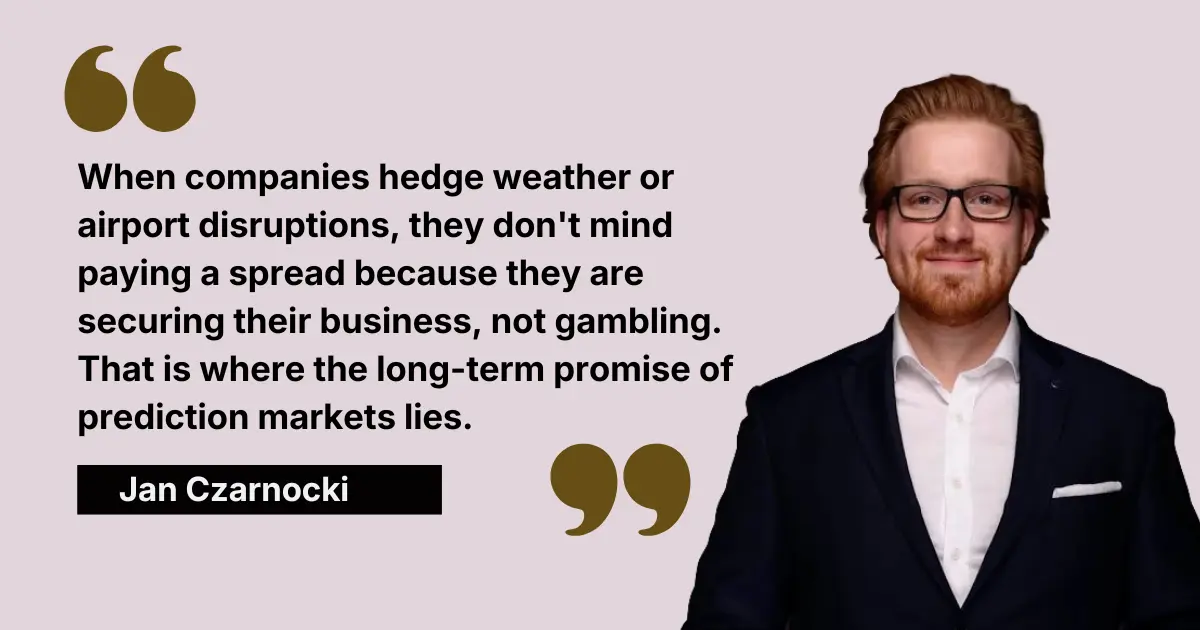
    Jan Czarnocki, Chief of Staff and General Counsel at Elastics, appeared on the NEXTPredict Podcast to outline a transformative vision for prediction markets. According to Czarnocki, these platforms are poised to evolve well beyond retail sports betting and eventually displace traditional commercial insurance models.

    Shift Toward Corporate Risk Management and Event Hedging

    During the discussion, Czarnocki explained the structural shift toward corporate risk management and event hedging. He described a future where skilled forecasters from leading prediction platforms take on underwriting roles traditionally held by insurance institutions.

    “The best future is where sharps from Polymarket and Kalshi are actually the underwriters of insurance policies for big institutional players…”

    This perspective signals a fundamental change in how institutional risk could be priced and managed, leveraging the collective intelligence and market efficiency of decentralized prediction markets.

  • Kalshi Seeks 24/7 Tesla and Nvidia Perpetual Futures as Wall Street Battles Over Regulation

    Kalshi Seeks 24/7 Tesla and Nvidia Perpetual Futures as Wall Street Battles Over Regulation

    Prediction marketplace Kalshi is preparing to introduce one of cryptocurrency’s most widely traded instruments to the U.S. equities market, with perpetual futures contracts tied to major companies including Tesla, Apple, and Nvidia that would operate around the clock.

    Regulatory Filing Planned for Dozens of Contracts

    The operator intends to seek regulatory approval for approximately 60 perpetual futures linked to individual stocks and exchange-traded funds, the Wall Street Journal reported late Thursday. If cleared, these would become the first regulated single-stock perpetual futures offered in the United States.

    How Perpetual Futures Work

    Perpetual futures, commonly known as perps, allow traders to speculate on whether an asset will rise or fall, frequently using leverage, without the contract ever reaching an expiration date. Instead of settling at maturity, traders exchange regular funding payments that keep the contract price anchored to the underlying asset’s spot price.

    From Crypto Innovation to Mainstream Markets

    Since the soon-to-be-defunct exchange BitMEX launched these products in 2016, perpetual futures have grown into one of the cryptocurrency sector’s largest business lines. Newer platforms such as Hyperliquid now enable traders to take leveraged positions on bitcoin and hundreds of tokens at any hour.

    Around-the-Clock Price Discovery

    A Tesla perpetual future could continue trading through nights and weekends while Tesla shares on the Nasdaq remain closed, providing a live view of what traders believe the company is worth hours—or even days—before the stock market itself reopens.

  • Former Amazon CFO Warren Jenson Joins Polymarket as Finance Chief

    Former Amazon CFO Warren Jenson Joins Polymarket as Finance Chief

    Polymarket Appoints Finance Veteran Warren Jenson as CFO to Drive U.S. Expansion

    Prediction market platform Polymarket has named Warren Jenson as its new Chief Financial Officer, a strategic hire aimed at accelerating the company’s U.S. expansion and strengthening global operations. Jenson will report directly to Founder and Chief Executive Officer Shayne Coplan.

    Seasoned Executive to Oversee Financial Strategy and Infrastructure

    In his new role, Jenson will oversee financial operations, capital planning, and long-term business strategy. He is also tasked with building the financial infrastructure required for Polymarket’s next stage of growth. The appointment signals the company’s intent to professionalize its leadership as it navigates an increasingly competitive landscape.

    Decades of Leadership Across Global Enterprises

    Jenson brings extensive experience from several major global corporations. He previously served as CFO at Amazon, Electronic Arts, Delta Air Lines, and NBC. Additionally, he held senior leadership positions at Nielsen and LiveRamp. His track record spans technology, entertainment, aviation, and media sectors, providing Polymarket with a financial leader accustomed to scaling complex, high-growth organizations.

    Leadership Team Expansion Amid Market Competition

    The hire follows Polymarket’s recent recruitment of former Uber executive Travis VanderZanden as Chief Growth Officer. Together, the appointments reflect a deliberate effort to bolster the executive bench during a period of rapid evolution in the prediction market sector.

    Prediction Market Volumes Surge, Competitive Pressure Mounts

    Prediction markets have experienced significant growth in recent months. Combined August volumes at Kalshi and Polymarket reportedly reached $48.4 billion, according to data from Piper Sandler. However, Kalshi accounted for approximately $40 billion of that activity, placing pressure on Polymarket to regain market share.

    Regulated U.S. Exchange and Revenue Milestones

    Beyond leadership changes, Polymarket continues to develop its regulated U.S. exchange and global platform. The company recently surpassed $1 billion in annualized revenue, underscoring the commercial traction of its decentralized prediction market model.

    Related: Lummis Uses $42M Tether Lawsuit to Push Senate Toward CLARITY Act