Tag: Crypto derivatives

  • Zcash Shorts Hit 72% as ZEC Price Holds Above $1,100 — What’s Next?

    Zcash Shorts Hit 72% as ZEC Price Holds Above $1,100 — What’s Next?

    Binance top traders have aggressively positioned for a Zcash price decline, with short accounts representing 72.05% of positioning versus just 27.95% long, according to CoinGlass analytics. The resulting long/short ratio of 0.39 underscores a strong consensus for downside among the exchange’s largest participants. Yet this bearish crowd faces a mounting challenge: persistent spot buying pressure and a technical structure that could trigger a short squeeze if key support holds.

    High-profile short position deep underwater

    Garrett Jin, a prominent figure in crypto trading and executive circles, illustrates the risk embedded in the crowded short trade. His 39.76K ZEC short position, valued at approximately $44.90 million, was entered near $576.30. With Zcash trading near $1,128.58 at press time, the unrealized loss on the position has ballooned to roughly $21.98 million.

    Jin’s liquidation price sits higher at $2,540.50, providing a buffer against immediate forced closure. However, any renewed upside move would deepen losses and increase pressure on similarly positioned traders, potentially accelerating a squeeze dynamic.

    Spot market buyers contradict derivatives bias

    While top trader accounts lean heavily short, spot market activity tells a different story. The 90-day Spot Taker CVD (Cumulative Volume Delta) indicator remains buyer-dominant, signaling aggressive buyers continue to control cumulative taker activity. This divergence matters: the dominant short positioning has not translated into equivalent selling aggression on the spot side. Instead, buyers have consistently absorbed available supply despite widespread expectations for a deeper correction.

    Jin’s mounting unrealized loss highlights the specific risk created when heavy bearish exposure encounters sustained aggressive buying.

    Derivatives cooling weakens short-side confirmation

    Broader derivatives participation has cooled significantly, undermining the conviction signaled by the top-trader ratio alone. ZEC Open Interest (OI) fell 11.49% to $2.41 billion in 24 hours, while derivatives trading volume plunged 42.06% to $5.99 billion over the same period. These declines suggest traders are reducing leverage exposure rather than aggressively adding fresh short positions.

    Historically, rising bearish exposure alongside expanding OI provides stronger evidence of new shorts entering the market. The current contraction in OI and volume instead reflects broad position reductions as speculative activity cools after ZEC’s sharp price expansion.

    Technical structure: FVG defense critical for wave five

    On the daily timeframe, ZEC has entered a pullback phase within a broader ‘Elliot Wave’ structure after failing to clear the $1,256.68 resistance level. The pullback is identified as a potential ‘Wave (4)’ correction before another price expansion.

    Crucially, a fair value gap (FVG) extends toward the $1,023.60 support area, creating a pivotal zone for the bullish technical structure. The MACD remains constructive despite the retreat, standing at 138.95 above its signal line at 112.00 with a positive histogram reading of 26.94. The correction has not yet invalidated the broader bullish framework.

    If buyers persistently defend the FVG, ZEC could pursue ‘Wave (5)’ and continue placing pressure on the crowded short positions.

    Outlook: crowded shorts meet resilient demand

    The dominant short positioning among Binance top traders faces a dual threat: persistent spot buyer absorption and a technical structure that favors upside continuation if key support holds. Falling derivatives participation suggests the short bias may reflect stale positioning rather than fresh conviction. A successful defense of the FVG near $1,023.60 could reignite upward momentum and force a painful unwind for the bearish crowd.
  • Bitcoin Slips to $78,800 as BNB, DeFi Tokens Buck Selloff

    Bitcoin Slips to $78,800 as BNB, DeFi Tokens Buck Selloff

    Bitcoin Slips Below $79K as Macro Pressures Weigh; BNB Chain Tokens Lead Gainers

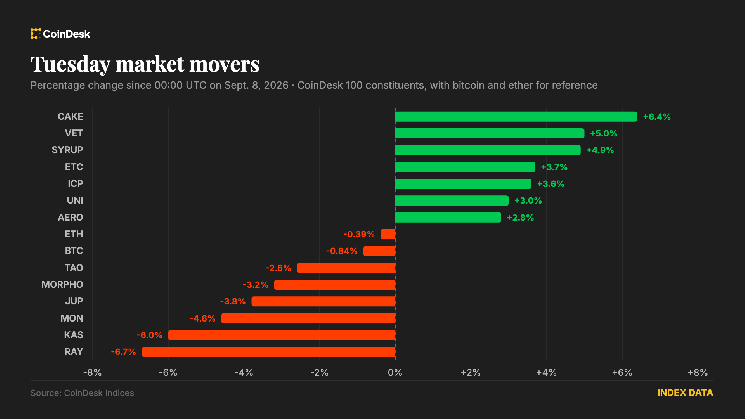
    Bitcoin (BTC) traded around $78,800 on Tuesday, down 0.42% since midnight UTC and 0.75% over the past 24 hours, according to CoinDesk data. The decline leaves the largest cryptocurrency 4.1% below the $82,320 resistance level it failed to breach last week. Ether (ETH) held relatively steady at $2,490, shedding just 0.02%, while Solana (SOL) dipped 0.06% to $103.77.

    Market Breadth Mixed as BNB Ecosystem Outperforms

    Among the 100 assets in the CoinDesk 100 Index, 42 traded in negative territory. BNB Chain tokens emerged as notable exceptions, with BNB rising 2% to $754 since midnight. Related assets CAKE (PancakeSwap) and SYRUP also advanced, benefiting from a rotation into the BNB Chain ecosystem.

    The CoinDesk 5 Index slipped 0.47%, while the broader CoinDesk 20 Index edged up 0.2%. The CoinDesk Memecoin Index outperformed with a 0.41% gain.

    Derivatives Signal Caution Amid Macro Headwinds

    Taker Flow Remains Bearish

    The buy-sell ratio of takers—traders who remove liquidity by executing at market prices—in crypto futures stayed bearish. Major tokens came under pressure from rising oil prices, speculation around Federal Reserve rate increases, and elevated bond yields.

    Open Interest Flat, Volume Rises 5%

    Twenty-four-hour open interest (OI) remained largely unchanged at $141 billion, but trading volume climbed 5% to $149.85 billion. The divergence suggests increased churn rather than fresh positional conviction, indicating traders are rotating capital without adding significant new leverage.

    Aerodrome’s AERO Leads Top-100 Gainers with 17% Surge

    Decentralized exchange Aerodrome Finance’s native token AERO surged 17% in 24 hours, topping the leaderboard among top-100 assets by market value. The rally coincided with a sharp rise in futures open interest to a record 129 million tokens, a combination that points to a buildup of long positions supporting the spot-price move.

    Positive CVD Confirms Aggressive Buying

    AERO’s bullish momentum is reinforced by a positive 24-hour open-interest-adjusted cumulative volume delta (CVD), signaling that buyers are executing market orders more aggressively than passive limit orders.

    Injective’s INJ Mirrors Bullish Futures Structure

    INJ, up 10%, displays a similar bullish futures setup, lending credibility to its spot-price breakout above $6—a level that has acted as a supply zone since mid-June, capping previous advances.

    Bitcoin Futures OI Rises Despite Price Drop

    Overall Bitcoin open interest remains below the 700,000 BTC mark, reflecting still-low appetite for leverage. However, open interest in major USDT- and USD-margined futures increased to 265,000 BTC from 257,000 BTC even as spot prices fell to $78,700 from $80,000. The uptick suggests some traders may have initiated short positions anticipating further downside.

    Bears Dominate Most Majors; AVAX, XLM, DOGE Show Strength

    Negative 24-hour cumulative volume deltas across most major tokens indicate bears are leading price action. Exceptions include Avalanche (AVAX), Stellar (XLM), and Dogecoin (DOGE), which posted positive CVDs.

    Volatility Indexes Calm; Deribit Options Lean Bullish Short-Term

    Bitcoin and ether volatility gauges remain near recent lows, signaling no scramble to buy options or hedge positions. On Deribit, weekly-expiry calls dominated 24-hour volume rankings for both BTC and ETH, reflecting short-term bullish expectations despite the broader bearish taker flow.

    Token Movers: CAKE, VET, SYRUP Lead; RAY, KAS, TAO Lag

    • PancakeSwap (CAKE): +4.9% since midnight UTC, +7.5% over 24 hours to $2.29, extending a rally driven by BNB Chain rotation and the exchange’s tokenized-stocks initiative.
    • VeChain (VET): +8% on the day, +9% over 24 hours to $0.00735.
    • SYRUP: +8% to $0.23, placing three DeFi and enterprise-chain names atop the gainers board while major assets sold off.
    • Raydium (RAY): -5.5% since midnight to $1.10, tracking Solana’s decline.
    • Kaspa (KAS): -4.7% to $0.034, unwinding most of a weekend surge that made it a top 24-hour gainer on Monday.
    • Bittensor (TAO): -1.5% on the day, -3.7% over 24 hours to $256, after leading the market on Sunday.
    • Aerodrome (AERO): +18% over 24 hours to $0.64, though momentum cooled to a 2.8% gain since midnight.
    • Jupiter (JUP): -3.8% to $0.24, a second consecutive heavy session following Monday’s 9% drop with no clear catalyst identified.
  • Bitcoin Holds Near $78,000 as Arbitrum Surges 30% on Robinhood Chain Revenue

    Bitcoin Holds Near $78,000 as Arbitrum Surges 30% on Robinhood Chain Revenue

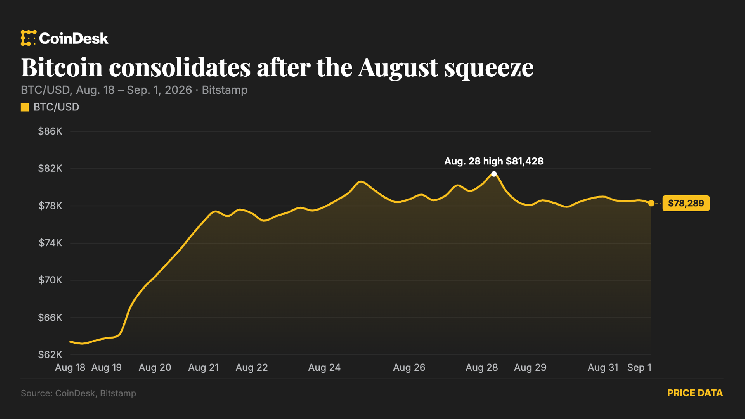
    Bitcoin is trading near $78,000, down 0.4% since midnight UTC and about 0.7% over the past seven days as the market consolidates after a short squeeze lifted the price from below $63,000 to nearly $81,400 last week.

    Bitcoin’s relative strength has remained intact despite the calmer conditions. Nasdaq 100 futures are down 0.5% since midnight, meaning bitcoin is once again outperforming equities.

    Spot bitcoin exchange-traded funds recorded $3.04 billion in net inflows across nine consecutive sessions, their longest streak since April. The run ended Friday with a $202 million outflow before resuming Monday with $217 million in fresh inflows, according to SoSoValue data.

    Altcoins are mixed in the latest session. The Altcoin Season index has fallen to 26 out of 100 from 34 on Friday, its lowest reading in more than 90 days.

    Crypto derivatives positioning remains balanced

    Balanced positioning: The 24-hour taker buy-sell volume ratio in crypto futures markets has remained balanced for a second consecutive day. Open interest has held near $136 billion, while trading volume has declined 7%. The combination suggests traders are adding neither significant long nor short exposure and are waiting for a clearer market signal.

    Arbitrum leads gainers: Arbitrum’s $ARB is the best-performing token among the top 100 cryptocurrencies over the past 24 hours, gaining nearly 30%. The rally is supported by increased futures participation, with open interest rising more than 10%. The data points to a buildup of long positions as $ARB attempts to establish support above chart resistance at 11 cents. Annualized funding rates near 8% suggest the market is not overheated.

    Monero open interest continues to rise: Open interest in privacy-focused Monero futures has climbed to 640,000 tokens, the highest level since February 2024. The signals are mixed. Funding rates have dropped to 15% from more than 50%, suggesting bullish positions are no longer overcrowded. However, the 24-hour open-interest-adjusted cumulative volume delta is negative, indicating bearish leadership. XMR has already pulled back to around $525 from Monday’s high of $548.

    Demand for $TRX shorts: Tron’s $TRX stands out with funding rates at minus 80%, signaling crowded bearish positioning. Short sellers are accepting a high cost to maintain their positions. $TRX is trading near 33 cents after falling for a third consecutive day.

    Light positioning in bitcoin and ether: Open interest in $BTC and $ETH remains subdued, hovering near multi-week lows.

    Volatility cools: Bitcoin’s and ether’s 30-day implied volatility indexes, BVIV and EVIV, have reversed their mid-August spikes, pointing to calmer market conditions.

    Options flow turns bullish: In options listed on Deribit, the $80,000 bitcoin call expiring Sept. 25 was the most-traded position over the past 20 hours. A call represents a bullish bet on the underlying asset. For ether, the $2,500 call attracted the most activity.

    Arbitrum leads the altcoin market

    Arbitrum’s surge is the clearest standout across the altcoin sector. The rally is linked to Robinhood Chain, which operates as a dedicated Arbitrum chain and sends 10% of net protocol revenue to the Arbitrum ecosystem.

    Offchain Labs co-founder Steven Goldfeder said Monday that Robinhood Chain’s 24-hour transaction revenue had exceeded $2 million, up from approximately $1.22 million the previous day. At that pace, Arbitrum’s share would amount to roughly $73 million annually.

    ARK Invest’s Lorenzo Valente calculated that gross revenue on Robinhood Chain rose from $54,676 on Aug. 22 to $1.088 million on Aug. 30, an increase of nearly 20 times. Arbitrum’s share increased from $5,400 to $108,000 over the same period.

    Curve DAO’s CRV$0.3586 rose 14% over 24 hours to approximately 35.13 cents on $119 million in trading volume. The move forms part of the broader decentralized finance rally that has lifted lending and decentralized exchange tokens through the second half of August.

    Uniswap’s $UNI extended its gains, rising 8% since midnight to around $5.80 after advancing 12% over the previous 24 hours. The token is now up 34% over the past seven days on $519 million in volume.

    Among the day’s smaller movers, Aave’s AAVE$126.93 gained 1.9% to $126.54, while Morpho’s MORPHO$2.5549 rose 2%. The moves suggest decentralized finance assets are holding up better than the broader crypto market during Tuesday’s session.

  • Thailand SEC Seeks New Rules for Retail Crypto Derivatives

    Thailand SEC Seeks New Rules for Retail Crypto Derivatives

    Thailand’s Securities and Exchange Commission (SEC) has proposed rules that would allow licensed intermediaries to facilitate retail investment in qualifying cryptocurrency derivatives traded on overseas exchanges.

    Announced on Aug. 31, the proposal would apply to retail, high-net-worth and ultra-high-net-worth investors. It would not provide unrestricted access to every crypto futures or options product listed outside Thailand.

    The consultation is open until Sept. 30. The SEC has not yet said when final rules could take effect or identified the foreign exchanges and contracts that would qualify.

    Retail crypto derivatives would face product and exchange limits

    Under the proposed framework, an overseas crypto derivative offered to noninstitutional clients would need to share key characteristics with digital asset derivatives permitted in Thailand. The SEC identified the underlying asset, maturity, leverage, delivery method and settlement structure as relevant comparison points.

    The requirement is intended to prevent intermediaries from directing retail investors toward contracts with unfamiliar structures or substantially higher leverage. The SEC did not publish a list of eligible cryptocurrencies, exchanges or maximum leverage levels in its English-language announcement.

    Those details may depend on domestic contract specifications being developed with the Thailand Futures Exchange (TFEX).

    The overseas exchange would also need to use a central counterparty, or CCP, to clear trades. A CCP becomes the buyer to each seller and the seller to each buyer, reducing direct counterparty exposure between market participants.

    In addition, the exchange would have to be supervised by a regulator that is a Signatory A to the International Organization of Securities Commissions’ Multilateral Memorandum of Understanding, or belong to the World Federation of Exchanges.

    These conditions establish a regulatory test rather than a blanket list of approved countries. An offshore platform would not qualify solely because it offers Bitcoin or Ether futures to customers in another jurisdiction.

    Institutional investors could access broader crypto products

    Crypto derivatives that do not meet the proposed retail conditions could be offered only to institutional investors. The SEC said these investors are better equipped to assess complex products and manage losses linked to leverage, volatility and settlement risks.

    Qualifying the exchange alone would therefore not be sufficient. The specific contract would also need to match the relevant Thai product characteristics before an intermediary could offer it to retail or wealthy individual clients.

    Existing Thai rules already allow intermediaries to facilitate overseas derivatives investments for retail and high-net-worth clients when the foreign instruments resemble products that can be traded in Thailand. The new proposal would establish tailored conditions for crypto derivatives because overseas contracts can vary widely in leverage, maturity and settlement.

    Perpetual futures may receive particular scrutiny because they have no fixed expiry date and use recurring funding payments. The SEC did not state whether such products would satisfy the similarity test. Their eligibility will depend on the final rules and domestic contract specifications.

    The proposal applies to regulated intermediaries facilitating access. It does not legalize direct use of every offshore crypto exchange by Thai residents or override restrictions affecting unlicensed foreign platforms.

    Thailand is still developing domestic crypto contracts

    Thailand expanded its derivatives framework earlier in 2026 by adding cryptocurrencies and digital tokens as eligible underlying assets under the Derivatives Act.

    As crypto.news previously reported, Thailand formally recognized cryptocurrencies as permissible underlyings for regulated futures and options. The SEC Board’s related notification was dated March 5.

    The regulator is now discussing contract specifications with TFEX. Those discussions are expected to cover underlying assets, contract sizes, margin requirements, leverage and settlement methods for domestic products.

    TFEX had not listed a cryptocurrency futures or options contract as of Sept. 1. Its public product directory included equity index, single-stock, precious metal, currency, interest-rate and agricultural derivatives, but no digital asset category.

    The lack of a domestic crypto derivatives contract leaves an open question for comparing overseas products. The SEC may need to complete or substantially define the TFEX framework before intermediaries can determine which foreign contracts meet the similarity requirement.

    Thailand has separately considered allowing crypto businesses to obtain derivatives licenses without establishing new corporate entities. The planned change would allow qualified firms to expand within one regulated structure while maintaining controls for conflicts of interest and customer protection. The earlier licensing proposal aimed to reduce duplicate corporate requirements.

    Sept. 30 consultation deadline will shape final rules

    Investors, intermediaries, banks, digital asset businesses and other stakeholders can submit comments through the SEC’s consultation page, Thailand’s Legal Hub or the email addresses provided by the regulator.

    The consultation asks whether noninstitutional investors should receive access when every prescribed condition is met. It separately asks whether institutional investors should be allowed to access products that fall outside those conditions.

    After Sept. 30, the SEC can revise the proposal before approving final amendments. No statutory deadline requires the regulator to complete the process immediately after the consultation closes.

    Further information will also be needed from TFEX. Its contract specifications would help determine which overseas instruments have sufficiently similar leverage, maturities and settlement arrangements.

    The proposal did not produce any verified market movement directly attributable to the announcement. It also did not approve a particular cryptocurrency, exchange, broker or derivatives contract.

    Thailand is also developing locally regulated crypto exchange-traded funds. In related coverage, proposed spot Bitcoin and Ether ETF rules set an 80% minimum digital asset exposure. Together, the initiatives show the regulator expanding supervised investment access while retaining product-level restrictions.

  • Thailand SEC Proposes Retail Access to Regulated Overseas Crypto Derivatives

    Thailand SEC Proposes Retail Access to Regulated Overseas Crypto Derivatives

    Thailand’s Securities and Exchange Commission (SEC) is considering rules that would allow intermediaries to give retail investors access to certain digital asset derivatives traded on overseas markets.

    Under the proposed framework, eligible products would need to closely resemble crypto derivatives already traded in Thailand. The assessment would cover the underlying assets, maturity, leverage and settlement methods.

    The derivatives would also have to trade on an exchange that uses a central counterparty for clearing and is supervised by a regulator affiliated with specified international regulatory or exchange organizations.

    Thailand expands regulated crypto derivatives framework

    The consultation is the latest move by Thailand to bring crypto-linked products into its regulated capital markets. In a notification dated March 5, the SEC formally designated cryptocurrencies and digital tokens as permissible underlying assets for derivatives.

    The regulator is also discussing potential contract specifications with the Thailand Futures Exchange.

    Crypto derivatives that do not meet the proposed conditions would be available only to institutional investors. The SEC said institutions are better equipped to evaluate and manage complex, high-risk products.

    Current rules allow intermediaries to facilitate overseas derivatives investments for retail and high-net-worth clients only when the products resemble derivatives traded domestically. According to the SEC, overseas crypto derivatives require tailored rules because their structures and risk levels can vary.

    The consultation will remain open until Sept. 30. The SEC has not announced an implementation date for the proposed amendments.

  • Zcash (ZEC) Price Rise Is a Red Flag for Bitcoin (BTC), Warns CryptoQuant Analyst

    Zcash (ZEC) Price Rise Is a Red Flag for Bitcoin (BTC), Warns CryptoQuant Analyst

    The rapid ascent of the privacy-centric cryptocurrency Zcash (ZEC) is raising alarms among on-chain analysts, who view the sudden rally as a significant warning sign for Bitcoin (BTC). While spot exchange-traded funds (ETFs) recently drew retail capital into the digital asset space, researchers have flagged critical signs of overheating in the cryptocurrency derivatives market.

    Historical market cycles point to a troubling trend: unusual surges in Zcash during periods when the leading cryptocurrency is consolidating have often served as a reliable leading indicator of an impending market-wide correction. According to recent data from CryptoQuant, the Zcash risk metric has climbed into extreme territory, flashing a clear warning signal for Bitcoin investors. This altcoin rally is unfolding while Bitcoin remains bound within a trading range of $60,000 to $80,000, struggling to break out past its previous highs.

    Analyst Warnings and Historical Patterns

    CryptoQuant analyst Maartun highlighted the suddenness of the move, pointing out that the privacy coin “just ripped 70% in a matter of days,” which has left him “more worried about Bitcoin than excited about Zcash” given the current structure of the market. According to the analyst, this exact technical signal has historically occurred right before major pullbacks in the market’s leading asset.

    Derivative Market Overheating and Volume Drop

    Technical data from CoinGlass supports these warnings of local overheating. Over a 24-hour window, Zcash trading volumes dropped significantly, with spot trading volume falling by 24.97% and derivatives volume shrinking by 24.16%. This suggests that the initial institutional excitement surrounding Zcash ETF developments has already been priced in, driving a price correction down to $779.38.

    Additionally, short-term activity in the futures market shows sharp divergence. In the four-hour timeframe, futures selling escalated rapidly, jumping by 101.68%. At the same time, leveraged trading remains highly elevated, with $1.53 billion in borrowed capital locked in Zcash margin positions. This leverage represents over 11% of the asset’s total market capitalization, which currently stands at $13.13 billion.

    Critical Views and Liquidation Risks

    The debate surrounding this rally is further intensified by commentary from Alex Thorn, the head of research at Galaxy Digital. Thorn voiced strong skepticism about the long-term viability and utility of the ecosystem. He criticized traders who chose to “pump ZEC because it’s ‘private bitcoin’” and went on to explain that account-based blockchains are “privacy nightmares” by design, arguing that they are “substantially less private than UTXO-based chains like bitcoin.”

    If the high concentration of leveraged positions—represented by the $1.53 billion futures overhang—begins to trigger forced liquidations, it could set off a domino effect across major crypto derivatives exchanges. Because Bitcoin is currently experiencing a lack of strong buying momentum within its current consolidation range, sudden panic in the derivatives space coupled with a broad liquidity drain could serve as the catalyst for a deeper market-wide correction, forcing investors to quickly transition into a risk-off posture.