Tag: Azerbaijan GP

  • James Hinchcliffe Explains Why Ferrari Is “Happy” With Lewis Hamilton-Charles Leclerc Rivalry

    James Hinchcliffe Explains Why Ferrari Is “Happy” With Lewis Hamilton-Charles Leclerc Rivalry

    Key Highlights

    • James Hinchcliffe asserts Ferrari welcomes the intensifying rivalry between Lewis Hamilton and Charles Leclerc, calling it the expected outcome of signing the seven-time champion.
    • Hamilton rebounded in 2026 with his first Ferrari podium in China and maiden victory for the Scuderia in Barcelona, sitting third in the standings with 191 points.
    • Hinchcliffe describes the two-driver battle as a “privileged position” that accelerates development, though he acknowledges difficult team-order decisions may loom if Ferrari contends for the title in 2027.

    Hinchcliffe: Ferrari’s Hamilton-Leclerc Rivalry Is a Feature, Not a Bug

    Former IndyCar race-winner and current F1 TV analyst James Hinchcliffe has dismissed suggestions that Lewis Hamilton‘s resurgence at Ferrari constitutes a headache for team principal Frédéric Vasseur. Speaking on the F1 Nation podcast ahead of the Azerbaijan Grand Prix, Hinchcliffe argued the Scuderia deliberately engineered a high-stakes intra-squad duel when it recruited the seven-time world champion, and that the current friction is precisely the dynamic the Maranello hierarchy anticipated.

    From Struggle to Strength: Hamilton’s 2026 Turnaround

    Hamilton’s debut campaign with Ferrari in 2025 yielded scant reward as he grappled with the car and the organization’s operational rhythm. The narrative shifted decisively in 2026. Having acclimated to the squad and the revised technical regulations, the Briton claimed his first podium in red at the Chinese Grand Prix before converting pole position into a breakthrough victory at the Barcelona-Catalunya Grand Prix. Those results have propelled him to third in the drivers’ championship on 191 points, albeit 101 adrift of leader Kimi Antonelli. Team-mate Charles Leclerc, long regarded as the franchise cornerstone, sits fifth with 167 points.

    “They Didn’t Sign Him to Be Subservient”

    Asked whether Hamilton’s newfound pace had created an unforeseen management challenge for Vasseur, Hinchcliffe was unequivocal. “I think they’re happy to have the problem,” he said. “I don’t think Ferrari would sign somebody that they were anticipating to be slower and subservient to Charles, to the ‘Ferrari Golden Boy’.” The pundit emphasized that Vasseur, having managed Hamilton in junior categories, entered the partnership with open eyes regarding the 39-year-old’s ceiling. “Everybody knows exactly what Lewis is capable of, and Fred has seen it from the beginning. So, no, I think they were more surprised last year at the lack of issue they had with this because Lewis wasn’t up to the same pace as Charles, and that this year is really more what they were expecting to have, and frankly, it’s what they want.”

    Development Accelerant and the “Privileged Position”

    Hinchcliffe framed the internecine competition as a catalyst for engineering progress. “When you have two drivers that can push each other like this, you’re going to help make the team better. Yes, at some point it might bring up some difficult conversations and some difficult decisions, but that’s a privileged position to be in.” He projected that if Ferrari delivers a title-capable chassis in 2027, the dialogue will evolve from managing egos to adjudicating championship strategy. “It’s one that they hope, if they get the car right next year, that we’ll be having similar conversations next year, but talking about the championship implications of who they should back.”

    Why This Matters

    The Hamilton-Leclerc axis represents Formula 1’s most scrutinized driver pairing: a record-equalling champion chasing an eighth crown versus a homegrown talent anointed as the Scuderia’s future. Hinchcliffe’s assessment reframes the narrative from potential dysfunction to calculated roster construction. Ferrari’s 2026 form — race-winning pace but a substantial deficit to Antonelli in the standings — suggests the team has the raw performance to exploit a two-driver development loop. However, the “difficult conversations” Hinchcliffe anticipates will materialize only if the 2027 regulation set yields a genuine title contender. For now, Vasseur’s challenge is converting the rivalry into constructive data without fracturing garage harmony, a balancing act that will define Ferrari’s trajectory into the next regulatory cycle.

    Frequently Asked Questions

    Where does Lewis Hamilton stand in the 2026 drivers’ championship?
    Hamilton is third with 191 points, 101 points behind championship leader Kimi Antonelli.
    What were Hamilton’s key results for Ferrari in 2026?
    He scored his first podium for the team at the Chinese Grand Prix and took his maiden Ferrari victory at the Barcelona-Catalunya Grand Prix.
    Does James Hinchcliffe believe Ferrari will face team-order dilemmas?
    Yes. He acknowledges “difficult conversations and some difficult decisions” may arise, but characterizes that scenario as a “privileged position” that Ferrari actively sought by signing Hamilton.
  • What Were Charles Leclerc’s “Other Opportunities” Before Signing New Ferrari Deal?

    What Were Charles Leclerc’s “Other Opportunities” Before Signing New Ferrari Deal?

    Key Highlights

    • Charles Leclerc has reaffirmed his long-term commitment to Ferrari, stating he wants to achieve his “ultimate goal” of becoming a world champion with the Scuderia and expressing 200% belief in team principal Frederic Vasseur.
    • Leclerc’s manager, Nicolas Todt, explored opportunities with Mercedes, McLaren, and Aston Martin, but negotiations with Ferrari concluded rapidly once the parties sat down together.
    • The current contract, signed in early 2024 alongside Lewis Hamilton’s arrival announcement, runs theoretically to 2029 but includes a 2026 break clause originally intended as protection against potential regulatory failures.

    Leclerc’s Loyalty Tested by Market Forces and Internal Dynamics

    Charles Leclerc’s relationship with Ferrari has long resembled a high-stakes romance punctuated by periodic flirtations with rival suitors. Each contract extension arrives amid whispers of interest from Mercedes, Red Bull, McLaren, and most recently Aston Martin, yet the Monégasque driver consistently returns to Maranello. On a recent episode of F1’s Beyond the Grid podcast, Leclerc offered rare transparency about the process: “For that, I’m also lucky to be in the position where I’ve got my manager… And my manager is here to let me know about what are the other opportunities, what’s going on around. And so I didn’t have any personal talks, but my manager did.” He elaborated that Nicolas Todt’s role is to provide “the full picture of what’s going on in the paddock,” confirming that “yes, there were other opportunities. But at the end of the day, we sat down with Ferrari and we made it happen quite quickly.”

    The Todt-Vasseur Axis and Its Strategic Leverage

    Central to Leclerc’s bargaining power is his manager, Nicolas Todt, whose connections run deeper than typical driver representation. The son of Jean Todt—the architect of Ferrari’s Michael Schumacher-era dominance and former FIA president—Todt Jr. manages a stable including Le Mans winner James Calado and formerly guided Felipe Massa. Crucially, he co-founded the ART Grand Prix organization with Frederic Vasseur over two decades ago, forging an alliance that proved decisive in January 2023 when Todt was instrumental in replacing Mattia Binotto with Vasseur as team principal. This access to Ferrari’s senior leadership, extending beyond the team principal to chairman John Elkann and CEO Benedetto Vigna, grants Leclerc a channel of influence unavailable at rival outfits. It facilitated not only Binotto’s departure but also the swift, peculiarly communicated removal of race engineer Xavier Marcos early in the 2024 season.

    Contract Architecture: Golden Handcuffs and Escape Hatches

    When Ferrari announced Lewis Hamilton’s 2025 arrival in January 2024, it simultaneously locked Leclerc into a long-term deal theoretically extending to 2029 with options. However, the contract contained a 2026 break clause—a calculated hedge against Ferrari botching the new technical regulations. That scenario has not materialized; instead, Ferrari has produced a competitive chassis and demonstrated an aggressive, effective upgrade trajectory. Yet operational misfires—strategy errors, pit-stop issues, and execution lapses—have cost valuable points. Meanwhile, the external landscape shifted: Mercedes, once a plausible destination when Todt sounded out the Silver Arrows about filling Hamilton’s vacancy, grew content with its own lineup. McLaren, where Todt held discussions with Andrea Stella and Zak Brown, entered 2024 with two championship-contending drivers. Aston Martin approached late last year, but amid internal turmoil that saw Adrian Newey’s arrival coincide with Andy Cowell’s ouster, the project presented what one observer termed “a farrago.” Faced with Ferrari’s improving trajectory versus organizational chaos elsewhere, Leclerc chose continuity.

    Why This Matters

    The Leclerc-Ferrari bond now enters a critical phase. With Hamilton installed as teammate, the internal equilibrium hinges on clear number-one status, operational excellence, and a car capable of challenging Red Bull and McLaren consistently. The 2026 break clause looms as a natural inflection point: if Ferrari fails to convert current promise into championships, both parties retain flexibility. For now, Leclerc’s public declaration—“I don’t want to give up on my ultimate goal, which is to become a world champion with Ferrari… I believe in the project. I believe in every single person of the team… And Fred is a big reason on why I have signed again as well. I believe in Fred 200%.”—signals alignment. Yet his leverage diminishes if performance plateaus; at the next renewal cycle, he will be over 30, an age when F1 options historically narrow. The Scuderia’s ability to translate technical innovation into race wins will determine whether this partnership achieves its stated destiny or becomes another chapter in Ferrari’s long championship drought.

    Frequently Asked Questions

    Does Charles Leclerc have a clause allowing him to leave Ferrari in 2026?

    Yes. The long-term contract signed in January 2024 includes a break clause activatable in 2026, originally inserted as protection against potential failure with the new technical regulations. Both parties retain the option to reassess at that juncture.

    What role did Nicolas Todt play in Frederic Vasseur becoming Ferrari team principal?

    Todt was instrumental in the January 2023 transition that replaced Mattia Binotto with Vasseur. The two co-founded ART Grand Prix together over 20 years ago, and Todt’s access to Ferrari’s senior leadership—including chairman John Elkann—enabled him to influence the decision.

    Which other teams expressed interest in signing Leclerc?

    Mercedes, McLaren, and Aston Martin all held discussions or were approached by Todt over the past two years. Mercedes was considered when Hamilton’s departure created a vacancy, McLaren was approached while fielding two title contenders, and Aston Martin made an approach amid its own organizational upheaval.

  • Formula 1 Approves Shorter Races for 2027 to Align with Revised Power Unit Regulations

    Formula 1 Approves Shorter Races for 2027 to Align with Revised Power Unit Regulations

    Key Highlights

    • The Formula 1 Commission has approved a 15 km reduction in grand prix race distance for 2027, dropping the standard from 305 km to 290 km pending FIA World Motor Sport Council ratification.
    • Power unit regulations shift toward combustion: the internal combustion engine (ICE) output rises to 420 kW while MGU-K deployment falls to 300 kW (350 kW in overtake mode), supported by a 5% fuel flow increase.
    • Race stoppage rules are overhauled: the three-hour maximum window for red-flagged events is replaced by a hard stop time based on daylight, and race directors gain authority to extend free practice sessions after prolonged interruptions.

    F1 Commission Greenlights 2027 Race Distance Reduction

    The Formula 1 Commission convened in London on Monday and rubber-stamped a package of regulatory changes for the 2027 season, headlined by a decision to shorten every grand prix by 15 kilometres. The standard race distance will fall from 305 km to 290 km, a move that translates to roughly three fewer laps at most circuits on the calendar. The measure still requires formal approval from the FIA World Motor Sport Council (WMSC) before it enters the sporting regulations.

    Power Unit Rebalance Drives Chassis and Fuel Strategy Changes

    The distance cut is a direct consequence of the 2027 power unit framework agreed earlier. To re-balance the formula and curb the level of “superclipping” and energy harvesting that characterised recent seasons, the Commission confirmed that the internal combustion engine will be upscaled to a 420 kW peak output. Simultaneously, the maximum power drawn from the MGU-K is reduced to 300 kW during standard running, with the overtake mode retaining a 350 kW ceiling. Delivering the extra combustion output demands a 5% increase in fuel flow.

    Rather than mandate larger fuel cells to accommodate the higher flow rate—which would entail costly chassis redesigns—the FIA and Formula One Management (FOM) opted to trim race distances. The shorter races minimise the risk of drivers running dry in the closing laps while keeping the current fuel tank specification intact. It remains an open question whether the 290 km format will persist into 2028, when the regulations evolve again: ICE output is slated to climb to 450 kW, fuel flow will rise by 13% overall, and the combustion-to-electric energy split shifts to 60/40, a configuration that will necessitate a larger fuel tank.

    Race Stoppage Protocol Overhauled for Daylight Constraints

    Beyond powertrain matters, the Commission forwarded a significant rewrite of the race suspension clock to the WMSC. The existing two-hour race-time limit remains, but the three-hour absolute window that currently governs red-flag stoppages will be eliminated. In its place, a hard stop time tied to daylight conditions will be enforced for any delayed or rain-affected grand prix. The FIA communique explained the rationale directly: “these changes were introduced to ensure that the spectators have the best possible chance to enjoy a full race if disruptions occur.”

    Race directors will also receive expanded authority to extend free practice sessions when extended red-flag periods eat into track time. The rule change was motivated by the Spanish Grand Prix FP3 session, which lost approximately 30 minutes after separate incidents involving Lewis Hamilton and Ollie Bearman. Hamilton’s impact at Turn 22 required roughly 25 minutes of barrier repairs, and Bearman’s late-session crash truncated the remaining running by a further five minutes.

    Gearbox Development Unlocked for 2027 Season

    In a move welcomed by manufacturers, gearbox homologation has been rescinded for 2027. The decision allows suppliers to continue developing their transmissions throughout next season rather than freezing specifications. The Commission’s document also alluded to additional minor technical regulation tweaks for 2025, alongside undisclosed updates to the sporting and financial regulations for the current championship year.

    Why This Matters

    The 2027 rule package represents the most substantial regulatory reset since the ground-effect era began in 2022. By dialing up combustion output and dialing down electrical deployment, the FIA aims to restore a more traditional power delivery profile while containing costs through the race-distance reduction rather than chassis redesigns. The shift to a hard stop time for red-flagged races addresses long-standing criticism that the three-hour window created scheduling uncertainty for broadcasters and promoters, particularly at venues with limited daylight or tight curfews. Free practice extensions give teams a safeguard against lost preparation time, a practical response to the increasing frequency of session-stopping incidents. Finally, lifting gearbox homologation acknowledges that transmission development remains a meaningful performance differentiator and prevents a premature technology freeze ahead of the 2028 power unit evolution.

    Frequently Asked Questions

    How much shorter will 2027 Formula 1 races be?
    Each grand prix will be reduced by 15 km, from the current 305 km standard to 290 km. At most circuits this equates to approximately three fewer laps.
    Why is the race distance being cut instead of increasing fuel tank size?
    The 2027 power unit rules raise ICE output to 420 kW and increase fuel flow by 5%. Enlarging fuel tanks would require costly chassis modifications; shortening races achieves the same fuel-margin safety net without structural changes.
    What changes are being made to red-flag and race stoppage rules?
    The three-hour maximum window for a red-flagged race is replaced by a hard stop time based on daylight. Race directors also gain the power to extend free practice sessions after prolonged interruptions, a direct response to the truncated FP3 session at the 2024 Spanish Grand Prix.
  • Carlos Sainz Backs Bold Approach for Williams Junior Will Green’s Racing Future

    Carlos Sainz Backs Bold Approach for Williams Junior Will Green’s Racing Future

    Key Highlights

    • Carlos Sainz advises 13-year-old Williams Academy driver Will Green to prioritize finding the limit over consistency in his transition from karting to single-seaters.
    • The Spanish Formula 1 driver emphasizes that making mistakes while pushing hard is essential for learning and confidence-building at the junior level.
    • Green, the 2026 Karting European Championship junior champion, conducted the interview published on the Williams Racing YouTube channel.

    Sainz Mentors Williams’ Newest Academy Talent

    Carlos Sainz has offered candid guidance to Will Green, the 13-year-old karting prodigy who joined the Williams Racing Academy in December 2024, urging the British youngster to embrace risk-taking over conservative consistency as he prepares for the leap to single-seater competition. The conversation, filmed for the Williams Racing YouTube channel, featured the unique dynamic of Green interviewing the 32-year-old Spanish Grand Prix winner, providing a rare glimpse into how established Formula 1 stars view the developmental pathway.

    Embrace Mistakes to Multiply Talent

    Sainz’s central message focused on the psychological approach required during the formative junior years. “Don’t be afraid to make mistakes. It’s better to push too hard and make mistakes than try and be too conservative,” Sainz said in the video on the Williams YouTube channel. “You are at the age where it’s important to learn as much as possible. So, don’t be scared.” He elaborated that the window for aggressive experimentation is narrow and critical. “Don’t be afraid to make mistakes, risk too much and go for overtakes or last-lap moves that maybe are too risky. I would say that age is the time to do it because that’s when you will learn the most.”

    The Ferrari driver distinguished between productive errors and avoidable blunders. “Always try to be as close to the limit as possible. Obviously, don’t do anything stupid. If you can avoid stupid mistakes, avoid stupid mistakes. But go and take risks because when they pay off, you feel a lot of confidence, and that’s where your talent multiplies. You’re not only talented but also confident.” This philosophy underscores a broader paddock consensus that early-career confidence, forged at the edge of adhesion, is a prerequisite for elite performance.

    A Natural Transition from Karting to Cars

    Reflecting on his own graduation from karts, Sainz offered reassurance regarding the technical adjustment. “I felt that going from karting to cars was quite natural to me. It didn’t feel weird,” he added. “You will jump in a car one day. They will teach you how to drive with the gears, with everything. The first two laps will be strange but then your natural instinct of just pushing flat out whatever they give you will kick in and you will find a way.” The remarks serve to demystify the step up for Green, who currently holds the 2026 Karting European Championship junior title.

    Why This Matters

    The exchange highlights the increasing structure of Formula 1 junior programs, where teams like Williams invest in drivers as young as 13 and facilitate direct mentorship with current race winners. Sainz’s advice aligns with the “find the limit first” doctrine employed by many driver coaches: early consistency often masks a lack of ultimate pace potential. For Green, the 2026 European junior champion, the immediate challenge will be applying this mindset during his first tests in machinery such as the Formula 4 car, where the cost of errors rises sharply compared to karting. Williams’ decision to publish the dialogue publicly also signals a transparency strategy, showcasing their academy culture to sponsors, fans, and future recruits.

    Frequently Asked Questions

    Who is Will Green and what has he achieved?
    Will Green is a 13-year-old British driver announced as a Williams Racing Academy member in December 2024. He recently won the 2026 Karting European Championship junior title.
    What specific advice did Carlos Sainz give about making mistakes?
    Sainz told Green it is better to push too hard and make mistakes than to be too conservative, stating that taking risks at this age is when a driver learns the most and builds the confidence that multiplies talent.
    Where can the full interview be watched?
    The interview conducted by Green with Sainz was published on the official Williams Racing YouTube channel.
  • 2025 F1 Academy champion Doriane Pin sets timeline for Formula 1 race seat

    2025 F1 Academy champion Doriane Pin sets timeline for Formula 1 race seat

    Key Highlights

    • Mercedes Formula 1 development driver Doriane Pin has set a five-year target to secure a race seat on the F1 grid.
    • The 2025 F1 Academy champion became the first woman to drive a Mercedes F1 car at Silverstone in April 2026, testing the 2021 W12 challenger.
    • Pin advocates for greater diversity and inclusion in motorsport, emphasizing the need for more opportunities for women in Formula 1 and beyond.

    Pin Sets Ambitious Five-Year Formula 1 Timeline

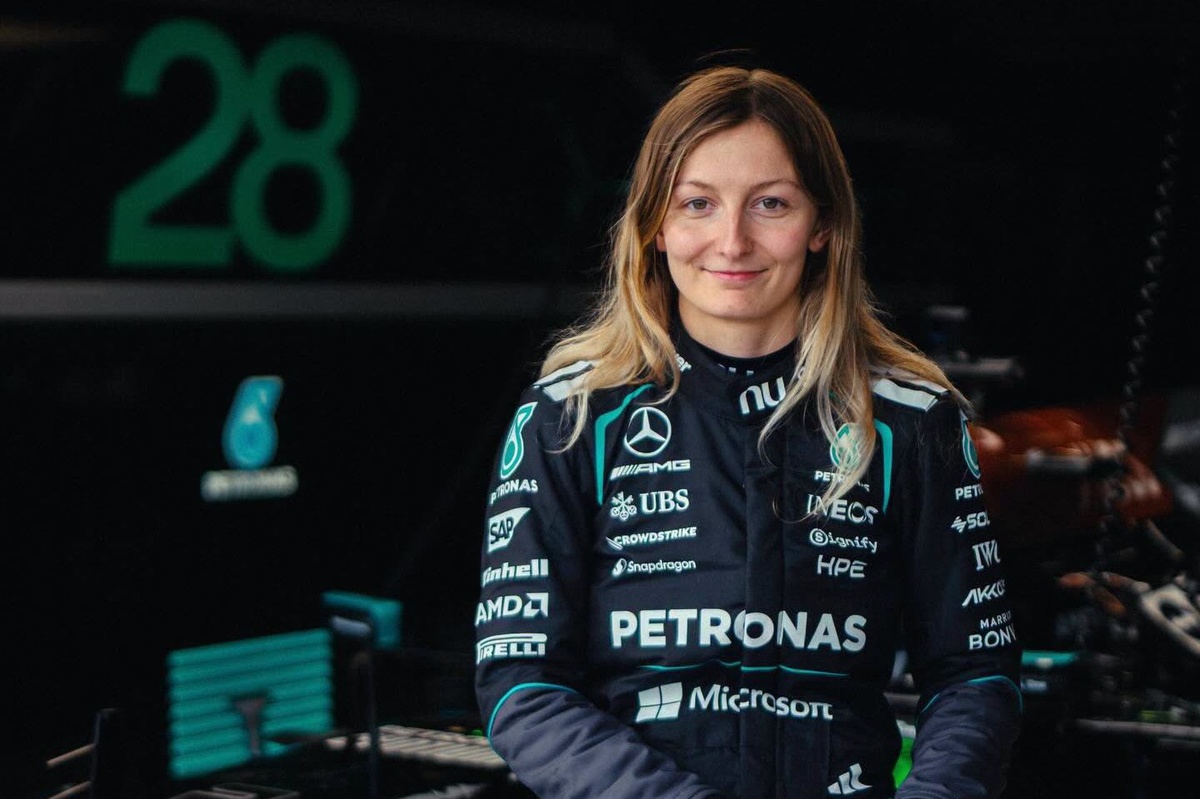
    Mercedes Formula 1 development driver Doriane Pin has publicly declared her intention to earn a race seat on the Formula 1 grid within the next five years. The French driver, who currently serves as a development driver for the Brackley-based team, outlined her long-term career aspirations during a recent Mercedes In Convo With Kids interview. When asked where she envisions herself in half a decade, Pin responded directly: “In Formula 1. “That would be cool. It will open some doors to all the girls that want to be a Formula 1 driver.”

    Historic Silverstone Test and Multi-Series Programme

    Pin’s trajectory accelerated significantly after she clinched the F1 Academy championship in 2025, a triumph that secured her a development driver contract with Mercedes. In April 2026, the 22-year-old made history by becoming the first woman to drive a Mercedes Formula 1 car at Silverstone, piloting the W12 — the team’s challenger from the 2021 season. Beyond her Formula 1 commitments, Pin maintains a demanding multi-discipline schedule. She serves as a development driver for Peugeot in the FIA World Endurance Championship and for Citroën in Formula E, while also competing in the Le Mans Prototype 2 Pro-Am class of the European Le Mans Series for the Duqueine Team.

    Championing Diversity in a Male-Dominated Sport

    Pin’s ambition extends beyond personal achievement; she is a vocal advocate for systemic change within the motorsport industry. Asked what she would change about the world, she centered her answer on representation: “Diversity, in general,” she said about one thing she would change about the world. “So in sports and outside of sports, I think we need more diversity. “So more opportunities for everyone. Especially with my experience in a male-dominated sport like motorsport. So it would be good if we had a lot of women also in Formula 1.” Her perspective is informed by direct experience navigating the sport’s hierarchical structure, positioning her as a prominent voice for the next generation of female talent.

    Why This Matters

    Pin’s stated timeline and current trajectory place her among the most credible female prospects for a Formula 1 race seat in recent history. Her path mirrors and advances the progress made by predecessors such as Susie Wolff, who drove in official free practice sessions for Williams in 2014 — becoming the first woman to participate in a Grand Prix weekend in 22 years — and Jessica Hawkins, who completed a 26-lap test in the Aston Martin AMR21 at the Hungaroring in September 2023. With the F1 Academy now firmly established as a feeder series under Formula 1’s management, Pin’s development across single-seaters, endurance racing, and electric competition provides a uniquely broad technical foundation. Should she achieve her five-year goal, it would represent a watershed moment for gender diversity at the pinnacle of motorsport.

    Frequently Asked Questions

    Who is Doriane Pin?

    Doriane Pin is a 22-year-old French racing driver who won the 2025 F1 Academy championship. She is currently a Formula 1 development driver for Mercedes, a development driver for Peugeot in the World Endurance Championship and Citroën in Formula E, and competes in the LMP2 Pro-Am class of the European Le Mans Series for Duqueine Team.

    What historic milestone did Pin achieve at Silverstone in April 2026?

    Pin became the first woman to drive a Mercedes Formula 1 car at Silverstone, testing the team’s 2021 W12 challenger as part of her development driver duties.

    Which other female drivers have recently tested Formula 1 machinery?

    Susie Wolff drove in official free practice sessions for Williams in 2014, and Jessica Hawkins completed a 26-lap test in the Aston Martin AMR21 at the Hungaroring in September 2023.

  • Why the 2026 F1 Azerbaijan Grand Prix Is Scheduled for a Saturday

    Why the 2026 F1 Azerbaijan Grand Prix Is Scheduled for a Saturday

    The 2026 Formula 1 season enters its final stretch with 14 of the scheduled 23 rounds complete following last weekend’s Spanish Grand Prix. Kimi Antonelli claimed victory in Madrid on Sunday, closing out the European leg of the calendar before the series heads to Azerbaijan and a run of Asian and American flyaway races.

    Why the 2026 Azerbaijan Grand Prix moves to Saturday

    The 2026 Azerbaijan Grand Prix will run on Saturday, 26 September — one week later than its 2025 slot — despite an original Sunday, 27 September date on the provisional calendar. A schedule revision announced in June 2025 shifted the event forward following a request from the Azerbaijan promoter and relevant government stakeholders, according to an official Formula 1 statement at the time.

    The change accommodates Azerbaijan Remembrance Day, observed annually on 27 September. The national day of mourning honours military personnel and civilians who died during the Second Nagorno-Karabakh War, known domestically as The Patriotic War. The conflict erupted on 27 September 2020 in the disputed Nagorno-Karabakh region and lasted 44 days, ending in an Azerbaijani victory and triggering anti-government protests in Armenia. Official figures cite 2,783 Azerbaijani soldiers killed.

    With Remembrance Day falling on Sunday, 27 September 2026, the entire Grand Prix weekend moves forward by 24 hours:

    • Media day: Wednesday
    • Free Practice 1 & 2: Thursday
    • Free Practice 3 & Qualifying: Friday
    • Grand Prix (51 laps): Saturday

    How common are Saturday Formula 1 races?

    While Sunday has long been the standard race day, Formula 1 has contested grands prix on every day of the week. The very first World Championship race — the 1950 British Grand Prix at Silverstone — took place on a Saturday, and the British round remained a Saturday fixture until 1975.

    The Indianapolis 500, which counted toward the F1 championship from 1950 to 1960, traditionally ran on 30 May (moving to Monday when 30 May fell on a Sunday). After 1985, however, Saturday races vanished from the calendar until Las Vegas returned in 2023. Since its revival, the Las Vegas Grand Prix has been held on Saturday each year.

    More recently, the 2024 Bahrain and Saudi Arabian Grands Prix also ran on Saturdays to avoid a clash with the start of Ramadan.

    George Russell, Mercedes
    Photo by: Sam Bagnall / Sutton Images via Getty Images