Category: Coins

Digital assets, cryptocurrencies, blockchain, and currency news.

  • Crypto Wins Regardless of Clarity Act Vote, Coinbase’s Armstrong Says

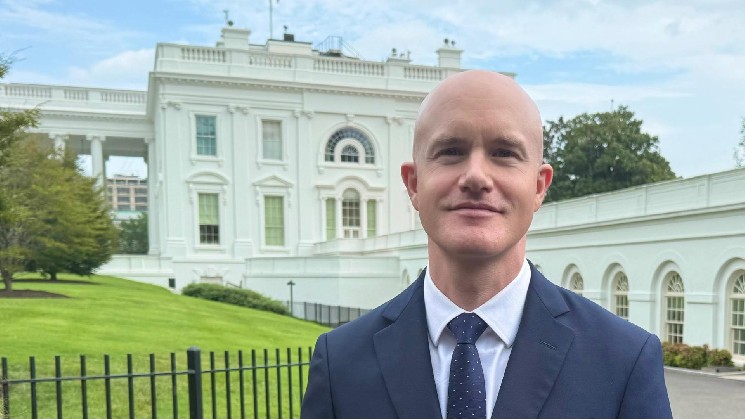
    Crypto Wins Regardless of Clarity Act Vote, Coinbase’s Armstrong Says

    Coinbase CEO Highlights Bipartisan Progress on Crypto Legislation, Flags Ethics Negotiations

    Coinbase CEO Brian Armstrong said significant bipartisan progress has been made on comprehensive cryptocurrency legislation, though key ethics provisions for elected officials remain under negotiation.

    Broad Coalition Backs Measure

    Armstrong described the legislative process as collaborative, noting extensive input from stakeholders across the political spectrum and industry.

    “There’s been a lot of good bipartisan compromise, hundreds of pages of input from both sides,” he said, adding that law enforcement groups, banks and crypto companies are behind it.

    He confirmed that the “must-have issues” Coinbase had previously raised “have now been resolved.”

    Ethics Provisions for Officials Still Unresolved

    One outstanding issue involves ethics rules for elected officials who hold digital assets. When asked whether the legislation adequately addresses potential conflicts of interest, Armstrong indicated negotiations are ongoing.

    “the details are still being worked out and negotiated.”

    He outlined the current positions:

    the White House has “already put out an offer on the table that has a very strong ethics provision,” while Democrats “have requested something a little bit beyond that, which would include divestiture.”

    Despite the gap, Armstrong expressed optimism that a resolution is near.

    “appear to be very close to a solution.”

    Armstrong Pushes Back on Regulatory Arbitrage Claims

    Responding to criticism from JPMorgan Chase CEO Jamie Dimon — who has accused Coinbase of leveraging the bill’s stablecoin provisions for regulatory arbitrage against traditional banks — Armstrong did not name Dimon directly but characterized the opposition as self-interested.

    critics with large payments businesses face a “competitive issue” and are “talking their own book.”

    Armstrong countered that major financial institutions support the legislation, citing Goldman Sachs, BNY Mellon and Fidelity as backers.

    Agentic Finance Identified as Next Growth Frontier

    Looking beyond current legislative fights, Armstrong pointed to agentic finance as an emerging area with significant potential.

    “still early, but that’s the big TAM that’s on the horizon.”
  • Bitcoin Sell Pressure Hits One-Month Low as Long-Term Holders Reduce Profit-Taking

    Bitcoin Sell Pressure Hits One-Month Low as Long-Term Holders Reduce Profit-Taking

    Bitcoin On-Chain Sell-Side Risk Drops Below Half of August Peak, Glassnode Reports

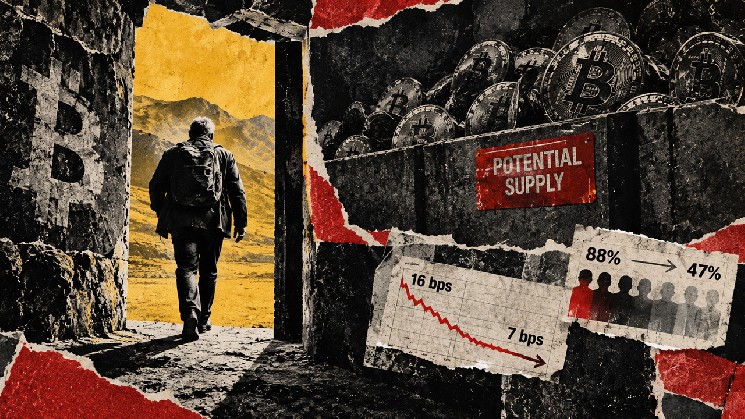
    Bitcoin’s on-chain sell-side risk has declined to less than half its August high, signaling reduced potential selling pressure even as a significant cluster of older coins remains held above current market prices. Analytics firm Glassnode detailed the shift in a September 9 report covering on-chain data through September 7.

    Sell-Side Risk Ratio Falls to 7 Basis Points

    The firm’s Sell-Side Risk Ratio stood at 7 basis points per day on a seven-day basis, down sharply from 16 basis points at August’s peak. This metric aggregates on-chain profits and losses and divides the total by realized capitalization, measuring value realization relative to that capital base to indicate potential selling pressure.

    Long-term holders accounted for 47% of realized profit during the period, compared with 88% at the August peak. The decline suggests older holders are contributing a smaller share of the market’s realized profit, though the percentage does not measure their share of all Bitcoin sales.

    A ratio below half its earlier level does not mean the volume of Bitcoin sold on exchanges has halved.

    Profit Realization Spikes Moderate

    Glassnode separately reported that the realized-profit spike on September 3 was less than half the size of August’s spike. That comparison tracks profit spikes specifically, distinct from the seven-day risk measure. Together, the findings describe quieter realization activity and a changed mix of holders taking profits.

    Overhead Supply Cluster Holds at $83,000–$86,000

    The report identifies roughly 1.07 million BTC acquired between $83,000 and $86,000, almost all held by long-term holders. That block of coins barely changed over 30 days. The holdings remain potential supply, while the realization data describe what holders have recently been doing.

    Exchange Demand Remains a Separate Test

    Reports noted negative exchange spot flow on September 8. Spot cumulative volume delta (CVD) remained negative despite improving, meaning aggressive exchange selling still outweighed aggressive buying in that measure.

    CVD tracks the balance of executed trading, while sell-side risk tracks on-chain profit-and-loss realization relative to realized capitalization. A lower reading in the latter does not require the former to turn positive.

    Bitcoin holders are realizing less profit and loss relative to the capital base, while the overhead coins remain largely in place. Treating that entire block as immediate selling pressure would overstate the evidence. A sustained advance would still require buyers to absorb the supply that actually comes to market.

    Related Reading: Bitcoin’s next $80,000 breakout has $47 billion more profitable supply to absorb

  • Bitcoin, Ethereum, XRP Price Predictions Today: Why Crypto Is Falling

    Bitcoin, Ethereum, XRP Price Predictions Today: Why Crypto Is Falling

    Crypto Market Pulls Back: Bitcoin, Ethereum, and XRP Technical Analysis Amid Treasury Buybacks

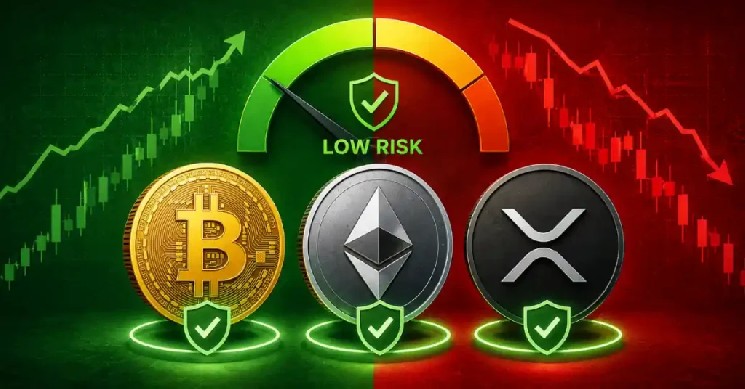
    The global cryptocurrency market capitalization declined to $2.75 trillion, marking a 1.2% drop over the past 24 hours, with trading volume reaching $95.24 billion. Major assets retreated across the board: Bitcoin slipped to $78,218.90, Ethereum eased to $2,470.18, and XRP fell to $1.39.

    Bitcoin: Cooling Off, Not Breaking Down

    Bitcoin remains trapped in a resistance zone between $80,000 and $82,000, while support holds firm between $73,000 and $75,000. Chart analysts indicate the pullback follows an overbought signal on the 3-day RSI, combined with a confirmed bearish divergence that emerged roughly a week ago after Bitcoin’s recent short squeeze. Together, these signals point to further consolidation or a mild pullback rather than a sharp reversal.

    Liquidation data highlights the more immediate level to watch between $77,200 and $77,400, with additional liquidity below that near $76,100. A dip toward the $76,000–$77,000 range remains a plausible near-term scenario, even as the broader multi-year trend stays intact.

    Ethereum: Still Structurally Bullish Despite the Dip

    In the near term, Ethereum faces resistance around $2,520 to $2,530, a level that has rejected price multiple times in recent weeks. The analyst noted that repeated tests of resistance without a sharp rejection tend to weaken that resistance over time, increasing the odds of an eventual breakout. However, a potential bearish divergence remains a risk if Ethereum’s RSI fails to clear its prior high during any breakout attempt.

    XRP: Holding Key Support Amid Sideways Action

    XRP continues to defend a critical support zone between $1.30 and $1.40 on the weekly chart, with the token trading sideways in the shorter term. Immediate support sits near $1.34 to $1.35, while resistance lies at $1.46 to $1.47. Because Bitcoin dominance has pulled back slightly, altcoins including XRP may hold up better than Bitcoin during this cooling-off period rather than falling in lockstep.

    Treasury Buybacks Add a Macro Layer

    Away from the charts, the U.S. Treasury bought back $12.5 billion in short-term debt today and is expected to repurchase up to $6 billion in long-term bonds tomorrow—triple the usual size. The moves are aimed at managing bond market liquidity and containing yields, a dynamic that continues to factor into broader risk asset sentiment alongside crypto’s technical setup.

  • World Expands Solana’s Betting Economy as Prediction Markets Reach 1 Million Users

    World Expands Solana’s Betting Economy as Prediction Markets Reach 1 Million Users

    World, a prediction market protocol built on Solana, has formally launched its standalone platform to more than one million users from its waitlist. The rollout moves the service out of its preliminary phase inside the Phantom wallet, where it had operated since July 2026, and onto a dedicated web interface.

    Market Catalog Exceeds 150,000 Contracts

    The platform now hosts over 150,000 markets spanning sports, politics, crypto, economy, and culture. Sports coverage includes NFL regular-season games, seven professional soccer leagues, and Formula 1. Political contracts feature the 2026 U.S. midterm elections. Each market uses a binary “yes” or “no” structure priced between $0 and $1, with prices reflecting the probability estimated by participants. Winning outcomes settle at $1; losing outcomes settle at $0.

    Non-Custodial Architecture and On-Chain Liquidity

    World operates under a non-custodial model, meaning it does not hold user-deposited funds. Traders do not need a brokerage account or centralized exchange verification. Users pay standard Solana network fees when opening or closing positions. Orders are routed directly to decentralized liquidity providers within the ecosystem.

    Ramzy Ali, Head of Decentralized Finance at the Solana Foundation, explained that the model retains 100% of liquidity directly on-chain. Data provided by the protocol confirms that operations avoid centrally controlled off-chain order books.

    Automated Settlement via Chainlink Infrastructure

    Contract resolution and settlement are powered by Chainlink Data Streams and the Chainlink Runtime Environment (CRE). This integration automates the processing of final outcomes when an event concludes or a deadline is reached. Technical documentation from the firm indicates the mechanism eliminates the need for human panels or token-holder voting committees.

    Johann Eid, Chief Business Officer at Chainlink Labs, noted that the demand seen on the waitlist reflects strong interest in fast, transparent on-chain settlements. For sporting events, the network requires verified final scores; for monetary policy contracts, the system processes official Federal Reserve decisions.

    Regulatory Status and Undisclosed Metrics

    As of publication, World has not disclosed official figures for daily trading volume, exchange fees, or cumulative open interest. The company has also not specified whether it holds registrations with the U.S. Commodity Futures Trading Commission (CFTC). Consequently, effective access for U.S.-based traders remains subject to local jurisdictional regulations.

    Expansion Roadmap: Equities, Commodities, and Weather Derivatives

    World’s announced roadmap includes the introduction of directional contracts on traditional equities. Future plans call for markets tied to commodities such as gold, silver, crude oil, and natural gas, as well as weather derivatives for major metropolitan areas.

  • Tether and Fasanara Launch $400 Million Stablecoin Private Credit Fund

    Tether and Fasanara Launch $400 Million Stablecoin Private Credit Fund

    Tether and Fasanara Capital Launch $400M StableFund to Bridge SME Financing Gap With USDT Infrastructure

    Tether and Fasanara Capital announced the launch of StableFund on September 9, unveiling an evergreen private credit vehicle backed by $400 million in co-investment from the two sponsors. The fund combines Tether’s USDT settlement infrastructure with Fasanara’s global fintech lending network to finance short-duration, asset-backed credit strategies targeting small and medium-sized enterprises and consumer lending.

    Fund Structure and Capital Targets

    The joint announcement states that StableFund will target up to $3 billion in third-party institutional capital. The sponsors clarified that this figure represents a fundraising objective rather than committed outside capital, while the $400 million reflects sponsor co-investment disclosed at launch.

    StableFund’s evergreen structure is designed to scale as third-party institutions commit capital. However, the release does not disclose target returns, fee terms, redemption conditions, or a timetable for reaching the outside-capital goal.

    Fasanara Leads Investment Management Across 60+ Countries

    London-based Fasanara Capital will act as investment manager, deploying capital through its fintech lending network. The strategy focuses on originating short-duration, asset-backed instruments via fintech platforms operating in more than 60 countries, targeting SME loans, consumer credit, trade receivables, and supply-chain finance.

    Fasanara describes itself as managing more than $6 billion across those verticals. These are company-provided figures included in the sponsors’ release.

    Tether Embeds USDT Into Lending Flows as Co-Sponsor and Originator

    Tether will serve as co-sponsor, originator, and adviser. Its role includes sourcing USDT-linked financing opportunities and providing stablecoin infrastructure for settlement, on- and off-ramp connectivity, and treasury-rail integration. The structure is intended to embed USDT directly into lending operations rather than limit the token to trading or payments use cases.

    Part of a Broader Shift Toward Tokenized Credit

    The launch aligns with a growing trend of digital assets entering credit products. BlockchainReporter recently reported that Arch Lending began accepting tokenized gold as loan collateral, another example of tokenized assets expanding into lending markets. StableFund distinguishes itself as a sponsored institutional vehicle focused on originating real-economy loans rather than solely facilitating crypto-native borrowing.

    No Borrowers or Deployed Capital Disclosed at Launch

    The sponsors cited demand for alternative financing and a persistent funding gap among smaller businesses as market drivers for the strategy, though those estimates remain projections included in their release.

    Critically, the announcement does not identify initial borrowers, disclose completed loans, or specify which jurisdictions will receive the first capital allocations. As a result, the September 9 development constitutes a fund launch and capital commitment — not evidence that the targeted $3 billion has been raised or that lending outcomes have been realized.

  • Kalshi Seeks En Banc Rehearing in Nevada Sports Prediction Markets Case

    Kalshi Seeks En Banc Rehearing in Nevada Sports Prediction Markets Case

    Prediction market platform Kalshi has escalated its legal challenge against the state of Nevada, filing a petition for an en banc rehearing before the Ninth Circuit Court of Appeals. The move comes after a three-judge panel ruled in favor of Nevada, upholding the state regulator’s authority to classify Kalshi’s sports-related event contracts as gambling.

    Background: Kalshi vs. Nevada Regulatory Action

    The dispute centers on Kalshi’s offerings of event contracts tied to sports outcomes. The Nevada Gaming Control Board (NGCB) previously issued a cease-and-desist order asserting that these contracts constitute unlicensed gambling under state law. Kalshi, a federally regulated exchange overseen by the Commodity Futures Trading Commission (CFTC), argues that its contracts fall under federal derivatives jurisdiction and are therefore preempted from state gambling regulation.

    Ninth Circuit Panel Decision

    In a recent decision, a Ninth Circuit panel sided with Nevada. The court held that the state retains the authority to regulate the sports contracts as gambling, rejecting Kalshi’s argument that the Commodity Exchange Act (CEA) preempts state law in this instance. The panel’s ruling effectively allows the NGCB’s enforcement action to proceed, creating a significant regulatory hurdle for the platform’s operations in the state.

    Petition for En Banc Rehearing

    Kalshi’s petition for a full court rehearing—known as an en banc review—asks the entire complement of active Ninth Circuit judges to reconsider the panel’s decision. Such petitions are granted sparingly, typically reserved for cases involving exceptional importance or conflicts with precedent. Kalshi contends that the panel’s ruling creates a circuit split regarding the scope of CEA preemption and threatens the regulatory framework for federally designated contract markets.

    Implications for Prediction Markets and Federal Preemption

    The outcome of this case carries broad implications for the prediction market industry and the balance of power between federal derivatives regulation and state gambling laws. A final ruling affirming state authority could encourage other states to pursue similar enforcement actions against federally regulated exchanges offering event contracts on sports, elections, or other outcomes. Conversely, a reversal would reinforce the CFTC’s exclusive jurisdiction over designated contract markets.

    Next Steps

    The Ninth Circuit will now decide whether to grant the petition for en banc review. If denied, the panel’s decision stands, and Kalshi may consider petitioning the U.S. Supreme Court. If granted, the case will be re-argued before a larger bench of judges, extending the legal timeline but offering Kalshi a critical opportunity to overturn the adverse precedent.

  • Zora Co-Founder Dee Goens Steps Up as CEO After 98% Revenue Plunge

    Zora Co-Founder Dee Goens Steps Up as CEO After 98% Revenue Plunge

    Zora Co-Founder Dee Goens Takes CEO Role Amid Sharp Revenue Decline

    Zora co-founder Dee Goens announced Wednesday that he has assumed the chief executive position at the onchain social network, succeeding Jacob Horne. The leadership change arrives during a turbulent period for the platform, as its creator-coin business has contracted dramatically since peaking in 2025.

    Understanding Zora’s Token Ecosystem

    Zora’s terminology often creates confusion. The $ZORA token serves as the platform’s native asset, distinct from Zora Coins—the protocol activity metrics tracked by DefiLlama—and Creator Coins and Post Coins, which users trade to speculate on creators and their content. The $ZORA token functions primarily for reward distribution and liquidity provision, but it confers no governance rights or ownership stakes to holders.

    This distinction is critical. Zora’s recovery depends on reigniting trading volume for Creator and Post Coins while establishing a compelling incentive for $ZORA holders to support the platform’s growth. As CEO, Goens must demonstrate that token-based attention can sustain long-term trading activity, generate meaningful revenue for creators, and strengthen the connection between Zora’s business fundamentals and its native token.

    Revenue Collapse: From $5.6 Million Quarter to Near Zero

    The financial data underscores the severity of the downturn. According to DefiLlama, Zora Coins protocol revenue reached $5.64 million in Q3 2025. That figure plummeted to $3.06 million in Q4 2025, $279,810 in Q1 2026, and $106,540 in Q2 2026—a 98.1% decline from the Q3 2025 peak. The current Q3 2026 figure stands at $46,810, though the quarter remains incomplete.

    Recent onchain activity reflects the same weakness. DefiLlama reports $14,971 in fees, $6,165 in protocol revenue, and $551,284 in DEX volume over the last 30 days. Cumulative fees total $10.43 million, with overall DEX volume reaching approximately $399.47 million.

    Why Momentum Stalled

    Zora’s initial model tied tokens to both creators and their output: Creator Coins represented individuals, while Post Coins represented specific posts. A 0x case study notes that Creator Coins were linked to $ZORA, whereas Post Coins were tied to the creator’s own coin.

    Distribution mechanics drove the 2025 boom. When Coinbase integrated Zora into the Base App feed, daily token creation surged from roughly 6,000 at the start of July to nearly 50,000 by month’s end, per 0x data. The platform’s Swap API subsequently facilitated $59 million in volume across 352,000 trades using Zora coins.

    That momentum reversed in 2026. As reported by Cryptopolitan in February, Base App discontinued its Creator Rewards program and Farcaster-powered social feed, pivoting toward trading—despite having allocated over $450,000 in rewards to more than 17,000 creators.

    Betting on Pairing Infrastructure and Multichain Expansion

    Goens is now steering Zora toward a broader trading infrastructure. “Pairing and social trading will create new waves of adoption for crypto,” he wrote on X, adding that “Zora is here to help grow the pie.”

    The product has begun moving in that direction. Custom Pairs now allow creators to choose the asset their coin pairs with—options include ETH, USDC, Robinhood stock tokens, or Solana tokens across Base, Robinhood Chain, and Solana. These pairs carry a 1% trading fee, with 0.70% allocated to the creator. Trend Coins charge a minimal 0.01% fee. An August update added support for Robinhood Chain and native Solana deposits, plus gas sponsorship for cross-chain swaps across the three networks.

    The Proof Ahead for Goens

    Token alignment remains a central challenge. While Goens has mentioned buybacks or rewards as potential mechanisms to align $ZORA holders with protocol success, he has not disclosed the amount, funding source, timing, or mechanism for such initiatives. This matters because $ZORA holders currently hold no legal claim to protocol revenue or treasury assets.

    The deeper test is longevity. Galaxy Research has observed that new token markets tend to be highly concentrated and capture attention only briefly, producing liquidity bursts rather than sustained activity. Zora will need more than another viral cycle. Goens’ ultimate challenge is whether quarterly revenue can grow through ongoing multichain trading rather than a one-time distribution spike.

  • Trezor Email Provider Breached Amid Spread of Fake Wallet Security Alert

    Trezor Email Provider Breached Amid Spread of Fake Wallet Security Alert

    Trezor Warns Customers of Phishing Campaign Following Third-Party Email Provider Breach

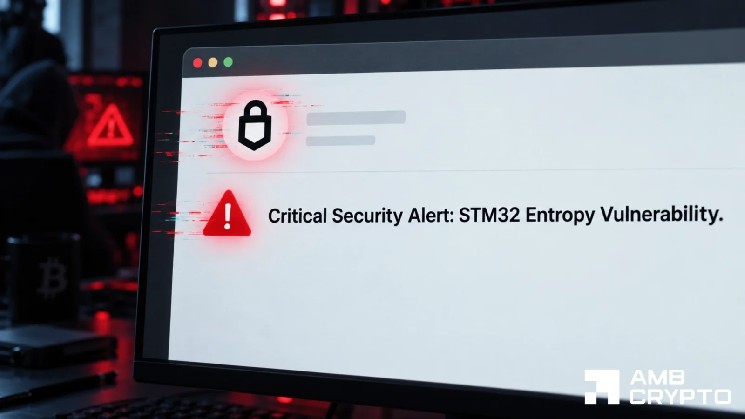
    Hardware wallet manufacturer Trezor has alerted users to a phishing campaign targeting its customers after attackers compromised a third-party email provider. The fraudulent message mimics a critical security advisory, attempting to lure recipients into revealing sensitive wallet information.

    Fake Security Alert Mimics Legitimate Warning

    The phishing email carries the subject line “Critical Security Alert: STM32 Entropy Vulnerability.” The message falsely claims a major security risk affects Trezor hardware wallets, creating urgency designed to pressure users into clicking malicious links. Those links direct victims to a website requesting confidential wallet details, including recovery seeds.

    Trezor confirmed the email is fraudulent in a public statement:

    The email…is not coming from us, and it’s a phishing attempt.

    Attackers Exploited Legitimate Domain

    The company has taken down the domain used in the campaign and is investigating how threat actors gained access. Because the emails originated from a genuine domain, they bypassed typical sender-verification checks, making the deception more convincing even for security-conscious users who routinely inspect sender addresses.

    Trezor has not disclosed the identity of the compromised email provider, the number of customers who received the malicious message, or whether any customer data was accessed during the breach. The firm also reports no cryptocurrency losses linked to this specific campaign.

    Separate Incident Involving Shipping Provider ShipMonk

    This email provider breach follows an earlier security incident involving Trezor’s shipping partner, ShipMonk. That breach exposed names, email addresses, phone numbers, and delivery addresses. Trezor later disclosed an additional 67,000 U.S. customers were affected.

    The company has not connected the two incidents or suggested the same threat actors are responsible for both.

    Recommended Actions for Affected Users

    • Do not click any links in the suspicious email.
    • Delete the message immediately.
    • Never enter your wallet recovery seed on any website or share it with anyone.

    Trezor continues to investigate the email provider breach and has pledged further updates as the investigation progresses.

  • Kraken Launches Editable Grid Bot with Backtesting on Desktop App

    Kraken Launches Editable Grid Bot with Backtesting on Desktop App

    Kraken has launched Smart Grid, an automated range-trading bot integrated directly into its Kraken Desktop application for eligible Pro users. The move places the exchange into a competitive grid-bot market, differentiating the tool through native desktop performance, robust backtesting, savable configurations, and the ability to adjust parameters while the strategy is running.

    Native Desktop Execution and Configuration

    Unlike browser-based alternatives, Smart Grid runs natively within the Kraken Desktop client, leveraging the same low-latency, low-memory architecture that powers the application itself. Eligible traders access the bot through the desktop interface rather than the web platform.

    Before deploying capital, users define the strategy by selecting an eligible trading pair, allocating an investment amount, and setting upper and lower price boundaries. Additional controls include the number of order levels and the spacing between them. Configurations can be saved for reuse or modified as market conditions shift.

    Backtesting Against Historical Data

    Grid strategies are designed for sideways or chopping markets; a sustained directional move can push the asset outside the configured range, halting the bot’s ability to execute buy and sell orders across its levels. To help traders evaluate this risk, Smart Grid includes a backtesting engine that simulates the chosen parameters against historical price data.

    The exchange emphasizes that backtesting shows how a configuration would have performed previously and does not predict future results.

    Live Parameter Editing and Risk Controls

    A key feature is the ability to edit the grid after activation. Traders can open the configuration panel, change settings, and apply revised parameters without stopping the bot or rebuilding the strategy from scratch.

    The product also includes live performance tracking, an overall grid stop-loss, and an option to enable or disable margin trading. Margin availability and stop-loss behavior may vary depending on the user’s account type and region.

    Part of a Broader Push for Active Traders

    The launch follows other 2026 initiatives targeting systematic and algorithmic traders. In April, Kraken promoted its API infrastructure for algorithmic strategies across spot and futures markets. In July, the exchange introduced Kraken Funded, a program allowing eligible users who pass a trading evaluation to access platform-provided capital.

    Not a Passive-Income Product

    According to Kraken’s announcement, “Smart Grid is not a passive-income product.” The company stresses that “Users remain responsible for selecting the price range, monitoring the strategy and adjusting its risk settings as market conditions change.”

  • Mastercard Launches Agent Connect for AI-Powered Commerce

    Mastercard Launches Agent Connect for AI-Powered Commerce

    Mastercard is expanding its payments infrastructure to support a new generation of AI-powered shopping experiences. The company introduced Agent Connect as merchants prepare for customers who rely on digital assistants to discover products.

    One Integration for AI Agents, Platforms, and Payment Providers

    The service gives businesses a single integration for connecting with AI agents, digital platforms, and payment providers. Mastercard also expanded its Agent Suite with tools designed to support product discovery, cart creation, and authorized purchases.

    New Tools Target Agent-Led Shopping

    Agent Connect lets AI agents guide shoppers through different stages of the buying process. However, Mastercard aims to keep merchants involved throughout that journey. Businesses can retain control over their brands, prices, and customer relationships.

    Additionally, Mastercard introduced Agent Pay to handle purchases initiated by AI agents. The system uses tokenized authorization to confirm a customer’s intent before completing transactions. Hence, agents cannot independently approve purchases without customer permission.

    Mastercard Builds Its AI Payment Strategy

    The rollout initially targets US consumers and includes partners such as Samsung and Trip.com. Brazilian digital services company Bemobi will also use the technology.

    Moreover, Mastercard already uses AI across roughly one-third of its services. Agent Connect extends that strategy into consumer payments. Consequently, the company is positioning secure authorization as a key requirement for agent-led commerce.