Category: Coins

Digital assets, cryptocurrencies, blockchain, and currency news.

  • Zcash Aims to Burn Fees, Recycle Them Into Miner Rewards

    Zcash Aims to Burn Fees, Recycle Them Into Miner Rewards

    Zcash Advances Network Sustainability Mechanism for NU7 Upgrade

    The Network Sustainability Mechanism (NSM) proposal is gaining momentum on the Zcash network as a core component of the upcoming NU7 upgrade. This protocol redesign removes a portion of $ZEC from active circulation through transaction fees and recycles that value into future validator rewards, marking a departure from the traditional token-burning model that permanently destroys digital assets.

    NSM Core Proposal: Solving the Security Budget Crisis

    The NSM proposal defines the deployment parameters for Zcash’s NU7 upgrade and has attracted support for addressing the network’s long-standing “security budget” crisis. By routing 60% of transaction fees into a secondary protocol reserve, the mechanism establishes a permanent capital pool designed to sustain block subsidies over time. This structure decouples network security from the volatility of daily fee markets, providing predictable funding for validators regardless of short-term demand fluctuations.

    Beyond economic stability, the upgrade positions $ZEC as a differentiated asset signaled for multi-decade durability. The proposal also lays technical groundwork for a potential future transition to a Proof-of-Stake (PoS) consensus algorithm, while satisfying community governance requirements without expanding the token supply.

    A Circular Strategy: Recycling Value Instead of Burning

    Zcash’s NSM introduces a multi-pronged approach to counter the long-term decline of block subsidies:

    • Value recycling replaces permanent token destruction with a reserve-and-redistribution model.
    • Issuance smoothing prevents hashrate shocks by storing fee revenue during high-traffic periods and releasing it gradually during extended bear markets.
    • Security decoupling insulates validator incentives from speculative fee volatility.

    Under this design, the protocol accumulates fees during network congestion and smoothly pays out the stored capital to validators when fee revenue drops, ensuring consistent security funding across market cycles.

    Hard Cap Preserved: No New Token Minting

    Despite the protocol alterations, Zcash’s maximum hard cap of 21 million $ZEC remains unchanged. The NSM does not authorize new coin creation. Instead, it withdraws already-minted $ZEC from active circulation into a reserve pool, temporarily reducing the circulating supply. Those same coins are then slowly re-issued to validators over time, maintaining the fixed supply ceiling while improving token velocity dynamics.

    Block Time Slashed to 25 Seconds for Faster Finality

    A complementary core decision approved alongside the NSM for NU7 reduces the target block time from 75 seconds to 25 seconds. This tripling of block production speed fundamentally transforms the network’s user experience and operational profile.

    Benefits for Exchanges, Merchants, and Wallets

    The faster block interval delivers several practical advantages:

    • Improved finality: Transactions reach irreversible confirmation significantly faster, helping exchanges and merchants mitigate chain reorganization risk.
    • Responsive wallet experience: Balance updates and transaction confirmations occur three times faster, reducing user anxiety during retail and peer-to-peer payments.
    • Modern network feel: The shift moves Zcash from a deliberate, slower transactional model to a highly responsive chain aligned with current user expectations for speed.

    Looking Ahead: NU7 as a Foundation for Long-Term Viability

    Together, the NSM’s economic redesign and the block time reduction form a cohesive upgrade package aimed at securing Zcash’s relevance for decades. By recycling fee value, preserving the hard cap, and accelerating throughput, the NU7 upgrade addresses structural challenges in security funding, tokenomics, and usability—positioning the protocol for a sustainable, competitive future.

  • Derive (DRV) Surges 40% Following v3 Upgrade Plan; Can It Maintain All-Time High?

    Derive (DRV) Surges 40% Following v3 Upgrade Plan; Can It Maintain All-Time High?

    Derive ($DRV) surged more than 40% over the last 24 hours while major assets such as Bitcoin (BTC) and Ethereum (ETH) traded in the red. Daily trading volume for the altcoin jumped over 463%, crossing $25 million at press time.

    Price Action and Key Technical Levels

    The token had been recovering from a 52% correction that followed its previous all-time high (ATH) of $0.19. An initial rally driven by the Upbit listing gave way to a bear phase lasting more than two months before the recent breakout.

    Market bulls have now pushed $DRV back toward the $0.19–$0.20 supply zone — the fourth test of this resistance area. The current leg up began on August 19, lifting the price from $0.09 to $0.20, and at one point printed a new ATH of $0.28 before settling around $0.24 at press time.

    Technical Indicators Favor Bulls on the 4-Hour Chart

    • Moving Averages: Price is trading above both the 100 and 200 EMAs, a classic bullish structure.
    • Bull Bear Power (BBP): The oscillator flipped green over the past three sessions, signaling strengthening buying pressure.

    However, a break below the $0.13 support zone could trigger a return to the correction phase. In that scenario, bullish reactions may be anticipated at $0.11 and $0.09.

    Fundamental Catalysts: V3 Upgrade, Buybacks, and Staking

    Investor enthusiasm has been sustained by a series of protocol-level developments:

    V3 Upgrade and OP Stack Wind-Down

    Derive posted its V3 plan on the project forum, triggering a 20% sentiment-driven rally. The upgrade will migrate custody to Ethereum mainnet and split risk books, enabling faster listings for real-world assets (RWAs) and additional altcoins. The existing OP Stack chain is being wound down as part of this transition.

    Fee-Fueled Buyback Program

    Protocol fees continue to feed $DRV buybacks, with 35% of fees allocated to repurchases. The 84th weekly buyback event acquired 199,760 $DRV at an average price of $0.14, bringing the cumulative total to 27.645 million tokens.

    Source: Derive Explorer

    Staking Locks Up Majority of Supply

    Over 67.63% of the circulating supply is currently held in the staked address, keeping available liquidity tight and supporting price stability during rallies.

    Outlook

    $DRV’s ability to sustain its breakout past the $0.19–$0.20 zone will depend on the interplay between these fundamentals — ongoing buybacks, high staking participation, and the V3 mainnet migration — and the technical structure on lower timeframes. A successful flip of the $0.19–$0.20 resistance into support could open the path toward further price discovery, while a rejection would likely see the altcoin retest the $0.13–$0.11 demand area.

  • US House Passes Bill to Make Data Centers Pay More of Their Grid Costs

    US House Passes Bill to Make Data Centers Pay More of Their Grid Costs

    The U.S. House of Representatives passed the Ratepayer Protection Act (H.R. 9340) on Wednesday by a vote of 417-3, marking the first congressional bill to address the economic impact of rapidly expanding data centers on the nation’s power grid.

    Federal Standard for Large-Load Cost Allocation

    The legislation establishes a federal standard requiring state utility regulators to consider whether “full incremental cost” should be recovered from large-load consumers for generation, transmission, or distribution upgrades necessary to serve them. The bill defines large-load consumers as entities consuming at least 100 megawatts of energy at a single location and mandates that these companies provide financial guarantees before utilities make infrastructure investments.

    While state authorities must adopt the regulation, they retain the right to reject it. Energy policy experts suggest this opt-out provision weakens the framework, though supporters argue it creates a federal benchmark without overriding state ratemaking authority.

    No Cap on Electricity Prices

    The Act does not restrict electricity prices or affect residential bills. Its primary focus is identifying which entities pay for infrastructure required to serve hyperscale data centers and AI compute facilities.

    Rep. Frank Pallone (D-N.J.), the ranking Democrat on the House Energy and Commerce Committee, called the measure “imperfect” and said it addressed only part of the problem, according to Politico. The bill now advances to the Senate for consideration.

    Industry Commitments and Regulatory Pressure

    The legislation follows President Donald Trump’s March 4 Ratepayer Protection Pledge. The Brookings Institution notes that Amazon, Google, Meta, Microsoft, OpenAI, Oracle, and xAI have committed to securing new power and covering delivery-infrastructure upgrades for their data centers. However, translating these voluntary commitments into enforceable protections remains dependent on state regulators and utilities.

    Record Demand Strains Grid Infrastructure

    Pressure on the grid is already measurable. The Energy Information Administration projects electricity sales will reach an all-time high of 4,135 billion kilowatt-hours in 2026, driven partly by data centers and industrial production, while residential prices hit 18.2 cents per kilowatt-hour.

    An ICF analysis published by Brookings suggests residential tariffs could surge 15% to 40% by 2030, with some potentially doubling by 2050. A University of California study estimates data centers may account for 11.8% of total U.S. electricity consumption by 2030.

    The Federal Energy Regulatory Commission has directed six regional grid operators to justify or reform large-load tariffs, including measures to prevent cost shifting and accelerate interconnection.

    Capacity Costs Skyrocket in Key Markets

    As previously reported by Cryptopolitan, PJM capacity costs surged approximately 1,038% compared to 2024 rates. An Ohio brick manufacturer’s monthly capacity fee jumped from $1,600 to $12,000. Data centers now drive roughly 40% of PJM’s unprecedented $16.4 billion capacity auction.

    Shifting Economics of AI Infrastructure

    PwC, using Oxford Economics modeling, estimates global data center investment will reach $2.5 trillion by 2030. The International Energy Agency identifies electricity supply and grid access as central constraints on AI expansion, while Boston Consulting Group says geography, financing, and compute costs increasingly shape AI economics.

    Requiring large-load customers to absorb more infrastructure costs could reduce cost shifting to households and businesses while raising upfront project expenses. Regions with abundant power, faster connections, and lower financing costs may gain a competitive edge in attracting the next wave of AI infrastructure investment.

  • Zcash Surges 23% as Bitcoin, Major Tokens Rally Despite Fed’s First Rate Hike Since 2023

    Zcash Surges 23% as Bitcoin, Major Tokens Rally Despite Fed’s First Rate Hike Since 2023

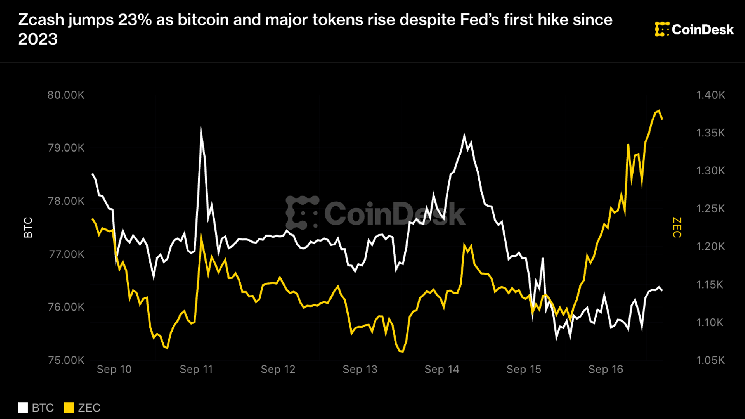
    Privacy-focused cryptocurrency Zcash (ZEC) surged 23% over the past 24 hours, leading gains across major digital assets as Bitcoin and the broader crypto market rallied overnight into Asian trading hours Thursday. The move coincided with a recovery in U.S. stock futures following the Federal Reserve’s first interest-rate increase since 2023.

    Market Snapshot: ZEC Leads, Bitcoin Holds Near $76K

    At the time of writing, ZEC traded near $1,369, significantly outperforming the market. Bitcoin edged up less than 1% to approximately $76,258, while Solana (SOL) gained nearly 3% to just below $100. BNB and HYPE, the native token of the crypto trading platform Hyperliquid, each added more than 2%. Ether (ETH), XRP, and Dogecoin (DOGE) posted gains between 1% and 2%.

    Paradigm Co-Founder Highlights Zcash as Bitcoin Privacy Complement

    The sharp rally in ZEC followed public comments from Matt Huang, co-founder of prominent crypto investment firm Paradigm. In a post on X, Huang discussed Zcash’s role as a privacy layer for Bitcoin and disclosed that his firm holds a position in the token.

    “a private complement to Bitcoin.”

    Huang, whose firm owns ZEC, described the protocol as “a private complement to Bitcoin.” He expressed support for continued funding of Zcash’s core developers while advocating that governance votes by coin holders should be combined with other decision-making mechanisms for network upgrades.

    Zcash Governance and Monetary Policy in Focus

    Zcash enables users to transact without publicly revealing sender, recipient, or transaction amounts. Its community recently backed proposals aimed at accelerating payment speeds while maintaining the protocol’s scheduled reductions in new coin issuance—a disinflationary feature shared with Bitcoin’s halving cycle.

    The convergence of positive macro tailwinds, high-profile institutional endorsement, and ongoing protocol improvements appears to be driving renewed investor interest in privacy-preserving digital assets.

  • Jupiter Token Falls 10% as $0.24 Support Breaks, Protocol Inflows Turn Negative

    Jupiter Token Falls 10% as $0.24 Support Breaks, Protocol Inflows Turn Negative

    Jupiter (JUP) suffered a sharp decline during the latest cryptocurrency sell-off as traders broadly reduced exposure to risk assets. The entire digital asset market came under heavy selling pressure, with most established coins recording significant losses.

    Jupiter Price Breaks Key Support

    Amid the bearish shift, JUP lost the $0.24 support level and fell to an intraday low of $0.20, dropping below its short-term 9-day and 21-day moving averages. At the time of writing, the token was trading near $0.21, down 10.2% on the daily chart. Trading volume rose 20% to $50 million over the same period, indicating heightened sell-side activity.

    Protocol Inflows Turn Negative

    Data from DefiLlama shows Jupiter’s USD inflows swung sharply negative, plummeting from $33 million to -$55 million. This reversal suggests a substantial outflow of capital from the network, confirming intense selling pressure.

    Derivatives Data Shows Reduced Exposure

    Futures market metrics from CoinGlass reinforce the risk-off narrative. Jupiter’s Open Interest declined 15% to $55.7 million, while derivatives volume fell 6% to $69 million. The drop in Open Interest signals that investors are actively closing positions and reducing leverage.

    Futures Netflows Signal Aggressive Panic

    According to CoinGlass, Jupiter futures recorded $16.8 million in outflows against $13.97 million in inflows. Netflows consequently collapsed 172% to -$2.8 million, a clear indicator of aggressive market panic and dominant bearish sentiment.

    Technical Outlook: Risk of Further Decline

    The TradingView Bulls vs. Bears indicator dropped to -49, reaching levels last seen in mid-August. A negative reading confirms that sellers have significantly outweighed buyers. If selling pressure persists and sentiment remains risk-averse, JUP could breach the $0.20 support and target $0.19. To invalidate this bearish structure, the price must close back above the short-term moving averages near $0.23.

    Summary

    • JUP declined 10%, breaking $0.24 support to hit a low of $0.20.
    • The drop was driven by strong selling pressure after sentiment turned risk-off, prompting investors to reduce exposure.
    • On-chain and derivatives data confirm capital outflows, falling Open Interest, and negative futures netflows.
    • Technical indicators remain bearish; a close above $0.23 is needed to shift the short-term outlook.
  • Crypto VC funding hits $5.68B in Q2, Galaxy says

    Crypto VC funding hits $5.68B in Q2, Galaxy says

    Venture investment in crypto and blockchain companies surged 31% in the second quarter of 2026 compared to the first quarter, while deal volume rose 10%, according to a September 16 report from Galaxy Research. The rebound pushed total first-half investment to $10.018 billion across 744 deals, putting the industry on pace for roughly $20.037 billion for the full year — slightly below the $20.3 billion recorded in 2025.

    Q2 Rebound Driven by Later-Stage Financing

    The second quarter saw $5.683 billion deployed across 384 deals, a sharp recovery from Q1 when startups received around $4 billion across 355 deals. Galaxy’s Q1 report showed capital falling by about half quarter-over-quarter after a large later-stage financing surge in late 2025.

    The Q2 rebound was larger in dollar terms than in transaction volume. Capital increased 31% while deal count rose only 10%, indicating that larger financings accounted for much of the quarterly increase. Galaxy said the rise was driven primarily by later-stage transactions, with mature companies receiving approximately 78% of the capital invested during the quarter.

    Deal Sizes Reach New Highs

    Galaxy reported a median crypto deal size of roughly $4.9 million in Q2, a new high. However, valuation information was available for only 16% of Q2 transactions and was heavily weighted toward later-stage companies.

    By transaction count, pre-seed rounds accounted for 21% of completed deals, while later-stage investments represented 26%. This distribution produced a large gap between the number of early-stage transactions and the amount of capital committed to mature companies. Early-stage businesses continued to attract deals, but larger financing rounds drove the majority of dollars invested.

    Trading and Exchange Category Dominates Capital Allocation

    Trading, exchange, investing and lending companies received roughly $3.523 billion during the quarter, representing close to three-fifths of all crypto venture capital invested in Q2. DeFi followed with approximately $478 million. More than 90% of the capital invested in the trading, exchange, investing and lending category went to later-stage companies.

    By deal count, trading, exchange, investing and lending companies recorded 51 transactions. DeFi and payments/rewards each recorded 40 deals. Web3, NFT, DAO, metaverse and gaming companies completed 37 deals, followed by tokenization with 36, enterprise blockchain with 34, and infrastructure with 32.

    Bitcoin Price Correlation Remains Weak

    Galaxy’s data shows that the relationship between bitcoin prices and crypto venture activity remains weaker than during the 2017 and 2021 cycles. Bitcoin reached new highs in late 2025 while venture activity moved unevenly, although both bitcoin and venture investment increased during Q2 2026.

    U.S. Companies Capture Lion’s Share of Capital

    U.S.-headquartered companies captured 73.5% of the capital represented in Galaxy’s Q2 dataset. The United Kingdom followed with 4%, while France accounted for 3.2%. The U.S. share was smaller when measured by transaction count: American companies represented 39.1% of the 384 deals, followed by the United Kingdom at 7% and Singapore at 5.7%.

    The geographic concentration was higher than in Q1, when U.S.-based startups received 70.2% of capital and represented 43.5% of completed transactions, according to Galaxy’s earlier report.

    Recent Notable Financing Activity

    Recent financing activity has included transactions involving exchanges, stablecoin payments, and tokenized markets. Payward, the parent company of Kraken, was the largest disclosed crypto funding deal during the September 5–11 period after Nasdaq Ventures agreed to invest $100 million in the company. Latitude raised $35 million in a Series A during the same week to develop stablecoin-based cross-border payment infrastructure, while Antarctic Exchange announced a $7 million financing tied to its derivatives trading platform.

    Fundraising Concentrated Among Fewer New Funds

    Five new crypto-focused funds raised approximately $3.9 billion in Q2, according to Galaxy. The firm said the number of new funds was the lowest for a quarter since Q3 2019. Galaxy cited macroeconomic conditions, investor interest in artificial intelligence, spot crypto exchange-traded products, and digital asset treasury companies as factors competing for allocator capital.

    The report stated that “fund managers still face a difficult environment.”

    The dollar amount raised was higher than the roughly $1.1 billion secured across eight new funds in Q1. Galaxy’s first-quarter report described Q1 as the lowest quarterly new-fund count since Q3 2020. If first-half fundraising continues at the same pace, Galaxy estimates that crypto venture funds could raise around $10 billion during 2026, above the $8.75 billion raised in 2025. The average fund size reached approximately $377.98 million, while the median fund size stood near $80 million.

    Weekly Activity Shows Continued Momentum

    During September 5–11, five disclosed crypto funding deals totaled $151 million, according to crypto.news. Payward’s $100 million transaction accounted for roughly two-thirds of the weekly total. Galaxy’s next quarterly dataset will provide the next measurement of venture activity after the Q2 rebound.

  • Deutsche Bank Bets Big on Digital Assets, Potentially Reshaping European Crypto

    Deutsche Bank Bets Big on Digital Assets, Potentially Reshaping European Crypto

    Deutsche Bank Prepares Digital Asset Custody Launch for European Institutions

    Deutsche Bank is advancing into digital assets with plans to offer custody services to institutional and corporate clients across Europe later this year. The bank will hold wallets and private keys, enabling clients to safeguard and transfer Bitcoin (BTC), Ether (ETH), USD Coin (USDC), EURC, and EURAU without building their own custody infrastructure.

    Banking Framework for Digital Asset Access

    The service aims to place digital assets within a regulated banking framework, incorporating key protections such as private key storage, wallet control, and transaction approval controls. This approach could provide European institutions an easier entry point into crypto markets through existing banking relationships. While the initial asset list remains limited, tokenized financial instruments are expected to follow at a later stage.

    Regulatory approval remains a prerequisite between the announcement and launch, making the approval process and subsequent adoption critical developments to monitor.

    Regulated Custody Demand Driven by Institutional Allocation Trends

    Institutional interest has shifted beyond simple investment exposure to focus on regulated access mechanisms. According to a 2026 Coinbase-EY survey of over 350 decision-makers, 73% plan to increase allocations to digital assets. Within that study, 81% preferred spot exposure through registered vehicles such as ETFs and ETPs.

    This preference creates strong demand for regulated custody providers. Although hundreds of European-based MiCA-authorized cryptocurrency companies currently operate, very few major banks function as custodians. Deutsche Bank can therefore bridge crypto custody with established banking relationships across Europe, targeting asset managers, hedge funds, brokers, corporations, and sovereign institutions.

    Stablecoins Could Transform Custody into Recurring Settlement Channel

    Stablecoins have the potential to evolve Deutsche Bank’s custody service from a static storage product into an active settlement rail. USDC currently maintains approximately $74 billion in circulation, according to DeFiLlama data, demonstrating deep existing demand.

    EURC provides institutions a euro-denominated alternative within the same custody framework. Together, these stablecoins could support treasury transfers, business payments, and cross-border settlements alongside basic asset storage. If repeated transfers materialize, the activity would generate transaction flows beyond passive custody.

    Tokenized Assets May Extend Financial Rail Functionality

    Future addition of tokenized assets could further expand the service’s utility. Purchases, redemptions, and transfers of tokenized instruments would create additional flow opportunities. Consequently, stablecoins and tokenization combined could position a custody service provider as an active financial rail for institutional clients.

  • Bitcoin Absorbs Fed Rate Hike as Officials Anticipate Further Tightening

    Bitcoin Absorbs Fed Rate Hike as Officials Anticipate Further Tightening

    Bitcoin maintained its position near pre-announcement levels around $76,000 on Wednesday, showing minimal immediate reaction to the U.S. Federal Reserve’s decision to raise its benchmark interest rate for the first time since 2023.

    Fed Raises Rates by 25 Basis Points

    The Federal Open Market Committee voted unanimously to increase rates by 25 basis points, setting a new target range of 3.75% to 4%. This move, typically associated with pressure on stocks and risk assets, came as the central bank continues to address persistently high inflation.

    At the time of writing, Bitcoin was trading at $76,663, representing a 1.35% gain over the previous 24 hours.

    Market Reaction Largely Anticipated

    Cooper Duschang, research analyst at Talos, noted in comments shared with Cointelegraph:

    “The initial reaction suggests the Fed’s decision was largely anticipated by crypto markets. Bitcoin has remained relatively resilient, holding broadly around pre-announcement levels even as equities moved lower.”

    Equities Decline While Bitcoin Holds

    U.S. stocks slipped on Wednesday following the rate decision. Crypto analysts caution that Bitcoin’s current resilience could face fresh tests if the Fed implements additional rate hikes before year-end.

    During the FOMC press conference, Fed Chair Kevin Warsh stated that inflation remains too high while the U.S. economy shows signs of strengthening. Updated economic projections indicate a majority of officials anticipate at least one more rate increase before the end of the year.

    16 out of 18 FOMC participants expected another rate increase this year. Source: US Federal Reserve

    Andrew Melville, head of research at Block Scholes, characterized a potential additional increase as a “more hawkish surprise than today’s 25bp hike.”

    Derivatives and Spot Markets Show Divergence

    While Bitcoin’s spot price remained stable, Duschang highlighted significant activity beneath the surface:

    “Perpetual futures have shifted towards net selling, led by approximately $82 million in Bitcoin and $68 million in Ether over the past hour. In contrast, Bitcoin recorded around $15.5 million of net spot buying, suggesting spot demand is absorbing some of the selling pressure coming through derivatives.”

    Duschang also pointed to notable exchange flows, with approximately 2,170 Bitcoin moving onto exchanges following the rate announcement, followed by a withdrawal of 1,260 Bitcoin.

    “Rather than a uniform risk-off response, investors appear to be actively repositioning as they digest the Fed’s message. The key question now is whether Bitcoin’s resilience and spot demand hold as attention shifts from today’s widely anticipated hike to the prospect of further tightening.”

    Analysts Warn of Repricing Risk

    Martin Lee, market insights lead at DWF Labs, warned that the Fed’s renewed “hawkish stance” of “higher for longer” rates would lead to risk-on assets “repricing this new reality.”

    Related: Bitcoin awaits Fed rate decision below $76K as analysis discounts ‘dovish surprise’ odds

    Magazine: HYPE price could suffer as Binance takes its revenue: Alice Liu

  • CLARITY Act Update After Failure: SEC Chair Breaks Silence, Says ‘Stay Tuned’

    CLARITY Act Update After Failure: SEC Chair Breaks Silence, Says ‘Stay Tuned’

    SEC Chairman Paul Atkins expressed gratitude to stakeholders across the administration, Congress, investors, and innovators who have advanced the CLARITY Act, while confirming the agency will proceed with regulatory action regardless of the legislation’s fate.

    “I have been unequivocal: with or without legislation, we will act decisively within the SEC’s statutory authority to deliver certainty for American investors and for the entrepreneurs shaping our technological future,” Atkins said. “Stay tuned.”

    A Pattern of Agency-Level Action

    Atkins’ remarks followed a separate announcement outlining the SEC’s latest regulatory proposals, which he characterized as reflecting a focus on keeping Commission rules within the agency’s statutory authority while aligning with current and anticipated market practices.

    The SEC proposed rescinding Rule 14a-8, arguing the rule exceeds the agency’s statutory scope and intrudes into matters of state law. The Commission also proposed amendments to Rule 14a-4(c), aimed at giving companies more flexibility and shareholders greater control over proposals eligible for discretionary proxy voting authority.

    House Advances Crypto Tax Legislation

    Separately, the House Ways and Means Committee advanced the Digital Asset Tax Certainty Act in a 38-5 vote. The bill would ease tax treatment for small cryptocurrency transactions, clarify how stablecoins are handled, and address rules governing mining, staking, and wash sales. The legislation still requires full House approval before moving to the Senate.

    The proposed legislation would eliminate capital gains tax on crypto transactions and network fees under $10, with certain exceptions, and also covers staking, mining, tokenized assets, wash sales, and rules for crypto brokers.

    Strategic Bitcoin Reserve Bill Under Consideration

    Alongside the tax bill, lawmakers are also considering the Strategic Bitcoin Reserve Bill, which would lock up the roughly $25 billion in Bitcoin currently held by the U.S. government for a period of 20 years.

    Shifting Legislative Momentum

    With the CLARITY Act stalled in the Senate, momentum in Washington has shifted toward narrower, more targeted measures. The current approach combines agency rulemaking from the SEC on one front with House-level tax and reserve legislation on the other, rather than pursuing the comprehensive market structure framework the CLARITY Act was designed to deliver.

  • Ethereum Client Diversity Fractures Under Incompatible Estimates

    Ethereum Client Diversity Fractures Under Incompatible Estimates

    Ethereum’s consensus layer relies on a diverse set of independently built clients to maintain network safety. If a critical bug affects a client controlling too much of the network, the chain could stop finalizing blocks or, in a worst-case scenario, finalize an incorrect chain. However, a snapshot from September 16 revealed that the industry’s primary client-diversity dashboard displayed three contradictory estimates for the leading client’s market share, highlighting the fragility of current measurement methods.

    Conflicting Data from Major Tracking Tools

    The clientdiversity.org dashboard presented three incompatible readings for the same moment in time. Blockprint estimated Teku held a 99.83% share, Miga Labs placed Lighthouse at 51.32%, and Rated Network estimated Teku at 53.86%. These discrepancies arise because each tool uses a fundamentally different proxy to infer client usage, and at least one of those proxies has been rendered obsolete by a recent protocol upgrade.

    Why Accurate Measurement Is Critical for Network Safety

    Ethereum.org’s official guidance defines two distinct failure thresholds tied to client concentration. A bug in a client used by more than one-third of validators can halt finality—a liveness failure that prevents users from treating transactions as irreversible. A critical bug in a client controlling a two-thirds supermajority could cause an incorrect chain to finalize, a safety failure that risks slashing validators or forcing an expensive exit-and-re-entry process.

    While public guidance often uses node count as a shorthand, researchers emphasize that consensus risk depends on the distribution of voting weight across validators, not merely the number of visible machines. The September snapshot failed to provide a clean, stake-weighted answer.

    Three Methodologies, Three Blind Spots

    Blockprint: A Defunct Fingerprint

    Blockprint identifies clients by analyzing block proposal patterns. However, Sigma Prime, the project’s developer, has archived the repository and explicitly stated the classifier is no longer accurate following Ethereum’s Electra upgrade, labeling the project defunct. Despite this, clientdiversity.org continued to label the Blockprint panel as “updated daily.”

    Miga Labs: Peer Discovery Gaps

    Miga’s Ant crawler discovers peers on the peer-to-peer network and requests client metadata directly. This method faces coverage limitations from firewalls, refused connections, discovery gaps, and rotating peer IDs. Crucially, a single node can serve many validators, meaning a sample of nodes does not reveal the amount of stake backing each observation.

    Rated Network: The Operator Attribution Problem

    Rated groups validator keys by deposit address for operator-level analysis, then maps those groups to real-world entities using transaction research, block graffiti, and voluntary disclosures. Rated acknowledges there is no standard method for this higher-order mapping. This attribution layer is distinct from the client estimate shown on the dashboard, but it demonstrates how deeply concentration analysis depends on persistent public links between keys, operators, and entities.

    Concentration Is Not Interchangeable

    Client concentration, operator concentration, and stake concentration are related but distinct metrics. A large operator can diversify across multiple clients, while nominally separate validators may share a single operator, hosting provider, or software stack. Treating these as equivalent obscures the true risk profile.

    Ethereum’s Lean Privacy Proposal Redraws the Map

    A July research post by Vitalik Buterin outlines a “Lean” privacy phase that would fundamentally alter what observers can measure. The proposal moves per-validator accounting into zero-knowledge proofs (ZK-STARKs). Under this design, the active validator registry would be rebuilt daily using fresh keys, eliminating long-term validator indices. Deposits would use hiding commitments to sever the public link between a withdrawal address and prior validator activity, achieving what Buterin describes as “strong validator anonymity.”

    Buterin acknowledged a tension: privacy can hide centralization, though he suggested large operations might still leak enough aggregate data to remain identifiable. The broader Ethereum privacy roadmap lists several such protocol changes as active work or candidates, noting the roadmap is unfinished and subject to change.

    Daily Key Rotation Disrupts Existing Surveillance

    Daily key changes would break measurement methods that assume a validator can be tracked over time. Hiding deposit and withdrawal links would erode the deposit-address grouping used in operator attribution. While Miga’s peer-based crawler and behavioral block classifiers do not rely solely on long-lived keys, new protocol and client behaviors could degrade their signal reliability. Blockprint’s failure post-Electra serves as a precedent: a protocol change can instantly invalidate a fingerprinting heuristic.

    Network Traces Reveal Hosting Risks

    A 2025 USENIX study demonstrated that four observer nodes located over 15% of Ethereum validators in the P2P network during a three-day measurement. This proves network traces can expose hosting concentration, but it also underscores why preserving those traces creates privacy and targeting risks.

    The Path to Authenticated, Private Aggregate Reporting

    A research path exists for publishing aggregate client shares without revealing individual choices, but it has not yet solved the authentication problem. A Nethermind research project explored private voting for client reporting, where validators encrypt their client choice, prove ballot validity, and allow a set of authorities to decrypt only the aggregate. The design evaluated homomorphic encryption, distributed key generation, and zero-knowledge proofs.

    An IETF research draft on verifiable distributed aggregation describes cryptographic primitives for private sums, histograms, groupings, and heavy hitters. These tools can validate the structure of a submitted measurement while hiding the individual input.

    Unresolved Design Questions

    Complexity increases with multiplexed setups and distributed validators, which may use more than one consensus or execution client simultaneously, making an honest report more complex than a single label. Nethermind identifies sampling, fake data resistance, software attestation, decryption authority selection, and performance as unresolved challenges.

    Even if private client aggregate reporting succeeds, it could show a client crossing a warning threshold without revealing individual validators, yet still miss a scenario where one entity controls many unrelated keys. Client share and operator share require separate, authenticated measurements. Neither the Lean proposal nor current private-reporting research specifies a complete system for operator-concentration transparency.

    Measurement Must Be Designed Into Privacy

    Ethereum can enhance validator privacy without abandoning its client-diversity safety discipline, but measurement must become an explicit component of the privacy design. This requires stake-authenticated reporting, verifiable aggregation, published uncertainty intervals, and distinct treatment of client, operator, and stake concentration. Daily re-anonymization will expose how much the current picture depends on incompatible estimates and public traces that privacy research intends to remove.