Category: Coins

Digital assets, cryptocurrencies, blockchain, and currency news.

  • Coinbase Surpasses $1 Billion in DEX Trading Volume for Tokenized

    Coinbase Surpasses $1 Billion in DEX Trading Volume for Tokenized

    Key Highlights

    • Coinbase tokenized stocks surpassed $1 billion in decentralized exchange trading volume within their first month on the Base layer-2 network.
    • The milestone generates transaction fees for Base and creates future revenue pathways through securities lending and a share of DEX trading fees, according to Token Terminal.
    • Regulatory acceptance in the U.S. is enabling traditional equities to intersect with DeFi, offering enhanced liquidity and accessibility for retail and institutional investors.

    Coinbase Tokenized Stocks Hit $1 Billion DEX Volume Milestone on Base

    Coinbase has reached a significant milestone as its tokenized stock offerings surpassed $1 billion in decentralized exchange (DEX) trading volume during their inaugural month on the Base platform. The achievement marks a notable convergence of traditional equity markets with decentralized finance infrastructure, demonstrating tangible demand for on-chain representations of real-world assets. According to blockchain analytics commentator Token Terminal, this activity not only produces immediate transaction fee revenue for the Base network but also establishes a foundation for future income streams, including securities lending programs and a proportional share of ongoing DEX trading fees.

    Market Dynamics Drive Adoption of Tokenized Equities

    The surge in trading volume reflects a broader shift among market participants toward alternative investment vehicles within the cryptocurrency ecosystem. As traders navigate mixed signals across the wider digital asset market, the robust performance of Coinbase’s tokenized stocks has distinguished itself as a focal point for capital allocation. This movement suggests a growing appetite for products that bridge conventional financial instruments with the composability and settlement efficiency of blockchain rails. By offering tokenized versions of established equities, Coinbase is providing investors with enhanced liquidity profiles, fractional ownership capabilities, and 24/7 market access—features that address longstanding limitations of traditional securities infrastructure.

    Regulatory Tailwinds Support Product Expansion

    Coinbase, recognized as a leading United States-based cryptocurrency exchange providing trading, staking, and now tokenized asset services, operates within a regulatory environment that has progressively signaled greater openness to tokenized securities. This evolving framework has created a strategic window for the company to introduce innovative products that cater to a diverse investor base spanning retail participants and institutional allocators. The compliance-forward approach positions Coinbase to capitalize on rising demand for regulated digital asset exposure while mitigating jurisdictional uncertainty that has constrained similar initiatives in prior market cycles.

    Why This Matters: The Convergence of TradFi and DeFi

    The $1 billion volume milestone represents more than a single product success—it signals a structural inflection point in how traditional financial assets are distributed, traded, and settled. Tokenized stocks on Base exemplify the practical application of blockchain technology to solve real-world market structure inefficiencies, including T+2 settlement delays, limited after-hours liquidity, and high barriers to fractional investing. For Base, the fee revenue and potential securities lending yield create a sustainable economic model that incentivizes further asset onboarding. For the broader industry, Coinbase’s execution validates the thesis that regulated entities can successfully deploy DeFi primitives for mainstream financial products, potentially accelerating adoption by asset managers, broker-dealers, and custody providers who have awaited proof of concept at scale.

    Frequently Asked Questions

    What are Coinbase tokenized stocks and how do they work on Base?

    Coinbase tokenized stocks are blockchain-based representations of traditional equity shares, issued and backed 1:1 by the underlying securities held in custody. On Base, Coinbase’s Ethereum layer-2 network, these tokens can be traded on decentralized exchanges with near-instant settlement, fractional denominations, and continuous market hours, while maintaining regulatory compliance through Coinbase’s licensed framework.

    What revenue opportunities does this create for the Base ecosystem?

    Beyond immediate transaction fees generated from DEX trading activity, Token Terminal notes that the protocol can derive ongoing revenue from securities lending programs—where tokenized shares are lent to market makers or short sellers—and from a share of DEX trading fees captured through Base’s sequencer and fee-switch mechanisms.

    What should traders monitor going forward?

    Market participants should track sustained trading volume trends, user engagement metrics on Base, the rollout of securities lending functionality, and any regulatory developments from the SEC or CFTC that could affect the issuance, trading, or custody of tokenized securities in the United States.

  • Decentralized Finance Surges as Tokenized Stocks Gain Traction

    Decentralized Finance Surges as Tokenized Stocks Gain Traction

    Key Highlights

    • Token Terminal identifies real-world asset (RWA) strategies as a critical growth driver for DeFi, with platforms attracting tokenized stock deposits positioned for significant gains.
    • The tokenized stocks market capitalization has reached $2.5 billion, with BNB Chain commanding a dominant market share and Aave leading in tokenized gold capture.
    • As global equities transition on-chain, institutional interest is expected to deepen liquidity and expand lending, borrowing, and trading opportunities across DeFi venues.

    Token Terminal Spotlights RWA Strategies as DeFi Growth Catalyst

    Token Terminal, a prominent data and analytics platform specializing in decentralized finance, has underscored the rising effectiveness of real-world asset (RWA) strategies in attracting tokenized stock deposits. The analysis arrives at a pivotal moment for the sector, suggesting that DeFi venues capable of onboarding tokenized equities stand to capture substantial value as traditional financial markets migrate on-chain. This shift promises to unlock new lending, borrowing, and trading primitives, potentially reshaping the competitive dynamics of the digital asset ecosystem.

    Market Leadership Emerges in Tokenized Asset Verticals

    Current market data reveals a maturing competitive landscape across tokenized asset categories. BNB Chain has established a commanding position in the tokenized stocks vertical, which recently surpassed a $2.5 billion market capitalization. Meanwhile, Aave has emerged as the dominant venue for tokenized gold, capturing significant market share in the commodity-backed token segment. These developments signal that specialized liquidity hubs are forming around distinct asset classes, a trend that could accelerate as institutional infrastructure improves.

    Institutional On-Ramp Fuels Structural Shift

    The broader crypto market continues to exhibit mixed momentum, yet the structural narrative around RWA integration remains robust. Token Terminal’s insights highlight that the effectiveness of these strategies will directly influence trading volumes and liquidity depth across DeFi protocols. As institutional participants increasingly explore on-chain equivalents of traditional securities, the flow of global equities into decentralized venues is poised to become a primary driver of next-phase growth. Market observers note that monitoring platform-level adaptation to tokenized asset demand will be critical for anticipating liquidity migrations and yield opportunities.

    Why This Matters

    The convergence of traditional equity markets with DeFi infrastructure represents one of the most significant structural shifts in digital finance since the advent of stablecoins. By enabling fractional, programmable, and composable representations of real-world assets, RWA protocols address longstanding barriers to institutional adoption—including settlement inefficiency, opaque custody chains, and limited interoperability. The $2.5 billion milestone in tokenized stocks, while modest relative to global equity markets, validates product-market fit and suggests a scalable trajectory. As regulatory clarity improves and custodial solutions mature, the tokenization flywheel could accelerate rapidly, positioning early-mover platforms like BNB Chain and Aave as foundational layers for the on-chain economy.

    Frequently Asked Questions

    What is Token Terminal’s role in the RWA analysis?

    Token Terminal serves as a data and analytics platform focused on the decentralized finance sector. Their research identifies which RWA strategies are proving effective at attracting tokenized stock deposits, providing market participants with clarity on integration trends between traditional asset classes and DeFi protocols.

    Which platforms currently lead in tokenized asset market share?

    BNB Chain commands a significant share of the tokenized stocks market, while Aave leads in tokenized gold market capture. These platforms have established early liquidity advantages in their respective verticals as the tokenized assets sector surpasses $2.5 billion in market capitalization for tokenized equities alone.

    How might institutional interest change DeFi market dynamics?

    Increased institutional participation is expected to enhance liquidity depth and trading volumes across DeFi venues. As global equities transition on-chain, platforms with effective RWA strategies will likely see expanded lending, borrowing, and trading activity, potentially shifting the competitive hierarchy toward protocols that successfully bridge traditional finance infrastructure with decentralized rails.

  • WIF Price Prediction: Pullback Likely Despite 13% Surge, Analysts Say

    WIF Price Prediction: Pullback Likely Despite 13% Surge, Analysts Say

    Key Highlights

    • dogwifhat ($WIF) surged 13.14% in 24 hours as capital rotated into Solana memecoins, with trading volume jumping 95.16% to $105.8 million.
    • The rally stalled at the $0.2157 resistance level, where RSI bearish convergence at 62.85 signaled potential price rejection.
    • Spot market data shows seller dominance (90-day Spot Taker CVD), while rising open interest ($85.12M) creates leverage-driven downside risk.

    Capital Rotation Fuels $WIF Rally Amid Solana Memecoin Momentum

    Solana’s memecoin sector captured renewed trader attention over the past 24 hours, posting a near 6% collective gain as speculative capital rotated toward higher-risk ecosystem tokens. dogwifhat ($WIF) emerged as a primary beneficiary, recording a 13.14% daily price increase alongside a dramatic 95.16% surge in trading volume to $105.8 million. The volume expansion suggests heightened participation, though analysts caution that increased activity alone does not confirm sustainable buying pressure.

    Technical Resistance at $0.2157 Halts Recovery Attempt

    On the daily chart, $WIF rebounded from the $0.1758 region toward $0.2157 but failed to breach this overhead barrier. Notably, the barrier capped previous recovery attempts, making another price rejection significant for the short-term structure. More importantly, the RSI indicator formed a bearish convergence around the 62.85-zone as the price met rejection. Each recent RSI approach towards this threshold zone aligned with $WIF hitting the upper range, before a subsequent price retreat. At the time of writing, the RSI stood at 58.82, after retreating from the higher 62.85-zone. The repeated convergence between the indicator’s RSI resistance and price pullbacks could strengthen the possibility of a price correction.

    Spot Market Data Reveals Seller Dominance Despite Volume Spike

    $WIF’s resistance struggle alone did not confirm the pullback case though. In fact, the token’s Spot activity and derivatives positioning showed why selling pressure could gain greater influence after the price rally. According to CryptoQuant, $WIF’s Spot Volume Bubble Map highlighted intensified activity as traders increasingly participated in the recent move. Also, the 90-day Spot Taker CVD indicator read seller-dominant after the sharp hike in trading activity. This meant that at press time, aggressive sellers had taken control of the Spot executions as $WIF struggled to keep its rally alive. This imbalance weakened the rally as the trading expanding activity failed to translate into stronger taker-buy demand. Rather, the hike in participation activity coincided with selling as $WIF faced a significant technical barrier. Sustained seller dominance could therefore restrict fresh upside and increase pressure on traders who entered during the rally.

    Rising Leverage Adds Downside Risk Through Derivatives Exposure

    Finally, the memecoin’s derivatives market also added another layer of concern as leveraged exposure expanded during the price hike. According to CoinGlass, the Open interest climbed by 11.10% to $85.12 million, suggesting that traders added positions alongside the price recovery. Meanwhile, Binance top traders maintained a clear bullish bias despite weakening from previous positioning extremes. Specifically, the long accounts represented 60.52% against the shorts at 39.48%, producing a Long/Short Ratio of 1.53. Thus, this sizeable share of leveraged positioning remains exposed to a reversal as Spot sellers control activity. The developing price correction could pressure these longs and trigger position closures. Eventually, such unwinding would create additional selling pressure, potentially accelerating a pullback that initially began in the Spot market.

    Why This Matters

    The $WIF price action illustrates a recurring dynamic in the Solana memecoin ecosystem: rapid, volume-driven rallies that encounter structural resistance and deteriorating spot market internals. The divergence between rising participation (volume, open interest) and seller-dominant taker flow suggests that new entrants may be providing exit liquidity for earlier positions rather than establishing sustainable bullish trends. With $85.12 million in open interest and a 1.53 long/short ratio on Binance, the derivatives market carries significant liquidation risk if spot sellers maintain control. For traders and analysts monitoring Solana’s memecoin sector, the $0.2157 resistance level and the 62.85 RSI convergence zone serve as critical reference points for assessing whether the current rotation represents a durable trend shift or a liquidity-driven bounce vulnerable to leverage unwinding.

    Frequently Asked Questions

    What caused dogwifhat’s 13% price increase in the last 24 hours?

    Capital rotation into Solana memecoins drove a sector-wide gain of nearly 6%, with $WIF capturing outsized inflows that pushed trading volume up 95.16% to $105.8 million.

    Why did the $WIF rally stall near $0.2157?

    The $0.2157 level has repeatedly capped previous recovery attempts. Technical analysis shows RSI bearish convergence at the 62.85 zone aligning with each price rejection, signaling weakening momentum at this resistance.

    What risk does rising open interest pose for $WIF holders?

    Open interest climbed 11.10% to $85.12 million during the rally, with Binance top traders holding a 1.53 long/short ratio. If spot sellers maintain control and price corrects, leveraged long positions face liquidation risk that could accelerate selling pressure.

  • Visa Tightens Memecoin Card Rules After Digital-Media Classification

    Visa Tightens Memecoin Card Rules After Digital-Media Classification

    Key Highlights

    • Visa is directing payment processors to stop using merchant category code 5815 (digital media) for memecoin purchases and instead apply cryptocurrency-related classifications.
    • JPMorgan Chase flagged at least one Visa transaction for incorrect coding, and the New York Attorney General’s Office is reviewing the issue.
    • The reclassification does not prohibit card-based memecoin purchases but may affect how card rewards are applied to such transactions.

    Visa Cracks Down on Memecoin Transaction Coding

    Visa is moving to tighten how memecoin purchases are classified across its network after scrutiny revealed that some card transactions were being processed under a digital-media merchant category code typically reserved for goods such as movies and audiobooks. The change follows test purchases made through Robinhood Wallet and Fomo using Visa and Mastercard cards via Apple Pay and Google Pay, which were processed by Crossmint and received merchant category code 5815. That code covers digital goods, whereas cryptocurrency purchases traditionally fall under separate merchant codes that determine how card issuers handle transactions, including rewards eligibility and risk controls.

    Issuer and Regulatory Scrutiny Prompts Action

    The misclassification drew immediate pushback from major financial institutions and regulators. JPMorgan Chase challenged the coding of at least one Visa transaction, stating it carried the wrong merchant category code and confirming it had opened a case with Visa. Simultaneously, the New York Attorney General’s Office said it was reviewing the issue. In response, Visa has reportedly instructed payment processors, including Checkout.com, to cease using the digital-media category for memecoin purchases and has given them until next week to update their systems to reflect cryptocurrency-related classifications.

    SEC Guidance Does Not Govern Card Network Rules

    Crossmint had cited a 2025 U.S. Securities and Exchange Commission staff statement on memecoins in connection with the transactions. However, that guidance pertains to securities law classification and does not determine how card networks categorize transactions for processing, rewards, or compliance purposes. Visa’s directive addresses the payment-network layer specifically, ensuring that memecoin purchases are routed through the appropriate merchant codes used for other cryptocurrency transactions.

    Why This Matters

    The reclassification carries practical consequences for consumers and the broader crypto payments ecosystem. Merchant category codes influence whether a transaction qualifies for standard credit card rewards—such as cash back on digital media—or is excluded, as many issuers treat cryptocurrency purchases differently. By aligning memecoin coding with established cryptocurrency categories, Visa closes a loophole that could have allowed purchasers to earn rewards unintended for digital-asset acquisitions. The move also signals that card networks and issuers are actively monitoring the intersection of consumer payments and emerging token types, especially as wallets like Robinhood Wallet and apps like Fomo expand access to memecoins through familiar checkout rails like Apple Pay and Google Pay. Regulatory attention from the New York Attorney General underscores that compliance scrutiny extends beyond securities law into consumer-protection and payment-network integrity.

    Frequently Asked Questions

    Does Visa’s change ban buying memecoins with a credit or debit card?

    No. Visa’s directive does not prohibit card-based memecoin purchases. It requires that such transactions be classified under cryptocurrency-related merchant category codes rather than the digital-media code (5815).

    Will this affect credit card rewards on memecoin purchases?

    Potentially, yes. Many card issuers exclude cryptocurrency-coded transactions from standard rewards programs. Shifting memecoin purchases to crypto merchant codes may cause them to lose eligibility for cash back, points, or miles that might have applied under the digital-media classification.

    What role did the SEC’s 2025 memecoin statement play in this decision?

    The SEC staff statement addresses whether certain memecoins qualify as securities under federal law. It does not govern payment-network merchant category codes. Visa’s action is independent and focused on transaction processing classification, not securities regulation.

  • FCA Opens Crypto Authorisation Gateway; UK Firms Must Apply by February 2027

    FCA Opens Crypto Authorisation Gateway; UK Firms Must Apply by February 2027

    Key Highlights

    • The FCA authorisation gateway for UK cryptoasset firms opens on September 30, 2026, with a submission window running until February 28, 2027, for firms to secure transitional provisions.
    • A new regulatory regime covering qualifying stablecoins, trading platforms, staking, and custodial services takes effect on October 25, 2027; existing Money Laundering Regulations registrations do not substitute for full FSMA authorisation.
    • The FCA urges firms to begin preparation immediately and plans further consultations in October on stablecoins, proprietary trading, decentralised protocols, and financial promotions.

    FCA Opens Authorisation Gateway for UK Cryptoasset Firms

    The United Kingdom’s Financial Conduct Authority (FCA) has confirmed that its authorisation gateway for cryptoasset businesses will open on September 30, 2026. This move precedes the full implementation of a new regulatory regime for cryptoassets scheduled to take effect on October 25, 2027. On September 16, the regulator published its final perimeter guidance, clarifying exactly which activities will fall within the scope of Financial Services and Markets Act (FSMA) authorisation. The guidance is designed to give firms a clear runway to prepare for expanded compliance obligations across the digital asset sector.

    Scope of New Regulatory Regime and Key Activities

    The new framework brings a defined set of cryptoasset activities under FCA oversight for the first time. These regulated activities include the issuance of qualifying stablecoins, the operation of cryptoasset trading platforms, arranging or dealing in digital asset transactions, safeguarding cryptoassets, and arranging cryptoasset staking services. Critically, the FCA has stated that existing registrations under the Money Laundering Regulations (MLRs) do not equate to FCA authorisation under the new rules. Companies currently registered for MLRs must still seek full FSMA authorisation if they intend to undertake any of the newly regulated activities, requiring a fundamental review of their operational permissions.

    Application Timeline and Transitional Provisions

    The FCA will accept authorisation applications during a six-month window from September 30, 2026, until February 28, 2027. Firms that submit within this period may be eligible for saving and temporary permissions, allowing them to continue operating while their applications are assessed, provided they meet the relevant conditions. The regulator has been unequivocal about the urgency: should start preparing now and not wait until the last minute to initiate the application process. Those who miss the February 28, 2027 deadline will lose access to these transitional benefits entirely and may face enforcement action once the regime goes live.

    Compliance Preparation and Future Consultations

    To support readiness, the FCA is offering pre-application guidance and has advised firms to focus their internal preparations on market conduct, customer treatment, leadership and governance, and operational systems. Getting ready for regulation starts with understanding how the regime applies to your business, the FCA noted in its latest guidance. This perimeter guidance represents an incremental step in the UK’s broader digital asset strategy, but FCA officials have stressed that detailed work remains. In October, the regulator plans to open a new consultation addressing adjustments to rules for qualifying stablecoins, proprietary trading, certain technology providers, decentralised protocols, arrangements involving central securities depositaries, and financial promotions—signalling further evolution of the regulatory landscape.

    Why This Matters

    The opening of the FCA authorisation gateway marks a pivotal shift for the UK cryptocurrency sector, moving from a registration-based anti-money laundering framework to a comprehensive prudential and conduct regulatory regime. For the first time, activities such as stablecoin issuance, staking arrangements, and platform operations will require full FSMA authorisation, aligning cryptoasset firms with standards applied to traditional financial institutions. The six-month application window is a critical compliance deadline; failure to apply excludes firms from transitional operating rights, potentially forcing a cessation of UK activities. Moreover, the upcoming consultations indicate that the regulatory perimeter will continue to expand, particularly around decentralised finance (DeFi) protocols and financial promotions. Firms that engage early with the FCA’s pre-application process and align their governance frameworks now will be best positioned to navigate the regime’s full enforcement in October 2027.

    Frequently Asked Questions

    When does the FCA authorisation gateway open for cryptoasset firms?
    The gateway opens on September 30, 2026. Applications will be accepted until February 28, 2027.
    Do existing Money Laundering Regulations (MLR) registrations count as FCA authorisation under the new regime?
    No. The FCA has explicitly stated that MLR registrations do not equate to FSMA authorisation. Firms must submit a new authorisation application to conduct regulated cryptoasset activities after October 25, 2027.
    What happens if a firm misses the February 28, 2027 application deadline?
    Firms that fail to apply by the deadline will not be able to access saving or temporary provisions. They will not be permitted to operate regulated cryptoasset activities in the UK once the regime takes effect on October 25, 2027, unless they obtain full authorisation through the standard process.
  • Tezos Surges 30% to 4-Month High After Post-Quantum Code Launch

    Tezos Surges 30% to 4-Month High After Post-Quantum Code Launch

    Key Highlights

    • Tezos (XTZ) surged 30% to $0.38, breaking above its descending resistance trendline for the first time since May
    • Post-quantum resilient DAL shownet went live with 12 bakers and 14 DAL nodes, replacing vulnerable KZG polynomial commitments
    • Open Interest climbed 44% to $18.1 million and derivatives volume surged 272% to $58 million, signaling renewed trader participation

    Tezos Breaks Multi-Month Resistance Amid Technical Breakout

    Tezos may be finally waking up thanks to the broader market’s bullishness. Especially after Tezos closed with higher highs for two consecutive days, breaking above its descending resistance trendline. In doing so, the altcoin rallied from $0.24, flipped its $0.3 resistance, and hit a high of $0.38 for the first time since May.

    At the time of writing, Tezos was trading at around $0.34 following a 30% surge on the daily charts. Over the same period, the altcoin’s trading volume skyrocketed by 878% to $68 million. This may be evidence of high market activity and steady capital flows.

    Post-Quantum Code Deployment Drives Fundamental Catalyst

    Shownet Launch Replaces Vulnerable KZG Commitments

    Besides the improvement in market sentiment, Tezos [$XTZ] pumped in part due to a recent ecosystem development. According to Tezos commons, $XTZ’s post-quantum code has now gone live. The post-quantum resilient DAL shownet is an experimental network with 12 bakers and 14 DAL nodes. Roomsburg noted that this moves post-quantum work into a live test for Tezos builders. The shownet will replace quantum vulnerable KZG polynomial commitment. The shift will enable developers to test infrastructure through RPC endpoints.

    However, Roomsburg also stated that with the shownet now running, the real test will be whether it holds up.

    Network Activity Metrics Show User Growth

    On the flip side, this development also attracted new users to the network. New users increased from 573 to 608. At the same time, a hike in user base also boosted transactions, with daily transactions rising to 121K.

    Derivatives Data Signals Return of Speculative Appetite

    2026 has seen Tezos struggle significantly, with most of its demand drying up too. However, the shift in market sentiment has now incentivized traders, especially speculators, to return. According to Coinglass, Tezos’s Open Interest climbed by 44% to $18.1 million, while the derivatives volume surged by 272% to $58 million.

    Both OI and Volume rising in tandem may allude to strong participation and steady capital inflows. That may be why traders rushed to open strategic positions, either shorts or longs. Meanwhile, the overall Long/Short Ratio has remained below 1 around 0.96. On the contrary, on exchanges such as Binance and OKX, the metric was above 1. The ratio suggested that although investors have started to flip longs, the shift is not complete across all exchanges.

    Why This Matters

    The convergence of technical breakout and fundamental protocol upgrade positions Tezos at a critical inflection point. The post-quantum shownet deployment addresses a long-term cryptographic vulnerability while providing developers a live testing environment— a prerequisite for institutional confidence in blockchain longevity. Simultaneously, the 878% volume surge and 44% Open Interest increase suggest speculative capital is returning after a prolonged demand drought in 2026. However, the mixed Long/Short Ratio across exchanges (0.96 aggregate vs. above 1 on Binance and OKX) indicates fragmented conviction. The network’s ability to sustain 121K daily transactions and retain the 608 new users will determine whether this rally has structural legs or remains a speculative flush.

    Frequently Asked Questions

    What price levels should XTZ traders watch next?
    If demand holds, XTZ will reclaim $0.38, flip $0.4 in the short term, and eye $0.5 in the medium term. However, a drop below $0.3 could follow if speculation fades or bulls get flushed out.
    What is the post-quantum DAL shownet and why does it matter?
    The shownet is an experimental network with 12 bakers and 14 DAL nodes that replaces quantum-vulnerable KZG polynomial commitments. It moves post-quantum work into a live test for Tezos builders and enables developers to test infrastructure through RPC endpoints.
    How significant is the derivatives activity surge?
    Open Interest climbed 44% to $18.1 million and derivatives volume surged 272% to $58 million, indicating strong participation and steady capital inflows. However, the Long/Short Ratio at 0.96 aggregate (above 1 on Binance and OKX) shows the long-bias shift isn’t yet complete across all venues.
  • Solana Launches STOCKLANA for Continuous Trading

    Solana Launches STOCKLANA for Continuous Trading

    Key Highlights

    • Solana launches STOCKLANA, enabling 24/7 stock trading with over $125,000 in prize incentives.
    • Initial social response shows strong community interest with 619 likes and 80 retweets on the announcement tweet.
    • The initiative aims to unify stock and crypto trading experiences while driving broader adoption of the Solana blockchain.

    Solana Unveils STOCKLANA for Round-the-Clock Stock Trading

    Solana has officially announced the launch of STOCKLANA, a new trading initiative that allows users to trade stocks 24 hours a day, seven days a week. The announcement, made via the project’s official X account, highlights a prize competition exceeding $125,000 designed to incentivize participation and stress-test the platform’s capabilities. According to the tweet, the program positions Solana as an emerging player in the continuous trading ecosystem, bridging traditional equity markets with the always-on nature of cryptocurrency infrastructure.

    Strategic Push for User Engagement and Platform Adoption

    The rollout of STOCKLANA represents a calculated strategic move by the Solana Foundation to deepen user engagement across its high-performance blockchain. By removing time-zone restrictions inherent in legacy stock exchanges, the platform targets active traders seeking uninterrupted market access. The substantial prize pool—surpassing $125,000—serves as a direct acquisition lever, rewarding early adopters for volume and activity. Early social metrics underscore the tactic’s initial resonance: the announcement tweet garnered 619 likes and 80 retweets, signaling robust community curiosity and a willingness to experiment with the novel trading paradigm.

    Market Context and Technical Positioning

    While the broader cryptocurrency market continues to flash mixed signals, Solana’s focus on innovative trading infrastructure differentiates it from competitors relying solely on DeFi primitives or meme-coin liquidity. STOCKLANA emphasizes a unified user experience, allowing participants to navigate both equity and digital asset markets within a single interface. The project’s current trading volume stands at zero—a baseline expected for a freshly launched product—but the incentive structure is explicitly designed to catalyze liquidity rapidly. Solana’s underlying architecture, optimized for high throughput and low latency, provides the technical bedrock necessary to support the order-flow demands of continuous, cross-asset trading.

    Why This Matters

    The introduction of STOCKLANA reflects a broader industry trend: the convergence of traditional finance (TradFi) market structures with blockchain-native settlement and access layers. As regulators globally clarify frameworks for tokenized securities and 24/7 market operations, platforms that can demonstrate reliable, compliant, and liquid continuous trading will capture first-mover advantage. For Solana, success here validates its thesis that a monolithic, high-speed Layer 1 can serve as the settlement layer for a diverse suite of financial applications beyond native crypto use cases. The coming weeks will reveal whether prize-driven bootstrapping translates into sustained organic volume, a critical metric for the platform’s long-term positioning in the tokenized equities race.

    Frequently Asked Questions

    What is STOCKLANA and how does it differ from traditional stock exchanges?

    STOCKLANA is a Solana-backed initiative enabling 24/7 trading of stocks, removing the fixed trading hours imposed by legacy exchanges like NYSE or Nasdaq. It combines this continuous access with a prize competition exceeding $125,000 to incentivize early participation.

    What has been the initial community response to the launch?

    The official announcement tweet received 619 likes and 80 retweets, indicating strong early interest from the Solana community and crypto traders exploring cross-asset opportunities.

    Does STOCKLANA currently have active trading volume?

    As of the announcement, STOCKLANA’s trading volume stands at $0, which is typical for a newly launched platform. The prize incentives are structured to rapidly bootstrap liquidity and user activity in the coming days.

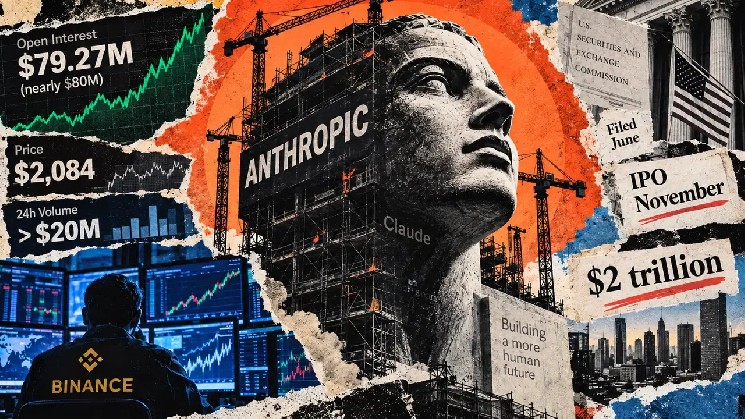
  • Anthropic’s Potential $2 Trillion IPO Drives $80 Million Crypto Trade

    Anthropic’s Potential $2 Trillion IPO Drives $80 Million Crypto Trade

    Key Highlights

    • Crypto derivatives tied to Anthropic’s anticipated IPO have reached nearly $80 million in open interest, with Binance accounting for roughly 40% of trading volume.
    • Circle CEO Jeremy Allaire publicly urged Anthropic to go public, arguing that public-market scrutiny would strengthen governance and transparency for frontier AI companies.
    • Anthropic confidentially filed for an IPO in June and is reportedly targeting a November listing at a potential $2 trillion valuation, which would rank among the largest offerings ever.

    Crypto Markets Price Anthropic’s IPO Before Wall Street

    Speculative fervor around Anthropic’s prospective initial public offering has migrated into cryptocurrency derivatives markets, where traders have accumulated nearly $80 million in open interest on pre-stock futures contracts despite the company having disclosed no offering price, share count, or final valuation. According to CoinGlass data, the ANTHROPIC pre-stock contract traded around $2,147 with more than $20 million changing hands in futures volume over 24 hours. Binance has emerged as the dominant venue, capturing approximately 40% of the activity. The instrument does not represent actual equity in the Claude developer; CoinGlass shows no circulating supply or spot trading, and Anthropic remains privately held. Instead, the price reflects derivatives markets attempting to value exposure to a company whose shares are not yet publicly available.

    Pre-IPO Perpetuals Surge as New Asset Class

    Anthropic’s derivatives activity is part of a broader shift in which crypto exchanges are building tradable instruments around Silicon Valley’s most valuable private companies. Binance Research reported that open interest across Anthropic and OpenAI pre-IPO perpetuals surpassed $160 million in September, up from roughly $1 million in April and a 179% increase from the prior month. The two companies accounted for about 95% of pre-IPO perpetual volume during the first half of September. These cash-settled derivatives reference an anticipated public company valuation or share price and require no underlying shares to support the contracts, meaning traders are effectively taking opposing positions on what the company could eventually be worth. The structure allows crypto markets to react to corporate developments almost immediately—OpenAI-linked instruments rose after the release of its Astra model and fell after Chief Executive Sam Altman signaled a potential IPO delay.

    Allaire Urges Anthropic to Embrace Public Scrutiny

    Circle Chief Executive Jeremy Allaire has added his voice to the debate, publicly urging Anthropic to complete its transition to public markets. “Take the leap, Anthropic,” Allaire said, arguing that concerns about volatile markets, valuation and AI safety strengthen rather than weaken the case for exposing the company to greater scrutiny. Drawing on Circle’s experience after taking the USDC issuer public in June 2025—pricing its IPO at $31 per share with a total offering of about $1.2 billion including the full exercise of the underwriters’ overallotment option—Allaire said going public imposed audited financial reporting, quarterly disclosures, independent board governance, and Sarbanes-Oxley controls that made Circle easier for banks, governments, and enterprise customers to evaluate. He argued that frontier AI companies are approaching a similar inflection point as their technology becomes embedded across businesses and economic infrastructure, and that model capabilities, safety procedures, computing commitments, revenue concentration, and corporate governance are increasingly matters of public interest.

    Dual Track: Traditional Investors Wait, Crypto Traders Act

    Anthropic now approaches the public markets from two directions. Traditional investors are waiting for its prospectus and the financial disclosures needed to judge whether a valuation approaching $2 trillion is justified—Reuters reported earlier this month that some investors were discussing that figure, while The Wall Street Journal reported the company plans to stage the IPO in November, later than the October timetable previously expected. Anthropic is also considering releasing another AI model ahead of the listing as competition with OpenAI intensifies. Meanwhile, crypto traders have already built nearly $80 million in outstanding futures positions behind a market trying to answer the valuation question in real time. Rising open interest signals increased participation and leverage, though it does not by itself demonstrate overwhelmingly bullish sentiment, as every futures position has both a long and short side. The gap between these two markets should narrow once Anthropic makes its registration documents public, allowing traders to compare the assumptions embedded in pre-IPO contracts with the revenue, costs, risks, and share structure the company actually presents to prospective shareholders.

    Why This Matters

    The emergence of liquid pre-IPO derivatives for Anthropic and OpenAI marks a structural shift in how private-market valuations are discovered and traded. Historically, price discovery for venture-backed unicorns occurred in infrequent funding rounds or secondary markets with limited access. Now, crypto perpetuals provide continuous, leveraged, and globally accessible pricing signals—albeit detached from underlying equity. For Anthropic, this creates a parallel reference price that could influence institutional sentiment ahead of its formal roadshow. For regulators, it raises questions about market integrity, investor protection, and the boundary between derivative speculation and securities offerings. Allaire’s intervention underscores a growing view among public-market veterans that AI labs wielding infrastructure-scale influence should accept the disclosure and governance obligations of listed companies. The November IPO timeline, if confirmed, will test whether traditional underwriters and crypto-native traders converge on a shared valuation—or whether the pre-market derivatives have already priced in expectations that the public filing cannot support.

    Frequently Asked Questions

    What are Anthropic pre-stock futures and do they represent real shares?
    No. The ANTHROPIC pre-stock contracts traded on platforms like Binance are cash-settled derivatives referencing an anticipated public valuation. They are not backed by actual Anthropic shares, carry no ownership rights, and CoinGlass shows no circulating supply or spot market for the instrument.
    When is Anthropic expected to go public and at what valuation?
    The Wall Street Journal reported Anthropic plans to stage its IPO in November, later than an earlier October target. Investors have discussed a potential valuation of up to $2 trillion, though the company has not disclosed an offering price, share count, or final valuation. Anthropic confidentially filed a draft registration statement with the SEC in June.
    Why is Circle CEO Jeremy Allaire urging Anthropic to go public?
    Allaire argues that public-market discipline—audited financials, quarterly reporting, independent governance, and Sarbanes-Oxley compliance—would strengthen Anthropic’s credibility with banks, governments, and enterprise customers. He draws a parallel to Circle’s 2025 IPO and contends that frontier AI companies now operate at a scale where transparency is a matter of public interest, though he also notes an IPO cannot substitute for AI-specific regulation.
  • Microtransactions Dominate Bitcoin Usage, Signaling Major Shift

    Microtransactions Dominate Bitcoin Usage, Signaling Major Shift

    Key Highlights

    • Micro-transactions under 0.01 BTC now represent nearly 80% of all Bitcoin network activity, signaling a fundamental shift in on-chain usage patterns.
    • The transition from large-value transfers to high-frequency, small-value transactions aligns with rising institutional interest in Bitcoin exchange-traded products (ETPs).
    • Analysts suggest the trend could enhance price stability and accelerate mainstream adoption by demonstrating Bitcoin’s utility for everyday payments.

    Bitcoin Network Dynamics Shift Toward Micro-Transaction Dominance

    Recent on-chain data reveals a structural transformation within the Bitcoin network, where transactions valued below 0.01 BTC—equivalent to roughly $600 at current prices—now account for approximately 80% of total transaction volume. This marks a decisive departure from historical patterns dominated by large-value settlements and whale movements, suggesting the protocol is increasingly functioning as a medium for frequent, low-value exchanges rather than solely a store-of-value settlement layer.

    Changing User Behavior and Institutional Catalysts

    The surge in micro-transaction activity coincides with growing traction for Bitcoin exchange-traded products, particularly in the United States following the SEC’s approval of spot Bitcoin ETFs in January 2024. Asset managers such as Grayscale Investments have reported that Bitcoin ETPs are attracting capital flows at a pace rivaling, and in some periods exceeding, traditional gold-backed funds. This institutional wrapper is lowering barriers to entry for retail and advisory audiences, potentially driving the increased on-chain fragmentation observed in recent months.

    Scalability Implications and Network Utility

    As the proportion of sub-0.01 BTC transactions climbs, questions around Bitcoin’s base-layer scalability and fee market dynamics intensify. While the Lightning Network and other layer-2 solutions are designed to absorb high-frequency, low-value traffic, the persistence of such activity on-chain indicates either growing user comfort with base-layer fees or delayed adoption of off-chain alternatives. The trend underscores the evolving narrative of Bitcoin as both a reserve asset and a functional payment rail, a dual role that could reshape long-term demand dynamics.

    Why This Matters

    The dominance of micro-transactions represents a potential inflection point for Bitcoin’s maturation as a financial asset. Historically, high concentrations of large transactions correlated with speculative cycles and custodial reshuffling. A shift toward granular, user-initiated activity suggests deeper integration into commercial and peer-to-peer economies. Coupled with the institutionalization via ETPs—now recognized by major allocators as a legitimate portfolio diversifier alongside gold—this on-chain evolution may support a more resilient price floor and broader acceptance in regulatory and commercial frameworks. Market participants should monitor whether layer-2 adoption accelerates in response to base-layer congestion, and how fee revenue trends affect miner economics post-halving.

    Frequently Asked Questions

    What qualifies as a micro-transaction on the Bitcoin network?

    In the context of the recent data, a micro-transaction is defined as any on-chain Bitcoin transfer valued below 0.01 BTC, which at current market prices represents approximately $600 or less.

    How do Bitcoin ETPs influence on-chain transaction patterns?

    Bitcoin exchange-traded products, such as those offered by Grayscale, BlackRock, and Fidelity, enable traditional investors to gain exposure without self-custody. Increased ETP adoption often correlates with higher on-chain activity as issuers manage creation and redemption baskets, while broader accessibility may spur retail usage for payments and transfers.

    Does the rise in micro-transactions affect Bitcoin’s scalability?

    A sustained high volume of small on-chain transactions can increase network congestion and fee pressure, potentially accelerating demand for layer-2 solutions like the Lightning Network. However, it also demonstrates real-world utility, which is a positive signal for long-term adoption.

  • Polygon to Burn 100M POL as Revenue Hits $24.5M, Token Impact Uncertain

    Polygon to Burn 100M POL as Revenue Hits $24.5M, Token Impact Uncertain

    Key Highlights

    • Polygon Foundation CEO Sandeep Nailwal announced a plan to permanently burn 100 million $POL tokens, representing approximately 1% of the circulating supply, pending Security Council approval.
    • The burn mechanism is fueled by protocol revenue that reached $24.5 million year-to-date, with DeFiLlama data confirming annual revenue crossing $25 million—a two-year high.
    • $POL price surged 10% on the announcement, contributing to a weekly 20% recovery, though whale sell-offs of over 30 million tokens and resistance at the 50-week moving average ($0.11) pose near-term headwinds.

    Polygon Unveils Aggressive $POL Deflationary Strategy Ahead of Anticipated Bull Cycle

    Polygon Foundation CEO Sandeep Nailwal took to X on Friday to outline a bold tokenomics shift designed to position the network for the next cryptocurrency market upswing. The centerpiece of the announcement is a proposal to permanently remove 100 million $POL tokens from circulation—a figure equivalent to roughly 1% of the current circulating supply. The initiative is funded directly by the protocol’s own revenue streams, which Nailwal highlighted have reached $24.5 million year-to-date. The proposal currently awaits final sign-off from the Polygon Security Council before implementation can begin, after which the foundation intends to conduct manual quarterly burns.

    Polygon is printing revenue. $24.5m YTD. We are deploying a change that lets anyone in the community trigger its burn.

    — Sandeep Nailwal, CEO, Polygon Foundation

    Revenue Growth and Competitive Positioning Drive the Burn Mechanism

    The burn capacity is anchored in Polygon’s evolving revenue model. Base fees on the network automatically accumulate $POL in a collector wallet, which currently holds 121 million $POL valued at approximately $1.2 million. According to data from DeFiLlama, the protocol’s annualized revenue has surpassed $25 million, marking a two-year high. Nailwal asserted that Polygon’s strategic pivot toward payments—specifically stablecoin-based transfers—has yielded fee traction three times that of Arbitrum and five times that of Near Protocol. This revenue foundation is what makes the recurring burn mechanism sustainable, moving beyond a one-time event to a structural deflationary feature.

    Market Reaction: Price Surge Meets Technical Resistance and Whale Selling

    The announcement catalyzed an immediate market response, with $POL surging 10% on Friday. The move extended the token’s weekly gain to 20%, aided by a broader market tailwind as Bitcoin reclaimed the $80,000 level. However, the rally unfolds against a backdrop of significant technical hurdles. The token had previously rallied 80% in Q3, climbing from $0.07 to $0.11, before a sharp pullback in late August. Since September, price action has consolidated above the $0.09 support level, which coincides with the 200-day Moving Average.

    Overhead Resistance and On-Chain Signals Temper Optimism

    While the daily Relative Strength Index (RSI) remained below overbought territory at press time—suggesting room for further upside—the Average True Range (ATR) was flat, signaling low volatility that could make a decisive breakout difficult. The $0.11 level represents a critical confluence of resistance: it marked the local high of the August rally and aligns with the 50-week Moving Average, which previously capped gains. Adding to the selling pressure, on-chain analytics from Santiment revealed that key whale wallets dumped over 30 million $POL in the last three days. This profit-taking activity could stall the recovery, increasing the probability of a retest of the $0.09 support if the $0.11 barrier holds. Conversely, a clean break above the 50-week MA could signal the start of the next major recovery leg.

    Why This Matters

    Polygon’s move signals a maturation of Layer 2 tokenomics, shifting from inflationary emissions to a revenue-backed, deflationary model. By tying token burns directly to protocol fees—generated largely through stablecoin payment volume—Polygon creates a direct feedback loop between network utility and token scarcity. This contrasts with many peers that rely solely on staking rewards or fixed supply caps. The initiative also underscores the growing importance of real-yield metrics in crypto valuation; DeFiLlama’s verification of $25M+ annual revenue provides a tangible fundamental anchor. For investors, the interplay between the new burn mechanism, whale distribution patterns, and the $0.11 technical resistance will be the key variables determining whether $POL can convert short-term speculative interest into a sustained trend reversal.

    Frequently Asked Questions

    What triggers the $POL token burn and how much will be removed?

    The burn is triggered by protocol revenue accumulated in the collector wallet, which currently holds 121 million $POL. The initial proposal seeks to permanently burn 100 million $POL—approximately 1% of circulating supply—pending Security Council approval, followed by manual quarterly burns thereafter.

    How does Polygon’s revenue compare to competing Layer 2 networks?

    According to CEO Sandeep Nailwal, Polygon’s fee traction from stablecoin-based payments is currently 3x that of Arbitrum and 5x that of Near Protocol. DeFiLlama data corroborates this, showing Polygon’s annualized revenue crossing $25 million, a two-year high.

    What are the key price levels to watch for $POL following the burn announcement?

    Immediate resistance sits at $0.11, which aligns with the 50-week Moving Average and the August local high. Support is established at $0.09, reinforced by the 200-day Moving Average. A break above $0.11 could signal trend continuation, while rejection may lead to a retest of $0.09, especially given recent whale selling of over 30 million tokens.