Category: Coins

Digital assets, cryptocurrencies, blockchain, and currency news.

  • Adding a Network, Bridges, and Explorers to Switch Blockchains in 2026

    Adding a Network, Bridges, and Explorers to Switch Blockchains in 2026

    Key Highlights

    • MetaMask and other wallets now automatically manage multichain accounts across Ethereum, Solana, Bitcoin, and Tron, eliminating manual network configuration for major blockchains.
    • Intent protocols like Across and Relay have replaced traditional bridges for everyday transfers, completing cross-chain moves in seconds rather than days.
    • Smart accounts under EIP-7702 enable batched transactions, sponsored fees, and alternative fee tokens, but introduce delegation risks requiring careful wallet-level confirmation.

    Wallet Evolution Eliminates Manual Network Setup for Major Chains

    The friction of manually adding blockchain networks—entering RPC addresses, chain IDs, currency symbols, and explorer URLs—has largely disappeared for mainstream users in 2026. MetaMask, the most widely used wallet for Ethereum and compatible chains, now operates with multichain accounts that manage addresses across Ethereum, Solana, Bitcoin, and, since January 2026, Tron from a single recovery phrase. The wallet automatically detects which network an application requires and switches context without user intervention. Manual network addition remains necessary only for newly launched chains or specialized ecosystems like ApeChain, which can be added either through the requesting decentralized application or via Chainlist.org, a repository that aggregates network parameters for thousands of chains.

    Security Protocols for Adding Networks and Verifying Transactions

    Despite automation, the security burden shifts to verifying network authenticity. The RPC endpoint determines which server the wallet communicates with, making it a vector for balance spoofing or activity logging. Users must compare the chain ID against the official project documentation—Ethereum’s chain ID is 1—and never accept network parameters from Telegram groups, Discord messages, or comment threads. Block explorers serve as the definitive ledger; Etherscan for Ethereum and equivalent explorers for other chains display transaction status, fees, token transfers, and contract approvals. The source warns that fake explorer pages promoted through search ads are a prevalent phishing technique, recommending bookmarked URLs over search results. The four critical explorer fields are status (Success, Pending, Failed), fee paid, token transfers showing actual asset movement, and approvals—permissions granted to contracts that persist indefinitely unless revoked.

    Intent Protocols Supplant Bridges for Routine Transfers

    Traditional bridges, long plagued by hacks such as the Sandbox bridge incident in August 2026, have been displaced for everyday use by intent-based protocols. Services like Across and Relay allow users to declare a desired outcome—for example, “100 USDC from Arbitrum to Base”—and a network of providers fulfills the order from their own liquidity on the destination chain, settling back on the origin chain afterward. This reduces transfer times from minutes or days to seconds. However, official bridges remain essential for three scenarios: large-volume transfers where native routes are cheaper and non-custodial; brand-new chains like Robinhood Chain that lack intent liquidity; and Layer 2 withdrawals to Ethereum, where the official Arbitrum or Optimism bridge imposes a seven-day challenge period. The recent shutdown of a TON ecosystem bridge, which left holders facing a deadline to exit, underscores the counterparty risk inherent in bridge dependencies.

    Smart Accounts and the Persistent Threat of Stale Approvals

    The Ethereum Pectra upgrade in May 2025 introduced EIP-7702 smart accounts, which temporarily convert an externally owned account into a programmable account without changing its address. Benefits include batching multiple operations—such as approvals and swaps—into a single confirmation, enabling applications to sponsor gas fees, and allowing fee payment in tokens other than ETH. MetaMask exposes this as a toggleable feature. The risk lies in delegation: activating a smart account assigns control to a contract, and attackers attempt to trick users into delegating to malicious contracts. The source emphasizes confirming smart account activation only within the wallet interface, never at a website’s request. Meanwhile, the greatest day-to-day risk remains dormant token approvals. The Magic Eden and Limit Break incident, active since September 24, 2026, demonstrates attackers exploiting approvals granted in 2024 to drain WETH and NFTs. Revoke.cash, covering over 100 networks, provides a low-cost method to audit and revoke stale permissions. For significant holdings, the recommended practice is a two-wallet architecture: a hot wallet for application interaction and a hardware-secured cold wallet that never signs transactions.

    Why This Matters

    The transition from manual network management to automated multichain wallets, from bridges to intent protocols, and from simple accounts to programmable smart accounts marks a maturation of blockchain user experience comparable to the shift from command-line to graphical interfaces. However, each abstraction layer introduces new attack surfaces: RPC spoofing, malicious delegation, and persistent approvals. The industry’s focus has moved from infrastructure building to security hygiene—verifying chain IDs, bookmarking explorers, auditing approvals, and segregating funds. As new chains like Robinhood Chain and ApeChain launch, and as Layer 2 ecosystems expand, the checklist approach—test transfer, verify in explorer, revoke approvals—becomes the standard operating procedure for safe cross-chain activity. The September 2026 timeline reflects a snapshot where usability has improved dramatically, but user vigilance remains the final security layer.

    Frequently Asked Questions

    Do I still need to manually add networks to MetaMask in 2026?
    Only for new or niche chains not yet integrated into the wallet’s default network list. Major networks including Ethereum, Solana, Bitcoin, and Tron are preconfigured. For others, use the dApp’s prompt or Chainlist.org, and always verify the chain ID against official documentation.
    Are traditional bridges obsolete?
    No. Intent protocols like Across and Relay handle routine transfers faster and cheaper, but official bridges remain necessary for large amounts, newly launched chains without intent liquidity, and Layer 2-to-Ethereum withdrawals subject to the seven-day challenge period.
    What is the biggest security risk for everyday users?
    Stale token approvals—permissions granted to contracts during past swaps or NFT listings that remain active indefinitely. The Magic Eden/Limit Break exploit since September 24, 2026, leveraged 2024 approvals to drain assets. Regular audits via Revoke.cash and a two-wallet strategy (hot + hardware cold storage) mitigate this risk.
  • Bitcoin Price Gains 44% for Second-Best Q3 as Ethereum Jumps 71%

    Bitcoin Price Gains 44% for Second-Best Q3 as Ethereum Jumps 71%

    Key Highlights

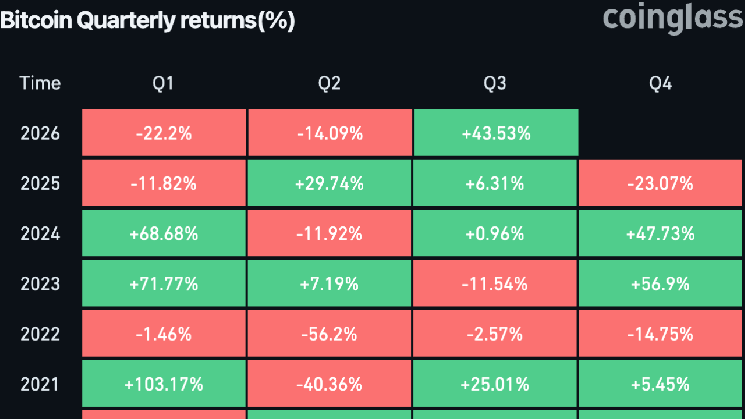
    • Bitcoin surged approximately 43.5% in Q3 2026, rising from roughly $58,500 to around $84,000, marking its second-best third quarter on record behind only the 80.4% gain in 2017.
    • Ethereum outperformed with a 71% quarterly advance, surpassing its previous Q3 record of 66.5% set in 2025 and establishing its strongest summer rally ever.
    • Both assets cleared key technical hurdles including the September 25 quarterly options expiry, with Bitcoin reclaiming critical investor cost-basis levels and showing strengthened ETF demand alongside restrained profit-taking.

    Bitcoin and Ethereum Break Historical Q3 Patterns

    Cryptocurrency markets have transformed what is typically one of the calendar’s quieter quarters into one of the strongest periods in digital asset history. Bitcoin’s price has gained roughly 43.5% during Q3 2026, climbing from about $58,500 at the quarter’s start to approximately $84,000 as of September 26. This performance puts the quarter on track to become Bitcoin’s second-best Q3 ever, trailing only the approximately 80.4% surge recorded in 2017.

    Ethereum has delivered an even more remarkable showing. According to Coinglass data, ETH has risen 71% this quarter, exceeding its previous Q3 record of about 66.5% set in 2025. The move marks Ethereum’s strongest summer rally on record, defying the historical pattern where July, August, and September often produce flat or modest returns compared with typically stronger fourth-quarter periods.

    Analysts Call Performance Extraordinary

    The combination of both major assets posting historic quarterly gains simultaneously has drawn significant attention from market observers. Crypto analyst Luciano described the developments as extraordinary, writing on X that this is the 2nd best quarter ever recorded for BTC and the best quarter $ETH has ever had. The significance extends beyond raw percentage gains, as both assets enter the final stretch of September with established momentum ahead of a quarter that has historically attracted greater speculative interest.

    Bitcoin Clears Technical Hurdles and Cost Bases

    The rally’s foundation appears to rest on more than derivatives speculation alone. Bitcoin has moved back above several investor cost-basis levels that previously capped recovery attempts. Exchange-traded fund demand has strengthened, spot trading volume has increased, and profit-taking remains relatively restrained compared with previous market peaks.

    Bitcoin’s price also held firm through the large September 25 quarterly options expiry, an event carrying substantial open interest that had the potential to generate significant short-term volatility. With that hurdle now behind the market, attention is shifting toward the next major onchain resistance level near the mean MVRV price around $96,700. A move toward that zone would again place Bitcoin within striking distance of the psychological $100,000 level.

    Why This Matters

    The historic Q3 performance fundamentally alters the setup for what has traditionally been cryptocurrency’s strongest seasonal quarter. Q4 has historically outperformed Q3 for digital assets, and the current momentum—combined with stronger ETF demand, improving spot market activity, and lighter profit-taking than at prior peaks—creates a potentially powerful launching pad. However, the immediate test centers on whether buyers can continue absorbing supply as Bitcoin trades in the mid-$80,000 range. If demand sustains, what is already a historic third quarter could become the foundation for an even more consequential fourth quarter, potentially accelerating institutional adoption narratives and broader market participation.

    Frequently Asked Questions

    How does Bitcoin’s Q3 2026 performance compare historically?

    Bitcoin’s approximately 43.5% gain in Q3 2026 represents its second-best third quarter on record, behind only the 80.4% surge in Q3 2017. It also marks Bitcoin’s best Q3 performance since 2013.

    What records did Ethereum set this quarter?

    Ethereum’s 71% quarterly advance surpassed its previous Q3 record of 66.5% set in 2025, establishing its strongest summer rally on record according to Coinglass data.

    What technical levels are traders watching next for Bitcoin?

    The next major onchain resistance sits near the mean MVRV price around $96,700. A move toward that level would bring Bitcoin back within striking distance of the psychologically significant $100,000 threshold.

  • PUMP Surges 18% After SEC Clarification, 398M Token Buybacks

    PUMP Surges 18% After SEC Clarification, 398M Token Buybacks

    Key Highlights

    • SEC staff clarified that tokens with protocol revenue and buybacks are not automatically securities, applying the Howey test focused on economic reality over terminology.
    • $PUMP surged 18% to $0.0045 with a 57% volume spike, while protocol inflows reversed to $24 million and buybacks continued removing 16.79% of supply.
    • Technical indicators signal bullish momentum, but persistent profit-taking and positive exchange netflows suggest selling pressure could challenge the uptrend.

    SEC Clarification Triggers Market Reassessment of Token Economics

    The U.S. Securities and Exchange Commission staff has issued guidance that could reshape how protocol-native tokens with revenue-sharing mechanisms are classified under federal securities law. According to the clarification, the agency applies the classic Howey test—assessing whether an investment of money in a common enterprise expects profits derived from the managerial efforts of others—while emphasizing economic substance over labeling. The guidance explicitly states that token buyback programs and liquid staking receipts, by themselves, do not convert an otherwise non-security commodity into a security. This distinction provides a regulatory foothold for protocols like $PUMP that generate genuine revenue and return value to holders through on-chain buybacks and burns.

    $PUMP Price Action and Capital Flows Reflect Renewed Optimism

    Reacting to the SEC’s stance, $PUMP rebounded sharply from a $0.0038 low, reclaiming the $0.004 psychological level and rallying to a daily high of $0.0046. At press time, the token traded near $0.0045, marking an 18% intraday gain accompanied by a 57% surge in spot trading volume. On-chain data from DefiLlama shows protocol USD inflows swung to $24 million, reversing four consecutive days of outflows that had briefly pushed net flows negative. The project’s treasury continues to execute its buyback strategy: after generating $3.2 million in revenue, $PUMP allocated $1.6 million to purchase 398 million tokens, per Lbexplorer. Cumulatively, the team has bought and burned $463.79 million worth of supply, removing 16.79% of tokens from circulation.

    Profit-Taking and Exchange Flows Signal Near-Term Resistance

    Despite the bullish catalyst, selling pressure remains elevated. On September 26, spot sell volume reached 2.68 billion tokens against 2.54 billion in buy volume, producing a negative buy-sell delta of -144.5 million—a clear indication of aggressive distribution, according to Coinalyze. Exchange netflows corroborate this trend: Coinglass data shows spot netflows have stayed positive for three straight days, climbing to $1.49 million following the rebound. Sustained positive netflows typically suggest holders are moving tokens to exchanges to sell, which could cap upside if demand does not absorb the supply.

    Technical Outlook: Bullish Structure Faces Supply Overhang

    Momentum indicators paint a constructive picture. The Trend Strength Index (TSI) on the $PUMP/USDT pair formed a bullish crossover and rose to 6.8, while the Aroon Oscillator has held near 42 for two consecutive sessions, reflecting stabilizing upside momentum, per TradingView. If current conditions persist, the next resistance zones are $0.0048 and the $0.005 psychological level. However, the confluence of active profit-taking and exchange inflows means a failure to hold above $0.004 could see price revisit the $0.0038 support.

    Why This Matters

    The SEC’s clarification arrives at a pivotal moment for revenue-generating DeFi protocols. By confirming that buybacks and liquid staking do not automatically trigger securities classification—provided the Howey test’s “managerial effort” prong is not met—the guidance reduces regulatory uncertainty for tokens that function more like commodity-like assets with cash-flow rights. For $PUMP specifically, the combination of regulatory tailwinds, accelerating buybacks, and improving capital flows creates a fundamental backdrop that could sustain re-rating if the protocol continues to demonstrate real revenue growth. Market participants will now watch whether inflows can outpace exchange deposits and whether the token can convert technical momentum into a higher-low structure above $0.004.

    Frequently Asked Questions

    Does the SEC guidance mean all tokens with buybacks are now non-securities?

    No. The SEC stated it applies the Howey test to each asset based on economic reality. A token is a security if investors expect profits primarily from the managerial efforts of founders or promoters. Buybacks and liquid staking alone do not make a commodity a security, but the overall structure and marketing of the token still matter.

    How much of $PUMP supply has been burned so far?

    According to Lbexplorer data cited in the report, the team has bought and burned $463.79 million worth of $PUMP, removing 16.79% of the total supply from circulation.

    What are the key price levels to watch for $PUMP next?

    Immediate resistance sits at $0.0048, followed by the $0.005 psychological level. On the downside, a break below $0.004 could trigger a retest of the recent $0.0038 low, especially if exchange netflows remain positive and sell volume continues to exceed buy volume.

  • DoubleZero Surges 29% as Open Interest Jumps 113% – Can 2Z Outpace $124M Token Unlock?

    DoubleZero Surges 29% as Open Interest Jumps 113% – Can 2Z Outpace $124M Token Unlock?

    Key Highlights

    • DoubleZero (2Z) surged over 29% in 24 hours, leading all top 200 cryptocurrencies by market capitalization amid a broader market rebound.
    • Technical indicators confirm bullish momentum: price cleared key liquidity above $0.075, CVD shows 19.57 million tokens bought at press time, and Open Interest jumped 113% alongside a 107% volume spike past $50 million.
    • Major token unlock looms on October 2nd: 1.77 billion 2Z tokens ($124 million, 17.79% of max supply) will enter circulation, potentially capping the uptrend that began September 16.

    DoubleZero Leads Market Recovery With 29% Intraday Rally

    DoubleZero (2Z) emerged as the standout performer across the top 200 digital assets by market capitalization over the past 24 hours, posting a gain exceeding 29% as the broader cryptocurrency market staged a rebound. The altcoin’s ascent pushed it decisively past the $0.075 resistance level, clearing liquidity clusters that had previously capped advances near the $0.060 equal highs. On-chain and derivatives data point to aggressive accumulation rather than speculative churn, with cumulative volume delta (CVD) metrics recording 19.57 million 2Z tokens purchased during the peak trading hour at press time. The Stochastic Momentum Index (SMI) on the daily timeframe registered near maximum levels, reinforcing the strength of the current up-move.

    Derivatives Data Signals Leveraged Long Positioning

    The rally’s structure is underpinned by a pronounced shift in derivatives markets. Open Interest on 2Z futures contracts surged 113%, while spot and perpetual trading volume climbed 107% to surpass $50 million at the time of writing, according to CoinGlass data. Notably, cumulative long liquidation leverage stood at $2 million versus just $955,000 in short orders, indicating that the price advance has been fueled by fresh long exposure rather than a short squeeze. This dynamic suggests conviction among leveraged participants, though it also introduces vulnerability should funding rates overheat or price action reverse sharply.

    Institutional Wallet Flows Reveal Accumulation Patterns

    Blockchain analytics from Arkham Intelligence highlight coordinated movement among major custodians and market makers. Fireblocks transferred 1.452 million 2Z tokens—valued at approximately $102,000—to a BtcTurk cold storage wallet, a transaction consistent with institutional accumulation. Simultaneously, Binance and Wintermute executed inter-wallet transfers, with Wintermute routing 1.113 million tokens to a Bybit hot wallet, likely for liquidity provisioning. South Korean exchange Upbit moved over 14 million 2Z (worth more than $800,000) across its internal hot wallet infrastructure, activity the data suggests is related to position management rather than distribution. Absent a coordinated selling effort by these entities, the technical backdrop remains supportive of further upside.

    October Token Unlock Presents Critical Supply Overhang

    The most significant risk to the current uptrend arrives on October 2nd, when the protocol’s vesting schedule releases 1.77 billion 2Z tokens—representing 17.79% of the maximum supply and valued at roughly $124 million at current prices. According to CoinMarketCap, this event will lift the circulating supply to 51%, up from a locked position exceeding 65% today. The bulk of the unlocking allocation is earmarked for early backers including Jump Crypto and Malbec Labs, alongside other institutional contributors. Market participants will closely monitor whether these stakeholders opt to hold, stake, or liquidate their newly liquid positions, as the resulting sell pressure could arrest the advance that has been in place since the September 16 trendline break.

    Why This Matters

    DoubleZero’s rally illustrates how mid-cap altcoins can decouple from broader market beta when derivatives positioning and institutional flow align. The convergence of technical breakout confirmation, rising Open Interest, and identifiable accumulator wallets provides a textbook case study in on-chain forensic analysis for traders. However, the impending token unlock represents a classic supply-side catalyst that has historically capped rallies in similarly structured vesting schedules. The October 2nd event will test whether demand from new market entrants and existing holders can absorb what amounts to nearly one-fifth of the token’s maximum supply entering free float within a single day. For the sector, the outcome may signal appetite for infrastructure-layer tokens with concentrated insider holdings—a dynamic relevant to numerous Layer 1 and DePin projects facing similar unlock cliffs in Q4 2024 and beyond.

    Frequently Asked Questions

    What are the key price levels to watch for 2Z following the breakout?

    Immediate resistance targets sit at $0.095 and $0.120, contingent on the price holding above the $0.075 breakout level. The primary downside invalidation zone is $0.050, which marks the trendline break origin from September 16.

    How large is the October 2nd token unlock relative to current circulation?

    The unlock will release 1.77 billion 2Z tokens ($124 million), equivalent to 17.79% of the maximum supply. This will increase the circulating supply to 51% from a current locked ratio exceeding 65%, with the majority allocated to Jump Crypto, Malbec Labs, and other institutional contributors.

    Are institutions buying or selling 2Z based on recent wallet activity?

    Recent on-chain flows suggest accumulation and liquidity management rather than distribution. Fireblocks moved tokens to a BtcTurk cold wallet, Wintermute transferred to Bybit for likely market-making purposes, and Upbit conducted internal wallet rotations. No major exchange deposit spikes indicative of selling pressure have been observed at press time.

  • Researchers Propose Zcash-Style Privacy for Bitcoin Without a Soft Fork

    Researchers Propose Zcash-Style Privacy for Bitcoin Without a Soft Fork

    Key Highlights

    • Researchers from Alloc Init proposed “Shielded Bitcoin,” a metaprotocol that hides BTC transfer amounts and counterparties using zero-knowledge proofs without altering Bitcoin’s consensus rules or requiring trusted bridges.
    • The design adapts Zcash’s encrypted-note model directly on Bitcoin’s base layer, allowing anyone to run indexers that verify proofs and track nullifiers to prevent double-spending.
    • Grayscale research head Zach Pandl recently warned that AI advances are making wallet-to-identity linking easier, suggesting shielded transaction tools may become essential for privacy-focused users.

    Alloc Init Researchers Unveil Shielded Bitcoin Privacy Metaprotocol

    A team of researchers behind Alloc Init has introduced “Shielded Bitcoin,” a novel metaprotocol designed to bring transaction privacy to Bitcoin’s base layer without modifying the network’s consensus rules or relying on trusted bridge operators. Presented by Clara Shikhelman, Mikhail Komarov, and Aleksei Moskvin, the proposal addresses a fundamental limitation of Bitcoin’s public ledger: amounts, transaction timing, and links between transactions remain visible and can often be associated with known wallets through blockchain analysis.

    How Encrypted Notes and Zero-Knowledge Proofs Enable Private Transfers

    The Shielded Bitcoin design borrows the encrypted-note approach pioneered by Zcash but implements it directly on Bitcoin’s existing infrastructure. When a user such as Alice pays Bob, her wallet publishes encrypted notes to the Bitcoin blockchain alongside a zero-knowledge proof. These notes contain the transfer amount and the recipient’s receiving information, while the cryptographic proof serves three critical functions: it confirms the notes being spent exist, verifies Alice’s authorization to spend them, and validates that input and output amounts balance — all without exposing any of these details publicly.

    Software components called indexers read these transfers, verify the zero-knowledge proofs, and track nullifiers — unique serial numbers that prevent the same note from being spent twice. According to the researchers, anyone can operate indexers, ensuring no single party controls the ledger state. The design also separates spending authority from viewing capabilities, allowing wallets to split into distinct keys: one for spending funds, a read-only key for detecting incoming transfers, and a third key for recovering a user’s own transaction history. This key hierarchy enables users to share limited transaction details with auditors or counterparties without surrendering spending control.

    Where Shielded Bitcoin Fits Among Existing Privacy Solutions

    Comparison With CoinJoin, Silent Payments, and Zcash

    Shielded Bitcoin enters a landscape of existing privacy-enhancing techniques for Bitcoin, each with distinct tradeoffs. Methods like CoinJoin, PayJoin, and Silent Payments operate within Bitcoin’s current transaction format and can obscure ownership trails, but transaction amounts and much of the transaction graph remain publicly visible. The researchers identified Zcash as the closest precedent due to its use of encrypted notes, nullifiers, and zero-knowledge proofs. However, Zcash operates on its own independent blockchain with separate consensus rules, whereas Shielded Bitcoin derives its state entirely from Bitcoin’s history.

    This architectural distinction carries implications: while Shielded Bitcoin avoids the need for a trusted intermediary or separate consensus mechanism, transaction patterns, distinctive wallet behaviors, and repeated publication fees could still allow observers to narrow down relationships over time through traffic analysis and heuristic clustering.

    Why This Matters

    The proposal arrives amid growing concern about the erosion of financial privacy on public blockchains. Grayscale’s research head, Zach Pandl, recently highlighted that advances in artificial intelligence are making it significantly easier to link wallet addresses to real-world identities. Pandl suggested that tools employing shielded transaction models — like those used by Zcash — could become “close to a necessity for privacy-minded users.” Shielded Bitcoin represents an attempt to bring similar cryptographic privacy guarantees to Bitcoin natively, without requiring users to move funds onto a separate chain or trust centralized mixing services. If adopted, it could shift the baseline for on-chain privacy on the world’s largest cryptocurrency network, though deployment would require wallet and indexer software development, as well as community consensus on the metaprotocol’s standards.

    Frequently Asked Questions

    Does Shielded Bitcoin require a soft fork or consensus change to Bitcoin?

    No. The researchers explicitly designed Shielded Bitcoin as a metaprotocol that operates on Bitcoin’s existing base layer without altering consensus rules. It uses cryptographic proofs published as transaction data rather than requiring protocol-level modifications.

    How does Shielded Bitcoin differ from using Zcash directly for private transactions?

    While both use encrypted notes, nullifiers, and zero-knowledge proofs, Zcash runs on its own independent blockchain with separate consensus rules. Shielded Bitcoin derives its state from Bitcoin’s history, meaning users stay on the Bitcoin network and do not need to bridge assets or trust a different validator set.

    Can observers still trace Shielded Bitcoin users through metadata analysis?

    Yes, the researchers acknowledge that transaction timing patterns, wallet behavior fingerprints, and fee publication rhythms could still allow sophisticated observers to correlate activity and narrow down relationships over time, even though amounts and counterparties are cryptographically hidden.

  • SEC Commissioner Hester Peirce to Step Down October 2

    SEC Commissioner Hester Peirce to Step Down October 2

    Key Highlights

    • SEC Commissioner Hester Peirce, known as “Crypto Mom,” resigned effective October 2, 2025, leaving the commission with only two sitting members: Chairman Paul Atkins and Commissioner Mark Uyeda.
    • Peirce’s departure removes the leader of the SEC’s Crypto Task Force at a critical juncture as the agency advances token-classification FAQs and proposed Regulation Crypto Assets.
    • The White House has not yet named a successor, and confirmation timelines typically span six to twelve months, creating an extended leadership vacuum at the five-member commission.

    Peirce Announces Departure After Eight-Year Tenure

    SEC Commissioner Hester Peirce announced her resignation on September 25, posting her resignation letter on X with the caption “T minus 7,” a countdown to her final day at the agency on October 2. Peirce, widely known as “Crypto Mom” for her persistent push for clearer, rules-based digital-asset regulation, has served on the commission since January 2018. Her departure will leave the SEC with just two sitting commissioners, Chairman Paul Atkins and Commissioner Mark Uyeda, and no successor yet named by the White House.

    Eight Years of Dissent and Crypto Task Force Leadership

    Peirce spent more than eight years as the commission’s most consistent advocate for written crypto rules, frequently dissenting from what she characterized as enforcement-first decisions, including the agency’s earlier refusals to approve spot Bitcoin exchange-traded funds. In January 2025 she took charge of the Crypto Task Force, the group behind much of the SEC’s digital-asset policy work, including its warnings on securities risk in crypto yield vaults and onchain lending. Her second term expired on June 5, 2025, but SEC rules allow a commissioner to serve up to about 18 months past a term’s end when no replacement has been confirmed.

    Resignation Letter Emphasizes Regulatory Philosophy

    In the letter addressed to President Trump, Peirce called her tenure “the honor of my professional lifetime” and wrote that “maximizing people’s freedom to choose what is best for themselves and their families within sensible regulatory parameters designed to give them the confidence to transact with others is a delicate and vitally important task for the regulator.” She said she leaves confident that the agency’s work will continue under Atkins and Uyeda.

    A Two-Member Commission and the Road Ahead

    The resignation reduces the commission to two Republican members and removes the Crypto Task Force’s leader at a moment when the agency’s crypto agenda is running at full speed. The agency already carried a vacant seat after Democratic Commissioner Caroline Crenshaw departed in January, so Peirce’s exit leaves two empty spots on the five-member commission. The announcement landed the same day the SEC published new token-classification FAQs, part of a rulemaking push that has included its proposed Regulation Crypto Assets. The White House has not named a successor, and confirmation timelines can run six to twelve months. Peirce is expected to join Regent University School of Law in Virginia as an associate professor in November.

    Why This Matters

    Peirce’s departure creates significant uncertainty for the SEC’s digital-asset regulatory agenda at a pivotal moment. With only two commissioners remaining, the commission lacks a quorum for certain rulemaking actions, potentially slowing the progress of proposed Regulation Crypto Assets and other pending initiatives. The Crypto Task Force, which Peirce led since January 2025, has been instrumental in shaping the agency’s approach to token classification, yield products, and lending protocols. Her absence may alter the trajectory of enforcement priorities and rulemaking timelines. The extended vacancy period—potentially six to twelve months before a successor is confirmed—means the SEC will operate with a skeletal leadership structure during a period of intense industry scrutiny and legislative activity around digital assets. Market participants should monitor White House nomination signals and Senate Banking Committee scheduling for clues about the agency’s future direction.

    Frequently Asked Questions

    When does Hester Peirce’s resignation take effect?

    Peirce’s resignation takes effect on October 2, 2025, as indicated by her “T minus 7” countdown posted on September 25.

    Who will lead the SEC’s Crypto Task Force after Peirce’s departure?

    The source material does not specify a successor for the Crypto Task Force leadership role. With only Chairman Paul Atkins and Commissioner Mark Uyeda remaining, the task force’s future leadership structure remains uncertain.

    What is Hester Peirce’s next professional role?

    Peirce is expected to join Regent University School of Law in Virginia as an associate professor starting in November 2025.

  • US Charges Man in $53M Crypto Scam

    US Charges Man in $53M Crypto Scam

    Key Highlights

    • Vietnamese national Trung Nguyen Van, 37, charged with two counts of money laundering in the Western District of Missouri for allegedly moving $53.3 million linked to cryptocurrency “pig butchering” fraud schemes targeting U.S. victims.
    • One victim allegedly transferred approximately $16 million in cryptocurrency during summer 2024 to a fake investment platform called “Triangle” before being unable to withdraw funds.
    • The FBI investigation traced blockchain transactions showing wallets controlled by Van received $53.3 million and subsequently transferred roughly $53.2 million onward, illustrating the scale and traceability of crypto-enabled fraud networks.

    Federal Prosecutors Charge Vietnamese National in Multi-Million Dollar Crypto Fraud Case

    U.S. prosecutors have unsealed criminal charges against Trung Nguyen Van, a 37-year-old Vietnamese national, alleging his central role in laundering proceeds from cryptocurrency “pig butchering” scams that defrauded American victims of tens of millions of dollars. The criminal complaint, filed in the Western District of Missouri, accuses Van of two counts of money laundering connected to a fraud network that moved more than $53 million through cryptocurrency wallets under his control. Van made an initial appearance in federal court in Los Angeles following his arrest. As with all criminal complaints, the charges remain allegations that have not been proven at trial, and Van is presumed innocent unless and until proven guilty beyond a reasonable doubt.

    Single Victim Loses $16 Million to Fake “Triangle” Investment Platform

    The investigation originated from a single victim who reported transferring approximately $16 million in cryptocurrency during the summer of 2024 to a platform identifying itself as “Triangle.” According to the U.S. Attorney’s Office, the victim developed trust with individuals associated with the scheme over time—a hallmark of pig butchering operations where scammers cultivate relationships before directing targets toward fraudulent investment opportunities. The victim ultimately found themselves unable to withdraw the supposed investments, prompting the report that launched the federal probe. Investigators subsequently linked the recipient wallet infrastructure to additional suspicious wallets and reports from other U.S. victims describing nearly identical experiences, revealing a broader pattern of coordinated fraud.

    Blockchain Analysis Reveals $53 Million in Laundered Proceeds

    Forensic blockchain analysis conducted by the FBI traced approximately $53.3 million in digital assets linked to wire fraud schemes into wallets identified as controlled by Van. The complaint alleges that roughly $53.2 million was subsequently moved onward from those wallets, transactions prosecutors characterize as deliberate laundering of fraud proceeds. The case underscores a dual reality of cryptocurrency in financial crime: while blockchain technology enables rapid, cross-border movement of large sums without traditional banking intermediaries—making it attractive to criminal networks—the same immutable public ledger creates a permanent evidence trail. Wallet addresses, transaction histories, and exchange transfers provide investigators with forensic data that, while complex to unravel, is difficult to erase completely. However, the funds often traverse multiple wallets, cross-chain bridges, privacy tools, and exchanges before law enforcement detects the activity, complicating recovery efforts.

    Why This Matters

    The charges against Van reflect a growing convergence between traditional financial crime enforcement and blockchain-native investigative techniques. “Pig butchering” scams—so named because fraudsters “fatten up” victims with trust before the “slaughter”—have evolved into industrial-scale operations, often run by transnational criminal syndicates operating from Southeast Asia. The $16 million loss from a single victim and the $53 million aggregate flow through Van’s alleged wallets illustrate the staggering capital these networks can extract. For the Department of Justice, the case signals an increasing reliance on on-chain analytics and collaboration with blockchain intelligence firms to pierce the pseudonymity of crypto transactions. For the cryptocurrency industry, it reinforces regulatory pressure on exchanges and service providers to implement robust know-your-customer (KYC) and anti-money laundering (AML) controls. The next steps will likely include asset seizure motions, potential superseding indictments as the investigation expands to co-conspirators, and continued efforts to trace and recover stolen funds for victims.

    Frequently Asked Questions

    What is a “pig butchering” cryptocurrency scam?

    A “pig butchering” scam is a type of fraud where perpetrators build a relationship with a victim over weeks or months—often through social media, dating apps, or messaging platforms—before introducing a fake cryptocurrency investment opportunity. The victim is encouraged to deposit increasing amounts, sometimes seeing fictitious returns, until they attempt to withdraw and discover the platform is fraudulent and the funds are gone.

    Has Trung Nguyen Van been convicted?

    No. Van has been charged via criminal complaint with two counts of money laundering. A criminal complaint is an allegation, not evidence of guilt. Van is presumed innocent unless and until proven guilty in a court of law. The case will proceed through the federal judicial process in the Western District of Missouri.

    Can the stolen cryptocurrency be recovered?

    Recovery is possible but difficult. Blockchain transparency allows investigators to trace fund flows, and law enforcement can work with exchanges to freeze assets linked to identified wallets. However, fraudsters often use mixers, cross-chain bridges, privacy coins, and rapid wallet rotation to obscure the trail. The complaint alleges $53.2 million was moved onward from Van’s wallets, suggesting much of the value may have already been dispersed or converted.

  • SUI Jumps 16% as Volume Nears $1.7B; Traders Eye $2 Target If Conditions Hold

    SUI Jumps 16% as Volume Nears $1.7B; Traders Eye $2 Target If Conditions Hold

    Key Highlights

    • SUI token surged 16.59% in a single session as trading volume nearly doubled to $1.73 billion, signaling strong capital inflow behind the price recovery.
    • On-chain metrics remained robust with 125,038 active addresses, 12,551 new addresses, and 41.44 million transactions processed in 24 hours, while Total Value Locked held firm at $551.65 million.
    • Technical breakout above a prolonged descending channel, confirmed by Parabolic SAR flip and bullish DMI structure, opens path toward $1.3295 resistance with $2.00 as a potential extended target.

    SUI Token Stages 16.59% Rally on Doubled Volume and Surging Network Activity

    The SUI token delivered a sharp 16.59% daily price gain as trading activity nearly doubled, providing substantial market participation behind the recovery move. According to market data, the token’s trading volume expanded 94.28% to reach $1.73 billion, almost doubling alongside the price advance. This volume surge attracted significantly greater market participation than the previous session, reinforcing the relevance of SUI’s price rebound from its wider declining technical structure. The token drew substantially more capital turnover as prices recovered rather than advancing on thin activity, though the rapid uptick brought prices toward a crucial technical zone where sustained participation will be essential for further upside.

    On-Chain Metrics Provide Fundamental Backing for Price Recovery

    Beyond trading markets, the Sui network recorded considerable usage during the recent 24-hour period, adding an on-chain dimension to the rally. According to DeFiLlama analytics, AAVE’s Active Addresses on Sui hit 125,038, with the network adding 12,551 new addresses within the 24-hour window. Transaction activity provided another strong indicator, with Sui processing 41.44 million transactions over the same period. These figures suggest network participation remained exceptionally active as SUI recorded its double-digit price recovery. The address increase gave the rally an on-chain element beyond expanding trading volume, while new addresses reflected fresh traders interacting with the network during the rally period. Expanded transaction activity indicated existing users continued generating considerable on-chain activity, creating potential for stronger fundamental backing as SUI attempts to extend its recovery.

    DeFi Liquidity Holds Firm as TVL Climbs to $551.65 Million

    The Sui DeFi ecosystem preserved considerable liquidity as prices pushed higher, with Total Value Locked (TVL) climbing to $551.65 million following a modest 0.34% increase over 24 hours. Despite the modest percentage gain, the key takeaway is that ecosystem liquidity did not contract even as speculative market activity expanded rapidly. This distinction matters because a falling TVL could have weakened the fundamental outlook beneath SUI’s recovery. Instead, capital locked across Sui DeFi remained firm as both network and trading activity strengthened. The rally emerged alongside stable ecosystem liquidity rather than a noticeable withdrawal of DeFi capital. Continued TVL growth could validate this backdrop if prices continue pushing higher, though price expansion significantly outpaced the daily TVL increase, leaving technical confirmation increasingly crucial for sustained upside.

    Technical Breakout Above Descending Channel Targets $1.3295 Resistance

    On a weekly timeframe chart, SUI strengthened its technical structure after breaking above its extended descending channel during the recent price recovery. The breakout followed a price reversal from the $0.6578 support region, marking an important shift in the token’s wider price structure. Adding further support to the bullish setup, the Parabolic SAR indicator flipped below the prevailing price near $0.5597. The Directional Movement Index (DMI) structure also favored buyers, with the +DI at 30.40 positioned above the -DI signal at 14.70. The Average Directional Index (ADX) strength indicator reached 20.75, leaving room for directional strength to expand as the price breakout developed. SUI now needs to protect its position above the broken descending channel. Ultimately, the token’s price breakout gained backing from stronger trading activity, elevated network usage, and firm DeFi liquidity. If bulls defend the channel breakout, the $1.3295 resistance could become the next test before a possible move toward $2.00.

    Why This Matters

    The convergence of rising trading volume, robust on-chain activity, and stable DeFi liquidity represents a rare multi-factor confirmation for a layer-1 token recovery. Most rallies in the current market environment are driven by either speculative futures flows or isolated fundamental improvements, but rarely both simultaneously. SUI’s ability to generate 41.44 million daily transactions while adding over 12,000 new addresses suggests genuine network adoption is occurring alongside price appreciation. The TVL stability at $551.65 million is particularly noteworthy given that many competing ecosystems have seen capital rotation out of DeFi during volatile periods. From a technical perspective, the weekly descending channel breakout combined with the Parabolic SAR flip and bullish DMI alignment creates a coherent structure that could attract trend-following capital. The $1.3295 level represents the next significant horizontal resistance, and a weekly close above it would likely trigger algorithmic and systematic buying interest toward the $2.00 psychological level.

    Frequently Asked Questions

    What drove SUI’s 16.59% daily price gain?
    The surge was driven by a 94.28% increase in trading volume to $1.73 billion, supported by strong on-chain metrics including 125,038 active addresses, 12,551 new addresses, and 41.44 million daily transactions, alongside stable DeFi TVL at $551.65 million.
    What are the key technical levels to watch for SUI?
    Immediate resistance sits at $1.3295 following the descending channel breakout. The Parabolic SAR flipped bullish near $0.5597, and the token reversed from $0.6578 support. A sustained move above $1.3295 could open a path toward $2.00.
    Is the rally supported by fundamentals or just speculation?
    Both. The rally coincides with expanding network usage (41.44M transactions, rising active/new addresses) and stable DeFi liquidity (TVL at $551.65M), suggesting fundamental activity underpins the speculative volume surge.
  • Paxos Labs Launches PAXGy, a New Gold-Backed Token

    Paxos Labs Launches PAXGy, a New Gold-Backed Token

    Key Highlights

    • Paxos Labs launches PAXGy, a yield-bearing token built on PAX Gold ($PAXG) that accrues value in gold terms through institutional lending of underlying reserves.
    • The token is accessible via OKX Gold Earn and the X Layer network, with secondary trading on Uniswap, 0x, and Ether.fi, while Chainlink CCIP enables cross-chain transfers without position closure.
    • Each PAXGy represents a growing claim on $PAXG as gold reserves generate yield, with holders able to redeem for the underlying Pax Gold token at any time.

    Paxos Labs Introduces PAXGy: A Gold-Backed Token Designed to Accrue Value in Gold Terms

    Paxos Labs, a regulated provider of digital asset infrastructure for enterprises, has officially launched PAXGy, a novel gold-backed token engineered to increase in value denominated in gold itself. Unlike traditional stablecoins or tokenized commodities that merely track the spot price of bullion, PAXGy introduces a yield-bearing mechanism where the underlying physical gold reserves are lent to institutional borrowers, causing the exchange rate between PAXGy and its base asset—PAX Gold ($PAXG)—to appreciate over time.

    Architecture Built on Verified Physical Gold Reserves

    The new token is constructed on top of $PAXG, Paxos’s established digital asset where each token represents one fine troy ounce of London Good Delivery gold held in LBMA-accredited vaults. Those reserves are independently attested by KPMG, providing institutional-grade verification of the backing. When users acquire PAXGy—either by depositing $PAXG directly or by swapping supported stablecoins—they receive a token that represents a proportional share of a lending pool. As interest accrues from the institutional loans, the net asset value of the pool rises, meaning each PAXGy becomes redeemable for a larger quantity of $PAXG than at the time of deposit. Redemptions are permissionless and available at any time, preserving liquidity for holders.

    Multi-Venue Distribution and Cross-Chain Interoperability

    Distribution at launch spans both centralized and decentralized channels. Retail and institutional users can access the product through OKX Gold Earn, the yield marketplace of the global cryptocurrency exchange OKX, as well as natively on X Layer, OKX’s zero-knowledge layer-2 network. For on-chain participants, liquidity pools are live on Uniswap, 0x, and Ether.fi, enabling permissionless trading and composability with DeFi protocols. Critically, Chainlink supplies cross-chain messaging via its Cross-Chain Interoperability Protocol (CCIP), allowing PAXGy holders to move positions between supported blockchains without first unwinding their exposure—a structural improvement over typical bridge workflows that require exit and re-entry.

    Why This Matters: Institutional Yield Meets Tokenized Commodity Infrastructure

    The launch of PAXGy signals a maturation in the tokenized real-world asset (RWA) sector, moving beyond simple 1:1 representation toward structured products that embed native yield derived from traditional financial markets. By lending LBMA-grade gold to vetted institutional counterparties, Paxos bridges the gap between conservative commodity exposure and the yield expectations of digital-asset investors. The integration with Chainlink CCIP further addresses a persistent friction point in multi-chain DeFi: capital efficiency during migration. As regulators in jurisdictions such as the EU (MiCA) and the U.S. (stablecoin legislation drafts) clarify frameworks for asset-referenced tokens, products like PAXGy that combine transparent reserve attestation, regulated infrastructure, and programmable yield logic may become templates for compliant, institutionally accessible digital gold instruments.

    Frequently Asked Questions

    How does PAXGy generate yield denominated in gold?

    The gold reserves backing $PAXG are lent to institutional borrowers. Interest earned on those loans increases the net asset value of the pool, so each PAXGy token becomes redeemable for a progressively larger amount of $PAXG over time.

    Where can I buy, earn, or trade PAXGy today?

    PAXGy is available through OKX Gold Earn and natively on the X Layer network. On-chain trading is supported on Uniswap, 0x, and Ether.fi.

    Can I move PAXGy between blockchains without selling my position?

    Yes. Chainlink CCIP enables cross-chain transfers of PAXGy across supported networks without requiring the user to redeem or close their position first.

  • Two Altcoins Merge, Triggering Price Surge

    Two Altcoins Merge, Triggering Price Surge

    Key Highlights

    • Bitcoin surged 25.5% in 24 hours to $0.89 according to the reported data, while VELO token climbed 22.1% to $0.038.
    • Aerodrome and Velodrome Finance announced a merger under a new unified cross-chain decentralized exchange branded “Aero.”
    • The merged Aero platform is scheduled to launch on October 21st, combining liquidity and infrastructure from both protocols.

    Market Movers: Bitcoin and VELO Post Double-Digit Gains

    Cryptocurrency markets showed notable volatility in the latest 24-hour session, with Bitcoin recording a 25.5% increase to reach $0.89. Simultaneously, the VELO token advanced 22.1% to trade at $0.038. The synchronized uptick across both assets suggests renewed risk appetite among digital asset traders, though the reported Bitcoin price of $0.89 deviates significantly from established market valuations and may reflect a specific exchange quotation or data anomaly within the source feed.

    Aerodrome and Velodrome Unite Under “Aero” Brand

    In a significant structural development for decentralized finance, Aerodrome Finance and Velodrome Finance have confirmed plans to merge operations under a single cross-chain decentralized exchange to be called “Aero.” The consolidation aims to unify the liquidity pools, governance frameworks, and technical infrastructure of the two protocols, which have historically operated as parallel automated market makers on different blockchain networks. According to the announced plan, the combined platform will leverage the strengths of both predecessor protocols to offer deeper liquidity and broader cross-chain interoperability.

    October 21st Launch Target Set for Unified DEX

    The merged Aero platform is scheduled to go live on October 21st. This launch date marks the culmination of integration efforts between the two development teams and their respective communities. The timeline suggests that smart contract audits, governance approvals, and liquidity migration logistics are proceeding toward a coordinated mainnet deployment. Users of both Aerodrome and Velodrome will likely face a migration process for existing positions, though specific technical details regarding token swaps, veNFT conversions, and reward continuity were not disclosed in the initial announcement.

    Why This Matters

    The Aerodrome-Velodrome merger represents a growing trend of consolidation within the decentralized exchange sector, where protocol fragmentation has historically diluted liquidity and complicated user experience. By combining forces, the new Aero DEX could achieve deeper order books, reduced slippage, and enhanced capital efficiency across multiple blockchain ecosystems. The cross-chain focus aligns with the industry’s shift toward interoperability solutions, potentially positioning Aero as a competitive alternative to both single-chain DEXs and centralized exchange on-ramps. Market participants will monitor the October 21st launch closely for execution quality, liquidity depth at inception, and the market’s reception of the unified governance token model.

    Frequently Asked Questions

    What is the launch date for the merged Aero DEX?

    The merged Aero platform is scheduled to launch on October 21st, according to the announced merger plan between Aerodrome and Velodrome Finance.

    How did VELO token perform in the latest session?

    VELO traded at $0.038, reflecting a 22.1% increase over the reported 24-hour period.

    What happens to existing Aerodrome and Velodrome users after the merger?

    The source announcement did not specify migration mechanics for existing liquidity providers, veToken holders, or reward recipients. Users should monitor official communications from both protocols for detailed migration guides ahead of the October 21st launch.