Category: Coins

Digital assets, cryptocurrencies, blockchain, and currency news.

  • Post-Satoshi Bitcoin Wallet Activates After 2,486,052% Gains

    Post-Satoshi Bitcoin Wallet Activates After 2,486,052% Gains

    Key Highlights

    • A dormant Bitcoin wallet containing 100 BTC ($8.09 million) has been activated after 14.9 years, with the coins moved in block 967732 on September 19, 2026.
    • The wallet address (1Mj5R3kbScUeccyiNKJnAMk6vhHppzsEq8) is attributed to “Noah Doe #3113” by Galaxy Research, linking it to a New York Supreme Court lawsuit seeking quiet title to over 3.7 million BTC across 39,069 addresses.
    • Onchain analysis suggests the 100 BTC were likely mined before the first Bitcoin halving in November 2012, placing the holder among early miners when block rewards were 50 BTC.

    Galaxy Research Identifies Dormant Wallet Movement

    Blockchain analytics firm Galaxy Research reported via its X account on September 19, 2026, that a long-dormant Bitcoin wallet containing exactly 100 BTC has been awakened after more than 14 years of inactivity. The coins were first received on November 2, 2011 — months after Bitcoin’s pseudonymous creator Satoshi Nakamoto exited the public stage — and remained untouched until their recent movement in block 967732.

    🌚 Awakened — dormant 14+ years100.00 $BTC ($8.09M) untouched since first received 2011-11-02 (14.9y ago) — just moved in block 967732Address: 1Mj5R3kbScUeccyiNKJnAMk6vhHppzsEq8Sender Attribution: Noah Doe #3113💰 Realized PnL: +$8.09M (+2,486,052% gain) – basis ~$3 avg -…

    According to Galaxy Research, the transaction represents a realized profit of $8.09 million, reflecting a staggering 2,486,052% gain from an estimated cost basis of approximately $3 per BTC. At the time of the report, Bitcoin traded at $80,347.

    Connection to “Noah Doe” Legal Battle

    The wallet’s attribution to “Noah Doe #3113” ties the movement to a high-profile legal case filed in March 2026 in the New York Supreme Court. The lawsuit, brought by plaintiff “Noah Doe” and two unnamed Wyoming limited liability companies, seeks quiet title to more than 3.7 million BTC associated with 39,069 Bitcoin addresses. The complaint includes coins potentially linked to Satoshi Nakamoto himself.

    The crypto community closely monitored a significant hearing in the “Noah Doe” case on September 8, 2026, just eleven days before this wallet’s activation. The timing has fueled speculation about whether the movement relates to the ongoing litigation, though no direct causal link has been established.

    Pre-Halving Mining Origins Suggested

    Onchain data indicates the 100 BTC stash was likely mined before Bitcoin’s first halving event on November 28, 2012. During the pre-halving era, 10.5 million BTC were issued across 210,000 blocks, with each block producing a 50 BTC coinbase reward. The presence of exactly 100 BTC in a single address — equivalent to two full block rewards — suggests the holder may have been an early Bitcoin miner, though Galaxy Research cautions that no further facts currently support this hypothesis.

    Of the 210,000 original 50 BTC coinbase unspent transaction outputs (UTXOs), 172,042 (83.5%) have been spent, with the vast majority moved before 2014. Approximately 33,995 unspent 50 BTC coinbase outputs remain, representing roughly 1.699 million BTC. Notably, an estimated 21,922 of these outputs (1.096 million BTC) are believed to have been mined by Satoshi Nakamoto, accounting for 64.5% of the remaining unspent pre-halving supply.

    Why This Matters

    The awakening of this 14.9-year dormant wallet underscores several converging narratives in the Bitcoin ecosystem. First, it highlights the ongoing resolution of early Bitcoin supply — whether through long-term holder conviction, legal adjudication, or estate settlements. Second, the “Noah Doe” litigation represents an unprecedented attempt to claim ownership of millions of dormant BTC through U.S. court proceedings, potentially setting legal precedent for digital asset property rights. Third, the movement of pre-halving coins provides rare onchain visibility into the behavior of Bitcoin’s earliest participants. With only 33,995 unspent 50 BTC coinbase outputs remaining, each activation reduces the floating supply of Bitcoin’s “genesis era” coins and offers data points for analyzing holder demographics from the network’s formative years.

    Frequently Asked Questions

    What is the “Noah Doe” lawsuit and why does it involve 3.7 million BTC?

    Filed in March 2026 in New York Supreme Court, the lawsuit seeks quiet title — a legal determination of ownership — to over 3.7 million BTC across 39,069 addresses. The plaintiffs, “Noah Doe” and two Wyoming LLCs, claim ownership of these long-dormant coins, some of which may be linked to Satoshi Nakamoto. The case represents one of the largest legal claims over Bitcoin holdings in history.

    How does Galaxy Research attribute wallets to “Noah Doe #3113”?

    Galaxy Research uses onchain analytics and clustering heuristics to label addresses associated with specific entities or legal designations. The “#3113” suffix suggests this wallet is one of thousands cataloged within the “Noah Doe” address cluster identified during the firm’s investigation of the litigation’s scope.

    Why is the pre-halving mining era significant for this wallet?

    Before the first halving in November 2012, each Bitcoin block rewarded miners with 50 BTC. A wallet holding exactly 100 BTC in a single address aligns with two full block rewards, a pattern consistent with early solo mining. With 83.5% of pre-halving coinbase outputs already spent, remaining unspent coins from this era are increasingly rare and historically significant.


  • Trump Says U.S. Will Form ‘AI Force’ and Appoint AI Czar, Reports Say

    Trump Says U.S. Will Form ‘AI Force’ and Appoint AI Czar, Reports Say

    Key Highlights

    • President Donald Trump announced plans to create an “AI Force” and appoint an artificial intelligence czar via a Truth Social post on Saturday.
    • The initiative is modeled after the Space Force established during Trump’s first term and aims to oversee the fast-growing AI sector without adding regulations that could slow innovation.
    • The announcement arrives amid active industry debate on AI safety, including Anthropic CEO Dario Amodei’s three-step proposal to pace AI development and Accenture’s new role as an embedded evaluator.

    Trump Unveils AI Force Initiative on Truth Social

    President Donald Trump declared on Saturday his intention to establish a new governmental entity dedicated to artificial intelligence, posting on Truth Social that the move would manage the rapidly expanding sector while avoiding regulatory drag on innovation. According to reports from Newsweek, The New York Times, and the BBC, the president framed the initiative as a successor to one of his first-term achievements.

    “For this purpose, I am forming the AI Force, much like I did Space Force, which has been a tremendous SUCCESS, in my First Term,” the president wrote. “To that end, I will be announcing, in the near future, the AI ‘Czar’ — Only High I.Q. individuals need apply!”

    Details Remain Sparse on Structure and Authority

    The president’s post did not specify whether the proposed AI Force would operate as a military command, a civilian agency, or a department within the executive branch. The New York Times noted that White House officials did not respond to an emailed request for clarification on the structure, scope, or legal authority of the new body. The BBC reported that Trump offered no further details or timeline for implementation, leaving open significant questions about how the entity would be funded, staffed, and empowered relative to existing offices such as the National Artificial Intelligence Initiative Office or the AI Safety Institute.

    Industry Context: Anthropic’s Safety Proposal and Tech Leader Responses

    The announcement coincides with a parallel track of self-regulation within the AI industry. On September 12, Cointelegraph reported that Anthropic CEO Dario Amodei published a three-step proposal designed to pace the speed of AI development, warning that unchecked progress might “outrun our ability to understand and control these systems.” On Sunday, Anthropic confirmed it had selected Accenture as its first embedded evaluator to help moderate the pace of AI development, advancing the first step outlined in Amodei’s framework. OpenAI CEO Sam Altman and SpaceX CEO Elon Musk responded positively to Amodei’s proposal, while Nvidia CEO Jensen Huang disagreed, arguing that such regulation was not necessary.

    Why This Matters

    The dual developments — a presidential directive for a new AI governance structure and a leading AI lab implementing voluntary safety guardrails — underscore the unresolved tension between innovation velocity and risk mitigation in artificial intelligence. The AI Force concept signals a potential shift toward centralized federal oversight, yet the absence of structural details leaves its relationship to existing bodies like the National Institute of Standards and Technology (NIST) and the AI Safety Institute undefined. Simultaneously, Anthropic’s engagement of Accenture as an embedded evaluator represents a novel industry-led approach to operationalizing responsible scaling policies. The divergent reactions from Altman, Musk, and Huang highlight the lack of consensus among technology leaders on whether self-regulation, government mandates, or a hybrid model will ultimately prevail. The coming months will test whether the administration translates the Truth Social announcement into an executive order or legislation, and whether Anthropic’s evaluator model becomes a template for broader adoption.

    Frequently Asked Questions

    What is the AI Force and how does it differ from the Space Force?
    The AI Force is a proposed new entity announced by President Trump to manage the artificial intelligence sector. He explicitly compared it to the Space Force, which was established as a distinct military branch during his first term, but did not clarify if the AI Force would be military, civilian, or a hybrid organization.
    Who will serve as the AI Czar and when will the appointment be made?
    President Trump stated he will announce the AI “Czar” “in the near future” and specified that “Only High I.Q. individuals need apply.” No names, selection process, or timeline have been disclosed.
    How does this announcement relate to current AI safety efforts by companies like Anthropic?
    The announcement came days after Anthropic CEO Dario Amodei proposed a three-step plan to pace AI development and the company named Accenture as its first embedded evaluator. While the Trump administration emphasizes managing AI without slowing innovation, Anthropic’s approach focuses on voluntary, structured oversight to prevent capabilities from outpacing control mechanisms.
  • Grayscale Zcash ETF Files for 3-for-1 Forward Share Split

    Grayscale Zcash ETF Files for 3-for-1 Forward Share Split

    Key Highlights

    • Grayscale’s Zcash ETF (ZCSH) will execute a 3-for-1 forward share split effective at the close of trading on September 28, according to an SEC filing.
    • The split aims to improve accessibility after the fund’s value surged approximately 2,800% over the past year, making the per-share price prohibitively high for some investors.
    • Zcash’s native token (ZEC) recently spiked to an effective all-time high of $1,521 following a disclosed investment by Paradigm co-founder Matt Huang, who called Zcash a “private complement to Bitcoin.”

    Grayscale Announces 3-for-1 Forward Split for Zcash ETF

    Grayscale Investments has filed with the U.S. Securities and Exchange Commission to implement a 3-for-1 forward share split for its Zcash Trust (ZCSH), a move designed to lower the per-share trading price and broaden investor access. According to the filing, the split will take effect at the close of trading on September 28. Shareholders of record will receive two additional shares for every one share held, resulting in a proportionate increase in the total number of shares outstanding while maintaining the same aggregate market value.

    Mechanics of the Split and Investor Impact

    The forward split operates as a standard corporate action that reduces the nominal price per share without altering the fund’s underlying net asset value. Grayscale illustrated the mechanics in a press release: “if you owned 10 shares valued at $300 each for a total $3,000 before the split, afterward you will own 30 shares valued at $100 each for an unchanged total of $3,000.” The firm explicitly stated the decision was driven by the trust’s dramatic appreciation, noting the token has increased in value by about 2,800% over the last year, rendering the price per unit “too high” for optimal market participation.

    ZEC Token Surges on Paradigm Investment Disclosure

    The structural announcement coincides with significant market momentum for Zcash’s native asset, ZEC. Cointelegraph reported on Thursday that ZEC rallied approximately 20% over a 24-hour period after Paradigm co-founder Matt Huang disclosed the crypto venture firm had made an unspecified purchase of the token. Huang characterized the asset as a “private complement to Bitcoin” and voiced support for the Zcash developer fund. He argued that sustained, long-term funding is critical as the industry confronts advancing threats from AI-driven cyber capabilities and the eventual advent of quantum computing.

    Market Reaction and Technical Milestones

    The confluence of the ETF split news and Huang’s endorsement catalyzed a sharp price discovery event. The Block reported that ZEC climbed as high as $1,521 early Friday, marking a new effective all-time high before retracing moderately. The rally occurs as the Zcash protocol prepares for its NU7 mainnet upgrade, currently targeting a November activation. That upgrade is expected to introduce 25-second block times, a significant throughput improvement intended to enhance the network’s utility for shielded transactions powered by zero-knowledge proofs.

    Why This Matters

    The Grayscale ZCSH split reflects a maturing dynamic in crypto-linked exchange-traded products: as underlying assets appreciate dramatically, fund sponsors must manage share prices to retain retail accessibility and trading liquidity. Simultaneously, the Paradigm investment signals renewed institutional conviction in privacy-preserving layer-one protocols, specifically those utilizing zero-knowledge cryptography. With the NU7 upgrade approaching, Zcash is attempting to reinforce its technical relevance—faster block times and sustained developer funding—at a time when regulatory scrutiny of privacy coins remains intense globally. The intersection of traditional finance wrapper mechanics (the ETF split) and core protocol evolution (NU7) highlights the dual-track development path for established crypto assets.

    Frequently Asked Questions

    When does the Grayscale Zcash ETF (ZCSH) share split take effect?

    The 3-for-1 forward split is effective at the close of trading on September 28. Shareholders will receive two additional shares for each share held at that time.

    Does the forward split change the total value of my investment in ZCSH?

    No. The split increases the number of shares outstanding proportionately while decreasing the price per share. The total market value of a shareholder’s position remains unchanged, as illustrated by Grayscale’s example of 10 shares at $300 becoming 30 shares at $100.

    What catalyzed the recent surge in Zcash (ZEC) price to $1,521?

    The price spike followed public disclosure that Paradigm co-founder Matt Huang purchased an unspecified amount of ZEC, calling it a “private complement to Bitcoin” and endorsing the protocol’s developer fund ahead of the planned NU7 network upgrade in November.

  • Why AVAX’s Rally Must Pass This ‘Structural Test’ on the Charts

    Why AVAX’s Rally Must Pass This ‘Structural Test’ on the Charts

    Key Highlights

    • Avalanche (AVAX) posted a double-digit daily surge exceeding 12%, but a 1-month Liquidation Heatmap from CoinGlass reveals limited upside liquidity clusters above current price levels.
    • Multiple deep downward liquidity clusters below the press-time price create magnetic pull toward lower levels, making the rally vulnerable without sustained momentum.
    • Accumulation/Distribution data shows heavy buying volume at 122 million, yet the Aroon Indicator on TradingView signals only weak bullish conviction with minimal separation between Aroon Up and Aroon Down lines.

    AVAX Rally Faces Liquidity Headwinds Despite Double-Digit Gains

    Avalanche (AVAX) has recently displayed clear bullish tendencies, recording a daily price surge of more than 12%. However, technical analysis derived from the 1-month Liquidation Heatmap on CoinGlass casts doubt on the sustainability of this uptrend. The heatmap indicates a near absence of upside liquidity clusters above the current market price, while simultaneously revealing multiple high-depth clusters positioned below it. In derivatives markets, these clusters represent concentrations of unfilled orders that frequently act as magnets, drawing price action toward them.

    Downside Magnetic Pull Threatens Recent Gains

    The structural imbalance in liquidity creates two divergent scenarios for AVAX. With limited to no upside clusters, further appreciation would depend almost entirely on continued momentum and aggressive buying pressure. Conversely, the pronounced downward clusters exert gravitational pull, increasing the probability that price could be drawn lower and erase the recent gains. This dynamic leaves the current rally in a fragile state, where the path of least resistance may be to the downside unless fresh catalysts emerge.

    Accumulation Surges but Trend Confirmation Remains Weak

    On-chain and volume data paint a mixed picture. The Accumulation/Distribution Indicator (A/D) on TradingView shows massive buying activity, with volume-weighted purchases hitting 122 million. Elevated accumulation typically signals positive investor sentiment and near-term bullish expectations. However, the Aroon Indicator—which plots Aroon Up (orange) and Aroon Down (blue) to gauge directional bias—confirms only a marginal bullish tilt. Aroon Up sits above Aroon Down, yet the gap between the two lines is minimal. A robust bullish confirmation would typically require Aroon Up at 100% and Aroon Down at 0%, a threshold not currently met.

    Structural Resistance at the Lower High

    Price action analysis highlights a critical technical hurdle: the lower high formed during prior weeks’ bearish leg. For the bullish structure to gain credibility, AVAX must achieve a decisive daily close above this level. Such a close would invalidate the recent downtrend and neutralize the structural lower high. Until that occurs, the market lacks a clear directional signal, and the risk of a reversion toward the deep liquidity clusters below remains elevated.

    Why This Matters

    The interplay between liquidity topology and momentum indicators underscores a recurring theme in altcoin markets: sharp, news-driven or sentiment-driven spikes often lack the structural scaffolding—specifically, stacked upside liquidity—to sustain advances. For AVAX, the 12% daily gain, while notable, has not yet been accompanied by the order-book architecture or trend-strength metrics that typically underpin durable uptrends. Traders and investors monitoring CoinGlass heatmaps and TradingView oscillators should watch for a daily close above the lower high as the primary confirmation signal; absent that, the probability favors a drift toward the high-density liquidity zones below current price.

    Frequently Asked Questions

    What does the CoinGlass Liquidation Heatmap show for AVAX?

    The 1-month heatmap reveals limited to no upside liquidity clusters above the current price, while multiple deep clusters exist below. These downside clusters act as magnets that could pull price lower, making the recent rally vulnerable without sustained buying pressure.

    How strong is the bullish signal from the Aroon Indicator?

    The Aroon Indicator on TradingView shows Aroon Up above Aroon Down, confirming a technical bullish bias, but the gap between the lines is minimal. A convincing bullish trend would typically require Aroon Up at 100% and Aroon Down at 0%, which is not currently the case.

    What price level must AVAX clear to confirm a structural trend change?

    AVAX needs a decisive daily close above the recent lower high. Clearing this level would nullify the prior bearish leg and the downtrend structure, providing a stronger foundation for a sustained rally.

  • Fireblocks Explores Institutional DeFi Needs

    Fireblocks Explores Institutional DeFi Needs

    Key Highlights

    • Fireblocks Senior Product Manager Daniel Allon highlights compliance and trade approval complexities as primary barriers to institutional DeFi adoption on Solana.
    • Institutions are actively evaluating Solana’s high-throughput, low-cost blockchain for DeFi integration but require simplified infrastructure to navigate regulatory requirements.
    • The discussion, featured on The Stack podcast with host nocircuit, underscores a broader shift where traditional finance seeks to leverage decentralized finance while managing regulatory risk.

    Institutional Appetite for Solana DeFi Grows Amid Compliance Hurdles

    Financial institutions are increasingly turning their attention to Solana’s decentralized finance ecosystem, drawn by the blockchain’s capacity for high-scale financial workflows, but significant operational friction remains. According to Daniel Allon, Senior Product Manager at digital asset infrastructure provider Fireblocks, the primary obstacles are not technological but structural—institutions face intricate compliance frameworks and multi-layered trade approval processes that can stall or prevent DeFi engagement altogether. Allon addressed these dynamics during a recent appearance on The Stack podcast alongside host nocircuit, where he detailed how Fireblocks is working to bridge the gap between institutional requirements and Solana’s on-chain capabilities.

    Fireblocks Targets Infrastructure Gaps to Unlock Adoption

    Fireblocks, a major custodian and settlement infrastructure provider for institutional crypto participants, is positioning its tooling to address the specific pain points Allon identified. The firm’s focus centers on streamlining the compliance and approval workflows that currently act as bottlenecks. By embedding policy engines, transaction governance, and regulatory reporting directly into the connectivity layer that links institutions to Solana’s DeFi protocols, Fireblocks aims to reduce the operational overhead that discourages participation. Allon emphasized that while Solana’s technical architecture—characterized by high throughput and low transaction costs—is well-suited for institutional volume, the surrounding infrastructure must mature to match the compliance rigor of traditional finance.

    Regulatory Navigation Remains Central to Strategy

    The conversation reflects a wider industry trend: traditional financial entities are no longer questioning whether to engage with blockchain-based finance, but how to do so within existing and evolving regulatory boundaries. Institutions require audit trails, counterparty risk controls, and jurisdictional compliance that many native DeFi protocols were not designed to provide. This mismatch has created demand for middleware solutions that can translate on-chain activity into institutionally acceptable formats. As Allon noted on the podcast, simplifying this integration layer is critical for moving beyond pilot programs toward sustained, scalable adoption.

    Why This Matters

    The growing dialogue around institutional Solana DeFi adoption signals a maturation phase for the blockchain sector. Solana’s technical advantages—sub-second finality, parallel transaction processing, and fees measured in fractions of a cent—have long been cited as theoretically ideal for high-frequency, high-volume financial applications. However, the practical onboarding of regulated entities has lagged due to the absence of compliance-native infrastructure. Fireblocks’ involvement, alongside similar efforts from other custodians and infrastructure providers, suggests the ecosystem is entering a phase where operational readiness may finally align with technical potential. The outcome will likely influence how quickly tokenized assets, on-chain foreign exchange, and programmable settlement move from concept to standard practice in global markets.

    Frequently Asked Questions

    What specific compliance challenges do institutions face when accessing Solana DeFi?

    Institutions must navigate multi-jurisdictional regulatory requirements, including anti-money laundering (AML) checks, know-your-customer (KYC) verification, sanctions screening, and internal trade approval hierarchies. These processes are often manual or siloed, creating friction when interacting with permissionless, pseudonymous DeFi protocols that lack built-in compliance controls.

    How is Fireblocks addressing these institutional needs on Solana?

    Fireblocks is developing infrastructure that embeds policy engines, governance workflows, and regulatory reporting directly into the connection layer between institutions and Solana’s DeFi ecosystem. This allows firms to enforce compliance rules—such as counterparty allowlists, transaction limits, and jurisdiction-based restrictions—at the point of execution, rather than relying on post-trade reconciliation.

    Why is Solana specifically attracting institutional DeFi interest compared to other blockchains?

    Solana’s architecture offers high throughput (thousands of transactions per second), low and predictable transaction costs, and sub-second finality. These characteristics make it technically suitable for institutional-scale applications such as high-frequency trading, large-volume settlement, and real-time programmable finance—use cases that are economically unviable on higher-fee, lower-throughput networks.

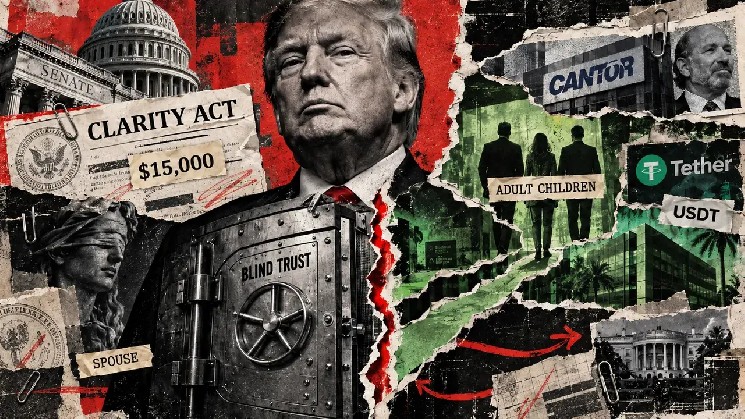
  • Why Trump backed a crypto ethics rule that stopped at the family business

    Why Trump backed a crypto ethics rule that stopped at the family business

    Key Highlights

    • The CLARITY Act’s failed ethics provision would have required senior federal officials to divest crypto-related equity holdings above $15,000 or place them in qualified blind trusts, covering spouses but not adult children.
    • Commerce Secretary Howard Lutnick’s transfer of Cantor Fitzgerald ownership to trusts benefiting his adult children illustrates the gap between legal separation and ongoing family financial exposure to crypto policy.
    • The Senate bill’s collapse leaves unresolved how far conflict-of-interest rules should extend when government policy can rapidly alter the value of family-held digital asset businesses.

    The CLARITY Act’s Ethics Provision: What It Targeted

    The final Senate draft of the Clarifying Law Around Regulations of Innovative Technology (CLARITY) Act contained a narrowly tailored ethics rule that came surprisingly close to becoming law before the bill stalled on Sept. 15. The provision would have applied to the president, vice president, senior executive officials, members of Congress, and other federal officeholders already subject to public financial-disclosure requirements. It mandated that any covered official holding an equity interest worth at least $15,000 in a business whose largest revenue source in any of the preceding three calendar years was issuing or sponsoring digital assets—excluding tokenized traditional assets—must either sell that interest or place it into a qualified blind trust. The same restriction extended to spouses, but adult children were explicitly excluded.

    Republicans characterized the final draft as incorporating most of a bipartisan ethics proposal and dozens of changes requested by Democrats. Yet several Democrats withheld support, arguing the protections did not go far enough. The disagreement centered less on the mechanics of the rule than on where the line between an official’s financial interest and the family’s should be drawn—a distinction that has become increasingly consequential as crypto ventures proliferate among political families.

    The Lutnick Case: Legal Separation vs. Family Economic Reality

    Commerce Secretary Howard Lutnick provides a real-world case study of why that boundary matters. Before joining President Donald Trump’s Cabinet in February 2025, Lutnick spent decades running Cantor Fitzgerald, a major Wall Street trading and investment firm that became deeply embedded in the crypto ecosystem through its relationship with Tether, issuer of the world’s largest stablecoin, USDT. Cantor has held billions of dollars in U.S. Treasuries for Tether and serves as reserve custodian and preferred primary dealer for Tether’s regulated U.S. stablecoin.

    Upon entering government, Lutnick stepped down from Cantor and, in October 2025, transferred his ownership through trusts benefiting his adult children. His son Brandon now runs the company and serves as controlling trustee of the trusts holding the voting interests. Securities and Exchange Commission filings confirm that after the transfer, Howard Lutnick no longer held beneficial ownership of the securities tied to that control structure. Legally, the separation is clean. Economically, however, the family remains heavily exposed to a business whose fortunes are directly affected by federal stablecoin regulation, banking access rules, and securities law—all policy levers within the Commerce Department’s sphere of influence.

    Blind Trusts vs. Family Transfers: A Critical Distinction

    The CLARITY draft’s blind-trust requirement highlighted a common misconception. In federal ethics law, a qualified blind trust is not merely an arrangement where an official transfers assets to a trustee and promises not to interfere. It requires an independent trustee and strict limits on the official’s knowledge of, and control over, the investments. The purpose is to prevent the officeholder from knowing enough about the portfolio to shape government decisions around particular holdings. Moreover, federal ethics guidance generally treats the original holdings as known until the trustee disposes of them or they fall below the relevant threshold; an official cannot erase knowledge of owning a company simply by signing a trust agreement.

    Lutnick’s structure, by contrast, removed his control while deliberately keeping ownership within the next generation of the family. That is a legitimate estate-planning and ethics-compliance move under current law, but it falls short of the blind-trust standard the CLARITY draft would have imposed for certain covered holdings. The bill’s language specified that under this provision, the trustee’s actions and those of businesses held by the trust would not be attributed to the official, though existing conflict-of-interest laws would still apply.

    Where the Bill Drew the Line—and Why It Mattered

    Federal conflict law has traditionally drawn the attribution line close to the official: financial interests of a spouse or minor child can be attributed to an executive-branch employee, but an independent adult child’s interests generally are not. That principle prevents the law from assuming every financially independent son or daughter is simply an extension of a government official. Crypto makes the consequences of that boundary much easier to see. A parent can leave office-facing control behind while the next generation continues running a business tied to stablecoins, token issuance, or Bitcoin finance—sectors whose economics can shift rapidly with federal policy.

    The Trump family illustrates the same dynamic. Trump’s latest certified financial disclosure showed more than $1.4 billion in 2025 income from crypto ventures, according to Reuters, with most connected to World Liberty Financial and the Trump meme coin business. World Liberty was founded with members of his family, including his sons. The White House has said Trump’s finances are managed by his children and that his private interests don’t influence administration policy. Under the Senate proposal, a qualifying interest still owned by Trump himself could have required divestment or a blind trust, as would his spouse’s holdings. Ownership held independently by adult children would fall outside that particular requirement.

    Why This Matters

    The collapse of the CLARITY Act leaves a regulatory vacuum that extends beyond market structure into the heart of government ethics. As digital asset businesses become major sources of private wealth for political families, the speed with which federal policy—stablecoin legislation, banking guidance, securities enforcement—can alter the value of those holdings creates a persistent conflict-of-interest challenge. Congress can require a president or Cabinet secretary to sell an asset or submit to a qualified blind trust. What it has not settled is how far those restrictions should follow the money once the business passes to the next generation. Until that question is answered, the gap between legal compliance and public confidence will remain a defining feature of crypto-era governance.

    Frequently Asked Questions

    What specific holdings would the CLARITY Act ethics rule have covered?

    The rule targeted equity interests worth at least $15,000 in businesses or subsidiaries whose largest revenue source in any of the preceding three calendar years was issuing or sponsoring digital assets, excluding tokenized traditional assets. It also restricted officials from issuing or sponsoring digital assets for compensation. Simply holding Bitcoin or other tokens would not have triggered the requirement unless the official held equity in a qualifying issuer or sponsor.

    Why were adult children excluded from the ethics provision?

    Federal conflict law traditionally does not automatically attribute the financial interests of independent adult children to a government official. The CLARITY draft followed that precedent, covering the official and spouse but not adult children. Several Democrats opposed the bill in part because they believed this exclusion left too much room for families to remain financially connected to crypto businesses while the government writes the industry’s rules.

    How does a qualified blind trust differ from transferring a company to family members?

    A qualified blind trust requires an independent trustee and strict limits on the official’s knowledge of and control over investments. The original holdings are treated as known until the trustee disposes of them. Transferring a family company to adult children, as Howard Lutnick did, removes the official’s control but deliberately keeps ownership and economic exposure within the family—a legal separation that does not meet the blind-trust standard.

  • Fetch.ai Investigates Token Conversion Contract Exploit

    Fetch.ai Investigates Token Conversion Contract Exploit

    Key Highlights

    • Fetch.ai is actively investigating a reported exploit targeting its token conversion contract, prompting immediate security scrutiny.
    • The project’s official X account (@Fetch_ai) has warned users to rely exclusively on official communication channels for updates.
    • The incident has introduced uncertainty into Fetch.ai trading activity, with market participants awaiting investigation results.

    Fetch.ai Launches Investigation Into Token Conversion Contract Exploit Reports

    Fetch.ai, the decentralized platform leveraging artificial intelligence-driven agents for automation, has confirmed it is investigating reports of a security exploit involving its token conversion contract. The announcement, disseminated through the project’s official X account @Fetch_ai, marks a critical moment for the blockchain network as it confronts potential vulnerabilities in its core infrastructure. The development team’s proactive disclosure signals a commitment to transparency, though the situation has already cast a shadow over user confidence and market sentiment surrounding the FET token ecosystem.

    Official Channels Emphasized Amid Security Scrutiny

    In its public communication, Fetch.ai explicitly urged community members and token holders to trust only verified official channels for information regarding the ongoing investigation. This directive underscores the heightened risk of misinformation, phishing attempts, and social engineering attacks that typically proliferate during security incidents in the cryptocurrency space. The project’s emphasis on channel verification reflects broader industry best practices for incident response, where controlling the narrative and preventing scam exploitation are paramount to protecting the user base.

    Market Reaction Reflects Investor Apprehension

    Trading activity for Fetch.ai currently shows no reported volume or price data, a phenomenon that market observers attribute to the uncertainty generated by the exploit announcement. The absence of liquidity metrics suggests that investors and traders are adopting a wait-and-see posture, reluctant to commit capital until the scope and severity of the vulnerability are clarified. This trading pause highlights the acute sensitivity of digital asset markets to security-related news, particularly for protocols like Fetch.ai that position themselves at the intersection of blockchain and artificial intelligence infrastructure.

    Why This Matters: Security Trust in AI-Blockchain Convergence

    The Fetch.ai exploit investigation carries significance beyond a single protocol’s technical challenges. As a platform building at the convergence of decentralized ledger technology and autonomous AI agents, Fetch.ai represents a category of infrastructure where security assumptions are still being stress-tested in production environments. Token conversion contracts—critical bridges for asset interoperability—are high-value targets for attackers due to their liquidity concentration and complex logic. The outcome of this investigation will likely inform security standards across the emerging AI-agent blockchain sector, influencing how developers architect conversion mechanisms, how auditors assess multi-layer protocols, and how users evaluate risk in systems where autonomous agents execute financial transactions. Regulatory observers will also monitor the response, as incident handling transparency becomes a benchmark for consumer protection in decentralized finance.

    Frequently Asked Questions

    What specific component of Fetch.ai is under investigation?

    The investigation focuses on the project’s token conversion contract, a smart contract mechanism responsible for facilitating asset exchanges or migrations within the Fetch.ai ecosystem. No other protocol components have been implicated in the current reports.

    Where should users obtain verified updates about this situation?

    Fetch.ai has directed all community members to rely exclusively on its official communication channels, particularly its verified X account @Fetch_ai, for accurate and timely information regarding the investigation’s progress and any required user actions.

    Has the exploit affected FET token trading on exchanges?

    Current market data indicates no reported trading volume or price for Fetch.ai, suggesting that exchanges may have suspended trading or that market participants have withdrawn liquidity pending clarification of the security incident’s scope and resolution.

  • Gen Z Invests Like Boomers, But Makes Surprising Portfolio Choices

    Gen Z Invests Like Boomers, But Makes Surprising Portfolio Choices

    Key Highlights

    • Gen Z investors on Binance are directing more than twice as much equity trading volume toward unleveraged ETFs (25%) compared to millennials (9.5%), with ETF inflows remaining resilient even as overall investment declined.
    • Gen Z accounts show the lowest trading turnover across direct equities, tokenized bStocks, and TradFi perpetuals among working-age cohorts, with 76% of bStocks accounts and 77% of direct-equity accounts acting as net accumulators.
    • Despite growing up with crypto-native products, Gen Z users treat leveraged instruments as short-term tools rather than core holdings, allocating less than 3% of net inflows to leveraged and inverse ETFs by early August.

    Gen Z Investors Defy Risk Stereotypes with Conservative Portfolio Behavior on Binance

    A new Binance Research report published August 12 reveals that the youngest cohort of investors on the exchange is exhibiting surprisingly traditional investment habits, challenging assumptions that digital-native generations gravitate exclusively toward high-risk, speculative assets. The analysis, covering Binance users over a short period after the direct-equity product reached scale in June 2026, shows Gen Z participants recording the lowest portfolio turnover across all three major product lines: direct equities, tokenized bStocks, and TradFi perpetuals.

    ETF Adoption Outpaces Older Generations

    The clearest divergence appears in exchange-traded fund usage. In the first days of August, ETFs accounted for 25% of Gen Z’s direct-equity trading volume, up from 14.6% in June. Millennials, by comparison, allocated just 9.5% of their equity volume to funds during the same period. The inflow data reinforces this trend: unleveraged ETFs captured 18.5% of Gen Z’s net equity inflows in June and 21.9% in July, while the share directed to individual stocks declined from 77% to 74.2%.

    July saw a broad pullback in Gen Z equity deployment, with net investment falling 17.4%. However, unleveraged ETF inflows barely moved, declining only 2%, versus a 20.4% drop for single-stock inflows and a 28.5% drop for leveraged products. Gen Z was also the only cohort whose ETF holder base expanded in July, growing 2.9% while millennial and Gen X holders fell 4.5% and 5.9% respectively. This suggests ETFs function as a core allocation rather than a peripheral trade.

    Holdings Reflect Quality Bias Over Lottery Tickets

    Among Gen Z accounts that had only bought and never sold, the largest average direct-equity purchase was Schwab’s US Dividend Equity ETF (SCHD) at $16,567 per trade, followed by Broadcom at $12,370. While overall holdings show a semiconductor and artificial intelligence tilt, smaller average purchases went to names associated with retail speculation such as Tesla ($633) and Nvidia ($514 in bStocks). The pattern indicates larger tickets flow toward dividend and quality factors, while speculative names receive smaller position sizing.

    Holding behavior supports the accumulation narrative. Approximately 22% of Gen Z direct-equity accounts had never placed a sell order, compared with 19% for Gen X and 9% for Baby Boomers. Millennials led this metric at 30%. When the definition expands to net accumulators (buying more than selling), Gen Z moves to the front: 76% of bStocks accounts and 77% of direct-equity accounts were net accumulators, the highest shares across all generations.

    Perpetuals Used for Trading, Not Capital Formation

    Gen Z’s engagement with TradFi perpetuals reveals a similar discipline. The average Gen Z account executed 13 perpetual trades per month, below millennials (17), Gen X (16.5), and Baby Boomers (19). Only 14% of Gen Z perpetual accounts qualified as high-frequency, lower than all other working-age cohorts and even below boomers at 16%.

    Avoidance of leveraged and inverse products is pronounced: 88.2% of Gen Z TradFi-perpetual accounts recorded no activity in these instruments, compared with 84.5% for millennials and 85.9% for Gen X. In bStocks, 98.9% of Gen Z accounts avoided them entirely. Baby Boomers remain the most conservative overall, with 98.9% of direct-equity accounts avoiding leveraged and inverse products versus 96.5% for Gen Z.

    Leverage Treated as Tactical, Not Strategic

    The data shows leverage is used as intended: for short-term positioning rather than capital parking. Leveraged and inverse ETFs represented 9.25% of Gen Z direct-equity turnover in July but only 3.93% of net inflows, falling further to 2.65% by early August. TradFi perpetuals show a comparable pattern: roughly 60% of Gen Z accounts were net buyers (the highest proportion of any age group), yet net flow represented less than 1% of gross volume, indicating rapid position cycling.

    By contrast, direct equities displayed a net flow ratio of 26.5% with average net inflows of $1,898 per account. The distinction underscores that persistent capital is allocated to ownership-oriented products while derivatives serve tactical purposes.

    Why This Matters: Emerging-Market Access Reshapes Brokerage Dynamics

    Binance’s earlier research on the next generation of investors provides context for this behavior. Gen Z comprises approximately 44% of direct-stock and bStocks users and 45% of TradFi-perp users, making it the largest cohort in direct stocks and bStocks and roughly level with millennials in perpetuals. More than 90% of TradFi users across generations reside in emerging markets, where accessing US securities through conventional domestic brokers can be significantly more difficult.

    For many of these users, the crypto exchange functions as the most accessible brokerage they have encountered. The interface is familiar, accounts are pre-funded, fractional exposure is available, and markets operate outside standard US trading hours. Binance reported that 13% of all Direct Stocks users were Gen Z customers in emerging markets with less than $2,000 in equity assets. This structural advantage allows the platform to capture ordinary investment flows without converting every user into a high-frequency derivatives trader.

    Crypto-Native Doesn’t Mean Risk-Seeking

    The contrast with earlier crypto cycles is stark. Products like Pickle Finance, with its “Jars” and “Farms” compounding returns across protocols, and ShibaSwap, using terms like “Bury” for staking with tokens named SHIB, LEASH, and BONE, created a vernacular that made decentralized finance sound, in the report’s words, “like a pension designed during a prolonged supermarket incident.” A decade of such experimentation fostered an assumption that generations raised on Dogecoin would embrace financial complexity.

    Instead, the data shows younger users allocating a growing share of equity capital to unleveraged ETFs, trading less frequently than older cohorts, and confining leveraged exposure to a small slice of net investment. This does not signal an abandonment of crypto: a 2023 FINRA Foundation and CFA Institute survey found 55% of US Gen Z investors owned cryptocurrency, and CryptoSlate has previously documented broader young American appetite for crypto assets. Rather, it suggests that using crypto infrastructure and seeking maximum financial risk are distinct preferences.

    For a user whose first financial interface was an exchange app, Binance does not represent a rebellious alternative to a traditional brokerage; it is simply the financial infrastructure they know. Once stocks and ETFs appear within that interface, there is no imperative for their investment taste to mirror the branding of crypto’s earlier years. Gen Z is not replicating 1990s wealth management—semiconductor exposure, AI stocks, tokenized equities, and 24-hour markets are modern tools—but they are applying an old-fashioned instinct: buy, hold, and avoid making every position dependent on leverage. The crypto industry spent years making finance stranger to attract younger users; the youngest users may have taken the interface and left some of the weirdness behind.

    Frequently Asked Questions

    How does Gen Z’s ETF usage compare to older generations on Binance?

    In early August, ETFs accounted for 25% of Gen Z’s direct-equity trading volume, more than double the 9.5% seen among millennials. Gen Z was also the only cohort to grow its ETF holder base in July (+2.9%), while millennial and Gen X holders declined.

    Are Gen Z investors avoiding leverage entirely?

    No. Gen Z accounts do trade leveraged products and perpetuals, but they treat them as short-term tactical tools. Leveraged and inverse ETFs represented over 9% of turnover in July but less than 3% of net inflows, and perpetual net flows were under 1% of gross volume, indicating rapid position cycling rather than capital allocation.

    Why are so many Gen Z users in emerging markets using Binance for traditional equities?

    Over 90% of Binance’s TradFi users across all generations are based in emerging markets where accessing US securities through domestic brokers is difficult. Binance offers a familiar, pre-funded interface with fractional shares and extended trading hours, effectively serving as the most accessible brokerage for these users.

  • REX Launches 2x Leveraged ETF Tied to Bitcoin Treasury Firm Strive

    REX Launches 2x Leveraged ETF Tied to Bitcoin Treasury Firm Strive

    Key Highlights

    • REX Shares and Tuttle Capital Management launched the T-REX 2X Long ASST Daily Target ETF (ticker: ASSX) on Cboe, offering 200% daily leveraged exposure to Strive shares.
    • Strive, a Bitcoin treasury company, holds 25,000 BTC—ranking as the fifth-largest publicly traded corporate Bitcoin holder—and recently acquired 469 BTC via its SATA perpetual preferred stock.
    • The fund resets leverage daily and does not hold Bitcoin directly; Strive shares closed Friday at $30.09, up 6.4%, above the $29.40 average analyst price target.

    REX and Tuttle Debut Double-Leveraged Strive ETF on Cboe

    REX Shares and Tuttle Capital Management have expanded their lineup of single-stock leveraged exchange-traded funds with the launch of the T-REX 2X Long ASST Daily Target ETF, which began trading Friday on Cboe Global Markets under the ticker ASSX. The fund is engineered to deliver twice the daily percentage change of Strive (ticker: ASST) shares before fees and expenses, providing traders with a magnified bet on the Bitcoin treasury company’s equity performance rather than on the cryptocurrency itself.

    Mechanics and Distinction From Spot Bitcoin ETFs

    Unlike the spot Bitcoin ETFs that have dominated inflows this year, ASSX holds no Bitcoin and does not seek to track the price of BTC. Instead, it uses swap agreements and other derivatives to achieve 200% daily exposure to Strive’s share price. Because the fund resets its leverage at the end of each trading session, returns over periods longer than a single day can diverge materially from two times the cumulative performance of Strive stock—a characteristic common to all daily-reset leveraged ETFs and a critical risk factor for investors holding beyond intraday horizons.

    Strive’s Bitcoin Treasury Profile

    Strive, founded by Vivek Ramaswamy and Anson Frericks, operates as both an asset manager and a corporate Bitcoin accumulator. According to data from BitcoinTreasuries.NET, the company holds approximately 25,000 BTC, placing it fifth among publicly traded corporate holders behind MicroStrategy (now Strategy), Marathon Digital, Riot Platforms, and Hut 8. Strive financed its most recent acquisition of 469 BTC through sales of its SATA perpetual preferred stock, a structure designed to avoid shareholder dilution while expanding the treasury.

    Why This Matters

    The launch of ASSX signals growing sophistication in the crypto-adjacent ETF ecosystem, moving beyond direct spot exposure into derivative instruments tied to Bitcoin-correlated equities. Strive’s unique model—combining asset management with a corporate treasury strategy—creates a distinct risk-return profile: its share price reflects both Bitcoin’s volatility and the market’s valuation of its capital-allocation decisions. For traders, ASSX offers a tool to express high-conviction, short-term views on Strive specifically, while the broader suite of 2x ETFs from REX and Tuttle—covering Strategy (MSTR), BitMine (BITF), Cipher Mining (CIFR), Circle (CRCL), and SharpLink (SBET)—enables sector-wide leveraged plays. With Strive shares trading above the consensus 12-month price target of $29.40 (per S&P Global), the market appears to be pricing in continued treasury expansion, though the daily-reset mechanism makes ASSX unsuitable for passive long-term holders.

    Frequently Asked Questions

    Does ASSX hold Bitcoin directly?
    No. ASSX does not hold Bitcoin or track its price. It seeks 200% of the daily performance of Strive (ASST) shares through derivative contracts.
    How does the daily leverage reset affect returns?
    Because ASSX resets its 2x leverage daily, holding the fund for more than one trading day can result in returns that differ significantly from twice Strive’s cumulative performance due to compounding effects, especially in volatile markets.
    What other 2x leveraged ETFs do REX Shares and Tuttle Capital Management offer?
    The firms also provide 2x ETFs linked to Strategy (MSTR), BitMine (BITF), Cipher Mining (CIFR), Circle (CRCL), and SharpLink (SBET).
  • Analyst Behind Viral Model Reveals Bitcoin’s Next Bullish Target

    Analyst Behind Viral Model Reveals Bitcoin’s Next Bullish Target

    Key Highlights

    • Bitcoin has closed above the 50-week moving average (~$79,000), with the next technical target at the 100-week moving average (~$89,000).
    • Analyst PlanB declares the Bitcoin bear market over, citing August’s close at $78,571 and recovery across multiple market indicators.
    • Profitable Bitcoin supply surged from 50% to 72%, while the monthly RSI climbed from 41 to 51, signaling strengthening momentum.

    Bitcoin Breaks Key Technical Barrier as PlanB Signals Bear Market End

    Bitcoin’s price action has crossed a critical threshold, closing above the 50-week moving average near $79,000 and trading around $81,000 at the time of analysis. Widely followed pseudonymous analyst PlanB highlighted the development, stating, “Bitcoin closed above the 50-week moving average. The next target is the 100-week moving average, around $89,000.” This technical milestone positions the asset for a potential test of the longer-term 100-week average, a level historically associated with major trend transitions.

    Multiple On-Chain and Momentum Indicators Confirm Recovery

    Beyond the moving average crossover, PlanB emphasized a confluence of supporting data points. The analyst noted that August concluded with Bitcoin at $78,571, marking a turning point after which various market indicators began to recover. Notably, the percentage of Bitcoin supply in a profitable state has jumped significantly from 50% to 72%, reflecting a broad improvement in holder economics. Simultaneously, the monthly Relative Strength Index (RSI) has risen from 41 to 51, crossing above the neutral 50 threshold and indicating a shift from bearish to bullish momentum on the macro timeframe.

    Analyst Concludes Bottom Is Likely In

    Synthesizing these technical and on-chain metrics, PlanB assessed that the bear market in Bitcoin has ended and that the cryptocurrency may have already passed its cycle bottom. The combination of price reclaiming the 50-week moving average, expanding profitable supply, and improving momentum oscillators constructs a technical framework that supports bullish expectations for the upcoming period. While the analyst’s commentary carries weight in the crypto community, the standard disclaimer applies: This is not investment advice.

    Why This Matters

    The 50-week and 100-week moving averages are among the most watched long-term trend filters in Bitcoin technical analysis. A sustained close above the 50-week average has historically preceded extended uptrends, while the 100-week average often acts as a “line in the sand” between bull and bear market regimes. The simultaneous improvement in realized profitability metrics—from 50% to 72% of supply in profit—suggests a reduction in unrealized losses across the network, which typically reduces selling pressure. The monthly RSI reclaiming 50 adds a momentum confirmation that has been absent during the recent consolidation phase. Together, these factors align with a classic market structure shift from accumulation to markup, though macroeconomic risks and regulatory developments remain external variables.

    Frequently Asked Questions

    What are the specific price levels for the 50-week and 100-week moving averages mentioned by PlanB?
    The 50-week moving average sits around $79,000, which Bitcoin has now closed above. The next target, the 100-week moving average, is approximately $89,000.
    What on-chain metric showed the most dramatic improvement according to the analysis?
    The percentage of Bitcoin supply in a profitable state increased from 50% to 72%, a 22-percentage-point jump indicating significantly healthier holder economics across the network.
    Does PlanB’s analysis constitute a price prediction or investment recommendation?
    No. The analysis presents a technical assessment based on moving averages, profitability ratios, and momentum indicators. The source explicitly includes the disclaimer: “This is not investment advice.”