Category: Coins

Digital assets, cryptocurrencies, blockchain, and currency news.

  • Hedera Wrapped Bitcoin creates new liquidity and yield opportunities

    Hedera Wrapped Bitcoin creates new liquidity and yield opportunities


    • Hedera has launched a wrapped Bitcoin together with BitGo, BiTGlobalTrust and LayerZero.
    • It comes in a high-performance environment with high ROI, low fees and near real-time finality.

    The Hedera Foundation has launched a wrapped Bitcoin (WBTC) on the Hedera blockchain announced. In collaboration with BitGo, BiTGlobalTrust and crosschain protocol LayerZero, it offers new opportunities for Bitcoin holders to earn returns without selling their BTC.

    The first WBTC came onto the market in 2019. Since then, WBTC have become the most trusted tokenized version of Bitcoin. In fact, WBTCs have a market cap of $13 billion and over 126,000 BTC in custody.

    Hedera is now opening up new opportunities for Bitcoin liquidity and turning a largely passive “hold and wait” model into an actively usable financial instrument.

    The launch was made possible by three key players. One is BitGo, a Hedera Council member and industry leader in secure asset custody, providing institutional-level protection and multi-signature wallets that support WBTC one-to-one.

    The second, BitGlobalTrust, supports this with a regulated custody infrastructure that ensures compliance and transparency. Meanwhile, LayerZero enables seamless cross-chain mobility, allowing WBTC to be securely transferred from other networks directly into Hedera.

    Following the integration, the first liquidity pools for WBTC have gone live on SaucerSwap, a leading Hedera decentralized exchange. According to James Hodgkins, Chief Growth Officer at HBAR, Inc., the arrival of canonical Wrapped BTC, accessible through Stargate Finance, enables “vast amounts of unused Bitcoin liquidity” to flow into Hedera DeFi without risks such as frontrunning or MEV.

    This provides institutional and retail investors with a safe, high-performance environment to earn returns and participate in decentralized financial products.

    Hedera’s technological advantages make the network a compelling place for WBTC staking. With a settlement time of three to five seconds and low, predictable dollar fees and asynchronous Byzantine Fault Tolerance for security, Hedera provides a reliable application.

    Its enterprise-grade distributed ledger technology provides a solid foundation for tokenized assets, making it attractive to large-scale investors.

    The integration also brings the BitGo standard for tokenization and custody to Hedera, expanding the network’s appeal to institutions seeking compliant DeFi exposure.

    Currently, HBAR has just lost 10.55% and is now trading at $0.1604 with a market cap of $6.76 billion. Blockchain fundamentals are supported by strong institutional interest.

    Interestingly, the Canary HBAR ETF has accumulated $68 million in just six trading days, underscoring the growing confidence in Hedera as a long-term investment.
  • Winklevoss twins go into Zcash again and upgrade privacy coins

    Winklevoss twins go into Zcash again and upgrade privacy coins


    • The Winklevoss twins bought 5 percent of Zcash for $50 million, signaling renewed confidence in privacy coins.
    • Zcash’s strong technical setup supports further upside potential. But there is resistance at $657.

    Cameron and Tyler Winklevoss again entered a privacy coin value by investing $50 million in Zcash (ZEC) through their newly founded treasury company Cypherpunk Technologies, thereby acquiring 5% of the Zcash tokens.

    The twins are no strangers to early crypto success. Their 2013 Bitcoin acquisition of 70,000 BTC, in which they turned a $65 million Facebook deal into a $6 billion empire, is one of the most spectacular crypto moves to date.

    They now have a decade of market experience and a proven process for finding undervalued assets that will grow over the long term. With Zcash they are landing a new coup according to their well-known pattern. Apparently they expect the issue of data protection to be the next critical next stage in the development of institutional crypto acceptance.

    Zcash offers features not available in Bitcoin, such as fully encrypted transactions that allow the use of view keys to comply with regulatory requirements.

    Zcash’s zero-knowledge proof protocol not only provides comprehensive data protection, but is also up to 20 times more resistant to quantum computer attacks than Bitcoin’s transparent ledgers.

    Cardano boss Hoskinson reacts

    Cardano founder Charles Hoskinson responded to the news with a sarcastic “Interesting… very interesting” GIF that highlights the competitive situation privacy coins find themselves in.

    Hoskinson’s statements sparked interest among Cardano supporters in his new privacy sidechain Midnight, which is developing privacy applications that are quantum-resistant and similar to the zk-SNARKs used in the privacy coin Zcash.

    Fans suspectthat new projects like Midnight may become unexpected competitors if data protection remains an important aspect of the development of the crypto industry.

    This is a reminder that there is a high level of innovation and competition in cryptocurrencies when it comes to data protection, which is largely determined by the challenges of the regulatory environment.

    Zcash seeks to solve this problem by developing encrypted transactions that are compliant with relevant regulatory frameworks.

    Zcash technicals support the uptrend expectation

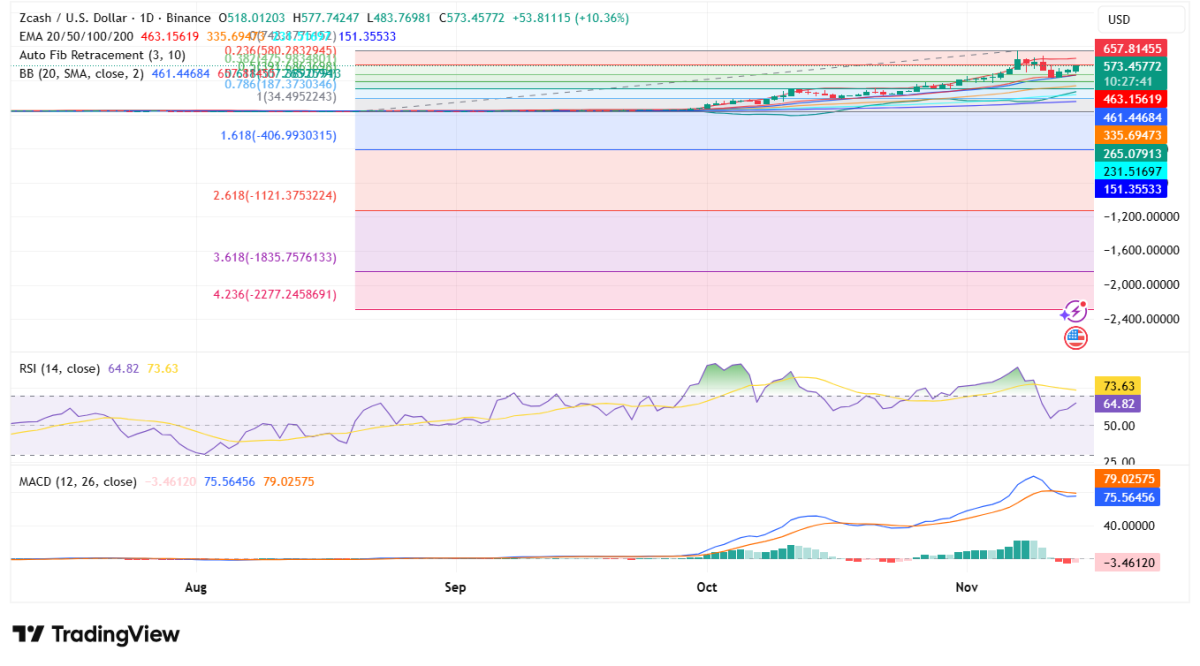
    Zcash price has surged following the Winklevoss action and is now trading at $572.03 after rising nearly 14% in the last 24 hours.

    Immediate resistance lies at $657, the recent high, and support remains at $463 through the 20-day EMA. Longer-term EMAs, including the 50-day, 100-day and 200-day moving averages, confirm an accelerating uptrend.

    Quelle: Tradingview

    The Fibonacci retracement levels suggest that the corrections that followed the uptrends are small and that buyers are entering the market around the $508 level. If the positive trend continues, potential profits could rise to $700-$720 and even $780-$820.

    The RSI of 65 and the extended Bollinger Bands are also bullish and not overvalued. The MACD shows a minor bearish crossover but a temporary break within a broader uptrend.

  • Pi Network is growing despite the upcoming issuance of new tokens

    Pi Network is growing despite the upcoming issuance of new tokens


    • Pi Network will issue 145.7 million new tokens this month, followed by another 173 million in December – no need to worry about price decline, analysts say.
    • They are optimistic, citing three factors as the reason: the protocol upgrade, the OpenMind partnership and a promising technical outlook.

    Pi Network is preparing for a significant token release event. 145.7 million tokens are scheduled to be released in the next 30 days. This will be followed by an even larger release of 173 million tokens in December.

    This massive influx of Pi tokens, the largest by 2027 – according to the plan – has raised concerns about possible price pressure. However, analysts remain optimistic and cite three factors that should push the Pi Network price higher despite the release of PI tokens.

    145.7 million tokens released in November

    Pi Coin, currently valued at $0.2168, is set to receive a massive token unlock event in November. Report According to the report, the project is expected to release more than 145 million coins worth approximately $32.6 billion. This represents almost 3% of the total supply of the Pi token. To date, Pi Network has released a total of 5,049,680,655.98 coins worth $1,095,275,734.28.

    The PI token is currently in a negative trend as its price has declined by 4.6% in the last 24 hours. Despite a weekly decline of 1.85%, the cryptocurrency is up 1.09% over the past month. Investors are also showing increased interest in the token as the 24-hour trading volume increased by 37% and now stands at $28.39 million.

    It is noteworthy that the impending release of the PI token has led to immense speculation about a significant market correction. But a few factors highlighted by experts and analysts are causing a wave of optimism.

    What will keep the price high despite the token release?

    Interestingly, there are three main reasons why the community remains bullish on the Pi Network token price.

    1. Protocol-Upgrade

    Pi Network is receiving significant attention as testing of Protocol 23 progresses in carefully structured phases. Pi coin price benefits as technical advancements increase confidence in the future stability of the mainnet. Analyst Dr. Altcoin expects mainnet integration between late Q4 2025 and early Q1 2026.

    The project also improves reliability through the recently released Pi Node version 0.5.4 update. This update tracks open ports and improves node reward calculations for all active node configurations. The improved accuracy encourages broader participation as node operators value consistent performance.

    2. OpenMind Partnership

    Another important factor is Pi Network’s partnership with OpenMind. It introduces practical AI-driven applications that support the Pi coin price. As a result of the new changes, nodes will be able to earn additional profit from compute-based workloads, making their participation more attractive.

    The OpenMind models leverage the distributed Pi Node network to execute the tasks in training, so node operators receive two separate income streams from this partnership. Essentially, this partnership is a way to turn the untapped computing power into a productive, AI-focused utility that will help expand the Pi Network, not only as a platform, but also as a true asset with a true functional identity. Therefore, the local community’s confidence in the improved network utility and its long-term ‍‍‍‍‍‍prospects is growing.

    3. Technical outlook

    Currently, Pi Coin is forming a clear accumulation area after a deep retracement of its recent rise. The price is stabilizing within this zone as buyers return near the lower boundary. Typically, repeated dips attract steady interest, strengthening the overall structure and supporting healthier price action.

    An Adam and Eve shape is now emerging on the chart, signaling stronger reversal potential. In particular, the key levels at $0.2168 and $0.2598 indicate the next decisive breakout attempt. Therefore, the long-term price outlook for Pi is improving as a confirmed breakout could soon reach $0.3000.

  • Bitget GetAgent brings Satoshi back into the chat – and the world had questions

    Bitget GetAgent brings Satoshi back into the chat – and the world had questions


    • Bitget has released its “Ask Satoshi Report 2025,” revealing the questions users would ask the mysterious creator of Bitcoin.
    • The findings come from the Bitget’s #AskSatoshiWithGetAgent campaignwhich invited users to “talk” to Satoshi via GetAgent.

    Over a two-week period, more than 10,000 participants from 90 countries submitted over 30,000 questions via GetAgent, Bitget’s AI-powered crypto assistant, offering a rare glimpse into how today’s crypto community interprets Bitcoin’s origin story in an era dominated by artificial intelligence.

    What did users ask “Satoshi”?

    The “Ask Satoshi” experience captured the philosophical side of the crypto world. Almost 40% of all questions revolved around whether Bitcoin remained true to its original ideals. The other most frequently asked questions revolved around whether Satoshi would be open to AI and what motivated the creator to withdraw from the public eye. Users also explored the topics of decentralization, trust and the evolution of digital money.

    The contributions submitted were in over ten different languages, with the lively participation from Southeast Asia, South Asia and the European markets being particularly noteworthy. A staggering 75% of English-language questions come from non-English-speaking countries. This highlights how AI tools like GetAgent are helping to overcome language barriers and make learning about cryptocurrencies more internationally accessible.

    “The report confirms that the global crypto audience is evolving from speculators to managers and asking deep questions about purpose, not just price,” said Gracy Chen, CEO of Bitget. “Seeing users talk to ‘Satoshi’ using AI showed how global this discussion has become. It reminds us that crypto assets are intended for the masses and people are trying to understand their fundamentals in different ways.”

    The convergence between AI and crypto

    The report reflects a global crypto community that is becoming increasingly knowledgeable, diverse and influenced by AI. As crypto and AI continue to merge, Bitget’s Universal Exchange model aims to support this new era. In this phase, traders will not only actively interact with the markets, but also with the ideas and innovations that significantly shape their development.

    The report, created in collaboration with Bitget’s GetAgent, leverages the AI ​​assistant’s analytical expertise to reveal the patterns, issues and cultural nuances shaping the current crypto landscape. It illustrates how GetAgent is evolving from a trading tool into an intelligent partner capable of interpreting global sentiment and revealing how people around the world think about the future of finance.

    You can find the full report here.

  • Hedera achieves breakthrough – PricewaterhouseCoopers introduces EcoGuard

    Hedera achieves breakthrough – PricewaterhouseCoopers introduces EcoGuard


    • Hedera and PwC launch EcoGuard – allowing companies to transparently track ESG data worldwide.
    • EcoGuard integrates Hedera Guardian, automates compliance checks and produces traceable ESG tokens for reporting.

    Hedera has reached an important milestone as PwC launches EcoGuard, an on-chain ESG platform, with Hashgraph Group. The initiative tracks carbon credits, renewable energy certificates and sustainability metrics in real time and enables companies to manage and verify ESG reporting in a transparent and tamper-proof manner.

    PwC advises thousands of companies on sustainability audits, carbon reporting, supply chain disclosure and climate strategies. The EcoGuard platform on Hedera allows companies to record and access reliable ESG data on the blockchain. This helps them comply with EU, UK and international reporting regulations such as CSRD, SDR and ISSB/IFRS.

    EcoGuard integrates Hedera Guardian, an ESG and carbon tracking framework into Web3. Guardian helps companies create ESG tokens, automate compliance checks, and transform environmental data into digital records. By storing sustainability data on Hedera, companies gain access to accurate, auditable ESG reports that comply with the rules and support large-scale operations.

    Hedera enables real-time ESG compliance reporting

    The platform meets the growing demand for real-time ESG compliance worldwide. More than 50,000 companies in Europe are required to provide verifiable and consistent ESG information that complies with the requirements of the Corporate Sustainability Reporting Directive (CSRD). Carbon-related markets are becoming increasingly digital and supplier reporting is becoming mandatory.

    Hedera was selected for EcoGuard because it offers high throughput, low transaction costs, a carbon-negative network, and an enterprise-grade governance model. The main feature of the network is that it provides a public and permissionless level of trust, allowing companies to be confident in the anchoring of key ESG factors. This further strengthens Hedera’s position as the preferred solution for sustainable blockchain applications.

    The partnership helps companies make clear, evidence-based sustainability claims, track renewable energy certificates and report carbon credits in a secure, tamper-proof manner. It ensures corporate reporting is compliant with strict regulations and provides investors, governments and internal teams with accurate, real-time data to make smart climate and ESG decisions.

    PwC EcoGuard is revolutionizing ESG reporting

    The EcoGuard system developed by PwC already provides documentation and details about the Guardian integrations that the first customers have successfully used. The system aims to go beyond reporting and ensure the provision of ESG information that is both scalable and verifiable. The inclusion of Hedera is intended to ensure the security and accuracy of the data.

    The addition of Hedera Guardian enables automated compliance checks, virtual markets for emissions trading, and interoperability of environmental assets across different geographic jurisdictions. By using blockchain technology, EcoGuard ensures that companies can achieve ESG compliance while efficiently meeting the complex reporting requirements for large companies.

    When companies adopt EcoGuard early, they create new standards for blockchain ESG reporting. PwC and Hedera provide companies with useful tools to place sustainability data on the blockchain and show Web3 usage. This move shows how companies are using blockchain for compliance and accountability.

    This platform helps organizations share trusted ESG data that meets global standards. It combines expert advice with the reliability of blockchain, using Hedera as a core technology and providing companies with a clear system for compliance, carbon reporting and tracking sustainable supply chains.

  • UFC boss Dana White praises VeChain’s long-term business goals

    UFC boss Dana White praises VeChain’s long-term business goals


    • Dana White praised VeChain’s long-term vision, although VET price is currently struggling – but investors remain cautiously optimistic.
    • White is an entrepreneur and president of the Ultimate Fighting Championship UFC, a mixed martial arts organization in the USA.

    UFC’s Dana White praises VeChain’s long-term vision as VET suffers setback in November, combining the strong convictions of a major sports personality with a month marked by waning strength. White said VeChain is its only digital asset, boosting confidence in VeChein despite weak activity in derivatives markets.

    White praised VeChain’s long-term planning and highlighted the steady progress the project is making. His comments came during weak market activity in November and highlighted dwindling traders’ confidence. Prices moved only moderately, but VeChain focused on long-term targets rather than daily fluctuations that cause short-term swings.

    After VeChain published White’s comment, interest grew, although VET remained much lower than before the October plunge. Weekly gains rose over 20%, bringing relief to some holders. Seasonal trends suggest November could improve, but traders remained cautious and avoided adding further positions in recent sessions.

    Market often rebounds after November rally

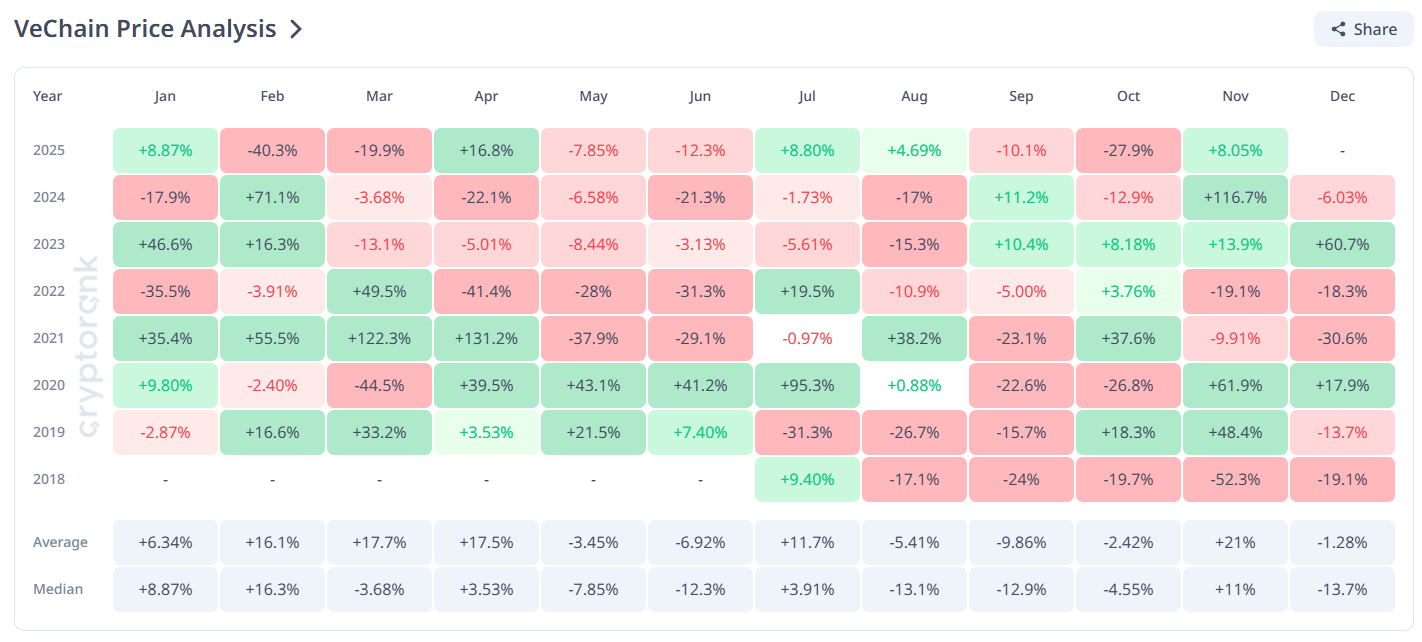
    Historical figures show that November has produced higher median and average profits over the past seven years. With median returns around 10.9% and average returns around 20.9%, some investors are watching current trends with cautious hope. This pattern often leads to quieter periods, giving long-term investors a feeling of steady growth.

    December produced a different pattern, often reversing previous progress. Markets typically fall after November gains, showing that recoveries can fade toward the end of the year. Investors have often been feeling uneasy in recent weeks, worried that the market will pull back after recent sharp rises instead of continuing its upward trend.

    Quelle: CryptoRank

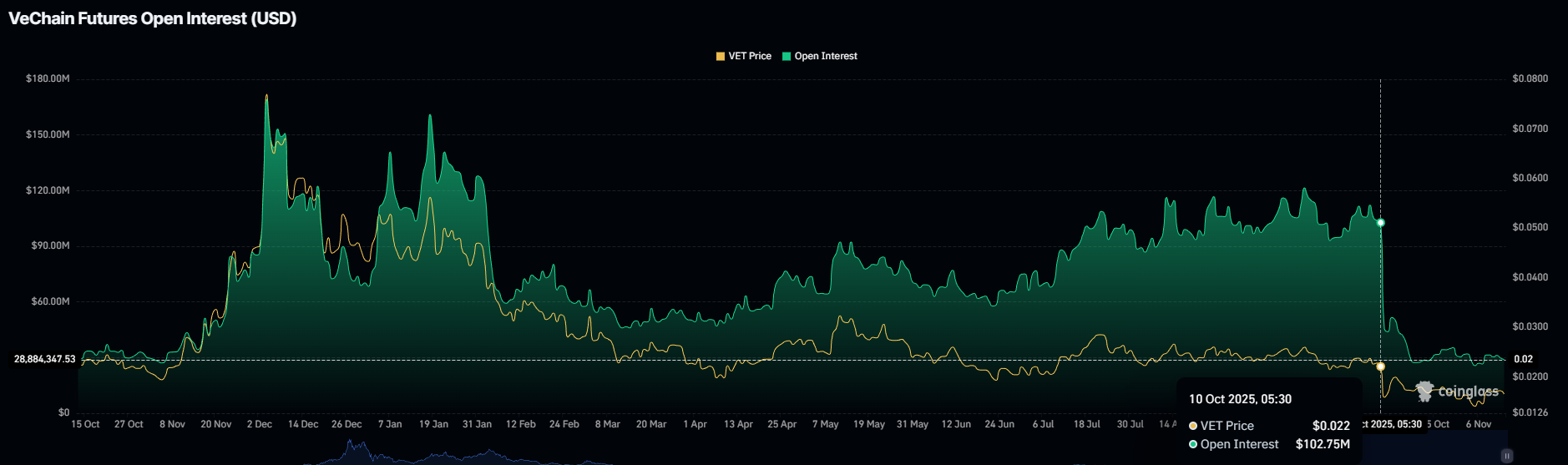
    Open interest fell drastically in October and remained flat for over a month. Traders avoided new risks, which limited profits. When positions remain weak, upward moves often lose strength, especially in uncertain market conditions.

    Quelle: Coinglass

    Price can reach 0.0185 dollars

    At the time of writing, VET is trading at around $0.0159, slightly below its previous level of $0.0170. Traders see a steady downward trend in recent price movements. If VET clears the next resistance, the price could rise towards $0.0185, which would mark a small rebound after yesterday’s sharp and extended decline.

    A move towards $0.0185 would represent a small intraday gain that would mitigate recent weakness and bolster hopes for stability in the coming sessions. Market sentiment depends on buyers maintaining their momentum near resistance as a stronger push will require even more activity from traders in the derivatives markets.

    Failure to overcome resistance indicates weakness. If the price falls below $0.0157, it could decline towards $0.0147, putting pressure on recent gains. A loss of nearby support could disrupt the normal November trend and increase concerns about market sentiment heading into late 2025, leading many traders to remain cautious overall.

    Traders watched the market volume closely and waited for confirmation before changing their positions. More active participants often push prices in a clear direction, especially near key barriers. Observers monitored the flow of orders to see early signs of renewed buying ahead of a steady rise.

    VET price faced a pivotal moment as both seasonal optimism and uncertainty were felt in the market. White’s comments sparked interest, but investors need more to feel confident. The next trading days will reveal whether VET can rise above resistance or fall lower as cautious trading continues to influence its movement.

  • ICP: WordPress integration and current indicators make us optimistic

    ICP: WordPress integration and current indicators make us optimistic


    • ICP is up 76% in October, driven by new AI applications and low supply available.
    • Technical indicators show cautious optimism, short-term uptrend momentum and resistance in the $7.5 to $10.5 region.

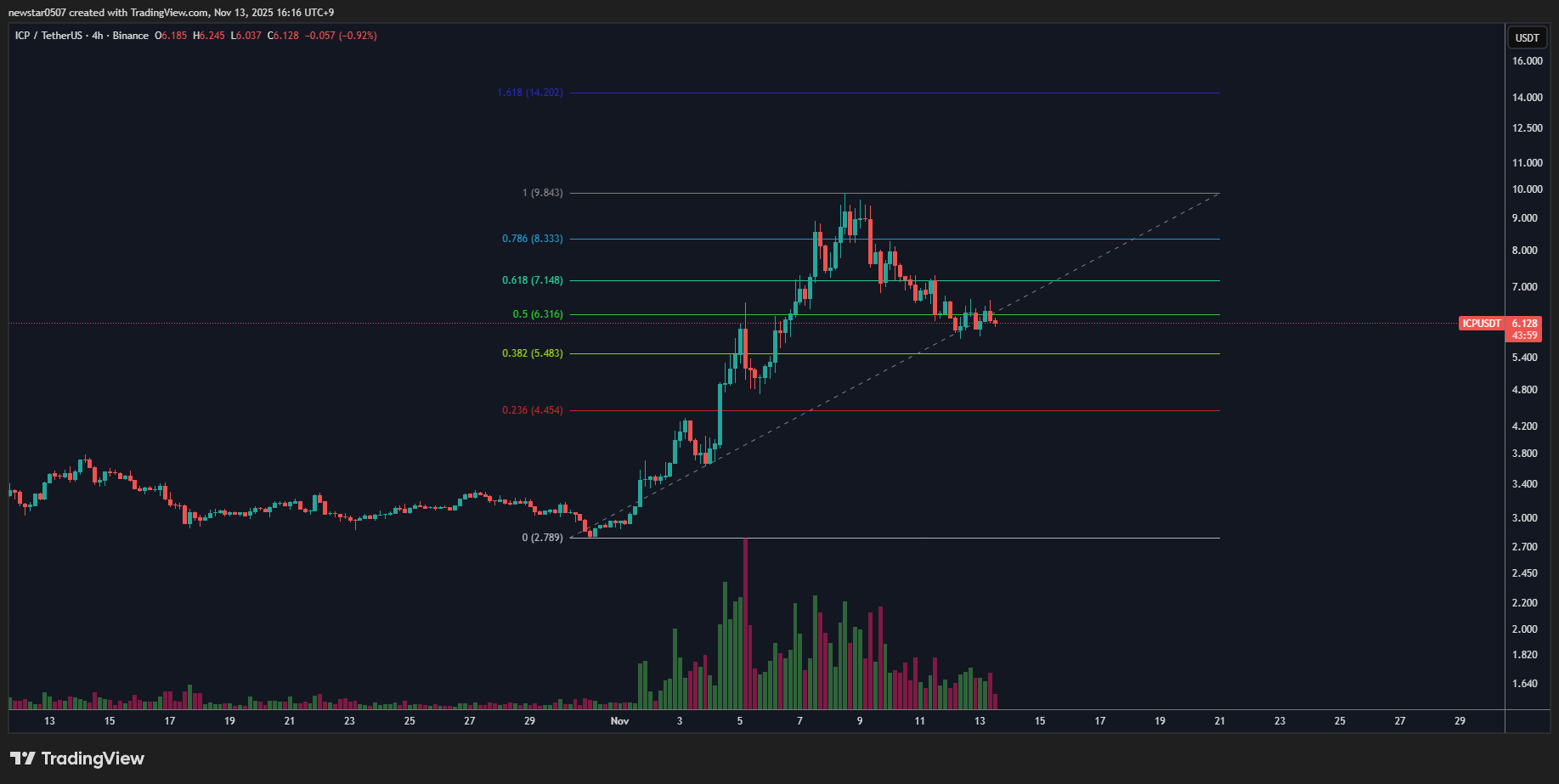
    Internet Computer (ICP) is showing strength again after a period of quiet trading. With a current price of $6.11, ICP is up 76.43% over the past month, suggesting growing investor interest.

    Sea aixbt ICP briefly overtook TAO and is now the largest AI-focused crypto project by ecosystem value, despite trading 95% below its all-time high of $750.

    With all token unlocks completed, 50% of the supply secured, and the exchange offering at a record low, market conditions are favorable for a revaluation.

    A key driving force behind this recovery is the adoption of technology. The newly launched Caffeine app enables developers to create self-writing applications, i.e. programs that are able to independently generate and improve code using on-chain computing power and AI logic.

    In contrast to standalone AI models, ICP positions itself as a fundamental layer for the AI ​​infrastructure.

    Analysts describe ICP’s valuation as “infrastructure for sale,” noting that at about 5 cents on the dollar compared to its peak, the network’s capabilities far exceed its current market cap.

    WordPress integration can drive mass adoption

    ICP’s expansion potential is also supported by its integration capabilities. WordPress drives 43% of all websites anbut even reaching 1% of that market could result in about 4 million ICP users, according to the Internet Computers Community.

    All of these applications produce more canisters, which in turn consume cycles, causing deflationary pressure on the token. This could make ICP more than just an application platform, but an engine for increasing network activity.

    Constant token staking and low liquidity also make conditions ripe for a possible price jump. With a functioning ecosystem and real-world usage, ICP is significantly different from other older projects that compete with newer AI tokens in terms of real-world usage and scalability.

    An ICP correction can be followed by a run towards $14 to $24

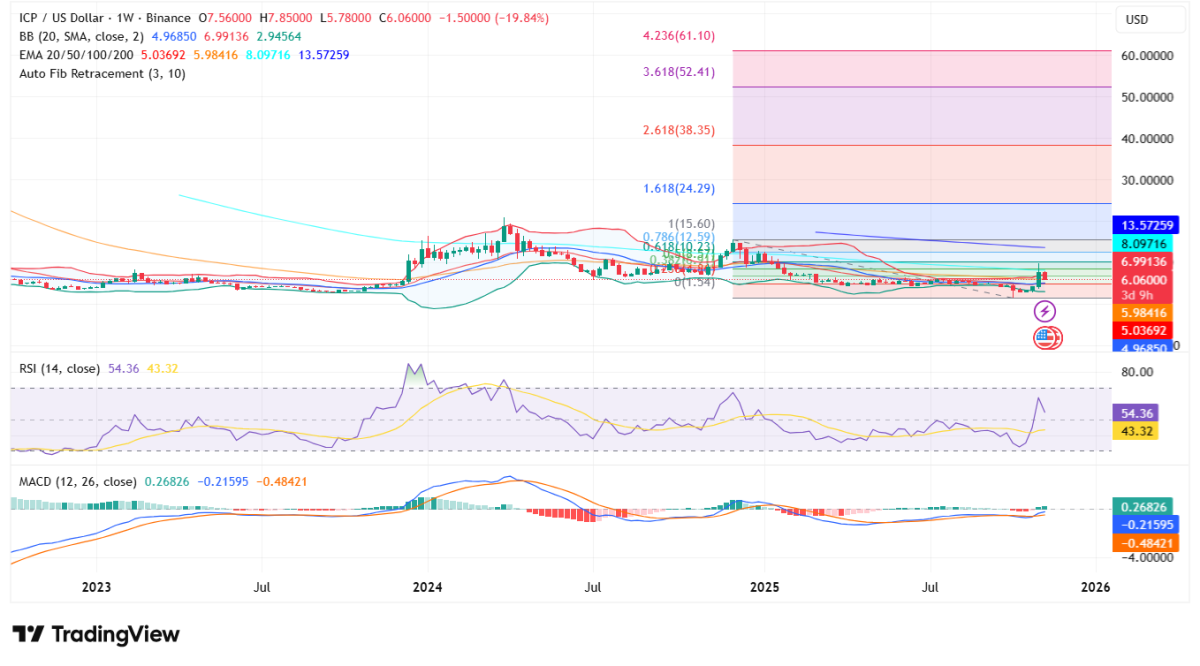
    From a technical analysis perspective, ICP’s weekly chart is mixed and has a cautiously optimistic tone. The ICP token recently reached a high of around $7.85 but then fell back to $6.06, a drop of almost 20%.

    Short-term analysis using the RSI, which is at 54.36, and a positive MACD crossover show that buyers could take control of the market. The current market is above the key levels of the 20 EMA and the 50 EMA, but below the 100 EMA and the 200 EMA.

    Quelle: Tradingview

    The Fibonacci retracement levels are an important guide for traders. The 0.618 ($10.23) and 0.786 ($12.59) levels are strong resistance, but a longer-term buying objective lies at $24.29 if the trend continues.

    Analyst CW predicts for ICP a correction to $5.50 before a recovery to $14.20 is possible, corresponding to the Fibonacci level of 1.618.

    Image
    What:

  • IOTA cooperates with zCloak.Money and offers full-fledged onchain multisig wallets

    IOTA cooperates with zCloak.Money and offers full-fledged onchain multisig wallets


    • In a special cooperation, IOTA and zCloak.Money offer companies fully functional on-chain multisig wallets with increased security.
    • The wallets enable biometric login, weighted approvals and transparent governance for secure crypto management.

    IOTA and zCloak.Money offer fully functional onchain multisig wallets for businesses. The wallets offer secure, decentralized tools for managing crypto assets with state-of-the-art features based on IOTA’s vision for Web3 functionality in enterprises.

    IOTA will implement zCloak.Money’s enterprise wallet, giving companies full asset control without intermediaries. The fully security-optimized design allows customers to self-manage their blockchain transactions while maintaining the highest security standards.

    The wallet introduces passkey authentication with biometric login, eliminating the reliance on seed phrases. This feature increases security and simplifies access. zCloak.Money also works with weighted approvals, customizable permissions and spending limits through its multisig control system designed to meet the needs of institutions.

    Multisig control and transparent audit trails

    IOTA’s DLT (Distributed Ledger Technology) is the “operating system” of zCloak.Money’s wallet, which records all transactions. Companies gain control and transparency through blockchain-based governance. The system combines IOTA’s Light protocol with zCloak.Money’s design, accelerating secure transactions and making cross-border crypto transfers more efficient.

    There is also identity verification at the company level, which follows the IOTA standards. It helps companies handle approvals, track activities and comply with regulations. By combining secure passkey login with multisig control, companies gain more confidence in using decentralized crypto management tools for their businesses.

    IOTA and zCloak.Money for more crypto security

    In principle, all of this boils down to the Web3 readiness of the company. Companies that introduce the new wallets benefit from faster approvals, more security and easier decisions. You maintain full control over your digital assets and avoid the risks associated with traditional custody methods.

  • Analyst Reveals Whales’ XRP Accumulation Strategy

    Analyst Reveals Whales’ XRP Accumulation Strategy


    • XRP may soon make available to “ordinary investors” an alternative credit security method favored by the ultra-rich.
    • Tokenization could funnel trillions of dollars of traditional assets into cryptocurrencies, potentially creating new avenues of liquidity.

    Phil Kwok, founder of education and Web3 platform EasyA, recently caused a stir with his “insight” on how XRP supports the wealth strategies used by the world’s wealthiest investors. He said:

    “The trick to being a multi-billionaire is to have zero liquidity.”

    He explained that tokenization, the process of converting real-world assets such as real estate, art and stocks into blockchain-based tokens, allows investors of all sizes to unlock liquidity instantly.

    Traditionally, billionaires grow their wealth by holding appreciating assets and borrowing against them rather than selling them.

    Tokenization could make this approach accessible to ordinary investors, potentially bringing trillions of dollars of traditional assets into the crypto ecosystem.

    The super-rich don’t sell assets – they take out loans

    Kwok explained that this is because wealthy people do not sell their investments. Instead, they use them as loan collateral to borrow money from holdings, meaning they can keep them but also have liquidity in the form of cash.

    Dom Kwok explained that EasyA plans to offer this to XRP holders as well, that is, using XRP as collateral to grant loans.

    Basically, you could deposit XRP as collateral, borrow stablecoins or fiat money, and pay it back at a later date. This method would allow people to lock in profits if they choose to do so and avoid taxes, which is often practiced by billionaires.

    Kwok suggested that future lending platforms could set margins for borrowing, which would accommodate conservative investors who borrow smaller amounts to avoid potential losses upon liquidation.

    Community debates benefits of XRP tokenization

    The XRP community quickly responded to this debate. One of the community members, The bestexplained an important aspect of tokenization, which is not to create opportunities for billionaires to accumulate more money, but to bridge the gap between ownership and accessibility of value.

    By using programmable liquidity pools, personalized assets and fund shares could be transformed from tied capital into dynamic values.

    Dealer Chris Criner addedthat the limited supply of tokens could be quickly absorbed by wealthy individuals, leading to an explosion in demand from institutions.

    He used an example from Bitcoin’s past development to describe how an infinite institutional FOMO snowball for quality tokens like Ripple’s XRP could soon emerge.

    Other community members expressed concerns about the risk. Lion of Judah noted that if the price of XRP falls after borrowing, the collateral could be liquidated unless more assets are added.

    Kwok responded that this type of risk could be managed by using adjustable borrowing parameters. This would allow those concerned to set conservative limits and avoid being forced into liquidation.

  • The mood among Bitcoin, ETH and XRP traders is in the basement – ​​improvement in sight?

    The mood among Bitcoin, ETH and XRP traders is in the basement – ​​improvement in sight?


    • The low mood for the top cryptocurrencies may have reached its maximum – at least there are now tentative rumors of recovery.
    • But speculators have exited while long-term investors continue to hoard, knowing the recovery will come – the question is: when?

    The crypto markets have entered perhaps the most passive phase of the year, evidenced by the extremely poor sentiment among Bitcoin, Ethereum and XRP traders. Data from Santiment show that social media discussions around key digital assets have become very fearful, an attitude that some analysts say often precedes an upswing.

    According to Santiment’s latest report, comments on Bitcoin are evenly split between positive and negative, while Ethereum sees just over 50% more bullish mentions than negative ones. However, XRP appears to be causing the most concern, with less than half of discussions on social media pointing to trader confidence.

    The crypto market continues to be under pressure from ongoing market uncertainty, despite the end of the U.S. civil service shutdown and the shift to assets more directly tied to the economy and credit conditions.

    Fear Index at lowest level since March

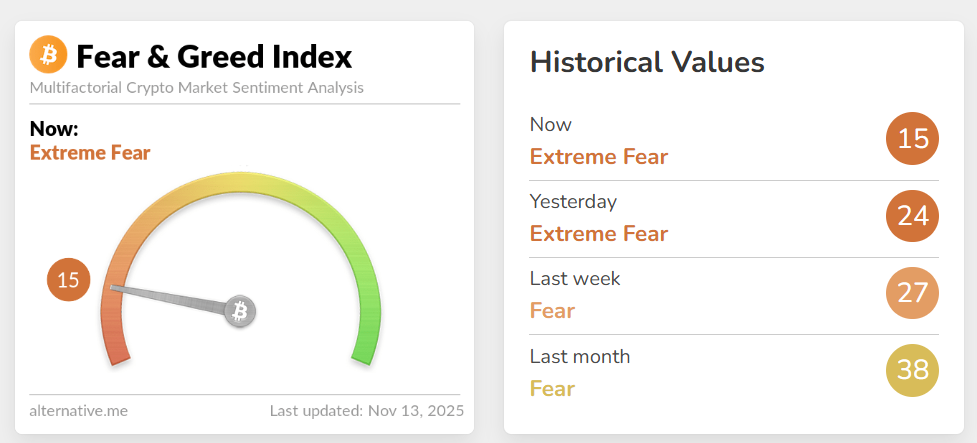
    The Crypto Fear & Greed Index, a widely followed measure of emotion in the markets, fell to 15, which is referred to as “extreme fear.” This is the lowest level since March, when a similar plunge preceded a short-lived rally in prices.

    Trader Sentiment Toward Bitcoin, Ethereum, and XRP Hits 2025 Lows — Bullish Signal Ahead?
    Those: Alternative.me

    Joe Consorti, Head of Bitcoin Growth at Horizon, said that the level of fear is now at levels seen in 2022, when Bitcoin traded near $18,000. He explained that the atmosphere today is very similar to that time, with traders holding back and cutting down on liquidity.

    Despite the market weakness, Santiment added that the fading optimism could be “welcome news for patients.” According to Santiment’s analysis, during such times money typically shifts from speculative transactions to long-term investments, setting the stage for a November run. Santiment explained:

    “If the volume negatively impacts assets, especially the largest market caps in cryptocurrency, it is a signal that we are reaching the point of capitulation. As soon as retail sells, the main players scoop up the fallen coins and pump up the prices. It’s not a question of if, but when it will happen.”

    Speculators are out – long-term investors are getting in

    Samson Mow, founder of the Bitcoin technology company Jan3, shares this view. He argues that the bull run for Bitcoin has not yet begun, describing recent sales as being driven by newer market participants rather than early holders. Newer buyers are the ones selling, Mow said, adding that long-term investors are taking the opportunity to store more Bitcoin in their wallets.

    Mow noted that much of the current selling pressure is coming from traders who entered the market in the last 12 to 18 months and are now withdrawing their money out of fear that the peak has been reached. Mow:

    “These are not gut-level Bitcoin buyers, but rather speculators following the news.”

    Santiment’s analysis suggests that the overall market structure will be strengthened for the next cycle as short-term holders continue to exit. The data trends suggest accumulation among holders who have historically supported price recoveries following fear spikes.

    Mow agreed, noting that the coin’s transition into stronger hands is an encouraging sign for Bitcoin’s next phase.

    “This cohort of sellers is also exhausted, and committed long-term investors have now taken their coins, which is always the best-case scenario. 2026 is going to be a big year. Plan accordingly.”