Category: Coins

Digital assets, cryptocurrencies, blockchain, and currency news.

  • Venezuela Arrests Three ‘Los Binanceros’ Members Over Binance P2P Arbitrage

    Venezuela Arrests Three ‘Los Binanceros’ Members Over Binance P2P Arbitrage

    The Bolivarian National Police in Venezuela recently arrested three young men in Maracaibo, accusing them of running an illicit currency arbitrage ring through the peer-to-peer (P2P) platform of the cryptocurrency exchange Binance. The enforcement action has ignited a critical discussion among local crypto traders about where lawful P2P transactions end and criminal activity begins under Venezuelan law.

    How the Alleged Binance P2P Scheme Operated

    According to law enforcement authorities, the arrested individuals—identified as 18-year-old Adrián Jesús Gómez, 19-year-old José Ángel Hernández, and 22-year-old Guillermo José Roldán—operated out of a residence in the Francisco Eugenio Bustamante parish of Maracaibo. Police officials claim the trio belonged to an organized group dubbed ‘Los Binanceros’ and executed a highly structured financial loop:

    • Acquisition: The suspects acquired U.S. dollars at the subsidized, official rate through regulated exchange houses and official Central Bank of Venezuela (BCV) auctions.
    • Conversion: They deposited these funds into the Binance platform to purchase the dollar-pegged stablecoin $USDT.
    • Liquidation: Finally, they sold the stablecoin on the Binance P2P marketplace in exchange for local currency (bolivars) at the unofficial parallel market rate, which sits significantly higher than the government’s controlled rate.

    Following the raid, police confiscated several mobile phones, a laptop, and a motorcycle. The suspects and the seized physical evidence have been transferred to the jurisdiction of the Public Prosecutor’s Office for formal prosecution.

    Why Venezuelan Authorities Regulate Exchange Rate Arbitrage

    The core of the legal issue lies in Venezuela’s dual-rate currency system. Because the BCV strictly controls and rations foreign currency at a subsidized rate, a substantial gap often opens between the official rate and the parallel market rate. This discrepancy creates an immediate opportunity for risk-free profit: purchasing cheap dollars through government-regulated channels and selling them at the elevated market rate.

    Venezuelan regulators do not view this as standard market trading. Instead, they classify it as unauthorized currency arbitrage. Funding parallel-market transactions using state-subsidized currency directly violates local exchange control laws. Furthermore, Venezuela’s robust anti-money laundering policies allow financial prosecutors to freeze and investigate any bank accounts receiving funds linked to these illicit spreads, regardless of whether the account holders are licensed financial agents.

    Risks for Everyday P2P Crypto Users in Venezuela

    While owning, trading, and utilizing digital currencies like $USDT is entirely legal under Venezuela’s regulatory framework, standard peer-to-peer traders still navigate a landscape filled with potential legal hurdles. The primary risks for everyday users include:

    1. High-Frequency Compliance Flags

    Engaging in high-volume or rapid-fire P2P trades can trigger automated anti-money laundering (AML) alerts at domestic banking institutions. Even if a trader is not exploiting exchange rate gaps, sudden spikes in account activity can lead to frozen bank accounts and subsequent investigations.

    2. Third-Party Payment Vulnerabilities

    One of the most common security flaws in P2P trading is accepting payments from bank accounts that do not match the verified identity of the counterparty on the exchange. If those external funds are tied to fraud, extortion, or other criminal activities, the recipient’s account can be flagged for money laundering.

    3. Liability of Omission

    Under Venezuelan criminal law, individuals can be held liable for failing to act when presented with suspicious activity. Ignoring obvious red flags on incoming payments, rather than actively participating in a crime, can still expose a P2P trader to prosecution for negligence or complicity.

    Ultimately, Venezuelan authorities appear to distinguish between citizens using P2P platforms to preserve the purchasing power of their personal savings and those systematically exploiting government-regulated currency channels for parallel-rate profits, as seen in the case of ‘Los Binanceros’. For the average crypto user, maintaining strict transaction hygiene—such as verifying counterparty names and rejecting third-party bank transfers—remains the most effective way to avoid regulatory scrutiny.


  • Jimmy Butler Resolves Family Matter, Refocuses on Warriors Future

    Jimmy Butler Resolves Family Matter, Refocuses on Warriors Future

    Jimmy Butler’s extended legal dispute with former partner Kaitlin Nowak has taken a surprising turn, according to new court filings that reveal the two are now sharing a residence. Nowak submitted documents Wednesday indicating she and the Golden State Warriors forward have reached a “comprehensive” parenting agreement covering their three children.

    In the filing, Nowak also stated that she and Butler “are living with one another,” while noting that “there are other circumstances which can be presented to the court.”

    Dispute stretched back to 2023

    The legal conflict originated in October 2023 when Nowak filed a paternity and child support lawsuit. A subsequent judgment established Butler as the biological father of their three children. The parties later agreed to $55,000 per month in child support, with court records showing Butler was also paying an additional $10,000 monthly for childcare expenses.

    That supplementary payment became a point of contention in late 2024. Butler petitioned the court to reconsider the childcare cost, arguing a nanny was unnecessary because two of the children were attending school. His filing also alleged that Nowak was “unemployed and refuses to seek employment.”

    Settlement could be weeks away

    The latest filing suggests a significant shift in the dynamic between the two since those earlier disputes. Nowak is requesting the court keep the case active on the docket and expressed confidence it can be fully resolved within the next 45 to 60 days. The matter had reportedly been dismissed earlier this month.

    The documents do not specify whether Butler and Nowak have reconciled romantically, and neither party has publicly addressed their current living arrangement. What is evident, however, is that a case once defined by arguments over support payments, childcare costs, and parenting responsibilities now appears close to a comprehensive resolution.

  • Vinícius Júnior’s Girlfriend Virginia Fonseca Faces Backlash Over Viral Video with Another Man

    Vinícius Júnior’s Girlfriend Virginia Fonseca Faces Backlash Over Viral Video with Another Man

    Virginia Fonseca Faces Backlash Over Trainer Interaction at Vinícius Júnior’s Home

    Brazilian influencer, entrepreneur, and television presenter Virginia Fonseca has become the center of online controversy after a video posted by her personal trainer sparked intense debate across social media platforms. The footage, which appears to have been filmed inside the Madrid residence of Real Madrid star Vinícius Júnior, shows an interaction between Fonseca and her trainer that many viewers interpreted as inappropriate.

    Video Sparks Debate Over Boundaries

    The clip captures a moment where the two appear to lean in close, leading numerous commenters to speculate they were about to kiss. The situation escalated when Fonseca visibly pushes the trainer away, a gesture that has been analyzed from multiple angles by fans and critics alike. While some online discussions veered toward the trainer’s sexuality, the predominant focus remained on the nature of the interaction itself and the perceived breach of professional boundaries.

    Location Adds Fuel to Controversy

    Compounding the scrutiny is the setting of the video. Fans have identified the background as Vinícius Júnior’s private home gym, raising questions about Fonseca’s frequent presence at the footballer’s property. Critics have accused the influencer of treating the Real Madrid forward’s residence as a regular social hub, particularly around his fitness facilities. The apparent familiarity of the location intensified the backlash, with many expressing frustration that the interaction occurred inside what appears to be the athlete’s personal space.

    Social Media Reaction Divides Opinion

    Online commentary has split between those condemning the behavior as disrespectful to both the trainer and the homeowner, and others defending the interaction as a harmless moment taken out of context. The discourse highlights the intense public scrutiny faced by high-profile influencers and athletes regarding their private lives and social circles. As of now, neither Fonseca nor Vinícius Júnior has issued a public statement addressing the viral video or the surrounding allegations.

  • Shaquem Griffin Unveils AI-Powered Bionic Arm Years After Losing Hand

    Shaquem Griffin Unveils AI-Powered Bionic Arm Years After Losing Hand

    Former NFL linebacker Shaquem Griffin, who lost his left hand at the age of four, is experiencing a new level of independence thanks to advanced prosthetic technology. Griffin is now utilizing an AI-powered bionic arm designed to recognize his muscle movements and translate them into precise, functional actions.

    AI-Powered Bionic Arm Restores Independence

    The cutting-edge prosthetic allows Griffin to perform everyday tasks that many take for granted. From gripping objects of various shapes and sizes to completing simple daily activities, the device responds intuitively to his intentions. This technology represents a significant leap forward in prosthetic capability, moving beyond basic open-and-close mechanisms to offer nuanced control powered by artificial intelligence.

    From NFL Field to Everyday Life

    Griffin’s journey has long been defined by overcoming physical limits. After a standout career at the University of Central Florida, he made history as the first one-handed player drafted into the modern NFL era, selected by the Seattle Seahawks in 2018. While his time on the professional gridiron showcased his elite athletic adaptation, this new chapter focuses on the fundamentals of daily living.

    New Possibilities Through Technology

    The impact of the bionic arm extends beyond physical utility; it signals a profound shift in what is possible for individuals with limb differences. For Griffin, the device is opening up an entirely new world of possibilities, demonstrating how the intersection of robotics and machine learning can restore agency and expand the boundaries of human potential.

  • Itauma vs Hrgovic, Mayer vs Cameron: Fight Preview, Schedule, How to Watch

    Itauma vs Hrgovic, Mayer vs Cameron: Fight Preview, Schedule, How to Watch

    Your Complete Preview Guide for Saturday’s Doubleheader: Itauma vs. Hrgovic and Mayer vs. Cameron

    Boxing fans are gearing up for a significant night of action this Saturday featuring two high-stakes matchups. This guide covers everything you need to know about the heavyweight clash between Moses Itauma vs. Filip Hrgovic and the super-featherweight showdown between Mikaela Mayer vs. Chantelle Cameron before the first bell rings.

    Moses Itauma vs. Filip Hrgovic: Heavyweight Prospect Meets Contender

    The heavyweight division takes center stage as rising star Moses Itauma steps up against former title challenger Filip Hrgovic. This bout represents a critical crossroads moment: Itauma looks to announce himself as a genuine world title threat, while Hrgovic aims to prove he remains an elite gatekeeper in the division. Expect analysis on Styles, records, and the tactical adjustments both camps have made leading into fight week.

    Mikaela Mayer vs. Chantelle Cameron: Super-Featherweight Championship Stakes

    In the co-feature, two of women’s boxing’s most accomplished technicians collide. Mikaela Mayer and Chantelle Cameron bring world-level experience and contrasting styles to the ring. With championship implications on the line, this contest promises high-level boxing IQ, pace, and the strategic nuance that defines elite female prize fighting. We break down the keys to victory for both former unified champions.

    Stay tuned for final predictions, broadcast details, and undercard highlights as fight night approaches.

  • What Supplements Do Athletes Take and Why?

    What Supplements Do Athletes Take and Why?

    While nutrition experts generally advocate meeting dietary needs through whole foods first, practical limitations often make supplementation necessary. Creatine serves as a prime example: though naturally present in meat and fish, dietary intake falls far short of effective doses.

    The Creatine Challenge: Food vs. Supplementation

    “You would need the best part of a kilogram of raw chicken a day to get the amount of creatine you need,” says nutrition specialist Close. Consuming raw poultry carries significant food-poisoning risks from harmful bacteria, making whole-food sourcing impractical.

    Creatine is a natural compound synthesized in the kidneys, liver, and pancreas. It provides rapid energy for muscles, proving critical for short-duration, high-intensity activities such as sprinting.

    From Lab to Locker Room: The 1990s Breakthrough

    Creatine’s rise as a mainstream supplement began in the 1990s. After two decades of research, two scientists shared findings with Steve Jennings, whose Maxim sports nutrition company supplied the British Olympic team.

    During the 1992 Barcelona Games, investigative reporter Doug Gillon uncovered a “secret trial” involving British athletes and a box of Ergomax C150 effervescent creatine tablets. He wrote that if the scientists’ claims—that creatine could improve explosive athletic performance by 1–3%—were true, then “sport may never be the same again”.

    History proved Gillon prescient. By the 1996 Atlanta Olympics, an estimated 80% of athletes were using creatine. Since then, research has expanded to suggest potential cognitive benefits alongside physical ones.

    According to the Journal of the International Society of Sports Nutrition, the 1990s creatine breakthrough “launched a new era in sports nutrition” and “sparked exploration into other supplements”.

    Market Growth and Expert Perspective

    The global dietary supplements market was valued at $209.5 billion (£154 billion) in 2025 and is projected to reach $431.7 billion (£317.4 billion) by 2033, per Grand View Research.

    Close, who oversaw nutrition for the 2025 British and Irish Lions rugby tour, frames supplements as the “final piece of the jigsaw” rather than a foundation.

    “What we’re talking about is small margins of benefit, where actually these athletes who focus on the food, I think what you often find is that they’ve got the big-ticket items right,” he says.

    “So they’re seeing great performance benefits because their overall diet is immaculate.”

    “They might be missing out on the one per-centers, but they’ve really nailed the 99 per-centers. And they often do better than those who chase the one per-centers but have not given enough attention to the 99 per-centers.”

    Athlete Endorsement: Supplements Come Second

    Australian cyclist Nicole Frain echoes this hierarchy.

    “I’m a pretty big believer that they are called sport supplements. They are there to supplement the things you already do right.”

    “I don’t think supplements are the answer to fix my problems.”

    “You need to be eating a balanced diet, training well, sleeping right, recovering well, hydrating – all of those things – before we add in all of the extras.”

  • ECB Advances Digital Euro With 36-Provider Pilot

    ECB Advances Digital Euro With 36-Provider Pilot


    The European Central Bank selected 36 banks, fintechs and payment processors on July 14 to help test a beta digital euro in real-world payment environments beginning in the second half of 2027.

    The participants include Deutsche Bank, UniCredit, Revolut, Stripe, Adyen, Worldline, Nexi Payments and SumUp. They will connect their payment services to the Eurosystem’s infrastructure and support transactions between central-bank staff and selected merchants during a pilot scheduled to run for 12 months.

    TL;DR

    • The ECB selected 36 payment service providers from 16 euro-area countries after receiving more than 50 applications.
    • The pilot will test online and offline person-to-person payments, physical-store purchases and e-commerce transactions.
    • The beta digital euro will not have legal-tender status and does not represent a final decision to issue the currency.
    • A possible 2029 launch remains dependent on EU legislation and subsequent approval by the ECB Governing Council.

    Payment Firms Move From Consultation to Integration

    The selection moves the digital euro project beyond design discussions and into a multi-year technical integration process. According to the ECB’s July 14 announcementmore than 50 payment service providers applied after the central bank opened its call for expressions of interest in March 2026.

    The 36 successful applicants cover 16 of the euro area’s 21 member states and include both traditional lenders and non-bank payment companies. The official participant list includes Deutsche Bank, DZ Bank, UniCredit, BPCE, National Bank of Greece, Caixa Geral de Depósitos and Bank of Cyprus alongside Revolut, Stripe, Adyen, Worldline, Satispay, SumUp and Nexi Payments.

    The diversity is operationally important. A digital euro would not be distributed through a single ECB-controlled consumer platform. Banks and payment companies would provide the accounts, applications, customer support and merchant connections through which people interact with the central-bank money.

    “The strong market interest in the pilot shows the private sector’s readiness to engage actively and quickly advance with the digital euro project,” ECB Executive Board member Piero Cipollone said.

    Technical development is expected to begin in the third quarter of 2026. The providers must connect to the Digital Euro Service Platform, develop the required payment functions, complete certification and onboard eligible users before the operational trial starts in the second half of 2027.

    Providers Will Test Both Sides of a Payment

    The ECB separates the participating companies into distributing and acquiring payment service providers. Some will perform both roles.

    • Distributing providers will give eligible users access to beta digital euro services, including account setup, funding, payment initiation and transaction management.
    • Acquiring providers will connect selected physical and online merchants so they can accept beta digital euro payments.
    • Dual-role providers will test the complete transaction flow from the payer’s wallet to the merchant’s acceptance system.

    The pilot will operate at the ECB and 19 participating national central banks. Central-bank employees will act as the individual users, while selected cafeterias, restaurants and e-commerce businesses will provide controlled merchant environments.

    The transactions will cover four principal use cases: online person-to-person transfers, offline person-to-person transfers, online payments at physical points of sale and purchases through e-commerce or mobile-commerce platforms.

    Offline person-to-person payments will use near-field communication, allowing two compatible devices to exchange value by being tapped together without either device connecting to the internet. Physical merchants will test online contactless payments using Software Point of Sale technology, which allows a standard smartphone or similar device to function as a payment terminal.

    This structure allows the ECB to test more than whether the underlying ledger can process transfers. The trial will examine how users open and fund wallets, how providers authenticate customers, how merchants receive confirmation and how the entire system behaves when transactions fail or require refunds.

    The Beta Euro Is Not a Public CBDC Launch

    The pilot currency will be technically and functionally close to the digital euro described in the EU’s proposed legislation, but it will not have legal-tender status. Businesses outside the selected trial environment will not be required to accept it.

    The ECB’s pilot guidance explains that the beta digital euro will represent a liability recorded on the Eurosystem’s books. For online use, it will be treated as scriptural money under the existing payment-services framework.

    Users will not hold accounts directly with the ECB or a national central bank. They must instead hold or open a commercial-bank-money account with a participating provider for the duration of the trial.

    The selected providers will remain responsible for their customer relationships and must comply with the existing Payment Services Directive, General Data Protection Regulation and EU anti-money-laundering rules.

    Those restrictions make the exercise closer to a controlled operational test than a limited public rollout. Participation will be restricted to central-bank staff and selected merchants, allowing the Eurosystem to assess robustness, scalability and usability before exposing the infrastructure to a wider population.

    Offline Payments Put Privacy and Resilience to the Test

    Offline functionality is one of the pilot’s most consequential components because it is designed to preserve digital payments during internet or network disruptions.

    The ECB’s broader design uses secure hardware inside compatible phones or other devices to store offline value and execute transfers locally. The payment is settled between the devices rather than waiting for a connection to the central infrastructure.

    That model is intended to provide privacy closer to physical cash. Under the ECB’s proposed privacy frameworkthe details of an offline transaction would be known only to the payer and recipient.

    Online payments would follow a different model. Customer identification and anti-money-laundering obligations would remain with the user’s payment provider, while the ECB and national central banks would process pseudonymous identifiers rather than directly identifiable customer information.

    The trial should reveal whether those protections can operate alongside fraud controls, device security and reliable balance management. Offline transfers create additional technical risks because the system must prevent the same funds from being spent twice while devices remain disconnected.

    Holding and transaction limits are expected to form part of the eventual design to reduce financial-stability and misuse risks, but final limits have not yet been established. The pilot should not be treated as confirmation of any specific cap.

    A 2029 Launch Still Depends on Lawmakers

    The ECB aims to be technically ready for a potential first issuance during 2029, assuming European lawmakers adopt the necessary digital euro regulation.

    The European Commission’s proposed regulation would establish the legal framework for the currency, including distribution, privacy, legal-tender treatment and the ECB’s authority to impose holding limits.

    The pilot does not bypass that process. The ECB has stated that it will decide whether to issue a digital euro only after the regulation has been adopted. The Governing Council could still delay, modify or reject issuance based on the legislation, technical findings and broader policy assessment.

    Recent provider selection therefore confirms that the infrastructure work is advancing, not that Europe has made an irreversible decision to launch a central bank digital currency. The 2027 trial will test whether banks, fintechs, merchants and the Eurosystem can operate one payment system across different institutions, devices and national markets before the political decision is made.

  • Beer 2.0: The meme coin brewing something bigger on Solana

    Beer 2.0: The meme coin brewing something bigger on Solana


    Panama, Republic of Panama, May 20th, 2025, Chainwire

    Beer 2.0 wants to be more than a nostalgic allusion to its predecessor. It’s a fresh infusion of meme culture, community power and real utility – served cold on Solana.

    In less than 48 hours since the official announcement have each other over 10,000 people about the official website registered for the pre-sale of Beer 2.0 . This strong response underlines one Level of anticipation that surpasses the typical meme coin hype and points to significant traction as pre-sales approach.

    The new direction of Beer 2.0

    Beer 2.0 is not just about good times and winnings. It aims to expand the Meme Coin model with integrations in NFTs, gaming and future DAppsto develop further and bring concrete use cases to the table – while keeping the humor on the table.

    By building on Solana Beer 2.0 benefits from lightning-fast transactions and low fees, making it ideal for high-frequency trading, gaming interactions, and on-chain viral moments.

    888.8 billion tokens and a presale window

    The project relies on transparency in both the vision and the tokenomics structure. The total offer is up 888.8 billion tokenscapped of those 20% over one 48 hours Presalethe on 21. May 2025 at 19:00 Uhr MESZbegins to be released to the public.

    Important allocations:

    • 35% to the main creator
    • 30% for liquidity
    • 20% for public advance sales
    • 10% for marketing
    • 4% for advisors and supporters
    • 6% divided between two partner groups

    Early Access Perks

    There are tiered bonuses in the first 30 minutes of pre-sales to reward early backers – but the exact percentages are time-dependent. Participation takes place after principle“First come, first served”so timing and preparation are important.

    Interested participants must:

    1. Setting up a Solana wallet (z. B. Phantom)
    2. SOL via major exchanges like Binance or KuCoinkaufen
    3. On the website and the official social media channels to start the pre-sale campaign after the verified pre-sale addressseek
    4. Send SOL to this address within the 48 hour window
    5. Get BEER 2. 0 tokens after sale – trackable via Solscan

    Roadmap to cultural dominance

    Beer 2.0 is a long-term vision supported by a phased rollout that combines culture, real-world interaction and Web3 expansion.

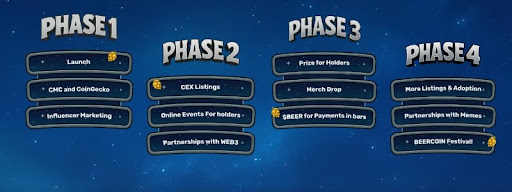
    The timetable extends over four phases:

    Phase 1:

    • The market launch marks the beginning of the journey to ignite traction and win over the first believers.
    • Scheduled listings CoinMarketCap and CoinGecko play an important role – not only for visibility, but also for trust. These platforms confirm legitimacy and help put Beer 2.0 on the global radar.
    • Influencer-Marketingto drive virality by tapping crypto locals to spread the word and bring new holders on board through humor, likeability and outreach.

    Phase 2:

    • CEX-Listings for scalable access. While DEXs are intended for early adopters, CEXs offer the liquidity and ease of entry for new entrants.
    • Online events for the owners create a sense of belonging and fun while reinforcing the ethos of Positive Mental Attitude (PMA).
    • Strategic Web3 partnerships enable Beer 2.0 to expand its reach.

    Phase 3:

    • Exclusive Prices for the ownersto reward long-term commitment.
    • A Merch-Dropto transform Beer 2.0 from a coin into a cultural symbol.
    • Real $BEER payments in bars are researched.

    Phase 4:

    • More listings and expanded The adoption campaign
    • Meme partnerships – Collaborations with creators and communities that shape crypto culture.
    • BEERCOIN Festivalan IRL gathering to celebrate the movement.

    Beyond tokens: culture, camaraderie and a brewery mobile

    The project promotes a positive mental attitude (PMA) and strengthens camaraderie between owners through weekly giveaways and community competitions.

    The project also offers a Grand Prize $30,000 in the form of a mobile brewery for happy supporters, which increases the appeal of the project to people.

    A Toast to Realism: Risks and Reminders

    Even if the interest in advance sales is undisputed, the project is aware of the environment:

    • Volatility: After launch, prices may fluctuate drastically.
    • liquidity: DEX IPOs (Raydium, Jupiter) top the list; CEX IPOs (Bybit, KuCoin, Gate.io, etc.) are in preparation.
    • regulation: Like all crypto projects, Beer 2.0 operates in a changing legal environment.
    • Implementation risk: The ambitions are high – but the implementation will determine whether Beer 2.0 becomes more than a meme.

    How Beer 2.0 stands out

    Beer 2.0 signals a new phase in the evolution of meme coins – one where the strength of the community meets actual on-chain interaction. With the Presale starting May 21stand plans for integration into NFTs, games and beyond, it will be more than just a moment.

    Users can use the Beercoin 2.0 official websitestay up to date

    About the $BEER 2.0

    The $Beer2. 0 Team is an independent group of developers and community builders focused on creating culturally relevant crypto projects.

    Beer 2.0 is a memecoin launched on the Solana blockchain to combine entertainment with accessible on-chain participation.

    The project draws on the experience of previous meme tokens, including $TRUMP, and includes limited supply, transparent token distribution, and community-first initiatives. The team is focused on decentralized engagement, online events and real-world integration, including plans for brand collaborations.

    Contact

    Mykh Handz

    Sklyer Inc

    [email protected]

  • NiceHash is hosting the first Bitcoin conference in Slovenia on November 8th and 9th – and is celebrating its 10th company anniversary

    NiceHash is hosting the first Bitcoin conference in Slovenia on November 8th and 9th – and is celebrating its 10th company anniversary


    Leading hashrate marketplace NiceHash is proud to host the first Bitcoin conference in Maribor, NiceHashX, to announce which offers an interesting and little-known entry into the European crypto market. Dubbed the “Bitcoin Conference on the Sunny Side of the Alps,” the event will take place in Maribor for two days on November 8th and 9th to celebrate the tenth anniversary of the hashrate marketplace founded in 2014 by two Slovenian students.

    One of the main goals of the conference is to encourage people to consider Maribor and Slovenia in general as a hub for Bitcoin. Over 1,000 companies in the Central European country already accept BTC as a payment methodand the event will feature several local companies from Maribor that are actively using this technology. In fact, one of the event’s several stages is dedicated to showcasing these local businesses.

    NiceHash CEO Vladimir Hozjan says:

    “We are excited to show the world that Slovenia is at the forefront of Bitcoin adoption in Europe. With 10 years of experience in the industry now, we have seen a phenomenal growth in interest in the use of Bitcoin here in Maribor and across the country. Join us as we celebrate and experience Bitcoin in its purest form, used by everyday people, alongside some of the best minds in the industry.”

    The conference boasts an impressive list of speakers, including prominent figures such as Saifedean Ammous, author of The Bitcoin Standard, ex-Cointelegraph reporter Joe Hall (Nakamoto), Martin Kuchař, CEO of the BTC Prague conference, Pierre Corbin, co-founder of Bitcoin FilmFest, Jameson Lopp, CTO of CASA, and many others. Topics of discussion include European Bitcoin adoption and regulation, the mining and energy situation, and the future of exchanges in an age of increasing regulation.

    Attendees can look forward to an exciting exhibition area, a trio of main stages and many side events including an official after-party with a VIP dinner and music show. In addition, NiceHash has launched a BTC payment process with local traders, which will be demonstrated at the conference and in the city of Maribor.

    Nestled in the foothills of the Pohorje Mountains, a popular ski resort, and with nearby vineyards, Maribor is a worthwhile travel destination known for its centuries-old architecture, cozy cafes and relaxed atmosphere. Maribor was named European Capital of Culture in 2012.

    Often overlooked in the European crypto scene, Slovenia has the second largest number of blockchain startups after Switzerland and a very high Bitcoin adoption rate per capita. The country boasts many Bitcoin-related places, such as BTC City in Ljubljana and the Satoshi Monument. The many businesses that already accept Bitcoin include restaurants, hotels, cafes and supermarkets, directly exposing end consumers to crypto. The number of Slovenian crypto customers should reach around 400,000 by 2028 which corresponds to around a fifth of the population.

    Who is NiceHash?

    NiceHash is a leading player in the mining sector of the crypto industry. Founded in Slovenia in 2014, the company is the world’s largest hashrate marketplace and has made it easier for millions of customers worldwide to get started with Bitcoin. NiceHash offers a comprehensive range of mining and Bitcoin payment services and launched the world’s first fully automated Lightning payouts for miners in 2024.

    Contact:
    Joe Downie, CMO
    [email protected]

  • ETFSwap (ETFS) surpasses 4,000 users and raises $1.5 million

    ETFSwap (ETFS) surpasses 4,000 users and raises $1.5 million


    ETFSwap (ETFS)an emerging decentralized cryptocurrency and exchange-traded fund (ETFS) platform, has achieved a number of significant milestones that mark a historic moment in its development and pre-sales. With the support and trust of thousands of users and investors worldwide, this groundbreaking platform is experiencing a meteoric rise in popularity.

    Additionally, ETFSwap (ETFS) is gaining global recognition as a significant player in the tokenized ETF market. It offers a cryptocurrency and ETF trading platform that is both distinctive and accessible as well as unique and user-friendly.

    ETFSwap (ETFS) sees an unprecedented increase to over 4,000 users

    In November 2023, the global ETF industry reached a valuation of $10.99 trillion and has been growing rapidly ever since. Given this expansion, more and more cryptocurrency enthusiasts and investors have been looking for ways to capitalize on the potential of this sector.

    ETFSwap (ETFS) forms a bridge between the traditional and decentralized finance (DeFi) ecosystems. This platform provides investment opportunities to global investors, giving them access to trillion-dollar sectors such as healthcare, energy, technology, commodities and more

    ETFSwap (ETFS) offers crypto investors a new service that has never been seen before in the industry. It provides access to the trillion-dollar market of traditional ETFs and allows them to expand their investment portfolio by tokenizing these assets for easy trading. But perhaps ETFSwap (ETFS) is truly superior to its competitors because it offers an easy on- and off-ramp for trading both cryptocurrency and fiat ETFs, coupled with the decentralization of the Ethereum blockchain.

    Over the next year, the platform plans to complete its roadmap with the full launch of the ETFSwap (ETFS) trading platform, open to all. Additionally, it will launch its partnership program, launch its decentralized staking application (DApp), and introduce community rewards.

    The token will be launched on decentralized exchanges such as Uniswap, with public trading to follow. This is accompanied by a comprehensive marketing rollout such as CoinMarketCap Fast-Track, Key Opinion Leaders (KOLs) and token competitions.

    The ETFSwap (ETFS) platform was fromCyberScopea leader in the blockchain security industry,subjected to strict testing . The audit found no vulnerabilities in the contract and the company declared the platform safe for investment.

    Before fully launching the platform, the company is focused on obtaining all necessary licenses to offer this novel service to investors worldwide. To sweeten things, there is no KYC (Know Your Customer) required, meaning investors just need to connect their wallet to start trading on the site.

    ETFSwap (ETFS) is already enjoying unprecedented adoption among users in various regions of the world. Currently, the innovative platform has recorded more than 4,000 users in just a few weeks.

    This surge in adoption is fueled not only by the advanced trading technology and features of ETFSwap (ETFS), but also by the increasing interest in token ETFs in the digital asset landscape.

    Important milestones and advances in presales

    Thanks to ETFSwap users, ETFSwap (ETFS) has successfully reached important development milestones. With the help of institutional investors, ETFSwap (ETFS) was able to raise over $750,000 in its private financing round.

    In addition to the growth of ETFSwap’s user base, over 75 million tokens were sold in the first phase of the ongoing presale.

    The ETFSwap team noticed the increase in sales and through a strategic decision increased the ETFS token price from $0.00854 in the first presale phase to $0.01831 in the second phase. The public advance sale has in a few weeksin total raised over $1.5 million.

    For more information about the ETFS pre-sale:

    Users can visit ETFSwap Presale

    Users can join the ETFSwap community

    Contact

    Jacob Moss

    ETFSwap LLC

    [email protected]