Author: DN19 Newsroom

  • Bitcoin Rally Stalls, but Long-Term Sentiment Remains Bullish

    Bitcoin Rally Stalls, but Long-Term Sentiment Remains Bullish

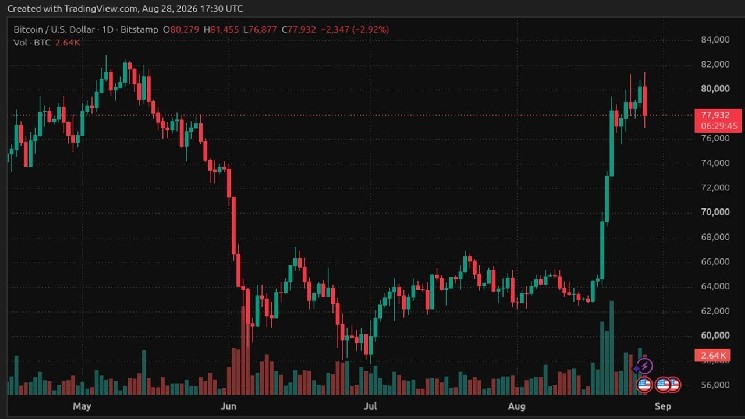
    Bitcoin fell to $76,877 on Friday after Federal Reserve Chair Kevin Warsh delivered a hawkish keynote at Jackson Hole, confirming the resistance zone that had limited the cryptocurrency earlier in the week.

    September rate-hike expectations rose to approximately 56%, up from about 35% a day earlier, after Warsh said the Federal Reserve still has “work to do” on inflation. Despite the sell-off, Myriad traders continued to favor Bitcoin rising to $84,000 over falling to $55,000.

    Bitcoin declined from an overnight high of $81,455, surrendering most of its double-digit weekly gain. The high was reached within a resistance zone that had already capped several attempted breakouts this year.

    Myriad: How high will Bitcoin go? Click to make your prediction.

    Warsh’s Jackson Hole speech drives Bitcoin lower

    Warsh marked his 100th day as Fed chair by offering markets no fresh policy guidance, but his comments were enough to pressure risk assets. In his keynote, he said the Fed needs to see inflation moving clearly toward its target and doing so at a sufficient pace before it can declare its work complete. Until then, the central bank still has “work to do.”

    Traders interpreted the remarks as hawkish. According to the CME Group’s FedWatch tool, the probability of a September rate hike increased to 55.7% from 35.4% the previous day.

    The move also affected leveraged crypto positions. CoinGlass data showed approximately $481 million in liquidations across the cryptocurrency market during the 24 hours surrounding the speech. More than $360 million involved long positions caught off guard by Bitcoin’s decline. Bitcoin ended Friday at $77,557, down 3.39%.

    Bitcoin price analysis: What the charts show

    From a technical perspective, the pullback looks more like a consolidation phase than a confirmed trend reversal. Bitcoin’s Relative Strength Index stands at 69.7, below the overbought level above 80 that preceded Tuesday’s rejection. Meanwhile, the Average Directional Index is near 39.5, still indicating a strong trend rather than a broken one.

    Bitcoin remains within the bullish move that carried it from the June low near $68,858 to this week’s high around $81,455. If selling intensifies, traders are likely to monitor the $73,670-$75,157 area first. A close below that zone would put both the 50-week moving average and the June breakout structure under pressure.

    On the upside, the $81,000-$82,500 area remains the key resistance shelf. Bulls need to reclaim it to establish a path toward fresh highs.

    Myriad traders continue to favor Bitcoin at $84,000

    The longer-term bullish outlook is reflected in Myriad’s “BTC next move” market, which has been active since late February. The market has recorded $231,000 in trading volume and has no fixed resolution date.

    Its two outcomes—a move to $84,000 or a decline to $55,000—have repeatedly exchanged the lead since spring as Bitcoin’s price moved sharply in both directions. That pattern changed this month: the probability of the $84,000 outcome rose by 31.7 percentage points to 77%, compared with 23% for the $55,000 scenario. Friday’s rejection from resistance did not materially alter that split.

    Myriad: Where does Bitcoin go next? Click to make your prediction.

    The last time traders were this bullish was around April.

    Bitcoin’s fundamental support remains intact

    The fundamental case for higher Bitcoin prices has not significantly changed. U.S. spot Bitcoin exchange-traded funds recorded $2.8 billion in inflows over eight consecutive days through Wednesday, their longest such streak since April.

    The demand followed a Treasury Department announcement that it would at least double its purchases of long-dated bonds beginning September 9. The move supports a segment of the bond market that has faced weak demand since June. Lower long-term yields and a weaker dollar revived the “debasement trade” that helped Bitcoin climb from approximately $62,000 to $80,000 this month.

    Warsh’s remarks did not change that backdrop. He outlined no explicit interest-rate path and instead highlighted an inflation condition the Fed has not yet met.

    Why Bitcoin traders should watch the bears

    In the short term, the market setup still calls for caution. Warsh’s rejection of forward guidance leaves traders without a clear policy signal until the Fed’s next rate decision. Bitcoin therefore remains vulnerable to headline-driven volatility around every inflation report released before then.

    The PCE price index is increasing at an annual rate of 3.7%, nearly twice the Fed’s 2% target, and Warsh provided no timetable for inflation to return to that level.

    Bitcoin has already faced multiple rejections at the current resistance zone in recent months. Warsh’s speech gave bulls no clear reason to expect the Federal Reserve to make the next attempt at a breakout easier.

    Disclaimer

    The views and opinions expressed by the author are for informational purposes only and do not constitute financial, investment, or other advice.

  • Bitcoin Rejects $81,500 as Whales Build Massive Sell Wall at $81K

    Bitcoin Rejects $81,500 as Whales Build Massive Sell Wall at $81K

    Bitcoin lost momentum after briefly breaking above $81,000 as traders awaited Federal Reserve Chair Kevin Warsh’s inaugural Jackson Hole speech. The cryptocurrency fell soon after reaching the key resistance level for the second time this week, echoing its Aug. 25 retreat after bitcoin climbed above $80,000 for the first time in more than three months.

    Market data showed bitcoin reaching a high of $81,455 shortly after 9:30 p.m. Thursday, temporarily overcoming bearish pressure that had intensified since Tuesday. A sharp sell-off then erased the gains recorded on Aug. 27, pushing bitcoin to a session low of $78,442 at around 10:15 a.m.

    More than an hour after Warsh’s speech, bitcoin dropped to a new low of $76,877 before quickly recovering above $77,000 and testing $78,000.

    Bitcoin’s Weekly Gains Narrow as Liquidations Rise

    The retreat reduced bitcoin’s weekly gain to 2% and lowered its market capitalization to $1.58 trillion from more than $1.61 trillion. Despite the pullback, bitcoin remains on track for double-digit monthly gains following its sharp rally between Aug. 19 and Aug. 21.

    In the derivatives market, bitcoin’s reversal less than 24 hours after reclaiming $80,000 triggered $107 million in liquidations across long and short positions. Data from Coinglass showed a relatively even split, with $50 million in long positions and $57 million in short positions wiped out. Across the wider cryptocurrency market, approximately $300 million in leveraged positions disappeared.

    According to market analysis outlet Cryptoreviewing, bitcoin’s early-morning surge to $81,500 followed by an immediate decline below $79,300 contributed to $465 million in 24-hour liquidations. That figure was significantly higher than the standard derivatives losses indicated by exchange data alone.

    In a post on X, Cryptoreviewing said bitcoin swept the upside liquidity zone between $80,400 and $81,600 almost perfectly but failed to hold above $80,000. The failure weakened short-term momentum and shifted the near-term market bias back toward caution.

    Bitcoin Order-Book Liquidity Skews Lower

    Cryptoreviewing also highlighted a sharp imbalance in liquidity distribution. Approximately $5.7 billion is positioned below the market between $75,000 and $78,500, compared with about $2.8 billion above between $81,500 and $84,000. The analysis said the imbalance leaves a deeper bitcoin pullback as a meaningful higher-timeframe risk.

    On lower timeframes, the largest liquidity pockets are concentrated around $78,600 and $79,100 below the market, and $81,300 and $81,900 above it. The analysis identified these levels as the most likely sweep zones in the near term.

    In its order-flow analysis, Cryptoreviewing said whales were maintaining significant sell walls between $80,800 and $83,000. Large bids remained stacked around $78,000 to $79,000 and at lower levels, suggesting institutional buyers were continuing to buy dips while bitcoin faced a formidable ceiling for further gains.

    Open interest has rebuilt, futures traders are adding exposure, and the Coinbase Premium has turned positive. However, weakening spot demand suggests leverage is returning faster than organic buying.

    Warsh Rejects Forward Guidance

    In his address, Warsh reiterated his rejection of “forward guidance”—the signaling strategy favored by previous Federal Reserve chairs—arguing that persistent inflation continues to threaten economic momentum despite recent positive data.

    He called for a return to traditional central banking, with interest rates adjusted as economic conditions change to maintain price stability without destabilizing employment.

    The Iran war and surging crude oil prices have clouded the outlook for U.S. economic growth. However, Warsh maintained a resilient tone, pointing to unprecedented corporate spending on technology and artificial intelligence infrastructure as a powerful counterweight.

  • Atlético Nacional Squad Announced for Match Against Alianza in Matchday 8

    Atlético Nacional Squad Announced for Match Against Alianza in Matchday 8

    Atlético Nacional will face Alianza in Matchday 8 of the 2026-II Liga BetPlay this Saturday, August 29, in Valledupar. The match is scheduled to begin at 8:30 p.m. ET.

    The Verdolagas have announced their 20-player squad for the fixture, with head coach Lucas González selecting a group that includes two goalkeepers, five defenders, six midfielders and seven forwards.

    Atlético Nacional absences due to injury

    Elías Cabrera, Elkin Rivero, Andrés Román, Jorman Campuzano, Milton Casco and Nicolás Rodríguez will miss the match because of injuries. Rodríguez is expected to have the longest recovery period and could return to competition in approximately six weeks.

    Atlético Nacional squad vs. Alianza

    Goalkeepers

    • Armani
    • Marquínez

    Defenders

    • N. Parra
    • García
    • Tesillo
    • Perlaza
    • Velásquez

    Midfielders

    • Marín
    • Zapata
    • Rengifo
    • Cardona
    • Lozano
    • Ríos

    Forwards

    • Arango
    • Moreno
    • Sarmiento
    • K. Parra
    • Morelos
    • Rosa
    • Poveda

    Source: espndeportes.espn.com

  • Chrome Extensions Caught Stealing Crypto Wallets

    Chrome Extensions Caught Stealing Crypto Wallets

    Cybersecurity researchers have uncovered a cryptocurrency theft campaign involving 19 malicious browser extensions targeting crypto users.

    Socket said the extensions—18 for Google Chrome and one for Microsoft Edge—were published or weaponized during the past six months. The security firm said the operation may date back to February 2024.

    In some cases, the attackers created extensions that initially appeared legitimate. In others, they purchased existing extensions from their original developers before turning them malicious. Of the 19 extensions identified by Socket, 14 were created by the threat actor and five were acquired from legitimate authors.

    “Enable Right Click & Copy — Smart Unlock + OCR” was the most dangerous extension identified. Socket said its Chrome version had approximately 70,000 users when the malicious functionality was introduced, while the Microsoft Edge version had roughly 10,000 users.

    According to Socket, the Chrome extension has since been removed from the Chrome Web Store. The Edge version, however, remained active.

    Socket researchers also found that the malware disables Content Security Policy protections on websites, allowing the attackers to interfere with legitimate web content and user interactions.

    Cryptocurrency wallet-draining modules

    The campaign includes a multi-chain cryptocurrency wallet drainer targeting EVM-compatible, Solana and Tron wallets. The malware can tamper with legitimate “Connect Wallet” and “Swap” buttons, redirecting users into transaction flows controlled by the attackers.

    Other modules target hardware-wallet users by displaying convincing fake Ledger and Trezor recovery or update pages. These pages are designed to trick victims into entering their seed phrases.

    The campaign also contains modules that harvest authenticated sessions and account information from cryptocurrency platforms, including Binance, Coinbase, Kraken, OKX, MEXC, KuCoin and Bybit, as well as MetaMask.

    Additional modules target Facebook and LinkedIn accounts, steal browsing history and deploy ClickFix-style fake browser-update pages, among other capabilities.

    Socket advised users to regularly review their installed browser extensions and remove any suspicious ones.

  • BlackRock’s Bitcoin ETF Regains Key Weekly Options Expiries After Rule Overhaul

    BlackRock’s Bitcoin ETF Regains Key Weekly Options Expiries After Rule Overhaul

    MIAX, the U.S. options exchange group, has restored Monday and Wednesday short-term expirations for options on BlackRock’s iShares Bitcoin Trust ETF (IBIT) after removing the fund from its third-quarter eligibility list.

    According to a MIAX listing alert, the exchange will begin listing IBIT under a new, lower-threshold Tier 2 framework on Aug. 18, 2026. The alert identifies IBIT expirations for Aug. 19, 24, 26 and 31, confirming that the fund returned during the third quarter rather than waiting for the next quarterly eligibility review.

    IBIT appeared on MIAX’s initial January 2026 roster and remained eligible during the second quarter. However, the ETF was absent from the Q3 list published on July 1.

    Why IBIT was removed from the MIAX Q3 list

    The MIAX and SEC notices do not specify which previous eligibility test led to IBIT’s removal. BlackRock’s historical fund data indicate that IBIT had approximately $43.23 billion in net assets on June 30. That figure was below the former $50 billion requirement but above the new $25 billion threshold.

    Assets under management may therefore have been a limiting factor. MIAX has not published IBIT’s June options-volume data or stated that assets under management were the only failed condition.

    How the new MIAX IBIT expiration tiers work

    The MIAX Pearl rule notice divides qualifying exchange-traded funds into two tiers. Tier 1 retains the previous requirements of more than $50 billion in assets under management and more than 10 million monthly options sides. It also adds Tuesday and Thursday short-term expirations.

    Tier 2 lowers the thresholds to more than $25 billion in assets under management and more than 5 million monthly options sides. However, this tier is limited to Monday and Wednesday expirations.

    Both tiers require a position limit of at least 250,000 contracts and participation in the Penny Interval Program. IBIT’s position and exercise limit was increased to 1 million contracts in May 2026.

    The rule change does not give IBIT expirations on every business day. Tier 2 permits no more than two Monday and two Wednesday expirations beyond the current week at any one time. The contracts are P.M.-settled, and MIAX will not list a Tier 2 expiration on a date that coincides with a standard, monthly or quarterly expiration.

    MIAX Pearl filed the change on Aug. 13, 2026. The SEC waived the usual 30-day delay and made the change operative upon filing, while retaining the authority to suspend the rule temporarily within 60 days. The Federal Register notice establishes Sept. 17, 2026, as the deadline for public comments.

    For traders monitoring IBIT options expirations, the venue-specific change has reopened additional Monday and Wednesday short-term expiration dates. It does not represent a market-wide change to IBIT options and does not establish how the new expirations will affect trading volume or Bitcoin volatility.

  • iPhone 18 Release Date: Why It Could Arrive Later Than Expected

    iPhone 18 Release Date: Why It Could Arrive Later Than Expected

    Apple may change how it releases the iPhone 18 lineup. After more than a decade of launching most new iPhone models at the same time, the company is reportedly considering a staggered release schedule, according to Bloomberg.

    Under the rumored plan, the standard iPhone 18 and iPhone Air 2 could arrive in spring 2027, while the more premium iPhone 18 Pro and iPhone 18 Pro Max would launch in September. Apple’s first foldable iPhone, rumored to be called the iPhone Ultra, could also debut alongside the Pro models, although supply chain challenges could delay its availability.

    The iPhone 18 lineup is also expected to feature smaller Dynamic Islands. The cameras may introduce variable aperture technology, which could appeal to photography enthusiasts. However, determining the release dates for the iPhone 18 family is more difficult than usual because of the rumored shift in Apple’s launch strategy.

    Here is what current reports suggest about the iPhone 18 release date, the expected launch schedule and Apple’s historical iPhone release patterns.

    Read More: Win an Apple Watch — Round 3 of CNET’s Guessing Game Is Live Now

    iPhone 18 event: When will Apple announce it?

    Apple is expected to unveil its latest iPhone lineup on Sept. 9 at 10 a.m. PT/1 p.m. ET during a special event at Apple Park in Cupertino, California. The CNET team will be on the ground to report on Apple’s latest devices.

    Based on Apple’s usual schedule, preorders could begin on the Friday after the event, likely Sept. 11, with the phones arriving in stores the following Friday, likely Sept. 18.

    The event is expected to stream on Apple’s website, YouTube, Apple TV and the Apple developer app.

    iPhone 18 Pro, Pro Max and foldable iPhone

    The iPhone 18 Pro and iPhone 18 Pro Max are likely to launch in September, following the release pattern Apple has used for its flagship iPhones since the iPhone 5 generation. Apple typically releases its highest-end devices before the holiday shopping season.

    Apple’s first foldable phone, rumored to be called the iPhone Ultra, may be available for preorder alongside the iPhone 18 Pro models but could ship later. Possible causes include supply chain constraints involving the hinge and displays.

    Historically, Apple has often released newly added iPhone models about a month after the initial models, although the iPhone Air may be an exception. Previous examples include the iPhone 12 Mini and iPhone 14 Plus.

    iPhone 18 and iPhone Air 2 release timing

    The standard iPhone 18 and iPhone Air 2 could face a significantly delayed release. The change may reflect a new two-season launch strategy, with premium iPhones arriving in the fall and more affordable models launching in the spring.

    “Apple will likely reveal its first foldable iPhone on September 9 along with the iPhone 18 Pro series,” said David Naranjo, associate director of Counterpoint Research. “The base iPhone 18 model announcements are expected to be pushed into spring 2027. This staggered launch marks a notable change in Apple’s release cadence, with a strong emphasis on premiumization.”

    It is not yet clear whether the delay would result from manufacturing restrictions, RAM shortages or a decision to prioritize Apple’s most advanced hardware. If the reports are accurate, customers looking for an entry-level iPhone could have to wait until 2027.

    The strategy could also encourage customers who would normally choose a standard iPhone to purchase a higher-end Pro model rather than wait for the less expensive device. The timing would reportedly coincide with Apple’s E-series launch.

    iPhone 18E

    Apple’s E-series iPhones have typically launched in the spring after the company’s more powerful models, following the pattern previously used by the iPhone SE line.

    The iPhone 18E is expected to be a lower-cost, pared-down version of the standard iPhone 18. It would likely offer essential features from the current generation without many of the premium features found on Apple’s flagship models.

    The iPhone 17E launched at $599 and was positioned as a balance between functionality and affordability. It remains unclear whether the iPhone 18E will also receive the price increase expected for this generation of iPhones.

    Apple announced the iPhone 17E in March, and the device went on sale the following week. If Apple follows the same pattern, the iPhone 18E could arrive in early or mid-March 2027. The standard iPhone 18 could potentially launch at the same time.

    Historical iPhone announcement and release dates

    iPhone generation Announcement date Available in stores
    iPhone 12 and iPhone 12 Pro Oct. 13 Oct. 23
    iPhone 12 Pro Max and iPhone 12 Mini Oct. 13 Nov. 13
    iPhone 13, iPhone 13 Mini, iPhone 13 Pro and iPhone 13 Pro Max Sept. 14 Sept. 24
    iPhone 14, iPhone 14 Pro and iPhone 14 Pro Max Sept. 7 Sept. 16
    iPhone 15, iPhone 15 Plus, iPhone 15 Pro and iPhone 15 Pro Max Sept. 12 Sept. 22
    iPhone 16, iPhone 16 Plus, iPhone 16 Pro and iPhone 16 Pro Max Sept. 9 Sept. 20
    iPhone 17, iPhone 17 Pro, iPhone 17 Pro Max and iPhone Air Sept. 9 Sept. 19
  • TRUMP Price Prediction: Does World Liberty’s Bank Deal Change Its Outlook?

    TRUMP Price Prediction: Does World Liberty’s Bank Deal Change Its Outlook?

    $TRUMP enters September in a tightening triangle after one of its most volatile weeks yet. The token surged 80% before reversing 33% almost immediately, with the decline linked to insider wallet transfers. The price swings come as political scrutiny intensifies around both the token and the wider Trump family crypto business.

    $TRUMP Price Analysis: Triangle Breakout Could Come in September

    $TRUMP has spent the past two weeks consolidating inside a symmetric triangle. Resistance slopes downward from the $3.70 spike high recorded on August 22, while support rises from the $1.60 base reached on August 19. The token is currently trading at $2.8132, near the triangle’s upper boundary.

    The 20-period EMA at $2.4724 and the 50-period EMA at $2.2652 remain below the current price and are turning higher as they catch up with this month’s sharp rally. The RSI stands at 69.41, just below overbought territory after reaching 80 twice during the sharp moves around August 20 and 22.

    The triangle’s apex is due in early September, making a breakout or breakdown likely during the first half of the month. A daily close above the $2.90-$3 range would confirm a breakout, while a move below $2.40 could send the price back toward the EMA cluster.

    $TRUMP News: Sheikh Tahnoon Backs 49% Stake in World Liberty’s New Bank

    The Wall Street Journal reported that Abu Dhabi’s Sheikh Tahnoon bin Zayed al Nahyan, the UAE’s national security adviser, backs the largest stake in World Liberty Financial’s new bank, with a 49% ownership position. The bank received preliminary approval from the Office of the Comptroller of the Currency to manage USD1, World Liberty’s $4 billion stablecoin.

    Tahnoon previously invested $500 million in World Liberty in January 2025, days before Trump’s inauguration. The deal directed $263 million to Trump family entities. An entity affiliated with the Trump family owns 38% of the new bank.

    Regulators required an unusual passivity agreement from Tahnoon’s shareholding entity. It was only the second such requirement imposed since Trump returned to office.

    Ethics experts raised concerns about the timing because the expanded business relationship is developing alongside the administration’s separate approval of AI chip exports benefiting Tahnoon’s firm, G42. The White House denied any conflict of interest.

    Senators Ask SEC to Investigate Possible “Rug Pull”

    Senators Warren and Blumenthal formally asked the Securities and Exchange Commission to investigate whether $TRUMP is an illegal scam. They cited reports that investors lost a combined $3.8 billion, while Trump-linked wallets gained approximately $636 million.

    SEC guidance issued in February 2025 generally exempts memecoins from securities law, although the guidance does not protect projects that use the label to evade regulation. The SEC has not responded publicly.

    Insider Wallets Continue Removing $TRUMP Liquidity

    Wallets linked to the $TRUMP project withdrew USDC from liquidity pools again on August 24, extending a pattern that has been tracked since April 2025.

    The latest withdrawals, combined with the earlier $6.2 million transfer to OKX that triggered this month’s 33% pullback, have kept concerns about insider selling in focus rather than making them a one-off issue.

    $TRUMP Price Prediction: September Upside and Downside Targets

    Bullish Case: $3.69 Target

    $TRUMP could hold triangle support around $2.40-$2.47 and break above resistance between $2.90 and $3 on a daily close. Continued attention on World Liberty’s bank approval or a favorable SEC outcome could encourage renewed buying toward the August spike high of $3.69.

    Bearish Case: $2.02 Risk Level

    $TRUMP could fail at triangle resistance and break below ascending support, repeating August’s sharp rally-and-reversal pattern. Continued insider withdrawals or any formal SEC action could drive the price toward the 100-period EMA at $2.02, with the 200-period EMA at $1.82 representing the next lower level.

    Source: cryptonews.net

  • STX Crypto Review 2026: Tokenomics, BTC Yield, and Staking Demand

    STX Crypto Review 2026: Tokenomics, BTC Yield, and Staking Demand

    Stacks’ expanding role in Bitcoin DeFi could strengthen demand for $STX, positioning the token as a higher-potential, higher-risk Bitcoin investment. Its investment case depends on whether Stacks can attract more Bitcoin capital and activity while converting that growth into recurring demand for the native token.

    The central question for any crypto investment is what creates demand beyond speculation. For $STX, demand comes from several roles within Stacks, a Bitcoin layer designed for smart contracts and Bitcoin-native financial applications. The token pays network fees, participates in the Proof of Transfer consensus system, can earn $BTC rewards through Stacking and is expected to serve as the capacity asset for Stacks’ proposed self-custodial Bitcoin Staking product.

    This gives $STX a different profile from tokens whose utility is largely tied to governance or incentive emissions. It also makes $STX a potential higher-beta Bitcoin play: its price may respond to broader Bitcoin market conditions while also reflecting the growth of Bitcoin-native applications on Stacks. That combination can amplify gains when both narratives strengthen, but it can also lead to sharper downside volatility.

    The opportunity remains dependent on execution. Bitcoin has a market capitalization of roughly $1.32 trillion, compared with approximately $86 million in DeFi total value locked on Stacks and an $STX market capitalization of about $300 million. Bitcoin Staking, arguably the most important future demand driver in the $STX investment thesis, was still operating on a private testnet as of July 16, 2026.

    What $STX does in the Stacks economy

    Stacks extends Bitcoin with smart contracts and financial applications while using Bitcoin as its settlement layer. $STX is the native asset that supports this economy through three primary functions.

    First, $STX pays transaction fees. Every transaction executed on Stacks requires the token, including swaps, lending activity and smart-contract interactions. This creates a direct relationship between network usage and demand for $STX as gas.

    Second, $STX supports Stacking, the network’s existing mechanism for earning $BTC rewards. Token holders can temporarily lock their $STX and participate in the Proof of Transfer system, or PoX. Stacks miners commit $BTC while competing to produce blocks and receive newly issued $STX rewards. The Bitcoin committed by miners is then distributed to eligible Stackers.

    This structure differs from many conventional proof-of-stake models. Stacking rewards are paid in Bitcoin rather than newly issued $STX. New $STX issuance continues through the network’s reward schedule, but Stacking rewards themselves come from the $BTC miners commit through PoX.

    Third, $STX is being developed as a capacity asset for Bitcoin Staking. Under the proposed system, $BTC holders would create protocol bonds by locking Bitcoin on Bitcoin Layer 1 and pairing it with an $STX commitment worth approximately 5% of the Bitcoin position. The amount of $STX committed would determine how much Bitcoin Staking capacity a participant could access.

    Together, these functions create three potential sources of demand for $STX: network transactions, existing Stacking participation and future Bitcoin Staking capacity.

    Institutional and investment access to Stacks

    In May this year, UTXO Management allocated $BTC to Bitcoin Stacking on Stacks as its inaugural institutional participant. The integration allows institutional Bitcoin holders to earn $BTC-denominated yield without moving assets off the Bitcoin base layer.

    Stacks has also attracted early backing from investors including Union Square Ventures, Digital Currency Group, Lux Capital, Winklevoss Capital and Naval Ravikant. Investors can access $STX through the Grayscale Stacks Trust, while 21Shares operates a physically backed Stacks ETP that incorporates Stacking rewards. $STX is also included among the assets tracked in the Coinbase 50 Index category.

    These products do not guarantee adoption or price appreciation. However, they provide investment and custody routes that many smaller crypto tokens do not have.

    $STX tokenomics: Supply is not fixed

    Any assessment of the $STX price outlook must consider supply as well as potential demand.

    One favorable factor is the relatively small gap between reported circulating supply and current total supply. CoinMarketCap recently reported approximately 1.815 billion $STX in circulation, while market data providers showed market capitalization and fully diluted valuation at nearly identical levels. This indicates that $STX does not currently have the large reported circulating-to-total-supply gap often associated with future venture or team token unlocks.

    However, it would be inaccurate to describe $STX as having a fully fixed or fully distributed supply.

    $STX has no hard maximum supply. The network continues issuing tokens through its mining reward schedule, and supply parameters can change through the Stacks Improvement Proposal governance process. The Stacks Foundation also notes that separate ecosystem treasury emissions were introduced through SIP-031.

    These factors mean that headline inflation figures require context when evaluating the token’s long-term supply profile.

    How $STX generates $BTC yield

    The most established utility behind $STX is its ability to generate Bitcoin-denominated rewards through Proof of Transfer.

    Unlike staking systems that create more of the same token to reward participants, PoX connects two different assets. Miners compete for the right to produce Stacks blocks by committing Bitcoin and receive $STX block rewards plus transaction fees. Eligible $STX Stackers receive $BTC from that miner activity.

    Stacks says the mechanism has distributed more than 4,200 $BTC to stakers since the network launched PoX in January 2021. The figure shows that Bitcoin-denominated rewards are an established feature rather than merely a planned utility. Individual returns vary according to miner commitments, the amount of $STX participating and the selected Stacking method.

    The current Stacking dashboard recently displayed a reward APY of about 7.17%, based on the previous full cycle, alongside more than 581 million $STX locked. The rate changes between cycles and should not be treated as a guaranteed return.

    How Bitcoin Staking could affect $STX demand

    Bitcoin Staking would extend the same economic system to $BTC holders.

    Under the planned self-custodial configuration, participants would lock Bitcoin directly on Bitcoin Layer 1 using a timelock while retaining control of their keys. They would then pair the $BTC with $STX worth approximately 5% of the Bitcoin position. Stacks currently targets around 3% annualized $BTC yield during the bootstrap phase, although realized returns may vary with miner economics and available reward capacity.

    For the $STX token, the approximately 5% pairing requirement is the key feature.

    At a Bitcoin price of roughly $65,960, 5,000 $BTC entering protocol bonds would represent about $330 million in Bitcoin. A 5% $STX requirement would correspond to approximately $16.5 million in $STX value.

    Stacks DeFi creates another source of demand

    $STX combines exposure to the broader Bitcoin cycle with token-specific demand from activity on Stacks. Improving Bitcoin sentiment may support $STX alongside the wider crypto market, while growth in Stacking, Bitcoin Staking and Stacks-based finance could provide an additional demand driver. The same structure can produce greater volatility when either part of the thesis weakens.

    The Bitcoin Staking thesis becomes more important if incoming capital has productive applications to access after reaching Stacks. That ecosystem already exists, although it remains small compared with major smart-contract networks.

    DeFiLlama currently tracks roughly $86 million in Stacks DeFi TVL. Zest Protocol accounts for about $68.5 million of that total, making lending one of the network’s largest existing use cases.

    Zest reports around 800 $BTC deposited and says it has processed more than 1,500 liquidations without bad debt. Its Stacks market allows assets including sBTC, $STX and liquid-staked $STX to serve as collateral for borrowing.

    Stacking DAO offers liquid Stacking products that allow $STX holders to retain DeFi liquidity while participating in Stacking strategies. DeFiLlama recently recorded approximately $13.8 million in value locked in the protocol.

    The key connection for $STX holders is not simply that these applications exist. Every onchain transaction across the Stacks economy requires $STX for network fees.

    A larger lending market would mean more transactions. Increased trading, stablecoin use, liquid Stacking and Bitcoin-focused financial products would also add network activity. This gives $STX a demand channel that operates separately from the protocol-bond mechanism.

    $STX powers the Stacks economy today and is designed to provide capacity for Bitcoin Staking as the network expands.

    FAQ

    What is $STX and what is it used for?

    $STX is the native token of Stacks. It pays transaction fees across the network, can be locked through Stacking to participate in the Proof of Transfer system and earn $BTC rewards, and is expected to serve as the paired capacity asset for Bitcoin Staking protocol bonds.

    How do investors earn yield with $STX?

    $STX holders can participate in Stacking independently or through supported pools and services. Proof of Transfer distributes $BTC committed by Stacks miners to eligible participants. Holders can also use liquid Stacking products and other DeFi applications, although these strategies introduce additional smart-contract, market and protocol risks.

    Is $STX a good investment?

    The answer depends on an investor’s risk tolerance and view of Stacks adoption. The fundamental case includes existing network utility, $BTC-denominated Stacking rewards, substantial $STX participation in Stacking, established investment products and a proposed Bitcoin Staking mechanism that could create direct token demand.

    Risks include ongoing token issuance, governance changes to emissions, $STX price volatility, relatively modest current DeFi activity and the fact that self-custodial Bitcoin Staking has not yet launched on mainnet.

    What does it mean to call $STX a higher-beta Bitcoin play?

    It means $STX may make larger price moves than Bitcoin in either direction. Its price is sensitive to the broader Bitcoin cycle, but it also reflects expectations around activity and adoption on Stacks. When Bitcoin conditions and Stacks adoption improve together, those forces can amplify demand for $STX. When sentiment weakens, its smaller market capitalization and liquidity can also contribute to sharper declines.

    How does Bitcoin Staking affect $STX demand?

    Under the current design, a Bitcoin Staking protocol bond requires $BTC to be paired with $STX worth approximately 5% of the Bitcoin position. Greater $BTC participation would therefore require greater $STX capacity. The paired $STX would also remain locked during the approximately six-month bonding period, potentially reducing immediately usable supply while the bonds remain active.

    Where can you buy $STX?

    $STX trades on major centralized exchanges including Binance, Coinbase, Kraken, Upbit and KuCoin. Availability, trading pairs and regulatory restrictions differ by jurisdiction, so investors should check the requirements of their chosen platform before purchasing.

  • Ninth Circuit Ruling Clears Way for Nevada to Enforce Gambling Rules on Kalshi

    Ninth Circuit Ruling Clears Way for Nevada to Enforce Gambling Rules on Kalshi

    Ninth Circuit Allows Nevada to Enforce Gambling Rules Against Kalshi

    The U.S. Court of Appeals for the Ninth Circuit has ruled against prediction market platform Kalshi in a dispute over whether state or federal authorities have the power to regulate sports event contracts.

    In a unanimous 3-0 decision, the court allowed Nevada gambling regulators to enforce state rules against Kalshi. The ruling reverses a lower court’s preliminary injunction, which had temporarily blocked Nevada from taking enforcement action.

    Why the Ninth Circuit Ruled Against Kalshi

    Kalshi operates a federally regulated exchange for event contracts. The company argued that the Commodity Exchange Act (CEA) preempts Nevada’s gambling regulations and sought to prevent the state from treating its sports event contracts as unlawful gambling.

    The Ninth Circuit concluded that Kalshi had not shown that the CEA explicitly preempts state gambling laws, which the court identified as a key requirement for its preemption claim.

    The decision clarifies the relationship between federal commodities regulation and state gambling oversight. Although the Commodity Futures Trading Commission (CFTC) supervises Kalshi’s exchange, states generally retain the authority to enforce their own gambling laws unless Congress has clearly indicated otherwise.

    What the Ruling Means for Kalshi

    The ruling does not determine whether Kalshi’s sports contracts are ultimately legal in Nevada. However, it removes the legal barrier that had prevented state regulators from pursuing enforcement action.

    Kalshi may seek further appeals, but Nevada can now proceed with its case. The company has not been shut down nationwide, and the decision does not resolve the final merits of the state’s claims.

    Potential Impact on Prediction Markets

    The case highlights the growing tension between innovative financial products and traditional state gambling laws. Prediction markets allow users to speculate on the outcomes of events, including elections and sports games. Their rising popularity has also exposed them to a patchwork of state regulations.

    The Ninth Circuit’s decision could influence how other states regulate similar platforms. Businesses operating in the prediction market sector may face increased pressure to comply with state gambling laws even when they operate under federal oversight.

    Legal experts have indicated that the ruling could encourage additional states to assert jurisdiction over prediction market operators. That could contribute to a more fragmented regulatory environment across the United States.

    Investors and users should be aware that the legal status of prediction markets can vary by state. The decision creates particular uncertainty in jurisdictions with strict gambling laws, even though it does not prohibit Kalshi from operating nationwide.

    Frequently Asked Questions

    What did the Ninth Circuit decide in the Kalshi case?

    The court ruled that Kalshi failed to show that the Commodity Exchange Act preempts Nevada’s gambling rules governing sports event contracts. As a result, Nevada can enforce its regulations while the case proceeds.

    Does the ruling ban Kalshi from operating in Nevada?

    No. The decision does not ban Kalshi outright. It allows Nevada regulators to pursue enforcement action, while the final outcome will depend on further proceedings in the lower courts.

    How could the decision affect other prediction markets?

    The ruling may encourage other states to assert jurisdiction over similar platforms, potentially resulting in greater state-level regulation of prediction markets.

    Source: cryptonews.net

  • Werk Room Weekly: Best ‘Drag Race’ Moments of 2026 So Far—Law Roach, Clavicular, ‘Heated Rivalry,’ and More

    Werk Room Weekly: Best ‘Drag Race’ Moments of 2026 So Far—Law Roach, Clavicular, ‘Heated Rivalry,’ and More

    Summer is the season for making memories—and for fans of “Drag Race” online, making meme-ories. In this edition of “Werk Room Weekly,” co-hosts Jason Cerin and Brian Faas round up the funniest and fiercest viral moments from the “RuPaul’s Drag Race” universe and beyond.

    Priyanka, Troye Sivan and even Clavicular served up memorable moments.

    Source: pagesix.com