Author: DN19 Newsroom

  • Xbox CEO Calls Project Helix a ‘Family of Devices’

    Xbox CEO Calls Project Helix a ‘Family of Devices’

    Microsoft’s Project Helix Will Be a Family of Next-Generation Xbox Devices

    Microsoft’s next-generation Xbox project, codenamed Project Helix, will include a “family” of devices rather than a single console, according to Xbox CEO Asha Sharma.

    Sharma announced Helix in March as the codename for Microsoft’s “next generation console” — wording that appeared to suggest one standalone device. However, she later clarified that the project covers multiple products.

    “We’ve been hard at work on a great next generation and a great family of devices for Helix, and we’ll share more soon,”

    Sharma told BBC News. She made the statement after being asked whether Project Helix would be a discless console. She did not answer that question, although Microsoft announced a program this week aimed at digitizing physical games.

    AMD partnership points to multiple Xbox devices

    Microsoft and AMD announced a “strategic multi-year partnership” in 2025 to collaborate on “a portfolio of devices,” including Microsoft’s next-generation console. That agreement suggests the companies may also be working together on the broader family of Project Helix products.

    Rumors have also suggested that third-party manufacturers could sell their own Project Helix devices. Jason Ronald, Xbox’s vice president of next generation, did not directly deny that possibility when he wrote:

    “Project Helix will be available as a 1st party Xbox console.”

  • British Far-Right Provocateur Milo Yiannopoulos Deported by ICE

    British Far-Right Provocateur Milo Yiannopoulos Deported by ICE

    Milo Yiannopoulos, the British far-right provocateur and former Yeezy executive, has been deported to the United Kingdom, the Department of Homeland Security said Saturday.

    U.S. Immigration and Customs Enforcement agents arrested Yiannopoulos on Thursday at Louis Armstrong New Orleans International Airport, according to a statement from a DHS spokesperson.

    The spokesperson described Yiannopoulos as an “illegal alien from the United Kingdom.” He legally entered the United States in 2019 but then “chose to overstay his welcome in violation of our nation’s laws.”

  • SEC Proposes Rule 3a12-8 Amendment for European Union Debt Securities

    SEC Proposes Rule 3a12-8 Amendment for European Union Debt Securities

    The U.S. Securities and Exchange Commission has proposed amending Rule 3a12-8 to add European Union debt obligations to the list of foreign government securities exempted from certain futures marketing and trading requirements.

    SEC Proposes Adding EU Debt Obligations

    The proposed change would expand the rule’s coverage to include debt obligations issued by the European Union, potentially affecting how these securities are treated in futures marketing and trading.

    Source: cryptonews.net

  • Bitfinex Signals Start of Bitcoin Bull Market as Gold Correlation Hits Record High

    Bitfinex Signals Start of Bitcoin Bull Market as Gold Correlation Hits Record High

    Bitfinex has highlighted Bitcoin’s rising price correlation with gold as the market’s debasement trade narrative evolves. Analysts say Bitcoin is increasingly behaving like digital gold as investors seek protection against rising debt and monetary manipulation.

    The exchange warned that the correlation between gold and Bitcoin has reached levels that typically do not persist for long, potentially signaling a shift in the current trend.

    “Both trade as one debasement hedge, $BTC the higher-beta version, but this reading has broken before. A potential risk-off environment shows whether bitcoin holds with gold or falls with stocks,”

    Bitfinex said the correlation comes as the macroeconomic backdrop shifts away from the artificial intelligence boom and toward the debasement trade. Recent actions by the U.S. Treasury, along with worsening concerns about U.S. debt, are influencing economic forecasts and prompting renewed questions about the dollar’s role as the world’s reserve currency.

    Bitcoin enters price expansion phase

    Bitfinex also described Bitcoin as a key asset for technology-focused investors pursuing the debasement trade. The exchange said Bitcoin has moved beyond its accumulation phase and entered a period of price expansion.

    “The Delta-Thermo Market Multiple reads 2.03, at the 2.5x threshold where the bull phase begins, with the 3.5x distribution top well above. The model marks this as the start of the bull phase, not a run into a top,”

    The current market setup resembles conditions seen in 2024, when JPMorgan strategists tied the investment trend to “concerns about ‘debt debasement’ due to persistently high government deficits across major economies, waning confidence in fiat currencies in certain emerging markets, and to a broader diversification away from the dollar.”

    However, Federal Reserve Chairman Kevin Warsh challenged the debasement trade narrative in his Jackson Hole debut by adopting a hawkish stance. He stressed that the central bank’s 2% inflation target remained achievable and hinted at potential interest rate increases ahead.

  • Fed Chair Kevin Warsh Triggers $488 Million Crypto Liquidation Cascade as Rate Hike Expectations Rise

    Fed Chair Kevin Warsh Triggers $488 Million Crypto Liquidation Cascade as Rate Hike Expectations Rise

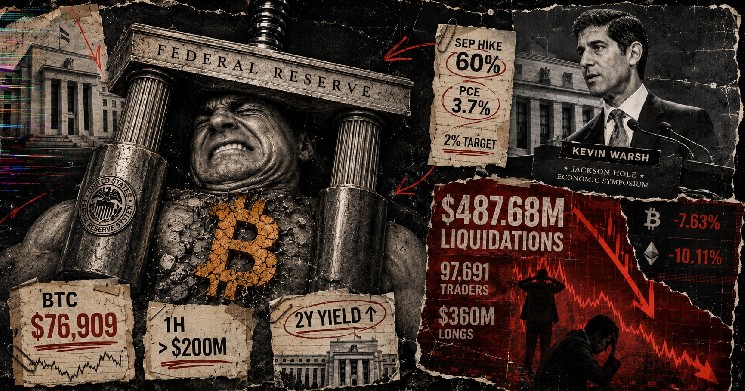
    Bitcoin fell below $77,000 on Friday after Fed Chair Kevin Warsh revived concerns that interest rates could move higher at Jackson Hole.

    Data from CryptoSlate showed Bitcoin, the largest cryptocurrency by market capitalization, dropping as low as $76,909 before recovering to $77,712 at press time. The cryptocurrency remained down about 4% over the previous 24 hours.

    The decline intensified a broader crypto deleveraging event that wiped out nearly $488 million from derivatives traders as markets sharply repriced expectations for Federal Reserve policy.

    Warsh revives rate-hike fears

    Traders raised the probability of a September rate increase to about 60%, up from roughly 35% before Warsh’s remarks. Short-term Treasury yields also climbed, while the US dollar strengthened.

    Warsh gave investors several reasons to reassess expectations that the Federal Reserve was preparing to ease monetary policy. He argued that inflation remained too high despite improved price data during the summer.

    The Fed’s preferred personal consumption expenditures price index was running at 3.7% over the past year and at a 4.1% annualized pace over the past six months. Both readings remain well above the central bank’s 2% target.

    Recent inflation reports had not convinced Warsh that the underlying trend had changed. He said:

    “We must be confident that underlying inflation is moving to our objective, clearly and at sufficient speed. Otherwise, we have work to do.”

    Warsh also questioned whether current borrowing conditions were restraining demand sufficiently. Credit markets showed limited signs of policy restraint, while corporate bond spreads remained historically narrow and bank lending standards relatively easy.

    He added:

    “I would be hard pressed to describe broad financial conditions as restrictive.”

    The combination delivered a hawkish signal to financial markets. Warsh described labor conditions as consistent with full employment, pointed to healthy consumer spending and strong business investment, and said the Fed’s “predominant focus right now should be on prices.”

    For crypto traders, the implication was immediate. A resilient economy gives the Fed more room to keep monetary policy tight, while persistent inflation increases the risk that its next move could be another rate increase rather than the easier financial conditions that risk assets had been anticipating.

    The two-year Treasury yield rose to a one-month high after the remarks as investors increased their bets on another rate increase.

    Leveraged crypto traders suffer nearly $488 million in liquidations

    The shift in rate expectations hit a crypto market that had entered Friday with substantial leveraged exposure following Bitcoin’s recent rally above $80,000.

    CoinGlass recorded $487.68 million in liquidations across the cryptocurrency market during the previous 24 hours, affecting 97,691 traders. More than $200 million in positions were closed within one hour of Warsh’s speech.

    Bitcoin and Ethereum led crypto liquidations as 24-hour losses reached $487.81 million across 97,772 traders. Source: CoinGlass

    Long positions accounted for more than $360 million of the losses, indicating that traders positioned for further gains absorbed most of the reversal. Bitcoin positions generated about $141 million of the liquidations.

    The largest individual liquidation was an $11.66 million ETH-USDT position on Binance.

    Warsh’s speech also affected the gold market. Reports said gold and silver lost more than $700 billion in combined market value following the remarks.

    Higher interest-rate expectations create several simultaneous headwinds for cryptocurrency markets. Rising Treasury yields increase the returns available from dollar-denominated assets, while a stronger dollar typically tightens financial conditions for speculative investments.

    Expectations for more restrictive monetary policy can also reduce the liquidity that helped drive Bitcoin’s recent advance.

    Friday’s reaction showed how quickly that relationship can reassert itself. Bitcoin had been trading near $80,000 before Warsh’s speech became the dominant macroeconomic catalyst. Contemporaneous reports showed the cryptocurrency falling more than 3% as rate-hike expectations increased.

    Less Fed guidance could increase crypto rate volatility

    Warsh offered little certainty about the Federal Reserve’s next move.

    The chairman has moved away from the forward guidance used heavily by his predecessors, arguing that telegraphing policy paths can distort markets and limit the central bank’s flexibility when economic conditions change.

    He also rejected the idea of giving investors a mechanical reaction function that would dictate how interest rates should respond to individual economic reports.

    This approach could make upcoming inflation and employment data more important for Bitcoin and other risk assets. Traders will have fewer signals from the Fed about how policymakers intend to respond to new economic information.

    Apollo Global Management Chief Economist Torsten Slok has argued that this type of policy regime could push more interest-rate moves outside Federal Reserve meeting days. Investors would continuously reprice economic data instead of waiting for policymakers to validate existing expectations.

    Slok noted that since the Fed began raising rates in 2022, much of the increase in longer-term Treasury yields has occurred outside Federal Open Market Committee meetings. Inflation reports, employment data, Treasury issuance and the term premium became larger drivers of the bond market.

    Warsh reinforced that philosophy on Friday, saying markets should form their own expectations rather than look primarily to the Fed for their “next trade.”

    For Bitcoin, Friday offered an early example of what that environment could look like.

    Warsh stopped short of committing to a September rate increase, leaving incoming data to determine whether the Fed follows through. However, his insistence that inflation remains too high, financial conditions are not particularly restrictive and interest rates remain the central bank’s main policy tool was enough to revive fears of tighter monetary policy.


  • SlowMist Flags Fake Qwen 3.8 27B GitHub Repository Hiding StealC Info-Stealer

    SlowMist Flags Fake Qwen 3.8 27B GitHub Repository Hiding StealC Info-Stealer

    A malware campaign disguised as downloadable model weights for Alibaba’s Qwen 3.8 27B AI model has targeted GitHub users who run open-source artificial intelligence models locally. SlowMist’s security team reported the threat on August 28, warning that the malicious files can steal credentials and other sensitive data.

    Fake Qwen AI model hosted on GitHub

    The fraudulent GitHub repository was designed to look like an official download page for Qwen, promising users a fully offline AI model that would keep their data private. However, the repository’s file size revealed the deception.

    The ZIP archive was just 487 KB, or less than half a megabyte. A genuine AI model with 27 billion parameters typically requires more than 16 GB of storage.

    Named uncensored_qwen_v2.6.zip, the malicious archive was created on August 20, 2026. Four days later, the attackers modified the repository’s README file so that every download link led directly to the harmful ZIP file.

    Alibaba’s legitimate Qwen project was not affected by the incident.

    StealC malware targets passwords and crypto wallets

    The archive contained three files: a command file, an executable program and a script disguised as a certificate. The executable was a renamed version of a LuaJIT interpreter, a tool commonly used by game engines. While the interpreter itself is not inherently dangerous, the fake certificate script uses it to deliver StealC malware.

    Once active, StealC collects the infected computer’s system name, username, machine ID and Windows version. It also captures a screenshot and sends the stolen information to an attacker-controlled server.

    The malware can additionally target browser login credentials, cookies, browsing history, email passwords and cryptocurrency wallet data.

    The attackers added a fallback mechanism that retrieves a backup server address from a smart contract on the Polygon blockchain. If the primary server is taken offline, the attackers can change the malware’s server location without updating the code on infected computers.

    Growing number of malicious AI repositories

    SlowMist identified at least 23 other GitHub repositories and 29 similar ZIP files that used the same Lua-based delivery chain.

    Island.io separately discovered and reported a campaign called FakeGit, which has been active since March 2025. The campaign has reportedly created around 7,600 malicious GitHub repositories and generated more than 14 million download events.

    About 800 of those repositories specifically impersonate AI-related tools. They use a technique called AgentBaiting, which can even persuade AI assistants to recommend the malicious projects.

    Cryptopolitan reported in January that Alibaba’s genuine models had surpassed 700 million downloads on Hugging Face, more than any other open-source AI system.

    In late June, at least 292 GitHub repositories copying well-known brands were flagged. Those repositories distributed BoryptGrab, a malware strain capable of stealing data from 32 cryptocurrency wallets and 19 web browsers.

    Separately, security firm InfoStealers described another automated campaign called Megalodon, which created more than 5,000 fake repositories in only six hours.

    How attackers make fake GitHub projects look legitimate

    Cybercriminals are increasingly copying legitimate projects, creating convincing README pages and using stolen developer identities to make malicious repositories appear authentic. They also list the fake projects in public AI directories such as LobeHub and Glama, increasing their visibility and credibility.

    Cryptopolitan previously reported a similar tactic in which the StopAndProtect operation turned nearly 2,000 compromised WordPress websites into traps for cryptocurrency users.

    Island.io said the malicious repositories are designed to exploit the growing demand for AI capabilities.

  • Core Lightning Urges Upgrade After AI Reports Reveal Security Flaws

    Core Lightning Urges Upgrade After AI Reports Reveal Security Flaws

    Core Lightning has urged Lightning Network node operators to upgrade to version 26.06.7 after developers identified several security vulnerabilities in the software.

    The emergency release, issued Aug. 28, addresses issues uncovered during a 10-day security review that included reports generated with the help of artificial intelligence. Developers verified several findings and released fixes while withholding technical details under a two-week disclosure embargo.

    Maintained by Blockstream, Core Lightning is used by operators running Lightning Network nodes. Developers have not disclosed the full nature of the vulnerabilities, leaving their potential impact unclear.

    Lightning Network Operators Face Security Deadline

    The disclosure embargo gives operators time to install the fixes before researchers publish additional details in mid-September. Unpatched nodes could face increased risk once the vulnerabilities become public.

    Core Lightning recommends using signed binaries when installing version 26.06.7. Operators who cannot upgrade immediately can use the –offline flag to monitor their nodes until the update is complete.

    Older Core Lightning Versions Lose Security Support

    Versions 26.04 and older no longer receive security fixes. The latest release follows Core Lightning version 26.06.6, which was published July 22.

    Earlier this year, developers fixed denial-of-service flaws affecting versions 26.04 and 26.06rc2. The latest findings add to scrutiny of Lightning Network security as automated tools make it easier to identify weaknesses in widely used software.

    Source: cryptonews.net

  • Attacker Drains More Than $1 Million from Avici Users in Live Attack on Solana Neobank

    Attacker Drains More Than $1 Million from Avici Users in Live Attack on Solana Neobank

    An attacker is draining customer funds from Avici, a Solana neobank that issues Visa cards backed by users’ cryptocurrency. More than $1 million had been stolen by press time.

    Avici markets its cards as self-custodial, with user balances held in onchain accounts authorized through passkeys rather than seed phrases. The attacker breached that authorization layer by calling an instruction that registers a new administrator on a user’s collateral account, then withdrawing the account’s balance.

    According to Solana RPC data queried by The Defiant, the attacker’s wallet, FVNFzq[…]QnCEj, held 10,005.03 $SOL worth approximately $1.07 million at 18:58 UTC, along with roughly $11,600 in $USDC and $USDT. Its $SOL balance had increased by about 2,595 tokens, or approximately $277,000, during the preceding 11 minutes.

    Avici said in a post at 18:42 UTC that it is “working directly with all relevant partners to resolve it and will share updates as soon as we have more information.” The company has not disclosed how the funds were taken, how many accounts were affected or whether users will be reimbursed.

    Attacker Added as Administrator Before Withdrawing Funds

    The wallet received 1.79 $SOL bridged through deBridge at 13:40 UTC and remained inactive for three hours. Its first call against Avici’s contracts was recorded at 16:49:48 UTC. Since then, it has signed 14,672 transactions, including 2,344 failed transactions.

    Transaction logs show a repeated three-instruction pattern for each victim. The wallet first calls SubmitSignatures on Avici’s authorization program in a transaction that also invokes Solana’s Ed25519 signature-verification precompile. It then calls AddCollateralAdmin on Avici’s collateral program, followed by WithdrawCollateralAsset on the same program.

    In one transaction reviewed by The Defiant, a single WithdrawCollateralAsset call transferred 2,346.77 $USDT from a user’s collateral account to the attacker’s token account. The wallet periodically converts the stolen stablecoins into $SOL; one swap added 209.76 $SOL.

    Both Avici programs are upgradeable and use the same upgrade authority, which is a standard Solana account rather than a multisig.

    Avici Acknowledged the Attack Nearly Two Hours After the First Drain

    Avici acknowledged the incident one hour and 53 minutes after the first draining transaction. Users had already posted about missing balances before the company’s statement appeared.

    “i just got drained of all my balance from my @avici acc,” one user wrote at 18:44 UTC. “waiting to hear from the project.”

    A live tracker created by pseudonymous onchain analyst STACC counted 125 distinct sending accounts during its tracking window. Inbound transfers ranged from approximately 9 $USDC to more than 26,000 $USDT.

    AVICI Token Price Falls Nearly 50%

    AVICI traded at $0.2175, down 49.4% over 24 hours, with a market capitalization of $2.84 million and 24-hour trading volume of $656,543, according to CoinGecko. The token set a record low on Friday after reaching $7.56 on Nov. 26, 2025.

    Most AVICI trading takes place on MetaDAO’s futarchy automated market maker, which accounts for approximately 58% of volume. The remaining activity is split among LBank, KCEX and MEXC.

    Avici Refunded Nearly 90% of ICO Commitments

    Avici raised funds through MetaDAO in October 2025 in one of the token launches that helped revive the initial coin offering model on Solana. The team capped the sale at $3.5 million despite $34,206,976 in commitments, refunding 89.8% of committed $USDC and setting an initial price of $0.35.

    The offering assigned the project a fully diluted valuation of $4,515,000 across a 12.9 million-token supply. AVICI now trades at approximately 62% of its ICO price.

    The company is registered as Avici Inc. in San Francisco. On Aug. 24, it said it would be among the first neobanks to offer Coinbase’s tokenized stocks on Base.

    Wallet-level compromises have represented a growing share of cryptocurrency losses in 2026, including Trust Wallet’s $7 million browser extension hack and thefts involving Coldcard hardware wallets. Decentralized finance recorded approximately 70 exploits and $746 million in stolen funds during the second quarter, making it the most heavily exploited quarter on record.

  • Edge Wallet Says Zendesk Breach Exposed User Emails, but Funds Remain Safe

    Edge Wallet Says Zendesk Breach Exposed User Emails, but Funds Remain Safe

    Edge Wallet has warned users that a data breach at its former customer support provider, Zendesk, exposed email addresses used to contact the company between September 2018 and May 2024.

    The incident did not expose Edge wallets, private keys, wallet data or user funds, the company said on X. Edge stopped using Zendesk after May 2024, limiting the breach to information shared with its support team.

    Email Exposure Increases Phishing Risk

    We’re notifying users of a breach involving Edge’s former support provider, Zendesk.Only email addresses used to contact the Edge support team between Sept 2018 to May 2024 were exposed. Edge wallets, private keys, wallet data, and funds remain safe.1/6

    — Edge (@EdgeWallet), August 28, 2026

    The exposed email addresses could be used in phishing and impersonation attempts. Edge urged users to avoid suspicious links, attachments and requests for personal information.

    Support emails do not provide access to wallets or authenticate transactions, the company said. The company also said its wallets operate through mobile applications, while private keys remain on users’ devices.

    As a result, attackers cannot directly access funds through Edge’s servers using the exposed information. Users should verify suspicious messages through the Edge mobile app or official support channels instead of responding to unexpected requests.

    Crypto Security Incidents Continue

    The disclosure comes as other crypto platforms face separate security incidents. Coldcard users reportedly lost about 1,367 Bitcoin following a firmware vulnerability, while an attacker drained 5.24 million ENJ tokens from Enjin’s Crypto Items platform on August 25.

    Defimon detected an exploit on @enjin that drained $142K on EthereumEnjin’s ERC-1155 “Crypto Items” platform lets each item route transfers through a per-item adapter. The attacker registered/used a malicious transfer adapter that skips the owner-approval check, so their…

    — Defimon Alerts (@DefimonAlerts), August 25, 2026

    The incidents highlight the range of risks facing crypto users, from stolen contact information to software vulnerabilities and platform exploits.

  • MoonPay Acquires Rhythm to Expand Onchain Trading Capabilities

    MoonPay Acquires Rhythm to Expand Onchain Trading Capabilities

    MoonPay Acquires Rhythm to Expand Onchain Trading Infrastructure

    MoonPay is expanding further into onchain trading through the acquisition of Rhythm, a platform designed to help traders identify opportunities, execute transactions and manage risk across fast-moving crypto markets.

    The deal brings Rhythm’s technology and its three co-founders—Joseph Murphy, James Miller and Lincoln Barnett III—into MoonPay. It also completes a relationship that began last year, when Rhythm became the first company backed by MoonPay Labs in 2025. That investment gave MoonPay an early view of the platform before the company decided to bring Rhythm’s team and technology in-house.

    For MoonPay, the acquisition adds to a business that has grown well beyond its original role of helping users buy and sell cryptocurrency with fiat currency. The company now operates across payments, trading, stablecoins and onchain infrastructure, serving more than 30 million customers in 180 countries and more than 1,500 enterprise clients.

    Rhythm Combines Trading Discovery and Execution

    Rhythm was built to address a common challenge in onchain markets: traders often rely on multiple tools to discover assets, assess opportunities, execute trades and manage risk. Its platform combines those functions, offering trading signals as well as automation, execution and risk-management tools.

    The technology will now become part of MoonPay’s expanding trading infrastructure. The acquisition also adds a team with experience developing high-frequency DeFi trading systems and other software designed to handle large volumes of transactions.

    Rhythm Chief Product Officer Joseph Murphy previously co-founded Minty Finance, where he helped build high-frequency DeFi trading software responsible for more than $7 million in executed trades.

    Murphy previously founded Mirage Software, an automated checkout technology company that facilitated more than $50 million in customer spending.

    Rhythm CEO Lincoln Barnett III has worked in DeFi trading and with startups across fundraising, go-to-market strategy, partnerships, operations and growth. At Rhythm, he led the company’s strategy and development across trading discovery, automation, risk management and execution.

    Chief Technology Officer James Miller brings experience across fintech, cloud infrastructure and trading systems. He previously worked as a full-stack engineer at Spendesk and co-founded Minty Finance with Murphy. His earlier roles included work on multi-region AWS infrastructure and consumer software.

    MoonPay Continues Expanding Beyond Crypto Payments

    Earlier this month, MoonPay also expanded PayBox, its payment vault built for AI, through an integration with Solana lending protocol Kamino. The integration allows eligible users to prepare lending and borrowing transactions through conversations with ChatGPT and Claude.

    Rhythm adds onchain trading capabilities to that broader expansion, bringing asset discovery, automation and risk management into MoonPay’s ecosystem of more than 30 million customers worldwide.

    Source: cryptonews.net