Author: Evan Mercer

  • CME Group to Launch Bitcoin Cash, Uniswap Futures Next Month

    CME Group to Launch Bitcoin Cash, Uniswap Futures Next Month

    Key Highlights

    • CME Group will launch Bitcoin Cash and Uniswap futures contracts on Oct. 19, pending regulatory approval.
    • Both products will be offered in standard and Micro contract sizes, covering 250 BCH and 25 BCH for Bitcoin Cash, and 10,000 UNI and 1,000 UNI for Uniswap.
    • The expansion follows CME’s earlier 2026 rollout of futures for Cardano, Chainlink, Stellar, Avalanche, and Sui, reflecting growing institutional demand for crypto risk-management tools.

    CME Group Expands Crypto Derivatives Lineup with Bitcoin Cash and Uniswap Futures

    CME Group announced Tuesday that it plans to add Bitcoin Cash (BCH) and Uniswap (UNI) futures contracts to its cryptocurrency derivatives suite, with a targeted launch date of Oct. 19, subject to regulatory approval. The move marks a continued deepening of the exchange’s commitment to providing institutional-grade access to a broader spectrum of digital assets.

    Contract Specifications and Micro Options

    The new futures will be available in both standard and Micro contract sizes, catering to a range of market participants from large institutions to smaller traders. Standard Bitcoin Cash futures will represent 250 BCH, while Micro Bitcoin Cash futures will represent 25 BCH. For Uniswap, standard futures will cover 10,000 UNI and Micro futures will cover 1,000 UNI. This tiered structure mirrors the approach CME has taken with its existing Bitcoin and Ether futures and options, allowing for more precise position sizing and capital efficiency.

    Responding to Institutional Demand Amid Market Maturation

    The company said the new contracts respond to client demand for institutional-grade risk-management tools as crypto markets develop. CME’s crypto futures and options recorded average daily volume of 279,800 contracts in the first half of 2026, with average open interest of 264,600 contracts. These figures underscore the sustained engagement of professional market participants in regulated crypto derivatives, even amid broader market volatility.

    Building on a Year of Altcoin Futures Expansion

    The launch comes after CME rolled out futures tied to Cardano, Chainlink, Stellar, Avalanche, and Sui this year. That series of listings signaled a strategic pivot beyond the dominant Bitcoin and Ether complex, acknowledging the growing relevance of layer-one platforms and decentralized finance protocols in institutional portfolios. By adding Bitcoin Cash—a payments-focused fork of Bitcoin—and Uniswap—the leading decentralized exchange protocol—CME is further diversifying its crypto index to capture distinct use-case narratives.

    Why This Matters

    The introduction of Bitcoin Cash and Uniswap futures on a regulated exchange like CME Group represents a significant milestone for the institutional adoption of alternative crypto assets. It provides traditional financial institutions, hedge funds, and asset managers with a familiar, centrally cleared venue to hedge exposure or express directional views on these specific tokens without needing to hold the underlying assets directly. This development also reflects the evolving regulatory comfort with a wider array of digital assets, as evidenced by the pending approval process. For the broader market, the availability of Micro contracts lowers the barrier to entry, potentially increasing liquidity and price discovery for BCH and UNI. As CME continues to expand its crypto derivatives catalog, it reinforces the trend of traditional financial infrastructure integrating digital assets, which could accelerate capital inflows and further legitimize the asset class.

    Frequently Asked Questions

    When will the Bitcoin Cash and Uniswap futures launch?

    The targeted launch date is Oct. 19, pending regulatory approval.

    What contract sizes will be available?

    Both standard and Micro contract sizes will be offered. Standard Bitcoin Cash futures represent 250 BCH; Micro Bitcoin Cash futures represent 25 BCH. Standard Uniswap futures cover 10,000 UNI; Micro Uniswap futures cover 1,000 UNI.

    How does this fit into CME’s existing crypto derivatives lineup?

    CME already offers futures and options on Bitcoin and Ether, and earlier in 2026 launched futures for Cardano, Chainlink, Stellar, Avalanche, and Sui. The addition of Bitcoin Cash and Uniswap continues the expansion into a diversified set of crypto assets driven by institutional client demand.

  • CME Group Announces Futures Trading for Two New Altcoins, Prices Surge

    CME Group Announces Futures Trading for Two New Altcoins, Prices Surge

    Key Highlights

    • CME Group will launch Bitcoin Cash (BCH) and Uniswap (UNI) futures on October 19, 2025, following regulatory review.
    • Both standard and micro contract sizes will be available, offering institutional-grade risk management tools for highly liquid altcoin markets.
    • The addition expands CME Group’s single-asset cryptocurrency futures portfolio to include Bitcoin, Ethereum, XRP, Solana, Cardano, Chainlink, Stellar, Avalanche, Sui, and now BCH and UNI.

    CME Group Announces New Altcoin Futures Launch

    Chicago Mercantile Exchange Group (CME Group), the world’s largest derivatives exchange, announced today that it will launch Bitcoin Cash and Uniswap futures on October 19, 2025, following regulatory review. This latest expansion of CME Group’s cryptocurrency product portfolio comes in direct response to strong customer demand for institutional-level risk management tools in highly liquid altcoin markets. According to the official announcement, market participants will have the option to trade both large-scale and micro-scale contracts, providing flexibility for a wide range of trading strategies and capital requirements.

    Contract Specifications and Trading Details

    The new product suite comprises four distinct contracts designed for greater versatility and capital efficiency. Bitcoin Cash futures will be offered at a standard contract size of 250 BCH, alongside Micro Bitcoin Cash futures at 25 BCH. For Uniswap, standard contracts will represent 10,000 UNI, with Micro Uniswap futures sized at 1,000 UNI. All contracts will trade on CME Globex, the exchange’s 24/7 electronic trading platform, within a regulated marketplace framework that provides central counterparty clearing and risk mitigation.

    Institutional Demand Drives Product Expansion

    Giovanni Vicioso, Global Head of Cryptocurrency Products at CME Group, stated: “As cryptocurrency markets continue to mature, participants need broader, regulated tools to manage evolving digital asset price risk. Designed for greater versatility and capital efficiency, these new $BCH and $UNI contracts enable clients to manage price risk and gain access to key crypto networks in our 24/7 open, regulated marketplace.” The launch reflects CME Group’s strategy to deepen its cryptocurrency derivatives lineup as institutional adoption accelerates. At this point, CME is further expanding its comprehensive portfolio of single-asset cryptocurrency products, which includes Bitcoin, Ethereum, XRP, Solana, Cardano, Chainlink, Stellar, Avalanche, and Sui futures, along with the newly added BCH and UNI contracts.

    Market Reaction and Price Impact

    Following the news, both BCH and UNI prices increased, signaling positive market reception to the expanded availability of regulated derivatives. The introduction of futures contracts on a major regulated exchange like CME Group typically enhances price discovery, improves liquidity, and provides hedging mechanisms that can reduce volatility for underlying spot markets. Analysts note that the availability of micro contracts lowers the barrier to entry for smaller institutional participants and sophisticated retail traders, potentially broadening the investor base for these assets.

    Why This Matters

    The launch of Bitcoin Cash and Uniswap futures on CME Group represents a significant milestone in the mainstreaming of cryptocurrency derivatives. As the world’s largest derivatives marketplace, CME Group’s product decisions often serve as a bellwether for institutional acceptance of digital assets. The inclusion of BCH and UNI—both representing distinct blockchain ecosystems (a Bitcoin fork focused on payments and a leading decentralized exchange protocol, respectively)—signals growing institutional interest beyond the largest two cryptocurrencies by market capitalization. This expansion also occurs amid evolving regulatory clarity in major jurisdictions, which has encouraged traditional financial infrastructure providers to deepen their crypto offerings. The availability of regulated, centrally cleared futures contracts addresses a critical infrastructure gap for asset managers, hedge funds, and corporate treasuries seeking exposure to or hedges against altcoin price movements without direct custody of the underlying tokens.

    Frequently Asked Questions

    When do the new Bitcoin Cash and Uniswap futures begin trading?
    The contracts launch on October 19, 2025, following regulatory review.
    What contract sizes are available for BCH and UNI futures?
    Standard Bitcoin Cash futures are 250 BCH per contract; Micro Bitcoin Cash futures are 25 BCH. Standard Uniswap futures are 10,000 UNI; Micro Uniswap futures are 1,000 UNI.
    Where will these futures trade?
    All contracts will trade on CME Globex, CME Group’s 24/7 electronic trading platform, with central counterparty clearing.
  • XRP Drains From Exchanges as Data Points to Potential Rally

    XRP Drains From Exchanges as Data Points to Potential Rally

    Key Highlights

    • Binance XRP reserves recorded a net negative flow of approximately 102,912 tokens as outflows dropped 25.96% versus a 20.37% decline in inflows, signaling holders are moving supply off-exchange during the price rally.
    • Whale inflows to Binance surged to 1.6 billion XRP over the prior 30 days—the highest since March—yet exchange reserves rose only 0.22% above the quarterly baseline, indicating high turnover and repositioning rather than distribution.
    • XRP’s fully diluted market cap remains elevated near $139 billion despite the pullback from $150 billion peak, while circulating-supply market cap holds around $94 billion, suggesting no fresh wave of exchange selling has materialized.

    Binance Exchange Reserves Signal Accumulation Over Distribution

    XRP traded at $1.5176 on September 22, consolidating within a daily range of $1.5062 to $1.5398 after retracing from a session high of $1.57. While the pullback may appear to signal fading momentum, on-chain exchange data from CryptoQuant paints a more constructive picture. Binance, the largest centralized venue for XRP, has seen its token reserves contract. Inflows to the exchange declined 20.37%, but outflows fell more sharply at 25.96%, producing a net outflow of roughly 102,912 XRP. Because tokens held on exchanges are immediately available for sale, this net reduction in exchange-held supply suggests a cohort of holders is withdrawing tokens to private wallets rather than liquidating into the recent recovery.

    Whale Activity Shows High Turnover, Not Selling Pressure

    Adding nuance to the reserve data, CryptoQuant contributor Arab Chain reported that large-wallet inflows to Binance reached approximately 1.6 billion XRP over the previous 30 days, marking the highest cumulative reading since March after a lull in May through July. Yet Binance’s total XRP reserve ended the week at 2,630,628,140 XRP—only 0.22% above its quarterly baseline and 0.34% higher week-over-week. The disconnect between massive whale inflows and minimal reserve growth points to elevated turnover: whales are actively moving large volumes, but the tokens are not accumulating on the exchange order books. This pattern aligns with repositioning or custodial rotation rather than a coordinated distribution campaign.

    Market Cap Resilience Supports Bullish Structure

    Broader capitalization metrics reinforce the absence of heavy selling pressure. XRP’s fully diluted market cap, which accounts for all tokens in existence, expanded from roughly $103 billion early in the rally to over $150 billion at the peak before settling near $138.97 billion. The circulating-supply market cap currently sits closer to $94 billion. Despite the price correction from the rally high, both measures remain elevated while net exchange flows stay negative. This combination indicates the pullback has not yet triggered a significant increase in exchange-available supply, preserving the underlying bullish structure.

    September Seasonality Presents Historical Headwind

    One countervailing risk factor is XRP’s September seasonal track record. In seven of the past eight years, September performance moved opposite to August’s direction. In the two instances where August closed positive—2020 and 2021—September delivered declines of 14% and 19.6%, respectively. This pattern is especially relevant in 2024 because XRP posted a 30% gain in August, its strongest August since 2021. While seasonal tendencies are not deterministic, the historical precedent adds a potential headwind as the month enters its final stretch.

    Why This Matters

    The divergence between surging whale inflows and flat exchange reserves highlights a critical analytical distinction for crypto market participants: large on-exchange movements do not automatically equate to selling intent. When reserves fail to grow despite heavy inflows, it often signals that sophisticated actors are rotating custody, rebalancing across venues, or positioning for future catalysts rather than exiting positions. For XRP specifically, the negative net flow during a price advance suggests conviction among holders who anticipate higher levels. However, the strong August performance combined with a historically bearish September seasonal profile creates a tactical tension. Traders and investors should monitor the $1.55 resistance for a breakout toward $1.68 and the $1.4860 support zone for structure validation, while weighing seasonal probability against the current on-chain evidence of accumulation.

    Frequently Asked Questions

    What does a net negative exchange flow mean for XRP price action?
    A net negative flow indicates more XRP is leaving Binance than entering, reducing the immediately sellable supply on the exchange. This typically reflects holder conviction and can support prices during rallies by limiting available liquidity for selling.
    Why are whale inflows rising while Binance reserves stay flat?
    The 1.6 billion XRP in whale inflows over 30 days has not translated into higher reserves because outflows are matching or exceeding inflows. This suggests whales are actively trading or moving tokens between custodial solutions rather than depositing to sell.
    How reliable is XRP’s September seasonal pattern as a trading signal?
    Seasonal patterns are statistical tendencies, not deterministic rules. While seven of the last eight Septembers moved opposite to August, and the two post-positive-August years saw double-digit declines, market structure, macro conditions, and token-specific catalysts can override historical seasonality.
  • Payward-Backed Reap Turns to Non-USD Stablecoins for 24/7 Cross-Border FX Settlement

    Key Highlights

    • Reap, a Visa Principal Issuer Member owned by Kraken parent Payward, plans to add a Mexican peso stablecoin to its card, cross-border payments, and treasury products.
    • The Hong Kong-based fintech is also exploring stablecoins pegged to the Hong Kong dollar, euro, South Korean won, and Japanese yen through its global stablecoin partnership with Visa.
    • Founder Daren Guo emphasizes that while public blockchains operate continuously, traditional FX settlement still relies on banking hours and can take days, with emerging-market corridors incurring 5% to 7% fees.

    Reap Expands Stablecoin Suite Beyond Dollar Denomination

    Hong Kong-based fintech platform Reap is preparing to launch a Mexican peso-denominated stablecoin across its card issuance, cross-border payments, and treasury management products, according to founder Daren Guo. The move signals a strategic push to diversify stablecoin utility beyond the U.S. dollar, which currently dominates nearly 99% of stablecoin payment volume even when commercial activity occurs in local currencies worldwide.

    Visa Partnership Enables Around-the-Clock Settlement

    Reap operates as a Visa Principal Issuer Member (VPIM), granting it the ability to issue cards on its own bank identification numbers (BINs) and support partners in more than 100 markets. The company’s global stablecoin partnership with Visa provides its card programs with around-the-clock settlement capabilities, addressing a critical friction point in traditional finance. As Guo explained, “Visa makes stablecoins settle. Reap makes them spendable.” This infrastructure allows Reap to bridge the gap between public blockchains, which run continuously, and the legacy foreign exchange system that remains tethered to banking hours, correspondent banks, and multi-day settlement cycles.

    Payward Acquisition Unlocks New Capabilities

    The expansion follows Reap’s acquisition by Payward, the parent company of cryptocurrency exchange Kraken. Guo noted that the deal “opens up additional capabilities,” including possible access to yield, tokenized equities and trading. With the backing of a major crypto exchange group, Reap is positioned to integrate deeper financial primitives into its stablecoin-powered payment rails, potentially offering clients yield-bearing instruments and tokenized asset exposure alongside core payments and treasury functions.

    Targeting High-Fee Emerging Market Corridors

    Guo highlighted the economic inefficiency of current cross-border flows, stating that “Public blockchains run continuously, but global foreign exchange (FX) still relies on banking hours, correspondent banks and settlement that can take days. In emerging and cross-border markets, moving money between currency corridors can incur fees of 5% to 7%.” By introducing stablecoins pegged to the Mexican peso, Hong Kong dollar, euro, won, and yen, Reap aims to reduce these costs and enable real-time, programmable money movement for businesses operating across currency zones.

    Why This Matters

    The stablecoin market has long been dominated by USD-pegged tokens such as USDT and USDC, creating a structural mismatch for businesses that earn and spend in non-dollar currencies. Reap’s multi-currency stablecoin roadmap, backed by Visa’s settlement network and Payward’s exchange infrastructure, represents a concerted effort to localize stablecoin utility for global commerce. If successful, the initiative could accelerate adoption of on-chain payments in Latin America, Europe, and Asia-Pacific, where businesses currently bear high FX conversion costs and settlement delays. The involvement of a Visa Principal Issuer Member also underscores growing institutional comfort with stablecoin-based payment rails, potentially setting a precedent for other fintechs to issue non-dollar stablecoins at scale.

    Frequently Asked Questions

    Which stablecoins is Reap planning to support?

    Reap is preparing to add a Mexican peso stablecoin and is exploring tokens pegged to the Hong Kong dollar, euro, South Korean won, and Japanese yen for integration across its card, cross-border payments, and treasury products.

    How does Reap’s Visa partnership enable stablecoin spending?

    As a Visa Principal Issuer Member, Reap can issue cards on its own BINs and leverage Visa’s global stablecoin partnership to provide around-the-clock settlement, making stablecoins spendable at any merchant that accepts Visa across more than 100 markets.

    What role does Payward play in Reap’s expansion?

    Payward, the parent company of Kraken, acquired Reap and provides additional capabilities including potential access to yield-generating products, tokenized equities, and trading infrastructure, enhancing Reap’s stablecoin-powered financial services suite.

  • $3.2 Million ‘Bitcoin Butterfly’ Option Trade Bets on $95,000 by End of October

    $3.2 Million ‘Bitcoin Butterfly’ Option Trade Bets on $95,000 by End of October

    Key Highlights

    • Options traders are positioning for Bitcoin to climb from approximately $85,000 to $95,000 over the next four weeks, with technical charts showing minimal resistance up to $98,000.
    • Bullish sentiment is reflected in rising call option demand and a notable butterfly spread strategy, while short-term risk reversals flipped aggressively in favor of calls during the recent move to $85K.
    • Coinbase Markets data shows elevated implied volatility across major tokens through September 27, with XRP leading at 8.9% expected one-standard-deviation swings, followed by Solana (8.0%), Ether (6.9%), and Bitcoin (5.0%).

    Options Market Signals Growing Bitcoin Bullishness Toward $95,000 Target

    Derivatives data suggests professional traders are increasingly betting on a sustained Bitcoin rally, with one prominent options structure targeting a move from roughly $85,000 to $95,000 over the coming month. The positioning aligns with technical analysis of Bitcoin’s daily chart, which reveals a notable absence of historical resistance levels between $85,000 and $98,000. With no prior price zones where the asset stalled or consolidated, current momentum could theoretically propel Bitcoin toward the upper end of that range in the near term, absent exogenous shocks.

    Butterfly Spread and Call Demand Highlight Upside Bias

    The bullish posture extends beyond a single trade. Market participants have also ramped up demand for upside exposure through call options, driving short-term risk reversals higher. This shift indicates a broader appetite for leveraged long positions rather than hedging activity. A butterfly spread — typically a defined-risk strategy profiting from a move to a specific strike — was identified as a key signal, suggesting the trader expects Bitcoin to gravitate toward the $95,000 level by expiration.

    Laser Digital Notes Volatile Risk Reversal Dynamics

    Commenting on the rapid shifts in options sentiment, Laser Digital observed in a note shared with CoinDesk: “Risk reversals have also been volatile, with front-end RRs flipping aggressively in favour of calls during the move up to $85K, before retracing somewhat this morning.” The commentary underscores the sensitivity of short-dated options skew to spot price action, with the initial surge to $85,000 triggering a sharp repricing of upside risk before a partial pullback in call premiums.

    Implied Volatility Elevated Across Major Crypto Assets

    Coinbase Markets Quantifies Expected Price Swings Through September 27

    Beyond directional bets, the options market is pricing in heightened uncertainty across the digital asset complex. According to Coinbase Markets, one-standard-deviation expected price swings through September 27 stand at 8.9% for XRP, 8.0% for Solana (SOL), 6.9% for Ether (ETH), and 5.0% for Bitcoin. These figures reflect implied volatility — a measure of anticipated magnitude of price movement rather than directional bias — with XRP exhibiting the highest expected turbulence among the four majors.

    Volatility Premium Suggests Event-Driven or Structural Uncertainty

    The dispersion in implied volatility across assets may reflect token-specific catalysts, such as regulatory developments for XRP or network upgrade timelines for Solana and Ethereum. Bitcoin’s relatively lower implied volatility at 5.0% could indicate greater market confidence in its near-term price stability, even as traders position for upside. Notably, these volatility readings are forward-looking and do not predict direction; they merely quantify the options market’s expectation of price dispersion over the specified horizon.

    Why This Matters

    The convergence of bullish options structures, rising call skew, and a technically permissive chart creates a coherent narrative: sophisticated market participants are allocating capital toward a Bitcoin breakout above $85,000 with a measurable target near $95,000. The absence of overhead resistance on daily timeframes removes a key technical obstacle, while elevated implied volatility across altcoins signals a broader risk-on posture in crypto derivatives. For investors, the data suggests monitoring $85,000 as a pivot — a sustained break could activate further call buying and gamma-driven momentum toward $95,000-$98,000. However, the volatility premium in assets like XRP and SOL warrants caution, as sharp two-way moves remain probable through late September.

    Frequently Asked Questions

    What does the butterfly options strategy indicate about Bitcoin price expectations?

    The butterfly spread identified in the options market is a defined-risk, defined-reward strategy that profits maximally if Bitcoin settles near a specific strike price at expiration. In this case, the structure targets the $95,000 level over a four-week horizon, signaling the trader expects Bitcoin to rise from current levels around $85,000 and consolidate near that target.

    How do risk reversals reflect market sentiment?

    Risk reversals measure the difference in implied volatility between out-of-the-money calls and puts. When risk reversals “flip aggressively in favour of calls,” as Laser Digital noted, it means traders are paying a premium for upside protection or speculation relative to downside hedges — a clear signal of bullish sentiment in the near term.

    Why is XRP showing higher implied volatility than Bitcoin?

    Implied volatility reflects the options market’s expectation of future price dispersion, not direction. XRP’s 8.9% expected swing — the highest among major tokens — likely stems from token-specific uncertainties such as ongoing regulatory proceedings or lower liquidity relative to Bitcoin, which tends to dampen volatility expectations for the largest cryptocurrency by market cap.

  • Binance Acquires $100M Circle Stake in Five-Year USDC Promotion Deal

    Binance Acquires $100M Circle Stake in Five-Year USDC Promotion Deal

    Key Highlights

    • Binance acquired $100 million worth of Circle Class A shares at $80.84 per share in a private placement that closed September 17, per an SEC filing.
    • The equity purchase accompanies a five-year expanded partnership where Circle will pay Binance monthly incentive fees tied to USDC holdings via Circle’s Modular Smart Contract Wallet.
    • Binance faces a two-year lockup on selling, transferring, or hedging the shares but retains full voting rights throughout the restriction period.

    Binance Deepens Ties with Circle Through $100 Million Equity Investment

    Binance has acquired 1.24 million Class A shares of Circle Internet Financial at $80.84 per share, committing $100 million in a private placement that closed on September 17, according to a U.S. Securities and Exchange Commission filing published Tuesday. The transaction price represented a discount to Circle’s market valuation prior to the sale, the stablecoin issuer confirmed. The equity stake comes with a contractual lockup preventing Binance from selling, transferring, or hedging the shares for up to two years, subject to certain exceptions, though the exchange retains the right to vote its shares during the restriction period.

    Strategic Partnership Expansion Anchors USDC Growth on Binance

    The equity purchase coincides with a significant expansion of the companies’ existing partnership around USD Coin (USDC), Circle’s dollar-pegged stablecoin. Under the new five-year agreement, Circle will pay Binance a monthly incentive fee calculated as a percentage of the USDC held through Circle’s Modular Smart Contract Wallet service. In exchange, Binance will execute promotional activities designed to drive adoption and usage of USDC across its global trading platform. The arrangement effectively aligns Binance’s financial interests with the growth of USDC reserves custodied through Circle’s infrastructure.

    Lockup Terms Preserve Voting Rights While Limiting Liquidity

    The share restrictions impose a notable constraint on Binance’s ability to manage its investment position. For a period extending up to two years from closing, the exchange is prohibited from selling, transferring, or entering into hedging transactions involving the Circle shares. However, the agreement explicitly preserves Binance’s voting rights attached to the Class A shares, allowing the exchange to participate in corporate governance matters throughout the lockup. Certain exceptions to the transfer restrictions apply, though the filing does not specify their precise nature.

    Why This Matters

    This deal signals a deepening institutional alignment between the world’s largest cryptocurrency exchange by volume and the second-largest stablecoin issuer. By taking an equity stake, Binance gains a direct financial interest in Circle’s trajectory—potentially including a future public listing—while securing favorable economics on USDC distribution. For Circle, the partnership guarantees prime placement and promotional support on Binance’s platform, which remains a critical liquidity venue for stablecoins despite regulatory headwinds in multiple jurisdictions. The structure also reflects a broader trend: stablecoin issuers competing aggressively for distribution through incentive programs, with Tether’s USDT still commanding the dominant market share. Regulators will likely scrutinize the incentive fee mechanism, which ties payments to custodial volumes, for potential conflicts of interest or market manipulation concerns.

    Frequently Asked Questions

    How much did Binance pay per share for its Circle stake?

    Binance purchased 1.24 million Class A shares at $80.84 per share, totaling $100 million. The price reflected a discount to Circle’s pre-sale market valuation.

    What restrictions apply to Binance’s Circle shares?

    Binance cannot sell, transfer, or hedge the shares for up to two years, subject to certain unspecified exceptions. The exchange retains full voting rights during the lockup period.

    How does the incentive fee structure work in the USDC partnership?

    Circle will pay Binance a monthly fee calculated as a percentage of USDC held through Circle’s Modular Smart Contract Wallet service. Binance will conduct promotional activities for USDC in return.

  • Bitcoin Recovers From Asian-Session Lows as Falling Oil Price Supports Risk Appetite

    Bitcoin Recovers From Asian-Session Lows as Falling Oil Price Supports Risk Appetite

    Key Highlights

    • Bitcoin surged above $86,000 after breaking the May high, driven by nearly $1 billion in single-day spot ETF inflows—the largest since October 2024.
    • WTI crude oil dropped below $90 a barrel on reports Iran may reopen the Strait of Hormuz, easing inflation fears and reducing pressure for further Federal Reserve rate hikes.
    • Broad risk appetite improved as the Nasdaq rallied, global stocks rose, U.S. bond yields fell, and optimism grew over U.S.–China trade negotiations.

    Bitcoin Extends Rally Past $86K on Record ETF Flows and Macro Tailwinds

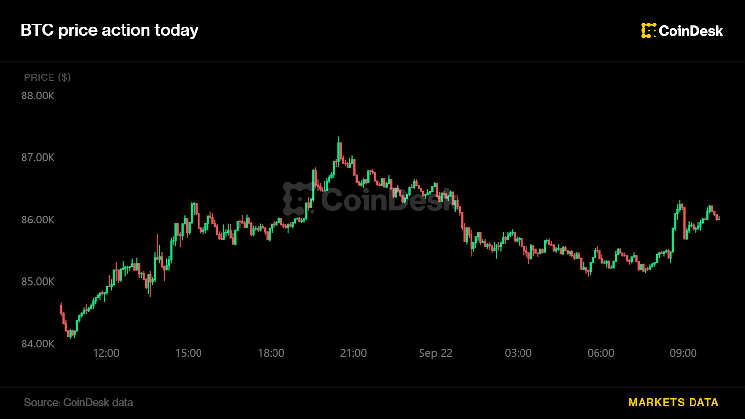
    Bitcoin (BTC) consolidated near $85,927 early Tuesday after a decisive break above its May high during Monday’s session, reinforcing a bullish technical structure that has been building for weeks. The largest cryptocurrency by market capitalization recovered from Asian-session lows around $85,000 and traded within striking distance of the $86,000 psychological level. The broader digital-asset benchmark, the CoinDesk 20 Index (CD20), advanced 2.2% over the past 24 hours, signaling broad-based participation across the crypto complex.

    Spot Bitcoin ETFs Post Largest Daily Inflow Since October

    A primary catalyst for Monday’s surge was extraordinary demand for U.S.-listed spot bitcoin exchange-traded funds. The cohort attracted nearly $1 billion in net inflows in a single trading day, marking the largest one-day haul since October 2024. The magnitude of the flow underscores renewed institutional conviction and suggests that the recent price consolidation was viewed as an accumulation opportunity rather than a distribution phase. Analysts note that sustained inflows of this scale could provide a structural bid underpinning further upside.

    Falling Oil Prices Ease Inflation Concerns and Fed Hawkishness

    Macroeconomic developments provided additional tailwinds. West Texas Intermediate (WTI) crude futures slid more than 2% to dip below $90 per barrel, extending a retreat from a recent peak near $106. The decline followed a Kyodo News report stating that Iran signaled willingness to reopen the Strait of Hormuz within seven days if the United States eased its blockade. A sustained drop in energy costs could alleviate inflationary pressures, weakening the argument for additional Federal Reserve interest-rate increases in the coming months—a scenario historically supportive of risk assets, including cryptocurrencies.

    Risk Appetite Revives on Equities Rally and Geopolitical Optimism

    The crypto advance coincided with a sharp rise in the Nasdaq Composite, rising global equity markets, and declining U.S. Treasury yields. Sentiment was further buoyed by optimism surrounding U.S.–China trade negotiations. Alex Kuptsikevich, chief market analyst at FxPro, summarized the confluence in an email: “The crypto market gained ground against the backdrop of a sharp rise in the Nasdaq index. Falling oil prices and US government bond yields, rising global stock markets and optimism regarding US-China negotiations supported risk appetite.”

    Why This Matters

    The simultaneous break of a key technical level, record-setting ETF inflows, and a favorable macroeconomic backdrop—lower oil, falling yields, and easing geopolitical tension—creates a rare alignment of fundamental and technical tailwinds for bitcoin. If ETF demand persists and the Federal Reserve maintains a dovish tilt amid disinflationary data, the path of least resistance for BTC could remain higher, with the next major resistance zone likely near the all-time high above $108,000. Market participants will closely monitor weekly ETF flow data, upcoming CPI/PCE prints, and any formal progress on the Strait of Hormuz situation for confirmation of the current narrative.

    Frequently Asked Questions

    What triggered Bitcoin’s break above the May high?
    A combination of nearly $1 billion in single-day spot bitcoin ETF inflows—the largest since October 2024—falling oil prices, declining U.S. bond yields, a rallying Nasdaq, and optimism over U.S.–China talks drove the breakout.
    How do lower oil prices affect Bitcoin?
    Lower oil prices reduce inflationary pressure, which lessens the likelihood of further Federal Reserve rate hikes. A more dovish Fed outlook typically supports risk assets, including cryptocurrencies.
    What is the significance of the Strait of Hormuz report?
    The Kyodo report that Iran may reopen the Strait of Hormuz if U.S. sanctions ease triggered a sharp drop in WTI crude below $90 a barrel, directly contributing to the disinflationary narrative benefiting Bitcoin.
  • Peter Brandt Predicts Ethereum Rally to $8,600 Amid Vitalik Buterin’s Quantum Focus

    Peter Brandt Predicts Ethereum Rally to $8,600 Amid Vitalik Buterin’s Quantum Focus

    Key Highlights

    • Veteran trader Peter Brandt forecasts Ethereum could reach $8,600 in the long term following a near-term breakout.
    • Ethereum co-founder Vitalik Buterin is prioritizing privacy enhancements, cybersecurity upgrades, and full quantum resistance for the Layer-1 blockchain.
    • The convergence of bullish technical analysis and foundational protocol upgrades signals a dual catalyst for Ethereum’s next growth phase.

    Brandt’s Technical Outlook Targets $8,600 Ethereum

    Veteran commodity trader Peter Brandt, widely followed for his classical charting expertise, has set a long-term price target of $8,600 for Ethereum (ETH). According to Brandt’s analysis, this ambitious level becomes attainable once ETH completes a near-term breakout from its current consolidation pattern. The projection draws on principles of classical charting and trend continuation, suggesting that a decisive move above key resistance could unlock a multi-year uptrend measured by logarithmic scaling. Brandt’s track record in identifying major trend inflections across asset classes lends weight to the forecast among technical analysts and macro-oriented crypto investors.

    Buterin’s Roadmap Prioritizes Quantum Resistance and Privacy

    Simultaneously, Ethereum co-founder Vitalik Buterin has outlined a strategic pivot for the protocol’s base layer, emphasizing three critical pillars: enhanced privacy, strengthened cybersecurity, and full quantum resistance. In recent communications, Buterin stressed that making the Layer-1 blockchain “fully quantum-resistant” is no longer a theoretical exercise but an urgent engineering priority as advances in quantum computing accelerate. The roadmap also doubles down on privacy-preserving frameworks for transactions and smart contracts, alongside hardened client diversity and formal verification to mitigate exploit surfaces. These initiatives aim to future-proof Ethereum’s settlement layer against both emerging cryptographic threats and evolving regulatory expectations around data protection.

    Converging Catalysts: Technical Breakout Meets Protocol Evolution

    The alignment of Brandt’s breakout thesis with Buterin’s architectural overhaul presents a rare confluence of technical and fundamental catalysts. Historically, Ethereum’s most sustained rallies have coincided with major protocol milestones—such as the Merge, Shanghai, and Dencun upgrades—that expanded utility and reduced supply-side pressure. The current focus on quantum-resistant cryptography, including potential adoption of lattice-based signatures and STARK-based validity proofs, could differentiate Ethereum as the first major blockchain to credibly neutralize quantum risk. Meanwhile, privacy enhancements such as stealth addresses and zero-knowledge proofs at the base layer may unlock institutional DeFi adoption that has been constrained by transparency requirements.

    Why This Matters

    Ethereum’s trajectory is increasingly defined by the intersection of market structure and protocol resilience. A breakout to new all-time highs, as Brandt anticipates, would reinforce ETH’s status as a sovereign-grade store of value and the primary collateral layer for on-chain finance. Buterin’s quantum-resistance mandate addresses an existential timeline: NIST’s post-quantum cryptography standards are being finalized, and any blockchain that fails to migrate risks obsolescence. Privacy upgrades, meanwhile, respond to growing demand from enterprises and regulated financial entities that require selective disclosure without sacrificing composability. Together, these developments position Ethereum to capture the next wave of institutional capital allocation into digital assets, provided the technical execution matches the roadmap’s ambition.

    Frequently Asked Questions

    What is Peter Brandt’s price target for Ethereum and what triggers it?
    Peter Brandt projects a long-term target of $8,600 for Ethereum, contingent on a near-term breakout from current price consolidation. His analysis relies on classical charting principles and logarithmic trend extrapolation.
    What are Vitalik Buterin’s current priorities for the Ethereum protocol?
    Vitalik Buterin is prioritizing three core areas: enhancing user privacy, strengthening cybersecurity across clients and smart contracts, and making the Ethereum Layer-1 blockchain fully quantum-resistant against emerging computing threats.
    How do quantum-resistant upgrades affect Ethereum’s long-term viability?
    Quantum-resistant cryptography ensures Ethereum’s settlement layer remains secure against future quantum computers capable of breaking current elliptic-curve signatures. Proactive migration preserves asset integrity, validator security, and trust in the network as a permanent infrastructure layer.
  • US Justice Department Takes Action: “Binance’s Iran Transactions Under Investigation!”

    US Justice Department Takes Action: “Binance’s Iran Transactions Under Investigation!”

    Key Highlights

    • U.S. federal prosecutors in Manhattan and the DOJ Criminal Division are investigating whether Binance violated sanctions regulations by processing transactions linked to sanctioned Iranian entities.
    • The probe follows a DOJ lawsuit last week seeking to seize approximately $61 million in cryptocurrency allegedly laundered through Binance from black-market Iranian oil sales.
    • Binance maintains a “zero-tolerance policy against sanctions violations” and says it fully cooperates with law enforcement, following a $4.3 billion settlement with U.S. authorities in November 2023.

    U.S. Authorities Expand Scrutiny of Binance Sanctions Compliance

    Federal prosecutors in New York and Washington are intensifying their examination of Binance, the world’s largest cryptocurrency exchange, over potential violations of U.S. sanctions regulations related to Iran. According to a Bloomberg report, the U.S. Attorney’s Office for the Southern District of New York and the Department of Justice’s Criminal Division are investigating whether Binance failed to block transactions that should have been prohibited under existing sanctions frameworks.

    The investigation centers on whether the exchange’s compliance teams were negligent or “knowingly allowed” transactions by sanctioned shell companies to proceed on its platform. While the specific transactions under scrutiny have not been publicly disclosed, the probe unfolds against the backdrop of a civil forfeiture lawsuit filed last week by the DOJ. That action seeks to seize approximately $61 million worth of cryptocurrency allegedly connected to the Iranian government and the Islamic Revolutionary Guard Corps (IRGC), with prosecutors alleging the funds were derived from the black-market sale of sanctioned Iranian oil and laundered through accounts on Binance.

    Binance Reiterates Compliance Commitment Amid Ongoing Investigations

    In response to the reported investigation, Binance issued a statement emphasizing its adherence to regulatory standards. The company declared it has a “zero-tolerance policy against sanctions violations and fully cooperates with law enforcement.” The exchange further stated it “is committed to identifying and removing actors who violate sanctions from its platform.”

    It remains unclear whether the current investigation will result in formal charges or a trial. Bloomberg noted that the information regarding the probe could not be independently verified and that the U.S. Department of Justice declined to comment on the matter.

    Context: A Pattern of Regulatory Action Against the Exchange

    The latest scrutiny adds to a significant history of regulatory challenges for Binance in the United States. In November 2023, the company pleaded guilty to violating multiple federal regulations, including U.S. banking and sanctions laws. As part of a comprehensive settlement with the Department of Justice, the Treasury Department’s Financial Crimes Enforcement Network (FinCEN), and the Commodity Futures Trading Commission (CFTC), Binance agreed to pay approximately $4.3 billion in fines and penalties. The agreement also required the appointment of an independent compliance monitor to oversee the exchange’s anti-money laundering and sanctions compliance programs for a period of three to five years.

    Why This Matters

    The ongoing investigation signals that U.S. authorities are actively testing the effectiveness of the compliance reforms implemented by Binance following its historic 2023 settlement. For the cryptocurrency industry, the case serves as a critical benchmark for how major exchanges are expected to police sanctions evasion, particularly concerning state-sponsored actors like the IRGC. The outcome could influence the stringency of Know Your Customer (KYC) and transaction monitoring standards across the digital asset sector globally. Furthermore, the seizure lawsuit highlights the increasing use of blockchain analytics by law enforcement to trace and interdict illicit financial flows tied to sanctioned oil revenue.

    Frequently Asked Questions

    What specific allegations are U.S. prosecutors investigating regarding Binance and Iran?

    Prosecutors are investigating whether Binance violated U.S. sanctions regulations by failing to block transactions linked to sanctioned Iranian entities, specifically examining if compliance teams were negligent or “knowingly allowed” transactions by sanctioned shell companies on the platform.

    How does this investigation relate to the DOJ’s recent $61 million seizure lawsuit?

    The investigation and the civil forfeiture lawsuit are related developments. The lawsuit, filed last week, alleges that proceeds from the black-market sale of sanctioned Iranian oil were laundered through Binance accounts, seeking to seize approximately $61 million in cryptocurrency linked to the Iranian government and the IRGC.

    What was the outcome of Binance’s previous settlement with U.S. authorities in 2023?

    In November 2023, Binance pleaded guilty to violating federal banking and sanctions laws and agreed to pay approximately $4.3 billion in fines and penalties to resolve investigations by the DOJ, FinCEN, and the CFTC. The settlement also mandated the appointment of an independent compliance monitor for three to five years.

  • BitGo Research Analyzes CLARITY Act Vote, SEC and CFTC

    BitGo Research Analyzes CLARITY Act Vote, SEC and CFTC

    Key Highlights

    • BitGo Research analysis indicates the SEC’s CLARITY Act vote and CFTC fallback will significantly reshape Bitcoin’s competitive positioning against other digital assets.
    • Regulatory uncertainty between the SEC and CFTC is creating mixed market signals and may influence institutional whale behavior and wallet movements.
    • Traders are advised to monitor SEC updates on the CLARITY Act and CFTC responses, as regulatory clarity could catalyze significant price movements across digital asset markets.

    Regulatory Crossroads: SEC and CFTC Navigate Digital Asset Oversight

    The cryptocurrency industry faces a pivotal moment as the U.S. Securities and Exchange Commission (SEC) and Commodity Futures Trading Commission (CFTC) continue to define their respective jurisdictions over digital assets. According to a recent analysis by BitGo Research, the SEC’s recent handling of the CLARITY Act vote—combined with the CFTC’s regulatory fallback—has introduced critical questions about the future regulatory framework governing cryptocurrencies. The research suggests these developments will materially impact Bitcoin’s market positioning relative to other digital assets, making it essential for market participants to track the evolving regulatory landscape closely.

    Market Dynamics Reflect Regulatory Ambiguity

    The broader crypto market is currently exhibiting mixed signals, with various assets demonstrating divergent momentum patterns. BitGo’s analysis underscores the pressing need for clearer regulatory frameworks, particularly as the SEC and CFTC navigate their overlapping and sometimes competing roles in cryptocurrency oversight. This regulatory uncertainty appears to be influencing institutional behavior, as large wallet movements—often attributed to whale activity—may signal preparations for anticipated shifts in market dynamics. The absence of reported trading volume for SEC-related assets suggests a wait-and-see posture among traders, though ongoing discussions around the CLARITY Act and SEC regulations could rapidly alter sentiment.

    The CLARITY Act and Classification Challenges

    The CLARITY Act aims to establish definitive guidelines for the classification of digital assets, a longstanding pain point for market participants and investors. The SEC, as the primary regulatory authority overseeing securities markets in the United States, extends its jurisdiction to cryptocurrencies when they are classified as securities. Meanwhile, the CFTC maintains oversight of commodities and derivatives markets, including certain digital assets. The lack of clear delineation between these regulatory domains has created compliance challenges for exchanges, issuers, and investors alike, contributing to the current environment of uncertainty that BitGo Research highlights.

    Why This Matters

    The outcome of the CLARITY Act legislative process and the subsequent regulatory coordination between the SEC and CFTC will likely determine the structural framework for U.S. cryptocurrency markets for years to come. Regulatory clarity could unlock increased institutional investment and trading activity in Bitcoin and other digital assets by reducing compliance risk and legal ambiguity. Conversely, prolonged uncertainty or fragmented oversight may provoke caution among investors, suppress liquidity, and drive innovation offshore. The stakes are particularly high for Bitcoin, which stands to either solidify its position as a regulated, institutional-grade asset or face competitive pressure from alternative digital assets operating under clearer jurisdictional parameters.

    Frequently Asked Questions

    What is the CLARITY Act and why does it matter for cryptocurrency?

    The CLARITY Act is proposed legislation designed to provide clearer guidelines on the classification of digital assets, specifically addressing whether they fall under SEC jurisdiction as securities or CFTC jurisdiction as commodities. Its passage would reduce regulatory ambiguity that currently hampers market development and compliance efforts.

    How might the SEC and CFTC regulatory overlap affect Bitcoin specifically?

    BitGo Research indicates that the regulatory outcome will significantly impact Bitcoin’s positioning against other digital assets. Clear classification could enhance Bitcoin’s institutional appeal, while continued uncertainty may create competitive disadvantages relative to assets with more defined regulatory status.

    What should traders monitor in the coming weeks?

    Traders should watch for formal SEC updates regarding the CLARITY Act vote, any rulemaking or guidance from the CFTC in response, and large wallet movements that may signal institutional repositioning ahead of regulatory decisions.