Author: Evan Mercer

  • Tokenized Shareholders Surge to 4.3 Million, Up 43x in a Year

    Tokenized Shareholders Surge to 4.3 Million, Up 43x in a Year

    Key Highlights

    • Tokenized stock wallet addresses surged 43-fold year-over-year to 4.3 million, with BNB Chain (1.8M), Robinhood Chain (1.3M), and Solana (997K) dominating holder counts.
    • Trading volume exploded from $237 million in January to $7.9 billion in August, while BNB Chain and Robinhood Chain captured 88.2% of tracked on-chain volume by September.
    • The SEC granted a conditional Innovation Exemption on September 17 for limited on-chain trading of NMS stocks, while Binance’s zero-maker-fee promotion ends September 30, testing demand sustainability.

    Tokenized Equity Adoption Accelerates Across Major Blockchains

    The race to bring public equities on-chain has moved decisively from niche experiment to mainstream infrastructure competition. Data from Token Terminal shows wallet addresses holding tokenized stocks have ballooned from roughly 100,000 a year ago to 4.3 million as of late September, a 43-fold increase that underscores rapidly growing user engagement. BNB Chain leads with 1.8 million holders, followed by Robinhood Chain at 1.3 million and Solana at 997,000. A parallel tracker, RWA.xyz, recorded 3.89 million holders by September 25, reflecting a 70.9% month-over-month jump.

    Token Terminal highlighted the milestone in a September 25 post: Tokenized stock holders have grown from ~100K a year ago to 4.3M today, led by $BNB Chain with 1.8M, Robinhood Chain with 1.3M, and Solana with 997K pic.twitter.com/MysBNJWacP — Token Terminal 📊 (@tokenterminal) September 25, 2026

    Incentive Programs Drive Wallet Growth, Not Necessarily Unique Investors

    The raw holder numbers require careful interpretation. Blockchain addresses are not verified individuals; a single user operating multiple wallets is counted repeatedly. Cryptopolitan noted earlier in August that the record spike coincided with Binance’s zero-maker-fee campaign and the launch of Robinhood Stock Tokens, suggesting promotional incentives are a primary catalyst for wallet creation rather than organic investor acquisition. The two chains together accounted for approximately 73% of total holders in August, a concentration that persisted into September.

    Trading Volume and DeFi Utility Outpace Asset Growth

    Market activity is expanding even faster than the holder base. Binance Research pegged the market capitalization of active tokenized equity at roughly $4 billion as of September 9, a 314% increase since the start of the year. Monthly trading volume surged from $237 million in January to $7.9 billion in August. The combined share of tracked chain volume commanded by BNB Chain and Robinhood Chain rocketed from 2.3% in June to 88.2% in September month-to-date.

    Utility is beginning to match speculation. Total value locked (TVL) in decentralized finance protocols tied to tokenized equities has jumped 1,242% year-to-date to $289.1 million. Of that, 65.4% sits in liquidity pools and 28.1% in lending markets, indicating these assets are increasingly functioning as collateral and on-chain liquidity sources rather than idle holdings.

    Regulatory Frameworks and Structural Risks Take Shape

    SEC Innovation Exemption Sets Guardrails for On-Chain Equities

    Regulators are actively shaping the market’s plumbing. On September 17, the U.S. Securities and Exchange Commission approved a temporary, conditional Innovation Exemption permitting limited trading of tokenized National Market System (NMS) stocks on selected on-chain venues. The framework includes volume caps, symbol limits, and information disclosure requirements. Commissioner Mark Uyeda stated the exemption will enable regulators and market participants to “experiment responsibly, learn, and translate old protections to new contexts.”

    Ownership Rights and Legal Ambiguities Persist

    Token ownership does not equate to direct equity ownership. Research from Crypto.com explains that tokens may be backed by assets held in custody or created synthetically, but holders typically do not receive shareholder voting rights or direct claim on the underlying stock. An International Monetary Fund note has warned about risks surrounding the legal link between a token and its reference asset. Meanwhile, the European Central Bank launched Project Pontes on September 21 to enable wholesale tokenized-asset transactions to settle in central bank money, signaling institutional infrastructure development.

    Why This Matters

    The tokenized equity sector is at an inflection point where retail-driven speculative growth, fueled by aggressive fee subsidies, is colliding with emerging regulatory guardrails and the gradual build-out of DeFi utility. The 43-fold wallet growth and near-$8 billion monthly volume demonstrate genuine demand for on-chain exposure to traditional stocks, but the concentration on two incentivized chains and the looming expiration of Binance’s zero-fee promotion on September 30 create a near-term stress test for retention. Citi’s Tokenization 2030 report frames the long-term prize: a base case of $5.5 trillion and an upside scenario of $8.5 trillion in tokenized asset value by 2030, with a potential $2.6 trillion demand catalyst if just 10% of U.S. retail allocations shift on-chain. The weeks following the incentive roll-off will reveal whether the current momentum reflects durable product-market fit or transient mercenary capital.

    Frequently Asked Questions

    What is the difference between a tokenized stock holder count and actual investor count?

    Holder counts track unique blockchain addresses, not verified individuals. One person using multiple wallets is counted multiple times, and incentive programs like zero-fee trading can inflate wallet creation without reflecting a proportional increase in unique investors.

    Do tokenized stock holders receive dividends or voting rights?

    Typically, no. Owning a tokenized stock token generally does not confer direct ownership of the underlying equity, shareholder voting rights, or dividend entitlements. Tokens may be backed by custodial assets or synthetic structures, but the legal link varies by issuer.

    What happens when Binance’s zero-maker-fee promotion ends on September 30?

    The promotion’s expiration will test how much of the recent wallet and volume growth is sustainable without fee subsidies. A significant drop in activity would suggest the surge was primarily incentive-driven, while stability would indicate stronger organic demand for on-chain equity exposure.

  • Bitcoin Enters Critical Period as BTC Braces for Historically Bullish Month, Data Shows

    Bitcoin Enters Critical Period as BTC Braces for Historically Bullish Month, Data Shows

    Key Highlights

    • Bitcoin is on track to close September in positive territory, completing a rare three-month uninterrupted uptrend stretching back to July.
    • Historical data since 2013 shows October — often dubbed “Uptober” — has delivered monthly gains in the vast majority of years, with only three negative Octobers recorded.
    • Options market activity signals bullish sentiment, highlighted by a notable trade targeting a $95,000 price level by October 30, though analysts caution that a single trade does not guarantee the outcome.

    Bitcoin’s Three-Month Winning Streak Nears Completion

    The leading cryptocurrency, Bitcoin, has sustained an upward trajectory since July, posting positive monthly closes for both July and August. As September draws to a close, BTC is poised to secure a third consecutive monthly gain, a feat that would mark a rare three-month uninterrupted uptrend for the July-through-September period. Historically, such a streak has occurred only a limited number of times, underscoring the significance of the current momentum as the market transitions into the final quarter of the year.

    Historical Patterns Favor October Gains

    Seasonal analysis of Bitcoin’s monthly returns reveals a distinct pattern: March, August, and September have frequently been declining months, while February, July, October, and November have tended to produce gains. October in particular stands out as a key period in Bitcoin’s historical performance. Since 2013, the asset has mostly ended October with positive returns, with only three Octobers registering a monthly decline. This track record has earned the month the moniker “Uptober” among market participants, raising expectations as the calendar flips.

    Market Focus Shifts to “Uptober” Narrative

    If Bitcoin finalizes its three-month winning streak in September, investor attention will pivot sharply to October’s performance. The combination of consecutive price increases and October’s historical reputation for strength has elevated bullish sentiment. Some market cycle models suggest a new bull run could commence in October or November, though analysts emphasize that past cycles alone do not constitute a definitive bullish signal. The narrative is further fueled by the question: “Does Bitcoin like October? How has it performed in previous Octobers?” — a query that encapsulates the data-driven optimism surrounding the month.

    Options Market Bets on $95,000 Target

    Adding to the bullish chorus, a notable options trade recently surfaced in which a trader positioned for Bitcoin to trade around $95,000 by October 30. The transaction stands out as one of the more aggressive bets in the options market, reflecting heightened confidence among certain participants. However, market observers stress that a single investor’s options activity does not necessarily translate into a guaranteed price trajectory. The trade serves as a sentiment indicator rather than a predictive guarantee.

    Why This Matters

    The convergence of a rare three-month winning streak, strong historical seasonality, and elevated options market positioning creates a unique technical and psychological setup for Bitcoin entering Q4. For institutional and retail investors alike, October’s track record since 2013 provides a statistical backdrop that often influences allocation decisions and risk appetite. Meanwhile, the $95,000 options strike highlights the growing sophistication of derivatives markets in expressing directional views. As the cryptocurrency approaches key psychological and technical resistance levels, the interplay between historical precedent and real-time derivatives positioning will likely dictate near-term price action. Traders should monitor whether September’s close confirms the three-month uptrend, as a confirmed streak could amplify the “Uptober” narrative and attract fresh capital inflows.

    Frequently Asked Questions

    How many times has Bitcoin posted a negative return in October since 2013?
    According to historical data, Bitcoin has experienced a monthly decline in October only three times since 2013, with the majority of years showing positive returns.
    Does the $95,000 options trade guarantee Bitcoin will reach that price by October 30?
    No. The trade reflects a single investor’s bullish bet and indicates sentiment in the options market, but it does not guarantee the price will reach $95,000. Options positions can be speculative and are not predictive certainties.
    What is the significance of a three-month winning streak from July to September?
    A three-month uninterrupted uptrend during the July-through-September period is historically rare for Bitcoin. Completing such a streak would signal sustained momentum heading into Q4, a period often associated with stronger seasonal performance.
  • Circle and Tether Freeze Hacker Wallet After Massive Bitget Crypto Heist

    Circle and Tether Freeze Hacker Wallet After Massive Bitget Crypto Heist

    Key Highlights

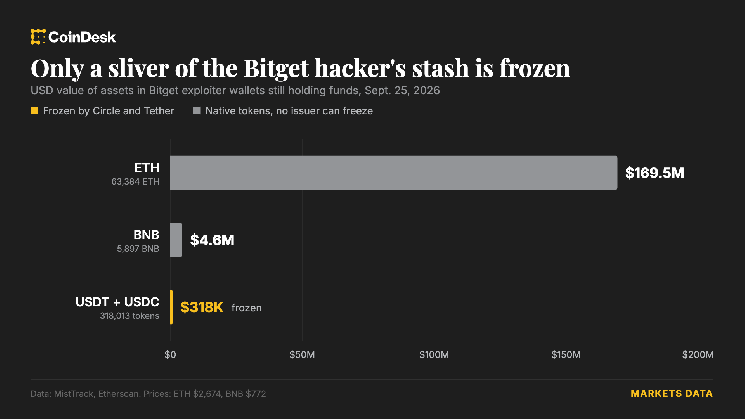
    • Circle and Tether froze approximately $318,000 in stablecoins (218,023 USDT and 99,990 USDC) held in a wallet labeled “Bitget Exploiter 8” on Etherscan, linked to Thursday’s $351.6 million Bitget exchange hack.
    • The frozen assets represent a small fraction of the total haul; blockchain analytics firm MistTrack confirms other exploiter addresses still hold over 63,000 ETH (valued at roughly $200 million+), which no issuer can freeze because they are native ether, not permissioned stablecoins.
    • Bitget CEO Gracy Chen stated the breach stemmed from a compromised backend system in the exchange’s wallet infrastructure that allowed attackers to spoof transaction data and trigger the authorization process, ruling out a private key compromise. She confirmed the exchange’s $464 million user protection fund covers the loss.

    Rapid Stablecoin Freeze by Circle and Tether

    Circle moved swiftly to blacklist the Ethereum address tagged as “Bitget Exploiter 8” at 05:00 UTC on Friday, according to onchain data. The wallet contained 170.47 ETH, 218,023 USDT, and 99,990 USDC at the time of the freeze. Blockchain security firm MistTrack reported that Tether subsequently banned the same wallet, effectively immobilizing the USDT and USDC balances—totaling roughly $318,000. While the action demonstrates the ability of centralized stablecoin issuers to intervene when funds hit permissioned tokens, the vast majority of the stolen assets remain in ether, which operates without a central freeze mechanism.

    Breach Mechanics: Backend Compromise, Not Private Key Theft

    Bitget CEO Gracy Chen provided a technical post-mortem, explaining that attackers compromised a backend system in the exchange’s wallet infrastructure, spoofed transaction data and triggered its authorization process to move funds out. Chen explicitly ruled out a private key compromise, distinguishing this incident from typical hot-wallet private key thefts. She added that Bitget’s user protection fund, which holds over $464 million, covers the loss, aiming to reassure users that deposits remain fully backed.

    Contrast with April’s Drift Protocol Incident

    The response stands in sharp contrast to Circle’s handling of the April $285 million Drift hack, where the attacker moved about $232 million in USDC from Solana to Ethereum using Circle’s own cross-chain transfer protocol. At the time, critics including onchain investigator ZachXBT argued Circle could have moved faster to blacklist wallets and freeze funds. Circle maintained that it freezes assets when legally required, underscoring the regulatory and procedural constraints that govern stablecoin issuers’ intervention policies.

    Why This Matters

    The Bitget hack highlights the persistent vulnerability of centralized exchange infrastructure—specifically backend authorization layers—even when private keys remain secure. It also illustrates the asymmetric power of stablecoin issuers: they can neutralize a portion of stolen funds once they touch USDC or USDT, but they have no control over native assets like ETH. For the broader crypto market, the incident reinforces the importance of exchange solvency reserves and user protection funds, while reigniting debate over the speed and transparency of stablecoin freeze decisions in the absence of uniform legal mandates.

    Frequently Asked Questions

    How much of the stolen $351.6 million has been frozen?
    Only about $318,000—comprising 218,023 USDT and 99,990 USDC—has been frozen. The remaining assets, primarily over 63,000 ETH held in other exploiter wallets, cannot be frozen by any issuer.
    What caused the Bitget security breach?
    According to CEO Gracy Chen, attackers compromised a backend system in the exchange’s wallet infrastructure, spoofed transaction data, and triggered the authorization process to withdraw funds. A private key compromise was explicitly ruled out.
    Will Bitget users lose funds?
    Bitget says no. The exchange’s user protection fund holds over $464 million, which CEO Gracy Chen confirmed is sufficient to cover the entire $351.6 million loss.
  • Tether Confirms Minimal EQIBank Exposure After $89M US Asset Seizure

    Tether Confirms Minimal EQIBank Exposure After $89M US Asset Seizure

    Key Highlights

    • Tether confirms exposure to EQIBank is less than 0.034% of total group assets, approximately $64 million based on its June 2024 attestation of $187.75 billion.
    • U.S. authorities seized funds from Capstone, a payment processor used by EQIBank to move customer money through Wells Fargo and JPMorgan Chase accounts, alleging misrepresentation of business activities.
    • Tether states it had no knowledge of the alleged conduct by Capstone cited in the Department of Justice civil forfeiture case.

    Tether Limits EQIBank Exposure Amid U.S. Asset Seizure

    Stablecoin issuer Tether has moved to reassure markets regarding its exposure to EQIBank, a Dominica-licensed lender caught in a U.S. law enforcement action. According to a company spokesperson, assets held at EQIBank represent less than 0.034% of Tether’s total group assets. Based on the firm’s June 2024 attestation reporting $187.75 billion in consolidated assets, that percentage translates to roughly $64 million at risk. The disclosure comes after reports by the Financial Times and The Information detailed a U.S. asset seizure that could potentially force EQIBank into liquidation.

    Capstone Payment Processor at Center of Civil Forfeiture Case

    The regulatory action centers on Capstone, a U.S.-based payment processor that EQIBank utilized to hold funds and facilitate customer money movements through correspondent banking accounts at Wells Fargo and JPMorgan Chase. Court filings indicate that U.S. prosecutors seized funds from those Capstone accounts and filed a civil forfeiture complaint. The Department of Justice alleges that Capstone misrepresented the nature of its business to the banking institutions involved, a characterization that triggered the enforcement action and the subsequent freezing of assets flowing through the processor’s channels.

    Tether Denies Prior Knowledge of Alleged Misconduct

    In a statement provided to CoinDesk, a Tether spokesperson explicitly distanced the company from the allegations facing Capstone. “Tether had no knowledge of the conduct by Capstone alleged by the Department of Justice,” the spokesperson said via email. The company further clarified that its assets held at EQIBank were limited to “less than 0.034% of the assets of the group,” though it declined to specify the exact dollar figure. The response underscores Tether’s effort to contain reputational fallout as the stablecoin giant navigates heightened scrutiny over its reserve composition and banking partnerships.

    Why This Matters

    The episode highlights the persistent counterparty and banking-layer risks inherent in the stablecoin ecosystem, even for the largest issuer by market capitalization. Tether’s reserve attestations have historically shown a mix of cash, Treasury bills, and other assets held across a network of global financial institutions. The EQIBank situation illustrates how enforcement actions against second- or third-tier payment processors—entities often invisible to end users—can create sudden liquidity constraints for custodial partners. For the broader digital asset industry, the case reinforces regulatory focus on the “on-ramp/off-ramp” infrastructure connecting crypto markets to the traditional financial system, particularly regarding anti-money laundering compliance and know-your-customer obligations at the payment processor level. Market participants will likely monitor whether other stablecoin issuers disclose similar exposures and how EQIBank’s potential liquidation proceedings unfold in the coming weeks.

    Frequently Asked Questions

    How much money does Tether have at risk in EQIBank?
    Based on Tether’s June 2024 group asset figure of $187.75 billion and the disclosed exposure limit of less than 0.034%, the at-risk amount is approximately $64 million. Tether has not provided an exact dollar amount.
    What triggered the U.S. seizure of funds connected to EQIBank?
    The U.S. Department of Justice seized funds from accounts held by Capstone, a payment processor used by EQIBank, at Wells Fargo and JPMorgan Chase. Prosecutors filed a civil forfeiture case alleging Capstone misrepresented its business activities to those banks.
    Did Tether know about Capstone’s alleged misconduct?
    No. A Tether spokesperson stated explicitly: “Tether had no knowledge of the conduct by Capstone alleged by the Department of Justice.”
  • Ethereum Exchange Supply Hits Record Low, Fueling ETH Price Speculation

    Ethereum Exchange Supply Hits Record Low, Fueling ETH Price Speculation

    Key Highlights

    • Ethereum exchange reserves have fallen to a historic low of 3.49% of total supply, with 1.16% withdrawn since June 1, according to Santiment data.
    • Approximately 35% of ETH is now staked, while decentralized finance (DeFi) protocols absorb significant additional supply, reducing centralized exchange liquidity.
    • Analysts caution that declining exchange balances alone do not guarantee price appreciation, as staking withdrawals or renewed exchange deposits could quickly reverse the supply dynamic.

    Ethereum Exchange Supply Hits Record Low Amid Staking and DeFi Migration

    On-chain analytics provider Santiment reports that the percentage of Ethereum (ETH) held on centralized cryptocurrency exchanges has dropped to just 3.49% of the total circulating supply, marking the lowest level recorded. The data reveals that an amount equivalent to 1.16% of the entire ETH supply has been withdrawn from trading platforms since June 1, signaling a sustained shift away from custodial holdings. This decline follows a volatile period for the asset: after breaking its 2021 all-time high in August 2025, ETH experienced a sharp correction in 2026, falling to price levels around $1,500.

    Staking and DeFi Drive Structural Supply Shift

    The migration of ETH off exchanges is not solely driven by holder sentiment. Santiment highlights that staking and decentralized finance (DeFi) activity play a major role in the supply redistribution. Approximately 35% of all ETH is currently staked, locking those tokens into the network’s consensus mechanism rather than leaving them available for immediate sale on centralized venues. Additional supply is deployed across DeFi protocols for lending, borrowing, and yield generation, further reducing the float accessible on traditional order books. This structural relocation means a growing portion of ETH is utilized within blockchain-native applications instead of sitting on exchange wallets.

    Price Implications: Sensitivity Over Certainty

    A shrinking exchange reserve typically indicates a reduction in the immediately available sell-side supply, which can amplify price movements during periods of strong buying pressure. With fewer coins on order books, large market orders may produce more pronounced price swings. However, Santiment and market observers emphasize that low exchange balances should not be interpreted as an outright bullish signal. The liquid supply can rebound rapidly if stakers unstake en masse, DeFi positions are liquidated, or holders redeposit funds to exchanges to capture profits or hedge risk. Consequently, the trajectory of ETH price depends on the interplay between exchange flows, staking participation rates, DeFi utilization, and fresh demand entering the market.

    Why This Matters

    The ongoing decline in Ethereum exchange reserves reflects a maturation of the asset’s holder base and infrastructure. As staking becomes mainstream — reinforced by the Shanghai and subsequent upgrades enabling withdrawals — and DeFi ecosystems deepen, the traditional metric of exchange supply loses some of its predictive power for short-term price action. Investors and analysts must now monitor a broader dashboard: validator queue dynamics, liquid staking token (LST) adoption, DeFi total value locked (TVL), and net exchange flows in concert. The current 3.49% exchange supply ratio represents a multi-year low, but the market’s next directional move will hinge on whether new demand absorbs the illiquid supply or whether latent supply re-enters centralized venues.

    Frequently Asked Questions

    What percentage of Ethereum supply is currently on exchanges?

    According to Santiment, only 3.49% of the total Ethereum supply is held on centralized exchanges as of the latest data, the lowest level on record.

    Why is ETH leaving exchanges if the price fell to $1,500 in 2026?

    The outflow is driven primarily by structural factors: approximately 35% of ETH is staked for network security, and significant additional supply is deployed in DeFi protocols. These movements are largely independent of short-term price action.

    Does low exchange supply guarantee ETH price will rise?

    No. While reduced exchange reserves can increase price sensitivity to buying pressure, supply can return to exchanges quickly through staking withdrawals, DeFi liquidations, or holder deposits. Price direction depends on the balance of all supply sources and demand.

  • Whitehats Rescue $5.7 Million in NFTs After Limit Break Payment Processor Exploit

    Whitehats Rescue $5.7 Million in NFTs After Limit Break Payment Processor Exploit

    Key Highlights

    • Limit Break’s Payment Processor V2 was exploited at 9 AM EST on September 25, 2026, resulting in the theft of 10 Meebits, 50 Otherdeeds, 10 World of Women NFTs, and 235 Desperate ApeWives before a whitehat operation rescued 23,155 NFTs valued at over $5.7 million.
    • The vulnerability extended to ApeChain assets approved to Payment Processor V3, while a related exploit left 660 WETH at risk and unrecovered.
    • Magic Eden confirmed it discontinued Payment Processor V2 in October 2024 and shut down its EVM marketplace in Q1 2026, stating no live listings were affected, but urged users who listed NFTs between February and October 2024 to revoke “approved for all” permissions.

    Exploit Discovery and Initial Impact

    The security incident came to light through a public disclosure by 0xQuit, known publicly as Quit, the pseudonymous vice president of blockchain at Yuga Labs. In a post on X at 9 AM EST on September 25, 2026, Quit detailed the attack timeline:

    At 9AM EST today somebody abused a bug in Payment Processor V2 to steal 10 Meebits, 50 Otherdeeds, 10 WoW, and 235 Desperate Apewives.
    It wasn’t until over 12 hours later that somebody reported it to me, and upon digging in I realized that a great many NFTs were subject to the…

    According to Quit, the exploit remained undetected for more than 12 hours before being reported. Upon investigation, researchers determined that the vulnerability affected a far broader set of NFT collections than initially compromised. The stolen assets included high-profile collections: Meebits, Otherdeeds (Otherside metaverse land deeds), World of Women (referenced as “WoW” in the tweet), and Desperate ApeWives.

    Whitehat Rescue Operation and Scope of Vulnerability

    Limit Break responded by immediately pausing Payment Processor V3 after being alerted to the vulnerability. However, Payment Processor V2 could not be paused due to its architectural design, necessitating a whitehat rescue operation to move affected assets to safety. The operation ultimately secured 23,155 NFTs with a combined value exceeding $5.7 million.

    The investigation revealed that a similar vulnerability existed on ApeChain, where some assets that had approved Payment Processor V3 also required emergency securing. Additionally, researchers identified a related exploit vector that could be used to steal WETH (Wrapped Ether). As of the disclosure, 660 WETH remained at risk and had not been recovered.

    Magic Eden’s Response and User Guidance

    Magic Eden issued a statement clarifying its exposure to the vulnerability. The marketplace confirmed it stopped using Payment Processor V2 in October 2024 and subsequently shut down its EVM marketplace in the first quarter of 2026. The company emphasized that no live Magic Eden listings were affected by the exploit.

    However, Magic Eden warned that NFTs listed on its EVM platform between approximately February and October 2024 may still be exposed to the vulnerability. The marketplace urged affected users to revoke “approved for all” permissions granted during that period to mitigate ongoing risk.

    Why This Matters

    This incident underscores persistent smart contract risks in NFT infrastructure, particularly in permissioned approval systems like “setApprovalForAll” that grant broad spending authority. The fact that Payment Processor V2 could not be paused highlights a critical design limitation in upgradeable contract architectures where older versions remain immutable and operational. The 12-hour detection gap also reveals monitoring gaps in high-value asset protocols. With 660 WETH still at risk from a related vector, the situation remains active. Marketplaces like Magic Eden discontinuing legacy processors reduces surface area, but historical approvals create long-tail exposure requiring user action. The cross-chain impact on ApeChain demonstrates how shared infrastructure vulnerabilities can cascade across ecosystems.

    Frequently Asked Questions

    Which NFT collections were initially stolen in the Payment Processor V2 exploit?

    The initial theft involved 10 Meebits, 50 Otherdeeds, 10 World of Women NFTs, and 235 Desperate ApeWives, as reported by 0xQuit (Quit) of Yuga Labs.

    Can users still protect assets that were listed on Magic Eden’s EVM marketplace in 2024?

    Yes. Magic Eden advises users who listed NFTs on its EVM platform between approximately February and October 2024 to revoke any “approved for all” permissions granted during that period to mitigate exposure.

    What is the status of the 660 WETH at risk from the related exploit?

    As of the disclosure, the 660 WETH remains at risk and has not been recovered. The related exploit vector is distinct from the primary Payment Processor V2 vulnerability but was identified during the same investigation.

  • Ripple CEO Brad Garlinghouse Unveils 5-Year Crypto Strategy Featuring Bitcoin, XRP, Three Altcoins

    Ripple CEO Brad Garlinghouse Unveils 5-Year Crypto Strategy Featuring Bitcoin, XRP, Three Altcoins

    Key Highlights

    • Ripple CEO Brad Garlinghouse proposes a simple five-year “buy and hold” strategy focusing on the top five cryptocurrencies by market capitalization: Bitcoin, Ethereum, Tether, BNB, and XRP.
    • Garlinghouse emphasizes he is not an “XRP maximalist,” reveals he personally holds a small amount of Solana, and argues different blockchain projects can succeed simultaneously without being direct competitors.
    • The executive cites “trust, utility, speed, and liquidity” as the fundamental drivers of XRP’s long-term value, asserting that the most liquid assets tend to become the most valuable over time.

    Garlinghouse Unveils Long-Term ‘Top Five’ Crypto Portfolio Strategy

    Speaking at a recent industry event, Ripple CEO Brad Garlinghouse outlined a straightforward investment thesis for long-term cryptocurrency holders, suggesting that a diversified basket of the five largest digital assets by market capitalization could yield “great results” over a five-year horizon. The strategy moves away from concentrated bets on single tokens, instead advocating for exposure to the established market leaders: Bitcoin (BTC), Ethereum (ETH), Tether (USDT), BNB, and XRP.

    XRP Inclusion Notable Amid ‘Non-Maximalist’ Stance

    The inclusion of XRP in Garlinghouse’s proposed top-five basket draws particular attention given his previous public stance. The Ripple chief has explicitly stated in the past that he does not define himself as an “$XRP maximalist,” signaling a broader market perspective rather than singular allegiance to the token native to the Ripple ecosystem. This approach underscores a philosophy of market-cap-weighted diversification rather than thematic or ecosystem-specific concentration.

    Solana Acknowledged as Valid, Non-Competitive Peer

    Addressing the inevitable comparisons between XRP and other high-throughput blockchains, specifically Solana (SOL), Garlinghouse declined to frame the relationship as a zero-sum competition. When asked why an investor should prefer XRP over Solana, he stated he was not trying to convince anyone to choose one over the other. He revealed he personally owns a small amount of Solana and maintains a positive view of various cryptocurrencies for different reasons. “He stated that he does not see Solana as a direct competitor to $XRP and that different crypto projects can be successful simultaneously,” reinforcing a multi-chain future thesis.

    Liquidity, Trust, and Utility Cited as XRP Value Drivers

    Concluding his remarks, Garlinghouse expressed strong optimism regarding XRP’s specific fundamentals. He argued that the determinants of a currency’s enduring value are “trust, utility, speed, and liquidity“—effectively, how liquid the asset is. He posited a direct correlation between liquidity and value, asserting that the most liquid currencies tend to be the most valuable because liquidity is the primary reason investors seek to hold an asset. This framework positions XRP’s design for institutional cross-border payments as its core competitive advantage.

    Why This Matters

    Garlinghouse’s comments arrive as institutional adoption of digital assets accelerates, with major financial firms increasingly treating cryptocurrency as a distinct asset class requiring diversified allocation strategies rather than speculative single-token bets. His “top five” framework mirrors traditional finance index-investing principles applied to the crypto market cap leaderboard. Furthermore, his explicit refusal to engage in tribalistic “maximalist” rhetoric—and his acknowledgment of holding Solana—signals a maturing industry leadership mindset focused on interoperability and collective ecosystem growth. For market participants, the remarks reinforce the narrative that regulatory clarity (particularly surrounding XRP’s status in the U.S.) and deepening liquidity pools are critical milestones for the next phase of crypto market development.

    Frequently Asked Questions

    What are the five cryptocurrencies Brad Garlinghouse includes in his proposed long-term strategy?
    The basket consists of Bitcoin (BTC), Ethereum (ETH), Tether (USDT), BNB, and XRP, ranked by current market capitalization.
    Does Brad Garlinghouse consider himself an XRP maximalist?
    No. Garlinghouse has previously stated he does not define himself as an “$XRP maximalist,” and he confirmed he personally holds a small amount of Solana (SOL).
    What fundamental factors does Garlinghouse believe drive XRP’s value?
    He cites “trust, utility, speed, and liquidity” as the primary drivers, arguing that the most liquid assets tend to become the most valuable over time.
  • KelpDAO Developer Sues LayerZero, CEO Over $292M Exploit and Blame-Shifting

    KelpDAO Developer Sues LayerZero, CEO Over $292M Exploit and Blame-Shifting

    Key Highlights

    • Evercrest Technologies, developer of KelpDAO, filed a lawsuit on September 24 against LayerZero Labs, its Canadian entity, and CEO Bryan Pellegrino over the April 2026 rsETH bridge exploit that caused approximately $292 million in losses.
    • The complaint alleges the exploit stemmed from a compromised LayerZero developer device, poisoned RPC data, and a 1-of-1 Decentralized Verifier Network (DVN) configuration that Evercrest claims LayerZero reviewed and instructed them to implement.
    • Evercrest is seeking damages covering a 2,000 ETH recapitalization, over $650 million in user withdrawals, lost fee revenue, KERNEL token declines, the shutdown of its sbUSD vault, a delayed stablecoin product, legal costs, and reputational harm.

    Evercrest Technologies Sues LayerZero Labs Over $292 Million rsETH Bridge Exploit

    Evercrest Technologies, the entity behind the KelpDAO liquid restaking protocol, has initiated legal action against LayerZero Labs, its Canadian subsidiary, and Chief Executive Officer Bryan Pellegrino. The complaint, published on September 24, centers on the April 18, 2026 exploit of KelpDAO’s rsETH bridge on Unichain, which resulted in approximately $292 million in losses. Evercrest contends the incident was not caused by a vulnerability in its own smart contracts but rather by a combination of poisoned RPC data, a compromised LayerZero developer machine, and a single-verifier DVN architecture that LayerZero allegedly endorsed.

    Attack Timeline and Technical Root Cause

    According to the filing, the attack chain began on March 6, 2026, when an attacker compromised a LayerZero developer’s machine. In April, the threat actor targeted the RPC infrastructure underpinning LayerZero’s Decentralized Verifier Network. The manipulated RPC endpoints allegedly caused LayerZero’s sole DVN to falsely attest that 116,500 rsETH had been locked on Unichain, despite no such lock occurring on the source chain. Because LayerZero served as the exclusive verifier for the Unichain Bridge, this false attestation triggered the minting of $292 million worth of rsETH on Ethereum mainnet.

    Evercrest states it detected the anomalous activity within one hour, immediately suspended its LayerZero-powered bridges, froze the attacker’s wallet, and prevented a second minting attempt of 40,000 rsETH. The rapid response limited further damage, but the initial exploit had already executed.

    Dispute Over Bridge Configuration and Responsibility

    A central point of contention in the lawsuit is the bridge’s verification architecture. Evercrest asserts that LayerZero reviewed and endorsed KelpDAO’s bridge configuration and explicitly instructed the team to operate its own DVN in a 1-of-1 setup. The complaint alleges that after the exploit, LayerZero shifted its public narrative, blaming KelpDAO’s single-verifier design. CEO Bryan Pellegrino reportedly stated that applications should not rely on a sole DVN, a position Evercrest says contradicts LayerZero’s prior written guidance. Evercrest maintains it followed LayerZero’s documented instructions throughout the integration process.

    Today we filed a lawsuit against LayerZero and its co-founder, Bryan Pellegrino, to right the wrongs associated with the exploit of rsETH’s LayerZero bridge earlier this year. For more details, please refer to the statement below.https://t.co/gPQTPeM0Zh
    — Kelp (@KelpDAO) September 25, 2026

    Damages Sought and Operational Fallout

    The complaint itemizes extensive damages, including a 2,000 ETH recapitalization requirement, more than $650 million in user withdrawals following the incident, lost protocol fee revenue, declines in the KERNEL governance token, the forced shutdown of KelpDAO’s sbUSD vault, and the delay of a planned stablecoin product. Evercrest also cites legal expenses, migration costs to alternative infrastructure, and reputational harm to the protocol and its stakeholders.

    Why This Matters

    The lawsuit highlights growing tensions in the cross-chain infrastructure layer as protocols seek accountability for exploits involving interoperability messaging. LayerZero’s DVN model, which allows applications to configure their own verification quorums, places significant responsibility on both the infrastructure provider and the integrating team. This case may set a precedent for how liability is allocated when a messaging layer’s off-chain components—such as RPC endpoints and developer environments—are compromised, and whether written integration guidance creates enforceable obligations. The outcome could influence how DeFi protocols evaluate bridge risk, negotiate service-level agreements with messaging providers, and structure multi-verifier architectures going forward.

    Frequently Asked Questions

    What specific failures does Evercrest attribute to LayerZero?

    Evercrest alleges three interlocking failures: a compromised LayerZero developer device on March 6, 2026; poisoned RPC data fed to LayerZero’s Decentralized Verifier Network in April; and a 1-of-1 DVN configuration that LayerZero reportedly reviewed, endorsed, and instructed KelpDAO to implement for the Unichain Bridge.

    How did Evercrest respond to the exploit?

    Evercrest states it identified the attack within one hour, suspended all LayerZero bridges, froze the attacker’s wallet, and blocked a second minting attempt of 40,000 rsETH, preventing additional losses beyond the initial $292 million exploit.

    What damages is Evercrest seeking in the lawsuit?

    The complaint seeks recovery for a 2,000 ETH recapitalization, over $650 million in user withdrawals triggered by the incident, lost fee revenue, KERNEL token value declines, the shutdown of the sbUSD vault, a delayed stablecoin launch, legal and migration costs, and reputational harm to the KelpDAO protocol and Evercrest Technologies.

  • Bond Volatility Surges While Bitcoin and Wall Street Remain Calm

    Bond Volatility Surges While Bitcoin and Wall Street Remain Calm

    Key Highlights

    • The U.S. 10-year Treasury yield briefly touched 5.2% on Thursday before settling at 5.163%, driven by Middle East conflict pushing oil and diesel prices higher and complicating the global inflation outlook.
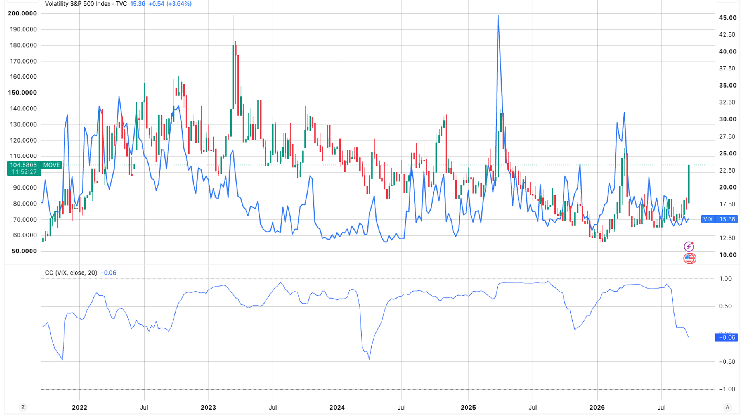
    • The ICE BofA MOVE Index ($MOVE) shows bond traders are paying significantly more for interest-rate volatility protection despite the S&P 500 rising roughly 21% since March when $MOVE was last at similar levels.
    • The 20-day correlation between the VIX and $MOVE turned negative (-0.06) for the first time since April 2024, while the BVIV-$MOVE correlation sits at -0.37, indicating a historic divergence between equity and bond volatility expectations as Bitcoin’s implied volatility hovers near yearly lows.

    Global Bond Yields Surge Amid Middle East Tensions

    A broad-based climb in government bond yields is rippling through global markets this week, with the benchmark U.S. 10-year Treasury yield briefly piercing the 5.2% threshold on Thursday before retreating slightly to 5.163%. The selloff in fixed income comes as the widening conflict in the Middle East drives crude oil and diesel prices higher, injecting fresh uncertainty into the inflation outlook and prompting traders to reassess how much further major central banks may need to tighten monetary policy. The move underscores the fragile nature of the disinflation narrative that had previously anchored market expectations for rate cuts.

    MOVE Index Signals Rising Rate Volatility Premium

    The ICE BofA MOVE Index, a widely watched gauge of expected volatility in U.S. Treasury markets, has climbed to levels last seen in March. However, the equity market backdrop has shifted dramatically: the S&P 500 stood near 6,350 when $MOVE previously traded at this level, but the index has since surged to 7,704, a gain of approximately 21%. This divergence highlights a critical shift—bond traders are now paying a considerably higher premium for protection against interest-rate swings even as equity markets rally, suggesting fixed-income participants see risks that stock investors are currently disregarding.

    Correlation Breakdown Between Asset Class Volatility

    The structural relationship between equity and bond volatility measures is showing signs of fracture. Over a 20-day rolling window, the correlation between the Cboe Volatility Index (VIX) and the MOVE Index has slipped to -0.06, turning negative for the first time since April 2024, though the reading remains statistically close to zero. The correlation between the Cboe Bitcoin Volatility Index (BVIV) and $MOVE is more distinctly negative at -0.37, marking one of its lowest readings in years. This decoupling occurs as bond volatility rises while Bitcoin’s expected volatility remains anchored near its yearly low, a dynamic that challenges traditional cross-asset hedging assumptions.

    Bitcoin’s Detachment from Yield Narrative

    Adding to the complexity, recent analysis from CoinDesk indicates that rising yields alone have demonstrated little consistent relationship with Bitcoin’s returns. The cryptocurrency’s implied volatility, as measured by BVIV, has failed to respond to the spike in rate volatility, remaining near annual lows. This suggests that Bitcoin is currently trading on idiosyncratic drivers—such as ETF flow dynamics and regulatory developments—rather than macroeconomic interest-rate sensitivity, further isolating the digital asset from traditional fixed-income turbulence.

    Why This Matters

    The simultaneous rise in bond yields and volatility premiums, coupled with a breakdown in cross-asset correlations, signals a potential regime shift for multi-asset portfolios. For institutional investors, the negative VIX-MOVE correlation undermines the traditional negative equity-bond correlation that has underpinned 60/40 portfolio construction for decades. The fact that Bitcoin volatility remains suppressed while rate volatility spikes suggests the asset is not currently functioning as a macro hedge against inflation or rate uncertainty. Market participants should monitor whether the $MOVE index sustains these elevated levels, as persistent bond volatility could force a repricing of risk assets broadly, including equities and digital assets, particularly if the Federal Reserve signals a higher-for-longer rate stance in response to energy-driven inflation pressures.

    Frequently Asked Questions

    What is the MOVE Index and why is it important?

    The ICE BofA MOVE Index ($MOVE) measures the implied volatility of U.S. Treasury securities across the 2-, 5-, 10-, and 30-year maturities. It serves as the bond market’s equivalent of the VIX, reflecting how much traders are paying to hedge against interest-rate swings. A rising $MOVE indicates growing uncertainty about the path of monetary policy and inflation.

    Why has the correlation between VIX and MOVE turned negative?

    The 20-day correlation between the VIX (equity volatility) and MOVE (bond volatility) fell to -0.06, its first negative reading since April 2024. This suggests equity traders are complacent—pricing in a soft landing and continued rally—while bond traders are hedging aggressively against sticky inflation and higher-for-longer rates, creating a rare divergence in risk perception across asset classes.

    Is Bitcoin acting as a hedge against rising yields?

    According to CoinDesk’s analysis, rising yields alone have shown little consistent relationship with Bitcoin’s returns. Currently, Bitcoin’s implied volatility (BVIV) is near yearly lows while bond volatility ($MOVE) spikes, and the BVIV-MOVE correlation sits at -0.37. This indicates Bitcoin is not currently functioning as a macro hedge against interest-rate volatility.

  • MOVE Index Surges Past 130, Fueling Bailout Speculation

    MOVE Index Surges Past 130, Fueling Bailout Speculation

    Key Highlights

    • The $MOVE Index has surged above 130, signaling heightened implied volatility in bond markets and growing liquidity concerns.
    • Traders and analysts, including prominent voice @CryptoHayes, are flagging the move as a potential precursor to policy intervention or regulatory action.
    • Historical patterns show similar index spikes have preceded central bank support measures, making current levels a critical watchpoint for market participants.

    $MOVE Index Breaches 130 Threshold, Triggering Policy Speculation

    The $MOVE Index — a widely tracked gauge of implied volatility in U.S. Treasury markets managed by ICE (Intercontinental Exchange) — has climbed above the 130 level, a threshold that market veterans associate with acute stress in fixed-income liquidity. The move was amplified across financial social media after a post by @CryptoHayes, the pseudonymous founder of BitMEX and a closely followed macro commentator, drew attention to the index’s rapid ascent. His tweet catalyzed a wave of discussion among rates traders, hedge fund managers, and crypto-market participants who monitor the $MOVE as a leading indicator of systemic funding pressure.

    Unlike the VIX, which reflects equity volatility, the $MOVE Index captures expected swings in Treasury yields across the 2-, 5-, 10-, and 30-year maturities. A reading above 130 has historically coincided with episodes such as the March 2020 pandemic liquidity crunch, the September 2022 U.K. gilt crisis, and the regional banking turbulence of early 2023. In each case, the Federal Reserve or other major central banks responded with emergency lending facilities, quantitative easing restarts, or explicit backstops — actions that subsequently stabilized markets but also reshaped asset-price trajectories across equities, credit, and digital assets.

    Mixed Crypto Signals Complicate the Picture

    The broader cryptocurrency market is sending conflicting signals as the $MOVE rises. Bitcoin (BTC) has shown resilience near recent range highs, while Ethereum (ETH) and major altcoins exhibit divergent momentum, reflecting uncertainty over whether tighter financial conditions or imminent policy relief will dominate. Liquidity in on-chain markets remains thinner than in 2021, and the correlation between crypto risk assets and rates volatility has strengthened since the 2022 bear market. Traders are parsing whether a sustained $MOVE elevation will force the Federal Reserve to signal a pause or pivot — a development that could inject fresh risk appetite into digital assets — or whether the index simply reflects transient positioning ahead of key economic data.

    Market structure analysts note that the $MOVE’s jurisdiction falls under the purview of the SEC, CFTC, and the Federal Reserve Bank of New York, all of which monitor fixed-income volatility as a barometer of dealer balance-sheet capacity. With primary dealers already managing elevated Treasury supply, a further $MOVE spike could strain market-making ability, widening bid-ask spreads and increasing the odds of an official-sector response.

    Why This Matters

    The $MOVE Index’s breach of 130 is not merely a technical milestone — it is a signal that the world’s deepest, most liquid bond market is pricing in exceptional uncertainty around interest-rate paths. For institutional allocators, this raises the specter of forced deleveraging in strategies reliant on stable funding, from basis trades to mortgage-backed securities hedging. For crypto-native funds, it underscores the growing integration of digital-asset pricing with traditional macro liquidity cycles. Policymakers at the Fed and Treasury will likely reference the $MOVE in upcoming FOMC discussions and Financial Stability Oversight Council (FSOC) meetings as they assess whether current market functioning warrants intervention. The next two weeks — featuring CPI, PPI, and retail sales data — will be decisive in determining whether the index retraces or consolidates at elevated levels, setting the stage for either a policy calm or a repeat of 2020-2023 crisis playbooks.

    Frequently Asked Questions

    What is the $MOVE Index and why does 130 matter?
    The $MOVE Index (Merrill Lynch Option Volatility Estimate) measures implied volatility across key U.S. Treasury maturities. A level above 130 has historically signaled severe fixed-income stress, often preceding central bank liquidity interventions.
    Who is @CryptoHayes and why did his post move markets?
    @CryptoHayes is Arthur Hayes, co-founder of BitMEX and chief investment officer of Maelstrom. His macro commentary commands a large following among crypto and rates traders, and his highlight of the $MOVE surge amplified institutional attention to the signal.
    How could a policy response affect cryptocurrency markets?
    If the Fed or Treasury acts to ease funding pressure — via swap lines, standing repo facilities, or balance-sheet expansion — risk assets including Bitcoin and Ethereum typically benefit from improved dollar liquidity. Conversely, inaction could prolong volatility and correlation-driven selloffs.