Author: Evan Mercer

  • Bitwise’s Solana ETF Reaches $1 Billion in Assets Under Management 10 Months After Launch

    Bitwise’s Solana ETF Reaches $1 Billion in Assets Under Management 10 Months After Launch

    Bitwise’s Solana staking ETF has surpassed $1 billion in assets under management, placing $SOL alongside bitcoin and ether among the small group of cryptocurrencies with ETF products exceeding that threshold.

    The fund, which trades under the ticker BSOL, reached the milestone exactly 10 months after its launch, according to Bitwise.

    “The Bitwise Solana Staking ETF, BSOL, just crossed $1 billion AUM, exactly 10 months after its launch,”

    the asset manager said on X.

    Bitwise said most of the approximately $1 billion in inflows arrived during a bear market, indicating that investors continued building Solana exposure despite a difficult first half for digital assets. Across the broader category, U.S. Solana ETFs now hold about $1.43 billion in assets, equivalent to roughly 2.35% of $SOL’s marketcap.

    Solana ETF inflows remain resilient during market weakness

    The market’s response to BSOL crossing $1 billion in assets has highlighted the strength of demand for Solana investment products. Bloomberg ETF analyst Eric Balchunas pointed to approximately $1.7 billion in cumulative inflows across the entire category, with little evidence of sustained withdrawals despite the earlier market downturn.

    Bitwise CEO Hunter Horsley said bitcoin, ether and solana are currently the only three crypto assets with ETFs that have grown beyond $1 billion. The scale of these products can improve liquidity, attract larger institutional investors and make the underlying assets more accessible through conventional brokerage accounts.

    Source: Hunter Horsley on X

    Solana’s price recovery has reinforced the trend. $SOL has climbed roughly 46% this month and is about 80% above its June low. The token has risen back above $100, lifting its market capitalization above $60 billion.

    Institutional access is also expanding beyond ETFs. Charles Schwab said on Aug. 27 that it plans to add spot trading for Solana, Avalanche and Chainlink to Schwab Crypto in the coming months. The brokerage oversees more than $12 trillion in client assets across approximately 39 million accounts.

    Growing ETF assets and broader brokerage access could give Solana a stronger foothold among traditional investors who prefer not to manage digital tokens or wallets themselves.

    For Bitwise, reaching $1 billion is significant not only because of the fund’s size but also because of the timing. Much of the capital entered while crypto markets were under pressure. As $SOL stages a sharp recovery, those inflows increasingly appear to reflect sustained institutional allocation rather than short-term opportunistic trading.

  • Ripple Overtakes Kraken as Top Holding in NYSE-Traded C1 Fund Portfolio

    Ripple Overtakes Kraken as Top Holding in NYSE-Traded C1 Fund Portfolio

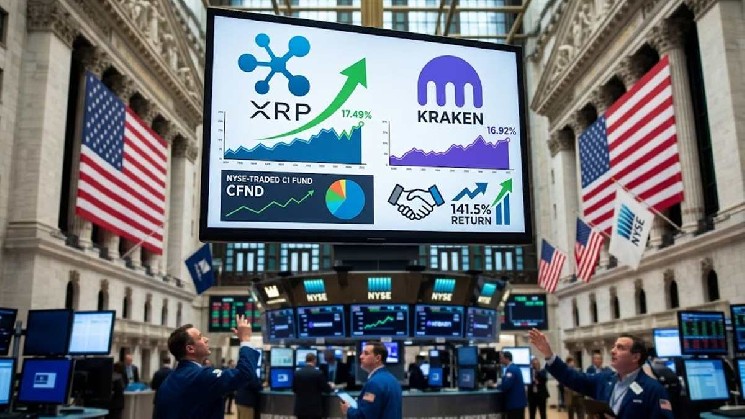
    Ripple Labs has become the largest holding in C1 Fund’s portfolio, accounting for 17.49% of net assets and moving ahead of Payward Inc., the parent company of Kraken, at 16.92%.

    C1 Fund had invested $41.3 million across 11 private digital-asset companies as of June 30, 2026, according to the fund’s second-quarter update. The fund trades on the New York Stock Exchange under the ticker CFND and focuses on secondary-market investments in late-stage private companies involved in digital-asset infrastructure and related services.

    Ripple Becomes C1 Fund’s Top Holding

    Ripple’s increased portfolio weighting was partly driven by a company share buyback. C1 Fund said the partial buyback generated a 141.5% return on the portion of its Ripple investment included in the transaction over approximately four months.

    The result reflects the return from the buyback rather than simply indicating that C1 Fund purchased additional Ripple shares during the quarter.

    Interest in private-market exposure to Ripple is also growing among traditional investment firms. Kinetics Internet Portfolio reported holding 1,875 Class A Ripple shares valued at approximately $246,319 as of June 30. The position represented about 0.1% of the fund’s $248.3 million in net assets and was classified as a Level 3 asset because Ripple remains a privately held company.

    Ripple equity and $XRP are separate investments. Ripple shares represent an ownership interest in the private company, while $XRP is a separate digital asset. Institutional participation in both markets nevertheless reflects broader acceptance of crypto-related financial products.

    Institutional Investors Increase $XRP ETF Exposure

    Institutional demand is also expanding through $XRP exchange-traded products. Goldman Sachs disclosed approximately $86.5 million invested across five spot $XRP ETFs as of June 30, after reporting no exposure to $XRP ETFs at the end of the previous quarter.

    The holdings included products from Bitwise, Franklin Templeton, Canary Capital, 21Shares and Grayscale.

    The wider digital-asset sector is also moving closer to the public markets. BitGo completed its initial public offering in January, while Kraken and Blockchain.com have confidentially filed IPO registration statements with the U.S. Securities and Exchange Commission, according to C1 Fund’s update.

  • Cardano Brings Blockchain Verification to Latin America’s Largest Fashion Group

    Cardano Brings Blockchain Verification to Latin America’s Largest Fashion Group

    Cardano and Blockforce Launch Blockchain Traceability System for Brazilian Leather Supply Chains

    The Cardano Foundation and Brazilian technology firm Blockforce have deployed a dual-ledger traceability system with more than 500,000 records anchored as of August 31, 2026.

    Fashion and retail group Azzas 2154 is using the platform to audit leather sourcing across its supply chain by cross-referencing tax documentation, supplier records, procurement data, commercial invoices, and official public databases.

    Commercial agreements are expected to generate 6.5 million certified records by the end of 2030. Joint batch-processing optimization through the uVerify protocol has reduced the operational cost per record by 92% compared with earlier deployment estimates.

    Cardano Provides Public Verification Layer

    On Monday, August 31, the Cardano network began operating as the public cryptographic verification layer for Blockforce’s enterprise traceability platform, which is designed for large corporations across Latin America.

    The system has been integrated into Azzas 2154, which became the region’s largest fashion group after the merger of Arezzo&Co and Grupo Soma. The company uses the framework to trace the origin of its leather supplies by correlating commercial invoices, procurement records, and information from official public databases.

    The architecture separates confidential operational data from the information required for public verification. Sensitive business data is stored on a permissioned network based on Hyperledger Fabric, while cryptographic proofs for individual batches are published on the public Cardano blockchain.

    Technical information from Blockforce states that the approach enables external auditors to verify the authenticity of product batches without accessing internal commercial data. The Cardano Foundation’s technical report says that optimizing joint batch processing through the uVerify protocol cut the issuance cost per record by 92% compared with previous deployment estimates.

    Dual-Ledger Design Supports Export Compliance

    The dual-ledger infrastructure is intended to address regulatory requirements in foreign markets. European Union deforestation regulations, known as EUDR, and digital product passport mandates impose increasingly strict environmental verification requirements on raw-material suppliers.

    Latin American exporters face growing scrutiny over the origin of their materials. According to statements by André Salem, CEO of Blockforce, publicly verifiable proofs are emerging as an entry requirement for international trade with European markets.

    In Brazil, the livestock and textile industries are working to modernize their auditing processes. Azzas 2154 documentation sets a corporate target of achieving 100% traceability for leather supplies across all of the group’s commercial brands by 2030.

    The compliance system is designed to avoid requiring small producers to adopt new information technology platforms. Instead, the software processes existing tax documentation and uses it to create a unified, auditable history for each product batch.

    Blockchain Traceability Expansion

    The project is also being positioned as a test of whether decentralized blockchain networks can provide practical enterprise verification alongside or instead of closed corporate systems.

    Data from the Cardano Foundation indicates that institutional anchoring activity could expand into supply chains in the automotive, chemical, and pharmaceutical industries in the coming quarters.

    Active contractual agreements schedule the issuance of 6.5 million certified proofs by 2030. The next compliance milestone is expected when the first audited reports under European regulations are published at the end of the current fiscal year.

  • Crypto.com to Launch Prediction Markets Tracking AI Jobs and Adoption

    Crypto.com to Launch Prediction Markets Tracking AI Jobs and Adoption

    Crypto.com to Launch AI Prediction Contracts Based on Workplace and Consumer Trends

    Crypto.com will introduce prediction contracts allowing users to forecast how quickly artificial intelligence is changing workplaces, consumer behaviour and major industries.

    More than 20 contracts are expected to begin rolling out in September. Unlike prediction markets linked to elections or sporting events, these contracts will be settled using surveys and company disclosures that measure how people and businesses are adopting AI.

    Users will trade on future AI adoption trends

    Crypto.com and PYMNTS have agreed to an exclusive two-year partnership covering the new products, according to their announcement.

    The contracts will trade through OG Prediction Markets, an exchange and clearinghouse regulated by the US Commodity Futures Trading Commission. Crypto.com and other partners will provide access to the markets.

    The initial group of contracts will focus on consumer behaviour, workplace changes, corporate AI adoption, healthcare, retail and financial services. Around 25 additional contracts are expected to be added each quarter.

    Although the individual questions have not yet been published, a contract could ask whether AI use among American workers will exceed a specified level in an upcoming survey.

    Participants would trade based on their expectations for the survey results, with the outcome determining which contracts pay out. Users will not be betting directly on whether AI succeeds or fails. Instead, they will be forecasting what future research shows about AI adoption and its economic effects.

    PYMNTS data will determine contract outcomes

    The markets will rely exclusively on measurements produced by PYMNTS Intelligence.

    PYMNTS surveys 4,000 US adults each month about their use of AI in areas including work, education, shopping and healthcare.

    A separate quarterly survey of 500 US companies examines how businesses use AI agents and automation. The research tracks whether productivity has improved and how employment and software requirements have changed.

    PYMNTS will also review company filings, earnings materials and public statements for evidence of AI investment, revenue changes and workforce effects.

    The organization has collected nearly 30 months of historical data, which will provide a baseline for measuring future changes in AI adoption and its impact across the economy.

  • Strive Adds $143 Million in Bitcoin as Treasury Firms Return to the Market

    Strive Adds $143 Million in Bitcoin as Treasury Firms Return to the Market

    Strive has purchased another 1,800 Bitcoin worth approximately $143 million, continuing its aggressive cryptocurrency accumulation strategy and expanding one of the largest corporate Bitcoin treasuries.

    CEO Matt Cole said Monday that Strive paid an average of $79,431 per Bitcoin for the latest purchase. The transaction brings the company’s total holdings to 23,156 BTC, valued at approximately $1.76 billion at the reference price cited in the disclosure.

    Strive expands Bitcoin treasury strategy

    The purchase follows Strive’s recent $81 million Bitcoin acquisition alongside a share sale. The company trades on the Nasdaq under the ticker ASST after merging with Asset Entities earlier this year.

    Strive was initially co-founded by entrepreneur-turned-politician Vivek Ramaswamy. It is among a growing group of public companies that have adopted Bitcoin treasury strategies, raising capital to accumulate the asset and link their financial performance to its price.

    The approach was pioneered by Michael Saylor’s Strategy and has attracted numerous imitators over the past year. However, corporate Bitcoin treasury strategies carry significant risk because of the cryptocurrency’s volatility.

    Corporate crypto buying resumes

    Strive’s latest purchase comes amid renewed buying across the sector as Bitcoin has rallied. Strategy ended an approximately two-month pause with a $370 million Bitcoin purchase this week, its first since June, after a market recovery pushed its position back into profit.

    Tom Lee’s Bitmine also made its largest Ethereum purchase since June, highlighting how crypto treasury companies have resumed accumulation as prices recovered.

    Bitcoin traded at around $78,600 on Monday, slightly lower on the day but on track to finish August with a gain of more than 24%, which would make it the cryptocurrency’s strongest month since 2017.

    Strive’s average purchase price for the latest tranche is slightly above current market levels, leaving the new Bitcoin investment roughly at break-even for now.

  • Tom Lee Makes a “Massive Bull” Bitcoin and Ethereum Prediction With One Condition

    Tom Lee Makes a “Massive Bull” Bitcoin and Ethereum Prediction With One Condition

    Tom Lee, Fundstrat’s head of research and chief investment officer, outlined his latest outlook for the Federal Reserve’s September policy decision, U.S. stocks and global markets in an interview with CNBC.

    Although September has historically been a weak month for financial markets and uncertainty remains over the path of interest rates, Lee said markets could deliver an upside surprise contrary to prevailing expectations.

    September Fed meeting seen as market turning point

    Lee described the Fed meeting on September 15th as a critical turning point. He said that if the central bank leaves interest rates unchanged, stock markets could trigger a very strong rally.

    According to Lee, a major market correction could be delayed until October. Alternatively, stocks could see only a limited pullback after the S&P 500 rises above the 8,000-point level.

    Crypto market recovery could accelerate

    Lee also said the periodic slowdown in the cryptocurrency market, often referred to as a “crypto winter,” had been relatively shallow and was approaching its end. He noted that crypto assets became the best-performing macro asset class during the third quarter of the year.

    With institutional investors increasingly turning to crypto stocks, Lee said investor interest could return quickly as the four-year crypto cycle reaches its conclusion in the coming days.

    The analyst identified potential regulatory changes as the sector’s biggest catalyst, stating:

    “If the CLARITY Bill passes Congress this year, Bitcoin and Ethereum will have an extremely strong and massive fourth quarter.”

    This is not investment advice.

  • Renowned Economist Says Fed Should Raise Interest Rates in September

    Renowned Economist Says Fed Should Raise Interest Rates in September

    SMBC Chief Economist and former U.S. Treasury Department official Joe Lavorgna said the Federal Reserve should raise interest rates in September and suggested the central bank is likely to move in that direction.

    Speaking on CNBC, Lavogna assessed the U.S. economy’s strong growth momentum, the recovery in manufacturing and volatility in real interest rates.

    U.S. economic growth strengthens

    Lavorgna said the U.S. economy has entered a growth trajectory approaching 5% in the third quarter. He argued that the Fed’s 75 basis point interest rate cuts last year, which were introduced amid concerns about the labor market, are no longer necessary.

    “I believe the Fed should and will raise interest rates in September. Given the economic outlook and growth expectations, reversing the extra rate cuts made last year would be a logical step.”

    Higher short-term rates could reduce market risks

    In response to a question about how an interest rate increase could be negotiated with the U.S. president, Lavorgna said higher short-term interest rates would reduce the market risk premium and could push long-term bond yields lower.

    He also said short-term rate increases would offer higher returns to depositors and Treasury bond investors, potentially supporting the economy over the medium to long term.

    This is not investment advice.

  • Owner of Turkish Cryptocurrency Exchange Arrested

    Owner of Turkish Cryptocurrency Exchange Arrested

    Bitexen owner Kemal Cenk Erdem has been arrested on charges of “concealing the illegitimate source of assets derived from crime” following an investigation by the Istanbul Chief Public Prosecutor’s Office.

    The arrest warrant for Erdem, who was detained as part of the investigation, referenced findings concerning financial ties and money transfers between several companies. After reviewing financial records, corporate connections and statements included in the case file, the judge determined that there were strong indications of guilt.

    Financial links cited in court ruling

    The court ruling noted that Kemal Cenk Erdem was not listed in the commercial registry as a direct shareholder, board member or authorized representative of Dinamik Elektronik Para ve Ödeme Hizmetleri A.Ş.

    However, the ruling stated that Erdem is the husband of Ayşin Erdem, the company’s founder, long-time sole shareholder and controlling partner. It also cited his partnerships and corporate connections with Bitexen Kripto Varlık Alım Satım Platformu A.Ş., Evenpal Teknoloji A.Ş. and KCE Finansal Teknoloji Yatırımları A.Ş.

    According to the ruling, financial transactions associated with Bitexen and Kemal Cenk Erdem were identified among the capital sources of DinamikPay and Dinamik Yatırım. The court also noted two-way financial transactions totaling nearly 100 million Turkish Lira between Ayşin Erdem and Kemal Cenk Erdem.

    Erdem denies allegations

    The court found that the evidence warranted a detailed investigation into whether Kemal Cenk Erdem facilitated the transfer of money allegedly connected to illegal gambling and committed money-laundering offenses.

    During the court hearing, Erdem denied the accusations. Erdem stated, “I have had no commercial dealings with the company in question, nor with the company of which I am the chairman of the board. I request to be released.”

    The court ordered Kemal Cenk Erdem’s arrest, citing strong suspicion of guilt, concrete evidence indicating a flight risk, the fact that evidence had not yet been fully collected and the assessment that judicial-control measures would be insufficient.

    This is not investment advice.

  • CLARITY Act Prospects Remain Uncertain as Senate Showdown Nears

    CLARITY Act Prospects Remain Uncertain as Senate Showdown Nears

    Kalshi traders see a strong chance that the Senate will hold a vote on the CLARITY Act before Oct. 1, but prediction markets assign the legislation a much smaller chance of becoming law in 2026.

    As of Aug. 31, Kalshi traders priced the probability of a Senate vote before Oct. 1 at 91%. Polymarket, however, gave the CLARITY Act only a 13% implied chance of becoming law this year.

    Image source: Kalshi, Aug. 31, 2026.

    Sept. 15 Senate Vote Sets the CLARITY Act Timeline

    The Senate left Washington on Aug. 8 after Majority Leader John Thune filed a cloture motion, setting up a procedural vote for Sept. 15. Cloture generally requires 60 votes and would allow the Senate to move toward debating and potentially passing the legislation.

    Clearing that hurdle would solve only the first problem. According to reporting by American Banker, Capital Alpha Partners’ Ian Katz cut his estimate for enactment from about 40% to 25%, or potentially lower. He warned that overcoming cloture would not guarantee final passage.

    Galaxy Digital reduced its estimate even further, placing the probability at 10% in August as Congress used up more of the legislative calendar.

    Prediction Markets Expect a Vote but Doubt Final Passage

    Trading activity in prediction markets reflects the same divide. Kalshi’s Senate vote contract has generated more than $1.25 million in volume, while its broader crypto market structure enactment contract has attracted more than $6.8 million.

    Image source: Kalshi, Aug. 31, 2026.

    Polymarket’s market on whether H.R. 3633 will become law in 2026 has drawn roughly $11.5 million. Its implied probability stands at just 13%, down sharply from the 82% odds traders assigned in February.

    Image source: Polymarket, Aug. 31, 2026.

    Three Disputes Threaten the Crypto Market Structure Bill

    The CLARITY Act would establish a federal framework for crypto markets, give the Commodity Futures Trading Commission exclusive authority over spot digital commodity markets, and leave the Securities and Exchange Commission responsible for certain securities offerings and exchange activity.

    Three disputes are putting pressure on the coalition needed to secure 60 Senate votes: ethics restrictions involving government officials and crypto, stablecoin rewards that banks view as competition for deposits, and protections for decentralized finance (DeFi) projects and non-custodial software developers.

    Several Democrats who once appeared open to negotiations have criticized the latest version of the bill. Banking groups have also continued to oppose stablecoin yield provisions. Republicans including Sens. Cynthia Lummis, Tim Scott, John Boozman, John Thune, and Thom Tillis remain among the legislation’s strongest supporters.

    SEC and CFTC Move Ahead as Congress Runs Out of Time

    Federal regulators are not waiting for lawmakers to resolve the legislation. SEC crypto rulemaking and CFTC initiatives involving exchanges, leveraged trading, and decentralized finance could establish major parts of the regulatory framework without congressional action.

    However, future administrations can generally reverse agency rules more easily than federal statutes. That makes the Sept. 15 vote a critical pressure point for the CLARITY Act.

    Even if senators clear the 60-vote procedural threshold, Congress faces a crowded schedule that includes government funding, defense legislation, and the approaching midterm elections. Another failure could push the broader crypto market structure debate into a lame-duck session or into 2027.

    For crypto companies, banks, and investors, the key question is no longer whether Washington will continue discussing the CLARITY Act. It is whether senators can assemble enough votes on Sept. 15 to keep the bill moving.

  • Bitcoin Remains Unfazed by Trump’s Iran Threats

    Bitcoin Remains Unfazed by Trump’s Iran Threats

    Bitcoin remained largely unchanged despite escalating tensions in the Middle East and U.S. President Donald Trump’s vow on Monday to hit Iran hard.

    The price of Bitcoin, the world’s largest cryptocurrency, recently stood at $79,076, showing no movement over 24 hours. The asset was also virtually unchanged from its level seven days earlier.

    Bitcoin gains nearly 30% in a month

    Bitcoin began a powerful rally two weeks ago, marking its strongest performance in three years. The cryptocurrency is now up nearly 30% over the past month.

    Bitcoin’s price began rising after the U.S. Treasury announced that it would at least double the size of its liquidity-support buyback operations. The announcement weakened the dollar, while non-yielding assets such as Bitcoin and gold benefited.

    Positive cryptocurrency regulation developments have also supported Bitcoin this month. Last week, President Donald Trump described the long-awaited crypto Clarity Act as a “very, very powerful” piece of legislation and urged lawmakers to pass it.

    The Clarity Act is intended to establish a framework for determining whether digital assets should be classified as securities, commodities or payment stablecoins. The cryptocurrency industry has long called for such legislation.

    Crypto ETF inflows support Bitcoin

    Investors have also returned to exchange-traded funds linked to cryptocurrencies, providing further support for Bitcoin’s price. Between August 17 and August 27, investors put more than $2.8 billion into the funds, the highest total since October.

    JUST IN: Crypto ETFs attracted $3.2 billion in inflows last week, “their largest weekly intake since October 2025”, The Kobeissi Letter reports. BlackRock’s IBIT led with $928 million last week, adding to their $1.3 billion from the prior week, and marking the biggest 2-week…

    — Bitcoin Magazine (@BitcoinMagazine), August 31, 2026

    Bitcoin reached a weekly high of $81,281 before declining again on Friday.

    Geopolitical conflict has weighed on Bitcoin’s price this year. The cryptocurrency has typically come under pressure following news of war and rallied when investors saw prospects for a ceasefire.

    When the United States and Israel first attacked Iran in February, Bitcoin’s price plunged. The cryptocurrency also remained volatile after reports of war in March and April.

    However, analysts say Bitcoin’s volatility has eased in recent months. Monday followed that pattern: Trump threatened to strike Iran again, but the digital asset showed little reaction.

    The United States and Iran resumed strikes on Sunday, marking the first such action in more than one month.

    “We’re going to hit them hard,” President Trump was quoted telling a Fox News reporter on Monday.

    Source: cryptonews.net