Tag: Zandvoort Grand Prix

  • Yuki Tsunoda Reveals Biggest 2025 Mistake, How Red Bull Struggles Made Him a Better Driver

    Yuki Tsunoda Reveals Biggest 2025 Mistake, How Red Bull Struggles Made Him a Better Driver

    Tsunoda’s Unexpected Return to Racing Bulls

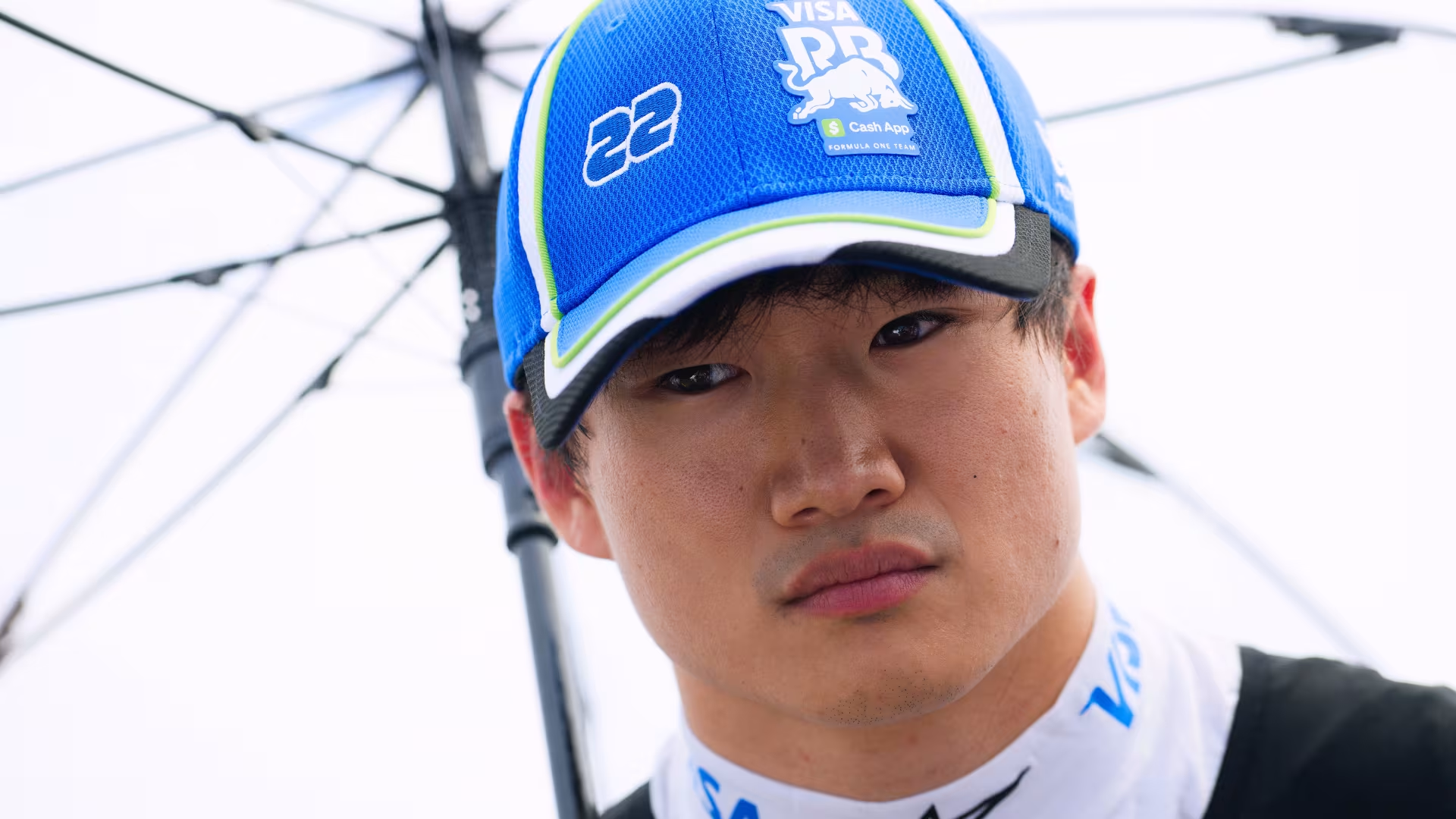
    Yuki Tsunoda has enjoyed a surprise three-race cameo in 2026, slotting into Racing Bulls in place of Liam Lawson following Isack Hadjar’s injury. While it remains unknown whether Tsunoda will get a fourth outing this season, the Japanese racer has certainly made the most of his unexpected comeback.

    Reflections on a Difficult 2025 Season at Red Bull

    Tsunoda is Red Bull’s reserve driver this season, having lost his race seat at the end of last year. After being promoted to Red Bull from the third round of the 2025 season, Tsunoda struggled to make much of an impact and was resigned to playing a support role in Max Verstappen’s championship bid.

    Speaking on the latest episode of official F1 podcast Beyond the Grid, Tsunoda explained just how tough 2025 was for him, after many years of relative success at Racing Bulls under their various guises, and exactly what he felt was his biggest mistake.

    “One thing about myself I think, if I say [being] completely honest, I have a big enough ego to not change my driving style,” Tsunoda said. “I know what I’m doing in terms of driving. I believe in myself, so I never try to change my driving style to other drivers, even though the driver is competitive and fast.

    “Obviously Max, it’s a different case, he’s a World Champion, he proves a lot of things and I still learn a lot of things from his driving. [It was] probably the first year out of any years since I started that I thought about changing driving style and tried to do something similar to Max.

    “But in my perspective, if I just look at data, I didn’t really see a huge difference in terms of driving. What I think now is the biggest mistake in last year was to try to replicate the set-up what he’s doing.”

    Tsunoda scored just seven times out of the 21 Grands Prix he contested with Red Bull, in a car that Verstappen took to second in the championship. The comparison between the two late in that season was stark, with Verstappen winning five of the final eight races, while Tsunoda in the same period recorded a P6, P7 and P10 finish.

    That resulted in Tsunoda losing his seat, with Hadjar promoted from Racing Bulls to replace him.

    “When I got told, I still remember, I didn’t feel that much of huge disappointment or devastated feeling. Obviously, still disappointed and pretty sad that I’m not driving next year. But not as I expected, I don’t know why.

    “I fought really hard. I fought more than ever in that 2025 year, more than ever. And even if I look back now, I don’t have much regret. I gave everything and the outcome is something I didn’t like, obviously, but honestly, I just gave everything.”

    Lessons Learned and a Strong Comeback

    Tsunoda believes the struggles he went through in 2025 have made him a better driver, and he has impressed for Racing Bulls.

    In a new generation of cars, which are very different from what he drove last year, Tsunoda has done well in the three races he has contested – especially in Zandvoort, where the Sprint format meant he only had one practice session to get used to all the changes.

    “Going back to this Netherlands story, jumping into the car that I’ve never driven, Sprint Qualifying format, team is doing really well, you know, running P5 in Championship, [knowing] that you can’t really mess up for the race, you want to have points,” he added.

    “Somehow, I was like really, [feeling] okay. I didn’t feel anything, that much, of pressure.”

    Tsunoda finished 11th in Zandvoort, one place ahead of his team mate. But he then finished 10th at Monza to pick up a point for the team and help them in their fight against Alpine.

    “The feeling I had, crossing the line, finishing P10, is definitely a bit more special P10 than certainly last three years of my career. Felt like really similar feeling towards first time I scored points in AlphaTauri [in my] first year.

    “I felt very valuable, [more] than usual. I was so happy, team are happy, and the kind of moments that you can celebrate with the team – that we had a good race weekend – is something I didn’t have for a while. It was a very nice moment.”

    Future Aspirations for 2027

    As to Tsunoda’s future, he is still trying to secure a full-time drive for next season. But it is a tough ask, with very few open seats left available.

    “My primary focus is F1. I’m trying to be back. That’s my target and I’m not thinking anything else. For myself, it’s fortunate that I got opportunities so I try and maximise it and hope I can be back in 2027.”

    To listen to this week’s episode of Beyond The Grid, simply hit go on the audio player above or click here to listen via your preferred podcasting platform.

    You can also check out a huge selection of previous episodes – spanning every decade of F1 – in our dedicated Beyond The Grid library.

    You can also watch the podcast on the F1 YouTube channel.
  • The Key Upgrade Behind McLaren’s Performance Leap

    The Key Upgrade Behind McLaren’s Performance Leap

    McLaren’s Zandvoort upgrades delivered more than a performance boost

    McLaren’s victory at Zandvoort, its second consecutive win after Budapest, highlighted the impact of the team’s upgrades introduced before and after Formula 1’s summer break. The developments did more than restore the aerodynamic load the car had been lacking: they also helped McLaren take a decisive step forward.

    High-speed corners reveal McLaren’s progress

    McLaren’s strengths were already becoming apparent at the Spanish Grand Prix in Barcelona, while the car looked even more convincing at Spa. The faster and longer the corner, where absolute speed is not the only consideration, the more competitive McLaren became. Its latest upgrades supplied the additional downforce needed to make the car a benchmark through those sections.

    The effectiveness of the developments even surprised McLaren, with the car’s performance in high-speed corners exceeding the team’s internal expectations.

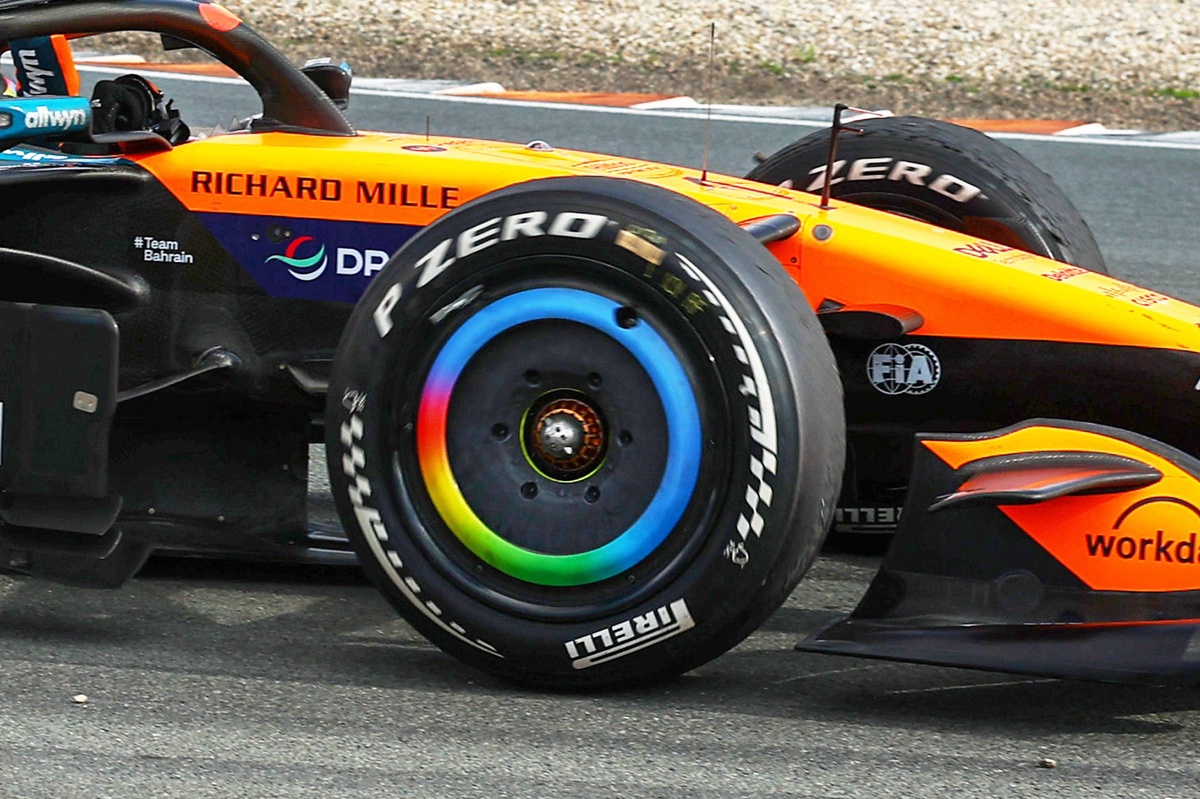
    Another factor in the Zandvoort victory received less attention: the introduction of new front wheel rims, a development McLaren technical director of engineering Neil Houldey had previewed before the weekend.

    McLaren wheel cover comparison

    Photo by: Clive Mason / Getty Images

    “We introduced a small change to the rear section of the floor to generate a bit of extra load, along with some minor tweaks to the rear brake ducts. We also have new front wheel rims, which will help us build more temperature in the tyres. These updates are not significant in terms of lap time, but they do make us slightly more competitive”, Houldey said.

    Why tyre temperature mattered at Zandvoort

    The significance of the wheel-rim change became clearer after the race. McLaren team principal Andrea Stella noted that Budapest and Zandvoort were both high-downforce circuits that naturally suited the car’s characteristics better than other tracks.

    McLaren’s difficulties at Monaco, however, showed that the problem was not limited to cornering speeds or circuit layout. The team had hoped to challenge at the front in Monte Carlo and repeat its successes from the previous year, but it finished outside the podium positions.

    Although Monaco offers teams greater freedom to set up the car because it involves fewer compromises, McLaren was hurt by a lack of downforce and difficulty generating heat in the front tyres. That reduced overall grip.

    The limitation had already appeared earlier in the season, most notably in Australia and China, where the car suffered significant graining. In Japan, however, graining was not a problem and a new track surface improved grip, allowing the MCL40 to score its first podium of the season.

    Front-axle graining was one of the concerns heading into the Zandvoort weekend, but it ultimately proved minimal across the field. The bigger challenge was getting the tyres into their optimal temperature window, even over a single lap.

    That was evident during the final Q3 runs on Saturday. Lando Norris secured pole position, while rival teams struggled to bring their tyres up to temperature and required an additional lap.

    Aston Martin’s 2026 wheel comparison demonstrates the difference between the front and rear designs used to manage temperatures

    Photo by: Gianluca D’Alessandro

    How McLaren’s new front rims managed tyre temperatures

    The issue was directly connected to McLaren’s upgrades in the Netherlands. Rule changes reopened wheel-rim development this season, giving teams an important tool for managing tyre temperatures and operating pressures.

    The internal cavities of a custom rim design, which some teams call “pockets”, allow engineers to passively control air exchange and thermal transfer to the tyre.

    At Zandvoort, McLaren focused on retaining more heat within the rim structure and transferring it more effectively to the tyre. As a result, only the front rim, produced by the team’s long-standing partner Enkei, was updated.

    The change was paired with a more enclosed wheel cover. Its purpose was to limit the cooling effect of ambient airflow hitting the assembly while also reducing drag.

    The rear rim remained unchanged because rear-tyre degradation was already a major factor throughout the weekend, including during the sprint and the race. At the rear of the car, McLaren’s priority was to keep temperatures under control during traction phases and through high-speed sections rather than generate additional heat.

    Strong gusts caused the cars to slide through high-speed corners, where extra downforce was crucial, as well as through key traction zones on the exits of slower corners. McLaren’s combination of aerodynamic improvements and front-rim development helped the team manage those challenges and convert its recent progress into another victory.

    Source: www.motorsport.com

  • Marc Marquez Explains Why He Told Injured Isack Hadjar to Miss the Dutch Grand Prix

    Marc Marquez Explains Why He Told Injured Isack Hadjar to Miss the Dutch Grand Prix

    Marc Marquez has explained why he advised Isack Hadjar not to compete in Formula 1’s Dutch Grand Prix while recovering from a wrist injury.

    The Red Bull driver had been keen to race at Zandvoort last weekend, despite injuring his wrist the previous week while working out in a gym. However, the 21-year-old ultimately decided to sit out the race after discussing the situation with team principal Laurent Mekies and former Red Bull athlete Marquez, who both urged him to prioritise his recovery.

    Reigning MotoGP world champion Marquez has now revealed that Hadjar contacted him after suffering the injury to ask for advice on how to manage his recovery.

    Having seen his own career disrupted by an arm fracture at Jerez in 2020, Marquez advised the French-Algerian driver not to rush his comeback and warned him about the possible consequences.

    “Hadjar contacted me,” Marquez told MotoGP.com. “I’m not a doctor, of course, but just for advice.

    “Because sometimes for a rider, or a driver in this case, it’s super difficult because sometimes you feel that OK, maybe you can. But it’s difficult to accept that, ‘OK, I will skip this race and I will prepare myself in a better way for the next one’.

    “And it’s just what I said. I learned in the past that missing one race will not change your life. Missing, or worsening your injury because you ride too early, can change your life.

    “My life changed a lot since the Jerez injury. So yeah, I just tried to give that advice to Hadjar, and I think he took the correct decision because he has a long career in front [of him].”

    Marquez reflects on his own injury experience

    Marquez’s comments highlight a significant change in his mindset. The factory Ducati rider has repeatedly admitted in recent years that he has learned to accept his physical limitations.

    The Spaniard’s MotoGP career nearly ended when he broke a bone in his arm during a heavy highside at the 2020 season opener in Jerez. After undergoing immediate surgery, he attempted to return just days later at the Andalucian GP, but the additional strain placed on his body weakened the plate attached to his arm.

    After withdrawing midway through the weekend, Marquez missed the entire season. It was not until a fourth operation in 2022 that he regained much of the mobility he had lost in his arm.

    When will Isack Hadjar return to Formula 1?

    Hadjar’s absence from the Dutch GP saw Liam Lawson promoted from Racing Bulls to replace him at Red Bull, while Yuki Tsunoda took Lawson’s place at the sister team.

    It remains unclear when Hadjar will return to action. The next Formula 1 Grand Prix is scheduled to take place at Monza on 6 September.

    Isack Hadjar — Photo by: Rainier Ehrhardt

    Source: www.motorsport.com