Tag: XRP Ledger

  • AI Agents Choose Ripple USD Over XRP as BlackRock Issues Major Prediction

    AI Agents Choose Ripple USD Over XRP as BlackRock Issues Major Prediction

    Key Highlights

    • Autonomous AI agents on the XRP Ledger are settling transactions predominantly with Ripple USD stablecoin rather than native XRP, according to XRPL AI Hub on-chain data.
    • BlackRock’s “The Machine-Native Economy” research note identifies the $300 billion stablecoin market—with $11.6 trillion in annual transaction volume—as the foundational unit of account for AI-driven micropayments.
    • Algorithmic budgeting requirements favor dollar-pegged assets: even hourly XRP volatility of a few percent can break an autonomous task’s financial model, while Ripple USD enables precise cost forecasting.

    AI Agents Drive Stablecoin Dominance on XRP Ledger

    On-chain payment activity tracked by XRPL AI Hub reveals a structural shift in how autonomous software agents settle value on the XRP Ledger. Analysis of all-time highs and 30-day trends in direct clearing settlements shows sustained dominance of Ripple’s regulated stablecoin, Ripple USD, while transaction volumes denominated in the network’s native cryptocurrency, XRP, have stagnated over the past week. The data captures a growing preference among machine participants for regulated stablecoins as the primary medium of exchange in continuous, around-the-clock settlement workflows.

    BlackRock Validates Machine-Native Economy Thesis

    This trend aligns with findings from BlackRock’s research note, The Machine-Native Economy, which describes a tectonic shift in financial infrastructure. The asset manager argues that the traditional banking system, constrained by human operating schedules, is technically incapable of handling the millisecond micropayments executed by autonomous software. According to BlackRock, the global stablecoin market has already surpassed $300 billion in size, while its annual transaction volume of $11.6 trillion has turned this asset class into a basic unit of account for AI. This circulating liquidity allows machine networks to reliably run high-frequency micropayments without causing friction or systemic blockages.

    Predictable Costs Fuel Algorithmic Preference for Ripple USD

    The machines’ pragmatism is explained by the nature of their programming. As Coinbase CEO Brian Armstrong noted, the number of AI agents making transactions will grow exponentially, but they critically need predictable costs. Software’s strict budgeting algorithms rule out volatile assets: even a change of a few percent in $XRP’s price within an hour could undermine an autonomous task’s financial model. By contrast, Ripple USD, pegged one-to-one to the U.S. dollar, allows algorithms to forecast costs precisely. Autonomous agents must purchase computing power around the clock and pay for API access, making tokenized GPUs a key raw material of the new technological order.

    XRP Retains Interbank Role While Stablecoins Lead Robot Economy

    While XRP retains its established role in interbank clearing, Ripple’s digital dollar is taking the lead in the internal economy of robots on the XRP Ledger across all time horizons. The divergence reflects a functional specialization: XRP serves as a bridge asset for institutional cross-border settlement, whereas dollar-pegged stablecoins provide the price stability required for autonomous, high-frequency machine-to-machine commerce.

    Why This Matters

    The convergence of AI agent proliferation and stablecoin infrastructure marks a fundamental evolution in how value moves through digital networks. BlackRock’s framing of a “machine-native economy” suggests that financial rails originally designed for human-paced commerce are being repurposed—and in some cases replaced—by settlement layers optimized for software-speed execution. As regulated stablecoins like Ripple USD gain traction on permissioned and public ledgers alike, they may become the default denomination for compute procurement, data licensing, and API metering in agent-driven workflows. This shift also carries regulatory implications, as the dominance of compliant, dollar-backed tokens in machine commerce could accelerate policy clarity around stablecoin issuance and reserve requirements.

    Frequently Asked Questions

    Why are AI agents choosing Ripple USD over XRP on the XRP Ledger?

    Autonomous agents require predictable pricing for budgeting computing resources and API access. XRP’s hourly price volatility of even a few percent can disrupt an agent’s financial model, while Ripple USD’s 1:1 dollar peg enables precise cost forecasting.

    What does BlackRock’s “The Machine-Native Economy” report conclude about stablecoins?

    BlackRock identifies the $300 billion stablecoin market—with $11.6 trillion in annual transaction volume—as the foundational unit of account for AI, arguing that traditional banking cannot support the millisecond micropayments required by autonomous software networks.

    Does XRP still have a role on the XRP Ledger?

    Yes. XRP continues to serve its established function in interbank and cross-border clearing, while Ripple USD is emerging as the preferred settlement asset for high-frequency, machine-to-machine transactions within the ledger’s internal economy.

  • XRP Ledger Batch Upgrade Delayed to Oct. 9 After Validator Support Reset

    XRP Ledger Batch Upgrade Delayed to Oct. 9 After Validator Support Reset

    Key Highlights

    • The XRP Ledger’s Batch upgrade, originally slated for Sept. 29 activation, has been delayed by at least 10 days after validator support temporarily dropped below the required threshold.
    • The corrected amendment, BatchV1_1, regained support from 30 of 35 trusted validators on Sept. 25, initiating a new two-week countdown targeting an Oct. 9 activation around 14:46 UTC.
    • RippleX engineering head Ayo Akinyele confirmed projects are already being developed with Batch capabilities, which enable atomic settlement of up to eight transactions for tokenized asset trades.

    Validator Threshold Miss Delays XRPL Batch Feature Rollout

    The XRP Ledger’s anticipated Batch amendment has missed its projected Sept. 29 activation window after validator support briefly dipped below the 80% supermajority required by the network’s amendment process. The feature, designed to allow users to bundle up to eight transactions into a single atomic operation, represents a significant infrastructure upgrade for tokenized asset settlement on the ledger.

    Technical Mechanism Enables Atomic Settlement

    Batch introduces an all-or-nothing execution model that could transform how tokenized assets change hands on the XRP Ledger. By grouping payment and delivery legs into one indivisible transaction set, the feature eliminates counterparty risk where one side of a trade executes while the other fails. This capability is particularly relevant for institutional workflows involving real-world asset tokenization, where simultaneous transfer of cash and securities is a regulatory and operational requirement.

    RippleX Confirms Ecosystem Development Underway

    RippleX’s head of engineering, Ayo Akinyele, previously indicated that development teams are actively building applications anticipating Batch functionality. “Some projects are already being built with Batch in mind, so activation would allow that work to move closer to production,” he said. Akinyele did not disclose specific partners or project timelines, though his comments suggest asset managers are among the early adopters preparing for the feature’s availability.

    Amendment Process Resets With Strong Validator Consensus

    Following the brief support shortfall, the revised amendment—formally designated BatchV1_1—secured endorsements from 30 of the 35 validators on the Unique Node List (UNL) as of Sept. 25, according to the XRPL amendment dashboard. This 85.7% approval rate comfortably exceeds the threshold, triggering a fresh two-week validation window. If support remains stable, the earliest possible activation is Oct. 9 at approximately 14:46 UTC.

    Why This Matters

    The Batch amendment is a foundational upgrade for the XRP Ledger’s expanding role in institutional finance. As major financial institutions explore blockchain-based settlement for tokenized funds, bonds, and repos, atomic multi-transaction execution becomes a prerequisite for regulatory compliance and operational efficiency. The delay, while brief, underscores the decentralized governance model of the XRPL: amendments require sustained validator consensus, not merely developer deployment. The rapid recovery to 30-of-35 support signals strong validator alignment on the feature’s utility. Market participants should monitor the amendment dashboard through the countdown period, as any erosion of support below 80% would reset the timeline again.

    Frequently Asked Questions

    What does the Batch feature actually do?

    Batch allows users to submit up to eight transactions as a single atomic unit. All transactions in the batch either succeed together or fail together, enabling simultaneous payment and asset delivery—critical for tokenized asset trades where settlement finality must be guaranteed.

    When is the new expected activation date?

    If current validator support holds, BatchV1_1 will activate on Oct. 9 at approximately 14:46 UTC, following a mandatory two-week validation period that began Sept. 25.

    Why did the activation get delayed?

    Validator support temporarily fell below the 80% supermajority required by the XRP Ledger’s amendment process. The network requires sustained approval from trusted validators on the Unique Node List before any protocol change takes effect.

  • Ripple News: Europe’s Digital Euro Rail Prompts XRP Holders to Calculate $1,000 Potential

    Ripple News: Europe’s Digital Euro Rail Prompts XRP Holders to Calculate $1,000 Potential

    Key Highlights

    • The European Central Bank officially launched the Pontes system on September 21, enabling EU banks to settle transactions using a digital euro and blockchain technology, with a full digital euro pilot targeted for mid-2027.
    • Axology has deployed a private network built on open-source XRP Ledger code that connects to Pontes, allowing tokenized securities and bonds to settle against central bank euros in a single atomic transaction.
    • Crypto analyst Dom Kwok has reiterated his long-standing $1,000 XRP price target with a cryptic "slowly and then all at once" message, though neither Ripple nor the ECB has linked Pontes to any specific token valuation.

    ECB Launches Pontes: Digital Euro Settlement Infrastructure Goes Live

    European Central Bank President Christine Lagarde announced this week that the central bank officially launched Pontes on Monday, September 21, a system that lets banks across the European Union settle transactions with each other using a digital euro and blockchain technology. “It’s the beginning, not the finish,” Lagarde said, adding that a full digital euro pilot is planned to roll out around mid-2027. The launch marks the ECB’s first operational step toward integrating distributed ledger technology into the core of European wholesale payments.

    How Pontes Works: Tokenized Assets Meet Central Bank Money

    In simple terms, Pontes gives European banks a way to trade tokenized assets among themselves using digital euros issued by the central bank, settled through blockchain-style technology instead of older banking systems. It doesn’t replace how banks operate, but it gives them a faster, more direct way to move value between each other. The architecture is designed to support delivery-versus-payment settlement, meaning the asset and the payment move together instead of sequentially, reducing counterparty risk and settlement latency.

    XRP Ledger Technology Enters European Banking Through Axology Partnership

    Here’s the part getting attention in crypto circles. Pontes itself doesn’t run on XRP directly, but at least one platform connected to it does. A company called Axology has built a private network using open-source XRP Ledger code, and it’s being used to tokenize things like securities and bonds. Those tokenized assets can then be settled against real central bank euros through Pontes, a setup where the asset and the payment move together instead of separately. On top of that, existing Ripple banking partners like Société Générale and DZ Bank are also active in this space, giving XRP Ledger technology multiple points of contact with Europe’s new digital banking system, even if XRP the token isn’t the official settlement currency itself.

    Scale of European Payments Market Underscores Potential Impact

    To understand why this matters, look at the scale of money involved. Total non-cash payments across Europe, combining business and everyday transactions, are estimated at roughly 233.8 trillion euros every single year. Even capturing a tiny slice of that volume through XRP Ledger-based technology would represent a massive amount of real activity. The Pontes launch effectively creates a regulated on-ramp for tokenized asset settlement using central bank money, a capability that has been theorized for years but rarely implemented at this scale.

    Why This Matters

    The Pontes launch represents a significant milestone in the convergence of traditional financial infrastructure and distributed ledger technology. By providing a central bank-backed settlement layer for tokenized assets, the ECB is establishing a precedent that other major central banks are closely watching. The involvement of Axology’s XRP Ledger-derived network demonstrates how permissioned, enterprise-grade implementations of public blockchain code can interoperate with sovereign digital currency systems. For market participants, the key development is not token price speculation but the validation of blockchain-based settlement as a legitimate component of the European financial plumbing. The mid-2027 timeline for a full digital euro pilot suggests a deliberate, phased approach that prioritizes stability and regulatory compliance over speed.

    Frequently Asked Questions

    Does the ECB’s Pontes system use XRP as a settlement currency?
    No. Pontes settles transactions in digital euros issued by the European Central Bank. XRP is not the settlement asset. However, Axology’s private network—built on open-source XRP Ledger code—connects to Pontes to tokenize assets that then settle against those central bank euros.
    What is the significance of Société Générale and DZ Bank’s involvement?
    Both banks are existing Ripple partners and are active in the European tokenized asset space. Their participation signals that major European financial institutions are exploring how XRP Ledger technology can integrate with the new ECB digital euro infrastructure, even without using the XRP token itself.
    Is Dom Kwok’s $1,000 XRP price target connected to the Pontes launch?
    Kwok’s $1,000 figure is his own personal prediction, not a confirmed outcome. Neither Ripple nor the ECB has connected Pontes directly to any specific XRP price target. Kwok has held this position publicly since at least late 2025 and recently posted a cryptic follow-up message reading “slowly and then all at once.”
  • XRP Surges 8.7% as Peter Brandt’s Chart Analysis Points to $5.40 Target

    XRP Surges 8.7% as Peter Brandt’s Chart Analysis Points to $5.40 Target

    Key Highlights

    • Veteran trader Peter Brandt projects XRP could reach $5.40 based on long-term monthly chart analysis, implying approximately 251% upside from current levels.
    • XRP surged 8.7% to $1.54 in 24-hour trading, reaching a session high of $1.57 before pulling back, with the token trading in an 11% range between $1.41 and $1.57.
    • Institutional developments accelerated as South African banking giant Absa launched digital asset custody built on Ripple technology, while the U.S. Senate rejected cloture on the CLARITY Act in a 49-50 vote.

    Peter Brandt’s Technical Analysis and $5.40 Price Target

    Veteran commodity trader Peter Brandt shared a bullish long-term projection for XRP on September 21, posting a monthly chart on X that he says implies an eventual advance to $5.40. The target would represent a substantial premium over recent trading ranges, requiring approximately 251% appreciation from the $1.54 level where XRP traded at the time of publication.

    Brandt, who entered the commodity trading business in 1976 and founded Factor Trading in 1980, emphasized the distinction between a public chart presentation and an executed trade. “This is my long-term chart of $XRP It implies an eventual advance to $5.40.” he wrote. “A claim of a ‘call’ or simple presentation of a chart is $NOT a trade. People who claim ‘trades’ need to provide proof or else the claims are BS. An X post is $NOT proof,” he added. His use of the term “eventual” frames the $5.40 objective as a long-term technical target rather than a near-term prediction, and he explicitly noted that proving an actual trade would require verifiable records showing entry, exit, and result.

    XRP Price Action and Market Performance

    Bitcoin.com Markets data confirmed XRP trading at $1.54, up 8.7% or $0.12 over the preceding 24 hours. The token established a session low of $1.41 early in the period before climbing steadily through most of the trading day. The advance peaked at $1.57 late in the session, after which XRP eased back to the $1.54 level, leaving it approximately 2% below its 24-hour high and roughly 9% above its low. The session’s full trading range spanned about 11% from low to high, reflecting heightened volatility accompanying the price discovery.

    Institutional Infrastructure Expansion and Regulatory Context

    The price rally coincided with significant institutional infrastructure developments. South African lender Absa, one of Africa’s largest banking groups, launched Absa Digital Asset Custody on September 21, built on Ripple’s custody technology. The launch occurred 11 months after Ripple and Absa announced their partnership, marking a concrete step in institutional adoption across the African continent.

    Asset manager 21Shares outlined a four-pillar investment case for XRP centered on regulatory clarity, institutional access, measurable utility, and fixed supply. The firm noted that while expanding XRP Ledger (XRPL) activity may not directly translate into sustained XRP demand, growing network activity could support demand through transaction fees, account reserves, and bridge transfers. 21Shares cited approximately $4 billion in tokenized assets and roughly $1.6 billion in RLUSD supply, with more than half circulating on the XRPL.

    On the regulatory front, the U.S. Senate rejected cloture on the CLARITY Act in a 49-50 vote. Ripple maintained that the failed vote did not alter XRP’s established legal position or disrupt demand across payments, stablecoins, and institutional markets, suggesting the token’s regulatory framework remains intact despite legislative setbacks.

    Why This Matters

    The convergence of technical analysis from a respected veteran trader, meaningful price appreciation with elevated volume, and tangible institutional infrastructure deployment creates a multi-layered bullish narrative for XRP. Brandt’s $5.40 target, while framed as a long-term technical implication rather than a trading recommendation, draws attention to the monthly chart structure that has historically preceded major trend advances in commodity and digital asset markets. The Absa custody launch demonstrates Ripple’s expanding institutional footprint beyond North America into African financial markets, while 21Shares’ analytical framework highlights the fundamental metrics—institutional access, on-chain utility, and regulatory standing—that professional allocators increasingly prioritize. The Senate’s CLARITY Act outcome, while a legislative disappointment for broader crypto regulatory clarity, appears to have had minimal immediate market impact on XRP specifically, reinforcing Ripple’s assertion that the token’s legal classification is settled. Market participants will likely monitor whether XRP can sustain above the $1.50 psychological level and build a higher base for the next leg toward Brandt’s long-term projection.

    Frequently Asked Questions

    What is Peter Brandt’s track record in technical analysis?

    Peter Brandt has over 45 years of commodity trading experience, founding Factor Trading in 1980 after beginning his career in 1976. He has managed institutional trading operations and authored two books on commodity trading and classical chart patterns, establishing him as a recognized authority in traditional technical analysis applied to digital assets.

    Does the Absa Digital Asset Custody launch directly increase XRP demand?

    Not necessarily. The custody service is built on Ripple’s technology infrastructure, but 21Shares notes that expanding XRPL activity may not translate directly into sustained XRP demand. However, the firm argues that growing network activity could support demand indirectly through transaction fees, account reserves, and bridge transfer mechanisms on the ledger.

    How significant was the Senate CLARITY Act vote for XRP specifically?

    According to Ripple, the failed cloture vote on the CLARITY Act did not change XRP’s established legal position or disrupt demand across its core use cases in payments, stablecoins, and institutional markets. The token’s regulatory classification remains intact regardless of the legislative outcome.

  • Ripple: Asset Managers Preparing for XRP Ledger’s Next Payments Upgrade

    Ripple: Asset Managers Preparing for XRP Ledger’s Next Payments Upgrade

    Key Highlights

    • The XRP Ledger’s Batch V1.1 amendment has secured support from 30 of 35 tracked validators, exceeding the 28-vote threshold to begin a 14-day activation countdown.
    • Batch enables exchanges, wallets, and marketplaces to attach service fees directly to customer transactions, processing payments and platform charges as a single atomic operation.
    • Activation is projected for September 29, 2024, provided validator support remains at or above 80%; the original Batch V1.0 was withdrawn in February after researchers discovered a critical signature-validation vulnerability.

    Batch Amendment Enters Activation Countdown With Strong Validator Consensus

    The XRP Ledger’s Batch amendment has officially entered its activation countdown after securing support from 30 of the network’s 35 tracked validators—well above the 28-vote supermajority required to trigger the two-week finalization window. The countdown commenced on September 15 at 14:06:41 UTC, positioning Batch V1.1 for projected activation shortly after the same time on September 29, provided validator backing holds at or above the 80% threshold throughout the period. Because validators retain the ability to change their votes, the activation date remains conditional until the window closes.

    Single-Operation Fee Attachment Streamlines Platform Economics

    Batch introduces a structural improvement for businesses operating on the XRP Ledger by allowing exchanges, wallets, and marketplaces to attach their service charges directly to a customer’s transaction. Rather than requiring separate transfers for the payment and the platform fee, both components are processed as one atomic operation. This design reduces operational complexity, lowers transaction overhead, and improves the user experience for applications that embed fee logic at the protocol layer.

    “Some projects are already being built with Batch in mind, so activation would allow that work to move closer to production,” Akinyele shared. “We’ll share more on specific partners and launch timing as those plans are finalized.”

    Security Remediation Paves Way for V1.1 Release

    The path to this activation follows a significant security intervention earlier this year. In February, researchers identified a critical flaw in Batch V1.0’s signature-validation process. Under certain conditions, the code could terminate signature checks prematurely, potentially allowing an attacker to include transactions from another account without the owner’s authorization. The vulnerability prompted developers to withdraw the original version entirely, delaying the feature’s deployment while a corrected implementation was developed and audited. Batch V1.1 incorporates the necessary fixes and has since undergone renewed validator scrutiny.

    Why This Matters

    Batch represents a meaningful evolution in the XRP Ledger’s native capabilities for composable, fee-aware transactions. By embedding platform economics directly into the ledger’s transaction model, the amendment reduces reliance on off-chain accounting or multi-step settlement flows—benefiting decentralized exchanges, custodial wallets, and payment processors that currently manage fee logic externally. The strong validator consensus signals network confidence in both the feature’s utility and the remediation of the V1.0 vulnerability. Successful activation would mark the restoration of functionality originally pulled over safety concerns, demonstrating the network’s governance process in action: identify, remediate, re-propose, and achieve supermajority approval.

    Frequently Asked Questions

    When will Batch V1.1 activate on the XRP Ledger?

    Batch V1.1 is projected to activate shortly after September 29, 2024, at 14:06:41 UTC, provided validator support remains at or above 80% for the full 14-day countdown window that began September 15.

    What was the critical flaw in Batch V1.0?

    Researchers discovered in February that Batch V1.0’s signature-validation process could stop checking signatures early under certain conditions, potentially allowing an attacker to include unauthorized transactions from another account. The original version was withdrawn and replaced by the corrected V1.1.

    How does Batch change fee processing for platforms on the XRP Ledger?

    Batch allows exchanges, wallets, and marketplaces to attach service fees directly to a customer’s transaction so that the payment and platform fee are processed as a single atomic operation, eliminating the need for separate transfers and reducing operational complexity.

  • XRPL’s New Lending Tool Could Lock Up XRP From Minutes to Decades

    XRPL’s New Lending Tool Could Lock Up XRP From Minutes to Decades

    Key Highlights

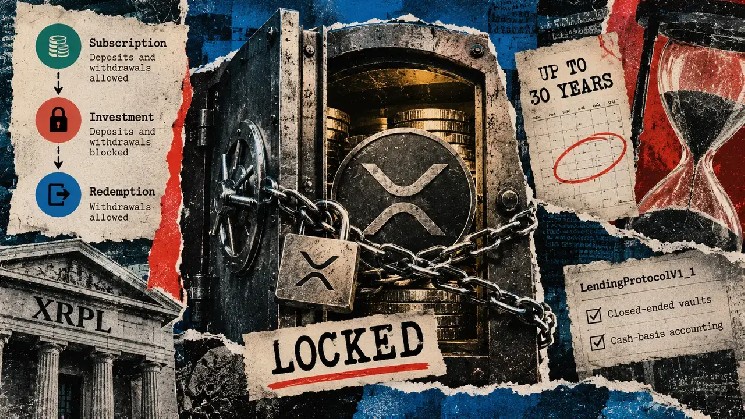
    • The XRP Ledger Foundation released xrpld 3.4.0 on September 16 with LendingProtocolV1_1, introducing closed-ended vaults with fixed subscription, investment, and redemption periods and cash-basis interest accounting.
    • Deposited assets in closed-ended vaults are locked during the investment phase, which can range from 60 seconds to just under 30 years, while interest is recognized only when borrowers actually pay it.
    • Both the base LendingProtocol and SingleAssetVault amendments remain below the 28-of-35 validator threshold required for activation, meaning the features are not yet live on the mainnet.

    XRP Ledger 3.4.0 Introduces Structured Lending With Fixed-Term Vaults

    The XRP Ledger Foundation shipped xrpld version 3.4.0 on September 16, embedding the LendingProtocolV1_1 code path that defines a new generation of closed-ended lending vaults. The release adds two structural changes: a fixed calendar that locks depositor capital for a predetermined term, and a shift to cash-basis accounting that records interest income only when borrowers make payments. Together, these changes aim to make the risk-return profile of on-ledger lending more transparent for participants.

    Unlike open-ended pools that allow continuous deposits and withdrawals, the new closed-ended vaults move through three distinct phases. At creation, the vault sets a SubscriptionDate and a RedemptionDate that remain immutable. During the subscription window, depositors may add assets and redeem shares freely. Once the investment phase begins, the protocol blocks new deposits and withdrawals, committing the vault’s capital to loan funding. Only when the redemption date arrives can depositors withdraw their share of the proceeds. The investment period must be at least 60 seconds and strictly less than 30 years, providing a wide but bounded range for term design.

    Cash-Basis Accounting Separates Expected From Realized Returns

    The accounting overhaul addresses a longstanding ambiguity in how vault income is reported. Under the prior whole-life model, scheduled interest could be booked at loan origination, before the borrower delivered any cash. A missed payment would then force the system to unwind income that had already appeared in the vault’s net asset value. The LendingProtocolV1_1 implementation stamps newly created vaults with a cash-basis accounting version, recognizing interest strictly as borrowers pay it. Vaults created under the earlier rules permanently retain legacy whole-life accounting, ensuring backward compatibility without forced migration.

    For depositors, the practical effect is a cleaner separation between a claim on a borrower and realized vault income. Scheduled payments remain off-balance-sheet receivables until cash arrives, making the reported asset value less dependent on money that has not yet been received. The change also alters how much debt a broker appears to carry against protocol limits, because future interest no longer enters the total at origination. This may create additional headroom for new loans under the protocol’s measurements, though actual utilization still depends on real borrowers and funding.

    Amendment Governance Remains the Critical Gate

    Despite the code being present in the 3.4.0 release, the features are not yet accessible on the live network. A dashboard snapshot fetched on September 17 showed the base LendingProtocol amendment at 13 of 35 trusted-validator votes and SingleAssetVault at 16 of 35, both below the displayed activation threshold of 28. The LendingProtocolV1_1 amendment itself did not appear in the responding node’s feature feed, nor was an activation countdown visible. Network governance therefore remains the first measurable hurdle: the amendments must become visible, attract sufficient validator support, and complete the two-week activation window before any vault can be created.

    Single-asset vaults can denominate their principal in XRP, an issued trust-line token, or a Multi-Purpose Token. This flexibility means that lasting XRP demand from the lending system depends entirely on later choices by application developers, borrowers, and depositors. Moving already-owned XRP into a vault produces a visible locked balance without requiring a market purchase, and applications could build lending pools around issued assets while leaving XRP outside the principal flow entirely.

    Why This Matters

    The introduction of closed-ended vaults and cash-basis accounting represents a maturation of the XRP Ledger’s native lending architecture. By enforcing a visible commitment period and recognizing income only upon receipt, the protocol reduces the opacity that can obscure credit risk in decentralized lending markets. However, the economic significance for XRP holders hinges on adoption metrics that have yet to materialize: the number of XRP-denominated vaults created, the volume of XRP deposited, loan origination activity, repayment performance, and whether depositors renew after the first redemption cycle. Until those on-chain indicators emerge, the system’s capacity to generate sustained demand for XRP—beyond a temporary liquidity sink—remains an open question. The next concrete milestones are the amendment activation process and the subsequent launch of application-level lending products that choose XRP as their principal asset.

    Frequently Asked Questions

    When will the new lending features be available on the XRP Ledger mainnet?
    The features require the LendingProtocol and SingleAssetVault amendments to reach a 28-of-35 validator supermajority and complete a two-week activation period. As of September 17, voting stood at 13 and 16 respectively, with LendingProtocolV1_1 not yet visible in the feature feed.
    Can depositors withdraw their assets early from a closed-ended vault?
    No. Once the investment phase begins at the SubscriptionDate, the protocol blocks all deposits and withdrawals until the RedemptionDate. The lock is enforced at the protocol level for the full term, which can range from 60 seconds to just under 30 years.
    Does this update create new demand for XRP?
    Not automatically. The vault design supports XRP, issued trust-line tokens, and Multi-Purpose Tokens as principal assets. Sustained XRP demand would require applications to select XRP for their vaults, borrowers to seek XRP-denominated credit, and depositors to repeatedly fund and renew positions after observing repayment performance.
  • XRP Ledger Hub Mysteriously Gains Stability, Ripple CTO Emeritus Notes

    XRP Ledger Hub Mysteriously Gains Stability, Ripple CTO Emeritus Notes

    Key Highlights

    • Ripple CTO David Schwartz reports his XRP Ledger hub server has climbed back above 500 connected peers after a mysterious stability improvement over the past two weeks.
    • The hub recorded 501 active peers at the latest reading, nearing a two-week high of 509, with significantly fewer peer disconnects observed since early September.
    • Schwartz confirmed he has no explanation for the sudden reliability gain, prompting community speculation ranging from network optimizations to playful theories about a “Stablegeist.”

    Ripple CTO David Schwartz Reports Unexplained Stability Surge in Personal XRP Ledger Hub

    Ripple Chief Technology Officer David Schwartz has disclosed a notable and unexplained improvement in the performance of his personal XRP Ledger (XRPL) infrastructure. In a post on X (formerly Twitter) dated September 17, Schwartz revealed that his hub server has “mysteriously gotten more stable and reliable with fewer peer disconnects” over the preceding two-week period, allowing it to sustain a peer count exceeding 500 for the first time in recent memory.

    Hub Performance Metrics Show Marked Improvement

    The improvement is visible in operational data covering September 3 through September 17. According to a chart shared by Schwartz, the hub registered 501 active peers at the time of his posting, sitting just below a two-week peak of 509 connected peers. For a hub operator, maintaining a high peer count with low churn is a key indicator of network health. A server that frequently loses peers must expend resources re-establishing connections to exchange ledger data, transactions, and consensus messages. The reduction in disconnects suggests Schwartz’s node is experiencing longer-lived, more predictable peer-to-peer sessions, resulting in a more efficient networking environment.

    Cause Remains Unknown Despite Community Speculation

    Despite the positive metrics, Schwartz was explicit that he has not identified a root cause. “Over the past two weeks my hub has mysteriously gotten more stable and reliable with fewer peer disconnects. I’m not sure of the cause, but I’ll take it. I’m back over 500 peers!” he wrote. The admission prompted immediate discussion among his followers. One user inquired whether he had a working theory for the sudden change, while another speculated about the potential deployment of an AI model on the hub infrastructure. Other responses were more lighthearted; one commenter jokingly attributed the stability to a “Stablegeist,” while another asked which XRP community “Riddler” was currently on duty. As of the latest update, Schwartz has not offered a technical hypothesis.

    Why This Matters

    The stability of hub servers is a foundational component of the XRP Ledger’s peer-to-peer topology. Hubs act as high-capacity relay points that facilitate rapid propagation of transactions and consensus data across the network. When a prominent hub—particularly one operated by the network’s lead architect—experiences unexplained volatility or stability, it can signal underlying changes in network topology, peer behavior, or unreleased software optimizations. While Schwartz’s observation is specific to his own infrastructure and not a network-wide event, the lack of a clear cause underscores the opaque nature of decentralized network dynamics. Developers and node operators will likely monitor whether similar stability patterns emerge across other high-degree nodes in the coming weeks, which could indicate a broader protocol-level shift or an environmental factor affecting connectivity.

    Frequently Asked Questions

    What is an XRP Ledger hub server?

    An XRP Ledger hub server is a high-capacity node that maintains persistent connections with a large number of other servers (peers) on the network. These hubs are critical for efficiently relaying ledger data, transactions, and consensus messages across the decentralized topology, ensuring low-latency propagation and network resilience.

    Why is David Schwartz’s hub performance significant?

    As Ripple’s CTO and one of the original architects of the XRP Ledger, Schwartz’s personal infrastructure serves as a bellwether for network health. Changes in his hub’s peer count and stability can reflect broader network conditions, software behavior, or connectivity trends that may affect other node operators.

    Has Ripple or the XRPL Foundation commented on the cause?

    No. David Schwartz explicitly stated he does not know the cause of the improvement, and no official statement has been issued by Ripple or the XRPL Foundation regarding network-wide changes that could explain the stability increase observed on his specific hub between September 3 and September 17.

  • Ripple Integrates XRP Payments With Stripe, Tempo AI Standard in New Developer Kit

    Ripple Integrates XRP Payments With Stripe, Tempo AI Standard in New Developer Kit

    Ripple has expanded its XRP Ledger developer toolkit to support a new payments standard designed for artificial intelligence agents, broadening the options for machines to pay for data, computing power, and other digital services using cryptocurrency.

    XRPL AI Starter Kit Adds Machine Payments Protocol Support

    Version 1.1 of the XRPL AI Starter Kit now integrates the Machine Payments Protocol (MPP) and the Open Wallet Standard, according to a blog post from RippleX developers. The Open Wallet Standard enables software to manage wallets across multiple blockchains through a single, unified interface.

    The update positions both XRP and RLUSD—Ripple’s dollar-pegged stablecoin—as native payment options for developers building AI-driven services.

    RippleX Commits to Multi-Standard Strategy

    “Our job is to make $XRP and $RLUSD first-class options wherever developers are building,” RippleX head of product Jazzi Cooper wrote on X.

    Ripple previously added support for x402, a separate web payments standard, in June. By backing both MPP and x402, the company is pursuing a multi-standard approach rather than betting on a single protocol.

    How MPP Enables AI Commerce

    The Machine Payments Protocol, co-authored by payments giant Stripe and Tempo—a blockchain purpose-built for payments—gives AI agents a standardized way to transact autonomously. An AI agent, defined as software that executes tasks on a user’s behalf, can now request a resource, receive a price quote, authorize payment, and receive the requested service in a seamless flow.

    Why This Matters for the Agent Economy

    As developers build services that charge machines per request, those AI agents need a currency the seller accepts and the software rails to send it. Ripple’s latest move aims to ensure XRP and RLUSD are among the default choices for this emerging machine-to-machine economy.

  • RippleX Releases Batch V1.1 Amendment for XRP Ledger After Critical Bug Fix

    RippleX Releases Batch V1.1 Amendment for XRP Ledger After Critical Bug Fix

    RippleX Declares XRP Ledger Batch Amendment Ready for Activation

    Ripple’s developer division, RippleX, has announced that the XRP Ledger’s Batch amendment is ready for activation. A technical review published Monday details how the feature was rebuilt following the discovery of a critical security flaw in the original version. The corrected Batch V1.1 is included in the xrpld v3.3.0 release and enables multiple transactions from different accounts to settle atomically within a single ledger close. RippleX describes this capability as foundational for atomic swaps and multi-party coordination on the network.

    Why the Original Batch Was Pulled

    The original Batch amendment, known as XLS-56, was withdrawn after security researchers and Cantina AI identified a critical flaw in its signature-validation routine on February 19, 2026. The checkBatchSign function, responsible for confirming that each inner-transaction account authorized a batch, contained an early-return bug. When the function encountered a signer whose account did not yet exist on the ledger, it incorrectly returned success and skipped validation of all remaining signers. RippleX stated that this flaw could have allowed an attacker to execute transactions on behalf of victim accounts without access to their private keys. Because the amendment was still in its voting phase and had not yet activated on the mainnet, no funds were at risk.

    How Batch V1.1 Was Hardened

    Batch V1.1 replaces the original amendment and eliminates the early-return bug. According to RippleX, the root-cause fix was merged via pull request #6446 and reviewed by four senior engineers. Additional assurance came from a Sherlock Batch Attackathon contest, a Halborn re-assessment, and a Common Prefix audit. An AI-assisted static analysis pipeline incorporating a Cantina scan has been integrated into the release process, complemented by regression testing on devnet and testnet. The amendment is included in the xrpld v3.3.0 release, which bundles it with five other proposals.

    Atomic Transactions and What Comes Next

    Batch is designed to allow multiple XRPL transactions to execute as a single all-or-nothing unit, meaning a batch either fully succeeds or fully reverts — a design intended for atomic swaps and coordinated settlements. As with every XRP Ledger amendment, Batch V1.1 must achieve an 80% validator majority for 14 consecutive days before activation, according to the network’s amendment tracker. Consequently, the amendment remains in its voting phase. The ledger has attracted broader attention this month: the Bank for International Settlements recently tested the network to anchor official statistics on-chain, while XRP has expanded further into traditional finance amid growing ETF demand and derivatives access.

  • New XRPL Upgrade Could Shift XRP Ownership from Retail Wallets to Banks

    New XRPL Upgrade Could Shift XRP Ownership from Retail Wallets to Banks

    Proposed XRPL Sponsor Amendment Could Shift $XRP Costs From Consumers to Institutions

    A proposed upgrade to the XRP Ledger (XRPL) would allow banks and fintech companies to absorb $XRP transaction fees and account reserves on behalf of their customers, potentially removing a significant friction point for mainstream adoption. Known as the Sponsor amendment and based on the XLS-68 Sponsored Fees and Reserves proposal, the change would let a sponsoring entity pay network costs while the end user retains full control of their account and private keys.

    Removing the $XRP Acquisition Barrier for End Users

    Currently, interacting with the XRPL requires every account to hold a base reserve of 1 $XRP plus additional reserves for trust lines and other ledger objects. Transaction fees, paid in $XRP, are also burned upon settlement. For financial institutions deploying tokenized assets, payments, or other applications, requiring every customer to acquire and manage $XRP beforehand creates onboarding friction.

    Jazzi Cooper, Ripple’s head of product, said the feature is designed so a sponsor such as a bank, issuer or platform can cover those costs on behalf of users. That could allow consumer-facing applications and institutional platforms to keep the underlying $XRP mechanics largely out of the customer experience.

    Capital Requirements Shift to the Sponsor’s Balance Sheet

    The trade-off moves the capital requirement to the sponsor. Account reserves must still be funded in $XRP, and transaction fees continue to be paid in the token and destroyed when transactions settle. Businesses effectively become the $XRP holders supporting customers who own none.

    Under current network parameters, XRPL requires a base reserve of 1 $XRP per account and 0.2 $XRP per standard owner-reserve unit, though validators can adjust these parameters. Under sponsorship, the $XRP allocated to a user’s reserve remains in the sponsor’s account while the ledger records which party is responsible for the obligation.

    A business sponsoring 1,000 otherwise empty customer accounts would therefore carry roughly 1,000 $XRP of additional base-reserve requirements alongside its own reserve. If those customers funded their accounts themselves, the same 1,000 $XRP requirement would be distributed among them. This distinction becomes significant if banks, payment companies, or tokenization platforms deploy XRPL products to millions of users. A firm serving 1 million users could theoretically carry about 1 million $XRP of base-account reserve obligations before accounting for trust lines, token-related objects, optional sponsorship relationships, and transaction fees.

    Optional Sponsorship Entries Add Complexity

    Optional Sponsorship ledger entries allow businesses to establish prefunded sponsorship relationships rather than signing every subsidized transaction individually, but each entry also consumes reserve capacity. This arrangement means wider XRPL adoption would not necessarily create an equivalent number of new retail $XRP holders. A bank could onboard a large customer base while purchasing and managing $XRP centrally, effectively concentrating the network’s reserve requirements among a smaller group of institutional sponsors.

    That structure could make $XRP easier to integrate into products where banks prefer customers to see only the asset or service they use, such as tokenized deposits, bonds, or money-market instruments. Ctrl Alt, which has worked on the sponsorship proposal alongside Ripple and XRPL developers, has described the model as a way for institutions to manage $XRP requirements internally while customers interact with tokenized assets without acquiring $XRP themselves.

    Sponsorship Creates Balance-Sheet and Capital-Management Challenges

    The same design introduces a capital-management problem for sponsors. An $XRP reserve remains committed while the sponsored account or ledger object still depends on it. A company cannot necessarily assume the $XRP becomes available immediately when a customer stops actively using its service.

    Under the proposed SponsorshipTransfer mechanism, a sponsorship can be ended or reassigned, but account sponsorship carries conditions. A beneficiary taking over its own reserve needs enough $XRP to satisfy the requirement. This creates a complication for the very users the feature is intended to support: a customer who never acquired $XRP may be unable to take over the reserve when a bank wants to stop sponsoring the account.

    The sponsor could transfer enough $XRP to the customer to cover the shortfall, but doing so creates a separate cost. The customer could also arrange for another sponsor to assume the obligation, with the incoming sponsor’s consent. Account deletion offers another exit when applicable. Once relevant blockers are cleared, a sponsored account can be deleted and the reserve obligation released, with remaining account $XRP directed as specified under the proposed rules.

    Object sponsorship adds further uncertainty. A code change merged into XRPL’s development branch in August adds reserve checks when certain sponsorships end, but that behavior is gated behind the separate fixCleanup3_4_0 amendment. Its eventual mainnet status will determine how freely some reserve commitments can be unwound.

    Those mechanics mean banks considering sponsorship would need to model more than the initial cost of acquiring $XRP. They would also need to estimate customer churn, average reserve requirements, transaction-fee consumption, and how much $XRP could remain committed to inactive but still-open accounts.

    Market Demand Depends on Deployment, Not Just Formula

    The proposal could create a new institutional use for $XRP without establishing how much fresh buying would follow. An existing $XRP holder could allocate tokens already on its balance sheet to sponsored customers without purchasing additional supply. New market demand would depend on the gap between that inventory and the reserve and fee commitments the institution chooses to assume.

    That makes eventual deployment data more important than the headline reserve formula. The number of sponsored accounts, sponsor balances, transaction volumes, and reserve units tied to tokenized assets would reveal whether businesses are accumulating $XRP to support the service or primarily recycling existing holdings.

    Validator Approval Remains the First Hurdle

    The proposal remains some distance from activation. As of press time, XRPScan data showed only six validators supporting the amendment, short of the 29-validator threshold, with no activation date scheduled.

    If the Sponsor amendment gains sufficient support and clears the required activation period, banks and platforms would then have to decide whether removing $XRP from their customer experience is worth carrying the token themselves. For companies planning large-scale tokenized-asset products, that calculation could ultimately turn $XRP from something every customer has to manage into an infrastructure cost concentrated on the institution’s own balance sheet.