Tag: Wintermute

  • Coinbase and Wintermute Release Key Analyses: “The Balance is Shifting in the Bitcoin-Gold Equation! This Week’s Focus Will Be This Level!”

    Coinbase and Wintermute Release Key Analyses: “The Balance is Shifting in the Bitcoin-Gold Equation! This Week’s Focus Will Be This Level!”

    Key Highlights:

    • Bitcoin has risen over the past month while gold has declined, despite their 90-day correlation approaching a record high.
    • Coinbase Institutional said marginal investment demand is favoring Bitcoin even as interest rates remain elevated.
    • Wintermute identified $82,500 as Bitcoin’s critical level this week after the cryptocurrency closed above its 50-week moving average for the first time since November 2025.

    Bitcoin Outperforms Gold Despite Near-Record Correlation

    Bitcoin is diverging from gold in recent performance, according to an analysis by Coinbase Institutional. The 90-day correlation between Bitcoin ($BTC) and gold is nearing a record high, indicating that the two assets have recently tended to move in similar directions. However, the analysis emphasized that a stronger correlation does not necessarily produce similar returns.

    Bitcoin rose over the past month, while gold declined during the same period. The divergence highlights how closely correlated assets can still deliver significantly different price movements over shorter time frames.

    Coinbase Institutional also pointed to the effect of higher interest rates on investment demand. According to the firm, new marginal demand has shifted toward Bitcoin in an environment of rising rates, with Bitcoin favored despite the higher cost of capital.

    “Bitcoin > altın. $BTC’nin altınla korelasyonu rekor düzeye yakın. Ama benzer korelasyonlar benzer getiriler anlamına gelmez. Son bir ayda $BTC yükseldi, altın ise düştü.
    The lesson we learned: Marginal demand favors bitcoin despite higher interest rates.

    Wintermute Identifies $82,500 as Bitcoin’s First Major Test

    Wintermute, a cryptocurrency market maker, has also assessed Bitcoin’s latest move. In its most recent market analysis, the company said Bitcoin closed above its 50-week moving average last week for the first time since November 2025.

    Following that advance, market attention has shifted to the $82,500 level. Wintermute described the level as critical for Bitcoin this week because it marks the upper boundary of the cryptocurrency’s previous consolidation range.

    Wintermute said that holding above $82,500 would be important for sustaining Bitcoin’s recent rally. The price has struggled to break through this area for weeks, and sustained trading above it could suggest that the first weekly close above the 50-week moving average represents a more lasting price formation rather than a temporary move.

    However, Wintermute expects Bitcoin to test $82,500 several times in the short term. A weekly close below the level could raise questions about the validity of the upward breakout, according to the market maker.

    Risk Assets Stay Strong Despite Higher Treasury Yields

    Wintermute also noted that risk assets remained strong last week even as the U.S. 10-year Treasury yield climbed above 5%, reaching its highest level since 2007. The observation places Bitcoin’s latest technical test against a backdrop of elevated bond yields and continued strength across risk-oriented markets.

    Why This Matters

    The developments show that Bitcoin and gold can maintain a high correlation while producing sharply different short-term returns. For Bitcoin, the $82,500 level now represents an important technical marker: holding above it would support the sustainability of the recent rally, while a close below it could weaken confidence in the breakout.

    Bitcoin’s position above its 50-week moving average and the continued strength of risk assets are central to Wintermute’s assessment. At the same time, Coinbase Institutional’s analysis indicates that marginal demand is currently favoring Bitcoin despite higher interest rates.

    Frequently Asked Questions

    Did Bitcoin outperform gold over the past month?

    Yes. Bitcoin rose during the last month, while gold declined, even though their 90-day correlation is nearing a record high.

    Why is $82,500 important for Bitcoin?

    Wintermute identified $82,500 as the upper limit of Bitcoin’s previous consolidation range and said that holding above it is important for sustaining the recent rally.

    What could happen if Bitcoin closes below $82,500?

    According to Wintermute, a close below $82,500 could raise questions about whether Bitcoin’s upward breakout is valid.

    This is not investment advice.

  • CFTC Scrutinizes Kalshi After $5 Billion in Near-Identical Ether Perpetual Trades, WSJ Reports

    CFTC Scrutinizes Kalshi After $5 Billion in Near-Identical Ether Perpetual Trades, WSJ Reports

    Key Highlights

    • The Commodity Futures Trading Commission is reviewing unusual trading patterns on Kalshi involving nearly one million ether perpetual futures trades clustered around $5,500, representing over $5 billion in volume.
    • Kalshi denies wash trading allegations, attributing the pattern to market makers maintaining fixed resting orders and hundreds of distinct traders participating in the transactions.
    • Jump Trading and Wintermute were identified among firms involved in the rapid transactions, with Jump stating it trades for profit and uses self-match prevention tools.

    CFTC Scrutinizes Concentrated Trading Activity on Kalshi Ether Perpetuals

    The Commodity Futures Trading Commission is examining unusual trading activity on the Kalshi exchange after an analysis by The Wall Street Journal revealed nearly one million ether perpetual futures trades executed in almost identical amounts. According to the Journal’s review of public data, more than one-third of trades in the market during recent weeks clustered around the $5,500 price level, accounting for over $5 billion in ether perpetual volume over the past month. The regulatory review comes at a pivotal moment for Kalshi, which launched its crypto perpetual futures business in May and has since sought approval to offer similar contracts tied to individual U.S. stocks.

    Allegations of Wash Trading Prompt Regulatory Review

    The trading pattern has prompted allegations of wash trading—a practice involving trades lacking genuine economic purpose that can create a misleading impression of market activity. The CFTC is reviewing the activity before determining whether to open an enforcement investigation, according to a person familiar with the matter cited by the Journal. The agency said it could not comment on whether an investigation is underway. Kalshi has categorically denied the allegations, stating that hundreds of distinct traders participated in the transactions and arguing that the repeated trade sizes resulted from market makers maintaining fixed resting orders that were repeatedly hit by faster traders.

    Kalshi Defends Market Structure and Liquidity Programs

    In its defense, Kalshi emphasized that self-trading is mechanically blocked on its platform and that coordinated wash trading is both prohibited and actively monitored. The company said its liquidity programs compensate market makers for maintaining orders at specific sizes and spreads rather than rewarding trading volume. A temporary program also refunds trading fees for qualifying self-clearing members but does not allow traders to receive more in rebates than they paid in fees. According to the Journal, Jump Trading and Wintermute were among the firms involved in the rapid transactions. Jump said it trades for profit, uses self-match prevention tools, and does not coordinate its activity with other traders.

    Why This Matters

    The CFTC’s scrutiny of Kalshi highlights the growing regulatory focus on crypto derivatives markets as they expand beyond traditional cryptocurrency exchanges into regulated venues. Kalshi, designated as a contract market by the CFTC, operates under a different regulatory framework than many offshore crypto platforms, making this review particularly significant for the evolution of U.S.-regulated crypto derivatives. The outcome could set precedents for how market-making activities, liquidity incentives, and high-frequency trading patterns are policed in crypto perpetual futures markets. As Kalshi seeks to expand into single-stock perpetual futures, the resolution of this review will likely influence the pace and conditions of that regulatory approval process.

    Frequently Asked Questions

    What triggered the CFTC’s review of Kalshi trading activity?

    The Wall Street Journal’s analysis of public data revealed nearly one million ether perpetual futures trades clustered around $5,500 in almost identical amounts, representing over $5 billion in volume over the past month. This concentration—accounting for more than one-third of recent market trades—prompted the CFTC to review the activity for potential wash trading.

    How has Kalshi responded to the wash trading allegations?

    Kalshi has denied the allegations, stating that hundreds of distinct traders participated in the transactions. The exchange attributes the repeated trade sizes to market makers maintaining fixed resting orders that were repeatedly executed by faster traders. Kalshi also noted that self-trading is mechanically blocked, coordinated wash trading is prohibited and monitored, and its liquidity programs reward order maintenance rather than volume.

    Which firms were identified as participants in the trading pattern?

    According to The Wall Street Journal, Jump Trading and Wintermute were among the firms involved in the rapid transactions. Jump Trading stated it trades for profit, uses self-match prevention tools, and does not coordinate its activity with other traders.

  • Ethereum Volatility Surges After Wintermute’s $160M Deposit; ETH Rebound Hinges on Key Condition

    Ethereum Volatility Surges After Wintermute’s $160M Deposit; ETH Rebound Hinges on Key Condition

    Ethereum Price Volatility Intensifies as Wintermute Moves $160M ETH to Exchanges

    Ethereum ($ETH) experienced sharp volatility after briefly reclaiming the $2,500 level and climbing toward $2,600 before pulling back toward $2,400. At press time, the asset traded near $2,524, reflecting a 2.26% daily gain and a 2% weekly increase. The pullback coincided with significant large-holder activity, though exchange supply metrics present a more nuanced picture of market dynamics.

    Wintermute Deposits 61,847 ETH to Binance and Coinbase

    Lookonchain reported that Wintermute deposited 61,847 $ETH worth approximately $160.3 million into Binance and Coinbase. The transfer initially raised selling concerns among market observers. However, an exchange deposit does not confirm a sale. Market makers regularly move inventory between venues for liquidity provision and operational purposes.

    Source: Arkham

    If intended for liquidity provision, the transfer may not represent directional selling. Nevertheless, market sales from that inventory could increase short-term supply and create downside volatility. The transfer matters, but its purpose determines whether it translates into genuine selling pressure.

    Ethereum Exchange Supply Ratio Hits 2016 Lows

    Despite Wintermute’s deposit, Ethereum’s broader Exchange Supply continued falling. AMBCrypto previously reported that Ethereum reserves on Binance had reached a three-month low. While Binance represents a single venue, the Exchange Supply Ratio (ESR) showed that the decline extended across exchanges.

    Source: CryptoQuant

    ESR declined for ten consecutive days and reached 0.125 at press time. The metric had not visited this level since 2016. Its decline indicates that exchanges hold a smaller share of Ethereum’s circulating supply. This suggests the market absorbed individual deposits without creating a broad buildup of immediately sellable $ETH.

    Historically, lower Exchange Supply can reduce selling pressure. The harder question remains why $ETH remained weak as its liquid supply contracted.

    Whale Distribution Outpaces Accumulation

    Source: SwissIntelligence

    SwissIntelligence data showed that 196 whales were distributing $ETH, compared with 125 accumulating. This imbalance suggests that large-holder selling continues to weigh on $ETH as whales secure modest gains.

    Technical Indicators Signal Seller Advantage

    Source: TradingView

    The True Strength Index has declined since forming a bearish crossover several days earlier. At the same time, the Balance of Power remained negative. Together, both indicators show that sellers retain a short-term advantage despite declining exchange balances.

    Key Price Levels and Scenarios

    $ETH is caught between fewer immediately sellable coins and more whales willing to sell. If whale distribution continues, $ETH could revisit $2,300 if Wintermute’s transfer becomes market sales. By contrast, shrinking Exchange Supply could help $ETH reclaim $2,600 and target $2,800 if demand returns. The next move may reveal whether buyers can absorb whale sales without losing the emerging supply squeeze.

    Final Summary

    • Wintermute deposited 61,847 $ETH worth $160.3 million into Binance and Coinbase.
    • Ethereum’s Exchange Supply Ratio reached 2016 levels, yet whale distribution continued weakening price momentum.
  • Institutional Whale Dumps Altcoin, Triggering 99 Percent Market Value Plunge

    Institutional Whale Dumps Altcoin, Triggering 99 Percent Market Value Plunge

    $LAPTOP, a memecoin associated with Hunter Biden, captured cryptocurrency market attention following a dramatic price collapse and significant on-chain sell-off immediately after its launch. Blockchain data reveals that market maker Wintermute has begun liquidating a portion of the $LAPTOKEN tokens allocated to it, while the token’s fully diluted valuation (FDV) has plummeted by more than 99% from its peak.

    Wintermute Begins Selling $LAPTOP Allocation

    According to on-chain analytics platform Lookonchain, Wintermute received a total of 2.5 million $LAPTOP tokens from the project team. The market maker has reportedly started selling these holdings on-chain, having already disposed of 466,255 $LAPTOP tokens at an average price of $4.47. The total value of these sales is estimated at approximately $2.08 million.

    Fully Diluted Valuation Collapses 99.43% in Two Hours

    The price decline reached extraordinary proportions within hours of the token’s debut. Data indicates that within the first two hours post-launch, $LAPTOP’s FDV crashed from a brief peak exceeding $300 billion to roughly $1.8 billion — a decrease of approximately 99.43%. Trading volume during this same window registered around $9.6 million.

    Airdrop Recipients Generate Substantial Returns

    On-chain analysis also uncovered that two newly created wallets receiving tokens from the $LAPTOP airdrop generated over $647,000 in combined revenue within a short timeframe. These addresses reportedly received a total of 4,276 LAPTOP tokens from Hunter Biden’s airdrop contract for Substack subscribers. One wallet earned approximately $404,000, while the other realized roughly $243,000.

    Further blockchain data revealed an ETH transfer between the two addresses. One wallet transferred USDC obtained from token sales to an address identified in open sources as belonging to Safe architect Florent, sparking speculation about a potential connection. However, this link remains unconfirmed.

    Market Commentary on the Collapse

    Serenity, commenting on the sharp decline in $LAPTOP’s value, stated that the token’s drop of over 99% after launch came as no surprise. Serenity argued that such token issuances do not create a positive overall outcome for individual investors and therefore does not support similar token launches.

    *This is not investment advice.

  • Missed Bitcoin Rally? Wintermute Outlines Scenarios to Catch Next Move

    Missed Bitcoin Rally? Wintermute Outlines Scenarios to Catch Next Move

    While most investors remain fixated on the U.S. Federal Reserve’s hawkish stance and count equity-market losses, institutional capital is quietly rotating into cryptocurrency. A new report from market maker Wintermute warns that traders waiting for a deeper pullback after Bitcoin’s recent breakout may miss the start of a fresh bull cycle entirely. The firm’s analysts characterize the current consolidation not as a terminus but as preparation for the next leg higher.

    Crypto Defies Macro Headwinds

    The past week delivered a stress test for risk assets. Unexpectedly strong U.S. labor data pushed the probability of another Federal Reserve rate hike to 60%, sending gold, government bonds, and technology stocks lower. Bitcoin initially followed suit, plunging from $82,400 to below $80,000, yet recovered all losses within minutes and closed the week up 3.45%. A weekly cross-asset performance ranking from Wintermute shows crypto outperforming both equities and gold during Week 36.

    Divergence From Equities Drives Resilience

    Wintermute attributes this decoupling to exhaustion in the stock market after the prolonged AI-driven rally. Investors are taking profits in equities and redeploying capital into Bitcoin and Ethereum. According to the market maker, crypto is rising for the first time in a long while not alongside stocks, but because of their decline.

    Why a 75% Crash Looks Unlikely This Cycle

    The primary bearish argument remains: We are too high. Let’s wait for a crash. Wintermute’s data, however, suggests this cycle is fundamentally different. Nearly 340 days have passed since the all-time high. In the 2018 and 2022 bear markets, Bitcoin had already shed more than 75% of its value by this stage and languished near the bottom for years. This time, the maximum drawdown has been only around 50%, and the floor of each new cycle is becoming progressively shallower.

    The catalyst is institutional participation. Major funds no longer wait for arbitrary price levels such as $20,000; they buy aggressively through spot ETFs much earlier. Nearly $1 billion has flowed into these vehicles over the past three weeks, with last Thursday recording the largest single-day inflows since January.

    Rotation Into Altcoins and AI Tokens

    The report indicates the market has entered a young cycle phase, where capital gradually migrates from the largest cryptocurrencies into riskier assets. Bitcoin and Ether provided the initial momentum, and attention is now shifting to altcoins. UNI and ARB surged nearly 40% over the week, while activity is picking up in the artificial intelligence sector—including TAO and RENDER—ahead of key December events.

    Two Critical Price Levels to Watch

    Wintermute distills the near-term outlook into two decisive zones:

    • $82,000 — A confident break above this level could trigger FOMO among cash-heavy funds, forcing them to chase the rally and propel prices higher.
    • $72,000 — This is the scenario-invalidation zone. A sustained move below it, accompanied by heavy spot ETF outflows, would put the bullish trend on hold, analysts warn.

    September CPI: The Month’s Main Test

    The next pivotal macro event arrives on September 11 with the release of the U.S. Consumer Price Index. Wintermute notes this inflation report will determine whether smart money continues rotating from equities into crypto or whether a broad-based sell-off takes hold.

  • Bitcoin Faces Critical Two Weeks as Wintermute Reveals Key Price Levels: “The Next Two Weeks Are Very Critical,” and “Below This Is…

    Bitcoin Faces Critical Two Weeks as Wintermute Reveals Key Price Levels: “The Next Two Weeks Are Very Critical,” and “Below This Is…

    Bitcoin rose above $81,000 last week before falling back to approximately $78,000 after Federal Reserve Chairman Kevin Warsh delivered a hawkish speech in Jackson Hole. With BTC trading near $78,000 in recent days, cryptocurrency market maker Wintermute has outlined its latest expectations for Bitcoin.

    Bitcoin Could Trade Between $75,000 and $82,000 Before the Fed Meeting

    Wintermute expects Bitcoin to remain between $75,000 and $82,000 until the Federal Open Market Committee (FOMC) meeting scheduled for September 15–16.

    According to Wintermute’s latest market analysis, Warsh’s speech at the Jackson Hole Annual Meeting increased expectations of a September rate hike to 64.4%. The company expects the September FOMC meeting to become a major catalyst for risk assets, particularly cryptocurrencies.

    Wintermute said market expectations for interest rates will be a decisive factor in Bitcoin’s next move. Economic data due during the first two weeks of September could significantly alter those expectations ahead of the FOMC meeting.

    US nonfarm payrolls data, scheduled for release on September 4, will be closely watched for its potential impact on interest-rate expectations and the direction of BTC.

    $82,000 Resistance Remains Key for Bitcoin

    Wintermute also noted that Bitcoin has faced repeated selling pressure near $82,000 following its recent rally. The company identified the following key levels:

    “$82,000: As a significant resistance$75,000: As the first significant support$72,000: As a critical support”

    Wintermute warned that a weekly Bitcoin close below $72,000 could alter the current market outlook. Below that level, the company sees no clearly defined support zone, potentially increasing the risk of further declines.

    In the current market environment, Wintermute considers a pullback toward $75,000 a healthier short-term move for Bitcoin. Such a decline could clear leveraged positions before the market makes another attempt to move higher.

    Based on this outlook, Wintermute expects Bitcoin to consolidate within the $75,000–$82,000 range until the September FOMC meeting.

    This is not investment advice.

  • Crypto Market Makers Cash In on Bitcoin’s Rally

    Crypto Market Makers Cash In on Bitcoin’s Rally

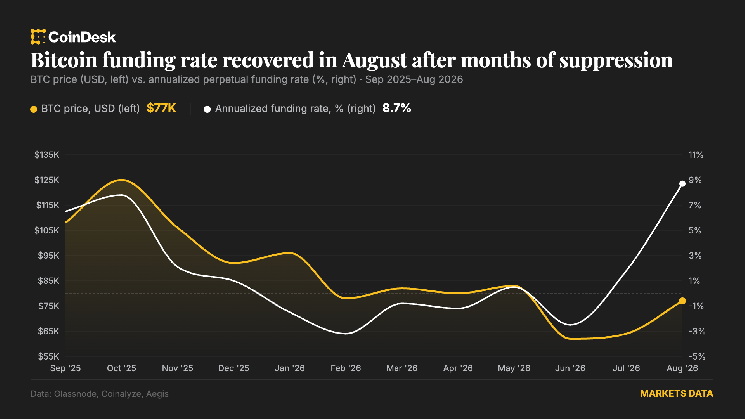
    When bitcoin surged from around $62,000 to above $77,000 in a matter of days last week, the rally wiped out $3 billion from leveraged short sellers who had accumulated bearish positions during the previous market downturn. For major crypto trading firms, however, the sharp price increase created an opportunity that did not depend on predicting bitcoin’s next move.

    Leading digital-asset trading firms including Abraxas Capital, Fasanara Capital and Wintermute have quietly accumulated hundreds of millions of dollars in short perpetual futures positions on Hyperliquid, an on-chain derivatives exchange.

    According to on-chain data tracked by Lookonchain, the three firms collectively hold short positions totaling 138,569 $ETH, worth roughly $338 million, and 3,425 $BTC, valued at approximately $265 million.

    At the same time, Abraxas Capital has been withdrawing large amounts of spot cryptocurrency from centralized exchanges. Data from Arkham Intelligence shows that the firm removed 73,872 $ETH, worth approximately $173 million, from Binance over the past four days alone.

    Crypto firms target funding yields instead of market direction

    The strategy is known as a cash-and-carry trade, or basis trade, and it has become one of the most widely used yield-generating strategies in crypto markets during bullish periods.

    The mechanics are straightforward: traders hold a spot cryptocurrency position while simultaneously shorting an equivalent amount through perpetual futures. Because the two positions largely offset each other, the trader has limited exposure to changes in the asset’s price.

    Instead, the firms seek to capture the funding rate — a periodic payment that traders holding long positions pay to short sellers when market sentiment is bullish.