Tag: Williams Racing

  • Williams Accepts 2026 F1 Development Compromise, Shifts Focus to 2027

    Williams Accepts 2026 F1 Development Compromise, Shifts Focus to 2027

    Key Highlights

    • Williams Racing has accepted a developmental compromise for the remainder of the 2026 Formula 1 season, having redirected the majority of its engineering resources toward the 2027 campaign.
    • Team principal James Vowles confirmed two new chassis and aerodynamic upgrades will debut at the Azerbaijan Grand Prix to address car mass limits, but warned the updates will not be sufficient to consistently score points given the pace of rival development.
    • A difficult Spanish Grand Prix at the new Madring circuit—where Alex Albon finished 15th and Carlos Sainz retired with floor damage—exposed the extent of Williams’ current performance deficit relative to the midfield.

    Vowles Acknowledges Difficult Spanish Grand Prix Reality

    Williams team principal James Vowles offered a candid assessment of the squad’s trajectory during his post-race “Vowles Verdict” debrief following a challenging Spanish Grand Prix at the brand-new Madring circuit. The weekend underscored the Grove outfit’s current struggles: Alex Albon and Carlos Sainz qualified 16th and 17th respectively, before Sainz incurred a three-place grid penalty for impeding, dropping him to 20th on the grid. Albon managed only 15th at the finish, while Sainz retired after 43 laps due to floor damage.

    “For us, a difficult grand prix. We knew it was going to be difficult going into it,” Vowles explained. “It’s just exaggerating the issues we have at the moment, and we haven’t added performance to the car for far too long and have fallen back relative to teams around us.”

    Baku Upgrades Offer Limited Relief

    Looking ahead to the Azerbaijan Grand Prix, Vowles outlined a technical plan aimed at extracting immediate gains. “We have Baku coming up next, and it’s a race we’ve been looking forward to for a while. We’re going to be bringing two new chassis to that event in a bid to get our car mass below the limit. So that should be a strong step up in performance for us. And in addition to that, we’ll have some aerodynamic upgrades that go with it.”

    However, the team principal tempered expectations regarding the impact of those updates. “There is a however. The field has moved on so significantly and these upgrades, whilst powerful, simply won’t be what we are looking for in order to consistently score points.”

    Strategic Pivot Toward 2027 Season

    The fundamental constraint, Vowles revealed, is a resource allocation decision made months ago. “We’ve invested a lot already into next year and beyond, and the resultant behind this is that we accept the compromise to this year, and it stems from what happened over the winter, and we weren’t able to recuperate to the level we wanted. So, a positive step forward but really we need more, and it will come into next year.”

    This strategic pivot means Williams has effectively conceded the remainder of the 2026 championship, accepting a period of limited competitiveness to accelerate development for the 2027 regulation cycle.

    Why This Matters

    Williams’ situation illustrates the brutal resource allocation dilemma facing midfield teams under Formula 1’s cost cap and aerodynamic testing restrictions. With development bandwidth finite, teams must choose between fighting for points in the current season or investing early in the next regulatory cycle—a decision that can define competitiveness for years. For Williams, a historic constructor seeking to return to the front, the 2027 regulation changes represent a potential inflection point. The team’s willingness to endure a barren second half of 2026 signals high internal confidence in their 2027 concept, but also carries reputational and commercial risk if the projected gains fail to materialize. The Baku upgrades will serve as a litmus test for whether the new chassis can at least stabilize the car’s platform before the long pivot to next year.

    Frequently Asked Questions

    Why is Williams bringing two new chassis to the Azerbaijan Grand Prix?
    Williams is introducing two new chassis in Baku to reduce the car’s mass below the regulatory minimum weight limit, which Vowles described as a “strong step up in performance” for the team.
    Will the Baku upgrades make Williams competitive enough to score points regularly?
    No. Vowles explicitly stated that while the upgrades are “powerful,” the development rate of rival teams means they “simply won’t be what we are looking for in order to consistently score points.”
    What caused Williams to accept a compromise for the rest of the 2026 season?
    The team shifted the majority of its engineering resources to the 2027 project during the winter, and Vowles acknowledged they “weren’t able to recuperate to the level we wanted” for the current campaign, forcing a strategic acceptance of reduced competitiveness in 2026.
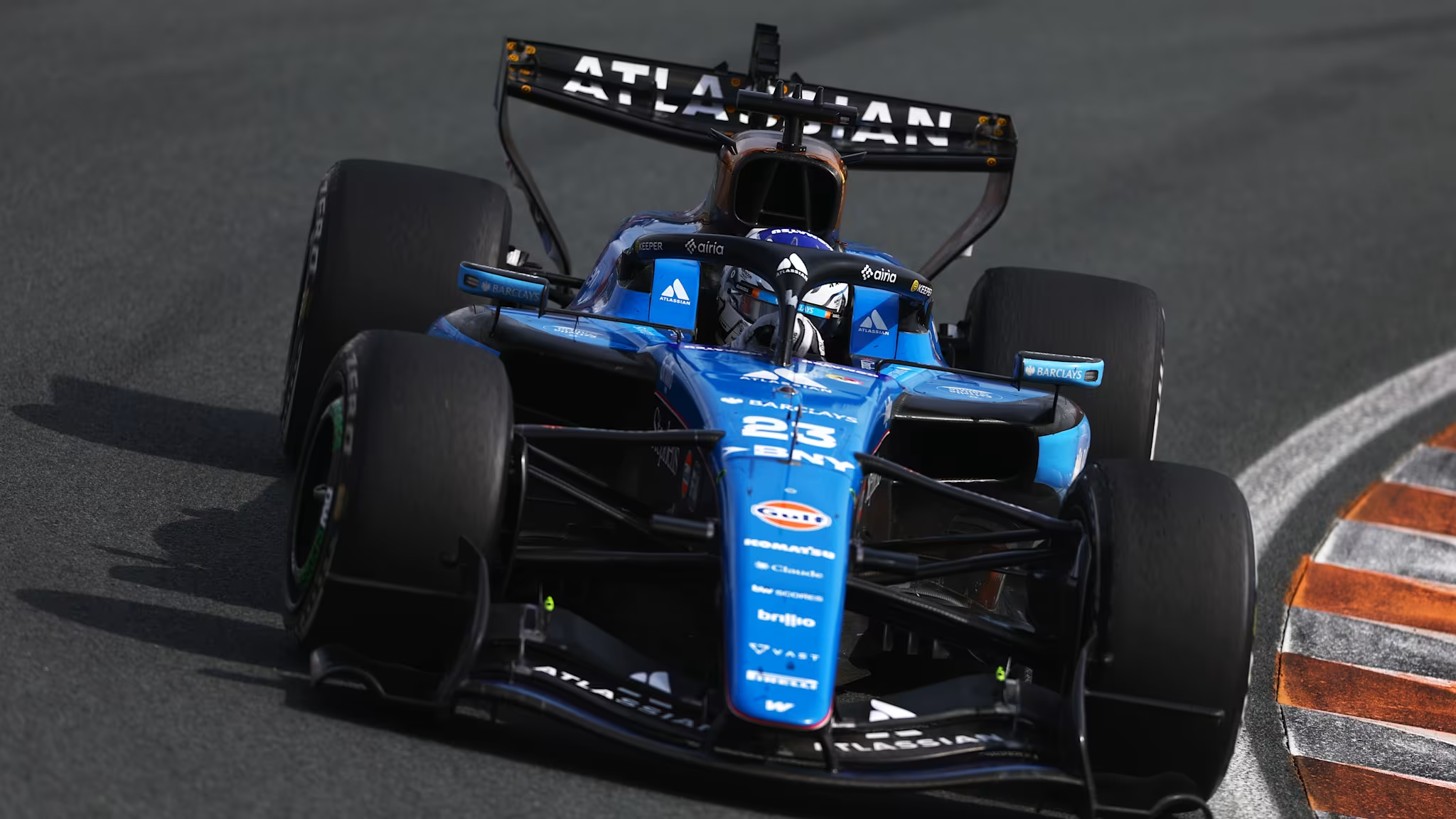
  • Williams’ FW48 Upgrade Package in Baku Crucial for Formula 1 Team’s Progress

    Williams’ FW48 Upgrade Package in Baku Crucial for Formula 1 Team’s Progress

    Key Highlights

    • Williams introduces its long-awaited major FW48 upgrade package at the Azerbaijan Grand Prix after a difficult 2026 season marked by weight issues and missed development milestones.
    • Drivers Carlos Sainz and Alex Albon caution that the upgrade may not close the gap to the midfield, as rival teams have accelerated their development pace beyond initial projections.
    • Team Principal James Vowles frames the Baku package as a critical validation of improved processes and simulation tools ahead of the 2027 FW50 project, while acknowledging no guarantees against future missteps.

    Williams Pins Hopes on Baku Upgrade After Difficult 2026 Campaign

    The Azerbaijan Grand Prix represents a pivotal weekend for Williams Racing as the team finally debuts the major upgrade package for its FW48 challenger. The 2026 season has proven painful for drivers Carlos Sainz and Alex Albon, particularly given the promise shown during the previous campaign. Delays forced the squad to miss the Barcelona Shakedown, and when the car eventually hit the track it was significantly overweight and suffered from inherent aerodynamic issues. Like Aston Martin, Williams elected to concentrate resources on a substantial mid-season package, though smaller updates such as a revised front wing for Silverstone and an ongoing weight-reduction programme have been introduced in the interim.

    Midfield Development Race Outpaces Williams’ Progress

    The results underscore the scale of the challenge. Early in the year the drivers secured five points finishes, with Albon’s eighth place in the high-attrition Monaco Grand Prix the high watermark. Since then, however, the team has failed to score a single point, regularly finishing in the P15–P17 range. Improved reliability across the field has played a part, but the primary factor is that rivals have developed at a faster rate while Williams has largely stood still. Albon articulated the shifting landscape after a difficult race in Madrid: I think what’s been interesting this year is most of the midfield teams, they always bring one or two upgrades a year. That’s kind of how it’s gone. This year, even the midfield teams are bringing three or four upgrades a year, and the size of upgrades are huge as well. So if you think of us in a normal year, Baku would have put us back in contention. But we have to be honest with ourselves, the speed of the development race this year is huge – and yeah, we’ve fallen back.

    When the Baku package was signed off months ago, the projected gains looked promising. Yet as midfield competitors have improved, the goalposts have moved. The FW48 will be faster, but the relative gain may not produce the dramatic grid surge originally envisioned. Albon added a sobering assessment of the current deficit: We’re finishing realistically 50 seconds behind the midfield at the minute in a race. So we’re losing a second a lap, more or less, in the race, and this has to be a pretty big upgrade to do it. Let’s see. We know it’s going to be a good step. Is it going to be the full step? I’m hopeful for it, but I don’t think it will be. Unfortunately, we said it last year, but the focus is on next year as well. And we realise we’re too far back at the moment to have a couple of upgrades for this year. We need to focus on next year.

    Sainz and Albon Manage Expectations for Immediate Gains

    Sainz, who qualified second and finished third in Azerbaijan last year — a reminder of Williams’ competitiveness at certain venues — strikes a similarly cautious tone. At his home race he stated: I think that upgrade is going to definitely help us to get ourselves closer to potentially fighting for some points. But realistically speaking, that’s nowhere near where we wanted to be this year, nowhere near what we promised. So, it’s still not enough, and it’s still not where we want to be. It’s an upgrade that will help a bit the motivation of the team and just to look into the weekend with something to look forward to, maybe to potentially get a point or two when we were like we were at the beginning of the year. But it’s nowhere near where we want to be, and I think our biggest hope is putting all the eggs in next year’s basket.

    Sainz’s point about motivation is salient. Even if the Baku package does not propel the team into Q3 contention, delivering the performance gains calculated months ago would demonstrate that the development processes are functioning correctly — a crucial confidence builder for the design team working on the 2027 FW50.

    Vowles Highlights Process Improvements and Simulation Gaps

    The weekend is equally critical for Team Principal James Vowles, the architect of Williams’ long-term revival who recently secured contract extensions from both Sainz and Albon. Vowles has pointed to changes in methodology, the recruitment of key personnel such as Chief Optimisation and Planning Officer Piers Thynne, and upgraded simulation infrastructure as reasons to believe the team will avoid repeating the mistakes that hampered the 2026 car’s genesis. Speaking at Zandvoort, he explained: You’re making a thousand decisions in the winter. You don’t need many of them to be wrong before you start putting yourself into the wrong path. And that’ll be the difference between a few tenths, but a few tenths these days is the between winning a championship or not. You go to the level of what are the big building blocks you’re putting in place? Which is a combination of people, which is different to what we had before. A combination of strength in the team that was different to what we had before. And for us, we had a lack last year at the beginning of ’25 of simulation technology. That actually only came online in November last year. The car was already pretty much done by that point in time. So what we were doing was using educated guessing, and we got some of it wrong. If you look at our rear ride height, we developed at the wrong rear ride height, as did Aston, for that matter, and corrected it. That doesn’t seem like a huge amount. But you’re aerodynamically developing in completely the wrong space, and it’s not driven by anything more than simulation telling you that’s a good direction for whatever characteristic you’re after, and it goes wrong. That error can still be made across any winter, because you’re in a theoretical space against a maximal space.

    Baku Package as Validation for 2027 FW50 Direction

    If the Baku upgrade performs as predicted, it will signal that Williams’ revised workflows and toolsets are yielding results. However, Vowles offers no guarantees that the 2027 development cycle will be flawless: Not for a second am I going to promise anyone, because there’s no championship team that would. What you’re more trying to do is show that there’s enough depth that didn’t exist previously in the ways of working systems, tools, processes, and people that allow you to catch as many of those as possible.

    Why This Matters

    The Azerbaijan Grand Prix serves as a litmus test for Williams’ technical reorganization under James Vowles. The team’s struggles in 2026 — overweight car, delayed upgrades, simulation shortfalls — mirror challenges faced by several midfield outfits, but the accelerated development pace across the grid has exposed those deficiencies more ruthlessly. The ability to deliver a correlated upgrade that matches wind-tunnel and CFD predictions is fundamental to the credibility of the FW50 project, which aims to return Williams to championship contention. Furthermore, the public expectation management by both Sainz and Albon reflects a mature driver–team alignment, essential for maintaining morale during a transition year. The recruitment of figures like Piers Thynne and the belated arrival of advanced simulation tools highlight the infrastructure gap Williams is racing to close before the 2027 regulation cycle.

    Frequently Asked Questions

    What specific upgrades is Williams bringing to the Azerbaijan Grand Prix?

    The article refers to a “major upgrade package” for the FW48, described as the long-awaited mid-season development that the team focused on after missing the Barcelona Shakedown. Earlier smaller updates included a revised front wing at Silverstone and an ongoing weight-reduction programme.

    Why are Sainz and Albon downplaying the immediate impact of the Baku upgrade?

    Both drivers note that rival midfield teams have introduced three or four substantial upgrades this year — more than the typical one or two — moving the performance target significantly since the Baku package was defined. Albon estimates Williams is currently losing roughly one second per race lap to the midfield, so even a “good step” may not be enough to reach the points-paying positions consistently.

    How does this weekend affect Williams’ 2027 FW50 programme?

    A successful correlation of the Baku upgrade would validate the new processes, simulation tools, and personnel (including Chief Optimisation and Planning Officer Piers Thynne) that Team Principal James Vowles has put in place. This validation is critical for confidence in the FW50 development, though Vowles stresses that no team can guarantee a mistake-free winter.

  • James Vowles Backs Madrid as ‘One to Watch’ Despite Calls for Changes

    James Vowles Backs Madrid as ‘One to Watch’ Despite Calls for Changes

    Key Highlights

    • Williams team principal James Vowles praised the inaugural Madrid Grand Prix organization, calling it potentially “one of the races to watch in the future” despite the circuit’s overtaking limitations.
    • The Madring street circuit offers exceptional logistics: 30 minutes from the city center, 10 minutes by metro, and roughly ten times the paddock space of typical venues.
    • Vowles confirmed Williams’ difficult weekend exposed their ongoing performance deficit, while noting Pirelli’s tyre selection—particularly the hard compound—was well-suited to the new tarmac.

    Vowles Hails Madrid Debut as Logistical Triumph Despite Racing Criticism

    Williams Racing team principal James Vowles has delivered a strong endorsement of Formula 1’s newest venue, declaring the inaugural Spanish Grand Prix at the Madring circuit a logistical success that could become a championship highlight. Speaking on the latest episode of The Vowles Verdict, the team chief commended the event organizers for avoiding the chaotic teething problems that typically plague first-year street races.

    “First and foremost, well done to the organisers,” the Williams team chief said during the latest episode of The Vowles Verdict. “It’s the first year of the grand prix, and typically that just means the event is a little chaotic, but it wasn’t the case in Madrid.

    Vowles emphasized the venue’s unique geographic advantages, noting its proximity to the Spanish capital and expansive footprint. He highlighted that the circuit sits just half an hour from the city centre—a journey reduced to roughly ten minutes via metro—and offers a paddock area approximately ten times larger than the standard allocation at other venues. While that space allows for significantly higher spectator capacity, Vowles candidly acknowledged the trade-off: considerable walking distances between the two main arena zones and the garages.

    “In fact, what I would say is it may be one of the races to watch in the future. Half an hour from the city centre, a capital city, 10 minutes, I think, if you took the metro as a result of it. Huge space, probably 10 times more space than we would normally have available to us, which has pros and cons. Pros means you can fit more people in. Cons, you wear out your shoe leather walking between the two different arenas and to the cars.”

    Technical Layout Praised, but Overtaking Deficit Looms Large

    On the sporting side, the verdict was more mixed. Drivers universally described the Madring layout as a demanding technical challenge, yet the race itself suffered from a distinct lack of overtaking opportunities—a shortcoming that has already prompted calls for layout revisions ahead of the 2027 edition. Vowles confirmed that circuit promoters are expected to study potential improvements to enhance the on-track spectacle.

    “In terms of the track itself, as you saw, very technical, and the drivers all commented that it was a difficult challenge for them, an enjoyable challenge for them,” Vowles continued. “But the racing also suffered slightly, and I’m sure the circuit organisers will be looking into how they can improve that for next year.”

    Williams’ Struggles Magnified by Circuit Demands

    For Williams, the weekend underscored the team’s current competitive trajectory. Vowles was blunt in his assessment: the Madring weekend was always anticipated to be difficult, and the circuit’s characteristics merely amplified the squad’s existing performance shortfall relative to midfield rivals. He pointed to a prolonged period without meaningful car upgrades as the root cause of their slide down the order.

    “For us, a difficult grand prix, we knew it was going to be difficult going into it. It’s just exaggerating the issues we have at the moment and we haven’t added performance to the car for far too long and have fallen back relative to teams around us.”

    Tyre Management and Pirelli’s Successful Selection

    Delving into the tyre data, Vowles revealed a clear split in compound performance. The soft and medium tyres suffered from pronounced graining—a rapid degradation of surface grip lap-on-lap—particularly evident during long runs rather than qualifying stints. Conversely, the hard compound proved remarkably durable, with multiple drivers able to stretch stints to near-full race distance. Vowles credited Pirelli for selecting the correct allocation and noted the new asphalt surface was in excellent condition, providing a stable platform for the compounds.

    “If I now focus on the details you may have seen on the softer compounds, the soft and the medium, we had graining, and that’s where the tyre suddenly just starts to lose a lot more performance every lap. Noticeable on the long runs, not in qualifying conditions. But the hard tyre, however, was a tyre, as you saw with a number of cars that could run near enough for the whole race. It was really on the edge, but just about on the good side. That means Pirelli have done a very good job bringing the right tyres to the event. It also means the circuit, the tarmac, was in a good state for it as well.”

    Concluding his analysis, Vowles reiterated that the primary objective for future editions must be improving overtaking dynamics, but he signed off with an unequivocal thumbs-up for the event’s debut.

    “As I said, the main real issue is: let’s look into how we can get more overtaking in future years. Otherwise, well done. Brilliant first race.”

    Why This Matters

    The Madrid Grand Prix represents Formula 1’s latest strategic push into major metropolitan markets, following the blueprint established by events in Las Vegas, Miami, and Singapore. Its successful logistical execution—seamless public transport integration, massive spectator capacity, and a purpose-built facility footprint—sets a new operational benchmark for street circuits. However, the overtaking deficit highlights the persistent tension between urban venue constraints and the sporting requirement for wheel-to-wheel racing. With the current contract running through 2026 and a likely extension to 2035, the FIA, FOM, and local promoters now face a critical 18-month window to engineer layout modifications—potentially widening key straights or reprofiling corners—before the 2027 season. For Williams, the weekend served as a stark data point: without a substantive aerodynamic upgrade package before the summer shutdown, the team risks cementing a backmarker status for the remainder of the 2025 campaign.

    Frequently Asked Questions

    Where is the Madrid Grand Prix held and how accessible is it?
    The race takes place at the Madring street circuit, located approximately 30 minutes from Madrid city centre by car and roughly 10 minutes via metro, offering exceptional public transport connectivity for a Formula 1 venue.
    What were the main criticisms of the inaugural Madring layout?
    The primary criticism centered on a lack of overtaking opportunities during the Grand Prix, prompting expectations that circuit organizers will pursue layout revisions ahead of the 2027 edition to improve the racing spectacle.
    How did Williams perform and what tyre strategy insights emerged?
    Williams endured a difficult weekend that exposed their ongoing performance deficit. The soft and medium tyres suffered from significant graining on long runs, while the hard compound proved highly durable, allowing near-full-race stints—Pirelli’s selection was validated by the new asphalt’s good condition.
  • Was Cadillac “faster” than Williams in Madring F1 Race?

    Was Cadillac “faster” than Williams in Madring F1 Race?

    Key Highlights

    • Sergio Perez showed strong race pace at the Spanish Grand Prix, matching and briefly surpassing Alexander Albon’s Williams before a water leak forced his retirement.
    • Teammate Valtteri Bottas struggled with significant tire degradation and brake management, highlighting a performance disparity within the Cadillac squad.
    • Cadillac targets improvement at the Azerbaijan Grand Prix, where the Baku circuit’s low-downforce nature may mask the MAC-26’s current aerodynamic deficiencies.

    Perez Finds Encouraging Pace Amid Reliability Woes

    Cadillac’s maiden Formula 1 campaign has largely been defined by backmarker status, but the Spanish Grand Prix at the new Madrid circuit—referred to as Madring—offered a glimmer of competitiveness from Sergio Perez. The Mexican driver qualified 18th but made a lively start, jumping past Yuki Tsunoda and Carlos Sainz to sit 16th. More importantly, his race pace proved genuinely competitive against the midfield benchmark.

    Perez spent the entirety of his race shadowing Alexander Albon’s Williams, running a near-identical strategy of mediums to hards under the Virtual Safety Car. “I was pretty much the same pace as [Alexander] Albon all the way through,” Perez commented. “I was within a second or two until we had the issue. So a really strong weekend for the team in terms of pace. We pushed everything, we were on the limit with the brakes, but we pushed to the very limit, and [I’m] happy with that.” Telemetry backed his assessment: while Perez was 0.403 seconds per lap slower on the medium compound over 11 representative laps, he turned the tables on the hard tire, lapping 0.351 seconds quicker than Albon over eight laps before a terminal water leak and blue flags ended his challenge.

    Bottas Highlights Degradation and Durability Deficits

    The picture was starkly different for Valtteri Bottas. The Finn languished at the rear of the field, managing excessive brake temperatures with persistent lift-and-coast throughout the afternoon. “We know we need to improve,” the Finn nervously chuckled. “The car is still not robust enough, and we need to make it a lot faster. And the deg today highlights how much we’re lacking, it’s like way more than the competition.” Cadillac’s reliability record underscores the struggle: the team has suffered 11 retirements or non-starts in the 2026 season, fewer than Aston Martin’s 15 but significantly more than Williams’ seven.

    When presented with Perez’s positive comparison to Albon, Bottas offered a nuanced counterpoint. “In the beginning we can be there, we’ve seen, but as the race progresses, the deg gets worse. But actually for the next event, I’m more hopeful that we can be there. Baku, the only high-speed corners, they are flat out; otherwise it’s slow- or medium-speed.” His assessment points to a fundamental aerodynamic inefficiency on the MAC-26 that punishes the car disproportionately on conventional circuits.

    Why This Matters: A Two-Tier Trajectory for a Rookie Team

    The divergent weekends of Perez and Bottas expose the volatile nature of Cadillac’s development curve. Perez’s ability to match a race-winning midfield outfit like Williams—albeit over a limited sample—suggests the underlying potential of the chassis and power unit package exists, provided the car is in its optimal window. Conversely, Bottas’s experience confirms that the operational window remains dangerously narrow, with tire degradation and thermal management acting as primary performance limiters. With 11 DNFs already on the board, reliability is not merely a statistical blemish but a barrier to data accumulation. The upcoming Azerbaijan Grand Prix represents a critical calibration opportunity: Baku’s unique layout, dominated by long straights and low-speed corners, reduces the downforce demand that currently plagues the MAC-26. A strong showing there would validate the team’s aerodynamic diagnosis and provide momentum heading into the European swing, but it would not solve the fundamental lack of robustness that Bottas emphasized.

    Frequently Asked Questions

    How did Sergio Perez’s pace compare to Alexander Albon at the Spanish Grand Prix?

    On the opening medium stint, Perez lapped 0.403 seconds slower per lap than Albon. After both switched to hard tires under the Virtual Safety Car, Perez was 0.351 seconds per lap quicker over eight representative laps before a water leak and blue flags intervened.

    What are Cadillac’s main technical issues according to Valtteri Bottas?

    Bottas cited insufficient car robustness, excessive tire degradation relative to rivals, and persistent brake temperature management issues requiring significant lift-and-coast throughout the race.

    Why is the Azerbaijan Grand Prix seen as a better opportunity for Cadillac?

    The Baku circuit features predominantly slow- and medium-speed corners with only flat-out high-speed sections, reducing the downforce demand that currently exposes the MAC-26’s aerodynamic deficiencies on conventional tracks.

  • Williams Tipped for ‘Huge Step’ Forward at Azerbaijan GP With Major Upgrade

    Williams Tipped for ‘Huge Step’ Forward at Azerbaijan GP With Major Upgrade

    Former Formula 1 driver Juan Pablo Montoya believes Williams is poised for a significant performance leap at the upcoming Azerbaijan Grand Prix, as the Grove-based team prepares to debut a major upgrade package.

    Difficult Spanish Grand Prix Highlights Williams Struggles

    The prediction comes on the back of another challenging weekend for Williams at the inaugural Spanish Grand Prix held at the Madrid circuit. Carlos Sainz saw his home race end in retirement, while teammate Alex Albon could only manage a 15th-place finish. The result compounds a difficult 2025 campaign that sees Williams sitting ninth in the Constructors’ Championship with 11 points, ahead of only Aston Martin and Cadillac.

    Montoya Anticipates “Huge Step” in Baku

    Speaking on F1 TV’s post-race broadcast, Montoya expressed high expectations for the team’s next outing.

    “I want to see what Williams brings,” Montoya said of the Azerbaijan Grand Prix on F1 TV’s post-race broadcast. “I want to see how much of a step Williams really brings. They even told Carlos today, ‘Sorry for all this pain. Next year, we want to make you proud.’

    “Their first big step in the right direction is the next race. So, we’ll see how much of a step in the right direction it is. I think it’s going to be a huge step, and they deserve it. It’s been a rough year for them.”

    Vowles Confirms “B-Spec” Chassis Upgrade

    Team principal James Vowles previously characterized the impending Baku package as a fundamental overhaul of the current machinery.

    “The best way to describe it to you is it’s a B-spec car,” he said in July. “It’s a new chassis, and other bits that go with it at the same time. That will be a large upgrade, that’s true.”

    Vowles emphasized that the upgrade serves a dual purpose: delivering on-track performance and validating the team’s internal engineering and production capabilities.

    “In terms of our direction of travel, we have to – as a business – prove to ourselves that we can do the engineering to the right level of quality, and build a car to the right level of quality in-season – effectively the equivalency of flying the plane and rebuilding it at the same time.

    “We have to prove to ourselves that we have changed from where we were three years ago, and have that capability. And we’re on target to do it at the moment.”

    Azerbaijan Grand Prix as a Defining Moment

    With the “B-spec” car set to debut on the streets of Baku, the Azerbaijan Grand Prix represents a critical milestone for Williams Racing. The event will offer the first tangible evidence of whether the squad’s restructuring under Vowles can translate into competitive performance and close the gap to the midfield.

  • Carlos Sainz Slept the Worst Last Night

    Carlos Sainz Slept the Worst Last Night

    Formula 1’s debut at the Madring circuit in Madrid delivered a spectacle more notable for its procedural tedium than its sporting drama, drawing immediate comparisons to the underwhelming inaugural European Grand Prix in Baku a decade earlier. While the 2016 Azerbaijan race eventually faded into a procession, it at least offered a spectacular visual backdrop through the historic Old City. Madrid’s first outing, staged on the exhibition grounds of IFEMA, lacked even that aesthetic redemption.

    A Circuit Without Identity

    The layout, a blend of permanent facility and temporary asphalt, prompted sharp criticism from Grand Prix Drivers’ Association chairman Alexander Wurz. Speaking in his punditry role for Austrian broadcaster ORF, Wurz described the venue as a concrete channel and questioned its distinctiveness.

    Am I in Australia now, am I in Valencia, am I here in Madrid, where am I? Or in Jeddah? These street circuits always look the same. That means I’m not representing my host city in such a cool way. There’s quite a lot you could do here.

    The comparison to Valencia’s unloved street circuit is unavoidable. Both share an anti-charm defined by wide, featureless straights and heavy braking zones that discourage overtaking. The Madring effectively functions as Monaco for the poor—all the processional frustration with none of the glamour or historical weight.

    Rosberg’s Critique and the Ambassador Role

    Former world champion Nico Rosberg, commentating for Sky Sports, directed pointed criticism at Carlos Sainz for his role as the event’s official ambassador.

    Carlos Sainz was the ambassador. So we need to criticise Carlos Sainz.

    That assessment feels disproportionate. Sainz had no hand in the circuit’s design or its peripheral location—a compromise dictated by the bureaucratic realities of routing a Grand Prix through a historic European city centre. Unlike Baku or Singapore, where the track threads through the urban heart, Madrid’s race sits on the outskirts, a victim of democratic process rather than driver influence.

    Opening-Lap Chaos and a Gamer’s Mistake

    What Sainz can own is his start-line audacity. After a blistering launch that saw him pass three cars into Turn 1, he attempted a move on Yuki Tsunoda that ended with a locked right-front tyre and heavy contact. The Williams driver later characterized the incident with striking understatement.

    small contact with Tsunoda that damaged my floor

    Onboard footage told a different story: a dive-bomb manoeuvre more suited to a PlayStation restart than a 300 km/h reality. The damage terminated his race pace, and a subsequent five-second penalty—this time for squeezing Fernando Alonso toward the wall under braking—compounded a miserable afternoon.

    Alonso’s Fury and Sainz’s Deflection

    The two-time champion did not hide his frustration over team radio.

    Yeah, he squeezed me into the wall, man. The start, he crashed into two people. Now squeezed me to the wall on breaking.

    Sainz’s response was equally revealing.

    I think he complained on the radio so he managed to get me a penalty like always.

    The exchange underscored a fractious dynamic between Spain’s two F1 stars, neither of whom factored in the result. Sainz eventually retired, citing negligible downforce from the floor damage.

    Hopefully this is the last year here in Madrid that I’m fighting for P16 and from next year onwards, I can fight for something more.

    The Williams Gamble and a Career at a Crossroads

    That optimism sits uneasily alongside the cold logic of the driver market. Sainz recently extended his Williams contract, framing it as belief in a long-term project. Yet the subtext is clear: no seat opened at Mercedes, Ferrari, McLaren, or Red Bull. Toto Wolff chose rookie Kimi Antonelli over the experienced Spaniard; Max Verstappen stayed put at Red Bull.

    At 32, with stints at Toro Rosso, Renault, McLaren, and Ferrari behind him, Sainz’s championship window is narrowing. His four Grand Prix wins and reputation for racecraft and commercial acumen guarantee a place in F1’s upper-middle tier, but the trajectory suggests a final chapter defined by midfield scraps rather than title assaults.

    A Missed Pivot to Audi?

    In hindsight, the Audi/Sauber project—where then-team principal Andreas Seidl courted him aggressively—might have offered a clearer path to relevance. A works programme, even a nascent one, carries structural advantages a customer team cannot replicate. By 2026, the regulatory reset could have aligned with Audi’s maturity curve. Williams, by contrast, remains in a rebuilding phase with no guaranteed timeline for front-running competitiveness.

    Where the Talent Belongs

    Sainz possesses the versatility and technical IQ to excel beyond the sprint format. Endurance racing—Le Mans, the Nürburgring 24 Hours—would showcase his consistency, tyre management, and strategic depth against a field that increasingly includes F1 graduates. There, he might yet duel with Verstappen or Antonelli on equal machinery, at the highest level—the kind befitting a driver of his calibre.

    For now, the Madring debut serves as a metaphor: a promising package placed on the wrong circuit, waiting for a breakthrough that the current roadmap struggles to deliver.

  • James Vowles Admits He Feared Losing Both Carlos Sainz and Alex Albon Amid Williams’ Struggles

    James Vowles Admits He Feared Losing Both Carlos Sainz and Alex Albon Amid Williams’ Struggles

    Williams team principal James Vowles has admitted he was concerned the team could lose both Carlos Sainz and Alex Albon during its difficult 2026 Formula 1 campaign.

    However, confirmation that both drivers will remain with Williams next season has given the Grove-based team a major boost, with Vowles saying a “weight lifted” off the factory.

    Williams feared losing Sainz and Albon

    Williams climbed from ninth to fifth in the 2025 constructors’ championship, with Sainz securing two podium finishes. The team has struggled to match that progress in 2026 and currently sits ninth after scoring just 11 points.

    Despite the downturn in form, Sainz and Albon were recently confirmed as Williams drivers for next season. Speaking to the media during the Dutch Grand Prix weekend, shortly after the announcements, Vowles was asked whether he had feared losing the pair.

    “[I was] concerned about losing both, because they are World Championship-material drivers that deserve the opportunity to be fighting for podiums or more, and we haven’t delivered that,” he explained.

    “And more than that, we had a scope of where we were moving to. I think that there’s no doubt if you sort of look to the outside – I hope there’s no doubt – over the last few years, we’ve been slowly stepping forward with last year being a blip. I think [it was] too positive from where we were, but a step in the right direction.

    “So for us to move backwards isn’t just a surprise to the drivers, it’s a surprise to everyone else, and that will always create risk that you lose them. What I’m thankful for is, the moment we had problems, they stood by our side.

    “There wasn’t finger pointing, it was actually, ‘tell me what I can do’, and they both came into the factory, spoke to the whole organisation and gave them a lift. Carlos did the same and Alex did the same this week once they re-signed.

    “They wanted to make sure that they were here with the team. They want this to be a part of them, that is here on a turnaround of this organisation, and I’m thankful for that. But it’s also an indication of what we’ve shown them in the back end of what’s happened and what we’re doing about it.”

    Why Williams’ driver stability matters

    Vowles said keeping Sainz and Albon was “incredibly important” because their decisions send a positive message about Williams’ long-term prospects and provide continuity as the team develops.

    “[Reason number] one, it shows the outside world – I can’t tell you everything that’s going on behind the scenes, but I can tell them, and if they are re-signing it will give you an indication that there’s a lot of change ongoing and they believe in what the future looks like.

    “And that belief is incredibly important, whether it’s for team members or for anyone in the outside world.

    “Number two, that consistency is important because the team is really maturing and changing and, as much as you can keep consistent, especially in a driver line-up, it becomes desperately important in order to keep building on that.

    “Probably the best way to summarise it to you is [that in] the factory, there’s a weight lifted off it this week as the result of it and I’ve seen them move forward at a much faster pace as a result, so the belief is real and tangible.”

    Why Williams announced the deals separately

    Albon’s new contract was announced first, with Sainz’s confirmation following a day later. Vowles said the separate announcements reflected the different circumstances surrounding each driver and also allowed the team to mark the occasions individually.

    “For me, and for the drivers, it was important to state that they are different stories and different timings,” the Team Principal said.

    “Also, it helped me because Alex was in the simulator on Tuesday and Carlos on Wednesday. I was able to show them to the team and I didn’t have them both on the same day at the same time!

    “But for me, they’re different journeys. Alex has been here since 2022. He has dedicated so much of his life to this project and he wants it to be successful, and I think that’s one message in its own right.

    “With Carlos, what he needed was to be demonstrated what’s happening behind the scenes and he wanted to then commit into the long term, and it’s a very different set of arrangements that we have between the two of them. I think the messaging is no different though.

    “We all have unfinished business. Our goal is to have Alex and Carlos by our side for many years to come. We have to do work on our side in order to make sure we are stepping up, irrespective of our drivers. The drivers are not the limitation to us at the moment. We are.

    “We have to fix that, and quickly, for us more than anything else. But the announcements of the drivers will show you that there’s belief in the project for the long term, and that individuals, even the ones that have been here since ‘22, can see the change and want to be a part of it.”

  • James Vowles Addresses Alex Albon–Carlos Sainz Collision at Dutch GP

    James Vowles Addresses Alex Albon–Carlos Sainz Collision at Dutch GP

    Williams team principal James Vowles says the team must accept part of the blame for the late-race collision between Alex Albon and Carlos Sainz at the Dutch Grand Prix.

    During a chaotic race at Zandvoort, won by McLaren’s Lando Norris, the two Williams drivers collided while fighting outside the points-paying positions.

    Williams accepts responsibility for Albon and Sainz crash

    Speaking in the team’s post-race video debrief, The Vowles Verdict, the Williams boss addressed the incident.

    “As you saw, Alex and Carlos came together on track,” Vowles explained. “There’s a lot of questions around whose fault it is, whose isn’t it? I’ll start with this. I think with our two drivers, both have a responsibility to not hit each other.

    “It’s hard to do it as a majority to one or the other, but both have a culpability in that. This particular circumstance, actually, I think we as a team have a culpability.”

    According to Vowles, the team’s decision to leave Sainz on worn tyres during the virtual safety car period contributed to the situation.

    “We tried leaving Carlos out at that VSC. The reason why was because had we stopped, he would have been behind Alex and Franco anyway. So you’re back net to where you would have been before, without the pace to be able to overtake them.

    “But that said, this also put our cars into a situation where they were fighting tooth and nail for no points on track. That’s not a situation we should be putting them in either.”

    Albon retired from the race after the collision, while Sainz continued to finish 16th.

    Sainz received a 10-second penalty for the incident, which he described as “fair” after the race.

    “Fair penalty. I had a bit of a surprise when I went to defend,” the Spaniard explained. “I had really worn hard tyres, struggling a lot with the car, with the pace of the race. “And when I went to brake on the inside, there was a massive bump on the inside of Turn 1. When you are further in the inside, the bigger it gets. I just hit with the plank. “I had the front tyres in the air. And as soon as I touched the brake, I locked up and I took Alex with me, which is the worst possible outcome for that race, because it’s not like we were fighting for anything big. But honestly, it caught me so much by surprise. Apologies to him, because it’s the last thing I wanted.”

  • James Vowles Reveals Carlos Sainz’s ‘Unique’ Trait Aiding Williams Amid Struggles

    James Vowles Reveals Carlos Sainz’s ‘Unique’ Trait Aiding Williams Amid Struggles

    Williams Racing team principal James Vowles has praised Carlos Sainz’s “unique” competitive mindset, crediting the Spaniard’s unwavering approach as a critical asset for the squad during a challenging 2026 Formula 1 season.

    Sainz Delivers Podium Before Williams’ Downturn

    Sainz guided Williams back to the podium last season, yet the team experienced a sharp reversal of fortune in 2026. After establishing themselves as the “best of the rest,” they found themselves battling toward the rear of the grid. The driver has been outspoken about the team’s struggles, citing delayed development and an overweight car as primary factors. Despite those setbacks, Sainz signed a multi-year contract extension, signalling his confidence in the project’s long-term trajectory.

    Vowles Highlights Sainz’s Consistent Mindset

    Vowles expressed his delight at retaining both Sainz and Alex Albon — who is also committed through 2027 — and reflected on Sainz’s demeanour during the Dutch Grand Prix weekend.

    “He is immensely good,” he said.

    “His attitude and approach doesn’t change irrespective of whether he’s fighting for 18th or a podium, and that’s quite unique.

    “Normally, you’ll see a change in persona from individuals – the more frustrated they are, the more emotion kicks into it, and Carlos doesn’t have that at all. He’s just driven by constant performance improvements. Fundamentally, that is what you need to be driving yourselves forward with.”

    Williams Targets Recovery Amid Regulatory Shifts

    Both the team and its drivers share the ambition to return to fighting for points, victories, and eventually championships. However, the timeline has been recalibrated following an unexpected performance drop under the current regulations. As rivals such as Aston Martin close the gap with substantial upgrades, pressure is mounting on Williams to demonstrate progress when their own updates debut at the Azerbaijan Grand Prix. Vowles, however, has cautioned that meaningful gains will require patience.

    “When we look at where the grid is right now, we are too far away,” he summarised. “So a lot of our focus is really going into next year, especially since there is a power unit change and an aerodynamic regulation change, in order to sort of get back onto, let’s say, a solid foundation.

    “It’s a team that’s hurting, there’s no doubt about it. We’re not where we want to be.

    “This is not what we planned for, so to have the news that two of your leaders are by your side and growing with you and believe in the journey you’re on is incredibly powerful for an organisation, especially when we’re asking what we are of them.

    “It isn’t just about what they bring on track, it’s about the leaders they are behind the scenes. An example of that is when this winter went pretty poor, both flew to the UK and spent time with the team to effectively just support them in every way that they could do, which is unusual, but it’s an indication of who they are as characters.”

  • Luke Browning to Drive for Williams in FP1 at the Italian Grand Prix

    Luke Browning to Drive for Williams in FP1 at the Italian Grand Prix

    Williams Racing has confirmed that reserve driver Luke Browning will return to the cockpit for the opening free practice session (FP1) at the upcoming Italian Grand Prix. The British racer is set to take over Alex Albon’s FW48 at the iconic Monza circuit.

    Luke Browning’s Journey with Williams F1

    Browning first joined the Williams Driver Academy back in 2023. Since then, he has frequently represented the Grove-based team during mandatory rookie practice sessions, starting with his initial FP1 outing at the 2024 Abu Dhabi Grand Prix. Following four subsequent practice runs, the young Briton was elevated to the role of official reserve driver at the beginning of 2026, balancing his Formula 1 obligations with a competitive drive in Japan’s Super Formula championship.

    Opportunities and Regulations in the FW48

    The 24-year-old was originally slated to drive the FW48 in both Spain and Austria earlier this season. Although an unexpected electrical gremlin sidelined him during the Barcelona weekend, Browning successfully took to the track at the Red Bull Ring. During FP1 in Austria, he secured an 18th-place finish, ending up just three-tenths of a second adrift of team leader Albon.

    Under current Formula 1 regulations, all teams must allocate at least two free practice sessions per year to a rookie driver. The FIA defines a rookie as any competitor who has started two or fewer Grands Prix in their career.

    “I’m thrilled to have another chance to drive an FP1 session with Atlassian Williams F1 Team,” said Browning. “It’s a great opportunity to get invaluable laps in the FW48 while building my understanding of the car and helping to bring useful data and feedback back to Grove.

    “Each session teaches you something new, and I want to take every bit of learning I can from this to keep pushing my development and the team forward. For this weekend, it’s about supporting Williams to help maximise the result here in Monza.”

    Overcoming a Challenging F1 Campaign

    Browning has been instrumental behind the scenes, dedicating significant hours to Williams’ simulator program. This preparation comes during a demanding campaign for the historic British team, which has struggled with delayed developments and a lack of competitive pace, leaving them fighting toward the back of the grid.

    Browning will look to make an immediate impact and provide critical feedback when the green light drops for FP1 at Monza at 1230 local time on September 4.