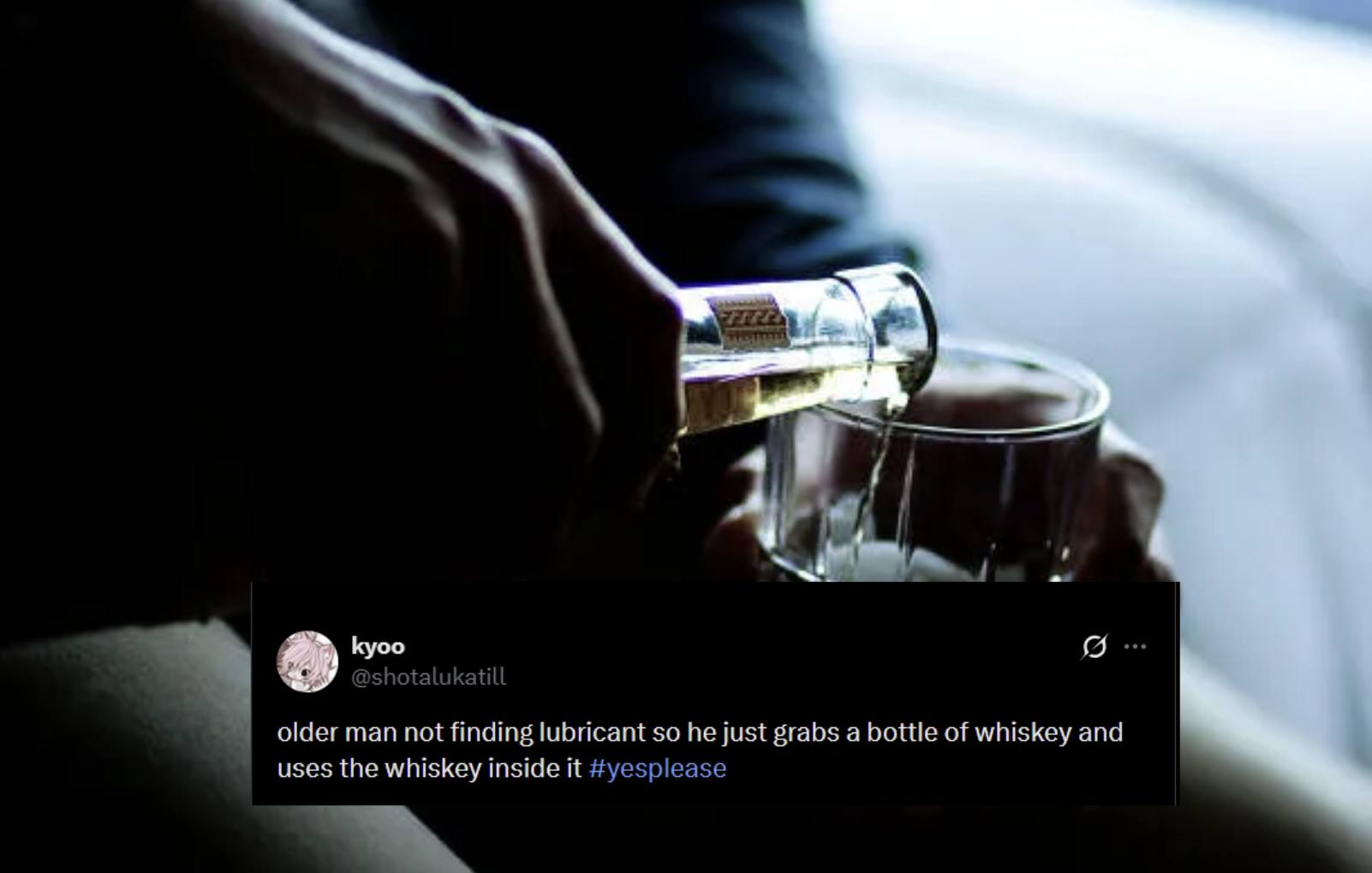
Tag: Whiskey Lubricant

  • Viral X Post Suggesting Whiskey as Lube Ruthlessly Mocked

    Viral X Post Suggesting Whiskey as Lube Ruthlessly Mocked

    Key Highlights

    • A viral X post from late September 2026, dubbed “Whiskey Lubricant,” described a sexual scenario involving an older man substituting whiskey for personal lubricant.
    • The post drew widespread mockery for its premise and prose style, with critics comparing it to low-quality BookTok romance tropes and Archive of Our Own (AO3) erotica.
    • Commentators suggested the depiction reflected a lack of firsthand sexual experience, arguing the author’s understanding of intimacy appeared shaped primarily by internet fanfiction conventions.

    Viral X Post Sparks Debate Over Literary Quality and Sexual Representation

    A short-form post published on X in late September 2026 ignited a wave of ridicule and critical analysis across the platform, centering on a scenario quickly labeled “Whiskey Lubricant” by the user base. The narrative described an older male protagonist who, upon discovering an absence of personal lubricant, opts to use whiskey as a substitute during a sexual encounter. While the platform routinely surfaces absurdist or deliberately provocative content, this specific entry garnered attention for the intensity of the negative reception directed at its literary execution rather than merely its shock value.

    Critics Target Prose Style and Narrative Plausibility

    Responses to the post coalesced around two primary vectors of criticism. First, users lampooned the writing style itself, drawing direct parallels to the often-maligned prose found in viral BookTok recommendations and amateur erotica hosted on Archive of Our Own (AO3). The comparison to AO3—a massive fanfiction repository known for its vast range of quality—served as a specific cultural shorthand for awkward phrasing, improbable anatomy, and melodramatic pacing. Second, the core premise of using whiskey, a high-proof alcohol, as a lubricant alternative was cited as a glaring indicator of biological implausibility, prompting jokes about the immediate physical consequences such an act would entail.

    Discourse Highlights Disconnect Between Tropes and Lived Experience

    Beyond the immediate mockery, a meta-discussion emerged regarding the origins of the post’s specific flavor of erotic writing. A significant portion of the commentary posited that the author’s conceptualization of sex bore the hallmarks of someone whose primary exposure to sexual narratives derives from online fanfiction ecosystems and social media-driven romance trends, rather than practical experience. Critics argued that the scenario relied heavily on established internet tropes—such as the “improvised lubricant” scenario common in hurt/comfort or “first time” fanfiction tags—without accounting for the physiological realities that would make the specific substitution of whiskey painful and dangerous. This line of critique framed the post as a case study in how algorithmic content consumption can distort understanding of human intimacy.

    Why This Matters

    The “Whiskey Lubricant” episode underscores the evolving dynamic between social media virality, fanfiction culture, and mainstream discourse on sexual literacy. As platforms like X (formerly Twitter) and TikTok’s BookTok community become primary vectors for erotic literature discovery—especially among younger demographics—the gap between performative, trope-heavy writing and anatomical reality widens. The incident reflects broader concerns among educators and cultural critics regarding the sources from which individuals derive sexual scripts. While fanfiction communities like AO3 have long self-regulated through tagging systems and reader feedback, the algorithmic amplification of decontextualized excerpts on general-purpose platforms strips away those guardrails, potentially cementing harmful misconceptions. The discourse also highlights the participatory nature of modern critique, where “hate-reading” and quote-tweeting function as a form of collective media literacy, publicly dissecting and rejecting narratives that fail plausibility tests.

    Frequently Asked Questions

    What was the “Whiskey Lubricant” post?

    It was a viral X post from late September 2026 describing a sexual scenario where an older man uses whiskey as a substitute for personal lubricant.

    Why did the post go viral?

    The post attracted widespread mockery for its implausible premise and writing style, which users compared to low-quality BookTok romance novels and amateur AO3 fanfiction erotica.

    What broader discussion did the post generate?

    Critics argued the post exemplified how internet and fanfiction tropes can shape unrealistic depictions of sex, suggesting the author lacked firsthand experience and relied on recycled online conventions rather than biological reality.

  • Viral X Post Recommending Whiskey as Lube Draws Ruthless Mockery

    Viral X Post Recommending Whiskey as Lube Draws Ruthless Mockery

    Key Highlights

    • A viral X post titled “Whiskey Lubricant” circulated in late September 2026, describing a sexual fantasy in which an older man substitutes whiskey for personal lubricant.
    • The post attracted widespread mockery for its implausible premise and prose style, with users likening it to low-quality BookTok content and Archive of Our Own (AO3) erotica.
    • Commentators argued the depiction of sex reflected a lack of firsthand experience, suggesting the author’s understanding was shaped primarily by internet and fanfiction tropes.

    The Viral Post and Its Premise

    In late September 2026, an X post labeled “Whiskey Lubricant” gained rapid traction across the platform. The post presented a fictional scenario centered on an older male protagonist who, upon discovering he had no lubricant available, opts to use whiskey during sexual activity. The narrative framed the substitution as a deliberate erotic choice rather than an improvised necessity, a framing that immediately struck many readers as physically improbable and narratively contrived. The post did not identify its author by name, nor did it link to a longer work; it existed as a standalone micro-fiction thread typical of the platform’s “thirst post” subculture.

    Online Reaction and Mockery

    Response to the post was overwhelmingly derisive. Quote-posts and replies flooded the thread with sarcastic commentary, meme formats, and explicit comparisons to amateur writing communities. Users specifically invoked BookTok—the TikTok subcommunity focused on romance and fantasy novels—and Archive of Our Own (AO3), the dominant fanfiction archive, as benchmarks for the post’s perceived literary quality. The consensus held that the scenario read less like a credible erotic vignette and more like a parody of the genre’s clumsiest tropes, including the fetishization of age gaps and the use of household substances as lubricants, a motif that has circulated in fanfiction for years but is widely recognized as unsafe in practice.

    Critique of Writing Style and Authenticity

    Beyond the premise, the prose itself became a target. Critics described the sentence structure, vocabulary, and pacing as hallmarks of someone mimicking erotic writing without understanding its mechanics or its physical realities. Several highly engaged replies posited that the author’s conception of sex appeared to be derived entirely from consuming fanfiction and social-media erotica rather than from lived experience. This line of criticism touched on a recurring discourse within online writing spaces: the feedback loop in which inexperienced writers replicate stylized, often anatomically inaccurate depictions of sex, which are then consumed by similarly inexperienced readers, reinforcing a distorted collective script.

    Why This Matters

    The “Whiskey Lubricant” episode illustrates how platform algorithms amplify fringe micro-fiction into mass spectacle, subjecting niche writing to mainstream scrutiny it was never designed to withstand. It also highlights the growing influence of fanfiction-derived tropes on broader erotic discourse, particularly among younger demographics whose primary exposure to sexual narratives comes from AO3, Wattpad, and BookTok rather than traditional publishing or comprehensive sex education. The safety implications are non-trivial: the casual depiction of alcohol as a lubricant normalizes a practice that can cause chemical irritation, mucosal damage, and condom degradation. While the post itself was almost certainly intended as fantasy, the volume of engagement demonstrates how quickly such content escapes its original context and enters the informational ecosystem.

    Frequently Asked Questions

    What exactly was the “Whiskey Lubricant” post?

    It was a short, fictional X post from late September 2026 describing an older man using whiskey as a substitute for personal lubricant during sex. The post went viral primarily because users mocked its premise and writing quality.

    Why did people compare it to BookTok and AO3 erotica?

    Critics felt the post’s tropes—improvised lubricants, age-gap dynamics, and stylized prose—mirrored the lowest-common-denominator content found in TikTok’s book-recommendation community and on the fanfiction archive Archive of Our Own, suggesting the author was imitating those styles poorly.

    Is using whiskey as lubricant actually dangerous?

    Yes. Alcohol can irritate sensitive mucosal tissue, disrupt the vaginal or anal microbiome, and degrade latex condoms, increasing the risk of breakage and sexually transmitted infections. Medical professionals strongly advise against using any substance not specifically formulated as a personal lubricant.