Tag: VanEck

  • VanEck Flags Heavy Executive Dilution at Bitcoin Treasury Firm Metaplanet

    VanEck Flags Heavy Executive Dilution at Bitcoin Treasury Firm Metaplanet

    Key Highlights

    • VanEck’s September 2026 Bitcoin ChainCheck flags executive stock-option capacity equal to approximately 22.4% of Metaplanet’s shares outstanding, raising dilution concerns for shareholders.
    • The analysis emphasizes that Metaplanet’s Bitcoin treasury itself remains intact and growing; the scrutiny focuses on capital structure efficiency rather than any sale of Bitcoin holdings.
    • As corporate Bitcoin adoption accelerates in Asia, investors may increasingly evaluate treasury strategies on Bitcoin-per-share accretion net of dilution, not just absolute BTC balances.

    VanEck Spotlights Dilution Risk in Metaplanet’s Bitcoin Treasury Model

    Metaplanet has emerged as one of the most closely watched corporate Bitcoin accumulators outside the United States, but a new analysis from VanEck is directing investor attention toward a less-visible component of the strategy: the equity compensation framework supporting it. In its mid-September 2026 Bitcoin ChainCheck, authored by Matthew Sigel, VanEck highlighted that Metaplanet’s executive stock-option pool represents capacity equivalent to roughly 22.4% of shares outstanding — a figure the firm characterizes as material for a company whose investment thesis increasingly hinges on growing Bitcoin exposure on a per-share basis.

    The Per-Share Math Behind the Headline Holdings

    Corporate Bitcoin strategies are typically discussed in terms of absolute treasury size — how many BTC a company holds. VanEck’s analysis argues that metric alone can obscure a critical dynamic: the denominator. If a firm expands its Bitcoin reserves while simultaneously issuing significant new equity or options, existing shareholders may own a shrinking slice of that treasury even as the headline balance rises. That tension is central to VanEck’s assessment of Metaplanet, where a roughly 15% reduction in executive base salaries sits alongside what the firm describes as substantial equity-based compensation.

    Capital Structure Scrutiny, Not Treasury Critique

    VanEck is explicit that this is not a story about Metaplanet liquidating its Bitcoin. The Japanese firm remains one of Asia’s most aggressive listed Bitcoin accumulators, and the ChainCheck makes clear the criticism targets the capital structure surrounding the treasury, not the treasury itself. The use of stock options to align management with shareholders is standard practice across listed markets; the distinction here is one of scale relative to a strategy explicitly marketed on Bitcoin-per-share growth. When dilution becomes part of the treasury math, VanEck suggests, it warrants the same analytical rigor applied to the acquisition side of the ledger.

    Why This Matters

    As more public companies across Asia and globally adopt Bitcoin treasury strategies, the framework for evaluating them is evolving. Absolute BTC holdings were a sufficient proxy for conviction in the early innings; the next phase of scrutiny will likely center on accretive efficiency — how much Bitcoin per share is actually being added after accounting for share-based compensation, at-the-market offerings, convertible debt, and other dilutive instruments. Metaplanet’s high-profile position makes it a bellwether for how the market prices that trade-off. Investors comparing corporate Bitcoin vehicles may soon demand normalized metrics such as “BTC per fully diluted share” alongside raw treasury totals, pushing boards to optimize capital structure with the same intensity they apply to procurement.

    Frequently Asked Questions

    Is Metaplanet selling its Bitcoin holdings?

    No. VanEck’s analysis explicitly states that Metaplanet is not selling its Bitcoin. The critique focuses on the potential dilution from executive stock options, not on any disposition of the treasury itself.

    What does the 22.4% dilution figure represent?

    The figure represents the total capacity of Metaplanet’s executive stock-option pool as a percentage of shares outstanding, per VanEck’s Bitcoin ChainCheck. It reflects the maximum potential dilution if all options were exercised, not dilution that has already occurred.

    Why does dilution matter for a Bitcoin treasury strategy?

    If a company’s investment thesis is built on increasing Bitcoin exposure per share, issuing new shares or options can erode that per-share gain even while the total Bitcoin balance grows. Shareholders end up owning a smaller fraction of the treasury, which can offset the benefit of additional BTC purchases.


  • VanEck Labels Metaplanet ‘Bad,’ Calls Executive Pay a ‘Shareholder Trap’

    VanEck Labels Metaplanet ‘Bad,’ Calls Executive Pay a ‘Shareholder Trap’

    Key Highlights

    • VanEck rates Metaplanet’s executive compensation “Bad” due to a 14.7% option pool driving shareholder dilution, far exceeding the 4.0% peer average among Digital Asset Treasury companies.
    • Metaplanet’s officer exposure stands at 8.2% (10.4x the 0.8% average) and its largest individual officer position at 3.8% (5.9x the 0.6% average), with no performance conditions beyond continued service.
    • VanEck proposes canceling approximately 273 million shares added via an “Evergreen” mechanism, replacing rights with a smaller shareholder-approved plan tied to Bitcoin per fully diluted share, and adopting a written equity-grant timing policy.

    VanEck Flags Metaplanet’s Executive Compensation as “Bad”

    Global investment manager VanEck has published a comparative analysis of executive compensation across the 10 largest Digital Asset Treasury companies (DATs), placing Metaplanet in the “Bad” category. The firm’s report highlights that Metaplanet’s compensation structure adds to shareholder dilution, citing a 14.7% option pool on a fully diluted basis, officer exposure of 8.2%, and a largest individual officer position of 3.8%.

    Peer Comparison: Strategy, BitMine, and Others Rated “Good”

    By contrast, six peers — Strategy, BitMine, Hyperliquid Strategies, Sharplink, Tron, and Bit Digital — earned a “Good” rating. VanEck attributes this to fixed pools, mandatory shareholder approval for increases, and officer exposure of 1% or less. For context, Strategy maintains a fixed 8.35 million-share pool (approximately 2% of fully diluted shares) with executive exposure of 0.5%. BitMine’s pool sits at 3.2% with officer exposure around 1%. Three companies — Twenty One Capital, Strive, and Forward Industries — were placed in the “Acceptable” band due to weaker safeguards.

    Metaplanet’s Dilution Mechanics and Historical Context

    Often dubbed Japan’s MicroStrategy, Metaplanet’s compensation framework originated when the company was a struggling hotel operator and was designed to protect executive pay from dilution. After its pivot to a Bitcoin treasury strategy, the mechanism remained, allowing the executive option pool to expand as the firm issued shares to fund Bitcoin purchases. By mid‑2026 the pool had reached 319.5 million potential shares (about 20% of the company) on a fully diluted basis. On 18 August 2026 Metaplanet removed the automatic “Evergreen” mechanism but retained the enlarged pool. Then on 11 September it rolled back the conversion ratio to its pre‑September 2025 level, cutting the pool by 41% to 188.2 million shares. However, 82.8 million shares had already been issued to insiders, leaving 105.4 million potential new shares (roughly 7% of the company). Compared with the other nine DATs, Metaplanet’s 14.7% plan pool is 3.7x the 4.0% peer average, officer exposure is 10.4x the 0.8% average, and its largest officer position is 5.9x the 0.6% average. Unlike Strategy, BitMine, and Strive, Metaplanet’s rights carry no performance conditions beyond continued service.

    VanEck’s Proposed Remediation Steps

    To address these concerns, VanEck has outlined four structural changes: first, cancel approximately 273 million shares added through the adjustment mechanism; second, replace the remaining rights with a smaller shareholder‑approved plan; third, link compensation to Bitcoin per fully diluted share; and fourth, adopt a written equity‑grant timing policy. VanEck estimates that, before the recent reductions, management dilution could have absorbed roughly 20% of the economic value created through Bitcoin purchases, leaving shareholders with about 80% in its analysis.

    Market Context: Bitcoin Holdings and Stock Performance

    Metaplanet’s Bitcoin holdings have reached 43,000 BTC, valued at $3.5 billion. The company’s stock traded at ¥243.00 after a 2.10% gain in the most recent session, though it has declined nearly 50% year‑to‑date, amplifying existing investor concerns about dilution and governance.

    Why This Matters

    The VanEck report underscores a growing focus on governance quality within the Digital Asset Treasury sector. As more companies adopt Bitcoin‑centric balance sheets, the alignment of executive incentives with shareholder value becomes critical. Metaplanet’s legacy compensation structure — designed for a different business model — illustrates how unchanged mechanisms can lead to excessive dilution, eroding the very value creation that the treasury strategy aims to deliver. The peer group’s “Good” ratings demonstrate that fixed pools, shareholder approval gates, and performance‑linked grants are achievable standards. VanEck’s specific remediation proposals provide a concrete roadmap for Metaplanet and a benchmark for other DATs evaluating their own compensation frameworks.

    Frequently Asked Questions

    Why did VanEck rate Metaplanet’s executive compensation “Bad”?
    VanEck assigned the “Bad” rating because Metaplanet’s 14.7% option pool is 3.7 times the peer average, officer exposure is 10.4 times the average, and its largest officer position is 5.9 times the average. Additionally, the rights lack performance conditions beyond continued service.
    What is the “Evergreen” mechanism and what did Metaplanet do about it?
    The “Evergreen” mechanism automatically increased the option pool as the company issued shares. Metaplanet removed this automatic feature on 18 August 2026 but retained the enlarged pool that had already accumulated.
    What changes does VanEck propose for Metaplanet?
    VanEck recommends canceling roughly 273 million shares added via the adjustment mechanism, replacing the remaining rights with a smaller shareholder‑approved plan, linking compensation to Bitcoin per fully diluted share, and implementing a written equity‑grant timing policy.
  • Metaplanet CEO Surrenders $220M Stock Rights to Restore Investor Trust

    Metaplanet CEO Surrenders $220M Stock Rights to Restore Investor Trust

    Metaplanet Cuts Executive Rewards Amid Declining Bitcoin Per-Share Value

    Tokyo-listed Bitcoin treasury company Metaplanet announced on September 11 that it is resetting its Series 10 stock acquisition rights, eliminating more than $220 million in warrant value. The move cancels 131.3 million potential shares — representing 41.1% of the Series 10 pool — and reduces the remaining unexercised shares by 55.5% to approximately 105.4 million.

    Reset Draws a Line at September 2025 Financing

    The board’s review of previous equity financings focused on the premium to Bitcoin net asset value (NAV) at which shares were sold, the $BTC Yield generated, and the resulting shareholder value. Financings completed through mid-2025 were executed at multiples of Bitcoin NAV and produced substantial increases in Bitcoin per fully diluted share.

    That dynamic shifted with Metaplanet’s September 2025 international offering and subsequent capital raises, which closed at more modest premiums to NAV. While those transactions still added Bitcoin per share, the rate of accretion slowed dramatically.

    CEO Simon Gerovich stated that the September offering marked the point when capital raises became “less accretive” and the Series 10 structure began giving holders disproportionate value relative to existing shareholders.

    Sharp Decline in $BTC Yield Highlights the Problem

    Metaplanet’s $BTC Yield — a measure of Bitcoin accumulation per diluted share — reached 129.4% in the second quarter of 2025 as holdings jumped to 13,350 BTC from 4,046 BTC. The metric fell to 33% in the following quarter, 11.9% in the fourth quarter, and dropped to 2.8% in the first quarter of 2026.

    This declining accretion created a structural issue: the Series 10 pool was designed to adjust alongside Metaplanet’s diluted share count. As the company issued more stock to buy Bitcoin, management’s potential entitlement could expand even when each financing generated progressively less Bitcoin for existing shareholders.

    Investor Pressure Drives Deeper Cuts

    Metaplanet initially addressed the issue in August by eliminating the automatic adjustment mechanism and fixing the Series 10 pool at 319.5 million potential shares, using the June 30, 2026 share count as the reference point. However, investor criticism persisted.

    The board has now gone substantially further, replacing the June 2026 reference date with September 1, 2025 and resetting the conversion ratio to 410 shares per Series 10 right from 696.

    Matthew Sigel, VanEck’s head of digital assets research, called the revision a “meaningful concession,” saying it better aligns management with shareholders. He also noted that the revision would see the firm’s “CEO forfeit $123 million of controversial Series 10 comp.”

    Compensation Reset Boosts Bitcoin Per Share Without New Purchases

    The cancellation of 131.3 million potential shares raises Bitcoin per fully diluted share by approximately 8.8%, according to Gerovich. The company still holds 43,000 BTC; the improvement comes purely from a reduction in the share-count denominator.

    By extinguishing more than $220 million of warrant value, Metaplanet is effectively surrendering part of management’s future equity upside to improve existing investors’ Bitcoin-per-share position. The change also ties executive rewards more closely to the quality of future capital raises, acknowledging that an additional Bitcoin bought with newly issued stock does not provide the same shareholder benefit at every valuation.

    The board also abandoned a proposal to transfer up to 90,000 Series 10 rights into a new employee incentive pool. Those rights will be canceled as part of the 41% reduction.

    New Pay Structure Under Development

    The remaining Series 10 awards are being pushed further out: unvested rights will become exercisable in three equal portions in 2029, 2030, and 2031, while shares received through exercise remain subject to the existing five-year lock-up. This timeline gives the board time to decide which metrics — such as $BTC Yield, Bitcoin per diluted share, or NAV accretion — should determine future rewards as the treasury strategy matures.

    Metaplanet is also expanding internationally, including a pending acquisition of a controlling stake in Nasdaq-listed Super League Enterprise and the establishment of a Hong Kong subsidiary, Metaplanet Asset Management Asia Limited. The company said it will work with a leading global compensation consultant and other external advisers on a new incentive program for employees and future hires.

    CEO Gerovich Outlines Next Steps

    Gerovich said:

    “We will develop a new plan in consultation with a leading global compensation consultant to incentivize new hires. We will share details as the design progresses.”

    Metaplanet’s next compensation plan will reveal whether the September 10 concession simply reduced an unusually large legacy award or permanently changed how executives are rewarded for growing the company’s Bitcoin stack.

  • Vaneck applies for the first BNB ETF with innovative staking

    Vaneck applies for the first BNB ETF with innovative staking


    • The BNB-ETF application submitted by Vaneck is the first attempt in the United States to offer direct engagement in BNB token.
    • The ETF would include staking through which investors earn BNB premiums through trustworthy partners.

      Vaneck has taken an important step to expand its crypto investment offer in the United States with the application for a stock market-traded BNB fund (ETF). If this is approved, this would be the first ETF in the country, the BNB, the native asset of the BNB chain.

      The step signals a growing institutional interest in BNB as a digital asset and strengthens Vaneck’s position as an important player on the crypto ETF market. Since the interest of the regulatory authorities continues to increase in token-based ETFs, the US stock exchange supervision SEC will examine the application.

      Vaneck requests BNB-ETF with direct token engagement

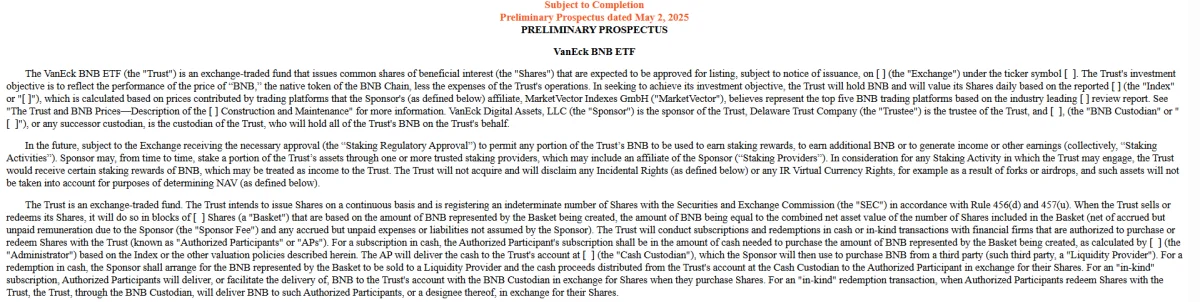
      The application, which was submitted on May 2 under the form S-1, outlines the plan of Vaneck to offer investors direct access to BNB. In the event of a permit, the Vaneck BNB ETF would be the first product listed in the USA that BNB holds directly and not over derivatives or futures. Vaneck has not announced a ticker symbol for the new fund. The ETF will reproduce the course of BNB and be kept by a regulated crypto deposit point (names have not yet been mentioned).

      According to the submission, Vaneck will also introduce staking into the ETF frames, whereby the approval of the stock market supervision is still pending. If the approval is granted, staking enables the ETF to achieve passive income by delegating BNB to trustworthy providers. In the prospectus, it is pointed out that the Staking partners could also include connected companies from Vaneck (subject to supervision). This would be the first time that a crypto-spot ETF in the USA uses staking as an earnings mechanism.

      The submission to the SEC follows the establishment of a trust company for the ETF in Delaware in the past month, which was a preliminary stage for this submission. The BNB ETF is the latest addition to Vaneck’s growing list of crypto ETF suggestions, which already includes Bitcoin, Ethereum, Solana and Avalanche.

      BNB becomes the fifth crypto asset in Vaneck’s ETF engagement

      As CNF reports, Vaneck is an early market leader in investment products for digital assets. The company was one of the first to launch Bitcoin and Ethereum ETFs in the United States after it received the approval of the SEC last year. Vaneck first entered the crypto area in 2017 when it suggested one of the first Bitcoin futures ETFs. With the submission of the BNB ETF, the asset manager extends his commitment to the most important blockchain ecosystems.

      According to our data, BNB, the fifth largest cryptocurrency after market capitalization, is traded at $ 608 and has not changed in the last 24 hours. The token is the heart of the BNB-Chain system and enables transaction fees, smart contracts and decentralized applications. He also plays a key role in the bony system and supports a number of financial services.

      Vaneck could have started a big step for BNB in ​​the United States, subject to approval. Since the SEC continues to check token-based ETFs, Vaneck’s application is a sign of institutional trust in the long-term use and investment of BNB.