Tag: USDT

  • Bitget Hacker Moves $83 Million in Stolen XRP That Ripple Cannot Freeze

    Bitget Hacker Moves $83 Million in Stolen XRP That Ripple Cannot Freeze

    Key Highlights

    • Circle and Tether froze approximately $320,000 in USDC and USDT stablecoins linked to the Bitget exchange hack, leveraging built-in blacklist controls.
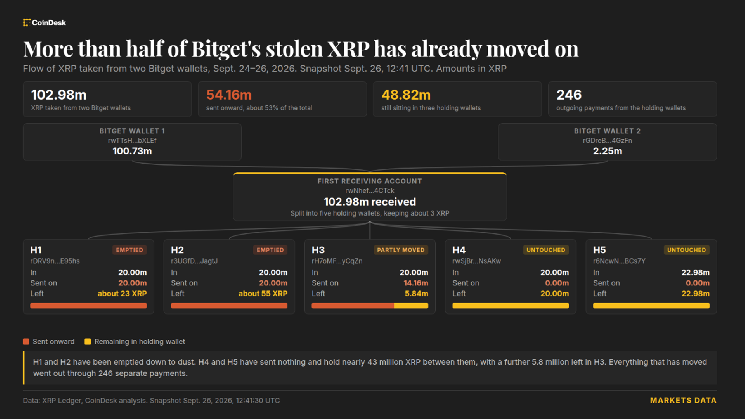
    • The attacker moved roughly 54 million XRP from the original five holding wallets overnight, reducing the balance from 70 million to 49 million tokens in eight hours.
    • XRP traded near $1.54 on Saturday, down 4% in 24 hours but retaining a 9% weekly gain, with the stolen haul valued at approximately $160 million.

    Stablecoin Issuers Intervene to Block Illicit Funds

    Circle and Tether, the operators behind the leading dollar-pegged stablecoins USDC and USDT, have taken swift action to mitigate the fallout from the massive Bitget crypto exchange breach. The companies froze roughly $320,000 worth of stablecoins associated with the hacker’s wallet addresses. Both tokens possess programmable controls that allow the issuers to blacklist specific addresses, effectively preventing the frozen assets from being transferred or redeemed. This intervention highlights the centralized enforcement layer that exists within major fiat-backed stablecoins, a feature often cited by regulators and critics alike.

    Attacker Accelerates XRP Distribution Across Wallets

    On-chain data shows the perpetrator significantly sped up the movement of stolen XRP tokens during the early hours of Saturday. At 04:32 UTC, approximately 70 million XRP remained in the original five accounts identified as the initial holding points for the stolen funds. Roughly eight hours later, that aggregate balance had dropped to 49 million, indicating a rapid dispersal strategy. The transfers reveal the attacker distributing the assets across a growing number of wallets, a common tactic to obfuscate the trail and complicate recovery efforts.

    Transaction Patterns Suggest Automated Scripting

    Analysis of the transfer flows shows certain payments replicating routes previously used by the first wallet. In one notable instance, an attempted transfer of about 521,000 XRP failed because the sending account lacked sufficient funds. Approximately one hour later, a second wallet executed an identical transfer of 521,000 XRP to the same intended recipient. This pattern suggests the use of automated scripts or predetermined routing logic rather than purely manual intervention, with the attacker managing multiple wallets in parallel to drain the holdings.

    Market Absorbs Supply Overhang Amid Price Resilience

    Despite the significant movement of stolen funds, XRP markets displayed relative stability on Saturday. The token traded around $1.54, representing a 4% decline over the preceding 24 hours but maintaining a weekly gain of approximately 9%, according to data from CoinGecko. At the prevailing price, the original XRP haul—estimated at roughly 100 million tokens based on the 54 million moved and 49 million remaining—was worth approximately $160 million. That figure equates to roughly 4% of XRP’s reported $4.4 billion in daily trading volume, suggesting the market possesses sufficient liquidity to absorb potential sell pressure, though actual price impact will depend on the depth of buy orders at the time of execution.

    Why This Matters

    The Bitget hack and subsequent fund movements underscore several critical dynamics in the crypto ecosystem. First, the ability of Circle and Tether to freeze assets demonstrates the “off-switch” capability inherent in centralized stablecoins, providing a rapid response mechanism for illicit flows that does not exist for native blockchain assets like XRP. Second, the speed and sophistication of the XRP laundering—evidenced by automated multi-wallet distribution and retry logic—illustrates the operational maturity of modern cybercriminal groups targeting exchanges. Finally, the market’s muted price reaction reflects XRP’s deep liquidity and the market’s growing desensitization to large-scale exchange breaches, though the ultimate impact hinges on whether the attacker opts for rapid liquidation via decentralized exchanges or slower over-the-counter channels.

    Frequently Asked Questions

    How much XRP was stolen in the Bitget hack?

    Based on on-chain analysis, the original haul held in five primary wallets totaled approximately 119 million XRP (70 million remaining at 04:32 UTC plus 49 million moved subsequently). At Saturday’s price of $1.54, the total value was roughly $160 million.

    Can Circle and Tether freeze XRP tokens?

    No. Circle and Tether can only freeze assets issued on their respective contracts—USDC and USDT. XRP is a native asset on the XRP Ledger and does not have a centralized freeze function. The $320,000 freeze applied only to stablecoin balances held in the hacker’s wallets.

    Will the stolen XRP dump crash the price?

    The stolen amount represents about 4% of XRP’s reported daily trading volume ($4.4 billion). While a sudden market sale could cause short-term slippage, the depth of the order books across major exchanges suggests the market could absorb the supply without a catastrophic price collapse, especially if distributed over time or via OTC desks.

  • Chainflip Loses 736,442 USDT in TRON Exploit

    Chainflip Loses 736,442 USDT in TRON Exploit

    Chainflip Loses $736,442 in USDT Through TRON Memo Exploit

    Cross-chain protocol Chainflip suffered a security breach resulting in the loss of 736,442.17 USDT after an attacker exploited how the platform processes TRON transaction memos. The incident occurred during the early hours of September 12, prompting the protocol to pause operations while developers investigated and prepared a fix, according to a September 13 incident update.

    An update on yesterday’s exploit affecting Tron $USDT.736,442.17 $USDT was taken. All other funds are unaffected and secure, and impacted users will be made whole.The network stays paused while we finalise the fix and the restart plan.Full update: https://t.co/LTWSqLBOn3
    — CHAINFLIP (@Chainflip) September 13, 2026

    How the TRON Memo Exploit Worked

    Unlike other supported blockchains where Chainflip receives swap instructions through dedicated contract functions, the protocol’s TRON USDT integration relies on transaction memos to read swap instructions attached to TRON transfers. According to the incident report, the attacker discovered a method to attach a new memo to a transaction that Chainflip validators had already signed.

    The protocol’s systems interpreted the added memo as a separate swap instruction. When this new instruction appeared to fail, Chainflip issued a refund — but the original deposit had already produced a payout. Processing the altered memo therefore caused the protocol to pay against the same deposit a second time.

    Chainflip attributed the flaw to its own processing of TRON transaction memos and confirmed that the TRON blockchain, the USDT smart contract, and Tether’s reserve system were not compromised.

    Attack Timeline and Detection

    The attacker repeated the exploit method eight times over approximately 90 minutes. Early attempts used small amounts, with each subsequent attempt nearly doubling the previous one. Only six attempts produced unauthorized payouts totaling 736,442.17 USDT.

    The protocol detected the incident after subsequent USDT payments began failing. Developers traced the failures to the repeated processing of deposits through altered memos. Chainflip suspended network activity to examine whether the vulnerability could affect other assets or integrations. A preliminary review found the exploit was limited to TRON USDT, with remaining vault funds secure.

    The project described this as its first critical security event involving funds taken from protocol vaults, noting that earlier operational problems had not caused comparable losses.

    User Impact and Repayment Plans

    One legitimate user swap worth 115,654.41 USDT remains unpaid, though the funds are still held in Chainflip’s vault and can be released after the network restarts. This transaction is not counted among the six unauthorized payouts.

    Chainflip stated that affected users would be made whole, though the reimbursement method had not been selected or published as of September 13. Several options remain under review. The protocol has notified relevant parties about the stolen funds to track or recover proceeds as they move between addresses and services, but did not name those parties or confirm whether any USDT had been frozen.

    Tether can freeze addresses holding its tokens when acting under applicable legal or enforcement processes. No public statement from Tether or TRON concerning the Chainflip attack had been identified by publication time.

    Network Restart Targeted for Monday

    Chainflip reported that the underlying fix had been completed, but developers still needed to finalize the exact restart procedure. The network will remain paused “until Monday at the earliest,” making September 14 the earliest possible restoration date rather than a confirmed launch time.

    Before reopening, the team plans to finalize a technical restart plan designed to avoid further processing problems. Chainflip has not disclosed whether validators will need new software, a coordinated upgrade, or a governance vote.

    Once the system resumes, the protocol expects to process the pending 115,654.41 USDT swap and begin handling compensation for users whose funds were paid to the attacker. A complete technical report will follow after the restart plan is locked down and the network is operating securely, though no publication deadline has been announced.

  • Paolo Ardoino: 650 Million People Hold Decentralized US Debt, Yet Tether Controls T-Bills

    Paolo Ardoino: 650 Million People Hold Decentralized US Debt, Yet Tether Controls T-Bills

    Tether CEO’s ‘Decentralized Ownership’ Claim Faces Scrutiny Over Legal and Economic Reality

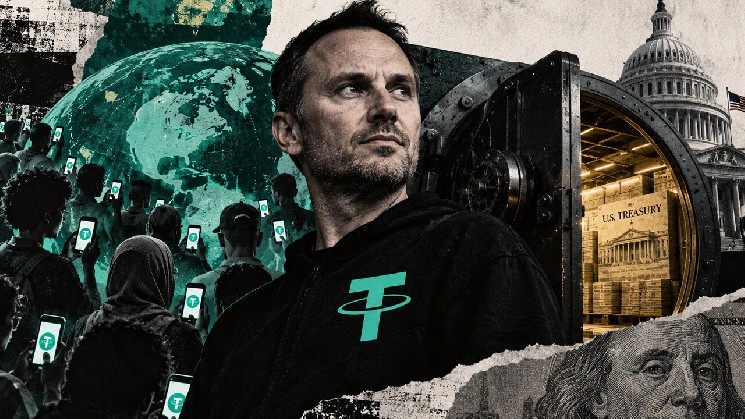
    Paolo Ardoino offered a striking answer to a familiar U.S. debt problem: replace concentrated foreign buyers with hundreds of millions of stablecoin users. In an Aug. 31 episode of The Wolf of All Streets, the Tether CEO said the company had created the decentralized ownership of the US debt through 650 million people who were basically holding some US Treasuries. His point centered on concentration risk: unlike a foreign government, hundreds of millions of users are unlikely to decide together to sell U.S. debt in a single morning.

    The macroeconomic intuition carries weight. Demand for USDT gives Tether funds that it can place in a Treasury-heavy reserve portfolio. However, calling token users owners of government debt collapses several distinct relationships into one. Tether’s own documents state that users own USDT, eligible verified customers have a personal contractual right to redeem, and Tether International owns and manages the reserve assets.

    The 650 Million Figure: Attribution and Methodology

    The 650 million figure is attributable to Tether, not an independently verified count of Treasury investors. In an Aug. 13 audit announcement, the company said more than 650 million users across emerging markets rely on Tether daily, without publishing a methodology for that figure.

    Tether’s earlier work shows why users needs qualification. Its 2024 methodology note treated on-chain addresses or accounts as a proxy and upper-bound estimate, acknowledging that one person can control multiple wallets. It then added estimates for people holding USDT through centralized services. Tether’s fourth-quarter 2025 report used that broad approach to estimate 534.5 million users at year-end.

    Those measures are useful for estimating reach, but they do not establish 650 million unique people, 650 million current holders, or 650 million customers able to redeem directly with Tether. They establish the scale Tether assigns to its network.

    What USDT Holders Actually Own

    Tether’s current terms call the right to purchase or redeem tokens a personal contractual right. They also say issuance and redemption are administered by Tether and require the customer to be verified.

    The company’s Relevant Information Document makes the allocation of control clearer. After a verified customer sends fiat and receives tokens, Tether says it holds or invests the funds in a basket of reserves. The composition of that basket can change at Tether’s sole discretion, and Tether says it primarily holds the assets through banks and licensed financial institutions.

    Its latest Financial Figures and Reserves Report uses similarly direct accounting language. It describes the reserves as assets owned by Tether International and the issued tokens as refund liabilities recorded at their contractual redemption value.

    That arrangement is not the same as owning a Treasury bill through a brokerage account or holding a beneficial interest in a fund that passes through portfolio economics. USDT holders own transferable tokens. The reserve assets sit on the issuer’s side of the structure.

    The documents do not eliminate holder rights; they define them more narrowly. The Relevant Information Document says an eligible redemption is paid at the token’s face value in fiat, less fees. It also says holders are not entitled to increases in reserve value above face value. The income and gains from the portfolio therefore do not flow through to USDT holders merely because Treasuries back the token.

    Redemption Terms and Limitations

    Direct access to that redemption promise is narrower than USDT’s global circulation. Tether’s fee schedule sets a $100,000 minimum for direct acquisition or redemption. A redemption costs the greater of $1,000 or 0.1%. Applicants must complete verification, and Tether retains sole discretion to approve or reject requests to become verified customers.

    The legal terms allow Tether to delay or suspend services, including redemptions, in circumstances involving suspected prohibited use, legal requirements, government directions, investigations, unauthorized access or risks that Tether considers unacceptable. Fees can change.

    Secondary Market vs. Direct Redemption

    Holders can still sell USDT through secondary markets, subject to the rules and liquidity of the exchanges, dealers, or other platforms they use. That is a market exit, however, rather than a direct exercise of the issuer contract. It may transfer the token to another buyer instead of shrinking Tether’s outstanding liabilities.

    The distinction also limits what can safely be said about creditor priority. Tether’s public materials establish an issuer liability and an eligible customer’s redemption right. They do not establish one universal insolvency ranking for every secondary-market holder across every jurisdiction.

    The Treasury Exposure Is Real and Large

    None of this makes the reserve portfolio economically irrelevant to users. USDT’s reliability depends in part on Tether’s ability to meet its obligations, and the composition and liquidity of the reserves are central to that ability.

    As of June 30, Tether International reported $187.751 billion in reserve assets against $183.642 billion in liabilities. The portfolio included $114.961 billion of direct U.S. Treasury bills. It also reported $18.626 billion of overnight reverse-repurchase exposure, collateralized by about $18.596 billion of U.S. Treasuries. Those are distinct positions. Directly owned bills and Treasury collateral supporting a repo should not be combined and described as if they create the same legal relationship.

    Decentralized Distribution, Centralized Control

    The scale helps explain Ardoino’s framing. Broad demand for USDT can create broad economic dependence on a company whose reserve allocation generates substantial demand for short-term government debt. Earlier analysis has examined Tether’s Treasury scale and the risks embedded in U.S. debt markets, and how stablecoin issuers can become marginal buyers as other holders retreat.

    The ownership question is different. Tether can spread dollar access across wallets and platforms, and rising issuance can increase the pool it allocates partly to Treasuries. It does not follow that each user owns a pro rata slice of those bills, can direct their sale, or receives their yield.

    A more precise description is that USDT decentralizes the distribution of an issuer-mediated dollar claim. The associated funding demand is geographically dispersed. Legal title to the reserves, portfolio control, and the economics above token face value remain centralized at Tether. Ardoino’s macro intuition is directionally meaningful, but the legal and economic plumbing remains issuer-mediated.

  • Tether and Fasanara Launch $400 Million Stablecoin Private Credit Fund

    Tether and Fasanara Launch $400 Million Stablecoin Private Credit Fund

    Tether and Fasanara Capital Launch $400M StableFund to Bridge SME Financing Gap With USDT Infrastructure

    Tether and Fasanara Capital announced the launch of StableFund on September 9, unveiling an evergreen private credit vehicle backed by $400 million in co-investment from the two sponsors. The fund combines Tether’s USDT settlement infrastructure with Fasanara’s global fintech lending network to finance short-duration, asset-backed credit strategies targeting small and medium-sized enterprises and consumer lending.

    Fund Structure and Capital Targets

    The joint announcement states that StableFund will target up to $3 billion in third-party institutional capital. The sponsors clarified that this figure represents a fundraising objective rather than committed outside capital, while the $400 million reflects sponsor co-investment disclosed at launch.

    StableFund’s evergreen structure is designed to scale as third-party institutions commit capital. However, the release does not disclose target returns, fee terms, redemption conditions, or a timetable for reaching the outside-capital goal.

    Fasanara Leads Investment Management Across 60+ Countries

    London-based Fasanara Capital will act as investment manager, deploying capital through its fintech lending network. The strategy focuses on originating short-duration, asset-backed instruments via fintech platforms operating in more than 60 countries, targeting SME loans, consumer credit, trade receivables, and supply-chain finance.

    Fasanara describes itself as managing more than $6 billion across those verticals. These are company-provided figures included in the sponsors’ release.

    Tether Embeds USDT Into Lending Flows as Co-Sponsor and Originator

    Tether will serve as co-sponsor, originator, and adviser. Its role includes sourcing USDT-linked financing opportunities and providing stablecoin infrastructure for settlement, on- and off-ramp connectivity, and treasury-rail integration. The structure is intended to embed USDT directly into lending operations rather than limit the token to trading or payments use cases.

    Part of a Broader Shift Toward Tokenized Credit

    The launch aligns with a growing trend of digital assets entering credit products. BlockchainReporter recently reported that Arch Lending began accepting tokenized gold as loan collateral, another example of tokenized assets expanding into lending markets. StableFund distinguishes itself as a sponsored institutional vehicle focused on originating real-economy loans rather than solely facilitating crypto-native borrowing.

    No Borrowers or Deployed Capital Disclosed at Launch

    The sponsors cited demand for alternative financing and a persistent funding gap among smaller businesses as market drivers for the strategy, though those estimates remain projections included in their release.

    Critically, the announcement does not identify initial borrowers, disclose completed loans, or specify which jurisdictions will receive the first capital allocations. As a result, the September 9 development constitutes a fund launch and capital commitment — not evidence that the targeted $3 billion has been raised or that lending outcomes have been realized.

  • Next currency crisis may be harder to contain due to stablecoins, New York Fed report finds

    Next currency crisis may be harder to contain due to stablecoins, New York Fed report finds

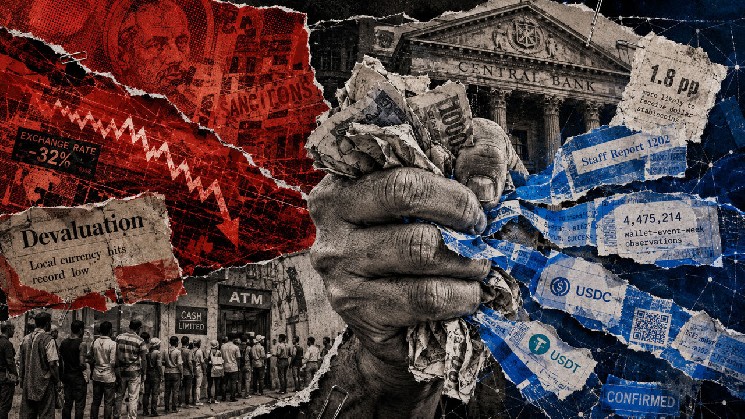
    A new study from the Federal Reserve Bank of New York reveals that dollar-pegged stablecoins flow more aggressively into digital wallets linked to countries undergoing currency or banking crises, highlighting a growing challenge for central banks attempting to manage capital flight.

    Crisis-Linked Wallets Show Higher Stablecoin Receipts

    Researchers Pablo Azar, Maryam Farboodi, and Nish Sinha found that wallets associated with nations experiencing financial distress were 1.8% more likely to receive dollar stablecoins during the week a crisis began. Receipt volumes across these wallets also increased significantly during those periods, according to an August staff paper published by the New York Fed.

    The analysis covered nine crisis episodes across eight countries between 2021 and 2025, including monetary disruptions, banking restrictions, sanctions, and devaluations affecting Argentina, Egypt, Iran, Myanmar, Nigeria, Russia, Turkey, and the United Kingdom.

    Methodology: Linking On-Chain Activity to Country Signals

    To trace stablecoin flows, the researchers linked Ethereum Name Service (ENS) registrations carrying country indicators—such as languages, scripts, and national identifiers—with transfer histories for 19 major dollar-pegged stablecoins.

    During crisis weeks, tagged wallets recorded both a higher probability of receiving stablecoins and larger receipt volumes. A separate specification found no significant increase in the two weeks before the shocks, while the probability of receiving stablecoins rose 1.9% during the crisis week itself.

    Sending activity increased later, with wallets becoming 1.3% more likely to send stablecoins two weeks after the crisis began. The sequence supports the researchers’ argument that demand for blockchain-based dollars rises when confidence in domestic financial arrangements comes under pressure.

    Data Limitations and Scope

    The dataset does not represent every resident or crypto wallet in the countries studied. Its roughly 4.5 million observations are wallet-event-week records, and the sample focuses on wallet-country pairs that received stablecoins at some point within a 53-week window around each crisis.

    The result therefore captures a change in behavior among wallets already connected to stablecoin activity rather than showing that stablecoin adoption rose by 1.8% across an entire national population.

    Stablecoins Complicate the Capital-Control Playbook

    The findings feed directly into a longstanding constraint on monetary policy described by the Mundell-Fleming framework: countries cannot simultaneously maintain a fixed exchange rate, unrestricted capital mobility, and independent control over domestic interest rates.

    Governments seeking to protect a currency while retaining monetary autonomy have traditionally restricted capital movement through banks and other regulated intermediaries. The New York Fed researchers model stablecoins as weakening that enforcement channel.

    A household facing restrictions on buying or transferring dollars through its bank may instead receive dollar-denominated tokens into a blockchain wallet. As access to those rails expands, the government must devote more resources to enforcement or allow more of the pressure to emerge through currency depreciation or domestic interest rates.

    The paper does not establish that stablecoins caused particular currencies to weaken during the nine episodes. Instead, the observed wallet activity supports the model’s central assumption that financial stress encourages stablecoin adoption. Its broader monetary-policy consequences remain theoretical.

    Centralized Issuers and Regulated Exchanges Remain Control Points

    Governments retain significant points of control. Major dollar tokens such as USDT and USDC are issued by centralized companies that can freeze addresses, while regulated exchanges can be required to restrict transactions or identify customers.

    Those powers shift enforcement away from a country’s banking system toward a wider network of issuers, exchanges, and blockchain addresses. Transfers between self-custodied wallets can leave governments with fewer immediate domestic chokepoints even when issuers retain the ability to intervene at other stages.

    Market Growth Amplifies Policy Challenge

    The policy challenge becomes more consequential as stablecoins expand from a niche crypto product into a global dollar-payment network. The market has already grown beyond $300 billion and is expected to reach trillions of dollars before the end of the decade.

    Blockchain analysis firm Chainalysis projects an even steeper rise in activity, estimating that adjusted stablecoin transaction volume could reach $719 trillion by 2035 through organic growth alone and approach $1.5 quadrillion if broader macro and adoption trends accelerate usage.

    That growth would increase the number of routes available to households seeking dollar exposure during periods of domestic financial stress, but it would not put stablecoins entirely beyond government reach.

    Regulatory Warnings Highlight Enforcement Gaps

    Federal Reserve Vice Chair for Supervision Michael Barr warned in June that U.S. stablecoin legislation left an illicit-finance vulnerability around secondary-market transfers involving unhosted wallets.

    The Bank for International Settlements (BIS) has identified a similar problem for monetary policy, arguing that stablecoin dollarization can threaten monetary sovereignty while restrictions may prove less effective when bearer-like tokens circulate through self-custodied wallets.

    That creates a more fragmented enforcement map. Governments can exert substantial control over banks, stablecoin issuers, and regulated trading venues, but may have less visibility or immediate reach when dollar tokens move between private wallets without returning to those intermediaries.

    Stablecoins Becoming a Macroeconomic Constraint

    The distinction becomes particularly important during a currency crisis, when demand for an alternative store of value and payment rail can rise just as authorities try to restrict capital movement.

    The New York Fed paper suggests that this choice of financial infrastructure is becoming part of the macroeconomic constraint itself. As stablecoin networks grow, effective capital mobility increasingly depends on both the controls governments impose and the blockchain rails households can still access.

    At the scale projected for the next decade, that could turn stablecoins from an alternative payment mechanism into a material constraint on how governments defend currencies during periods of financial stress.

  • Venezuela Arrests Three ‘Los Binanceros’ Members Over Binance P2P Arbitrage

    Venezuela Arrests Three ‘Los Binanceros’ Members Over Binance P2P Arbitrage

    The Bolivarian National Police in Venezuela recently arrested three young men in Maracaibo, accusing them of running an illicit currency arbitrage ring through the peer-to-peer (P2P) platform of the cryptocurrency exchange Binance. The enforcement action has ignited a critical discussion among local crypto traders about where lawful P2P transactions end and criminal activity begins under Venezuelan law.

    How the Alleged Binance P2P Scheme Operated

    According to law enforcement authorities, the arrested individuals—identified as 18-year-old Adrián Jesús Gómez, 19-year-old José Ángel Hernández, and 22-year-old Guillermo José Roldán—operated out of a residence in the Francisco Eugenio Bustamante parish of Maracaibo. Police officials claim the trio belonged to an organized group dubbed ‘Los Binanceros’ and executed a highly structured financial loop:

    • Acquisition: The suspects acquired U.S. dollars at the subsidized, official rate through regulated exchange houses and official Central Bank of Venezuela (BCV) auctions.
    • Conversion: They deposited these funds into the Binance platform to purchase the dollar-pegged stablecoin $USDT.
    • Liquidation: Finally, they sold the stablecoin on the Binance P2P marketplace in exchange for local currency (bolivars) at the unofficial parallel market rate, which sits significantly higher than the government’s controlled rate.

    Following the raid, police confiscated several mobile phones, a laptop, and a motorcycle. The suspects and the seized physical evidence have been transferred to the jurisdiction of the Public Prosecutor’s Office for formal prosecution.

    Why Venezuelan Authorities Regulate Exchange Rate Arbitrage

    The core of the legal issue lies in Venezuela’s dual-rate currency system. Because the BCV strictly controls and rations foreign currency at a subsidized rate, a substantial gap often opens between the official rate and the parallel market rate. This discrepancy creates an immediate opportunity for risk-free profit: purchasing cheap dollars through government-regulated channels and selling them at the elevated market rate.

    Venezuelan regulators do not view this as standard market trading. Instead, they classify it as unauthorized currency arbitrage. Funding parallel-market transactions using state-subsidized currency directly violates local exchange control laws. Furthermore, Venezuela’s robust anti-money laundering policies allow financial prosecutors to freeze and investigate any bank accounts receiving funds linked to these illicit spreads, regardless of whether the account holders are licensed financial agents.

    Risks for Everyday P2P Crypto Users in Venezuela

    While owning, trading, and utilizing digital currencies like $USDT is entirely legal under Venezuela’s regulatory framework, standard peer-to-peer traders still navigate a landscape filled with potential legal hurdles. The primary risks for everyday users include:

    1. High-Frequency Compliance Flags

    Engaging in high-volume or rapid-fire P2P trades can trigger automated anti-money laundering (AML) alerts at domestic banking institutions. Even if a trader is not exploiting exchange rate gaps, sudden spikes in account activity can lead to frozen bank accounts and subsequent investigations.

    2. Third-Party Payment Vulnerabilities

    One of the most common security flaws in P2P trading is accepting payments from bank accounts that do not match the verified identity of the counterparty on the exchange. If those external funds are tied to fraud, extortion, or other criminal activities, the recipient’s account can be flagged for money laundering.

    3. Liability of Omission

    Under Venezuelan criminal law, individuals can be held liable for failing to act when presented with suspicious activity. Ignoring obvious red flags on incoming payments, rather than actively participating in a crime, can still expose a P2P trader to prosecution for negligence or complicity.

    Ultimately, Venezuelan authorities appear to distinguish between citizens using P2P platforms to preserve the purchasing power of their personal savings and those systematically exploiting government-regulated currency channels for parallel-rate profits, as seen in the case of ‘Los Binanceros’. For the average crypto user, maintaining strict transaction hygiene—such as verifying counterparty names and rejecting third-party bank transfers—remains the most effective way to avoid regulatory scrutiny.